 A microsatellite is a tract of
repetitive DNA in which certain DNA motifs
(ranging in length from one to nine base
pairs) are repeated, typically 5–50 times.
 They occur at thousands of locations within
an organism's genome.
 They have a higher mutation rate leading to
high genetic diversity.
 A microsatellite are typically repeated 5–50
times.
 The sequence TATATATATA is a dinucleotide
microsatellite, and GTCGTCGTCGTCGTC is a
trinucleotide microsatellite
 Microsatellites are distributed throughout the
genome.
 The human genome for example contains
50,000–100,000 dinucleotide microsatellites,
and lesser numbers of tri-, tetra- and
pentanucleotide microsatellites.
 Many are in non-coding region
 Some can also be located in regulatory
regions and coding regions.
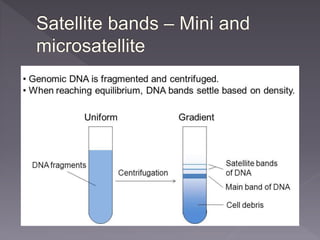
 The name "satellite" DNA refers to the early
observation - on centrifugation of genomic
DNA - a prominent layer of bulk DNA from
accompanying "satellite" layers of repetitive
DNA
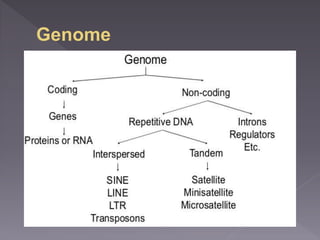
 Microsatellites or short tandem
repeats (STRs) or simple sequence
repeats (SSRs)
 Microsatellites and longer repeats -
minisatellites, - together called
as VNTR (variable number of tandem
repeats) DNA.
 A repeated pattern can be between one base
pair long (a mononucleotide repeat) to several
thousand base pairs long,
 Total size of a satellite DNA block can be
several megabases without interruption.
 Long repeat units have been described
containing domains of shorter repeated
segments and mononucleotides (1-5 bp),
arranged in clusters of microsatellites
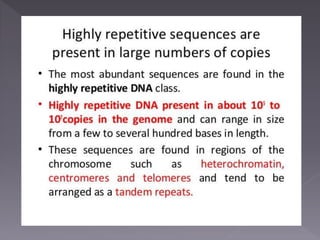
 Most satellite DNA is localized to the telomeric
or the centromeric region of the chromosome.
 The nucleotide sequence of the repeats is fairly
well conserved across species.
 Variation in the length of the repeat is common.
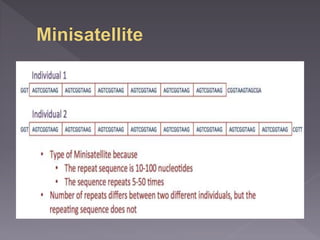
 For example, minisatellite DNA is a short region
(1-5kb) of repeating elements with length >9
nucleotides.
 microsatellites in DNA sequences are considered
to have a length of 1-9 nucleotides .
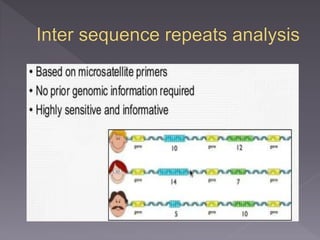
 The difference in how many of the repeats is
present in the region (length of the region) is the
basis for DNA fingerprinting
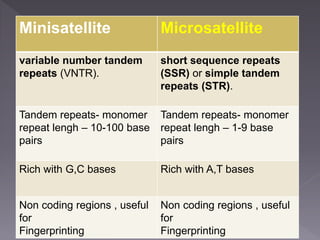
Minisatellite Microsatellite
variable number tandem
repeats (VNTR).
short sequence repeats
(SSR) or simple tandem
repeats (STR).
Tandem repeats- monomer
repeat lengh – 10-100 base
pairs
Tandem repeats- monomer
repeat lengh – 1-9 base
pairs
Rich with G,C bases Rich with A,T bases
Non coding regions , useful
for
Fingerprinting
Non coding regions , useful
for
Fingerprinting
 Microsatellites in non-coding regions allows
them to accumulate mutations unhindered
over the generations
 So it gives rise to variability that can be
used for DNA fingerprinting and identification
purposes.
 Some microsatellites are located in
regulatory regions of genes-
 Mutations in such cases can lead to
phenotypic changes and diseases, notably
in triplet expansion diseases such as fragile
X syndrome and Huntington's disease.[9]
 A tumour cell line might show a
different genetic fingerprint from that of the
host tissue
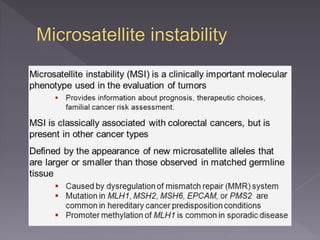
 In colorectal cancer, present with loss of
heterozygosity
 Microsatellites routinely used in cancer
diagnosis to assess tumour progression
 Forensic analysis are all tetra- or penta-
nucleotide repeats, as these give a high degree
of error-free data
 Another consideration is that the
person's medical privacy must be respected
 STRs are chosen which are non-coding, do not
influence gene regulation
 Not trinucleotide STRs which could be involved
in triplet expansion diseases
 Forensic STR profiles are stored in DNA
databanks
 Single-nucleotide polymorphism SNP
 Microsatellites remain highly informative
microsatellites can differentiate alleles within
a SNP-defined linkage disequilibrium block
of interest.
 Microsatellites - led to discoveries of type 2
diabetes (TCF7L2) and prostate cancer
genes (the 8q21 region)
 Designing primers and amplification of sets
of microsatellites cost low
 Their uses are wide-ranging
 Useful for measuring or local adaptation,the
allelic fixation index , population
size, and gene flow
 They remain a crucial tool in the field.
 Marker assisted selection or marker aided
selection (MAS) is an indirect selection
process where a trait of interest is selected
 Based on marker
(morphological, biochemical or DNA/RNA vari
ation) linked to a trait of interest
 For example, a GAA triplet expansion in the first
intron of the X25 gene appears to interfere with
transcription, and causes Friedreich Ataxia
 Tandem repeats in the first intron of the
Asparagine synthetase gene are linked to acute
lymphoblastic leukaemia
 A repeat polymorphism in the fourth intron of
the NOS3 gene is linked to hypertension in a
Tunisian population
 Reduced repeat lengths in the EGFR gene are
linked with osteosarcomas.
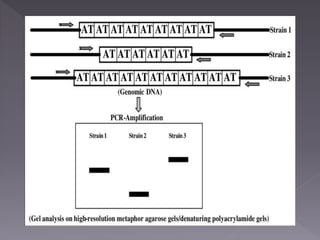
 Microsatellites are normally analysed by
conventional PCR amplification and
amplicon size determination, sometimes
followed by Sanger DNA sequencing
 Once these sequences have been amplified,
they are resolved either through agarose gel
or PAGE electrophoresis or capillary
electrophoresis
 Used for DNA profiling in cancer diagnosis
 In kinship analysis (especially paternity testing)
 In forensic identification.
 They are also used in genetic linkage analysis
to locate a gene or a mutation responsible for a
given trait or disease.
 also used in population genetics to measure
levels of relatedness between subspecies,
groups and individuals.
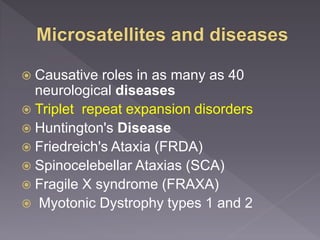
 Causative roles in as many as 40
neurological diseases
 Triplet repeat expansion disorders
 Huntington's Disease
 Friedreich's Ataxia (FRDA)
 Spinocelebellar Ataxias (SCA)
 Fragile X syndrome (FRAXA)
 Myotonic Dystrophy types 1 and 2
Thank you

Microsatellite

  • 8.
     A microsatelliteis a tract of repetitive DNA in which certain DNA motifs (ranging in length from one to nine base pairs) are repeated, typically 5–50 times.  They occur at thousands of locations within an organism's genome.  They have a higher mutation rate leading to high genetic diversity.
  • 9.
     A microsatelliteare typically repeated 5–50 times.  The sequence TATATATATA is a dinucleotide microsatellite, and GTCGTCGTCGTCGTC is a trinucleotide microsatellite  Microsatellites are distributed throughout the genome.  The human genome for example contains 50,000–100,000 dinucleotide microsatellites, and lesser numbers of tri-, tetra- and pentanucleotide microsatellites.  Many are in non-coding region  Some can also be located in regulatory regions and coding regions.
  • 10.
     The name"satellite" DNA refers to the early observation - on centrifugation of genomic DNA - a prominent layer of bulk DNA from accompanying "satellite" layers of repetitive DNA  Microsatellites or short tandem repeats (STRs) or simple sequence repeats (SSRs)  Microsatellites and longer repeats - minisatellites, - together called as VNTR (variable number of tandem repeats) DNA.
  • 14.
     A repeatedpattern can be between one base pair long (a mononucleotide repeat) to several thousand base pairs long,  Total size of a satellite DNA block can be several megabases without interruption.  Long repeat units have been described containing domains of shorter repeated segments and mononucleotides (1-5 bp), arranged in clusters of microsatellites  Most satellite DNA is localized to the telomeric or the centromeric region of the chromosome.
  • 15.
     The nucleotidesequence of the repeats is fairly well conserved across species.  Variation in the length of the repeat is common.  For example, minisatellite DNA is a short region (1-5kb) of repeating elements with length >9 nucleotides.  microsatellites in DNA sequences are considered to have a length of 1-9 nucleotides .  The difference in how many of the repeats is present in the region (length of the region) is the basis for DNA fingerprinting
  • 17.
    Minisatellite Microsatellite variable numbertandem repeats (VNTR). short sequence repeats (SSR) or simple tandem repeats (STR). Tandem repeats- monomer repeat lengh – 10-100 base pairs Tandem repeats- monomer repeat lengh – 1-9 base pairs Rich with G,C bases Rich with A,T bases Non coding regions , useful for Fingerprinting Non coding regions , useful for Fingerprinting
  • 18.
     Microsatellites innon-coding regions allows them to accumulate mutations unhindered over the generations  So it gives rise to variability that can be used for DNA fingerprinting and identification purposes.  Some microsatellites are located in regulatory regions of genes-  Mutations in such cases can lead to phenotypic changes and diseases, notably in triplet expansion diseases such as fragile X syndrome and Huntington's disease.[9]
  • 19.
     A tumourcell line might show a different genetic fingerprint from that of the host tissue  In colorectal cancer, present with loss of heterozygosity  Microsatellites routinely used in cancer diagnosis to assess tumour progression
  • 20.
     Forensic analysisare all tetra- or penta- nucleotide repeats, as these give a high degree of error-free data  Another consideration is that the person's medical privacy must be respected  STRs are chosen which are non-coding, do not influence gene regulation  Not trinucleotide STRs which could be involved in triplet expansion diseases  Forensic STR profiles are stored in DNA databanks
  • 21.
     Single-nucleotide polymorphismSNP  Microsatellites remain highly informative microsatellites can differentiate alleles within a SNP-defined linkage disequilibrium block of interest.  Microsatellites - led to discoveries of type 2 diabetes (TCF7L2) and prostate cancer genes (the 8q21 region)
  • 22.
     Designing primersand amplification of sets of microsatellites cost low  Their uses are wide-ranging  Useful for measuring or local adaptation,the allelic fixation index , population size, and gene flow  They remain a crucial tool in the field.
  • 23.
     Marker assistedselection or marker aided selection (MAS) is an indirect selection process where a trait of interest is selected  Based on marker (morphological, biochemical or DNA/RNA vari ation) linked to a trait of interest
  • 24.
     For example,a GAA triplet expansion in the first intron of the X25 gene appears to interfere with transcription, and causes Friedreich Ataxia  Tandem repeats in the first intron of the Asparagine synthetase gene are linked to acute lymphoblastic leukaemia  A repeat polymorphism in the fourth intron of the NOS3 gene is linked to hypertension in a Tunisian population  Reduced repeat lengths in the EGFR gene are linked with osteosarcomas.
  • 25.
     Microsatellites arenormally analysed by conventional PCR amplification and amplicon size determination, sometimes followed by Sanger DNA sequencing  Once these sequences have been amplified, they are resolved either through agarose gel or PAGE electrophoresis or capillary electrophoresis
  • 26.
     Used forDNA profiling in cancer diagnosis  In kinship analysis (especially paternity testing)  In forensic identification.  They are also used in genetic linkage analysis to locate a gene or a mutation responsible for a given trait or disease.  also used in population genetics to measure levels of relatedness between subspecies, groups and individuals.
  • 28.
     Causative rolesin as many as 40 neurological diseases  Triplet repeat expansion disorders  Huntington's Disease  Friedreich's Ataxia (FRDA)  Spinocelebellar Ataxias (SCA)  Fragile X syndrome (FRAXA)  Myotonic Dystrophy types 1 and 2
  • 29.