This document discusses various nucleic acid hybridization techniques. It begins with an introduction to DNA hybridization, including the principles of hybridization and basic procedures. It then describes several types of hybridization techniques: Southern hybridization detects DNA, Northern hybridization detects RNA, Western hybridization detects proteins, dot hybridization immobilizes fragmented DNA onto a membrane, and colony hybridization detects DNA in bacterial colonies. The document provides details on non-radioactive detection systems, the role of DNA probes, and comparing the techniques of Southern, Northern, and Western blotting.
OVER VIEW
Introduction
Southern Hybridization
Northern Hybridization
Western Hybridization
Dot Hybridization
Colony Hybridization
3.
INTRODUCTION
What isDNA hybridization?
Principle and basic procedure
DNA probe
Detector systems
4.
What isHybridization?
Hybridization is a process
of establishing non-
covalent, sequence-
specific interaction
between two or more
complementary strands of
nucleic acids into a single
hybrid.
5.
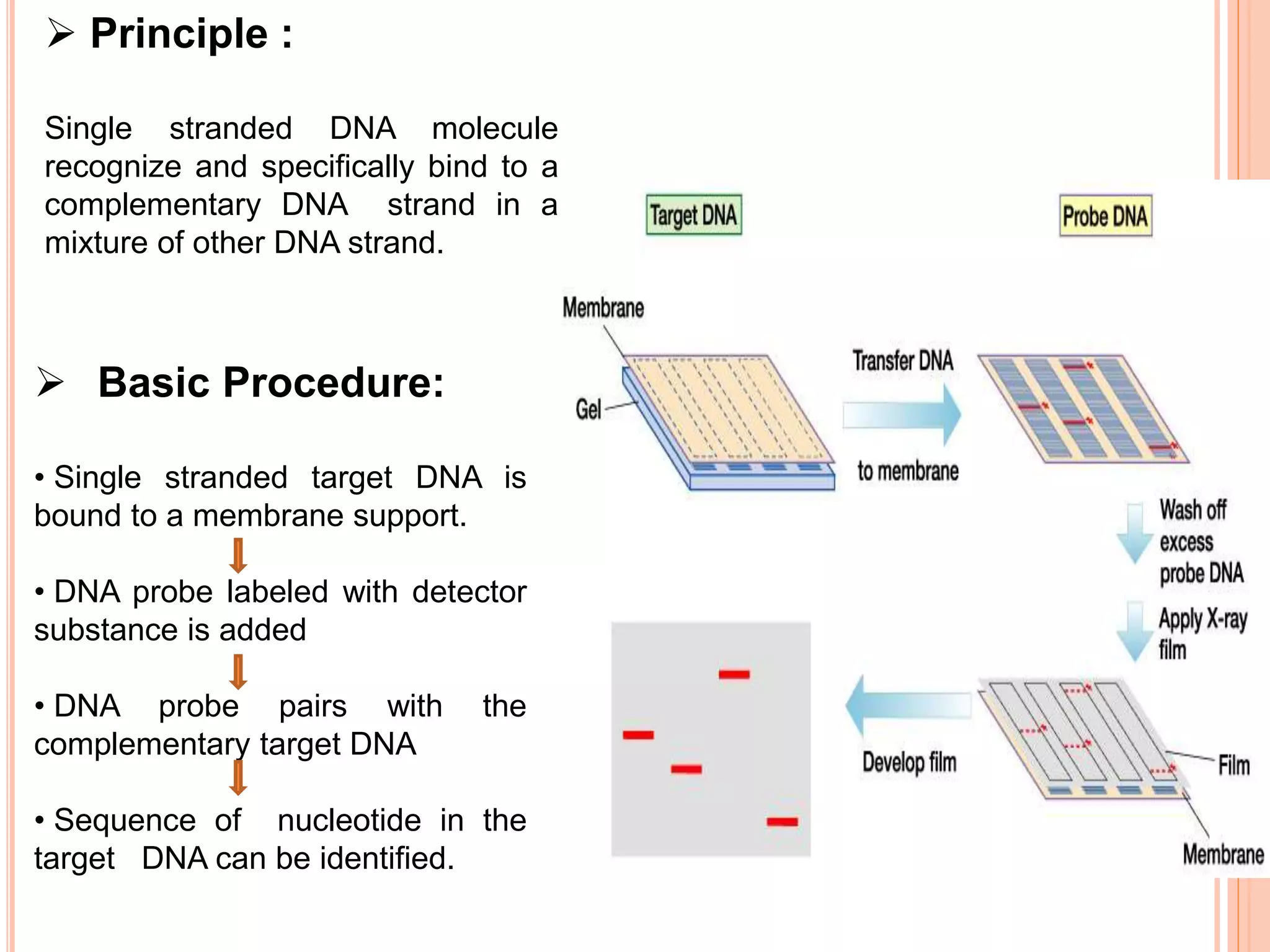
Principle :
Singlestranded DNA molecule
recognize and specifically bind to a
complementary DNA strand in a
mixture of other DNA strand.
Basic Procedure:
• Single stranded target DNA is
bound to a membrane support.
• DNA probe labeled with detector
substance is added
• DNA probe pairs with the
complementary target DNA
• Sequence of nucleotide in the
target DNA can be identified.
6.
DNA probe/Geneprobe:
Synthetic single stranded DNA molecule that can
recognize and specifically bind to a target DNA by
complementary base pairing in a mixture of bio
molecule.
Detector system in DNA
hybridization:
• Radioactive Detector system
• Non-Radioactive Detector system
8.
Non radioactivedetector system:
This detector system is based on the enzymatic conversion of a chromogenic substrate
or chemiluminiscent substrate.
Biotin labeled nucleotide are incorporated into the DNA probe.
Procedure for chemiluminiscent detection:
• Biotin labeled DNA probe is hybridized to the target DNA.
• The egg white protein avidin is added to bind Biotin.
• Then biotin labeled enzyme such as alkaline phosphatase is added to attach to avidin,
this protein have 4 separate biotin binding site that can bind to biotin labeled enzyme
and biotin labeled DNA probe.
• On addition of a chemiluminiscent substrate, alkaline phosphate converts it to a light
emitting substrate.
Procedure for chromogenic detector:
Here enzyme peroxidase is added in place of alkaline phosphate, and when
a chromogenic substrate is added color is produced which can be
measured.
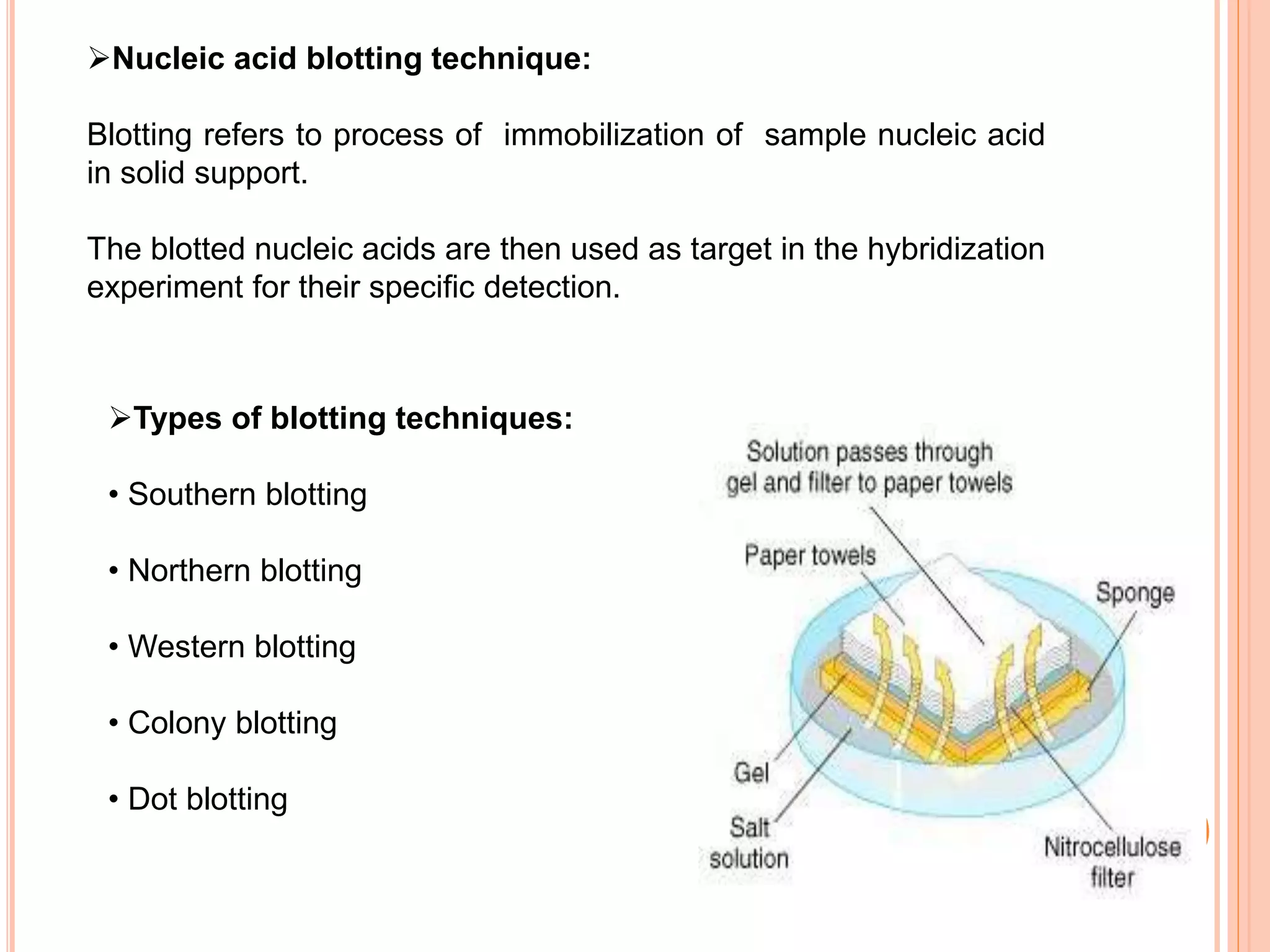
Nucleic acid blottingtechnique:
Blotting refers to process of immobilization of sample nucleic acid
in solid support.
The blotted nucleic acids are then used as target in the hybridization
experiment for their specific detection.
Types of blotting techniques:
• Southern blotting
• Northern blotting
• Western blotting
• Colony blotting
• Dot blotting
11.
• Southern Blotting
•First developed
by E.M.Southern
• DNA-DNA
hybridization is
the basis.
• Later this
techinque was
extended to
RNA(northern
blotting) and
protein(Western
Blotting).
Fig: Procedure for southern blotting
• Following theseparation of the protein
mix the polypeptide bands are transferred
to a membrane carrier. For this purpose
the membrane is attached to the gel and
this so-called sandwich is transferred to
an electrophoresis chamber.
• It is possible that some of the SDS is
washed out, and the protein partially re-
natures again, i.e. regains its 2D- and 3D
structure. However, the applied electric
charge causes the proteins to travel out of
the gel vertically to the direction they
traveled in on the gel, onto the membrane.
• The protein bands are thereby bound to
the membrane. The "blotted" bands are
now available to be treated further (e.g. for
detection of specific proteins with specific
antibodies).
Western Blotting
14.
Immunodetection
• The identificationof specific antibodies is possible after the separation and
blotting of proteins.
• Specific antibodies (mono- or polyclonal) bind to "their" band of proteins.
Unspecifically binding antibodies are removed by washing with detergent-
containing buffers.
• Additionally, unspecific binding pockets can be blocked before the addition of
specific antibodies.
• Primary antibodies are usually applied first, which are then recognized by a
secondary antibody.
•The secondary antibody is conjugated with colour, radioactivity or an enzyme
for detection. Biotin-conjugated antibodies are also used for this purpose
Western Blotting
Dot Blot
The sampleDNA or RNA from different individuals are fragmented on to a
nitrocellulose filter in the form of dots.
The DNA is then denatured and the filter is baked at 80ºc to fix the DNA
firmly to the filter.
The filter is pre treated to prevent non-specific binding of the probe to the
filter.
The filter is then treated with appropriate radioactive single stranded DNA
probe under condition favouring hybridization.
Filter is then washed repeatedly washed to remove free probe.
The hybridized probes are detected by autoradiography.
Southern Blotting NorthernBlotting Western Blotting
Molecule
detected
DNA mRNA Protein
Gel
electrophoresis
Agarose Gel Formaldehyde
agarose gel
Polyacrylamide gel
Gel
pretreatment
Depurination,
Denaturation and
deneutralization
- -
Blotting method Capillary transfer Capillary transfer Electric transfer
Probes DNA radioactive or
nonradioactive
cDNA,cRNA,
radioactive or
nonradioactive
Primary antibody
Detection
system
Autoradiography
Chemiluminescent
colorimetric
Autoradiography
Chemiluminescent
colorimetric
Chemiluminescent
colorimetric
Comparison of Southern, Northern and Western
Blotting Techniques