DNA
HYBRIDIZATION
By
Dr. Priti D.Diwan
Assistant Professor
Department of Zoology
J.D.Patil Sangludkar Mahavidyalay Daryapur
OVER VIEW
 INTRODUCTION
 SOUTHERN HYBRIDIZATION
 NORTHERN HYBRIDIZATION
 WESTERN HYBRIDIZATION
 DOT HYBRIDIZATION
 COLONY HYBRIDIZATION
 REFERENCES
INTRODUCTION
What is DNA hybridization.
Principle and basic procedure.
DNA probe
Detector systems
WHAT IS HYBRIDIZATION
• Hybridization is the process of
establishing a non-covalent, sequence-
specific interaction between two or more
complementary strands of nucleic acids
into a single hybrid
DNA HYBRIDIZATION
• PRINCIPLE-Single stranded DNA molecule recognize
and specifically bind to a complimentary DNA strand
in a mixture of other DNA strand
• BASIC PROCEDURE
-Single stranded target DNA is bound to a membrane
support
↓
-DNA probe labeled with detector substance is added
↓
-DNA probe pairs with the complimentary target DNA
↓
-Sequence of nucleotide in the target DNA can be identified
NUCLEIC ACID BLOTTING TECHNIQUE
• Blotting – refers to the process of
immobilization of sample nucleic acid in
solid support.
• The blotted nucleic acid are then used as
target in the hybridization experiment for
their specific detection
TYPES OF BLOTTING OR HYBRIDIZATION
TECHNIQUE
1) SOUTHERN BLOTTING
2) NORTHERN BLOTTING
3) DOT BLOTTING
4) COLONY BLOTTING
5) WESTERN BLOTTING
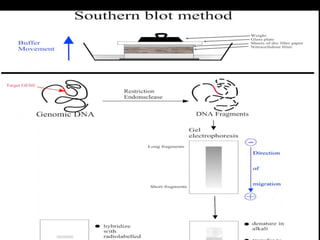
SOUTHERN BLOTTING/ SOUTHERN
HYBRIDIZATION
• First developed by E.M. SOUTHERN.
• DNA-DNA hybridization is the basis
• Later this technique is extended to RNA and
protein(northern and western blotting)
FACTORS AFFECTING SOUTHERN BLOTTING
1. STRINGENT CONDITION:
Refers to the specificity with which a particular DNA
target sequence is detected by a probe .
Thus with high stringent condition only complete
compliment sequence will bind .
Low stringent condition will allow hybridization of partially
matched sequence .
Therefore stringency is very essential in southern blotting
technique
2. MEMBRANE FOR BLOT TRANSFER
• Early years nitrocellulose was used but not
using now a days because it is fragile and has to
be handled with care .
• Now NYLON MEMBRANES are using as they
possess high tensile strength and better binding
capacity for nucleic acid.
APPLICATION OF SOUTHERN HYBRIDIZATION
• Invaluable method in gene analysis.
• Important for the conformation of cloning result .
• Useful for mapping restriction site around a single
copy gene sequences.
• Forensically applied to detect minute quantity of
DNA to identify parenthood, thieves, rapist etc.
• ZOO BLOTING: DNA pieces from one species can be
used to detect DNA molecule from other related
species.(e.g.: human to chimpanzee).
NORTHERN BLOTTING/ NORTHERN
HYBRIDIZATION
• Technique for the specific identification of RNA
• It is an extension method of southern blotting
• ADVANTAGES
• Useful in the identification and separation of RNA that is
complimentary to a specific DNA probe
• Sensitive test for the detection of transcription of a DNA
sequence that is used as probe
• DISADVANTAGES
• This is not really practicable since each gene may give
rise to two or more RNA transcripts
WESTERN BLOTTING
• Involves the identification of protein.
• Useful to understand nucleic acid function
particularly during the course of gene
manipulation
PROCEDURE
1. Protein bands are separated by poly
acrilamide gel electrophoresis.
2. Protein bands transferred on to a nylon
membrane or nitro cellulose.
3. The specific bands are identified in a variety
of ways such as
a. Antibodies are commonly used as probe for
detection of specific antigen.
b. Lecithin are also used as probes for identification
of glycoprotein
DOT BLOTTING
• Modified southern and northern blotting technique.
PROCEDURE
1. The sample DNA(or RNA) from different individual are fragmented on
to a nitrocellulose filter in the form of dots
2. The DNA is then denatured and then the filter is bached at 800c to fix
the DNA firmly to the filter
3. The filter is pre treated to prevent non specific binding of the probe to
the filter
4. The filter is then treated with appropriate radio active single
stranded DNA probe under condition favoring hybridization
5. Filter is then washed repeatedly to remove the free probe
6. The hybridized probes are detected by auto radiography
COLONY AND PLAQUE BLOTTING
• Used for identification and purification of
colonies
PROCEDURE
Bacteria are grown as colonies on an agar plate
Nitrocellulose filter paper over laid on the agar
plate
They are permanently fixed by heat
Then treatment with alkali the cell lyses and get
de natured
When DNA prints are exposed to specific probes ,
hybridization occur.
Hybridization complex can be localized and
detected by autoradiography
REFERENCES
1. BIOTECHNOLOGY BY U.SATHYANARAYANA
P.N:97-100,173-175
2. MICROBIOLOGY BY PRESSCOTT,HARLEY KLEIN
P.N:419-420
THANK YOU
21
DNA hybridization
Nucleic acids from different species can form hybrids
Can be used to detect similar DNA
sequences in two different species or
within the genome of a single species
Western blotting

blotting tech.pptx

  • 1.
    DNA HYBRIDIZATION By Dr. Priti D.Diwan AssistantProfessor Department of Zoology J.D.Patil Sangludkar Mahavidyalay Daryapur
  • 2.
    OVER VIEW  INTRODUCTION SOUTHERN HYBRIDIZATION  NORTHERN HYBRIDIZATION  WESTERN HYBRIDIZATION  DOT HYBRIDIZATION  COLONY HYBRIDIZATION  REFERENCES
  • 3.
    INTRODUCTION What is DNAhybridization. Principle and basic procedure. DNA probe Detector systems
  • 4.
    WHAT IS HYBRIDIZATION •Hybridization is the process of establishing a non-covalent, sequence- specific interaction between two or more complementary strands of nucleic acids into a single hybrid
  • 5.
    DNA HYBRIDIZATION • PRINCIPLE-Singlestranded DNA molecule recognize and specifically bind to a complimentary DNA strand in a mixture of other DNA strand • BASIC PROCEDURE -Single stranded target DNA is bound to a membrane support ↓ -DNA probe labeled with detector substance is added ↓ -DNA probe pairs with the complimentary target DNA ↓ -Sequence of nucleotide in the target DNA can be identified
  • 6.
    NUCLEIC ACID BLOTTINGTECHNIQUE • Blotting – refers to the process of immobilization of sample nucleic acid in solid support. • The blotted nucleic acid are then used as target in the hybridization experiment for their specific detection
  • 7.
    TYPES OF BLOTTINGOR HYBRIDIZATION TECHNIQUE 1) SOUTHERN BLOTTING 2) NORTHERN BLOTTING 3) DOT BLOTTING 4) COLONY BLOTTING 5) WESTERN BLOTTING
  • 8.
    SOUTHERN BLOTTING/ SOUTHERN HYBRIDIZATION •First developed by E.M. SOUTHERN. • DNA-DNA hybridization is the basis • Later this technique is extended to RNA and protein(northern and western blotting)
  • 10.
    FACTORS AFFECTING SOUTHERNBLOTTING 1. STRINGENT CONDITION: Refers to the specificity with which a particular DNA target sequence is detected by a probe . Thus with high stringent condition only complete compliment sequence will bind . Low stringent condition will allow hybridization of partially matched sequence . Therefore stringency is very essential in southern blotting technique
  • 11.
    2. MEMBRANE FORBLOT TRANSFER • Early years nitrocellulose was used but not using now a days because it is fragile and has to be handled with care . • Now NYLON MEMBRANES are using as they possess high tensile strength and better binding capacity for nucleic acid.
  • 12.
    APPLICATION OF SOUTHERNHYBRIDIZATION • Invaluable method in gene analysis. • Important for the conformation of cloning result . • Useful for mapping restriction site around a single copy gene sequences. • Forensically applied to detect minute quantity of DNA to identify parenthood, thieves, rapist etc. • ZOO BLOTING: DNA pieces from one species can be used to detect DNA molecule from other related species.(e.g.: human to chimpanzee).
  • 13.
    NORTHERN BLOTTING/ NORTHERN HYBRIDIZATION •Technique for the specific identification of RNA • It is an extension method of southern blotting
  • 15.
    • ADVANTAGES • Usefulin the identification and separation of RNA that is complimentary to a specific DNA probe • Sensitive test for the detection of transcription of a DNA sequence that is used as probe • DISADVANTAGES • This is not really practicable since each gene may give rise to two or more RNA transcripts
  • 16.
    WESTERN BLOTTING • Involvesthe identification of protein. • Useful to understand nucleic acid function particularly during the course of gene manipulation
  • 17.
    PROCEDURE 1. Protein bandsare separated by poly acrilamide gel electrophoresis. 2. Protein bands transferred on to a nylon membrane or nitro cellulose. 3. The specific bands are identified in a variety of ways such as a. Antibodies are commonly used as probe for detection of specific antigen. b. Lecithin are also used as probes for identification of glycoprotein
  • 18.
    DOT BLOTTING • Modifiedsouthern and northern blotting technique. PROCEDURE 1. The sample DNA(or RNA) from different individual are fragmented on to a nitrocellulose filter in the form of dots 2. The DNA is then denatured and then the filter is bached at 800c to fix the DNA firmly to the filter 3. The filter is pre treated to prevent non specific binding of the probe to the filter 4. The filter is then treated with appropriate radio active single stranded DNA probe under condition favoring hybridization 5. Filter is then washed repeatedly to remove the free probe 6. The hybridized probes are detected by auto radiography
  • 19.
    COLONY AND PLAQUEBLOTTING • Used for identification and purification of colonies PROCEDURE Bacteria are grown as colonies on an agar plate Nitrocellulose filter paper over laid on the agar plate They are permanently fixed by heat Then treatment with alkali the cell lyses and get de natured When DNA prints are exposed to specific probes , hybridization occur. Hybridization complex can be localized and detected by autoradiography
  • 20.
    REFERENCES 1. BIOTECHNOLOGY BYU.SATHYANARAYANA P.N:97-100,173-175 2. MICROBIOLOGY BY PRESSCOTT,HARLEY KLEIN P.N:419-420
  • 21.
  • 22.
    DNA hybridization Nucleic acidsfrom different species can form hybrids Can be used to detect similar DNA sequences in two different species or within the genome of a single species
  • 23.