Nucleic Acid Hybridization
Principles & Applications
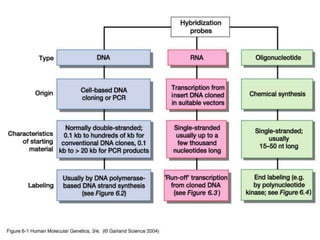
Preparation of nucleic acid probes:
- DNA: from cell-based cloning or by PCR. Probe is
double stranded. Labeling by DNA polymerase-based
DNA strand synthesis.
- RNA: by transcription from DNA cloned in an
expression vector. Probe is single stranded. Labeling by
“run-off” transcription.
- Oligonucleotide: by chemical synthesis. Probe is single
stranded. Labeling is by end labeling.
06_01.jpg
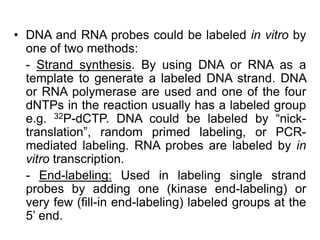
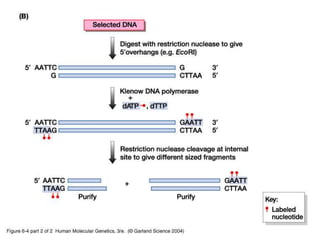
• DNA and RNA probes could be labeled in vitro by
one of two methods:
- Strand synthesis. By using DNA or RNA as a
template to generate a labeled DNA strand. DNA
or RNA polymerase are used and one of the four
dNTPs in the reaction usually has a labeled group
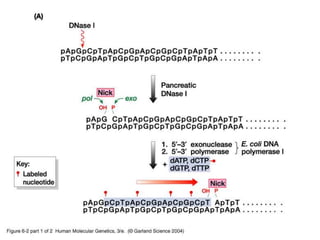
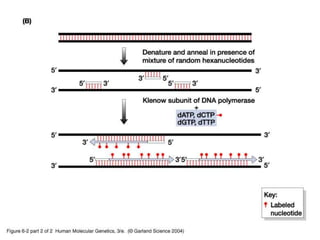
e.g. 32P-dCTP. DNA could be labeled by “nick-
translation”, random primed labeling, or PCR-
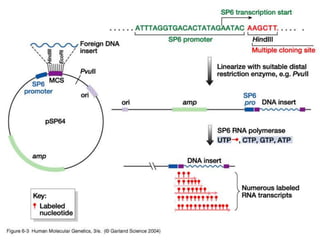
mediated labeling. RNA probes are labeled by in
vitro transcription.
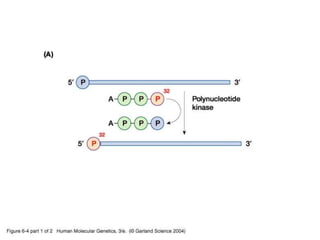
- End-labeling: Used in labeling single strand
probes by adding one (kinase end-labeling) or
very few (fill-in end-labeling) labeled groups at the
5’ end.
06_02.jpg
06_02_2.jpg
06_03.jpg
06_04.jpg
06_04_2.jpg
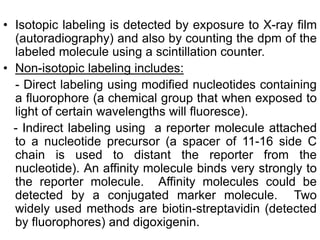
• Isotopic labeling is detected by exposure to X-ray film
(autoradiography) and also by counting the dpm of the
labeled molecule using a scintillation counter.
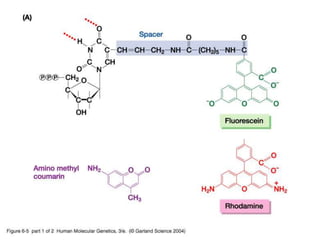
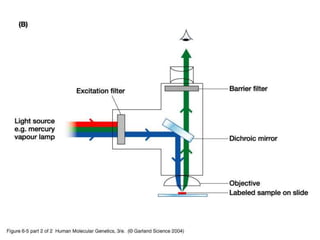
• Non-isotopic labeling includes:
- Direct labeling using modified nucleotides containing
a fluorophore (a chemical group that when exposed to
light of certain wavelengths will fluoresce).
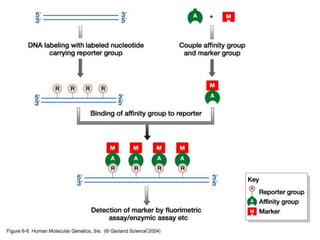
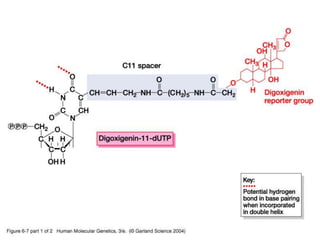
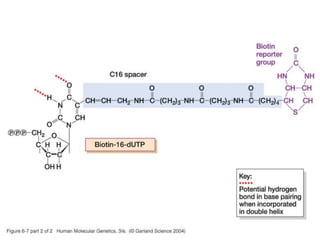
- Indirect labeling using a reporter molecule attached
to a nucleotide precursor (a spacer of 11-16 side C
chain is used to distant the reporter from the
nucleotide). An affinity molecule binds very strongly to
the reporter molecule. Affinity molecules could be
detected by a conjugated marker molecule. Two
widely used methods are biotin-streptavidin (detected
by fluorophores) and digoxigenin.
06_05.jpg
06_05_2.jpg
06_06.jpg
06_07.jpg
06_07_2.jpg
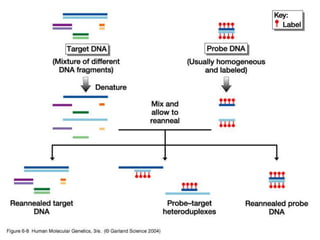
Principles of nucleic acid hybridization (NAH):
• NAH is used to identify how close DNA molecules
are. Factors to consider when performing a NAH
assay between a probe and a target molecule are:
- strand length
- base composition
- chemical environment– monovalent cations stabilize
the duplex while polar molecules such as formamide
and urea are chemical denaturants.
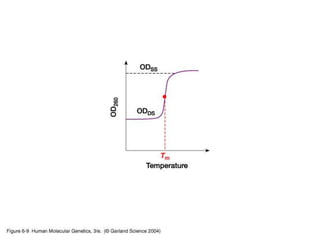
- melting temperature
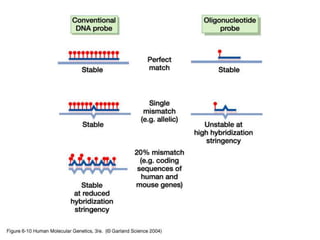
- hybridization stringency– temperature and salt
concentration (high NaCl conc. and low temp. is low
stringency while low NaCl and high temperature is
high stringency).
06_08.jpg
06_09.jpg
06_10.jpg
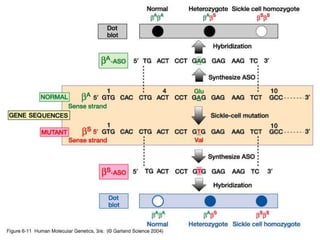
NAH assays:
• Dot-blot hybridization – used with allele-
specific oligonucleotides ASO probes where
the probes are labeled and hybridized to
immobilized target genomic DNA. In reverse
blot hybridization, the ASO probes are not
labellled and are immobilized on a membrane
then hybridized to the labeled target DNA
(genomic DNA).
06_11.jpg
Southern, Northern
and Western
blotting
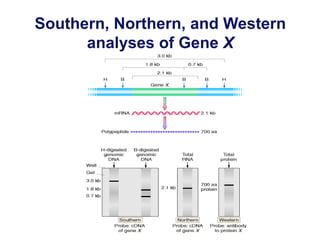
Southern, Northern, and Western
analyses of Gene X
Southern hybridization
• First described by E. M. Southern in 1975.
• Applications of Southern hybridization
– RFLP’s, VNTR’s and DNA fingerprinting
– Checking of the gene knockout mice
• The flow chart of Southern hybridization
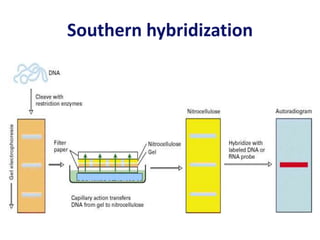
Southern hybridization
Transfer buffer
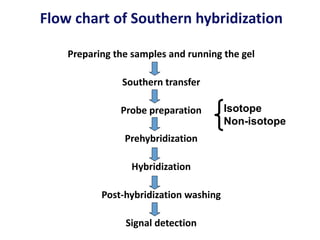
Flow chart of Southern hybridization
Preparing the samples and running the gel
Southern transfer
Probe preparation
Prehybridization
Hybridization
Post-hybridization washing
Signal detection
Isotope
Non-isotope
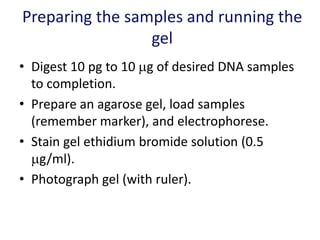
Preparing the samples and running the
gel
• Digest 10 pg to 10 g of desired DNA samples
to completion.
• Prepare an agarose gel, load samples
(remember marker), and electrophorese.
• Stain gel ethidium bromide solution (0.5
g/ml).
• Photograph gel (with ruler).
Critical parameters (I)
• Note the complexity of DNA
–Genomic DNA
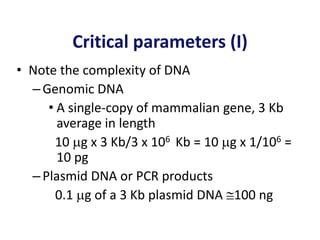
• A single-copy of mammalian gene, 3 Kb
average in length
10 g x 3 Kb/3 x 106 Kb = 10 g x 1/106 =
10 pg
–Plasmid DNA or PCR products
0.1 g of a 3 Kb plasmid DNA 100 ng
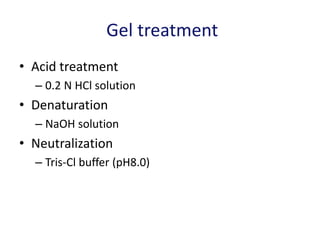
Gel treatment
• Acid treatment
– 0.2 N HCl solution
• Denaturation
– NaOH solution
• Neutralization
– Tris-Cl buffer (pH8.0)
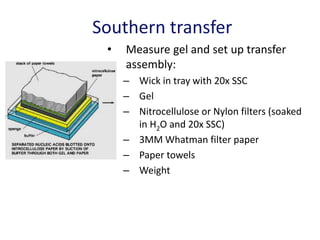
Southern transfer
• Measure gel and set up transfer
assembly:
– Wick in tray with 20x SSC
– Gel
– Nitrocellulose or Nylon filters (soaked
in H2O and 20x SSC)
– 3MM Whatman filter paper
– Paper towels
– Weight
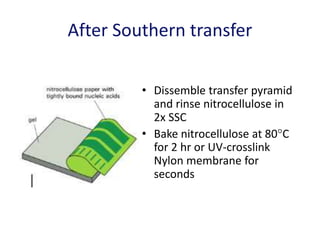
After Southern transfer
• Dissemble transfer pyramid
and rinse nitrocellulose in
2x SSC
• Bake nitrocellulose at 80C
for 2 hr or UV-crosslink
Nylon membrane for
seconds
Preparation of probes
• Synthesis of uniformly labeled double-
stranded DNA probes
• Preparation of single-stranded probes
• Labeling the 5 and 3 termini of DNA
Synthesis of double-stranded DNA probes
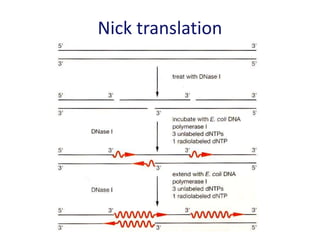
- Nick translation of DNA
- Labeled DNA probes using random
oligonucleotide primers
Nick translation
Preparation of single-stranded probes
• Synthesis of single-stranded DNA probes
using bacteriophage M13 vectors.
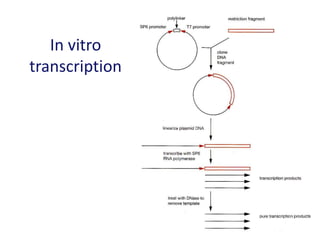
• Synthesis of RNA probes by in vitro
transcription by bacteriophage DNA-
dependent RNA polymerase.
In vitro
transcription
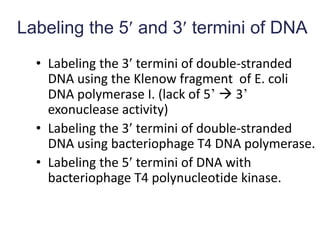
• Labeling the 3 termini of double-stranded
DNA using the Klenow fragment of E. coli
DNA polymerase I. (lack of 5’  3’
exonuclease activity)
• Labeling the 3 termini of double-stranded
DNA using bacteriophage T4 DNA polymerase.
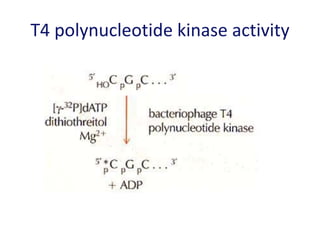
• Labeling the 5 termini of DNA with
bacteriophage T4 polynucleotide kinase.
Labeling the 5 and 3 termini of DNA
T4 polynucleotide kinase activity
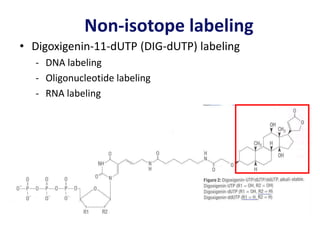
Non-isotope labeling
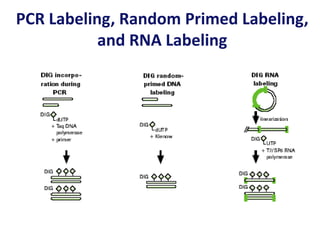
• Digoxigenin-11-dUTP (DIG-dUTP) labeling
- DNA labeling
- Oligonucleotide labeling
- RNA labeling
PCR Labeling, Random Primed Labeling,
and RNA Labeling
Prehybridization
• Add prehybridization solution and
prehybridize at hybridization temperature for
2-4 hr
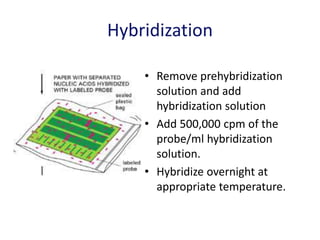
Hybridization
• Remove prehybridization
solution and add
hybridization solution
• Add 500,000 cpm of the
probe/ml hybridization
solution.
• Hybridize overnight at
appropriate temperature.
Post-hybridization washing
• Wash twice, 15 min each, in 1x SSC, 0.1% SDS
at room temperature.
• Wash twice, 15 min each, in 0.25x SSC,
0.1%SDS at hybridization temp
Critical parameters (II)
• Homology between the probe and the sequences
being detected
– Tm = 81 +16.6 (log Ci) + 0.4 [% (G+C)] - 0.6 (%
formamide)- 600/n - 1.5 (% mismatch)
– Factors can be changed:
• Hybridization temp.
• Washing temp.
• Salt concentration during washing
High temp., low salt: high stringency
Low temp., high salt: low stringency
– If 50 % formamide is used
• 42 oC for 95 ~ 100 % homology
• 37 oC for 90 ~ 95 % homology
• 32 oC for 85 ~ 90 % homology
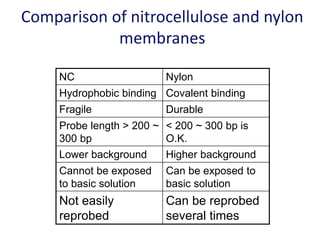
Comparison of nitrocellulose and nylon
membranes
NC Nylon
Hydrophobic binding Covalent binding
Fragile Durable
Probe length > 200 ~
300 bp
< 200 ~ 300 bp is
O.K.
Lower background Higher background
Cannot be exposed
to basic solution
Can be exposed to
basic solution
Not easily
reprobed
Can be reprobed
several times
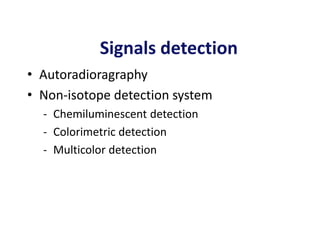
Signals detection
• Autoradioragraphy
• Non-isotope detection system
- Chemiluminescent detection
- Colorimetric detection
- Multicolor detection
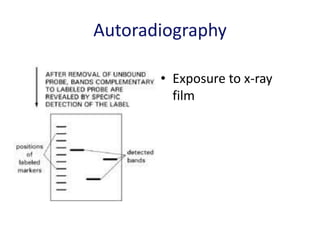
Autoradiography
• Exposure to x-ray
film
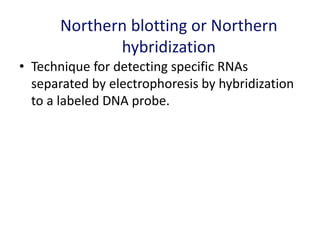
Northern blotting or Northern
hybridization
• Technique for detecting specific RNAs
separated by electrophoresis by hybridization
to a labeled DNA probe.
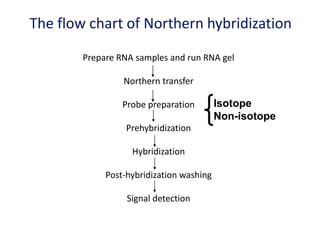
The flow chart of Northern hybridization
Prepare RNA samples and run RNA gel
Northern transfer
Probe preparation
Prehybridization
Hybridization
Post-hybridization washing
Signal detection
Isotope
Non-isotope
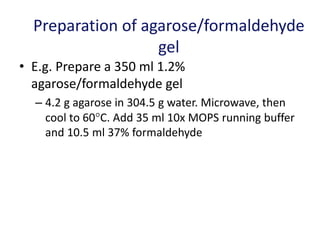
Preparation of agarose/formaldehyde
gel
• E.g. Prepare a 350 ml 1.2%
agarose/formaldehyde gel
– 4.2 g agarose in 304.5 g water. Microwave, then
cool to 60C. Add 35 ml 10x MOPS running buffer
and 10.5 ml 37% formaldehyde
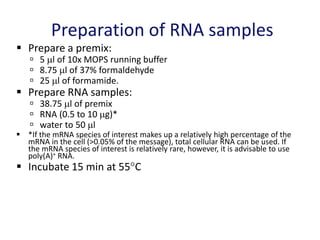
Preparation of RNA samples
 Prepare a premix:
 5 l of 10x MOPS running buffer
 8.75 l of 37% formaldehyde
 25 l of formamide.
 Prepare RNA samples:
 38.75 l of premix
 RNA (0.5 to 10 g)*
 water to 50 l
 *If the mRNA species of interest makes up a relatively high percentage of the
mRNA in the cell (>0.05% of the message), total cellular RNA can be used. If
the mRNA species of interest is relatively rare, however, it is advisable to use
poly(A)+ RNA.
 Incubate 15 min at 55C
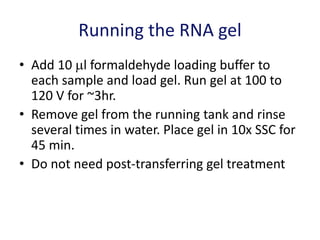
Running the RNA gel
• Add 10 l formaldehyde loading buffer to
each sample and load gel. Run gel at 100 to
120 V for ~3hr.
• Remove gel from the running tank and rinse
several times in water. Place gel in 10x SSC for
45 min.
• Do not need post-transferring gel treatment
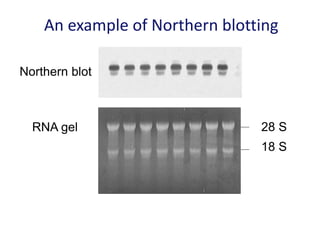
An example of Northern blotting
Northern blot
RNA gel 28 S
18 S
Western blotting, or immunoblotting
Technique for detecting specific proteins
separated by electrophoresis by use of
labeled antibodies.
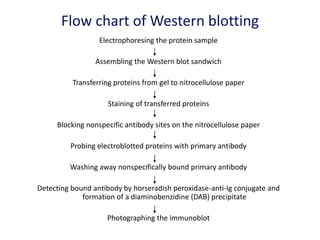
Flow chart of Western blotting
Electrophoresing the protein sample
Assembling the Western blot sandwich
Transferring proteins from gel to nitrocellulose paper
Staining of transferred proteins
Blocking nonspecific antibody sites on the nitrocellulose paper
Probing electroblotted proteins with primary antibody
Washing away nonspecifically bound primary antibody
Detecting bound antibody by horseradish peroxidase-anti-Ig conjugate and
formation of a diaminobenzidine (DAB) precipitate
Photographing the immunoblot
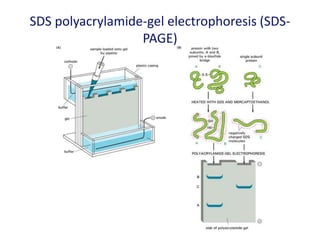
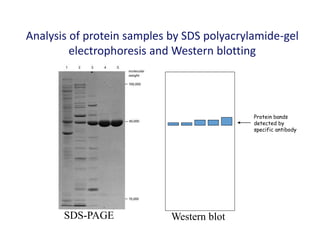
SDS polyacrylamide-gel electrophoresis (SDS-
PAGE)
Analysis of protein samples by SDS polyacrylamide-gel
electrophoresis and Western blotting
Protein bands
detected by
specific antibody
SDS-PAGE Western blot
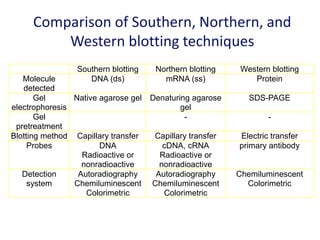
Comparison of Southern, Northern, and
Western blotting techniques
Southern blotting Northern blotting Western blotting
Molecule
detected
DNA (ds) mRNA (ss) Protein
Gel
electrophoresis
Native agarose gel Denaturing agarose
gel
SDS-PAGE
Gel
pretreatment
- -
Blotting method Capillary transfer Capillary transfer Electric transfer
Probes DNA
Radioactive or
nonradioactive
cDNA, cRNA
Radioactive or
nonradioactive
primary antibody
Detection
system
Autoradiography
Chemiluminescent
Colorimetric
Autoradiography
Chemiluminescent
Colorimetric
Chemiluminescent
Colorimetric
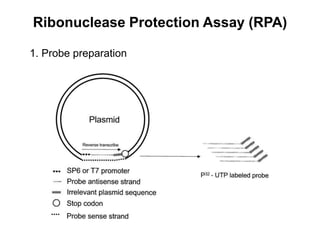
Ribonuclease Protection Assay (RPA)
1. Probe preparation
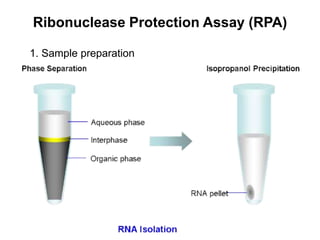
Ribonuclease Protection Assay (RPA)
1. Sample preparation
Ribonuclease Protection Assay (RPA)
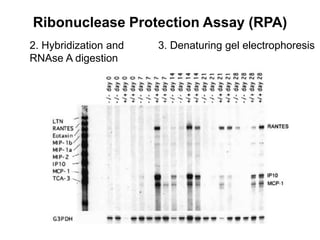
2. Hybridization and
RNAse A digestion
3. Denaturing gel electrophoresis

Blotting 2017

  • 1.
  • 2.
    Preparation of nucleicacid probes: - DNA: from cell-based cloning or by PCR. Probe is double stranded. Labeling by DNA polymerase-based DNA strand synthesis. - RNA: by transcription from DNA cloned in an expression vector. Probe is single stranded. Labeling by “run-off” transcription. - Oligonucleotide: by chemical synthesis. Probe is single stranded. Labeling is by end labeling.
  • 3.
  • 4.
    • DNA andRNA probes could be labeled in vitro by one of two methods: - Strand synthesis. By using DNA or RNA as a template to generate a labeled DNA strand. DNA or RNA polymerase are used and one of the four dNTPs in the reaction usually has a labeled group e.g. 32P-dCTP. DNA could be labeled by “nick- translation”, random primed labeling, or PCR- mediated labeling. RNA probes are labeled by in vitro transcription. - End-labeling: Used in labeling single strand probes by adding one (kinase end-labeling) or very few (fill-in end-labeling) labeled groups at the 5’ end.
  • 5.
  • 6.
  • 7.
  • 8.
  • 9.
  • 10.
    • Isotopic labelingis detected by exposure to X-ray film (autoradiography) and also by counting the dpm of the labeled molecule using a scintillation counter. • Non-isotopic labeling includes: - Direct labeling using modified nucleotides containing a fluorophore (a chemical group that when exposed to light of certain wavelengths will fluoresce). - Indirect labeling using a reporter molecule attached to a nucleotide precursor (a spacer of 11-16 side C chain is used to distant the reporter from the nucleotide). An affinity molecule binds very strongly to the reporter molecule. Affinity molecules could be detected by a conjugated marker molecule. Two widely used methods are biotin-streptavidin (detected by fluorophores) and digoxigenin.
  • 11.
  • 12.
  • 13.
  • 14.
  • 15.
  • 16.
    Principles of nucleicacid hybridization (NAH): • NAH is used to identify how close DNA molecules are. Factors to consider when performing a NAH assay between a probe and a target molecule are: - strand length - base composition - chemical environment– monovalent cations stabilize the duplex while polar molecules such as formamide and urea are chemical denaturants. - melting temperature - hybridization stringency– temperature and salt concentration (high NaCl conc. and low temp. is low stringency while low NaCl and high temperature is high stringency).
  • 17.
  • 18.
  • 19.
  • 20.
    NAH assays: • Dot-blothybridization – used with allele- specific oligonucleotides ASO probes where the probes are labeled and hybridized to immobilized target genomic DNA. In reverse blot hybridization, the ASO probes are not labellled and are immobilized on a membrane then hybridized to the labeled target DNA (genomic DNA).
  • 21.
  • 22.
  • 23.
    Southern, Northern, andWestern analyses of Gene X
  • 24.
    Southern hybridization • Firstdescribed by E. M. Southern in 1975. • Applications of Southern hybridization – RFLP’s, VNTR’s and DNA fingerprinting – Checking of the gene knockout mice • The flow chart of Southern hybridization
  • 25.
  • 26.
    Flow chart ofSouthern hybridization Preparing the samples and running the gel Southern transfer Probe preparation Prehybridization Hybridization Post-hybridization washing Signal detection Isotope Non-isotope
  • 27.
    Preparing the samplesand running the gel • Digest 10 pg to 10 g of desired DNA samples to completion. • Prepare an agarose gel, load samples (remember marker), and electrophorese. • Stain gel ethidium bromide solution (0.5 g/ml). • Photograph gel (with ruler).
  • 28.
    Critical parameters (I) •Note the complexity of DNA –Genomic DNA • A single-copy of mammalian gene, 3 Kb average in length 10 g x 3 Kb/3 x 106 Kb = 10 g x 1/106 = 10 pg –Plasmid DNA or PCR products 0.1 g of a 3 Kb plasmid DNA 100 ng
  • 29.
    Gel treatment • Acidtreatment – 0.2 N HCl solution • Denaturation – NaOH solution • Neutralization – Tris-Cl buffer (pH8.0)
  • 30.
    Southern transfer • Measuregel and set up transfer assembly: – Wick in tray with 20x SSC – Gel – Nitrocellulose or Nylon filters (soaked in H2O and 20x SSC) – 3MM Whatman filter paper – Paper towels – Weight
  • 31.
    After Southern transfer •Dissemble transfer pyramid and rinse nitrocellulose in 2x SSC • Bake nitrocellulose at 80C for 2 hr or UV-crosslink Nylon membrane for seconds
  • 32.
    Preparation of probes •Synthesis of uniformly labeled double- stranded DNA probes • Preparation of single-stranded probes • Labeling the 5 and 3 termini of DNA
  • 33.
    Synthesis of double-strandedDNA probes - Nick translation of DNA - Labeled DNA probes using random oligonucleotide primers
  • 34.
  • 35.
    Preparation of single-strandedprobes • Synthesis of single-stranded DNA probes using bacteriophage M13 vectors. • Synthesis of RNA probes by in vitro transcription by bacteriophage DNA- dependent RNA polymerase.
  • 36.
  • 37.
    • Labeling the3 termini of double-stranded DNA using the Klenow fragment of E. coli DNA polymerase I. (lack of 5’  3’ exonuclease activity) • Labeling the 3 termini of double-stranded DNA using bacteriophage T4 DNA polymerase. • Labeling the 5 termini of DNA with bacteriophage T4 polynucleotide kinase. Labeling the 5 and 3 termini of DNA
  • 38.
  • 39.
    Non-isotope labeling • Digoxigenin-11-dUTP(DIG-dUTP) labeling - DNA labeling - Oligonucleotide labeling - RNA labeling
  • 40.
    PCR Labeling, RandomPrimed Labeling, and RNA Labeling
  • 41.
    Prehybridization • Add prehybridizationsolution and prehybridize at hybridization temperature for 2-4 hr
  • 42.
    Hybridization • Remove prehybridization solutionand add hybridization solution • Add 500,000 cpm of the probe/ml hybridization solution. • Hybridize overnight at appropriate temperature.
  • 43.
    Post-hybridization washing • Washtwice, 15 min each, in 1x SSC, 0.1% SDS at room temperature. • Wash twice, 15 min each, in 0.25x SSC, 0.1%SDS at hybridization temp
  • 44.
    Critical parameters (II) •Homology between the probe and the sequences being detected – Tm = 81 +16.6 (log Ci) + 0.4 [% (G+C)] - 0.6 (% formamide)- 600/n - 1.5 (% mismatch) – Factors can be changed: • Hybridization temp. • Washing temp. • Salt concentration during washing High temp., low salt: high stringency Low temp., high salt: low stringency – If 50 % formamide is used • 42 oC for 95 ~ 100 % homology • 37 oC for 90 ~ 95 % homology • 32 oC for 85 ~ 90 % homology
  • 45.
    Comparison of nitrocelluloseand nylon membranes NC Nylon Hydrophobic binding Covalent binding Fragile Durable Probe length > 200 ~ 300 bp < 200 ~ 300 bp is O.K. Lower background Higher background Cannot be exposed to basic solution Can be exposed to basic solution Not easily reprobed Can be reprobed several times
  • 46.
    Signals detection • Autoradioragraphy •Non-isotope detection system - Chemiluminescent detection - Colorimetric detection - Multicolor detection
  • 47.
  • 48.
    Northern blotting orNorthern hybridization • Technique for detecting specific RNAs separated by electrophoresis by hybridization to a labeled DNA probe.
  • 49.
    The flow chartof Northern hybridization Prepare RNA samples and run RNA gel Northern transfer Probe preparation Prehybridization Hybridization Post-hybridization washing Signal detection Isotope Non-isotope
  • 50.
    Preparation of agarose/formaldehyde gel •E.g. Prepare a 350 ml 1.2% agarose/formaldehyde gel – 4.2 g agarose in 304.5 g water. Microwave, then cool to 60C. Add 35 ml 10x MOPS running buffer and 10.5 ml 37% formaldehyde
  • 51.
    Preparation of RNAsamples  Prepare a premix:  5 l of 10x MOPS running buffer  8.75 l of 37% formaldehyde  25 l of formamide.  Prepare RNA samples:  38.75 l of premix  RNA (0.5 to 10 g)*  water to 50 l  *If the mRNA species of interest makes up a relatively high percentage of the mRNA in the cell (>0.05% of the message), total cellular RNA can be used. If the mRNA species of interest is relatively rare, however, it is advisable to use poly(A)+ RNA.  Incubate 15 min at 55C
  • 52.
    Running the RNAgel • Add 10 l formaldehyde loading buffer to each sample and load gel. Run gel at 100 to 120 V for ~3hr. • Remove gel from the running tank and rinse several times in water. Place gel in 10x SSC for 45 min. • Do not need post-transferring gel treatment
  • 53.
    An example ofNorthern blotting Northern blot RNA gel 28 S 18 S
  • 54.
    Western blotting, orimmunoblotting Technique for detecting specific proteins separated by electrophoresis by use of labeled antibodies.
  • 55.
    Flow chart ofWestern blotting Electrophoresing the protein sample Assembling the Western blot sandwich Transferring proteins from gel to nitrocellulose paper Staining of transferred proteins Blocking nonspecific antibody sites on the nitrocellulose paper Probing electroblotted proteins with primary antibody Washing away nonspecifically bound primary antibody Detecting bound antibody by horseradish peroxidase-anti-Ig conjugate and formation of a diaminobenzidine (DAB) precipitate Photographing the immunoblot
  • 56.
  • 57.
    Analysis of proteinsamples by SDS polyacrylamide-gel electrophoresis and Western blotting Protein bands detected by specific antibody SDS-PAGE Western blot
  • 58.
    Comparison of Southern,Northern, and Western blotting techniques Southern blotting Northern blotting Western blotting Molecule detected DNA (ds) mRNA (ss) Protein Gel electrophoresis Native agarose gel Denaturing agarose gel SDS-PAGE Gel pretreatment - - Blotting method Capillary transfer Capillary transfer Electric transfer Probes DNA Radioactive or nonradioactive cDNA, cRNA Radioactive or nonradioactive primary antibody Detection system Autoradiography Chemiluminescent Colorimetric Autoradiography Chemiluminescent Colorimetric Chemiluminescent Colorimetric
  • 59.
    Ribonuclease Protection Assay(RPA) 1. Probe preparation
  • 60.
    Ribonuclease Protection Assay(RPA) 1. Sample preparation
  • 61.
    Ribonuclease Protection Assay(RPA) 2. Hybridization and RNAse A digestion 3. Denaturing gel electrophoresis