Trichiasis
Trichiasis
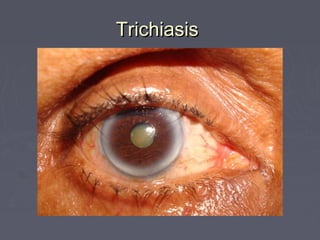
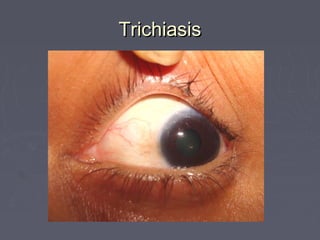
Misdirected eye lashes are called trichiasis.
Eyelashes (cilia) emerging normally i.e. from
anterior border of lid margin are misdirected
backward towards the ocular surface (cornea).
Tarsal plate remains normal in position.
Any condition causing entropion (involutional,
cicatricial as in Trachoma or spastic entropion) will
cause misdirected lashes (Trichiasis) to rub
against cornea
Causes of Trichiasis
1. Secondary to chronic inflammatory
   conditions like Trachoma, Stevens-
   Jhonson Syndrome, Pemphigus,
   Blepharitis, traumatic or operative scar,
   blepharitis (Ulcerative) and chemical burns
2. It may be idiopathic
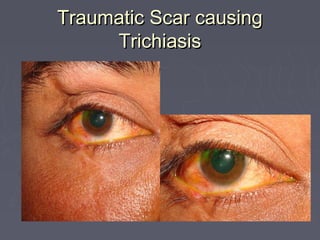
Traumatic Scar causing
     Trichiasis
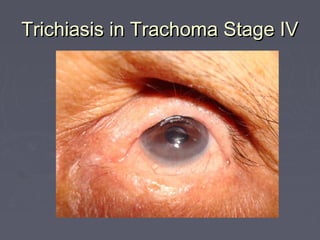
Trichiasis in Trachoma Stage IV
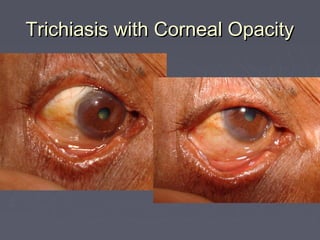
Trichiasis with Corneal Opacity
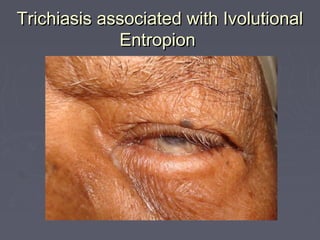
Trichiasis associated with Ivolutional
             Entropion
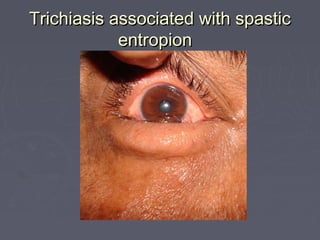
Trichiasis associated with spastic
            entropion
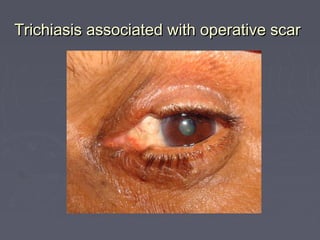
Trichiasis associated with operative scar
Symptoms
► Foreign body sensation
► Irritation
► Pain
► Redness
► Inability to open eyes
► Watering
Signs
► Misdirected eyelash(s)
► Conjunctival congestion
► Lacrimation/ blepharospasm
► Recurrent corneal erosions / superficial
  corneal opacity(ies)
► Corneal vascularization
► Recurrent corneal ulcer/ Non-healing
  corneal ulcer
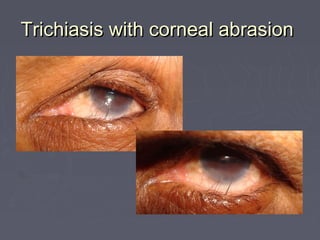
Trichiasis with corneal abrasion
Trichiasis
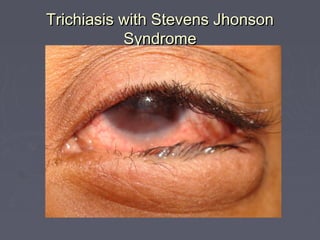
Trichiasis with Stevens Jhonson
           Syndrome
Treatment
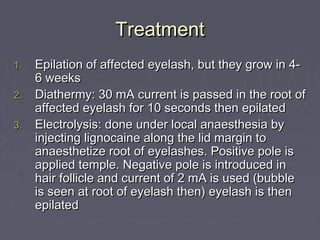
1.   Epilation of affected eyelash, but they grow in 4-
     6 weeks
2.   Diathermy: 30 mA current is passed in the root of
     affected eyelash for 10 seconds then epilated
3.   Electrolysis: done under local anaesthesia by
     injecting lignocaine along the lid margin to
     anaesthetize root of eyelashes. Positive pole is
     applied temple. Negative pole is introduced in
     hair follicle and current of 2 mA is used (bubble
     is seen at root of eyelash then) eyelash is then
     epilated
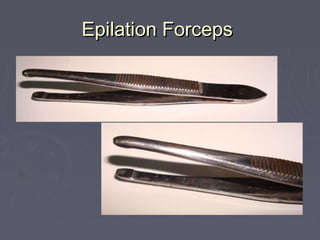
Epilation Forceps
Treatment
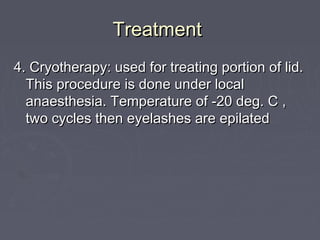
4. Cryotherapy: used for treating portion of lid.
  This procedure is done under local
  anaesthesia. Temperature of -20 deg. C ,
  two cycles then eyelashes are epilated
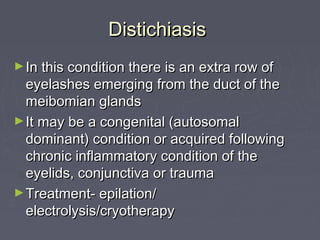
Distichiasis
► In this condition there is an extra row of
  eyelashes emerging from the duct of the
  meibomian glands
► It may be a congenital (autosomal
  dominant) condition or acquired following
  chronic inflammatory condition of the
  eyelids, conjunctiva or trauma
► Treatment- epilation/
  electrolysis/cryotherapy
Trichiasis
Symblepharon
► Symblepharon is adhesion between the
  bulbar and palpabral conjunctiva due to raw
  opposing surfaces
► Causes: opposing surfaces of palpabral and
  bulbar conjunctiva becomes raw and
  inflamed in cases of:
  a. Chemical burn (Alkali / Acid burn)
  b. Stevens- Johnson syndrome
  c. Pemphigus
Symblepharon
Types:
 - Anterior
 - Posterior
 - Total
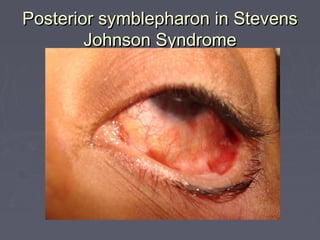
Posterior symblepharon in Stevens
        Johnson Syndrome
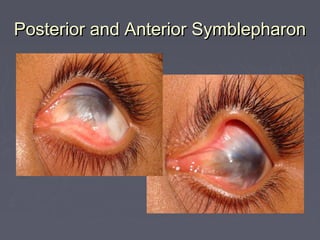
Posterior and Anterior Symblepharon
Symptoms
► Irritation, foreign body sensation
► Restriction of ocular movements
► Diplopia
Treatment
► Prevention: Sweeping of glass rod and use
  of topical steroids
► Treatment: surgical release + mucous
  membrane or amniotic membrane grafting
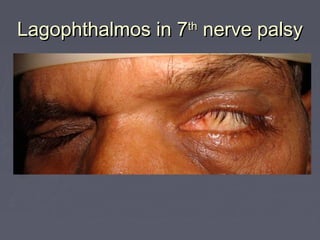
Lagophthalmos
Lagophthalmos

Definition : Incomplete closure of the
 palpabral aperture when attempt is made
 to close the eyes.
Lagophthalmos in 7 nerve palsy
                 th
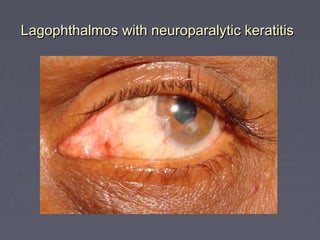
Lagophthalmos with neuroparalytic keratitis
Causes of Lagophthalmos
► Contraction of lids due to cicatrization or a
  congenital deformity
► Ectropion
► Paralysis of Orbicularis
► Proptosis due to exophthalmic goitre, orbital
  tumour/ inflammmation etc.
► Laxity of tissue and absence of reflex
  blinking in patients who are extremely ill.
Clinical Picture
Symptoms:
1. Inability to close eye(s)
2. Symptoms of dry eye
3. Blurring of vision
4. Foreign body sensation
5. Photophobia
Clinical Picture
Signs
1. Incomplete closure of lid
2. Exposure of conjunctiva and cornea
3. Dryness, congestion
4. Haziness of cornea, punctate infiltration
Complications
1. Corneal ulcer (Non-healing)
Treatment
Medical Treatment
1. Lubricating Eye drops
2. Control of infection
3. Protection of ocular surface
4. Close affected eye and tape upper lid or
   application of suture
Surgical Treatment:
Tarsorrhaphy (Lateral or paramedian)
PTOSIS
Ptosis
► Definition: Drooping of upper lid usually due
 to paralysis or defective development of the
 levator palpebrae superioris (LPS)
Types
► Congenital
  1. Simple
  2. Complicated
► Acquired
  1. Neurogenic
  2. Myogenic
  3. Aponeurotic
  4 Mechanical
Types
► Pseudoptosis – in Phthisis bulbi and
 anophthalmos


► Condition may be Unilateral or Bilateral
► Partial or complete
Measurement
► Normal position of lids
► Abnormal – Margin Reflex Distance (MRD)-
  Normal MRD is 4 mm +/- 1 mm
► Ptosis of less than 2 mm – Mild
► Ptosis of 3 mm – moderate
► Ptosis of 4 mm or more – severe
Compensatory Mechanism
► Overaction of frontalis
► Throwing back the head


► Assessment of LPS function –
  Excursion of 8 mm or more – good action
  Excursion of 5-7 mm – Fair action
  Excursion of 4 mm or less – poor
► Look for Bell phenomenon
Congenital Ptosis
► Commonest form of ptosis
► Usually bilateral / Heriditary
► Due to defective development of LPS
► Simple congenital ptosis is an isolated
  abnormality
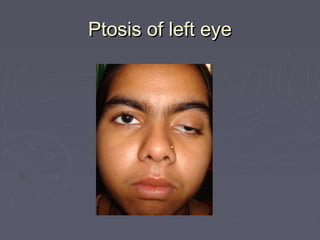
Ptosis of left eye
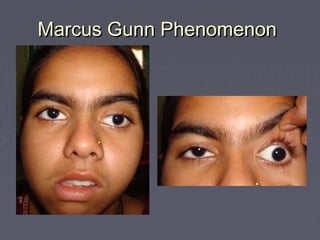
Marcus Gunn Phenomenon
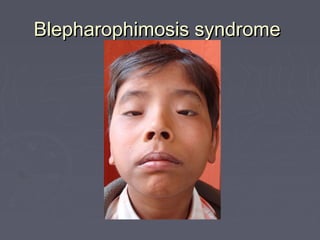
Blepharophimosis syndrome
Congenital Ptosis
► Complicated – when associated with
 developmental abnormality of surrounding
 structures
 Associated Sup rectus palsy
 Abnormal synkineses – Marcus Gunn ptosis
 Dystrophy of the LPS
 Blepharophimosis syndrome (Ptosis, horizontal
 shortening of palp aperture, epicanthus
 inversus, telecanthus lat ectropion of the lower
 lids)
Treatment of Congenital Ptosis
► Age (3-5 years), early surgery when pupil is
  covered
► Fasanella –servat operation (indicated when
  ptosis is 1.5 – 2 mm – excision of 4-5 mm
  upper tarsus)
► LPS resection – 10 mm resection is
  minimum (resection ranges from 12 – 24
  mm)
► Conjunctival (Blaskovics operation) or skin
  (Everbusch operation) route for surgery
Treatment of Congenital Ptosis
► Frontalis suspension- intact LPS with poor
 function (3 mm or less)
 4-0 Supramid suture or fascia lata is used
 Complications associated with this
 operation
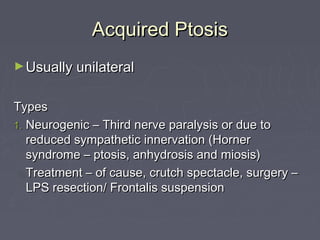
Acquired Ptosis
► Usually unilateral


Types
1. Neurogenic – Third nerve paralysis or due to
   reduced sympathetic innervation (Horner
   syndrome – ptosis, anhydrosis and miosis)
   Treatment – of cause, crutch spectacle, surgery –
   LPS resection/ Frontalis suspension
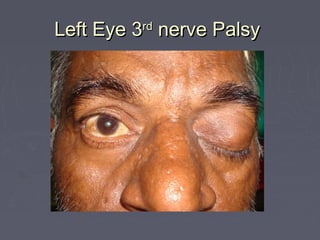
Left Eye 3 nerve Palsy
         rd
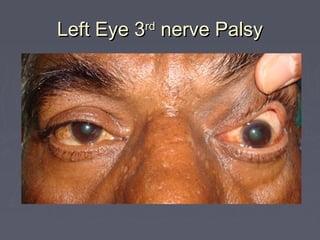
Left Eye 3 nerve Palsy
         rd
Acquired Ptosis
2. Myogenic – gradual onset, bilateral
  condition, symmetrical
  Myotonic dystrophy
  Chronic progressive exophthalmoplegia
  Mysthenia gravis ( damage to acetyl-cholin
  receptor at postsynaptic membrane with
  presence of antiacetylcholine receptor
  antibodies)
Acquired Ptosis
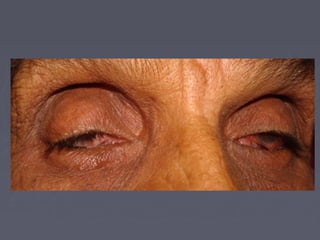
Mysthenia Gravis-
Symptoms – variable
Signs – bilateral ptosis, increases by
prolonged fixation or attempt to look up ,
external ophthalmoplegia – partial or
complete
Conformation by prostigmin or edrophonium
injection test
Acquired Ptosis
Aponeurotic Ptosis
Is involutional is due to weakness or
disinsertion of LPS aponeurosis from ant
surface of tarsal plate
High lid fold with good LPS function
Treatment – reinsertion of LPS and
resection of LPS
Mechanical Ptosis - Tumour or
inflammation weigh down the lid
Contusions
► Black Eye – swelling and ecchymosis of lids
 and conjunctiva

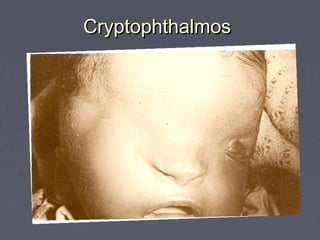
► Cryptophthalmos – rare condition
 characterized by presence of skin passing
 continuously from brow over the eye to the
 cheek.
Cryptophthalmos

Lid diseases ii

  • 1.
  • 2.
    Trichiasis Misdirected eye lashesare called trichiasis. Eyelashes (cilia) emerging normally i.e. from anterior border of lid margin are misdirected backward towards the ocular surface (cornea). Tarsal plate remains normal in position. Any condition causing entropion (involutional, cicatricial as in Trachoma or spastic entropion) will cause misdirected lashes (Trichiasis) to rub against cornea
  • 3.
    Causes of Trichiasis 1.Secondary to chronic inflammatory conditions like Trachoma, Stevens- Jhonson Syndrome, Pemphigus, Blepharitis, traumatic or operative scar, blepharitis (Ulcerative) and chemical burns 2. It may be idiopathic
  • 4.
  • 5.
  • 6.
  • 7.
    Trichiasis associated withIvolutional Entropion
  • 8.
    Trichiasis associated withspastic entropion
  • 9.
  • 10.
    Symptoms ► Foreign bodysensation ► Irritation ► Pain ► Redness ► Inability to open eyes ► Watering
  • 11.
    Signs ► Misdirected eyelash(s) ►Conjunctival congestion ► Lacrimation/ blepharospasm ► Recurrent corneal erosions / superficial corneal opacity(ies) ► Corneal vascularization ► Recurrent corneal ulcer/ Non-healing corneal ulcer
  • 12.
  • 13.
  • 14.
    Trichiasis with StevensJhonson Syndrome
  • 15.
    Treatment 1. Epilation of affected eyelash, but they grow in 4- 6 weeks 2. Diathermy: 30 mA current is passed in the root of affected eyelash for 10 seconds then epilated 3. Electrolysis: done under local anaesthesia by injecting lignocaine along the lid margin to anaesthetize root of eyelashes. Positive pole is applied temple. Negative pole is introduced in hair follicle and current of 2 mA is used (bubble is seen at root of eyelash then) eyelash is then epilated
  • 16.
  • 17.
    Treatment 4. Cryotherapy: usedfor treating portion of lid. This procedure is done under local anaesthesia. Temperature of -20 deg. C , two cycles then eyelashes are epilated
  • 18.
    Distichiasis ► In thiscondition there is an extra row of eyelashes emerging from the duct of the meibomian glands ► It may be a congenital (autosomal dominant) condition or acquired following chronic inflammatory condition of the eyelids, conjunctiva or trauma ► Treatment- epilation/ electrolysis/cryotherapy
  • 20.
  • 21.
    Symblepharon ► Symblepharon isadhesion between the bulbar and palpabral conjunctiva due to raw opposing surfaces ► Causes: opposing surfaces of palpabral and bulbar conjunctiva becomes raw and inflamed in cases of: a. Chemical burn (Alkali / Acid burn) b. Stevens- Johnson syndrome c. Pemphigus
  • 22.
  • 23.
    Posterior symblepharon inStevens Johnson Syndrome
  • 24.
  • 25.
    Symptoms ► Irritation, foreignbody sensation ► Restriction of ocular movements ► Diplopia
  • 26.
    Treatment ► Prevention: Sweepingof glass rod and use of topical steroids ► Treatment: surgical release + mucous membrane or amniotic membrane grafting
  • 27.
  • 28.
    Lagophthalmos Definition : Incompleteclosure of the palpabral aperture when attempt is made to close the eyes.
  • 29.
    Lagophthalmos in 7nerve palsy th
  • 30.
  • 31.
    Causes of Lagophthalmos ►Contraction of lids due to cicatrization or a congenital deformity ► Ectropion ► Paralysis of Orbicularis ► Proptosis due to exophthalmic goitre, orbital tumour/ inflammmation etc. ► Laxity of tissue and absence of reflex blinking in patients who are extremely ill.
  • 32.
    Clinical Picture Symptoms: 1. Inabilityto close eye(s) 2. Symptoms of dry eye 3. Blurring of vision 4. Foreign body sensation 5. Photophobia
  • 33.
    Clinical Picture Signs 1. Incompleteclosure of lid 2. Exposure of conjunctiva and cornea 3. Dryness, congestion 4. Haziness of cornea, punctate infiltration Complications 1. Corneal ulcer (Non-healing)
  • 34.
    Treatment Medical Treatment 1. LubricatingEye drops 2. Control of infection 3. Protection of ocular surface 4. Close affected eye and tape upper lid or application of suture Surgical Treatment: Tarsorrhaphy (Lateral or paramedian)
  • 35.
  • 36.
    Ptosis ► Definition: Droopingof upper lid usually due to paralysis or defective development of the levator palpebrae superioris (LPS)
  • 38.
    Types ► Congenital 1. Simple 2. Complicated ► Acquired 1. Neurogenic 2. Myogenic 3. Aponeurotic 4 Mechanical
  • 39.
    Types ► Pseudoptosis –in Phthisis bulbi and anophthalmos ► Condition may be Unilateral or Bilateral ► Partial or complete
  • 40.
    Measurement ► Normal positionof lids ► Abnormal – Margin Reflex Distance (MRD)- Normal MRD is 4 mm +/- 1 mm ► Ptosis of less than 2 mm – Mild ► Ptosis of 3 mm – moderate ► Ptosis of 4 mm or more – severe
  • 41.
    Compensatory Mechanism ► Overactionof frontalis ► Throwing back the head ► Assessment of LPS function – Excursion of 8 mm or more – good action Excursion of 5-7 mm – Fair action Excursion of 4 mm or less – poor ► Look for Bell phenomenon
  • 42.
    Congenital Ptosis ► Commonestform of ptosis ► Usually bilateral / Heriditary ► Due to defective development of LPS ► Simple congenital ptosis is an isolated abnormality
  • 43.
  • 44.
  • 45.
  • 46.
    Congenital Ptosis ► Complicated– when associated with developmental abnormality of surrounding structures Associated Sup rectus palsy Abnormal synkineses – Marcus Gunn ptosis Dystrophy of the LPS Blepharophimosis syndrome (Ptosis, horizontal shortening of palp aperture, epicanthus inversus, telecanthus lat ectropion of the lower lids)
  • 47.
    Treatment of CongenitalPtosis ► Age (3-5 years), early surgery when pupil is covered ► Fasanella –servat operation (indicated when ptosis is 1.5 – 2 mm – excision of 4-5 mm upper tarsus) ► LPS resection – 10 mm resection is minimum (resection ranges from 12 – 24 mm) ► Conjunctival (Blaskovics operation) or skin (Everbusch operation) route for surgery
  • 48.
    Treatment of CongenitalPtosis ► Frontalis suspension- intact LPS with poor function (3 mm or less) 4-0 Supramid suture or fascia lata is used Complications associated with this operation
  • 49.
    Acquired Ptosis ► Usuallyunilateral Types 1. Neurogenic – Third nerve paralysis or due to reduced sympathetic innervation (Horner syndrome – ptosis, anhydrosis and miosis) Treatment – of cause, crutch spectacle, surgery – LPS resection/ Frontalis suspension
  • 50.
    Left Eye 3nerve Palsy rd
  • 51.
    Left Eye 3nerve Palsy rd
  • 52.
    Acquired Ptosis 2. Myogenic– gradual onset, bilateral condition, symmetrical Myotonic dystrophy Chronic progressive exophthalmoplegia Mysthenia gravis ( damage to acetyl-cholin receptor at postsynaptic membrane with presence of antiacetylcholine receptor antibodies)
  • 53.
    Acquired Ptosis Mysthenia Gravis- Symptoms– variable Signs – bilateral ptosis, increases by prolonged fixation or attempt to look up , external ophthalmoplegia – partial or complete Conformation by prostigmin or edrophonium injection test
  • 54.
    Acquired Ptosis Aponeurotic Ptosis Isinvolutional is due to weakness or disinsertion of LPS aponeurosis from ant surface of tarsal plate High lid fold with good LPS function Treatment – reinsertion of LPS and resection of LPS Mechanical Ptosis - Tumour or inflammation weigh down the lid
  • 56.
    Contusions ► Black Eye– swelling and ecchymosis of lids and conjunctiva ► Cryptophthalmos – rare condition characterized by presence of skin passing continuously from brow over the eye to the cheek.
  • 57.