Vitreous substitutes
Dr venkatesh
• Vitreous Substitutes are substances used as adjuncts to vitreoretinal
surgery both intraoperatively and postoperatively in the management
of complicated forms of retinal detachment requiring vitrectomy.
• Vitreous Substitutes are soft surgical tools and are referred to as the
“third surgical hand”
• Intraoperatively they are used to re-establish intraocular volume, to
assist in : separating membranes adherent to the retina,
to manipulate retinal detachment
to mechanically flatten detached retina.
• Postoperatively they are used as long-term tamponading agents to
maintain the neural retina in apposition to retinal pigment
epithelium.
Vitreous substitute materials used intraoperatively are-
• Balanced Salt Solution
• Air and other Gases
• Viscoelastic Fluids
• Silicone Liquid
• Low viscosity Perfluorocarbon Liquids
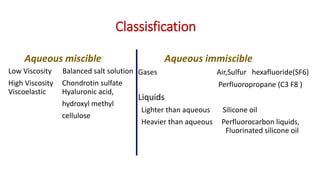
Classisfication
Aqueous miscible
Low Viscosity Balanced salt solution
High Viscosity Chondrotin sulfate
Viscoelastic Hyaluronic acid,
hydroxyl methyl
cellulose
Aqueous immiscible
Gases Air,Sulfur hexafluoride(SF6)
Perfluoropropane (C3 F8 )
Liquids
Lighter than aqueous Silicone oil
Heavier than aqueous Perfluorocarbon liquids,
l Fluorinated silicone oil
BSS
• Balanced salt solution is used as an irrigation fluid during vitrectomy
and also to maintain normal intraocular volume and pressure after
drainage of subretinal fluid during retinal detachment surgery and
after drainage of choroidal detachments.
• BSS enriched with bicarbonate, dextrose and gluthathione appears to
be better tolerated by ocular tissues, especially the corneal
endothelium.
• As an intravitreal irrigating solution, the enriched fluid also has the
advantage of allowing the maintenance of more normal
electroretinographic activity
• Some studies have shown that infusion fluid cooled to room
temperature (22°C) reduces the risk of intraoperative photic light
damage to the retina as compared with infusion solution used at
body temperature.
Intraocular gases
• The first use of air in Sx of RD by ohm(1917).
• Norton used intraocular gas to treat giant retinal tear & also
introduced clinical utility of SF6.
• Machemer recognized the value of intraocular tamponade with
expansile gases.
• Hilton & grizzard started pneumoretinopexy(1984).
• Intraocular gases are employed for pneumatic retinopexy,
inconjuction with scleral bucking and drainage of subretinal fluid and
also to provide internal tamponde postoperatively for complicated
forms of retinal detachment requiring vitrectomy.
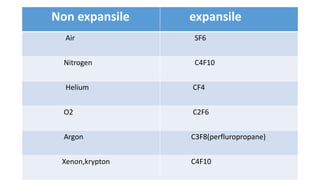
Non expansile expansile
Air SF6
Nitrogen C4F10
Helium CF4
O2 C2F6
Argon C3F8(perfluropropane)
Xenon,krypton C4F10
AIR
• Air was the first gas to be employed in retinal surgery.
• It is used during scleral buckle surgery to restore intraocular volume
after drainage of subretinal fluid and to unroll the posterior flap of
large retinal tears.
• Only a small bubble remains 24 to 48 hours after injection of air.The
exchange of intravitreal fluid for air is used routinely.
• If profuse intraoperative bleeding occurs and the view of the retina is
obscured,a fluid-air exchange can be helpful to improve visualization
of the retina.
• The air bubble compartmentalizes the blood and also may have a
temporary hemostatic effect.
• To neutralize refractive changes associated with intravitreal
air,compensating contact lenses are used.
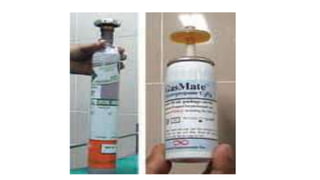
SF6
• Its max expansion is after 36 hrs,when itsvolumes (2x)doubles itself.
• It generally disappears in 10 days,depending upon the amount
injected.
• Used as 30%(SF6) +70%(air)-non expansile mixture.
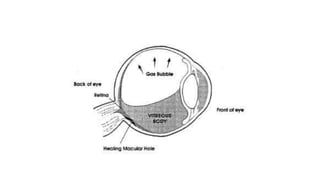
• When injected into the eye ,nitrogen from surrounding tissue diffuses
into the gas bubble & lead to expansion of pure gas bubble.
Perflurocarbon gases
• These r - inert
colorless
odourless
inflammable
• Perfluropropane is 6 times heavier than air
• As the length of carbon chain increases,the water solublity decreases.
• Due to this property that acoounts for greater expansion & longeivity
of gases with increasing molecular weight.
• Gas bubble should cover tear for near 3-5 days.
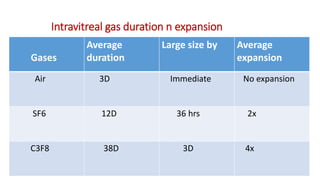
Intravitreal gas duration n expansion
Gases
Average
duration
Large size by Average
expansion
Air 3D Immediate No expansion
SF6 12D 36 hrs 2x
C3F8 38D 3D 4x
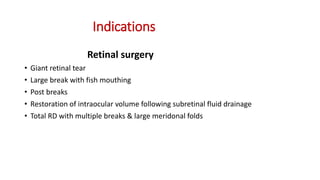
Indications
Retinal surgery
• Giant retinal tear
• Large break with fish mouthing
• Post breaks
• Restoration of intraocular volume following subretinal fluid drainage
• Total RD with multiple breaks & large meridonal folds
Vitreous surgery
• As an extended internal tamponade
characterstics of gases
• Surface tension
• Bouyancy
• The properties of gas bubble that are of particular importance in the
repair of retinal detachment are:
• The high surface tension between the gas bubble and the thin layer of
aqueous covering the retina serves to tamponade a retinal break by
blocking the flow of fluid from vitreous cavity into the subretinal
space,thus preventing accumulation of subretinal fluid.
• As the specific gravity of air or any gas is lower than that of water it
exerts a buoyant force that pushes the neural retina against the
pigment epithelium.
• This force flatten’s the retina by displacing the subretinal fluid
through the retinal breaks into the vitreous.
• The relatively uniform pressure applied by the gas bubble can smooth
out retinal folds on scleral buckle or around the margins of a retinal
tear
• The buoyant forces must be accurately directed by careful sustained
head positioning, so that the bubble is situated against the retinal
break until the surrounding chorioretinal adhesion provided by
diathermy or cryotherapy is established.
• The buoyant force provided by the gas bubble is dependent on the
volume of gas used. Since a gas bubble rises to the uppermost part of
the eye and the buoyant force is greatest at the apex of the arc of
contact of the gas bubble to the retinal surface,
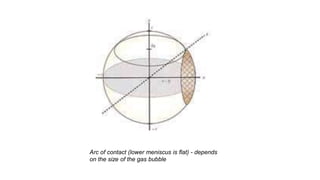
• and because the lower meniscus of the bubble is relatively flat and
exerts little or no contact with retina, intraocular gas is most useful
for superior retina breaks and is at a disadvantage when retinal break
is located inferiorly.
Arc of contact (lower meniscus is flat) - depends
on the size of the gas bubble
• Air does not expand if injected in vitreous cavity but SF-6, C2F6 and
C3F8 will expand in vitreous cavity as dissolved air from blood stream
enters the gas bubble to equilibrate with the intraocular gas bubble.
• Each of the gases is ultimately absorbed into blood stream
Important issues with gases
• In eyes with occluded angles from neovascularization or
PAS,expanding concentration of gas should be avoided because
marked elevation of IOP may result.
• It has been found experimentally that the half-life of SF6 and C3F8 in
phakic nonvitrectomized eyes is 2.2 to 2.7 times longer than in
aphakic vitrectomized eyes.
• Soluble general anesthetic agents such as nitrous oxide also increase
the gas bubble volume in patients with any intraocular gas during
general anesthesia.
• With a patient under general anesthesia, a bubble of pure SF6 may
expand to 2.5-3 times the injected volume.
• The maximum rise in intraocular pressure is reached at approximately
15-20 minutes after inhalation of nitrous oxide.
• If an intraocular gas bubble is planned for the end of surgery, nitrous
oxide should be discontinued at least 15 minutes before the injection
of intraocular gas
• because alveolar concentration of nitrous oxide is reduced by 90% 10
minutes after the cessation of the agent
• Variations in atmospheric pressure affect the total volume of the gas
bubble.
• If there is an abrupt change in outside pressure, the gas volume
tends to expand and
• this occurs when we travel by air or rapidly climb to high altitude.
• At altitudes more than 1000-1500 meters above the height at which
the gas bubble was injected, the increase in volume can be
considerable and even dangerous.
• A patient traveling to a place of high altitude should do so slowly , to
allow the gradual expansion of the gas.
• Gases used for intraocular surgery are of high molecular weight and
elements from the blood pass into the gas in three different stages:
bubble
expansion
equilibrium
dissolution.
• In the expansion stage,nitrogen and other gases enter the bubble and
expand it.
• This usually occurs between 6 and 8 hours after gas injection.
• The equilibrium stage starts at the point of maximal expansion and
continues until the partial pressure of nitrogen in the gas bubble and
in the blood capillaries is balanced.
• When this happens, the bubble stops expanding and slowly starts to
be reabsorbed.
• The last stage starts when the nitrogen pressure in the bubble is
greater or in equilibrium with the pressure in the capillaries.
• This leads to diffusion of elements outside the bubble with the
consequent reduction in bubble size.
• A face-down head position should be maintained until the bubble
decreases by 20% to avoid contact with the crystalline lens in an
upright position.
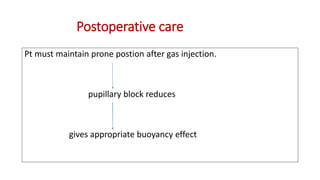
Postoperative care
Pt must maintain prone postion after gas injection.
pupillary block reduces
gives appropriate buoyancy effect
Complications
• During injection of gas
• Contact of bubble to post lens-immediate post op rise in iop
• Lens opacities
• Bullous keratopathy
• Subretinal gas migration
• New break formation in 13%cases with movement of eye-it may give
rise to vitreoretinal traction
Contraindications
Use of gas in pure form ,complications as follows:
• Large breaks >1 clock hr
• Multiple breaks >1 clock hr
• Severe or uncontrolled glaucoma
• Pt having neck problem or others who cannot maintain postures,post op
• Breaks in inferior 4 clock hrs of retina
• If pt has to travel by air <1wk
Silicone oil
• Cibis in 1962 used silicone oil in retinal Sx
• Stone was the first person in 1958 to describe the use of silicone as a
vitreous substitute.
• Silicon oils r linear synthetic polymers of dimethyl siloxane.
• Its density of 0.97g/cm3 is less than that of water such that it floats
over the fluid in the vitreous cavity.
• Silicone liquid is transparent and has refractive index of 1.404 which is
slightly higher than that of vitreous (-1.33).
Chemical properties
• clear
transparent
inert
non carcinogenic
heat resistant
• Viscosity is 1000
2000 centistokes
3000
• High surface tension
• Immiscible in water
• Refractive index is 1.4035
• Lighter than water
commonly used silicone oils are:poly(methyl-3,3,3-dimethyl siloxane)
Mode of action
• Tamponade
• Space fillers
• Mechanism inhibition of membranous contraction
• Hemosatsis
• Maintain iop
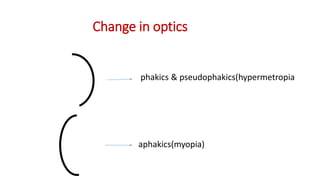
Change in optics
phakics & pseudophakics(hypermetropia
aphakics(myopia)
Indications
• RD with proliferative vitreoretinopathy
• Giant retinal tear
• Traumatic RD
• Diabetic TRD with rhegmatogenous detachment
• Retinal Detachment complicated by iris Neovascularization
• Patient noncompliance with position
• Patient intends to travel by air
Complications
• Emulsification
• Cataract
• Glaucoma
• Band shaped keratopathy
• Redetachment
Removal of Silicone Oil
• Silicone is a temporary tamponade agent and should therefore be
removed before complications arise such as secondary glaucoma,
reduced visual acuity, corneal decompensation ,chronic iritis or
reproliferations.
• The minimum time after which silicone liquid can be removed is
considered to be 3 to 8 wks
• but in Silicone Study, a minimum of 8 wks was required for severe
PVR.
• In general it is preferred that silicone liquid be removed by 3 to 6
mnths postoperatively although periods of up to a year and longer
are also reported.
• Whereas in proliferative diabetic retinopathy, the duration of silicone
liquid placement is said to bear no relationship to the rate of success
after removal of the liquid,
• studies of PVR have reported either a better prognosis after a longer
period of intravitreal liquid ( up to 22 months) or no correlation.
• Redetachment after removal occurs in 9 to 50% of cases in the
Silicone Study, the rate was 20% (14% after reoperation).
• A variety of methods have been developed for removal; these
techniques employ methods from passive drainage to special
cannulas to vacuum aspiration pumps.
• Despite careful lavage, however, residual silicone liquid droplets still
remain in the vitreous cavity after removal.
Semifluorinated Alkanes (SFA)
• They are transparent liquids that are immiscible with water.
• In terms of their interfacial energies they are amphiphilic in that they
have both a hydrocarbon end, which is highly hydrophobic and a
fluorocarbon end which is less hydrophobic.
• They have low specific gravity than PFCLs at between 1.2 and
1.7g/cm3
• there bubbles are more rounded than same volume of PFCLs.
• These materials have low viscosities of around 2.5mPa which make
them capable of injection and removal through small bore
instruments but susceptible to dispersion.
• In Europe,semifluorinated alkanes are used as silicone oil solvents
and the use of perfluorohexyloctane (F6H8) was approved for this
purpose in 1998.
• The amphiphilic property of the SFAs makes them soluble in
hydrocarbons and silicone oil.
• It is possible to take advantage of this property and mix SFAs with
silicone oil(known as double filling of Tamponade Agents).
• Double filling was originally conceived to provide a simultaneous
tamponade to upper and lower fundus.
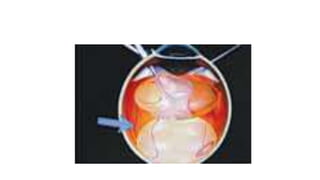
• . The double bubble is egg shaped and effectively only gives good
contact to inferior retina
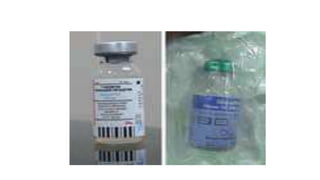
• There is a compound available that contains
69.5% ultrapure polydimethylsiloxane
&
30.5% perfluorohexyloctane
• (Densiron 68),which is immiscible in water, with a density of
1.06g/cm3 and viscosity 1.400.
• This compound has been recommended as a short-term tamponade,
but has also been described to induce complications such as
glaucoma and cataract
Heavy Silicone Oil
• The low density of silicone oil induces fluid deposition in inferior
quadrants and increases the percentage of inferior reproliferations.
• This has prompted the development of new vitreous substitutes with
a greater density than water, that allow the repair of retinal tears in
inferior quadrants.
• Heavy silicone oil is a new vitreous substitute with a high specific
gravity.
• Heavy silicone oil has been used to treat
retinal detachments with vitreoretinal proliferations
grade C2 or higher,
retinal detachment due to eye trauma and
giant or inferior retinal tears.
• The mean period recommended for its placement is 3 mnths after
which time it has to be surgically removed.
• An 18% rate of increased IOP has been described
• It is a mixture of silicone oil of 5000 centistokes and fluorinated and
hydrocarbonated olefin(RMN3).
• The mixture is homogenous and stable in the presence of water, air
and perfluorocarbon
PERFLUROCARBON LIQUIDS
• Chang popularized the use of PFCL in vitreous Sx
properties
• High specific gravity(1.9)than H2O-so it sinks
• Low viscosity favours easy introduction & removal
• Immiscible in water
• Clear,inert & RI similar to water
• High vapour pressure so evaporates fast
Available compounds:
perflurobutylamine(C12F29n)
perfluro-n-octane
perflurodecalen(C10F18)
Uses
• They r useful in some cases of vitrectomy as they r heavy ,they
displace subretinal fluid anteriorly which can pass through break.
thus it helps in flattening retina
• It helps to find out hole in superior bullous RD.
• A posterior retinitomy can b avoided with the use of PFCL.
• IN PVR:it has to b injected over the disc.
thus helps in opening funnel
in dissection of post membranes
• It pulls peripheral retina post
&
thus helps in visualization & dissection of membranes in ant PVR
• It acts as a soft instrument & some people call it as THIRD HAND.
i. In GRT- unfods the everted flaps.
ii. In removal of post dislocated lens & IOL.
iii. In grade 3-4 ROP.
iv. In removal subretinal & supra choroidal hemorrhage.
Complications
• New retinal breaks
• CRAO
• Subretinal migration
• Dispersion into multiple bubble
• Residual droplet
THANK YOU
Vitreous substitutes

Vitreous substitutes

  • 1.
  • 2.
    • Vitreous Substitutesare substances used as adjuncts to vitreoretinal surgery both intraoperatively and postoperatively in the management of complicated forms of retinal detachment requiring vitrectomy. • Vitreous Substitutes are soft surgical tools and are referred to as the “third surgical hand”
  • 3.
    • Intraoperatively theyare used to re-establish intraocular volume, to assist in : separating membranes adherent to the retina, to manipulate retinal detachment to mechanically flatten detached retina. • Postoperatively they are used as long-term tamponading agents to maintain the neural retina in apposition to retinal pigment epithelium.
  • 4.
    Vitreous substitute materialsused intraoperatively are- • Balanced Salt Solution • Air and other Gases • Viscoelastic Fluids • Silicone Liquid • Low viscosity Perfluorocarbon Liquids
  • 5.
    Classisfication Aqueous miscible Low ViscosityBalanced salt solution High Viscosity Chondrotin sulfate Viscoelastic Hyaluronic acid, hydroxyl methyl cellulose Aqueous immiscible Gases Air,Sulfur hexafluoride(SF6) Perfluoropropane (C3 F8 ) Liquids Lighter than aqueous Silicone oil Heavier than aqueous Perfluorocarbon liquids, l Fluorinated silicone oil
  • 6.
    BSS • Balanced saltsolution is used as an irrigation fluid during vitrectomy and also to maintain normal intraocular volume and pressure after drainage of subretinal fluid during retinal detachment surgery and after drainage of choroidal detachments. • BSS enriched with bicarbonate, dextrose and gluthathione appears to be better tolerated by ocular tissues, especially the corneal endothelium.
  • 7.
    • As anintravitreal irrigating solution, the enriched fluid also has the advantage of allowing the maintenance of more normal electroretinographic activity • Some studies have shown that infusion fluid cooled to room temperature (22°C) reduces the risk of intraoperative photic light damage to the retina as compared with infusion solution used at body temperature.
  • 8.
    Intraocular gases • Thefirst use of air in Sx of RD by ohm(1917). • Norton used intraocular gas to treat giant retinal tear & also introduced clinical utility of SF6. • Machemer recognized the value of intraocular tamponade with expansile gases. • Hilton & grizzard started pneumoretinopexy(1984).
  • 9.
    • Intraocular gasesare employed for pneumatic retinopexy, inconjuction with scleral bucking and drainage of subretinal fluid and also to provide internal tamponde postoperatively for complicated forms of retinal detachment requiring vitrectomy.
  • 10.
    Non expansile expansile AirSF6 Nitrogen C4F10 Helium CF4 O2 C2F6 Argon C3F8(perfluropropane) Xenon,krypton C4F10
  • 11.
    AIR • Air wasthe first gas to be employed in retinal surgery. • It is used during scleral buckle surgery to restore intraocular volume after drainage of subretinal fluid and to unroll the posterior flap of large retinal tears. • Only a small bubble remains 24 to 48 hours after injection of air.The exchange of intravitreal fluid for air is used routinely.
  • 12.
    • If profuseintraoperative bleeding occurs and the view of the retina is obscured,a fluid-air exchange can be helpful to improve visualization of the retina. • The air bubble compartmentalizes the blood and also may have a temporary hemostatic effect. • To neutralize refractive changes associated with intravitreal air,compensating contact lenses are used.
  • 13.
    SF6 • Its maxexpansion is after 36 hrs,when itsvolumes (2x)doubles itself. • It generally disappears in 10 days,depending upon the amount injected. • Used as 30%(SF6) +70%(air)-non expansile mixture. • When injected into the eye ,nitrogen from surrounding tissue diffuses into the gas bubble & lead to expansion of pure gas bubble.
  • 16.
    Perflurocarbon gases • Theser - inert colorless odourless inflammable • Perfluropropane is 6 times heavier than air • As the length of carbon chain increases,the water solublity decreases.
  • 17.
    • Due tothis property that acoounts for greater expansion & longeivity of gases with increasing molecular weight. • Gas bubble should cover tear for near 3-5 days.
  • 18.
    Intravitreal gas durationn expansion Gases Average duration Large size by Average expansion Air 3D Immediate No expansion SF6 12D 36 hrs 2x C3F8 38D 3D 4x
  • 19.
    Indications Retinal surgery • Giantretinal tear • Large break with fish mouthing • Post breaks • Restoration of intraocular volume following subretinal fluid drainage • Total RD with multiple breaks & large meridonal folds
  • 20.
    Vitreous surgery • Asan extended internal tamponade
  • 21.
    characterstics of gases •Surface tension • Bouyancy
  • 22.
    • The propertiesof gas bubble that are of particular importance in the repair of retinal detachment are: • The high surface tension between the gas bubble and the thin layer of aqueous covering the retina serves to tamponade a retinal break by blocking the flow of fluid from vitreous cavity into the subretinal space,thus preventing accumulation of subretinal fluid.
  • 23.
    • As thespecific gravity of air or any gas is lower than that of water it exerts a buoyant force that pushes the neural retina against the pigment epithelium. • This force flatten’s the retina by displacing the subretinal fluid through the retinal breaks into the vitreous. • The relatively uniform pressure applied by the gas bubble can smooth out retinal folds on scleral buckle or around the margins of a retinal tear
  • 24.
    • The buoyantforces must be accurately directed by careful sustained head positioning, so that the bubble is situated against the retinal break until the surrounding chorioretinal adhesion provided by diathermy or cryotherapy is established. • The buoyant force provided by the gas bubble is dependent on the volume of gas used. Since a gas bubble rises to the uppermost part of the eye and the buoyant force is greatest at the apex of the arc of contact of the gas bubble to the retinal surface,
  • 25.
    • and becausethe lower meniscus of the bubble is relatively flat and exerts little or no contact with retina, intraocular gas is most useful for superior retina breaks and is at a disadvantage when retinal break is located inferiorly.
  • 26.
    Arc of contact(lower meniscus is flat) - depends on the size of the gas bubble
  • 27.
    • Air doesnot expand if injected in vitreous cavity but SF-6, C2F6 and C3F8 will expand in vitreous cavity as dissolved air from blood stream enters the gas bubble to equilibrate with the intraocular gas bubble. • Each of the gases is ultimately absorbed into blood stream
  • 29.
    Important issues withgases • In eyes with occluded angles from neovascularization or PAS,expanding concentration of gas should be avoided because marked elevation of IOP may result. • It has been found experimentally that the half-life of SF6 and C3F8 in phakic nonvitrectomized eyes is 2.2 to 2.7 times longer than in aphakic vitrectomized eyes.
  • 30.
    • Soluble generalanesthetic agents such as nitrous oxide also increase the gas bubble volume in patients with any intraocular gas during general anesthesia. • With a patient under general anesthesia, a bubble of pure SF6 may expand to 2.5-3 times the injected volume. • The maximum rise in intraocular pressure is reached at approximately 15-20 minutes after inhalation of nitrous oxide.
  • 31.
    • If anintraocular gas bubble is planned for the end of surgery, nitrous oxide should be discontinued at least 15 minutes before the injection of intraocular gas • because alveolar concentration of nitrous oxide is reduced by 90% 10 minutes after the cessation of the agent
  • 32.
    • Variations inatmospheric pressure affect the total volume of the gas bubble. • If there is an abrupt change in outside pressure, the gas volume tends to expand and • this occurs when we travel by air or rapidly climb to high altitude.
  • 33.
    • At altitudesmore than 1000-1500 meters above the height at which the gas bubble was injected, the increase in volume can be considerable and even dangerous. • A patient traveling to a place of high altitude should do so slowly , to allow the gradual expansion of the gas.
  • 34.
    • Gases usedfor intraocular surgery are of high molecular weight and elements from the blood pass into the gas in three different stages: bubble expansion equilibrium dissolution. • In the expansion stage,nitrogen and other gases enter the bubble and expand it. • This usually occurs between 6 and 8 hours after gas injection.
  • 35.
    • The equilibriumstage starts at the point of maximal expansion and continues until the partial pressure of nitrogen in the gas bubble and in the blood capillaries is balanced. • When this happens, the bubble stops expanding and slowly starts to be reabsorbed.
  • 36.
    • The laststage starts when the nitrogen pressure in the bubble is greater or in equilibrium with the pressure in the capillaries. • This leads to diffusion of elements outside the bubble with the consequent reduction in bubble size. • A face-down head position should be maintained until the bubble decreases by 20% to avoid contact with the crystalline lens in an upright position.
  • 37.
    Postoperative care Pt mustmaintain prone postion after gas injection. pupillary block reduces gives appropriate buoyancy effect
  • 38.
    Complications • During injectionof gas • Contact of bubble to post lens-immediate post op rise in iop • Lens opacities • Bullous keratopathy • Subretinal gas migration • New break formation in 13%cases with movement of eye-it may give rise to vitreoretinal traction
  • 39.
    Contraindications Use of gasin pure form ,complications as follows: • Large breaks >1 clock hr • Multiple breaks >1 clock hr • Severe or uncontrolled glaucoma • Pt having neck problem or others who cannot maintain postures,post op • Breaks in inferior 4 clock hrs of retina • If pt has to travel by air <1wk
  • 40.
  • 41.
    • Cibis in1962 used silicone oil in retinal Sx • Stone was the first person in 1958 to describe the use of silicone as a vitreous substitute. • Silicon oils r linear synthetic polymers of dimethyl siloxane. • Its density of 0.97g/cm3 is less than that of water such that it floats over the fluid in the vitreous cavity. • Silicone liquid is transparent and has refractive index of 1.404 which is slightly higher than that of vitreous (-1.33).
  • 42.
  • 43.
    • Viscosity is1000 2000 centistokes 3000 • High surface tension • Immiscible in water • Refractive index is 1.4035 • Lighter than water commonly used silicone oils are:poly(methyl-3,3,3-dimethyl siloxane)
  • 44.
    Mode of action •Tamponade • Space fillers • Mechanism inhibition of membranous contraction • Hemosatsis • Maintain iop
  • 45.
    Change in optics phakics& pseudophakics(hypermetropia aphakics(myopia)
  • 46.
    Indications • RD withproliferative vitreoretinopathy • Giant retinal tear • Traumatic RD • Diabetic TRD with rhegmatogenous detachment • Retinal Detachment complicated by iris Neovascularization • Patient noncompliance with position • Patient intends to travel by air
  • 47.
    Complications • Emulsification • Cataract •Glaucoma • Band shaped keratopathy • Redetachment
  • 48.
    Removal of SiliconeOil • Silicone is a temporary tamponade agent and should therefore be removed before complications arise such as secondary glaucoma, reduced visual acuity, corneal decompensation ,chronic iritis or reproliferations. • The minimum time after which silicone liquid can be removed is considered to be 3 to 8 wks • but in Silicone Study, a minimum of 8 wks was required for severe PVR. • In general it is preferred that silicone liquid be removed by 3 to 6 mnths postoperatively although periods of up to a year and longer are also reported.
  • 49.
    • Whereas inproliferative diabetic retinopathy, the duration of silicone liquid placement is said to bear no relationship to the rate of success after removal of the liquid, • studies of PVR have reported either a better prognosis after a longer period of intravitreal liquid ( up to 22 months) or no correlation. • Redetachment after removal occurs in 9 to 50% of cases in the Silicone Study, the rate was 20% (14% after reoperation).
  • 50.
    • A varietyof methods have been developed for removal; these techniques employ methods from passive drainage to special cannulas to vacuum aspiration pumps. • Despite careful lavage, however, residual silicone liquid droplets still remain in the vitreous cavity after removal.
  • 51.
    Semifluorinated Alkanes (SFA) •They are transparent liquids that are immiscible with water. • In terms of their interfacial energies they are amphiphilic in that they have both a hydrocarbon end, which is highly hydrophobic and a fluorocarbon end which is less hydrophobic. • They have low specific gravity than PFCLs at between 1.2 and 1.7g/cm3 • there bubbles are more rounded than same volume of PFCLs.
  • 52.
    • These materialshave low viscosities of around 2.5mPa which make them capable of injection and removal through small bore instruments but susceptible to dispersion. • In Europe,semifluorinated alkanes are used as silicone oil solvents and the use of perfluorohexyloctane (F6H8) was approved for this purpose in 1998.
  • 53.
    • The amphiphilicproperty of the SFAs makes them soluble in hydrocarbons and silicone oil. • It is possible to take advantage of this property and mix SFAs with silicone oil(known as double filling of Tamponade Agents). • Double filling was originally conceived to provide a simultaneous tamponade to upper and lower fundus. • . The double bubble is egg shaped and effectively only gives good contact to inferior retina
  • 55.
    • There isa compound available that contains 69.5% ultrapure polydimethylsiloxane & 30.5% perfluorohexyloctane • (Densiron 68),which is immiscible in water, with a density of 1.06g/cm3 and viscosity 1.400. • This compound has been recommended as a short-term tamponade, but has also been described to induce complications such as glaucoma and cataract
  • 57.
    Heavy Silicone Oil •The low density of silicone oil induces fluid deposition in inferior quadrants and increases the percentage of inferior reproliferations. • This has prompted the development of new vitreous substitutes with a greater density than water, that allow the repair of retinal tears in inferior quadrants. • Heavy silicone oil is a new vitreous substitute with a high specific gravity.
  • 58.
    • Heavy siliconeoil has been used to treat retinal detachments with vitreoretinal proliferations grade C2 or higher, retinal detachment due to eye trauma and giant or inferior retinal tears. • The mean period recommended for its placement is 3 mnths after which time it has to be surgically removed. • An 18% rate of increased IOP has been described
  • 59.
    • It isa mixture of silicone oil of 5000 centistokes and fluorinated and hydrocarbonated olefin(RMN3). • The mixture is homogenous and stable in the presence of water, air and perfluorocarbon
  • 60.
  • 61.
    • Chang popularizedthe use of PFCL in vitreous Sx properties • High specific gravity(1.9)than H2O-so it sinks • Low viscosity favours easy introduction & removal • Immiscible in water • Clear,inert & RI similar to water • High vapour pressure so evaporates fast
  • 62.
  • 63.
    Uses • They ruseful in some cases of vitrectomy as they r heavy ,they displace subretinal fluid anteriorly which can pass through break. thus it helps in flattening retina • It helps to find out hole in superior bullous RD. • A posterior retinitomy can b avoided with the use of PFCL.
  • 64.
    • IN PVR:ithas to b injected over the disc. thus helps in opening funnel in dissection of post membranes
  • 65.
    • It pullsperipheral retina post & thus helps in visualization & dissection of membranes in ant PVR • It acts as a soft instrument & some people call it as THIRD HAND. i. In GRT- unfods the everted flaps. ii. In removal of post dislocated lens & IOL. iii. In grade 3-4 ROP. iv. In removal subretinal & supra choroidal hemorrhage.
  • 67.
    Complications • New retinalbreaks • CRAO • Subretinal migration • Dispersion into multiple bubble • Residual droplet
  • 68.