SIVA TEJA CHALLA
KERATOPROSTHESIS
DEFINTION
 Keratoprosthesis is a surgical procedure where
a severely damaged or diseased cornea is
replaced with an artificial cornea to restore useful
vision or to make the eye comfortable in painful
keratopathy
HISTORY
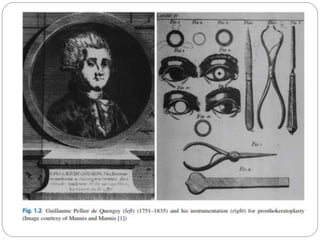
 1789-Pellier de quengsyglass lens in silver ring for
leukomatous cornea
 1853-Nussbaumcollar-stud glass device consisting
of two plates sandwiching the cornea and connected
by an optical cylinder, 2 with trials in rabbit eyes.
 1859-Heusserfirst to implant a keratoprosthesis in
a human eye;this was retained for 3 months.
 Other attempts made in Later half of 19th century (Von
Hippel 1877, Dimmer 1889, Baker1889, van Millingen
1895, Salzer 1895) but almost all the implants failed
and were extruded.
 The interest in keratoprostheses declined following
the development of successful penetrating
keratoplasty (PKP) in the first decade of the 20th
century
 the realization that transplanting a human cornea
would not be successful in all cases of corneal
blindness
 During the Second World War, the incidental
discovery of corneal tissue tolerance to plexi-glass
fragments from aeroplane canopies suggested a
new direction for future research
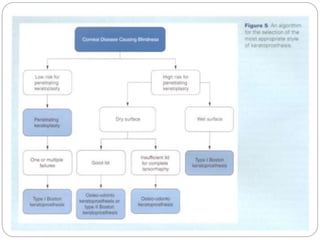
The commonly used ones are
BOSTON KPRO(TYPE 1 AND 2)
 The Boston Type I Kpro is the most widely used device.
 The Boston Type II Kpro may be indicated in patients with
severe ocular surface disease, poor ability to maintain a
moist ocular surface, and forniceal foreshortening with
inability to wear a contact lens
ALPHA-COR KPRO
 AlphaCor Kpro is indicated in patients with failed grafts due
to corneal allograft rejection
OSTEO-ODONTO KPRO(OOKP)
OOKP like theBoston Type II Kpro, is reserved for end-stage
ocular surface
disease as a last resort
INDICATIONS
1.AUTOIMMUNE DISORDERS
 Steven johnsons syndrome
 Dry eye and uveitis
2.ANIRIDIA
3.CHEMICAL OR THERMAL INJURY
4.BULLOUS KERATOPATHY advanced cases with stromal
scarring, lamellar or full-thickness procedures may be
required, while Kpros may be considered after serial graft
failures.
5.HERPETIC DISEASE Kpro after graft failure from herpetic
disease has been shown to be successful in achieving better
visual outcomes
6.GRAFT FAILURE
7.PAEDIATRIC CORNEAL OPACITIES PK is primary
procedure
BOSTON KERATOPROSTHESIS
 Boston Keratoprosthesis is the innovation and
design of Professor Claes H. Dohlman
 FDA approval 1992
 types 1 and 2
 made from poly methyl methacrylate (PMMA).
 Most commonly used type 1
 Indication
・Two failed grafts, with poor prognosis for further grafting
・Vision less than 20/400 in the affected eye
・Minimum vision of Light Perception
・Lower than optimal vision in the opposite eye
 Advantages
・Long-term (many years) stability and safety.
・It is also known for having excellent optics.
・Its optical system can provide excellent vision if the rest of the
eye is undamaged
 Contraindications
・Unilateral vision loss
・End-stage glaucoma or uncontrolled glaucoma
・Posterior segment pathology
・Presence of a functioning KPro in the fellow eye
Parts
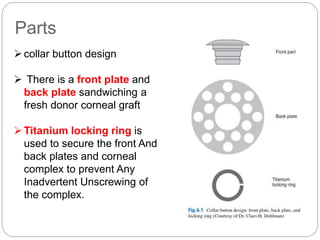
collar button design
 There is a front plate and
back plate sandwiching a
fresh donor corneal graft
Titanium locking ring is
used to secure the front And
back plates and corneal
complex to prevent Any
Inadvertent Unscrewing of
the complex.
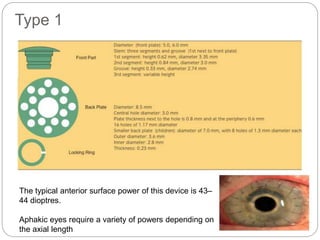
Type 1
The typical anterior surface power of this device is 43–
44 dioptres.
Aphakic eyes require a variety of powers depending on
the axial length
Type 2
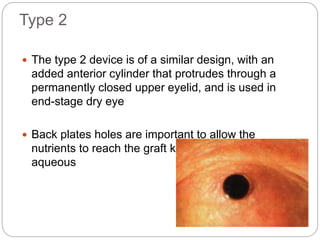
 The type 2 device is of a similar design, with an
added anterior cylinder that protrudes through a
permanently closed upper eyelid, and is used in
end-stage dry eye
 Back plates holes are important to allow the
nutrients to reach the graft keratocytes from the
aqueous
surger
y
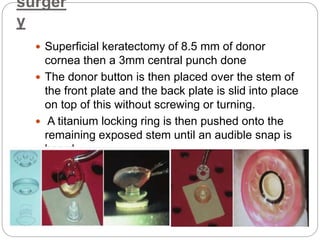
 Superficial keratectomy of 8.5 mm of donor
cornea then a 3mm central punch done
 The donor button is then placed over the stem of
the front plate and the back plate is slid into place
on top of this without screwing or turning.
 A titanium locking ring is then pushed onto the
remaining exposed stem until an audible snap is
heard
 The recipient cornea is then trephined as for
conventional PKP (trephine diameter 0.5 mm less
than donor trephine size).
 The donor graft with the KPro is then sutured in
place with interrupted 10–0 nylon, using the same
technique as a standard PKP.
 Surgery usually concludes with the intracameral
injection of 0.4 mg dexamethasone
 Conclusion with the application of a soft contact
lens
 Post op steroid E/D ,antibiotic E/D used
 Post op F/U at 1,2.4 wks,then monthly
 Each visit IOP and VA noted and soft contact lens
changed
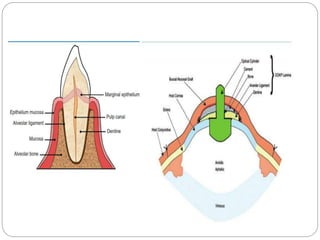
MODIFIED OSTEO ODONTO
KPRO(MOOKP)
 The OOKP was first described by Strampelli in 1963
 Later modified (MOOKP) by falcinelli and coll
 It uses the patient’s own tooth root and surrounding
alveolar bone to support a centrally cemented optical
cylinder.
 Multi staged procedure, sx in mouth and eye
 PRINCIPLE
 use of a wide single rooted tooth with surrounding
alveolar bone acts as carrier for a PMMA optical
cylinder, which is covered by buccal mucous
membrane,
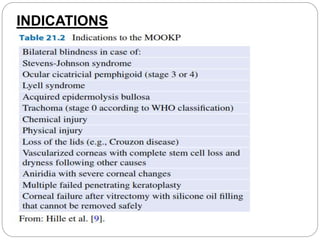
INDICATIONS
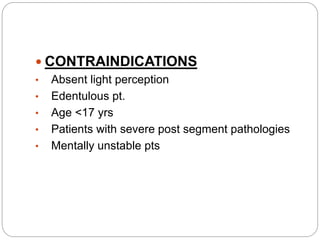
 CONTRAINDICATIONS
• Absent light perception
• Edentulous pt.
• Age <17 yrs
• Patients with severe post segment pathologies
• Mentally unstable pts
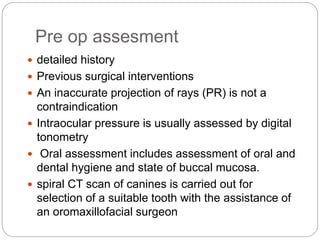
Pre op assesment
 detailed history
 Previous surgical interventions
 An inaccurate projection of rays (PR) is not a
contraindication
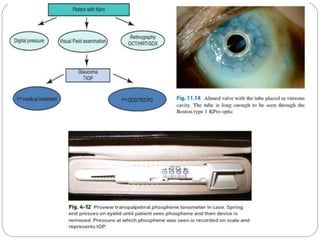
 Intraocular pressure is usually assessed by digital
tonometry
 Oral assessment includes assessment of oral and
dental hygiene and state of buccal mucosa.
 spiral CT scan of canines is carried out for
selection of a suitable tooth with the assistance of
an oromaxillofacial surgeon
Surgical procedure
 The MOOKP procedure involves 2 stages
performed over a period of 6-9 months.
 Stage I
Stage I is split further into 3 stages (IA, B & C).
Stage 1A: ICCE +AV + Total iridectomy
Stage 1B:Mucous membrane grafting
Stage 1C: Preparation of Osteodentalacrylic
Lamina (ODAL)
 Stage II
Implantation of ODAL on the bulbar surface
STAGE 1A
 superficial keratectomy
 fibrovascular pannus removal
 intracapsular cataract extraction
 anterior vitrectomy
 total iridectomy
 Complete removal of these structures is done to
reduce the possibility of postoperative glaucoma
and formation of retroprosthetic membranes.
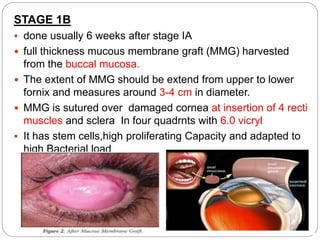
STAGE 1B
 done usually 6 weeks after stage IA
 full thickness mucous membrane graft (MMG) harvested
from the buccal mucosa.
 The extent of MMG should be extend from upper to lower
fornix and measures around 3-4 cm in diameter.
 MMG is sutured over damaged cornea at insertion of 4 recti
muscles and sclera In four quadrnts with 6.0 vicryl
 It has stem cells,high proliferating Capacity and adapted to
high Bacterial load
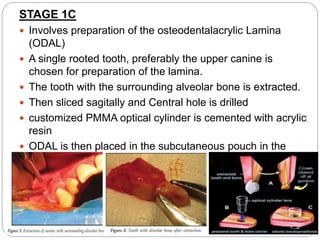
STAGE 1C
 Involves preparation of the osteodentalacrylic Lamina
(ODAL)
 A single rooted tooth, preferably the upper canine is
chosen for preparation of the lamina.
 The tooth with the surrounding alveolar bone is extracted.
 Then sliced sagitally and Central hole is drilled
 customized PMMA optical cylinder is cemented with acrylic
resin
 ODAL is then placed in the subcutaneous pouch in the
orbitozygomatic area for next 3 months to develop
vascularization and to promote the growth of connective
tissue.
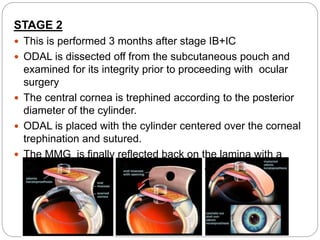
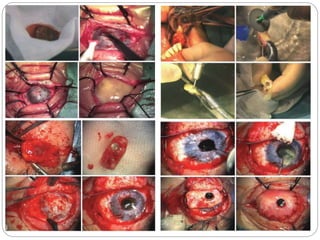
STAGE 2
 This is performed 3 months after stage IB+IC
 ODAL is dissected off from the subcutaneous pouch and
examined for its integrity prior to proceeding with ocular
surgery
 The central cornea is trephined according to the posterior
diameter of the cylinder.
 ODAL is placed with the cylinder centered over the corneal
trephination and sutured.
 The MMG is finally reflected back on the lamina with a
central trephination through which the anterior cylinder
protrudes out
POST OP MANAGEMENT
• Perioperatively, systemic and topical antibiotics are
administered.
• Systemic steroids and antiglaucoma medication are
also prescribed
 Visual acuity, refraction, digital tonometry, fundus,
optic nerve status and visual fields should be
checked at each follow up.
 The health of the mucous membrane,protrusion and
stability of the optic cylinder should be looked for.
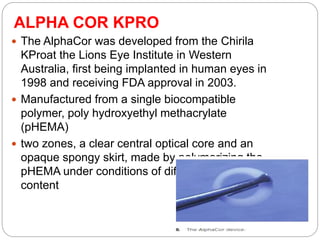
ALPHA COR KPRO
 The AlphaCor was developed from the Chirila
KProat the Lions Eye Institute in Western
Australia, first being implanted in human eyes in
1998 and receiving FDA approval in 2003.
 Manufactured from a single biocompatible
polymer, poly hydroxyethyl methacrylate
(pHEMA)
 two zones, a clear central optical core and an
opaque spongy skirt, made by polymerizing the
pHEMA under conditions of differing water
content
PRINCIPLE
 The ability of the outer skirt to be colonized by
invading keratocytes resulting in integration of the
device with surrounding tissues
INDICATIONS
 Patients should have adequate tear production as
assessed by the unstimulated Schirmer test with a
value of at least 50% of normal
 VA from <6/60 to light perception
 previous failed grafts with a poor chance with further
PKP
 Functioning retina
 absence of evidence of advanced glaucomatous
optic neuropathy or well-controlled glaucoma on
Surgical procedure-- 2 stage
procedure
STAGE 1
• 360° conjunctival peritomy
 debridement of the corneal epithelium
 superior half of the cornea is dissected into two
layers, superficial and deep, each of about 50%
thickness, through a superior paralimbal 180° incision
 extended to form a pocket in the inferior cornea
 superficial corneal flap is then reflected inferiorly to
expose the deep cornea, to allow trephination of the
central posterior lamella with a 3.5 mm disposable
trephine to enter the anterior chamber
 The AlphaCor is placed between the two layers within
the pocket, centred over the posterior lamellar
opening
 The superficial flap is then replaced and sutured at
the limbus with interrupted 10/0 nylon.
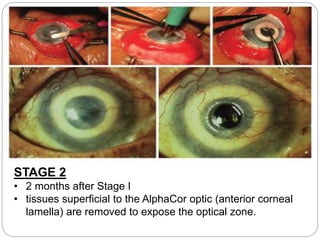
STAGE 2
• 2 months after Stage I
• tissues superficial to the AlphaCor optic (anterior corneal
lamella) are removed to expose the optical zone.
COMPLICATIONS
 MELTS AND EXTRUSION
 INFECTIOUS ENDOPHTHALMITIS
 GLAUCOMA
 RETRO PROSTHETIC MEMBRANES
 RETINAL DETACHMENT
 OTHERS
MELTS AND EXTRUSION
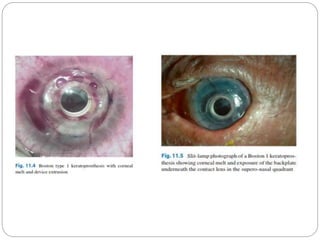
 Melts tends to occur at the base of Boston kpro
 SLE and anterior segment OCT are helpful in
detection and f/u of corneal thinning around kpro
 Any leak on siedels test,USG to be done to see
choroidal effusion
 If melts are seen then replace the whole thing with
fresh graft and put new kpro’
 In MOOKP, resorption of buccal mucosa can
occur,new graft can be placed
 Resoprtion of osteo odonto lamina can occur,serial
CT scan yearly
 If much resorption of dentine has occurred entire
thing should be replaced
INFECTIOUS ENDOPHTHALMITIS
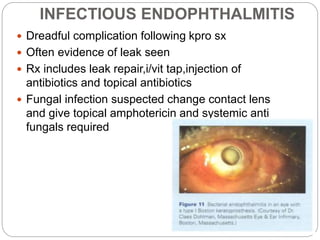
 Dreadful complication following kpro sx
 Often evidence of leak seen
 Rx includes leak repair,i/vit tap,injection of
antibiotics and topical antibiotics
 Fungal infection suspected change contact lens
and give topical amphotericin and systemic anti
fungals required
GLAUCOMA
 Single most serious complication following sx
leading to irreversible loss of vn
 D/T chronic low grade inflamman,progessive
angle closure,anterior displacement of iris have
been implicated
 Topical rx is effective in pts with boston type 1
kpro
 systemic rx can be used with boston type 2 and
MOOKP
 Tube shunts and endoscopic
cyclophotocoagulation have been succesfully
used with all types of kpros
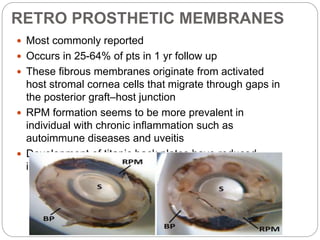
RETRO PROSTHETIC MEMBRANES
 Most commonly reported
 Occurs in 25-64% of pts in 1 yr follow up
 These fibrous membranes originate from activated
host stromal cornea cells that migrate through gaps in
the posterior graft–host junction
 RPM formation seems to be more prevalent in
individual with chronic inflammation such as
autoimmune diseases and uveitis
 Development of titanic back plates have reduced
incidence
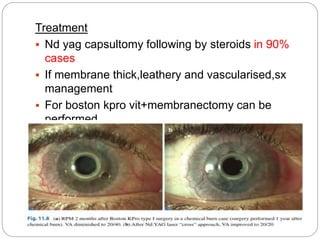
Treatment
 Nd yag capsultomy following by steroids in 90%
cases
 If membrane thick,leathery and vascularised,sx
management
 For boston kpro vit+membranectomy can be
performed
 However removal of prosthesis and repacement
with new one is preferred
RETINAL DETACHMENT
 Most common posterior segment complication
 with an incidence of 16.9 %
 Surgical rx with buckle or vitrectomy is performed
 achievement of anatomic success is limited by
the presence of chronic retinal scarring or
proliferative vitreo retinopathy (PVR) and visual
outcomes tend to be worse in these cases
 Choroidal detachments can also develop in eyes
with KPro, in as many as 17 % of patients
Other complications
MOOKP
THANK YOU

keratoprosthesis

  • 1.
  • 2.
    DEFINTION  Keratoprosthesis isa surgical procedure where a severely damaged or diseased cornea is replaced with an artificial cornea to restore useful vision or to make the eye comfortable in painful keratopathy
  • 3.
    HISTORY  1789-Pellier dequengsyglass lens in silver ring for leukomatous cornea  1853-Nussbaumcollar-stud glass device consisting of two plates sandwiching the cornea and connected by an optical cylinder, 2 with trials in rabbit eyes.  1859-Heusserfirst to implant a keratoprosthesis in a human eye;this was retained for 3 months.  Other attempts made in Later half of 19th century (Von Hippel 1877, Dimmer 1889, Baker1889, van Millingen 1895, Salzer 1895) but almost all the implants failed and were extruded.
  • 5.
     The interestin keratoprostheses declined following the development of successful penetrating keratoplasty (PKP) in the first decade of the 20th century  the realization that transplanting a human cornea would not be successful in all cases of corneal blindness  During the Second World War, the incidental discovery of corneal tissue tolerance to plexi-glass fragments from aeroplane canopies suggested a new direction for future research
  • 6.
    The commonly usedones are BOSTON KPRO(TYPE 1 AND 2)  The Boston Type I Kpro is the most widely used device.  The Boston Type II Kpro may be indicated in patients with severe ocular surface disease, poor ability to maintain a moist ocular surface, and forniceal foreshortening with inability to wear a contact lens ALPHA-COR KPRO  AlphaCor Kpro is indicated in patients with failed grafts due to corneal allograft rejection OSTEO-ODONTO KPRO(OOKP) OOKP like theBoston Type II Kpro, is reserved for end-stage ocular surface disease as a last resort
  • 7.
    INDICATIONS 1.AUTOIMMUNE DISORDERS  Stevenjohnsons syndrome  Dry eye and uveitis 2.ANIRIDIA 3.CHEMICAL OR THERMAL INJURY 4.BULLOUS KERATOPATHY advanced cases with stromal scarring, lamellar or full-thickness procedures may be required, while Kpros may be considered after serial graft failures. 5.HERPETIC DISEASE Kpro after graft failure from herpetic disease has been shown to be successful in achieving better visual outcomes 6.GRAFT FAILURE 7.PAEDIATRIC CORNEAL OPACITIES PK is primary procedure
  • 9.
    BOSTON KERATOPROSTHESIS  BostonKeratoprosthesis is the innovation and design of Professor Claes H. Dohlman  FDA approval 1992  types 1 and 2  made from poly methyl methacrylate (PMMA).  Most commonly used type 1
  • 10.
     Indication ・Two failedgrafts, with poor prognosis for further grafting ・Vision less than 20/400 in the affected eye ・Minimum vision of Light Perception ・Lower than optimal vision in the opposite eye  Advantages ・Long-term (many years) stability and safety. ・It is also known for having excellent optics. ・Its optical system can provide excellent vision if the rest of the eye is undamaged  Contraindications ・Unilateral vision loss ・End-stage glaucoma or uncontrolled glaucoma ・Posterior segment pathology ・Presence of a functioning KPro in the fellow eye
  • 11.
    Parts collar button design There is a front plate and back plate sandwiching a fresh donor corneal graft Titanium locking ring is used to secure the front And back plates and corneal complex to prevent Any Inadvertent Unscrewing of the complex.
  • 12.
    Type 1 The typicalanterior surface power of this device is 43– 44 dioptres. Aphakic eyes require a variety of powers depending on the axial length
  • 13.
    Type 2  Thetype 2 device is of a similar design, with an added anterior cylinder that protrudes through a permanently closed upper eyelid, and is used in end-stage dry eye  Back plates holes are important to allow the nutrients to reach the graft keratocytes from the aqueous
  • 14.
    surger y  Superficial keratectomyof 8.5 mm of donor cornea then a 3mm central punch done  The donor button is then placed over the stem of the front plate and the back plate is slid into place on top of this without screwing or turning.  A titanium locking ring is then pushed onto the remaining exposed stem until an audible snap is heard
  • 15.
     The recipientcornea is then trephined as for conventional PKP (trephine diameter 0.5 mm less than donor trephine size).  The donor graft with the KPro is then sutured in place with interrupted 10–0 nylon, using the same technique as a standard PKP.  Surgery usually concludes with the intracameral injection of 0.4 mg dexamethasone  Conclusion with the application of a soft contact lens  Post op steroid E/D ,antibiotic E/D used  Post op F/U at 1,2.4 wks,then monthly  Each visit IOP and VA noted and soft contact lens changed
  • 16.
    MODIFIED OSTEO ODONTO KPRO(MOOKP) The OOKP was first described by Strampelli in 1963  Later modified (MOOKP) by falcinelli and coll  It uses the patient’s own tooth root and surrounding alveolar bone to support a centrally cemented optical cylinder.  Multi staged procedure, sx in mouth and eye  PRINCIPLE  use of a wide single rooted tooth with surrounding alveolar bone acts as carrier for a PMMA optical cylinder, which is covered by buccal mucous membrane,
  • 18.
  • 19.
     CONTRAINDICATIONS • Absentlight perception • Edentulous pt. • Age <17 yrs • Patients with severe post segment pathologies • Mentally unstable pts
  • 20.
    Pre op assesment detailed history  Previous surgical interventions  An inaccurate projection of rays (PR) is not a contraindication  Intraocular pressure is usually assessed by digital tonometry  Oral assessment includes assessment of oral and dental hygiene and state of buccal mucosa.  spiral CT scan of canines is carried out for selection of a suitable tooth with the assistance of an oromaxillofacial surgeon
  • 21.
    Surgical procedure  TheMOOKP procedure involves 2 stages performed over a period of 6-9 months.  Stage I Stage I is split further into 3 stages (IA, B & C). Stage 1A: ICCE +AV + Total iridectomy Stage 1B:Mucous membrane grafting Stage 1C: Preparation of Osteodentalacrylic Lamina (ODAL)  Stage II Implantation of ODAL on the bulbar surface
  • 22.
    STAGE 1A  superficialkeratectomy  fibrovascular pannus removal  intracapsular cataract extraction  anterior vitrectomy  total iridectomy  Complete removal of these structures is done to reduce the possibility of postoperative glaucoma and formation of retroprosthetic membranes.
  • 23.
    STAGE 1B  doneusually 6 weeks after stage IA  full thickness mucous membrane graft (MMG) harvested from the buccal mucosa.  The extent of MMG should be extend from upper to lower fornix and measures around 3-4 cm in diameter.  MMG is sutured over damaged cornea at insertion of 4 recti muscles and sclera In four quadrnts with 6.0 vicryl  It has stem cells,high proliferating Capacity and adapted to high Bacterial load
  • 24.
    STAGE 1C  Involvespreparation of the osteodentalacrylic Lamina (ODAL)  A single rooted tooth, preferably the upper canine is chosen for preparation of the lamina.  The tooth with the surrounding alveolar bone is extracted.  Then sliced sagitally and Central hole is drilled  customized PMMA optical cylinder is cemented with acrylic resin  ODAL is then placed in the subcutaneous pouch in the orbitozygomatic area for next 3 months to develop vascularization and to promote the growth of connective tissue.
  • 25.
    STAGE 2  Thisis performed 3 months after stage IB+IC  ODAL is dissected off from the subcutaneous pouch and examined for its integrity prior to proceeding with ocular surgery  The central cornea is trephined according to the posterior diameter of the cylinder.  ODAL is placed with the cylinder centered over the corneal trephination and sutured.  The MMG is finally reflected back on the lamina with a central trephination through which the anterior cylinder protrudes out
  • 27.
    POST OP MANAGEMENT •Perioperatively, systemic and topical antibiotics are administered. • Systemic steroids and antiglaucoma medication are also prescribed  Visual acuity, refraction, digital tonometry, fundus, optic nerve status and visual fields should be checked at each follow up.  The health of the mucous membrane,protrusion and stability of the optic cylinder should be looked for.
  • 28.
    ALPHA COR KPRO The AlphaCor was developed from the Chirila KProat the Lions Eye Institute in Western Australia, first being implanted in human eyes in 1998 and receiving FDA approval in 2003.  Manufactured from a single biocompatible polymer, poly hydroxyethyl methacrylate (pHEMA)  two zones, a clear central optical core and an opaque spongy skirt, made by polymerizing the pHEMA under conditions of differing water content
  • 29.
    PRINCIPLE  The abilityof the outer skirt to be colonized by invading keratocytes resulting in integration of the device with surrounding tissues INDICATIONS  Patients should have adequate tear production as assessed by the unstimulated Schirmer test with a value of at least 50% of normal  VA from <6/60 to light perception  previous failed grafts with a poor chance with further PKP  Functioning retina  absence of evidence of advanced glaucomatous optic neuropathy or well-controlled glaucoma on
  • 30.
    Surgical procedure-- 2stage procedure STAGE 1 • 360° conjunctival peritomy  debridement of the corneal epithelium  superior half of the cornea is dissected into two layers, superficial and deep, each of about 50% thickness, through a superior paralimbal 180° incision  extended to form a pocket in the inferior cornea  superficial corneal flap is then reflected inferiorly to expose the deep cornea, to allow trephination of the central posterior lamella with a 3.5 mm disposable trephine to enter the anterior chamber  The AlphaCor is placed between the two layers within the pocket, centred over the posterior lamellar opening  The superficial flap is then replaced and sutured at the limbus with interrupted 10/0 nylon.
  • 31.
    STAGE 2 • 2months after Stage I • tissues superficial to the AlphaCor optic (anterior corneal lamella) are removed to expose the optical zone.
  • 32.
    COMPLICATIONS  MELTS ANDEXTRUSION  INFECTIOUS ENDOPHTHALMITIS  GLAUCOMA  RETRO PROSTHETIC MEMBRANES  RETINAL DETACHMENT  OTHERS
  • 33.
    MELTS AND EXTRUSION Melts tends to occur at the base of Boston kpro  SLE and anterior segment OCT are helpful in detection and f/u of corneal thinning around kpro  Any leak on siedels test,USG to be done to see choroidal effusion  If melts are seen then replace the whole thing with fresh graft and put new kpro’  In MOOKP, resorption of buccal mucosa can occur,new graft can be placed  Resoprtion of osteo odonto lamina can occur,serial CT scan yearly  If much resorption of dentine has occurred entire thing should be replaced
  • 35.
    INFECTIOUS ENDOPHTHALMITIS  Dreadfulcomplication following kpro sx  Often evidence of leak seen  Rx includes leak repair,i/vit tap,injection of antibiotics and topical antibiotics  Fungal infection suspected change contact lens and give topical amphotericin and systemic anti fungals required
  • 36.
    GLAUCOMA  Single mostserious complication following sx leading to irreversible loss of vn  D/T chronic low grade inflamman,progessive angle closure,anterior displacement of iris have been implicated  Topical rx is effective in pts with boston type 1 kpro  systemic rx can be used with boston type 2 and MOOKP  Tube shunts and endoscopic cyclophotocoagulation have been succesfully used with all types of kpros
  • 38.
    RETRO PROSTHETIC MEMBRANES Most commonly reported  Occurs in 25-64% of pts in 1 yr follow up  These fibrous membranes originate from activated host stromal cornea cells that migrate through gaps in the posterior graft–host junction  RPM formation seems to be more prevalent in individual with chronic inflammation such as autoimmune diseases and uveitis  Development of titanic back plates have reduced incidence
  • 39.
    Treatment  Nd yagcapsultomy following by steroids in 90% cases  If membrane thick,leathery and vascularised,sx management  For boston kpro vit+membranectomy can be performed  However removal of prosthesis and repacement with new one is preferred
  • 40.
    RETINAL DETACHMENT  Mostcommon posterior segment complication  with an incidence of 16.9 %  Surgical rx with buckle or vitrectomy is performed  achievement of anatomic success is limited by the presence of chronic retinal scarring or proliferative vitreo retinopathy (PVR) and visual outcomes tend to be worse in these cases  Choroidal detachments can also develop in eyes with KPro, in as many as 17 % of patients
  • 41.
  • 42.