Mucolytics, Expectorants,
Antitussives &
Bronchodialators
Cough
• Cough is a protective reflex, its purpose being expulsion of respiratory
secretions or foreign particles from air passages.
• It occurs due to stimulation of mechano- or chemoreceptors in throat,
respiratory passages or stretch receptors in the lungs.
• Cough may be useful or useless.
• Useless (nonproductive) cough should be suppressed.
• Useful (productive) cough serves to drain the airway, its suppression is not
desirable, may even be harmful, except if the amount of expectoration
achieved is small compared to the effort of continuous coughing.
• It is normal for people to cough once in a while, but sometimes a cough is a
symptom of an illness.
Types of cough
• Classified based on duration, characters, quality and timing
• An acute cough (lasting three weeks or less) is usually caused by
a viral infection of the upper respiratory tract, such as the
common cold.
• A cough that lasts longer than three weeks following a viral
upper respiratory tract infection is often called a ‘post-viral’
cough.
• A chronic cough is usually defined as a cough that lasts eight
weeks or longer.
*The most common causes of chronic cough are postnasal drip,
asthma and acid reflux from the stomach.
• Coughs are described as either ‘productive’ (wet,
chesty and producing phlegm) or ‘non-productive’
(dry, tickly or tight and not producing phlegm).
• Older children and adults typically cough material
up, but younger children usually swallow it.
• A productive cough should be encouraged
because it enables the removal of secretions from
the airways that, if retained, could impair
breathing and the ability of the lungs to resist
infection.
• A non-productive cough serves no useful
physiological purpose as no phlegm is produced
and the cough can make it hard for the patient to
sleep and function optimally.
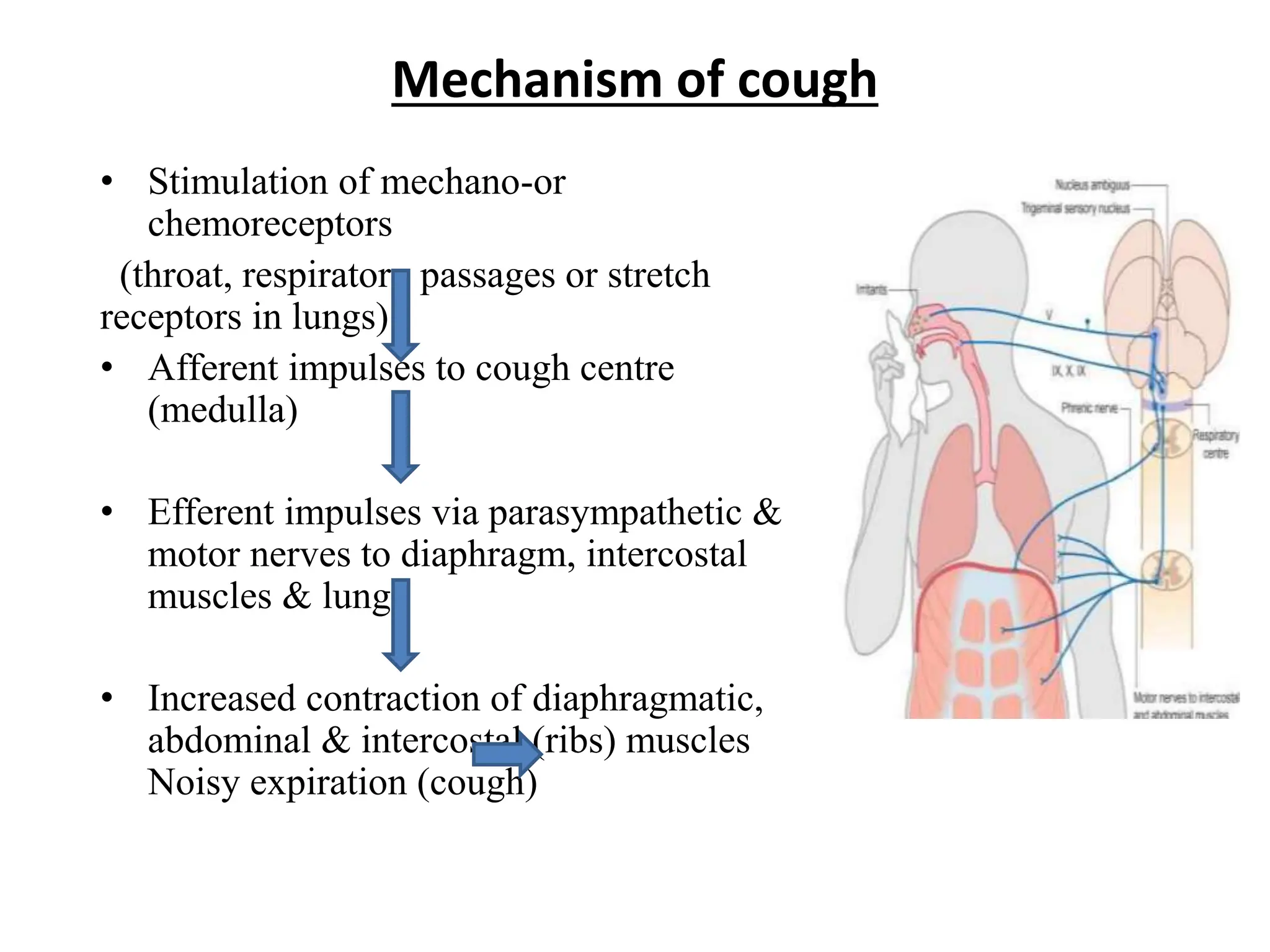
Mechanism of cough
• Stimulation of mechano-or
chemoreceptors
(throat, respiratory passages or stretch
receptors in lungs)
• Afferent impulses to cough centre
(medulla)
• Efferent impulses via parasympathetic &
motor nerves to diaphragm, intercostal
muscles & lung
• Increased contraction of diaphragmatic,
abdominal & intercostal (ribs) muscles
Noisy expiration (cough)
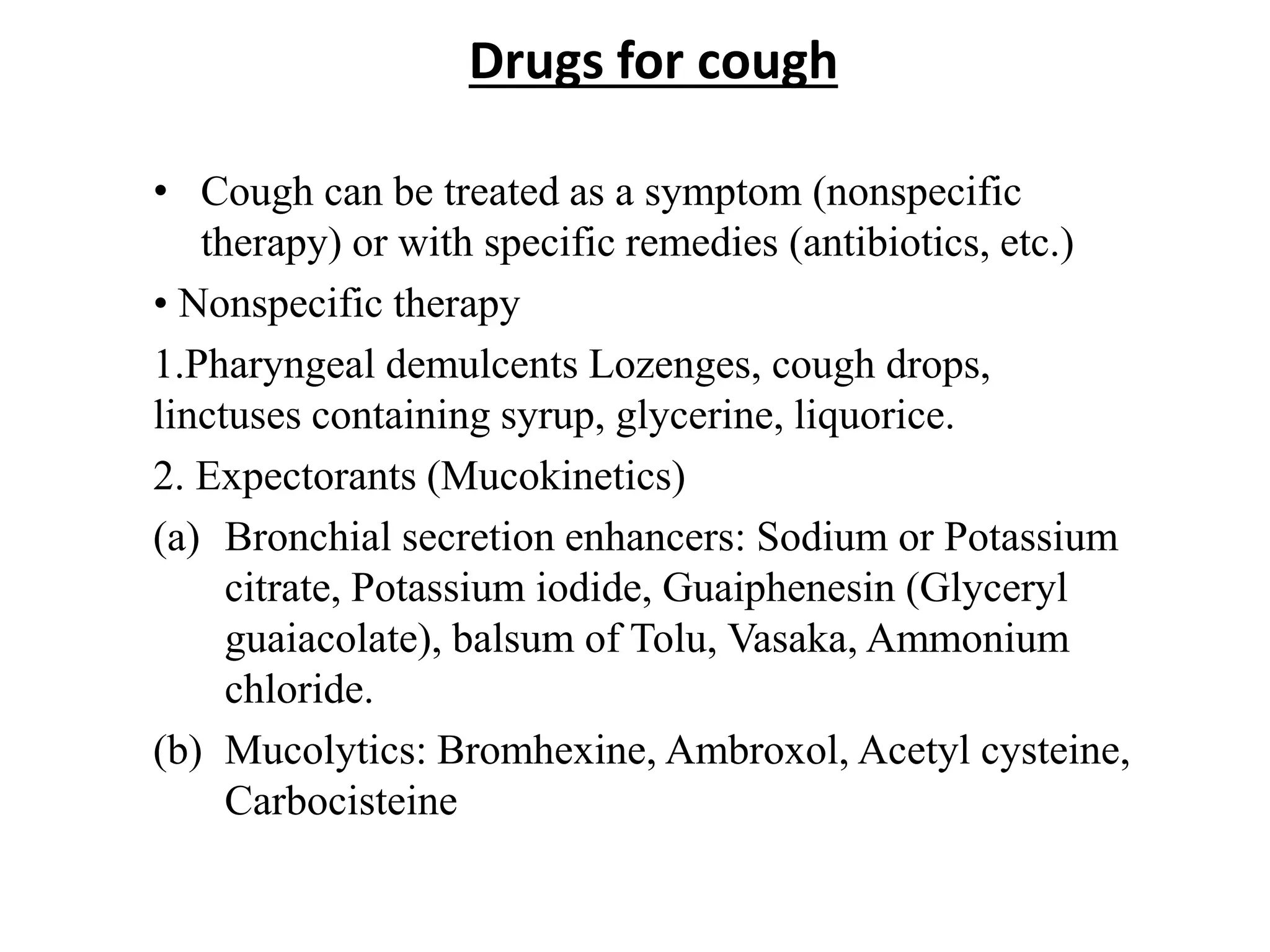
Drugs for cough
• Cough can be treated as a symptom (nonspecific
therapy) or with specific remedies (antibiotics, etc.)
• Nonspecific therapy
1.Pharyngeal demulcents Lozenges, cough drops,
linctuses containing syrup, glycerine, liquorice.
2. Expectorants (Mucokinetics)
(a) Bronchial secretion enhancers: Sodium or Potassium
citrate, Potassium iodide, Guaiphenesin (Glyceryl
guaiacolate), balsum of Tolu, Vasaka, Ammonium
chloride.
(b) Mucolytics: Bromhexine, Ambroxol, Acetyl cysteine,
Carbocisteine
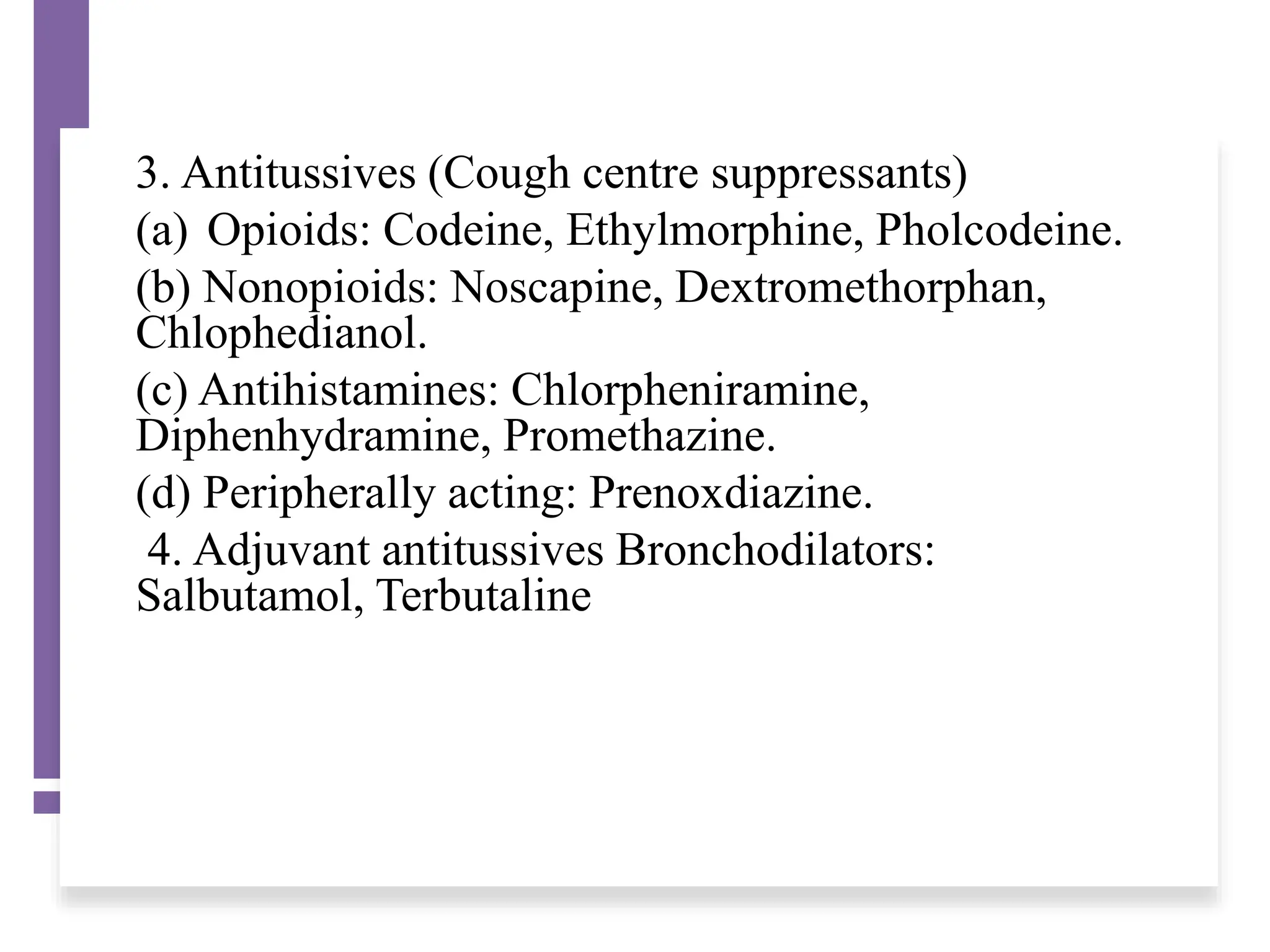
3. Antitussives (Cough centre suppressants)
(a) Opioids: Codeine, Ethylmorphine, Pholcodeine.
(b) Nonopioids: Noscapine, Dextromethorphan,
Chlophedianol.
(c) Antihistamines: Chlorpheniramine,
Diphenhydramine, Promethazine.
(d) Peripherally acting: Prenoxdiazine.
4. Adjuvant antitussives Bronchodilators:
Salbutamol, Terbutaline
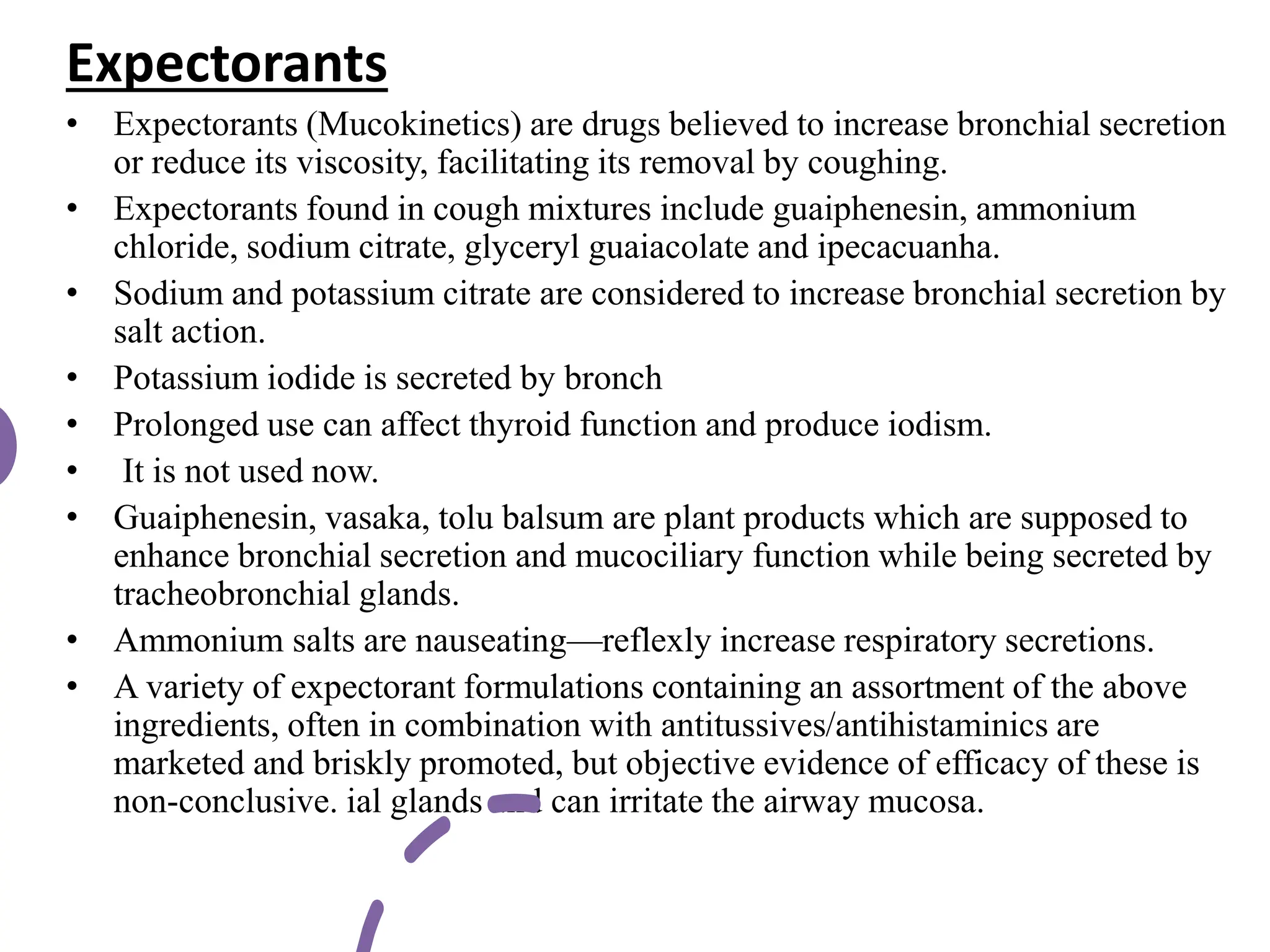
Expectorants
• Expectorants (Mucokinetics) are drugs believed to increase bronchial secretion
or reduce its viscosity, facilitating its removal by coughing.
• Expectorants found in cough mixtures include guaiphenesin, ammonium
chloride, sodium citrate, glyceryl guaiacolate and ipecacuanha.
• Sodium and potassium citrate are considered to increase bronchial secretion by
salt action.
• Potassium iodide is secreted by bronch
• Prolonged use can affect thyroid function and produce iodism.
• It is not used now.
• Guaiphenesin, vasaka, tolu balsum are plant products which are supposed to
enhance bronchial secretion and mucociliary function while being secreted by
tracheobronchial glands.
• Ammonium salts are nauseating—reflexly increase respiratory secretions.
• A variety of expectorant formulations containing an assortment of the above
ingredients, often in combination with antitussives/antihistaminics are
marketed and briskly promoted, but objective evidence of efficacy of these is
non-conclusive. ial glands and can irritate the airway mucosa.
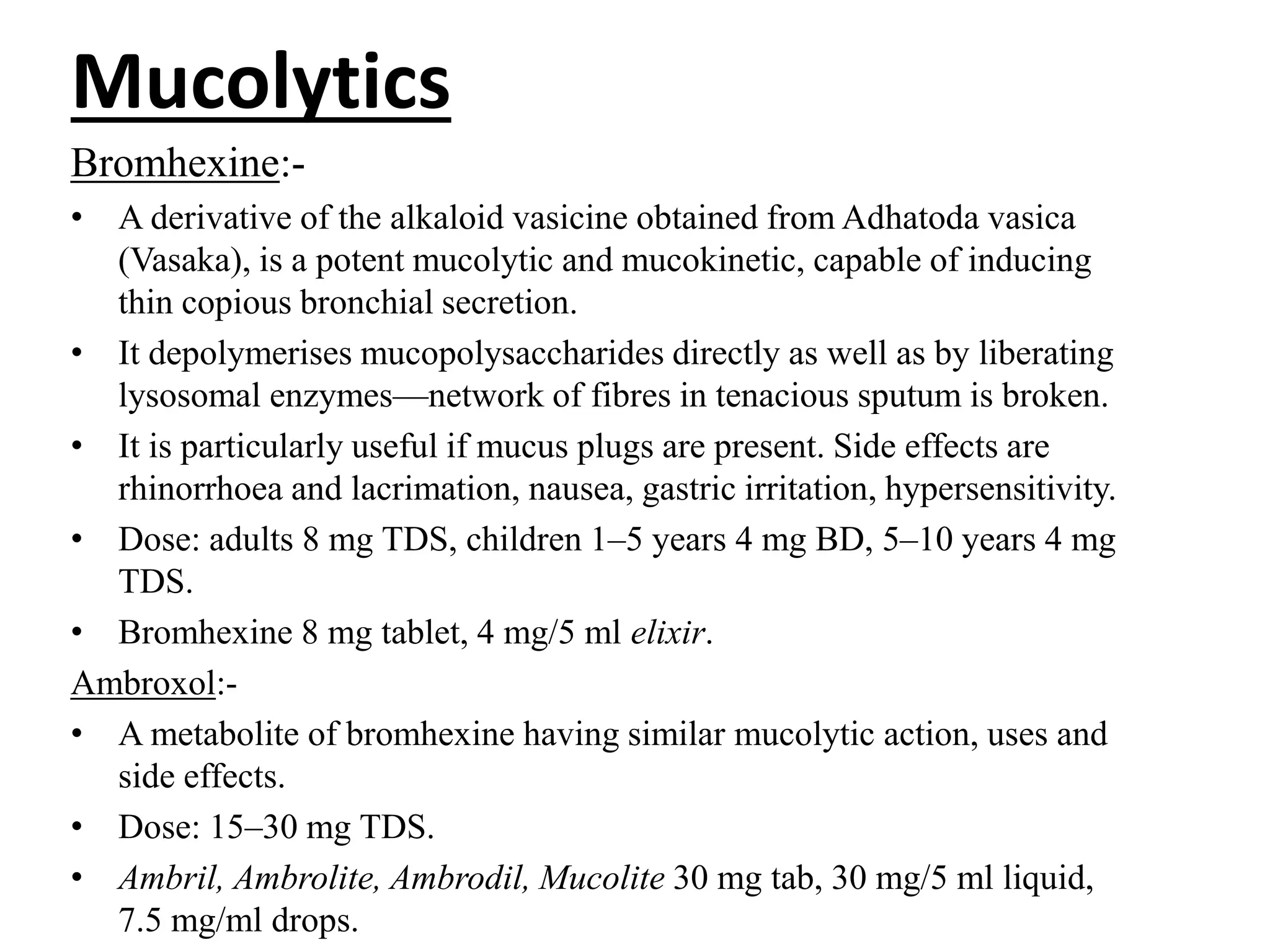
Mucolytics
Bromhexine:-
• A derivative of the alkaloid vasicine obtained from Adhatoda vasica
(Vasaka), is a potent mucolytic and mucokinetic, capable of inducing
thin copious bronchial secretion.
• It depolymerises mucopolysaccharides directly as well as by liberating
lysosomal enzymes—network of fibres in tenacious sputum is broken.
• It is particularly useful if mucus plugs are present. Side effects are
rhinorrhoea and lacrimation, nausea, gastric irritation, hypersensitivity.
• Dose: adults 8 mg TDS, children 1–5 years 4 mg BD, 5–10 years 4 mg
TDS.
• Bromhexine 8 mg tablet, 4 mg/5 ml elixir.
Ambroxol:-
• A metabolite of bromhexine having similar mucolytic action, uses and
side effects.
• Dose: 15–30 mg TDS.
• Ambril, Ambrolite, Ambrodil, Mucolite 30 mg tab, 30 mg/5 ml liquid,
7.5 mg/ml drops.
Acetylcysteine:-
• It opens disulfide bonds in mucoproteins present in sputum—
makes it less viscid, but has to be administered directly into the
respiratory tract.
• Mucomix 200 mg/ml inj. in 1,2,5 ml amps; injectable solution
may be nebulized/instilled through trachiostomy tube.
Carbocisteine:-
• It liquefies viscid sputum in the same way as acetylcysteine and
is administered orally (250–750 mg TDS).
• Some patients of chronic bronchitis have been shown to benefit.
• It may break gastric mucosal barrier; is contraindicated in peptic
ulcer patients. Side effects are gastric discomfort and rashes.
• Mucodyne 375 mg cap, 250 mg/5 ml syr. It is available in
combination with amoxicillin or cephalexin for treatment of
bronchitis, bronchiectasis, sinusitis, etc.
• Carbomox: Carbocisteine 150 mg + amoxicillin 250 or 500 mg
Antitussives
• These are drugs that act in the CNS to raise the threshold of cough center or
act peripherally in the respiratory tract to reduce tussal impulses, or both these
actions
• Because they aim to control rather than eliminate cough, antitussives should
be used only for dry nonproductive cough or if cough is unduly tiring,
disturbs sleep or is hazardous (hernia, piles, cardiac disease, ocular surgery)
Classification-
[A]Centrally Acting Antitussive
1.NarcoticAntitussives:
Codeine,Hydrocodone,Oxycodone
2.Non-narcotic Antitussives:
Dextromethorphan, Noscapine, Propoxyphene
[B] Peripherally Acting Antitussive
1.Mucosal Anaethetics:
Benzonatate, Chlophedianol
2.Hydrating Agents:
Steam, Aerosols
3.Miscellaneous:
Bromohexine
Opioids
Codeine:-
 An opium alkaloid, qualitatively similar to and less potent than morphine, but
is more selective for cough centre.
 Codeine is regarded as the standard antitussive; suppresses cough for about 6
hours.
 The antitussive action is blocked by naloxone indicating that it is exerted
through opioid receptors in the brain.
 Abuse liability is low, but present; constipation is the chief drawback.
 At higher doses respiratory depression and drowsiness can occur, especially in
children.
 Driving may be impaired.
 Like morphine, it is contraindicated in asthmatics and in patients with
diminished respiratory reserve; should be avoided in children.
 Dose: 10–30 mg; children 2–6 years 2.5–5 mg, 6–12 years 5–10 mg, frequently
used as syrup codeine phos. 4–8 ml.
 Codine 15 mg tab, 15 mg/5 ml linctus.
Nonopioids
Noscapine (Narcotine):-
 An opium alkaloid of the benzoisoquinoline series.
 It depresses cough but has no narcotic, analgesic or
dependence inducing properties.
 It is nearly equipotent antitussive as codeine,
especially useful in spasmodic cough.
 Headache and nausea occur occasionally as side
effect.
 It can release histamine and produce
bronchoconstriction in asthmatics.
 Dose: 15–30 mg, children 2–6 years 7.5 mg, 6–12
years 15 mg. Coscopin 7 mg/5 ml syrup, Coscotabs
25 mg tab.
Dextromethorphan:-
 A synthetic central NMDA (N-methyl D-aspartate)
receptor antagonist; the d-isomer has antitussive
action while l-isomer is analgesic.
 Dextromethorphan does not depress mucociliary
function of the airway mucosa and is practically
devoid of constipating action.
 Though considered non-addicting, some drug abusers
indulge in it.
 The antitussive action of dextromethorphan has been
rated equivalent to codeine, but some clinical studies
have found it to be no better than placebo.
 Side effect: Dizziness, nausea, drowsiness; at high
doses hallucinations and ataxia may occur.
 Dose: 10–20 mg, children 2–6 years 2.5–5 mg, 6–12
years 5–10 mg. It is a common ingredient of many
proprietary cough formulations (see antitussive
combinations below).
Chlophedianol:-
 It is a centrally acting antitussive with slow onset and
longer duration of action.
 Side effect: Dryness of mouth, vertigo, irritability.
Dose: 20–40 mg; Detigon, Tussigon 20 mg/5 ml
linctus with Ammon. chloride 50 mg and menthol
0.25 mg.
Prenoxdiazine:-
 In contrast to other antitussives, it acts peripherally;
desensitizes the pulmonary stretch receptors and
reduces tussal impulses originating in the lungs.
 It is indicated in cough of bronchial origin.
 Efficacy, however, is not impressive.
 Though an old drug developed in Hungary, it has been
introduced recently in India.
 Dose: 100–200 mg TDS-QID; Prenoxid 100, 200 mg
tab.
Bronchodilators:-
 Bronchospasm can induce or aggravate cough.
 Stimulation of pulmonary receptors can trigger both
cough and bronchoconstriction, especially in
individuals with bronchial hyperreactivity.
 Bronchodilators relieve cough in such individuals and improve the
effectiveness of cough in clearing secretions by increasing surface
velocity of airflow during the act of coughing.
 They should be used only when an element of bronchoconstriction
is present and not routinely.
 Their fixed dose combinations with antitussives are not
satisfactory because of differences in time course of action of the
components and liability for indiscriminate use.
 Fixed dose combinations of a centrally acting antitussive with a
bronchodilator or with an antihistaminic having high atropinic
activity have been banned in India, but many are still marketed.
 Aeromatic chest rub is widely advertized as a cough remedy.
 Though it has been shown to reduce experimentally induced cough
in healthy volunteers, there is no evidence of benefit in
pathological cough.

Mucolytics, Expectorants, Antitussives & Bronchodialators.pptx

  • 1.
  • 2.
    Cough • Cough isa protective reflex, its purpose being expulsion of respiratory secretions or foreign particles from air passages. • It occurs due to stimulation of mechano- or chemoreceptors in throat, respiratory passages or stretch receptors in the lungs. • Cough may be useful or useless. • Useless (nonproductive) cough should be suppressed. • Useful (productive) cough serves to drain the airway, its suppression is not desirable, may even be harmful, except if the amount of expectoration achieved is small compared to the effort of continuous coughing. • It is normal for people to cough once in a while, but sometimes a cough is a symptom of an illness.
  • 3.
    Types of cough •Classified based on duration, characters, quality and timing • An acute cough (lasting three weeks or less) is usually caused by a viral infection of the upper respiratory tract, such as the common cold. • A cough that lasts longer than three weeks following a viral upper respiratory tract infection is often called a ‘post-viral’ cough. • A chronic cough is usually defined as a cough that lasts eight weeks or longer. *The most common causes of chronic cough are postnasal drip, asthma and acid reflux from the stomach.
  • 4.
    • Coughs aredescribed as either ‘productive’ (wet, chesty and producing phlegm) or ‘non-productive’ (dry, tickly or tight and not producing phlegm). • Older children and adults typically cough material up, but younger children usually swallow it. • A productive cough should be encouraged because it enables the removal of secretions from the airways that, if retained, could impair breathing and the ability of the lungs to resist infection. • A non-productive cough serves no useful physiological purpose as no phlegm is produced and the cough can make it hard for the patient to sleep and function optimally.
  • 5.
    Mechanism of cough •Stimulation of mechano-or chemoreceptors (throat, respiratory passages or stretch receptors in lungs) • Afferent impulses to cough centre (medulla) • Efferent impulses via parasympathetic & motor nerves to diaphragm, intercostal muscles & lung • Increased contraction of diaphragmatic, abdominal & intercostal (ribs) muscles Noisy expiration (cough)
  • 6.
    Drugs for cough •Cough can be treated as a symptom (nonspecific therapy) or with specific remedies (antibiotics, etc.) • Nonspecific therapy 1.Pharyngeal demulcents Lozenges, cough drops, linctuses containing syrup, glycerine, liquorice. 2. Expectorants (Mucokinetics) (a) Bronchial secretion enhancers: Sodium or Potassium citrate, Potassium iodide, Guaiphenesin (Glyceryl guaiacolate), balsum of Tolu, Vasaka, Ammonium chloride. (b) Mucolytics: Bromhexine, Ambroxol, Acetyl cysteine, Carbocisteine
  • 7.
    3. Antitussives (Coughcentre suppressants) (a) Opioids: Codeine, Ethylmorphine, Pholcodeine. (b) Nonopioids: Noscapine, Dextromethorphan, Chlophedianol. (c) Antihistamines: Chlorpheniramine, Diphenhydramine, Promethazine. (d) Peripherally acting: Prenoxdiazine. 4. Adjuvant antitussives Bronchodilators: Salbutamol, Terbutaline
  • 8.
    Expectorants • Expectorants (Mucokinetics)are drugs believed to increase bronchial secretion or reduce its viscosity, facilitating its removal by coughing. • Expectorants found in cough mixtures include guaiphenesin, ammonium chloride, sodium citrate, glyceryl guaiacolate and ipecacuanha. • Sodium and potassium citrate are considered to increase bronchial secretion by salt action. • Potassium iodide is secreted by bronch • Prolonged use can affect thyroid function and produce iodism. • It is not used now. • Guaiphenesin, vasaka, tolu balsum are plant products which are supposed to enhance bronchial secretion and mucociliary function while being secreted by tracheobronchial glands. • Ammonium salts are nauseating—reflexly increase respiratory secretions. • A variety of expectorant formulations containing an assortment of the above ingredients, often in combination with antitussives/antihistaminics are marketed and briskly promoted, but objective evidence of efficacy of these is non-conclusive. ial glands and can irritate the airway mucosa.
  • 9.
    Mucolytics Bromhexine:- • A derivativeof the alkaloid vasicine obtained from Adhatoda vasica (Vasaka), is a potent mucolytic and mucokinetic, capable of inducing thin copious bronchial secretion. • It depolymerises mucopolysaccharides directly as well as by liberating lysosomal enzymes—network of fibres in tenacious sputum is broken. • It is particularly useful if mucus plugs are present. Side effects are rhinorrhoea and lacrimation, nausea, gastric irritation, hypersensitivity. • Dose: adults 8 mg TDS, children 1–5 years 4 mg BD, 5–10 years 4 mg TDS. • Bromhexine 8 mg tablet, 4 mg/5 ml elixir. Ambroxol:- • A metabolite of bromhexine having similar mucolytic action, uses and side effects. • Dose: 15–30 mg TDS. • Ambril, Ambrolite, Ambrodil, Mucolite 30 mg tab, 30 mg/5 ml liquid, 7.5 mg/ml drops.
  • 10.
    Acetylcysteine:- • It opensdisulfide bonds in mucoproteins present in sputum— makes it less viscid, but has to be administered directly into the respiratory tract. • Mucomix 200 mg/ml inj. in 1,2,5 ml amps; injectable solution may be nebulized/instilled through trachiostomy tube. Carbocisteine:- • It liquefies viscid sputum in the same way as acetylcysteine and is administered orally (250–750 mg TDS). • Some patients of chronic bronchitis have been shown to benefit. • It may break gastric mucosal barrier; is contraindicated in peptic ulcer patients. Side effects are gastric discomfort and rashes. • Mucodyne 375 mg cap, 250 mg/5 ml syr. It is available in combination with amoxicillin or cephalexin for treatment of bronchitis, bronchiectasis, sinusitis, etc. • Carbomox: Carbocisteine 150 mg + amoxicillin 250 or 500 mg
  • 11.
    Antitussives • These aredrugs that act in the CNS to raise the threshold of cough center or act peripherally in the respiratory tract to reduce tussal impulses, or both these actions • Because they aim to control rather than eliminate cough, antitussives should be used only for dry nonproductive cough or if cough is unduly tiring, disturbs sleep or is hazardous (hernia, piles, cardiac disease, ocular surgery) Classification- [A]Centrally Acting Antitussive 1.NarcoticAntitussives: Codeine,Hydrocodone,Oxycodone 2.Non-narcotic Antitussives: Dextromethorphan, Noscapine, Propoxyphene [B] Peripherally Acting Antitussive 1.Mucosal Anaethetics: Benzonatate, Chlophedianol 2.Hydrating Agents: Steam, Aerosols 3.Miscellaneous: Bromohexine
  • 12.
    Opioids Codeine:-  An opiumalkaloid, qualitatively similar to and less potent than morphine, but is more selective for cough centre.  Codeine is regarded as the standard antitussive; suppresses cough for about 6 hours.  The antitussive action is blocked by naloxone indicating that it is exerted through opioid receptors in the brain.  Abuse liability is low, but present; constipation is the chief drawback.  At higher doses respiratory depression and drowsiness can occur, especially in children.  Driving may be impaired.  Like morphine, it is contraindicated in asthmatics and in patients with diminished respiratory reserve; should be avoided in children.  Dose: 10–30 mg; children 2–6 years 2.5–5 mg, 6–12 years 5–10 mg, frequently used as syrup codeine phos. 4–8 ml.  Codine 15 mg tab, 15 mg/5 ml linctus.
  • 13.
    Nonopioids Noscapine (Narcotine):-  Anopium alkaloid of the benzoisoquinoline series.  It depresses cough but has no narcotic, analgesic or dependence inducing properties.  It is nearly equipotent antitussive as codeine, especially useful in spasmodic cough.  Headache and nausea occur occasionally as side effect.  It can release histamine and produce bronchoconstriction in asthmatics.  Dose: 15–30 mg, children 2–6 years 7.5 mg, 6–12 years 15 mg. Coscopin 7 mg/5 ml syrup, Coscotabs 25 mg tab.
  • 14.
    Dextromethorphan:-  A syntheticcentral NMDA (N-methyl D-aspartate) receptor antagonist; the d-isomer has antitussive action while l-isomer is analgesic.  Dextromethorphan does not depress mucociliary function of the airway mucosa and is practically devoid of constipating action.  Though considered non-addicting, some drug abusers indulge in it.  The antitussive action of dextromethorphan has been rated equivalent to codeine, but some clinical studies have found it to be no better than placebo.  Side effect: Dizziness, nausea, drowsiness; at high doses hallucinations and ataxia may occur.
  • 15.
     Dose: 10–20mg, children 2–6 years 2.5–5 mg, 6–12 years 5–10 mg. It is a common ingredient of many proprietary cough formulations (see antitussive combinations below). Chlophedianol:-  It is a centrally acting antitussive with slow onset and longer duration of action.  Side effect: Dryness of mouth, vertigo, irritability. Dose: 20–40 mg; Detigon, Tussigon 20 mg/5 ml linctus with Ammon. chloride 50 mg and menthol 0.25 mg.
  • 16.
    Prenoxdiazine:-  In contrastto other antitussives, it acts peripherally; desensitizes the pulmonary stretch receptors and reduces tussal impulses originating in the lungs.  It is indicated in cough of bronchial origin.  Efficacy, however, is not impressive.  Though an old drug developed in Hungary, it has been introduced recently in India.  Dose: 100–200 mg TDS-QID; Prenoxid 100, 200 mg tab. Bronchodilators:-  Bronchospasm can induce or aggravate cough.  Stimulation of pulmonary receptors can trigger both cough and bronchoconstriction, especially in individuals with bronchial hyperreactivity.
  • 17.
     Bronchodilators relievecough in such individuals and improve the effectiveness of cough in clearing secretions by increasing surface velocity of airflow during the act of coughing.  They should be used only when an element of bronchoconstriction is present and not routinely.  Their fixed dose combinations with antitussives are not satisfactory because of differences in time course of action of the components and liability for indiscriminate use.  Fixed dose combinations of a centrally acting antitussive with a bronchodilator or with an antihistaminic having high atropinic activity have been banned in India, but many are still marketed.  Aeromatic chest rub is widely advertized as a cough remedy.  Though it has been shown to reduce experimentally induced cough in healthy volunteers, there is no evidence of benefit in pathological cough.