Application of rDNA Technology and
Genetic Engineering in the Production of
Interferon, Hepatitis-B & Insulin
Mr. SAJID HUSSAIN
Assistant Professor
S. R. INSTITUTE OF PHARMACY
Maikpur, Bhuta, Bareilly
1
Some Genetically Engineered Pharmaceutical Products
2
and Applications
S.No Recombinant
DNA Product
Application
1.
Atrial natriuretic peptide
Treatment of heart disease (e.g., congestive heart
failure), kidney disease, high blood pressure
2. DNase Treatment of viscous lung secretions in cystic fibrosis
3. Erythropoietin Treatment of severe anemia with kidney damage
4. Factor VIII Treatment of hemophilia
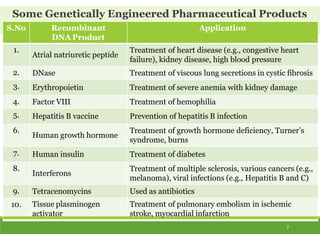
5. Hepatitis B vaccine Prevention of hepatitis B infection
6.
Human growth hormone
Treatment of growth hormone deficiency, Turner’s
syndrome, burns
7. Human insulin Treatment of diabetes
8.
Interferons
Treatment of multiple sclerosis, various cancers (e.g.,
melanoma), viral infections (e.g., Hepatitis B and C)
9. Tetracenomycins Used as antibiotics
10. Tissue plasminogen
activator
Treatment of pulmonary embolism in ischemic
stroke, myocardial infarction
INTERFERON
3
 Interferon is the molecule which interferes with viral replication
without disturbing the cellular metabolism and it may serve as
antiviral agent.
 Interferons are the set of small proteins which are secreted by
the cell in response to the viral infections.
 Its molecular weight ranges between 20,000 to 30,000 Daltons.
 The large quantity of interferon is produced by gene cloning i.e.,
introducing rDNA of interferon gene into E.coli.
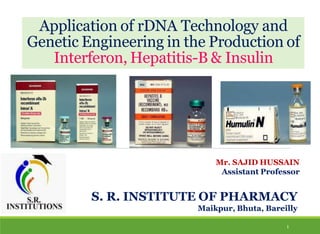
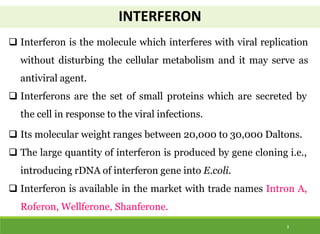
 Interferon is available in the market with trade names Intron A,
Roferon, Wellferone, Shanferone.
INTERFERON
4
 Interferons are broadly grouped into 3 types.
 Interferon α– Leucocytes
 Interferon β – Fibroblasts
 Interferon γ – Lymphocytes
 Interferon does not prevent the virus from infecting the cells but
inhibits its intracellular replication.
 rDNA has served as useful tool in the production of interferon.
 The nucleotide sequence of genes of INF α & INF β are obtained
from leucocyte interferon and fibroblastic interferon respectively
had quite similar structure.
 The synthesis of INF based on molecular biology was successful when
DNA sequence coding for human leucocyte INF was attached to the
yeasts alcohol dehydrogenase gene in a plasmid and was introduced into
cells of Saccharomyces cerevisiae.
 The yeast cells could synthesize about one million molecules of INF.
 In E.coli the plasmid could also successfully replicate, but production is
relatively slow in E.coli because in yeast it is easy to grow and replicate
glycoprotein derived from mammalian cells.
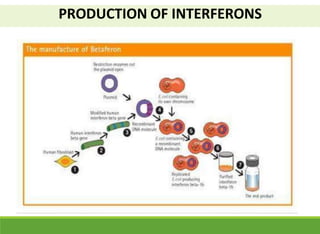
PRODUCTION OF INTERFERONS
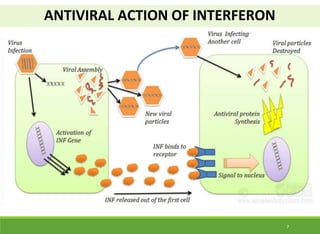
ANTIVIRAL ACTION OF INTERFERON
7
ANTIVIRAL ACTION OF INTERFERON
8
 The synthesis and release of interferons from a cell is induced by the viral
particles or by dsRNA of virus.
 Specific interferons are recognized by receptors present on the plasma
membrane. Once a cell receives the stimuli, the interferon proteins are
synthesized and release out of the cell.
 The secreted interferon molecules then bound to the ganglioside receptors on
the plasma membrane of another cell.
 The binding of interferons to its receptors triggers the production of many
enzymes that render the cell’s resistance to the viral infection.
 The two important antiviral enzymes whose production is triggered by the INF
are Oligo(A) Synthetase and Protein Kinase R (PKR).
 When an INF-stimulated cell is infected by the viral particle, the viral protein
synthesis is inhibited by an active endoribonuclease enzyme by degrading the
viral RNA.
FUNCTIONS OF INTERFERONS IN THE CELL
9
 Indirect antiviral properties
 Restrict the replication and assembly of viral particles
 Interferons can activate T cells
 Interferons can activate macrophages, neutrophils and natural
killer cells.
 Enhance the phagocytic property of macrophages.
 Increase the antigen presenting capacity of antigen presenting
cells.
APPLICATIONS OF INTERFERONS
10
INFα is used in the treatment of Hepatitis B and C infections
INFβ is used in the treatment of multiple sclerosis and
autoimmune disorders.
Interferons have antitumor properties
Combined therapy of interferon and chemotherapy is used in
the treatment of some cancers.
HEPATITIS-B VACCINE
11
 Hepatitis B virus (HBV) is one of the most common infectious diseases
known to man.
 The World Health Organization (WHO) estimates that there are as many as
285 million chronic carriers of this virus worldwide.
 Hepatitis B is 50 to 100 times more infectious than AIDS.
 Hepatitis B is irritation and swelling (inflammation) of the liver due to
infection with the hepatitis B virus (HBV).
 Other types of viral hepatitis include: Hepatitis A, Hepatitis C, Hepatitis D.
 It produces several chronic liver disorders such as Fulminant chronic
hepatitis, cirrhosis and primary liver cancer.
HEPATITIS-B VACCINE
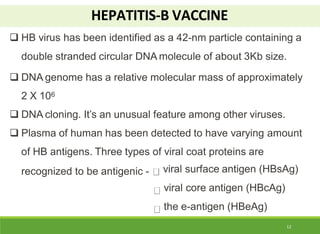
 HB virus has been identified as a 42-nm particle containing a
double stranded circular DNA molecule of about 3Kb size.
 DNA genome has a relative molecular mass of approximately
2 X 10⁶
 DNA cloning. It’s an unusual feature among other viruses.
 Plasma of human has been detected to have varying amount
of HB antigens. Three types of viral coat proteins are
recognized to be antigenic - viral surface antigen (HBsAg)
viral core antigen (HBcAg)
the e-antigen (HBeAg)
12
HEPATITIS-B VACCINE
13
HEPATITIS-B VACCINE
14
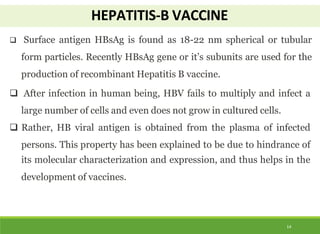
 Surface antigen HBsAg is found as 18-22 nm spherical or tubular
form particles. Recently HBsAg gene or it’s subunits are used for the
production of recombinant Hepatitis B vaccine.
 After infection in human being, HBV fails to multiply and infect a
large number of cells and even does not grow in cultured cells.
 Rather, HB viral antigen is obtained from the plasma of infected
persons. This property has been explained to be due to hindrance of
its molecular characterization and expression, and thus helps in the
development of vaccines.
STEPS INVOLVED IN PRODUCTION OF HEPATITIS-B VACCINE
15
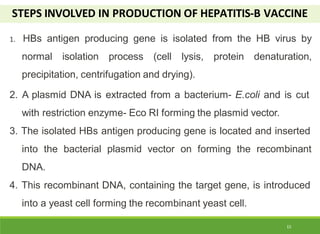
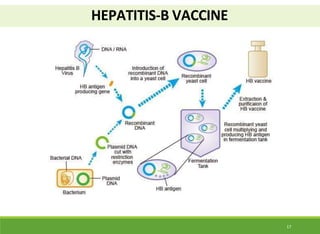
1. HBs antigen producing gene is isolated from the HB virus by
normal isolation process (cell lysis, protein denaturation,
precipitation, centrifugation and drying).
2. A plasmid DNA is extracted from a bacterium- E.coli and is cut
with restriction enzyme- Eco RI forming the plasmid vector.
3. The isolated HBs antigen producing gene is located and inserted
into the bacterial plasmid vector on forming the recombinant
DNA.
4. This recombinant DNA, containing the target gene, is introduced
into a yeast cell forming the recombinant yeast cell.
STEPS INVOLVED IN PRODUCTION OF HEPATITIS-B VACCINE
16
5. The recombinant yeast cell multiplies in the fermentation tank
and produces the HBs antigens.
6. After 48 hours, yeast cells are ruptured to free HBsAg. The
mixture is processed for extraction.
7. The HBs antigens are purified.
8. HBsAg are combined with preserving agent and other
ingredients and bottled. Now it is ready for vaccination in
humans.
HEPATITIS-B VACCINE
17
HUMAN INSULIN
18
• The earliest uses of biotechnology in pharmaceutical manufacturing
is the use of recombinant DNA technology to modify Escherichia coli
bacteria to produce human insulin, which was performed in 1978 at
Genentech.
• Insulin is a hormone produced by β-cells of islets of Langerhans of
pancreas. It was discovered by sir Edward Sharpey Schafer (1916)
while studying Islets ofLangerhans
• Insulin is a peptide hormone produced by pancreas and is a central
regulator of carbohydrates and fat metabolism in the body.
STRUCTURE OF HUMAN INSULIN
• Chemically Human insulin is small, simple protein composed of 51 amino acids
sequences and has a molecular weight of 5808 Da.
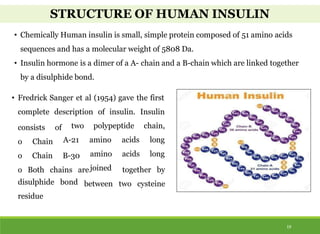
• Insulin hormone is a dimer of a A- chain and a B-chain which are linked together
by a disulphide bond.
• Fredrick Sanger et al (1954) gave the first
complete description of insulin. Insulin
consists of two polypeptide
A-21
B-30
acids
acids
chain,
long
long
o Chain
o Chain
o Both chains are
amino
amino
joined together by
between two cysteine
disulphide bond
residue
19
INSULIN PRODUCED INSIDE PANCREAS
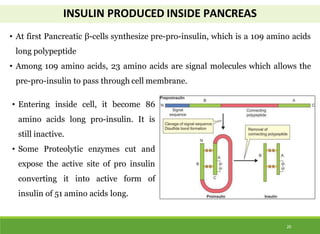
• At first Pancreatic β-cells synthesize pre-pro-insulin, which is a 109 amino acids
long polypeptide
• Among 109 amino acids, 23 amino acids are signal molecules which allows the
pre-pro-insulin to pass through cell membrane.
• Entering inside cell, it become 86
amino acids long pro-insulin. It is
still inactive.
• Some Proteolytic enzymes cut and
expose the active site of pro insulin
converting it into active form of
insulin of 51 amino acids long.
20
PRODUCTION OF HUMAN INSULIN BY rDNA TECHNOLOGY
•The basic step in recombinant DNA technology is similar for insulin
production also.
• At first suitable vector (plasmid) is isolated from E. coli and
then it is cut open by restriction endonuclease enzyme.
• The gene of interest (ie. Insulin coding gene) is isolated from β-
cell and inserted in opened plasmid.
• Plasmid and gene of interest are recombined together by DNA
ligase enzyme
• This recombined plasmid is inserted into suitable host cell (ie
E. coli) and now this recombined host cell starts producing
insulin hormone.
21
PRODUCTION OF HUMAN INSULIN BY rDNA TECHNOLOGY
•Hakura et al (1977) chemically synthesize DNA sequence of insulin for two
chains A and B and separately inserted into two PBR322 plasmid vector.
• These gene are inserted by the side of β-galactosidase gene of the
plasmid.
• The recombinant plasmid were then separately transformed into E. coli
host.
• The recombinant host produced pro-insulin chains ie. fused β-
galactosidase-A chain and β-galactosidase-B-chain separately.
• These pro-insulin chains A and B were separated from β-galactosidase
by treatment with cyanogen bromide. The detachment of pro-insulin
chains from β-galactosidase is possible because an extra codon form
methionine was added at N-terminal of each gene for A and B-chain.
• After detachment, A and B chains are joined invitro to reconstitute the
naïve insulin by sulphonating the peptide chains with sodium
disulphonate and sodium sulphite.
22
23

Applications of rDNA technology.pdf

  • 1.
    Application of rDNATechnology and Genetic Engineering in the Production of Interferon, Hepatitis-B & Insulin Mr. SAJID HUSSAIN Assistant Professor S. R. INSTITUTE OF PHARMACY Maikpur, Bhuta, Bareilly 1
  • 2.
    Some Genetically EngineeredPharmaceutical Products 2 and Applications S.No Recombinant DNA Product Application 1. Atrial natriuretic peptide Treatment of heart disease (e.g., congestive heart failure), kidney disease, high blood pressure 2. DNase Treatment of viscous lung secretions in cystic fibrosis 3. Erythropoietin Treatment of severe anemia with kidney damage 4. Factor VIII Treatment of hemophilia 5. Hepatitis B vaccine Prevention of hepatitis B infection 6. Human growth hormone Treatment of growth hormone deficiency, Turner’s syndrome, burns 7. Human insulin Treatment of diabetes 8. Interferons Treatment of multiple sclerosis, various cancers (e.g., melanoma), viral infections (e.g., Hepatitis B and C) 9. Tetracenomycins Used as antibiotics 10. Tissue plasminogen activator Treatment of pulmonary embolism in ischemic stroke, myocardial infarction
  • 3.
    INTERFERON 3  Interferon isthe molecule which interferes with viral replication without disturbing the cellular metabolism and it may serve as antiviral agent.  Interferons are the set of small proteins which are secreted by the cell in response to the viral infections.  Its molecular weight ranges between 20,000 to 30,000 Daltons.  The large quantity of interferon is produced by gene cloning i.e., introducing rDNA of interferon gene into E.coli.  Interferon is available in the market with trade names Intron A, Roferon, Wellferone, Shanferone.
  • 4.
    INTERFERON 4  Interferons arebroadly grouped into 3 types.  Interferon α– Leucocytes  Interferon β – Fibroblasts  Interferon γ – Lymphocytes  Interferon does not prevent the virus from infecting the cells but inhibits its intracellular replication.  rDNA has served as useful tool in the production of interferon.  The nucleotide sequence of genes of INF α & INF β are obtained from leucocyte interferon and fibroblastic interferon respectively had quite similar structure.
  • 5.
     The synthesisof INF based on molecular biology was successful when DNA sequence coding for human leucocyte INF was attached to the yeasts alcohol dehydrogenase gene in a plasmid and was introduced into cells of Saccharomyces cerevisiae.  The yeast cells could synthesize about one million molecules of INF.  In E.coli the plasmid could also successfully replicate, but production is relatively slow in E.coli because in yeast it is easy to grow and replicate glycoprotein derived from mammalian cells. PRODUCTION OF INTERFERONS
  • 6.
  • 7.
    ANTIVIRAL ACTION OFINTERFERON 7
  • 8.
    ANTIVIRAL ACTION OFINTERFERON 8  The synthesis and release of interferons from a cell is induced by the viral particles or by dsRNA of virus.  Specific interferons are recognized by receptors present on the plasma membrane. Once a cell receives the stimuli, the interferon proteins are synthesized and release out of the cell.  The secreted interferon molecules then bound to the ganglioside receptors on the plasma membrane of another cell.  The binding of interferons to its receptors triggers the production of many enzymes that render the cell’s resistance to the viral infection.  The two important antiviral enzymes whose production is triggered by the INF are Oligo(A) Synthetase and Protein Kinase R (PKR).  When an INF-stimulated cell is infected by the viral particle, the viral protein synthesis is inhibited by an active endoribonuclease enzyme by degrading the viral RNA.
  • 9.
    FUNCTIONS OF INTERFERONSIN THE CELL 9  Indirect antiviral properties  Restrict the replication and assembly of viral particles  Interferons can activate T cells  Interferons can activate macrophages, neutrophils and natural killer cells.  Enhance the phagocytic property of macrophages.  Increase the antigen presenting capacity of antigen presenting cells.
  • 10.
    APPLICATIONS OF INTERFERONS 10 INFαis used in the treatment of Hepatitis B and C infections INFβ is used in the treatment of multiple sclerosis and autoimmune disorders. Interferons have antitumor properties Combined therapy of interferon and chemotherapy is used in the treatment of some cancers.
  • 11.
    HEPATITIS-B VACCINE 11  HepatitisB virus (HBV) is one of the most common infectious diseases known to man.  The World Health Organization (WHO) estimates that there are as many as 285 million chronic carriers of this virus worldwide.  Hepatitis B is 50 to 100 times more infectious than AIDS.  Hepatitis B is irritation and swelling (inflammation) of the liver due to infection with the hepatitis B virus (HBV).  Other types of viral hepatitis include: Hepatitis A, Hepatitis C, Hepatitis D.  It produces several chronic liver disorders such as Fulminant chronic hepatitis, cirrhosis and primary liver cancer.
  • 12.
    HEPATITIS-B VACCINE  HBvirus has been identified as a 42-nm particle containing a double stranded circular DNA molecule of about 3Kb size.  DNA genome has a relative molecular mass of approximately 2 X 10⁶  DNA cloning. It’s an unusual feature among other viruses.  Plasma of human has been detected to have varying amount of HB antigens. Three types of viral coat proteins are recognized to be antigenic - viral surface antigen (HBsAg) viral core antigen (HBcAg) the e-antigen (HBeAg) 12
  • 13.
  • 14.
    HEPATITIS-B VACCINE 14  Surfaceantigen HBsAg is found as 18-22 nm spherical or tubular form particles. Recently HBsAg gene or it’s subunits are used for the production of recombinant Hepatitis B vaccine.  After infection in human being, HBV fails to multiply and infect a large number of cells and even does not grow in cultured cells.  Rather, HB viral antigen is obtained from the plasma of infected persons. This property has been explained to be due to hindrance of its molecular characterization and expression, and thus helps in the development of vaccines.
  • 15.
    STEPS INVOLVED INPRODUCTION OF HEPATITIS-B VACCINE 15 1. HBs antigen producing gene is isolated from the HB virus by normal isolation process (cell lysis, protein denaturation, precipitation, centrifugation and drying). 2. A plasmid DNA is extracted from a bacterium- E.coli and is cut with restriction enzyme- Eco RI forming the plasmid vector. 3. The isolated HBs antigen producing gene is located and inserted into the bacterial plasmid vector on forming the recombinant DNA. 4. This recombinant DNA, containing the target gene, is introduced into a yeast cell forming the recombinant yeast cell.
  • 16.
    STEPS INVOLVED INPRODUCTION OF HEPATITIS-B VACCINE 16 5. The recombinant yeast cell multiplies in the fermentation tank and produces the HBs antigens. 6. After 48 hours, yeast cells are ruptured to free HBsAg. The mixture is processed for extraction. 7. The HBs antigens are purified. 8. HBsAg are combined with preserving agent and other ingredients and bottled. Now it is ready for vaccination in humans.
  • 17.
  • 18.
    HUMAN INSULIN 18 • Theearliest uses of biotechnology in pharmaceutical manufacturing is the use of recombinant DNA technology to modify Escherichia coli bacteria to produce human insulin, which was performed in 1978 at Genentech. • Insulin is a hormone produced by β-cells of islets of Langerhans of pancreas. It was discovered by sir Edward Sharpey Schafer (1916) while studying Islets ofLangerhans • Insulin is a peptide hormone produced by pancreas and is a central regulator of carbohydrates and fat metabolism in the body.
  • 19.
    STRUCTURE OF HUMANINSULIN • Chemically Human insulin is small, simple protein composed of 51 amino acids sequences and has a molecular weight of 5808 Da. • Insulin hormone is a dimer of a A- chain and a B-chain which are linked together by a disulphide bond. • Fredrick Sanger et al (1954) gave the first complete description of insulin. Insulin consists of two polypeptide A-21 B-30 acids acids chain, long long o Chain o Chain o Both chains are amino amino joined together by between two cysteine disulphide bond residue 19
  • 20.
    INSULIN PRODUCED INSIDEPANCREAS • At first Pancreatic β-cells synthesize pre-pro-insulin, which is a 109 amino acids long polypeptide • Among 109 amino acids, 23 amino acids are signal molecules which allows the pre-pro-insulin to pass through cell membrane. • Entering inside cell, it become 86 amino acids long pro-insulin. It is still inactive. • Some Proteolytic enzymes cut and expose the active site of pro insulin converting it into active form of insulin of 51 amino acids long. 20
  • 21.
    PRODUCTION OF HUMANINSULIN BY rDNA TECHNOLOGY •The basic step in recombinant DNA technology is similar for insulin production also. • At first suitable vector (plasmid) is isolated from E. coli and then it is cut open by restriction endonuclease enzyme. • The gene of interest (ie. Insulin coding gene) is isolated from β- cell and inserted in opened plasmid. • Plasmid and gene of interest are recombined together by DNA ligase enzyme • This recombined plasmid is inserted into suitable host cell (ie E. coli) and now this recombined host cell starts producing insulin hormone. 21
  • 22.
    PRODUCTION OF HUMANINSULIN BY rDNA TECHNOLOGY •Hakura et al (1977) chemically synthesize DNA sequence of insulin for two chains A and B and separately inserted into two PBR322 plasmid vector. • These gene are inserted by the side of β-galactosidase gene of the plasmid. • The recombinant plasmid were then separately transformed into E. coli host. • The recombinant host produced pro-insulin chains ie. fused β- galactosidase-A chain and β-galactosidase-B-chain separately. • These pro-insulin chains A and B were separated from β-galactosidase by treatment with cyanogen bromide. The detachment of pro-insulin chains from β-galactosidase is possible because an extra codon form methionine was added at N-terminal of each gene for A and B-chain. • After detachment, A and B chains are joined invitro to reconstitute the naïve insulin by sulphonating the peptide chains with sodium disulphonate and sodium sulphite. 22
  • 23.