PHARMACEUTICAL CHEMISTRY
CHAPTER-2
TOPIC: PRECIPITATION TITRATION
D. PHARM 1ST YEAR
Presented By:
MS. SHWETA SINGH
(Assistant Professor)
RBMI, Bareilly
CONTENTS
Principle of Precipitation titration
Mohr’s Method
Fajan’s Method
Volhard Method
PRECIPITATION TITRATION
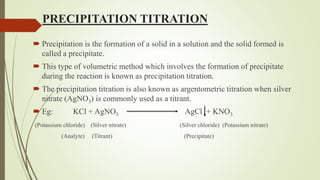
 Precipitation is the formation of a solid in a solution and the solid formed is
called a precipitate.
 This type of volumetric method which involves the formation of precipitate
during the reaction is known as precipitation titration.
 The precipitation titration is also known as argentometric titration when silver
nitrate (AgNO3) is commonly used as a titrant.
 Eg: KCl + AgNO3 AgCl + KNO3
(Potassium chloride) (Silver nitrate) (Silver chloride) (Potassium nitrate)
(Analyte) (Titrant) (Precipitate)
PRINCIPLE OF PRECIPITATION TITRATION
 The titration in which the precipitation reaction takes place is called precipitation titration.
 Eg: Titration of AgNO3 with halide ions (Cl-/Br-/F-/ I-).
 Precipitation titration is based on the solubility of products.
 If the solubility of titrant and analyte is high, precipitate will not form.
 If the solubility of titrant and analyte is low, precipitate will form easily.
 Eg: NaCl + AgNO3 AgCl + NaNO3
(Sodium chloride) (Silver nitrate) (Silver chloride) (Sodium nitrate)
(Analyte) (Titrant) (Precipitate)
KBr + AgNO3 AgCl + KNO3
(Potassium Bromide) (Silver nitrate) (Silver chloride) (Potassium nitrate)
(Analyte) (Titrant) (Precipitate)
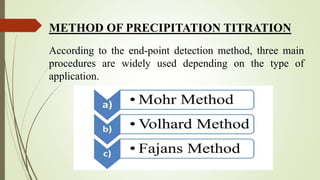
According to the end-point detection method, three main
procedures are widely used depending on the type of
application.
METHOD OF PRECIPITATION TITRATION
MOHR’S METHOD
 Karl Friedrich Mohr was the scientist who introduced this method.
 Titrant - 0.1 N AgNO3 (Silver nitrate)
 Analyte – 0.1 N NaCl (Sodium chloride)
 Indicator – 5% K2CrO4 (Potassium chromate)
Principle:
NaCl + AgNO3 AgCl + NaNO3 Ksp[AgCl]= 1.2X 10⁻¹⁰
K2CrO4 + AgNO3 Ag2CrO4 + 2KNO3 Ksp[AgCrO4]= 1.7X 10⁻¹²
 Chlorides and bromides are used as analytes in this method.
 The pH range in Mohr’s method is 6.5-7.5
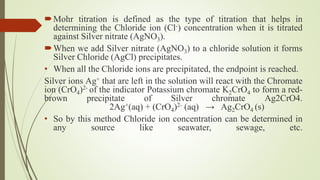
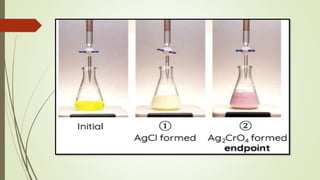
Mohr titration is defined as the type of titration that helps in
determining the Chloride ion (Cl-) concentration when it is titrated
against Silver nitrate (AgNO3).
When we add Silver nitrate (AgNO3) to a chloride solution it forms
Silver Chloride (AgCl) precipitates.
• When all the Chloride ions are precipitated, the endpoint is reached.
Silver ions Ag+ that are left in the solution will react with the Chromate
ion (CrO4)2- of the indicator Potassium chromate K2CrO4 to form a red-
brown precipitate of Silver chromate Ag2CrO4.
2Ag+(aq) + (CrO4)2- (aq) → Ag2CrO4 (s)
• So by this method Chloride ion concentration can be determined in
any source like seawater, sewage, etc.
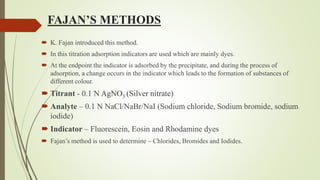
FAJAN’S METHODS
 K. Fajan introduced this method.
 In this titration adsorption indicators are used which are mainly dyes.
 At the endpoint the indicator is adsorbed by the precipitate, and during the process of
adsorption, a change occurs in the indicator which leads to the formation of substances of
different colour.
 Titrant - 0.1 N AgNO3 (Silver nitrate)
 Analyte – 0.1 N NaCl/NaBr/NaI (Sodium chloride, Sodium bromide, sodium
iodide)
 Indicator – Fluorescein, Eosin and Rhodamine dyes
 Fajan’s method is used to determine – Chlorides, Bromides and Iodides.
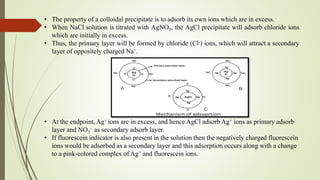
• The property of a colloidal precipitate is to adsorb its own ions which are in excess.
• When NaCl solution is titrated with AgNO3, the AgCl precipitate will adsorb chloride ions
which are initially in excess.
• Thus, the primary layer will be formed by chloride (Cl-) ions, which will attract a secondary
layer of oppositely charged Na+.
• At the endpoint, Ag+ ions are in excess, and hence AgCl adsorb Ag+ ions as primary adsorb
layer and NO3
- as secondary adsorb layer.
• If fluorescein indicator is also present in the solution then the negatively charged fluorescein
ions would be adsorbed as a secondary layer and this adsorption occurs along with a change
to a pink-colored complex of Ag+ and fluorescein ions.
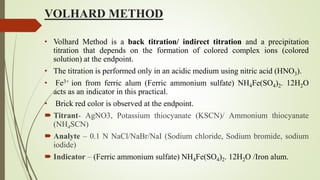
VOLHARD METHOD
• Volhard Method is a back titration/ indirect titration and a precipitation
titration that depends on the formation of colored complex ions (colored
solution) at the endpoint.
• The titration is performed only in an acidic medium using nitric acid (HNO3).
• Fe3+ ion from ferric alum (Ferric ammonium sulfate) NH4Fe(SO4)2. 12H2O
acts as an indicator in this practical.
• Brick red color is observed at the endpoint.
 Titrant- AgNO3, Potassium thiocyanate (KSCN)/ Ammonium thiocyanate
(NH4SCN)
 Analyte – 0.1 N NaCl/NaBr/NaI (Sodium chloride, Sodium bromide, sodium
iodide)
 Indicator – (Ferric ammonium sulfate) NH4Fe(SO4)2. 12H2O /Iron alum.
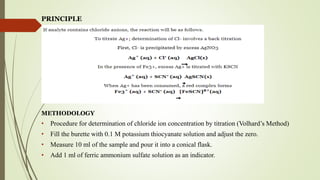
PRINCIPLE
METHODOLOGY
• Procedure for determination of chloride ion concentration by titration (Volhard’s Method)
• Fill the burette with 0.1 M potassium thiocyanate solution and adjust the zero.
• Measure 10 ml of the sample and pour it into a conical flask.
• Add 1 ml of ferric ammonium sulfate solution as an indicator.
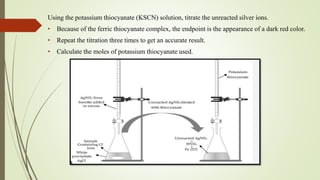
Using the potassium thiocyanate (KSCN) solution, titrate the unreacted silver ions.
• Because of the ferric thiocyanate complex, the endpoint is the appearance of a dark red color.
• Repeat the titration three times to get an accurate result.
• Calculate the moles of potassium thiocyanate used.

precipitation titration dpharm 1st year.

  • 1.
    PHARMACEUTICAL CHEMISTRY CHAPTER-2 TOPIC: PRECIPITATIONTITRATION D. PHARM 1ST YEAR Presented By: MS. SHWETA SINGH (Assistant Professor) RBMI, Bareilly
  • 2.
    CONTENTS Principle of Precipitationtitration Mohr’s Method Fajan’s Method Volhard Method
  • 3.
    PRECIPITATION TITRATION  Precipitationis the formation of a solid in a solution and the solid formed is called a precipitate.  This type of volumetric method which involves the formation of precipitate during the reaction is known as precipitation titration.  The precipitation titration is also known as argentometric titration when silver nitrate (AgNO3) is commonly used as a titrant.  Eg: KCl + AgNO3 AgCl + KNO3 (Potassium chloride) (Silver nitrate) (Silver chloride) (Potassium nitrate) (Analyte) (Titrant) (Precipitate)
  • 4.
    PRINCIPLE OF PRECIPITATIONTITRATION  The titration in which the precipitation reaction takes place is called precipitation titration.  Eg: Titration of AgNO3 with halide ions (Cl-/Br-/F-/ I-).  Precipitation titration is based on the solubility of products.  If the solubility of titrant and analyte is high, precipitate will not form.  If the solubility of titrant and analyte is low, precipitate will form easily.  Eg: NaCl + AgNO3 AgCl + NaNO3 (Sodium chloride) (Silver nitrate) (Silver chloride) (Sodium nitrate) (Analyte) (Titrant) (Precipitate) KBr + AgNO3 AgCl + KNO3 (Potassium Bromide) (Silver nitrate) (Silver chloride) (Potassium nitrate) (Analyte) (Titrant) (Precipitate)
  • 5.
    According to theend-point detection method, three main procedures are widely used depending on the type of application. METHOD OF PRECIPITATION TITRATION
  • 6.
    MOHR’S METHOD  KarlFriedrich Mohr was the scientist who introduced this method.  Titrant - 0.1 N AgNO3 (Silver nitrate)  Analyte – 0.1 N NaCl (Sodium chloride)  Indicator – 5% K2CrO4 (Potassium chromate) Principle: NaCl + AgNO3 AgCl + NaNO3 Ksp[AgCl]= 1.2X 10⁻¹⁰ K2CrO4 + AgNO3 Ag2CrO4 + 2KNO3 Ksp[AgCrO4]= 1.7X 10⁻¹²  Chlorides and bromides are used as analytes in this method.  The pH range in Mohr’s method is 6.5-7.5
  • 7.
    Mohr titration isdefined as the type of titration that helps in determining the Chloride ion (Cl-) concentration when it is titrated against Silver nitrate (AgNO3). When we add Silver nitrate (AgNO3) to a chloride solution it forms Silver Chloride (AgCl) precipitates. • When all the Chloride ions are precipitated, the endpoint is reached. Silver ions Ag+ that are left in the solution will react with the Chromate ion (CrO4)2- of the indicator Potassium chromate K2CrO4 to form a red- brown precipitate of Silver chromate Ag2CrO4. 2Ag+(aq) + (CrO4)2- (aq) → Ag2CrO4 (s) • So by this method Chloride ion concentration can be determined in any source like seawater, sewage, etc.
  • 9.
    FAJAN’S METHODS  K.Fajan introduced this method.  In this titration adsorption indicators are used which are mainly dyes.  At the endpoint the indicator is adsorbed by the precipitate, and during the process of adsorption, a change occurs in the indicator which leads to the formation of substances of different colour.  Titrant - 0.1 N AgNO3 (Silver nitrate)  Analyte – 0.1 N NaCl/NaBr/NaI (Sodium chloride, Sodium bromide, sodium iodide)  Indicator – Fluorescein, Eosin and Rhodamine dyes  Fajan’s method is used to determine – Chlorides, Bromides and Iodides.
  • 10.
    • The propertyof a colloidal precipitate is to adsorb its own ions which are in excess. • When NaCl solution is titrated with AgNO3, the AgCl precipitate will adsorb chloride ions which are initially in excess. • Thus, the primary layer will be formed by chloride (Cl-) ions, which will attract a secondary layer of oppositely charged Na+. • At the endpoint, Ag+ ions are in excess, and hence AgCl adsorb Ag+ ions as primary adsorb layer and NO3 - as secondary adsorb layer. • If fluorescein indicator is also present in the solution then the negatively charged fluorescein ions would be adsorbed as a secondary layer and this adsorption occurs along with a change to a pink-colored complex of Ag+ and fluorescein ions.
  • 11.
    VOLHARD METHOD • VolhardMethod is a back titration/ indirect titration and a precipitation titration that depends on the formation of colored complex ions (colored solution) at the endpoint. • The titration is performed only in an acidic medium using nitric acid (HNO3). • Fe3+ ion from ferric alum (Ferric ammonium sulfate) NH4Fe(SO4)2. 12H2O acts as an indicator in this practical. • Brick red color is observed at the endpoint.  Titrant- AgNO3, Potassium thiocyanate (KSCN)/ Ammonium thiocyanate (NH4SCN)  Analyte – 0.1 N NaCl/NaBr/NaI (Sodium chloride, Sodium bromide, sodium iodide)  Indicator – (Ferric ammonium sulfate) NH4Fe(SO4)2. 12H2O /Iron alum.
  • 12.
    PRINCIPLE METHODOLOGY • Procedure fordetermination of chloride ion concentration by titration (Volhard’s Method) • Fill the burette with 0.1 M potassium thiocyanate solution and adjust the zero. • Measure 10 ml of the sample and pour it into a conical flask. • Add 1 ml of ferric ammonium sulfate solution as an indicator.
  • 13.
    Using the potassiumthiocyanate (KSCN) solution, titrate the unreacted silver ions. • Because of the ferric thiocyanate complex, the endpoint is the appearance of a dark red color. • Repeat the titration three times to get an accurate result. • Calculate the moles of potassium thiocyanate used.