-- PRIYASRIVASTAVA
 090105801
 EIE, VI SEM.
BASIC:


                       For mapping      It is recognized as
                        molecular         one of the most
Nuclear Magnetic
                       structures &            powerful
   Resonance
                      learning how         techniques for
spectroscopy is a
                        molecules              chemical
      NDT.
                    function & relate
                                               analysis.
                      to each other.
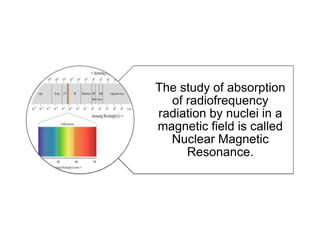
The study of absorption
  of radiofrequency
radiation by nuclei in a
magnetic field is called
  Nuclear Magnetic
     Resonance.
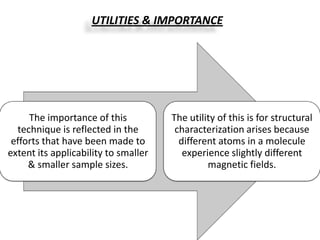
UTILITIES & IMPORTANCE


     The importance of this           The utility of this is for structural
  technique is reflected in the        characterization arises because
 efforts that have been made to         different atoms in a molecule
extent its applicability to smaller      experience slightly different
     & smaller sample sizes.                   magnetic fields.
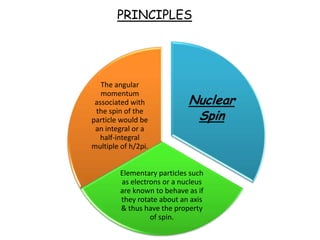
PRINCIPLES


   The angular

                             Nuclear
   momentum
 associated with
 the spin of the
particle would be             Spin
 an integral or a
  half-integral
multiple of h/2pi.


         Elementary particles such
         as electrons or a nucleus
         are known to behave as if
         they rotate about an axis
         & thus have the property
                  of spin.
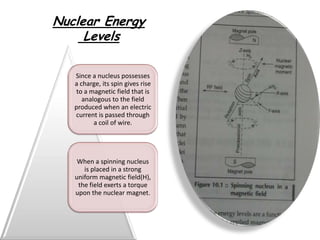
Nuclear Energy
     Levels

   Since a nucleus possesses
   a charge, its spin gives rise
    to a magnetic field that is
      analogous to the field
   produced when an electric
   current is passed through
          a coil of wire.


    When a spinning nucleus
      is placed in a strong
   uniform magnetic field(H),
    the field exerts a torque
   upon the nuclear magnet.
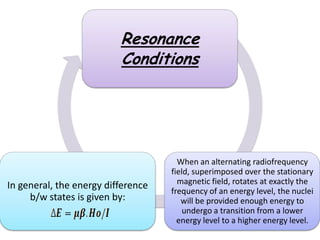
Resonance
                          Conditions


                                      When an alternating radiofrequency
                                    field, superimposed over the stationary
In general, the energy difference     magnetic field, rotates at exactly the
                                    frequency of an energy level, the nuclei
     b/w states is given by:           will be provided enough energy to
                                        undergo a transition from a lower
                                      energy level to a higher energy level.
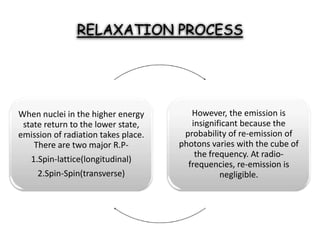
RELAXATION PROCESS


When nuclei in the higher energy        However, the emission is
 state return to the lower state,       insignificant because the
emission of radiation takes place.    probability of re-emission of
    There are two major R.P-         photons varies with the cube of
                                         the frequency. At radio-
   1.Spin-lattice(longitudinal)
                                       frequencies, re-emission is
     2.Spin-Spin(transverse)                    negligible.
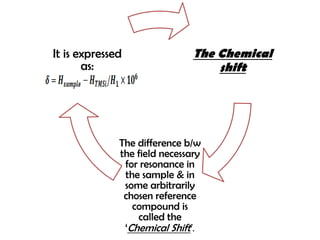
It is expressed                The Chemical
       as:                         shift


              The difference b/w
              the field necessary
               for resonance in
               the sample & in
               some arbitrarily
               chosen reference
                 compound is
                  called the
               ‘Chemical Shift’.
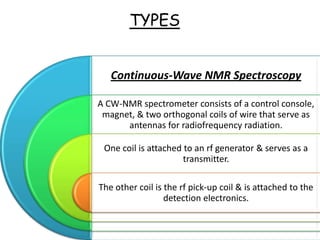
TYPES


   Continuous-Wave NMR Spectroscopy

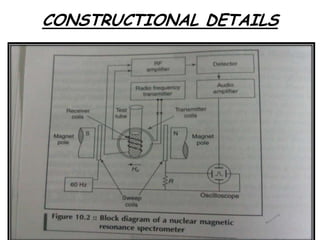
A CW-NMR spectrometer consists of a control console,
 magnet, & two orthogonal coils of wire that serve as
      antennas for radiofrequency radiation.

 One coil is attached to an rf generator & serves as a
                      transmitter.

The other coil is the rf pick-up coil & is attached to the
                  detection electronics.
Fourier Transform NMR Spectroscopy

It use a pulse of rf radiaiton which causes nuclei in
   a magnetic field to flip into the higher energy
                      alignment.
   Due to Heisenberg uncertainty principle, the
frequency width of the rf pulse is wide enough to
   simultaneously excite nuclei in environment.
   All the nuclei will re-emit rf radiation at their
  respective resonance frequencies, creating an
 interference pattern in the resulting rf emission
   vs. time, known as FID(Free Induction Decay)
CONSTRUCTIONAL DETAILS
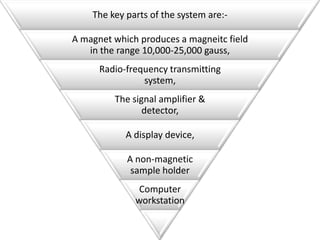
The key parts of the system are:-

A magnet which produces a magneitc field
   in the range 10,000-25,000 gauss,
      Radio-frequency transmitting
                system,
         The signal amplifier &
                detector,

            A display device,

            A non-magnetic
             sample holder
               Computer
              workstation
ELECTRON SPIN RESONANCE
            SPECTROMETERS


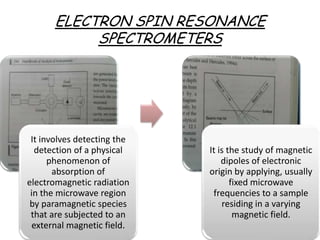
 It involves detecting the
  detection of a physical    It is the study of magnetic
      phenomenon of              dipoles of electronic
       absorption of         origin by applying, usually
electromagnetic radiation           fixed microwave
 in the microwave region      frequencies to a sample
 by paramagnetic species         residing in a varying
 that are subjected to an            magnetic field.
 external magnetic field.
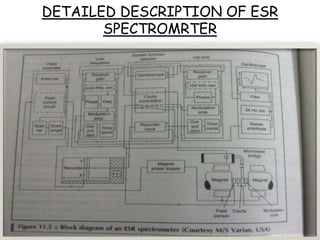
DETAILED DESCRIPTION OF ESR
       SPECTROMRTER
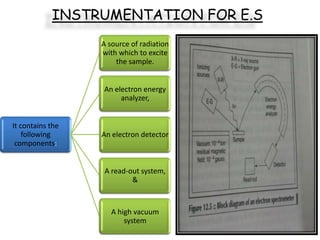
INSTRUMENTATION FOR E.S
                  A source of radiation
                  with which to excite
                      the sample.


                  An electron energy
                       analyzer,


It contains the
    following     An electron detector
 components:


                   A read-out system,
                           &


                     A high vacuum
                         system
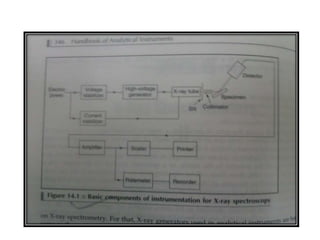
INSTRUMENTATION FOR X-RAY
      SPECTROMETRY

                   THE IMPORTANT
                   PARTS ARE:-

                   X-ray generating
                   equipment,

                   Collimator,

                   Monochromators,
                   and

                   Detectors
Nmr ppt.
Nmr ppt.

Nmr ppt.

  • 1.
  • 2.
    BASIC: For mapping It is recognized as molecular one of the most Nuclear Magnetic structures & powerful Resonance learning how techniques for spectroscopy is a molecules chemical NDT. function & relate analysis. to each other.
  • 3.
    The study ofabsorption of radiofrequency radiation by nuclei in a magnetic field is called Nuclear Magnetic Resonance.
  • 4.
    UTILITIES & IMPORTANCE The importance of this The utility of this is for structural technique is reflected in the characterization arises because efforts that have been made to different atoms in a molecule extent its applicability to smaller experience slightly different & smaller sample sizes. magnetic fields.
  • 5.
    PRINCIPLES The angular Nuclear momentum associated with the spin of the particle would be Spin an integral or a half-integral multiple of h/2pi. Elementary particles such as electrons or a nucleus are known to behave as if they rotate about an axis & thus have the property of spin.
  • 6.
    Nuclear Energy Levels Since a nucleus possesses a charge, its spin gives rise to a magnetic field that is analogous to the field produced when an electric current is passed through a coil of wire. When a spinning nucleus is placed in a strong uniform magnetic field(H), the field exerts a torque upon the nuclear magnet.
  • 7.
    Resonance Conditions When an alternating radiofrequency field, superimposed over the stationary In general, the energy difference magnetic field, rotates at exactly the frequency of an energy level, the nuclei b/w states is given by: will be provided enough energy to undergo a transition from a lower energy level to a higher energy level.
  • 8.
    RELAXATION PROCESS When nucleiin the higher energy However, the emission is state return to the lower state, insignificant because the emission of radiation takes place. probability of re-emission of There are two major R.P- photons varies with the cube of the frequency. At radio- 1.Spin-lattice(longitudinal) frequencies, re-emission is 2.Spin-Spin(transverse) negligible.
  • 9.
    It is expressed The Chemical as: shift The difference b/w the field necessary for resonance in the sample & in some arbitrarily chosen reference compound is called the ‘Chemical Shift’.
  • 10.
    TYPES Continuous-Wave NMR Spectroscopy A CW-NMR spectrometer consists of a control console, magnet, & two orthogonal coils of wire that serve as antennas for radiofrequency radiation. One coil is attached to an rf generator & serves as a transmitter. The other coil is the rf pick-up coil & is attached to the detection electronics.
  • 11.
    Fourier Transform NMRSpectroscopy It use a pulse of rf radiaiton which causes nuclei in a magnetic field to flip into the higher energy alignment. Due to Heisenberg uncertainty principle, the frequency width of the rf pulse is wide enough to simultaneously excite nuclei in environment. All the nuclei will re-emit rf radiation at their respective resonance frequencies, creating an interference pattern in the resulting rf emission vs. time, known as FID(Free Induction Decay)
  • 12.
  • 13.
    The key partsof the system are:- A magnet which produces a magneitc field in the range 10,000-25,000 gauss, Radio-frequency transmitting system, The signal amplifier & detector, A display device, A non-magnetic sample holder Computer workstation
  • 14.
    ELECTRON SPIN RESONANCE SPECTROMETERS It involves detecting the detection of a physical It is the study of magnetic phenomenon of dipoles of electronic absorption of origin by applying, usually electromagnetic radiation fixed microwave in the microwave region frequencies to a sample by paramagnetic species residing in a varying that are subjected to an magnetic field. external magnetic field.
  • 15.
    DETAILED DESCRIPTION OFESR SPECTROMRTER
  • 16.
    INSTRUMENTATION FOR E.S A source of radiation with which to excite the sample. An electron energy analyzer, It contains the following An electron detector components: A read-out system, & A high vacuum system
  • 17.
    INSTRUMENTATION FOR X-RAY SPECTROMETRY THE IMPORTANT PARTS ARE:- X-ray generating equipment, Collimator, Monochromators, and Detectors