HALL EFFECT
TRANSDUCERS
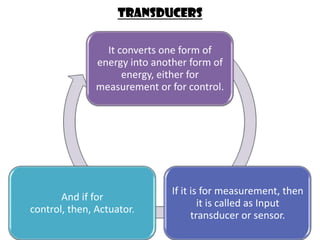
TRANSDUCERS

                 It converts one form of
               energy into another form of
                     energy, either for
               measurement or for control.


                               If it is for measurement, then
       And if for
                                       it is called as Input
control, then, Actuator.
                                     transducer or sensor.
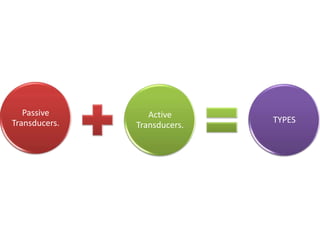
Passive        Active
Transducers.                  TYPES
               Transducers.
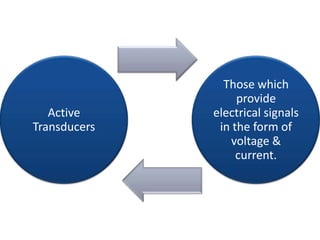
Those which
                   provide
   Active     electrical signals
Transducers    in the form of
                 voltage &
                   current.
It belongs to one           HALL EFFECT
      of the               TRANSDUCERS
Galvanomagnetic
   phenomena.


          It was discovered in
                 1879.
CONTD.

             In which interaction
          between magnetic field &
          moving electrical charges
         results in the development
           of forces that alter the
            motion of the charge.


         The Hall effect is observed
           in all metals, but it is
               prominent in
         semiconductor materials.
CONTD.


         A thin strip of bismuth
         or n-type germanium is
         subjected to magnetic
           field B normal to its
         surface, while it carries
           a current along the
         length of the strip, but
               normal to B.
CONTD.


     The magnetic field exerts a
                                     The edge surfaces act like charged
 force(known as Lorentz force) on
                                        electrodes and the potential
the electrons moving at a velocity
                                     difference measured b/w P & Q is
   v, with the result that some of
                                     known as Hall potential Eh, which
  them drift towards the edges of
                                      increases with increase of B & I.
              the strip.
CONTD.
                                    The build up of the
                                    charge on the edge
                                      surfaces will, in
                                 turn, develop an electric
                                 field(Hall field) of such a
                                 polarity that counteracts
                                 the collection of charges
                                      on the surfaces.


            The force on the
         electrons due to Hall
         field & Lorentz force
          balance each other
                 finally.
CONTD.


                       If e is the charge of
 The time required
                        the electron, then
    to reach this
                         the Lorentz force
equilibrium is about
                       Bev & the force due
10 to the power -14
                          to Hall field are
          s.
                       equal to each other.
• Hence, Bev = e /b
)
    • Or, = Bbv(volts)
    • If mobility of the charge carriers is represented by
      χ, then v is given by
    • V= χ /L
    • The Hall coefficient depends on the no. of free
      charge carriers per unit volume.
    •     = (      )/(n      )


               n
APPLICATIONS


                         It is preferred for
                             mapping of
  The Hall effect
                           magnetic field       With & wihtout
   transducer is
                        around conductors       the presence of
primarily suited for
                            carrying large     metallic objects in
the measurement
                           currents under        their vicinity.
of magnetic fields.
                            different flow
                             conditions,
CONTD.      This transducer has made it
            possible to measure dc & ac
          currents in conductors without
           interruption of the circuit and
           without making any electrical
            contact with the conductor.


          The range of current that can be
          measured in this manner can be
         as low as 0-1 mA or as high as 0-1
                        kA.
CONTD.


                                                                   It is used as a Proximity
In Instrumentation, the Hall
                                                                     detector, and also to
element is highly valued for
                                                                 measure the change in the
  its speed of response in        The advantages are its
                                                                 strength or direction of the
detection of changes in the     small size & high sensitivity.
                                                                    magnetic field due to
magnetic field to which it is
                                                                  displacement or nearness
          exposed.
                                                                       of the test object.
THANK
 YOU

Ipc ppt

  • 1.
  • 2.
    TRANSDUCERS It converts one form of energy into another form of energy, either for measurement or for control. If it is for measurement, then And if for it is called as Input control, then, Actuator. transducer or sensor.
  • 3.
    Passive Active Transducers. TYPES Transducers.
  • 4.
    Those which provide Active electrical signals Transducers in the form of voltage & current.
  • 5.
    It belongs toone HALL EFFECT of the TRANSDUCERS Galvanomagnetic phenomena. It was discovered in 1879.
  • 6.
    CONTD. In which interaction between magnetic field & moving electrical charges results in the development of forces that alter the motion of the charge. The Hall effect is observed in all metals, but it is prominent in semiconductor materials.
  • 7.
    CONTD. A thin strip of bismuth or n-type germanium is subjected to magnetic field B normal to its surface, while it carries a current along the length of the strip, but normal to B.
  • 8.
    CONTD. The magnetic field exerts a The edge surfaces act like charged force(known as Lorentz force) on electrodes and the potential the electrons moving at a velocity difference measured b/w P & Q is v, with the result that some of known as Hall potential Eh, which them drift towards the edges of increases with increase of B & I. the strip.
  • 9.
    CONTD. The build up of the charge on the edge surfaces will, in turn, develop an electric field(Hall field) of such a polarity that counteracts the collection of charges on the surfaces. The force on the electrons due to Hall field & Lorentz force balance each other finally.
  • 10.
    CONTD. If e is the charge of The time required the electron, then to reach this the Lorentz force equilibrium is about Bev & the force due 10 to the power -14 to Hall field are s. equal to each other.
  • 11.
    • Hence, Bev= e /b ) • Or, = Bbv(volts) • If mobility of the charge carriers is represented by χ, then v is given by • V= χ /L • The Hall coefficient depends on the no. of free charge carriers per unit volume. • = ( )/(n ) n
  • 12.
    APPLICATIONS It is preferred for mapping of The Hall effect magnetic field With & wihtout transducer is around conductors the presence of primarily suited for carrying large metallic objects in the measurement currents under their vicinity. of magnetic fields. different flow conditions,
  • 13.
    CONTD. This transducer has made it possible to measure dc & ac currents in conductors without interruption of the circuit and without making any electrical contact with the conductor. The range of current that can be measured in this manner can be as low as 0-1 mA or as high as 0-1 kA.
  • 14.
    CONTD. It is used as a Proximity In Instrumentation, the Hall detector, and also to element is highly valued for measure the change in the its speed of response in The advantages are its strength or direction of the detection of changes in the small size & high sensitivity. magnetic field due to magnetic field to which it is displacement or nearness exposed. of the test object.
  • 15.