LIQUID CHROMATOGRAPHY –
MASS SPECTROSCOPY (LC-MS)


             Presented by
         Md Akbar Siddiq Khan
               M.Pharm
      Nizam College Of Pharmacy
           Hyderabad - A.P
What is LC-MS?


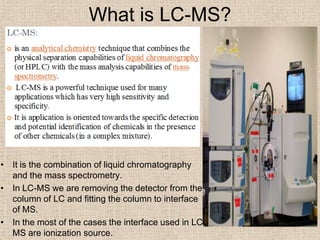
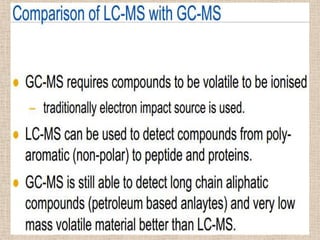
• It is the combination of liquid chromatography
  and the mass spectrometry.
• In LC-MS we are removing the detector from the
  column of LC and fitting the column to interface
  of MS.
• In the most of the cases the interface used in LC-
  MS are ionization source.
PROBLEMS IN COMBINING
               HPLC AND MS

        HPLC                      MS
•   Liquid phase operation    Vacuum operation
•   25 - 50 deg. C            200 - 300 deg. C
•   No mass range             Up to 4000 Da for
                              quadrupole MS
    limitations
                              Requires volatile buffers
•   Inorganic buffers         Accepts 10 ml/min gas
•   1 ml/min eluent flow is   flow
    equivalent to 500
    ml/min of gas
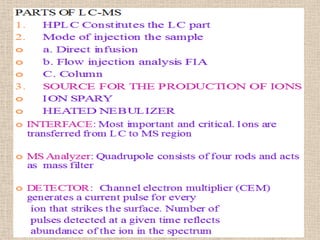
PARTS OF LC-MS


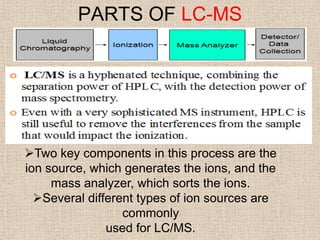
Two key components in this process are the
ion source, which generates the ions, and the
     mass analyzer, which sorts the ions.
  Several different types of ion sources are
                  commonly
               used for LC/MS.
MOBILE PHASE:-
The mobile phase is the solvent that moves the
  solute through out column.

 General requirements:-
   (1)low cost, uv transperancy,high purity.
   (2)low viscosity, low toxicity, non flammability.
   (3)non corrosive to LC system component.

 Solvent strength and selectivity:-
   it is the ability of solvent to elute solutes from a
  column.
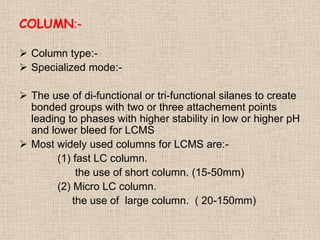
COLUMN:-

 Column type:-
 Specialized mode:-

 The use of di-functional or tri-functional silanes to create
  bonded groups with two or three attachement points
  leading to phases with higher stability in low or higher pH
  and lower bleed for LCMS
 Most widely used columns for LCMS are:-
        (1) fast LC column.
             the use of short column. (15-50mm)
        (2) Micro LC column.
            the use of large column. ( 20-150mm)
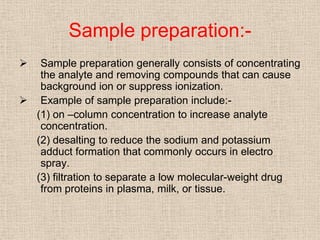
Sample preparation:-
  Sample preparation generally consists of concentrating
   the analyte and removing compounds that can cause
   background ion or suppress ionization.
 Example of sample preparation include:-
  (1) on –column concentration to increase analyte
   concentration.
  (2) desalting to reduce the sodium and potassium
   adduct formation that commonly occurs in electro
   spray.
  (3) filtration to separate a low molecular-weight drug
   from proteins in plasma, milk, or tissue.
Ionization and Interface:-
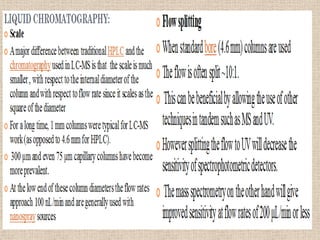
• It is difficult to interface a liquid chromatography
  to a mass-spectrometer cause of the necessity
  to remove the solvent.
• The commnly used interface are:-
  (1) Electrospray ionization (ESI)
  (2) Thermospray ionization (TSI)
  (3) Atmospheric pressure chemical ionization
  (APCI)
  (4) Atmospheric pressure photoionization(APPI)
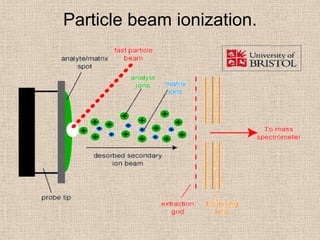
  (5) Partical beam ionization.
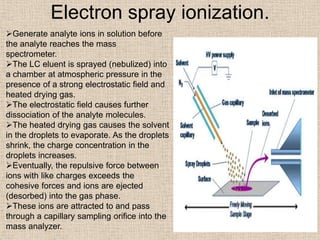
Electron spray ionization.
Generate analyte ions in solution before
the analyte reaches the mass
spectrometer.
The LC eluent is sprayed (nebulized) into
a chamber at atmospheric pressure in the
presence of a strong electrostatic field and
heated drying gas.
The electrostatic field causes further
dissociation of the analyte molecules.
The heated drying gas causes the solvent
in the droplets to evaporate. As the droplets
shrink, the charge concentration in the
droplets increases.
Eventually, the repulsive force between
ions with like charges exceeds the
cohesive forces and ions are ejected
(desorbed) into the gas phase.
These ions are attracted to and pass
through a capillary sampling orifice into the
mass analyzer.
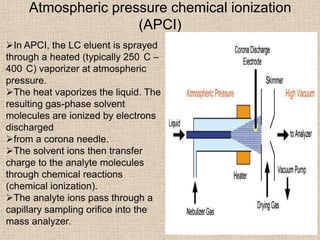
Atmospheric pressure chemical ionization
                     (APCI)
In APCI, the LC eluent is sprayed
through a heated (typically 250 C –
400 C) vaporizer at atmospheric
pressure.
The heat vaporizes the liquid. The
resulting gas-phase solvent
molecules are ionized by electrons
discharged
from a corona needle.
The solvent ions then transfer
charge to the analyte molecules
through chemical reactions
(chemical ionization).
The analyte ions pass through a
capillary sampling orifice into the
mass analyzer.
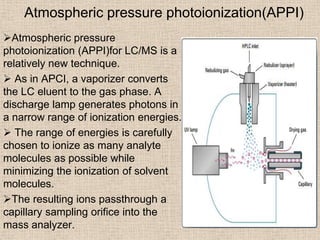
Atmospheric pressure photoionization(APPI)
Atmospheric pressure
photoionization (APPI)for LC/MS is a
relatively new technique.
 As in APCI, a vaporizer converts
the LC eluent to the gas phase. A
discharge lamp generates photons in
a narrow range of ionization energies.
 The range of energies is carefully
chosen to ionize as many analyte
molecules as possible while
minimizing the ionization of solvent
molecules.
The resulting ions passthrough a
capillary sampling orifice into the
mass analyzer.
Particle beam ionization.
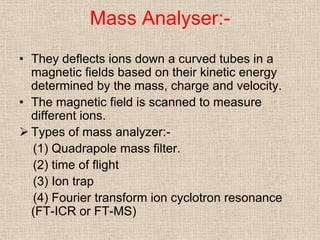
Mass Analyser:-
• They deflects ions down a curved tubes in a
  magnetic fields based on their kinetic energy
  determined by the mass, charge and velocity.
• The magnetic field is scanned to measure
  different ions.
 Types of mass analyzer:-
  (1) Quadrapole mass filter.
  (2) time of flight
  (3) Ion trap
  (4) Fourier transform ion cyclotron resonance
  (FT-ICR or FT-MS)
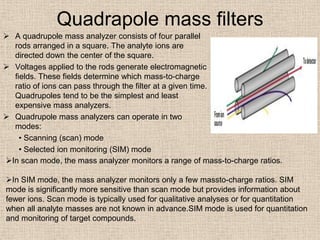
Quadrapole mass filters
 A quadrupole mass analyzer consists of four parallel
  rods arranged in a square. The analyte ions are
  directed down the center of the square.
 Voltages applied to the rods generate electromagnetic
  fields. These fields determine which mass-to-charge
  ratio of ions can pass through the filter at a given time.
  Quadrupoles tend to be the simplest and least
  expensive mass analyzers.
 Quadrupole mass analyzers can operate in two
  modes:
    • Scanning (scan) mode
    • Selected ion monitoring (SIM) mode
In scan mode, the mass analyzer monitors a range of mass-to-charge ratios.

In SIM mode, the mass analyzer monitors only a few massto-charge ratios. SIM
mode is significantly more sensitive than scan mode but provides information about
fewer ions. Scan mode is typically used for qualitative analyses or for quantitation
when all analyte masses are not known in advance.SIM mode is used for quantitation
and monitoring of target compounds.
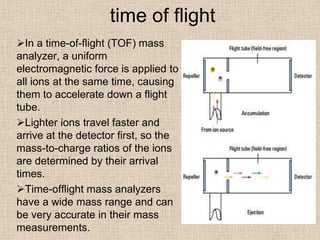
time of flight
In a time-of-flight (TOF) mass
analyzer, a uniform
electromagnetic force is applied to
all ions at the same time, causing
them to accelerate down a flight
tube.
Lighter ions travel faster and
arrive at the detector first, so the
mass-to-charge ratios of the ions
are determined by their arrival
times.
Time-offlight mass analyzers
have a wide mass range and can
be very accurate in their mass
measurements.
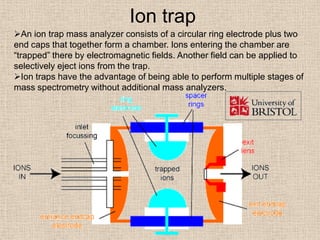
Ion trap
An ion trap mass analyzer consists of a circular ring electrode plus two
end caps that together form a chamber. Ions entering the chamber are
“trapped” there by electromagnetic fields. Another field can be applied to
selectively eject ions from the trap.
Ion traps have the advantage of being able to perform multiple stages of
mass spectrometry without additional mass analyzers.
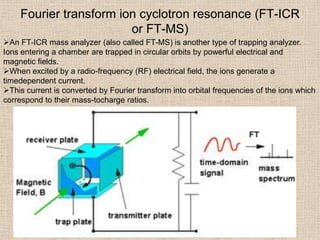
Fourier transform ion cyclotron resonance (FT-ICR
                        or FT-MS)
An FT-ICR mass analyzer (also called FT-MS) is another type of trapping analyzer.
Ions entering a chamber are trapped in circular orbits by powerful electrical and
magnetic fields.
When excited by a radio-frequency (RF) electrical field, the ions generate a
timedependent current.
This current is converted by Fourier transform into orbital frequencies of the ions which
correspond to their mass-tocharge ratios.
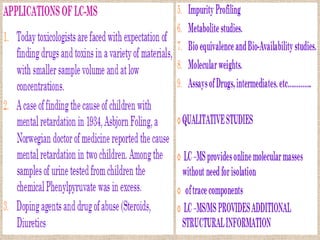
 Molecular weight determination
 Determining the molecular weight of green fluorescent
  proteins
 Structural determination e.g. structural determination of
  ginsenoside.
 Pharmaceutical application e.g. identification of bile acids
  metabolites.
 Biochemical application e.g. rapid protein identification
  using capillary lc/ms/ms.
 Food application e.g. identification of aflatoxin in food
  determination of vitamin D3 in poultry feed supplement
  using MS3
 Environmental application e.g. detection of phenyl urea
  herbicides, detection of low level of carbaryl in food.
Referance:-
• Wikimedia Foundation. 2010.
(1) W. Paul & H. Steinwedel; Zeitschrift für
  Naturforschung, 8A; 1953, p448.
(2) W. Paul; Agewandte Chemie -
  International Edition, 29; 1990, p739.
(3) G. C. Stafford et al.; International
  Journal of Mass Spectrometry and Ion
  Processes, 60; 1984, p85 and Analytical
  Chemistry, 59; 1987, p1677.
liquid chromatography - mass spectroscopy (LC-MS)

liquid chromatography - mass spectroscopy (LC-MS)

  • 1.
    LIQUID CHROMATOGRAPHY – MASSSPECTROSCOPY (LC-MS) Presented by Md Akbar Siddiq Khan M.Pharm Nizam College Of Pharmacy Hyderabad - A.P
  • 2.
    What is LC-MS? •It is the combination of liquid chromatography and the mass spectrometry. • In LC-MS we are removing the detector from the column of LC and fitting the column to interface of MS. • In the most of the cases the interface used in LC- MS are ionization source.
  • 3.
    PROBLEMS IN COMBINING HPLC AND MS HPLC MS • Liquid phase operation Vacuum operation • 25 - 50 deg. C 200 - 300 deg. C • No mass range Up to 4000 Da for quadrupole MS limitations Requires volatile buffers • Inorganic buffers Accepts 10 ml/min gas • 1 ml/min eluent flow is flow equivalent to 500 ml/min of gas
  • 4.
    PARTS OF LC-MS Twokey components in this process are the ion source, which generates the ions, and the mass analyzer, which sorts the ions. Several different types of ion sources are commonly used for LC/MS.
  • 7.
    MOBILE PHASE:- The mobilephase is the solvent that moves the solute through out column.  General requirements:- (1)low cost, uv transperancy,high purity. (2)low viscosity, low toxicity, non flammability. (3)non corrosive to LC system component.  Solvent strength and selectivity:- it is the ability of solvent to elute solutes from a column.
  • 8.
    COLUMN:-  Column type:- Specialized mode:-  The use of di-functional or tri-functional silanes to create bonded groups with two or three attachement points leading to phases with higher stability in low or higher pH and lower bleed for LCMS  Most widely used columns for LCMS are:- (1) fast LC column. the use of short column. (15-50mm) (2) Micro LC column. the use of large column. ( 20-150mm)
  • 9.
    Sample preparation:-  Sample preparation generally consists of concentrating the analyte and removing compounds that can cause background ion or suppress ionization.  Example of sample preparation include:- (1) on –column concentration to increase analyte concentration. (2) desalting to reduce the sodium and potassium adduct formation that commonly occurs in electro spray. (3) filtration to separate a low molecular-weight drug from proteins in plasma, milk, or tissue.
  • 10.
    Ionization and Interface:- •It is difficult to interface a liquid chromatography to a mass-spectrometer cause of the necessity to remove the solvent. • The commnly used interface are:- (1) Electrospray ionization (ESI) (2) Thermospray ionization (TSI) (3) Atmospheric pressure chemical ionization (APCI) (4) Atmospheric pressure photoionization(APPI) (5) Partical beam ionization.
  • 11.
    Electron spray ionization. Generateanalyte ions in solution before the analyte reaches the mass spectrometer. The LC eluent is sprayed (nebulized) into a chamber at atmospheric pressure in the presence of a strong electrostatic field and heated drying gas. The electrostatic field causes further dissociation of the analyte molecules. The heated drying gas causes the solvent in the droplets to evaporate. As the droplets shrink, the charge concentration in the droplets increases. Eventually, the repulsive force between ions with like charges exceeds the cohesive forces and ions are ejected (desorbed) into the gas phase. These ions are attracted to and pass through a capillary sampling orifice into the mass analyzer.
  • 12.
    Atmospheric pressure chemicalionization (APCI) In APCI, the LC eluent is sprayed through a heated (typically 250 C – 400 C) vaporizer at atmospheric pressure. The heat vaporizes the liquid. The resulting gas-phase solvent molecules are ionized by electrons discharged from a corona needle. The solvent ions then transfer charge to the analyte molecules through chemical reactions (chemical ionization). The analyte ions pass through a capillary sampling orifice into the mass analyzer.
  • 13.
    Atmospheric pressure photoionization(APPI) Atmosphericpressure photoionization (APPI)for LC/MS is a relatively new technique.  As in APCI, a vaporizer converts the LC eluent to the gas phase. A discharge lamp generates photons in a narrow range of ionization energies.  The range of energies is carefully chosen to ionize as many analyte molecules as possible while minimizing the ionization of solvent molecules. The resulting ions passthrough a capillary sampling orifice into the mass analyzer.
  • 14.
  • 15.
    Mass Analyser:- • Theydeflects ions down a curved tubes in a magnetic fields based on their kinetic energy determined by the mass, charge and velocity. • The magnetic field is scanned to measure different ions.  Types of mass analyzer:- (1) Quadrapole mass filter. (2) time of flight (3) Ion trap (4) Fourier transform ion cyclotron resonance (FT-ICR or FT-MS)
  • 16.
    Quadrapole mass filters A quadrupole mass analyzer consists of four parallel rods arranged in a square. The analyte ions are directed down the center of the square.  Voltages applied to the rods generate electromagnetic fields. These fields determine which mass-to-charge ratio of ions can pass through the filter at a given time. Quadrupoles tend to be the simplest and least expensive mass analyzers.  Quadrupole mass analyzers can operate in two modes: • Scanning (scan) mode • Selected ion monitoring (SIM) mode In scan mode, the mass analyzer monitors a range of mass-to-charge ratios. In SIM mode, the mass analyzer monitors only a few massto-charge ratios. SIM mode is significantly more sensitive than scan mode but provides information about fewer ions. Scan mode is typically used for qualitative analyses or for quantitation when all analyte masses are not known in advance.SIM mode is used for quantitation and monitoring of target compounds.
  • 17.
    time of flight Ina time-of-flight (TOF) mass analyzer, a uniform electromagnetic force is applied to all ions at the same time, causing them to accelerate down a flight tube. Lighter ions travel faster and arrive at the detector first, so the mass-to-charge ratios of the ions are determined by their arrival times. Time-offlight mass analyzers have a wide mass range and can be very accurate in their mass measurements.
  • 18.
    Ion trap An iontrap mass analyzer consists of a circular ring electrode plus two end caps that together form a chamber. Ions entering the chamber are “trapped” there by electromagnetic fields. Another field can be applied to selectively eject ions from the trap. Ion traps have the advantage of being able to perform multiple stages of mass spectrometry without additional mass analyzers.
  • 19.
    Fourier transform ioncyclotron resonance (FT-ICR or FT-MS) An FT-ICR mass analyzer (also called FT-MS) is another type of trapping analyzer. Ions entering a chamber are trapped in circular orbits by powerful electrical and magnetic fields. When excited by a radio-frequency (RF) electrical field, the ions generate a timedependent current. This current is converted by Fourier transform into orbital frequencies of the ions which correspond to their mass-tocharge ratios.
  • 22.
     Molecular weightdetermination  Determining the molecular weight of green fluorescent proteins  Structural determination e.g. structural determination of ginsenoside.  Pharmaceutical application e.g. identification of bile acids metabolites.  Biochemical application e.g. rapid protein identification using capillary lc/ms/ms.  Food application e.g. identification of aflatoxin in food determination of vitamin D3 in poultry feed supplement using MS3  Environmental application e.g. detection of phenyl urea herbicides, detection of low level of carbaryl in food.
  • 23.
    Referance:- • Wikimedia Foundation.2010. (1) W. Paul & H. Steinwedel; Zeitschrift für Naturforschung, 8A; 1953, p448. (2) W. Paul; Agewandte Chemie - International Edition, 29; 1990, p739. (3) G. C. Stafford et al.; International Journal of Mass Spectrometry and Ion Processes, 60; 1984, p85 and Analytical Chemistry, 59; 1987, p1677.