
PATTERN
RECOGNITION
INTROMISSION
It is the act of taking in raw data and making an action
based on the “category” of the pattern.
- Have evolved highly sophisticated neural and
cognitive systems for such tasks.
The ease with which we recognize a face, understand
spoken words, read handwritten characters, identify our
car keys in our pocket by feel, an decide whether an
apple is ripe by its smell belies the astoundingly
complex processes that underlie these acts of pattern
recognition.
MODEL
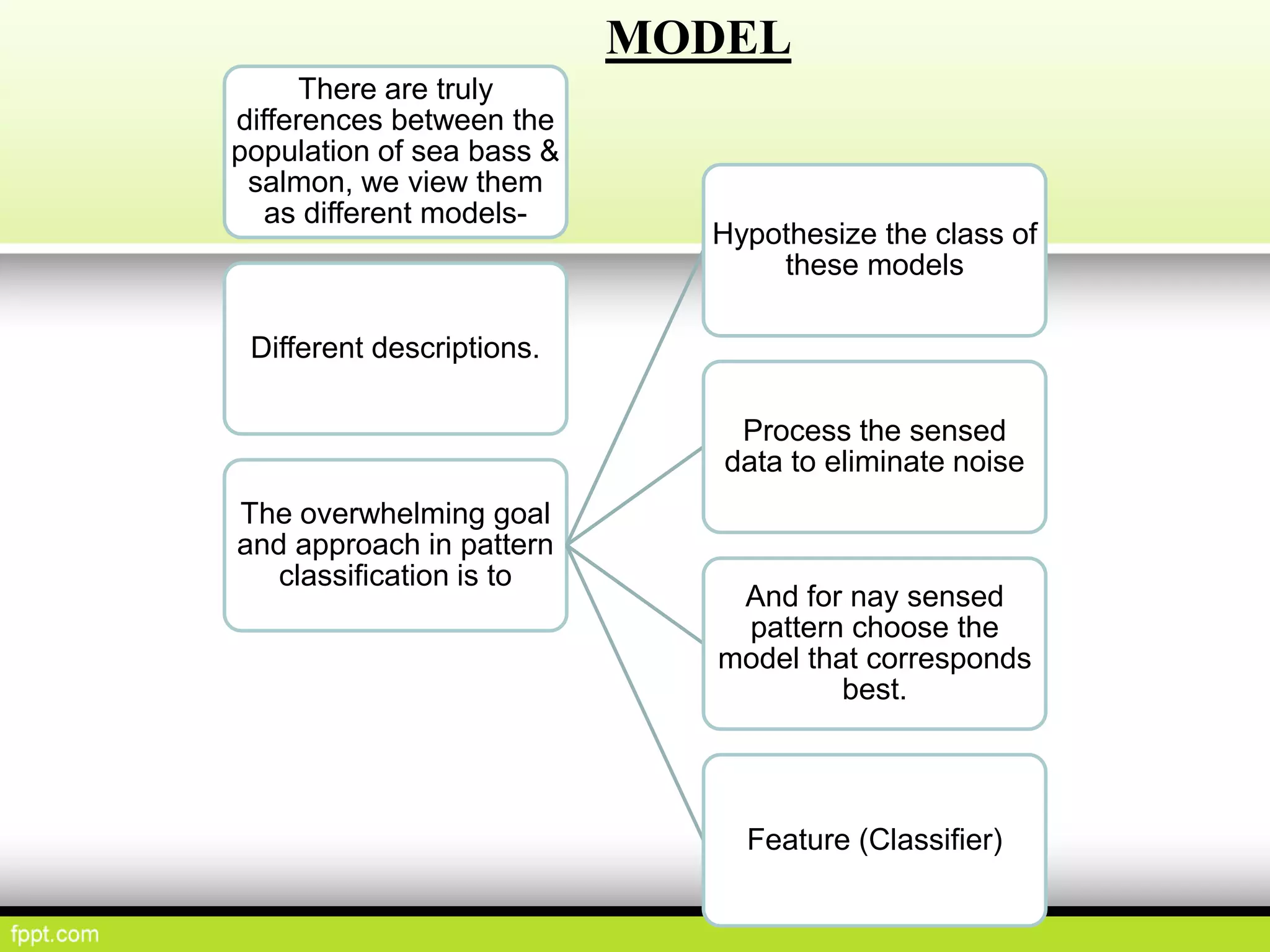
There are truly
differences between the
population of sea bass &
salmon, we view them
as different models-
Different descriptions.
The overwhelming goal
and approach in pattern
classification is to
Hypothesize the class of
these models
Process the sensed
data to eliminate noise
And for nay sensed
pattern choose the
model that corresponds
best.
Feature (Classifier)
PREPROCESSING SEGMENTATION
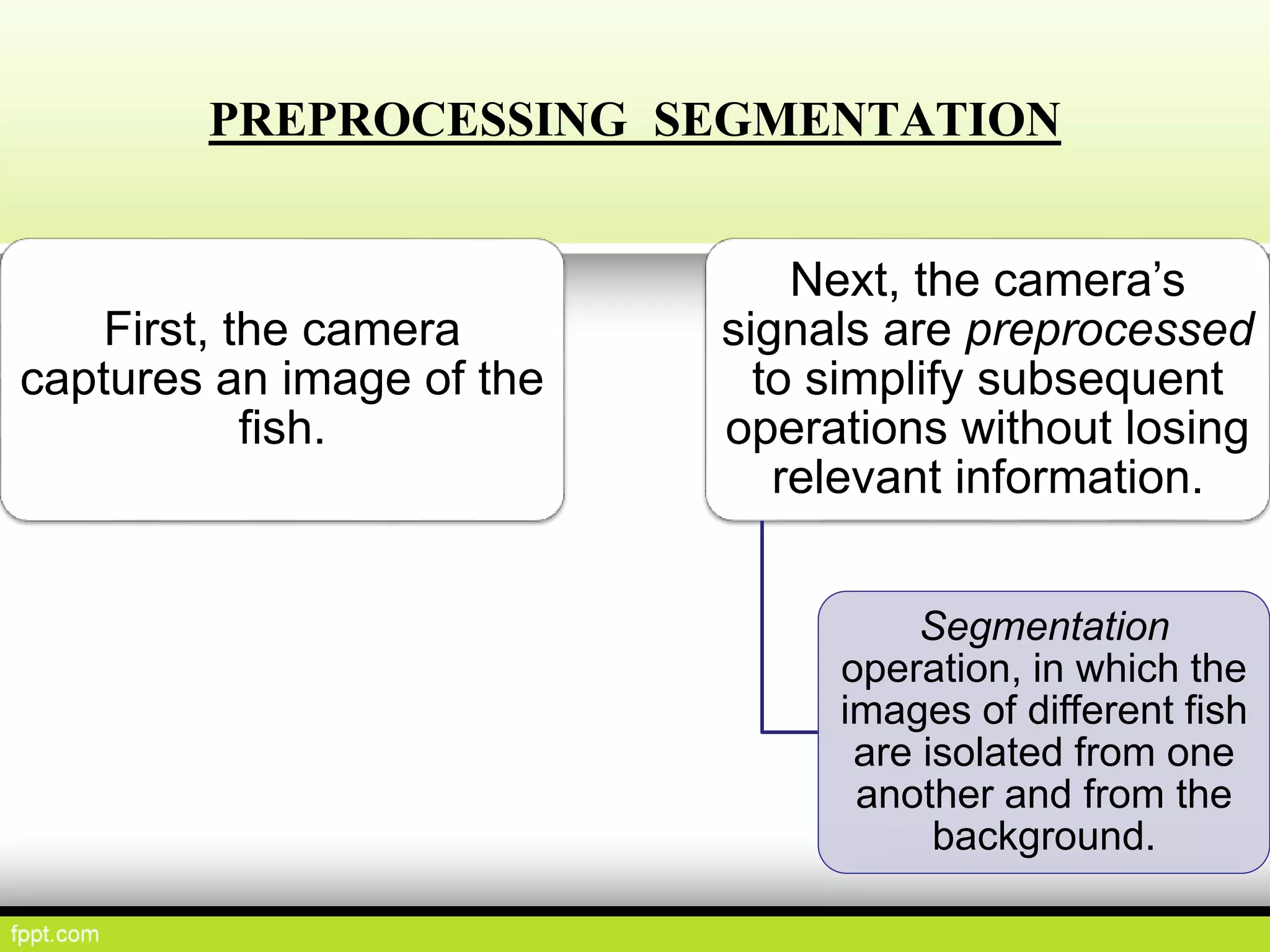
First, the camera
captures an image of the
fish.
Next, the camera’s
signals are preprocessed
to simplify subsequent
operations without losing
relevant information.
Segmentation
operation, in which the
images of different fish
are isolated from one
another and from the
background.
The information from a
single fish is then sent
to a Feature Extraction
• Whose purpose is to reduce
the data by measuring
certain “features” or
“properties”
• These features are then
passed to a classifier that
evaluates the evidence
presented and makes a final
decision as to the species.
• Sea bass have some typical length, and this is
greater than that of Salmon.
• Then length becomes an obvious feature, and we
might attempt to classify the fish merely by seeing
whether or not the length of a fish exceeds some
critical value(l*).
• To choose l* we could obtain some DESIGN OR
TRAINING SAMPLES of the different types of fish,
make length measurements & inspect the result.
• Other factors are:
• Cost
• Decision theory
• Decision boundary
• Generalization
• Analysis by synthesis.
These, then give us our
tentative models for the fish
PATTERN RECOGNITION SYSTEM
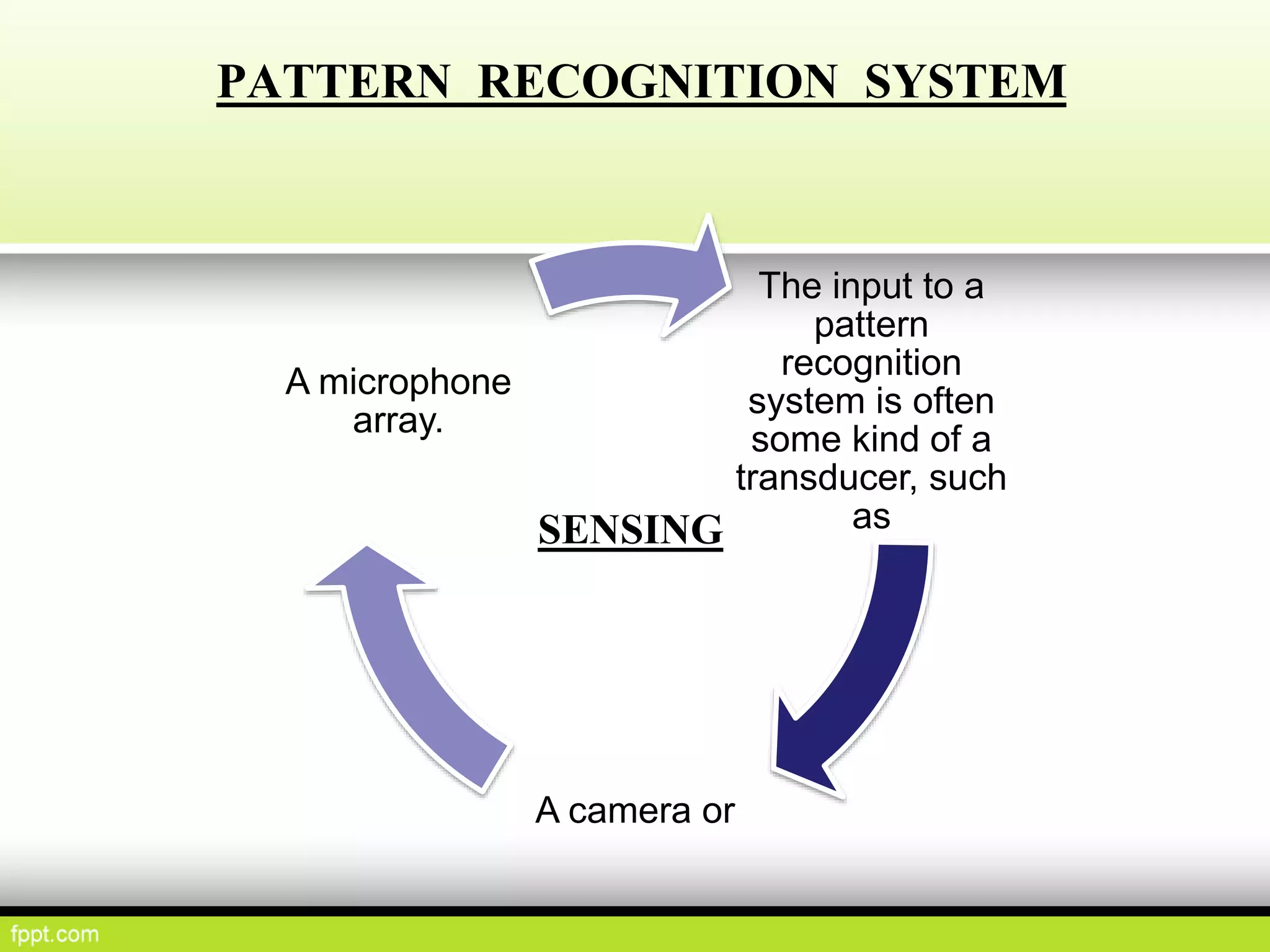
The input to a
pattern
recognition
system is often
some kind of a
transducer, such
as
A camera or
A microphone
array.
SENSING
Segmentation
& Grouping
Mereology
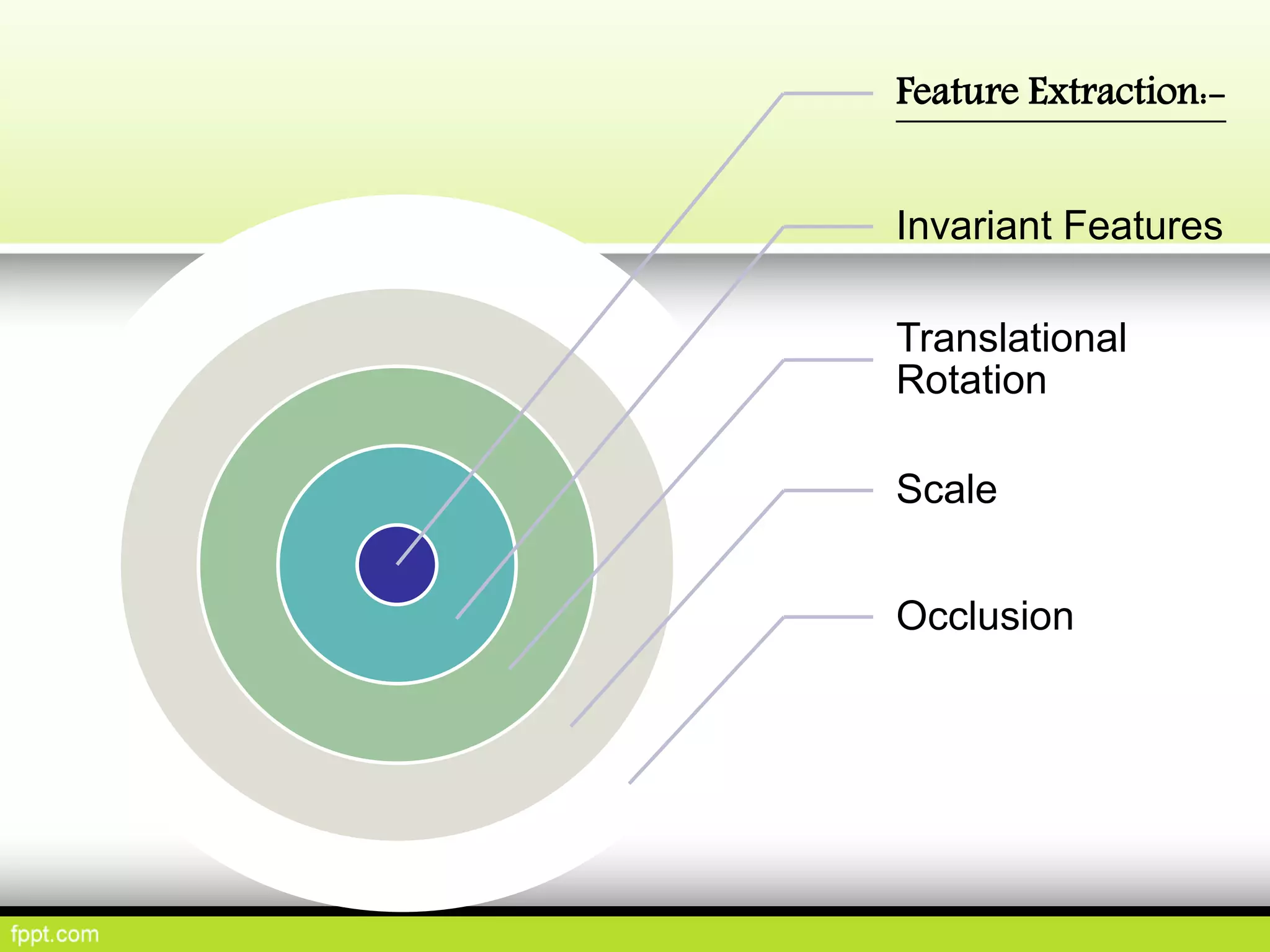
Feature Extraction:-
Invariant Features
Translational
Rotation
Scale
Occlusion
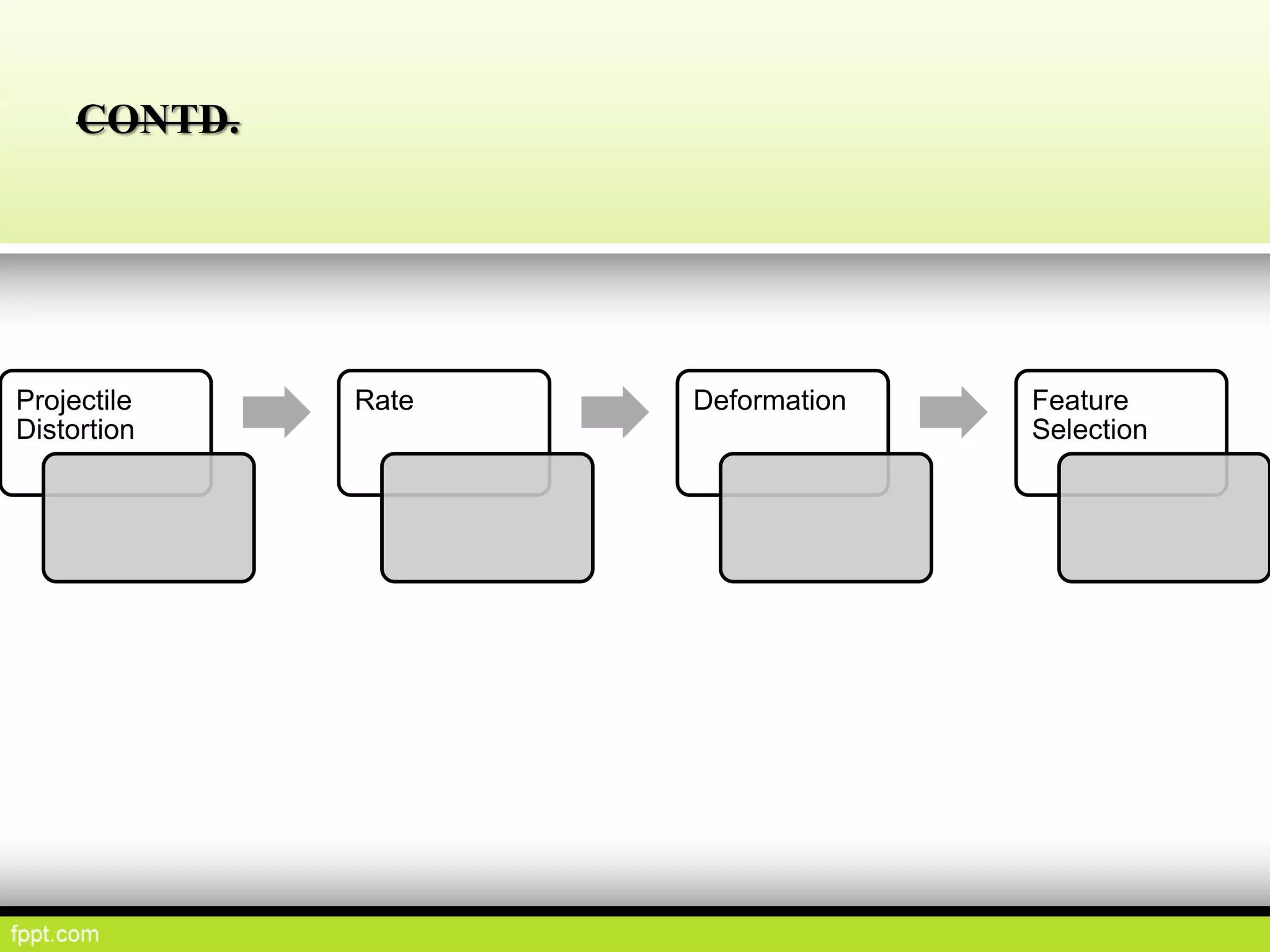
CONTD.
Projectile
Distortion
Rate Deformation Feature
Selection
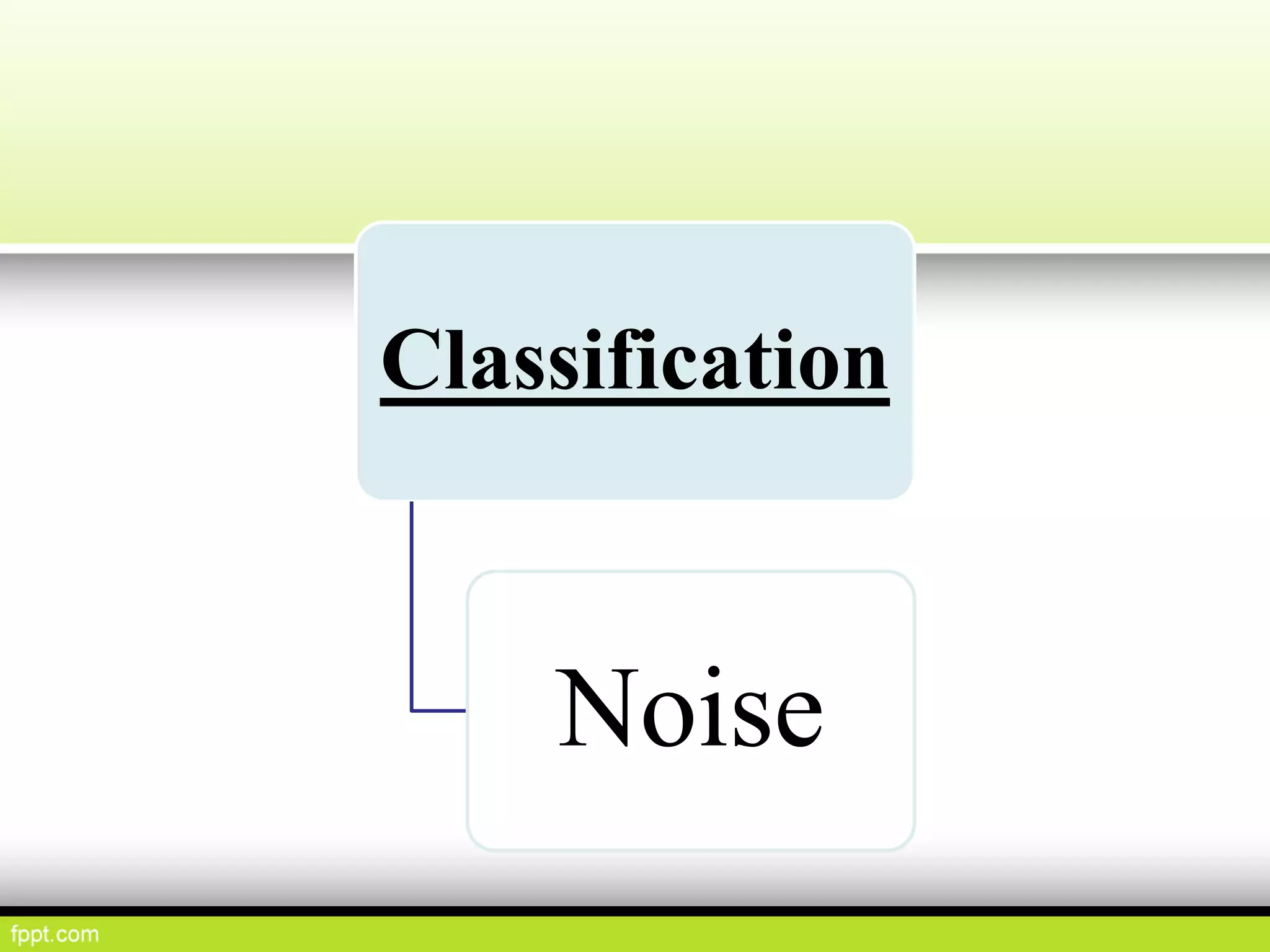
Classification
Noise
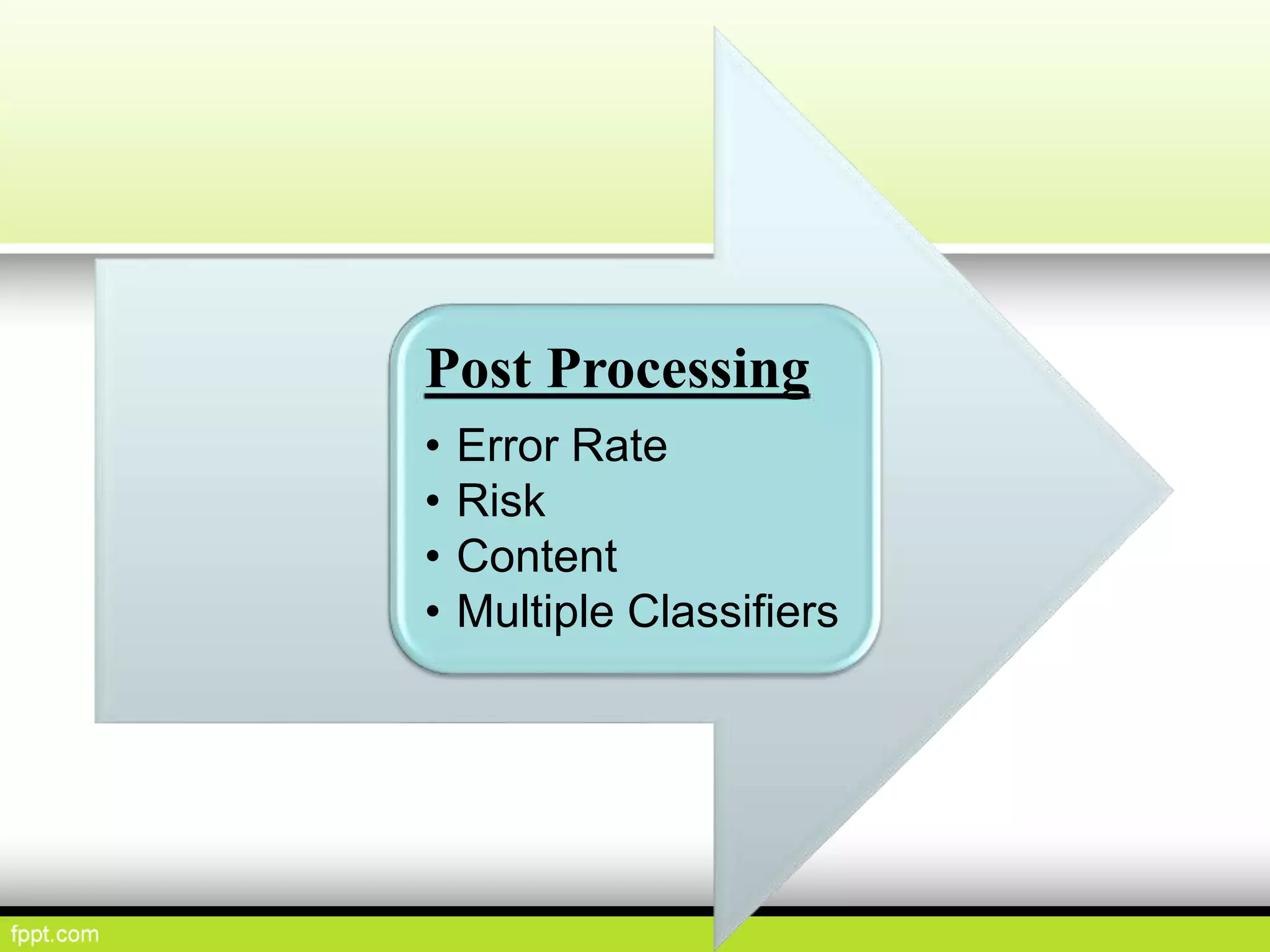
Post Processing
• Error Rate
• Risk
• Content
• Multiple Classifiers
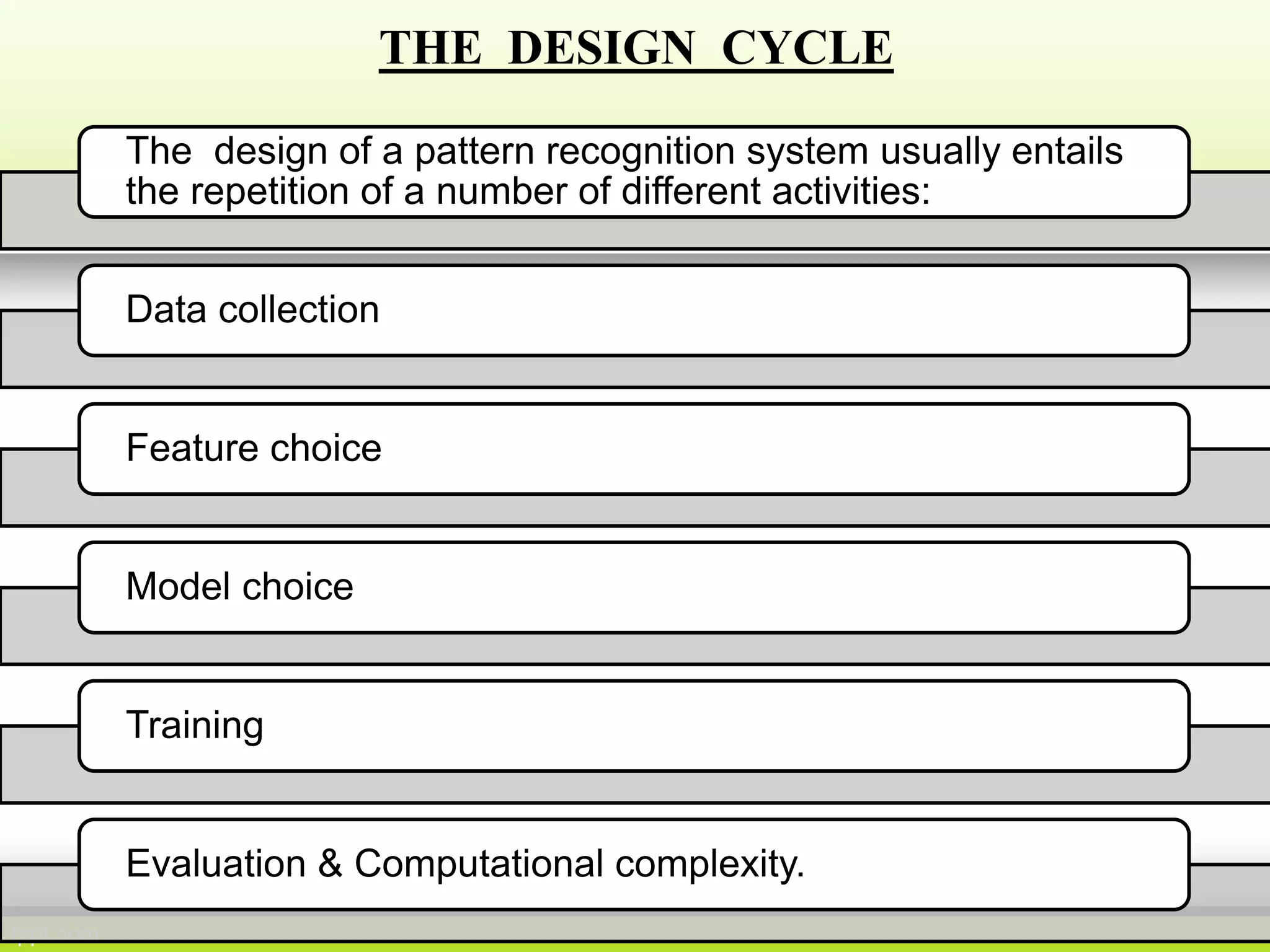
THE DESIGN CYCLE
The design of a pattern recognition system usually entails
the repetition of a number of different activities:
Data collection
Feature choice
Model choice
Training
Evaluation & Computational complexity.
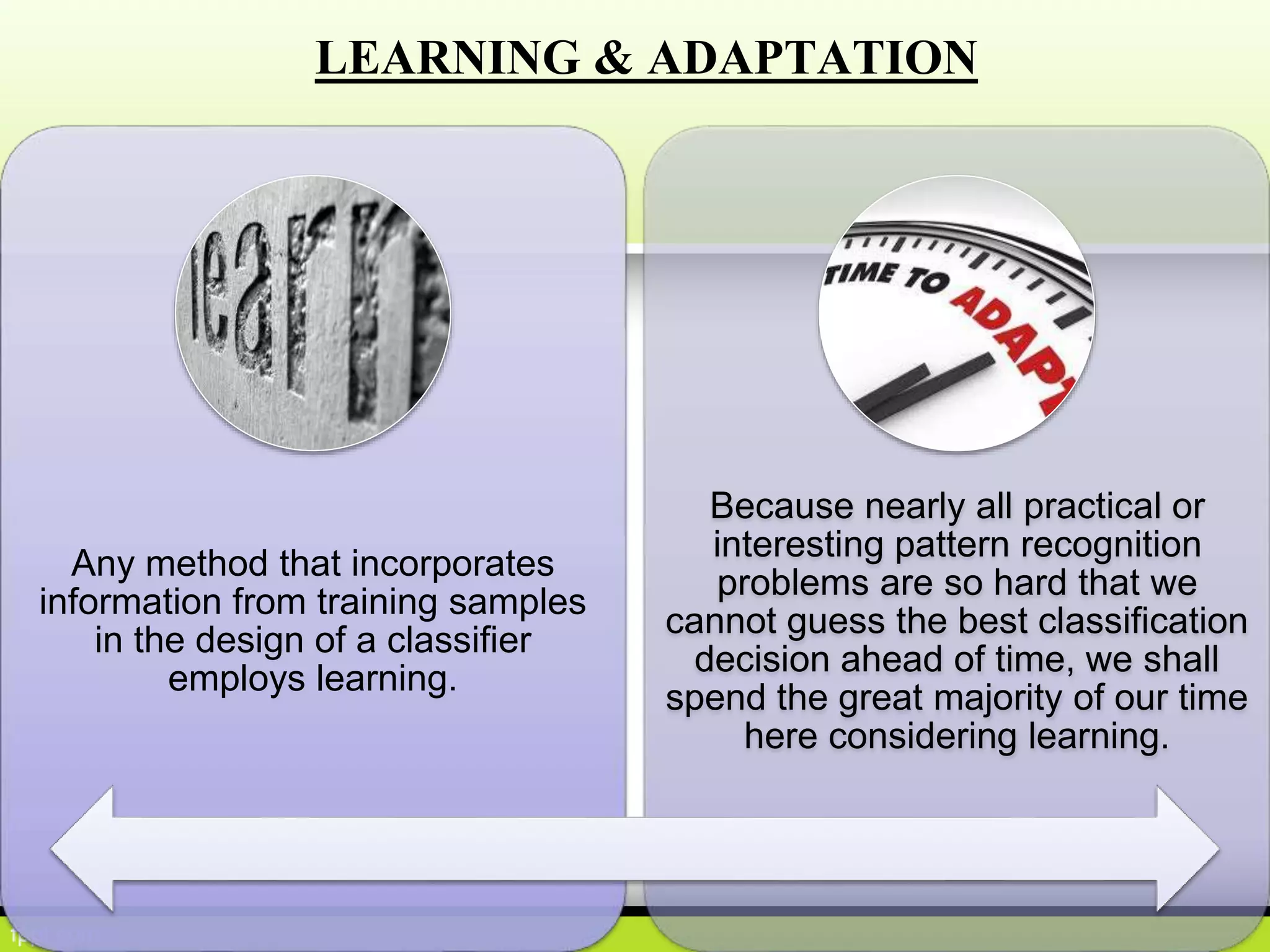
LEARNING & ADAPTATION
Any method that incorporates
information from training samples
in the design of a classifier
employs learning.
Because nearly all practical or
interesting pattern recognition
problems are so hard that we
cannot guess the best classification
decision ahead of time, we shall
spend the great majority of our time
here considering learning.
Creating classifiers
then involves positing
some general form of
model,
Or form of
classifiers,
And using training
patterns to learn
or estimate the
unknown
parameters of the
model.
Learning refers to some form of
algorithm for reducing the error
on a set of training data.
A range of gradient descent
algorithms that alter a
classifiers parameters in order
to reduce an error measure
now permeate the field of
statistical pattern recognition,
And these will demand a great
deal of our attention.
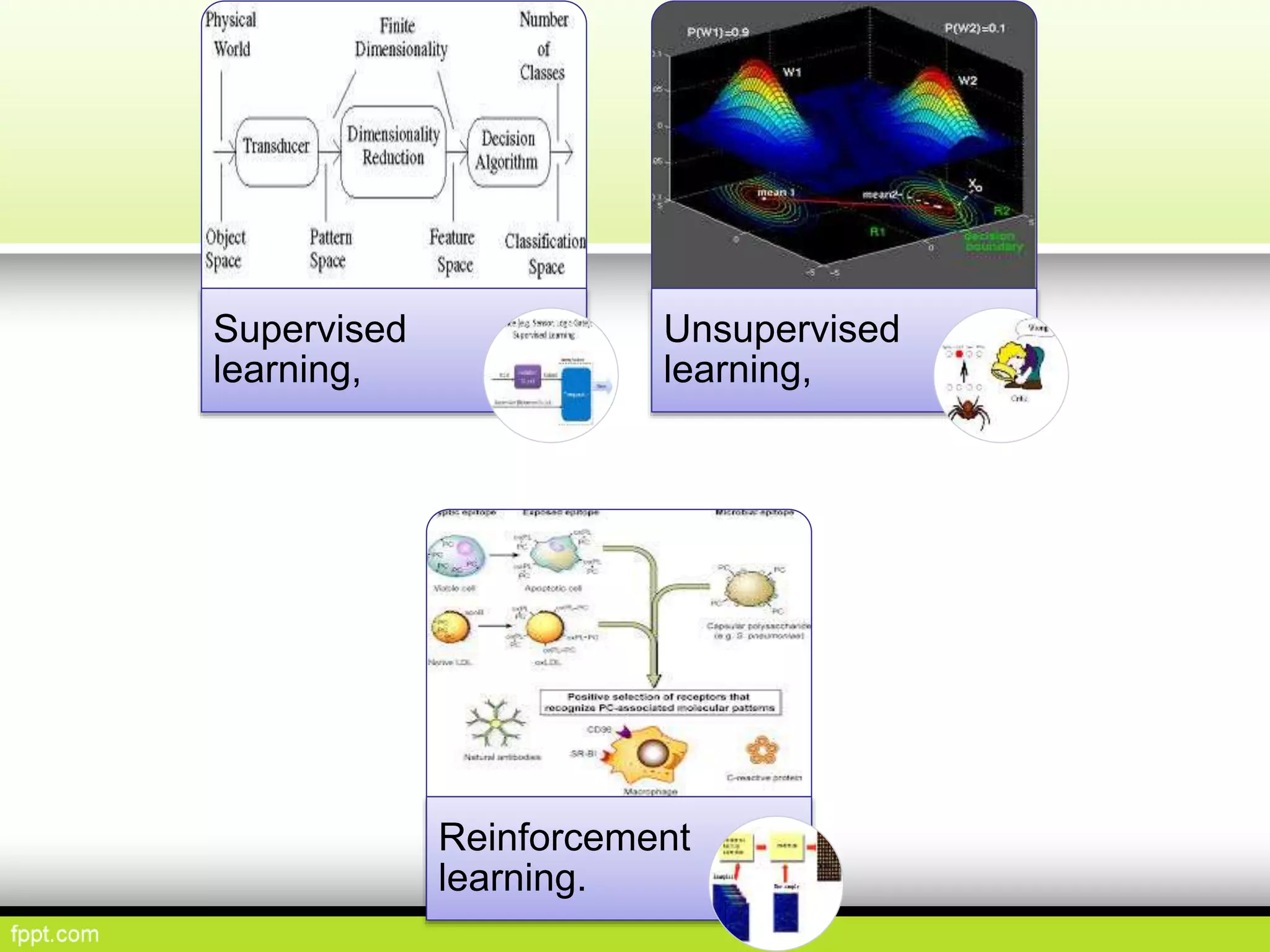
Learning comes in several
general forms.
Supervised
learning,
Unsupervised
learning,
Reinforcement
learning.
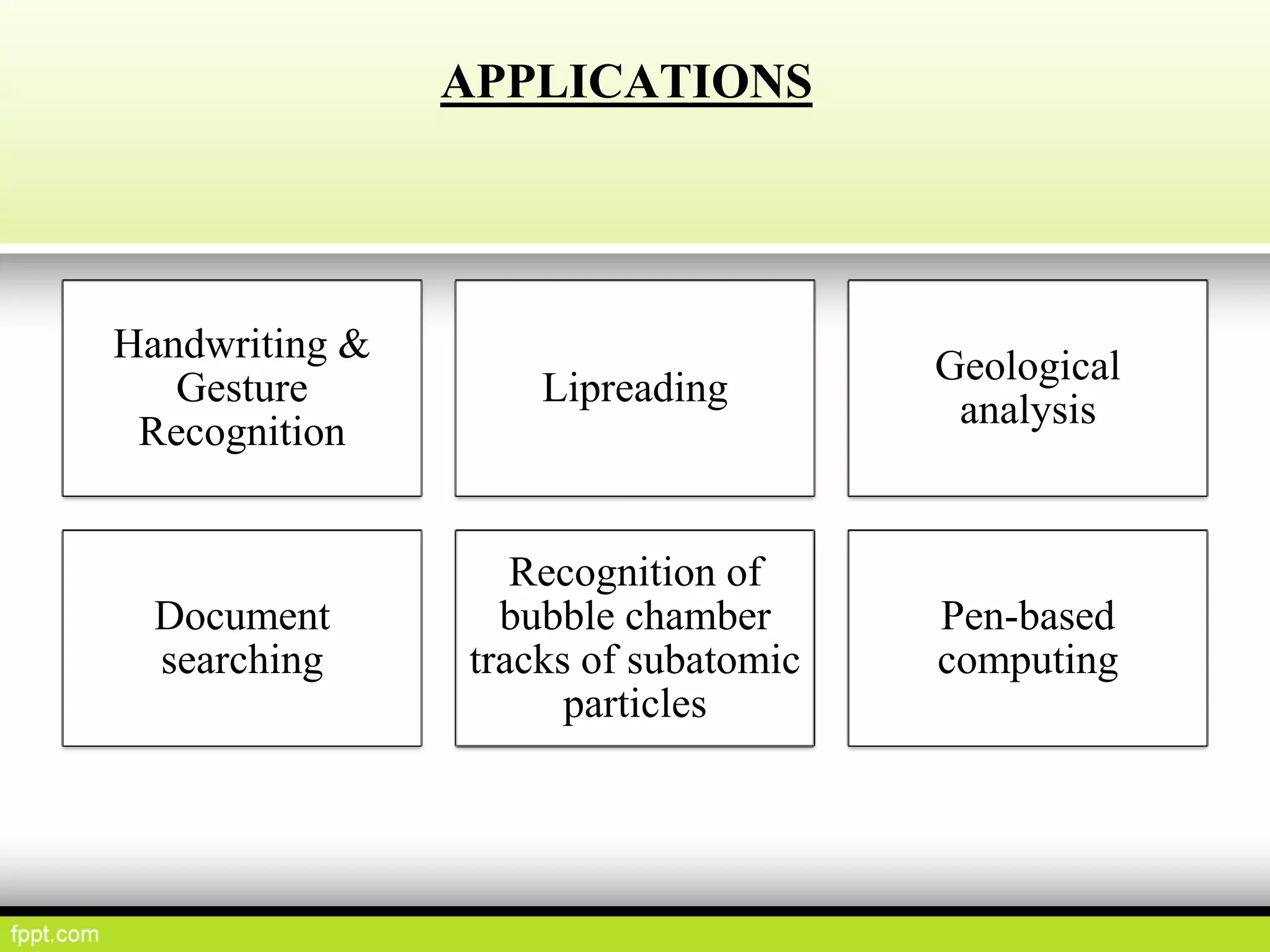
APPLICATIONS
Handwriting &
Gesture
Recognition
Lipreading
Geological
analysis
Document
searching
Recognition of
bubble chamber
tracks of subatomic
particles
Pen-based
computing
THANK
YOU…!!!

S.c ppt

  • 1.
  • 2.
    INTROMISSION It is theact of taking in raw data and making an action based on the “category” of the pattern. - Have evolved highly sophisticated neural and cognitive systems for such tasks. The ease with which we recognize a face, understand spoken words, read handwritten characters, identify our car keys in our pocket by feel, an decide whether an apple is ripe by its smell belies the astoundingly complex processes that underlie these acts of pattern recognition.
  • 3.
    MODEL There are truly differencesbetween the population of sea bass & salmon, we view them as different models- Different descriptions. The overwhelming goal and approach in pattern classification is to Hypothesize the class of these models Process the sensed data to eliminate noise And for nay sensed pattern choose the model that corresponds best. Feature (Classifier)
  • 4.
    PREPROCESSING SEGMENTATION First, thecamera captures an image of the fish. Next, the camera’s signals are preprocessed to simplify subsequent operations without losing relevant information. Segmentation operation, in which the images of different fish are isolated from one another and from the background.
  • 5.
    The information froma single fish is then sent to a Feature Extraction • Whose purpose is to reduce the data by measuring certain “features” or “properties” • These features are then passed to a classifier that evaluates the evidence presented and makes a final decision as to the species.
  • 6.
    • Sea basshave some typical length, and this is greater than that of Salmon. • Then length becomes an obvious feature, and we might attempt to classify the fish merely by seeing whether or not the length of a fish exceeds some critical value(l*). • To choose l* we could obtain some DESIGN OR TRAINING SAMPLES of the different types of fish, make length measurements & inspect the result. • Other factors are: • Cost • Decision theory • Decision boundary • Generalization • Analysis by synthesis. These, then give us our tentative models for the fish
  • 7.
    PATTERN RECOGNITION SYSTEM Theinput to a pattern recognition system is often some kind of a transducer, such as A camera or A microphone array. SENSING
  • 8.
  • 9.
  • 10.
  • 11.
  • 12.
    Post Processing • ErrorRate • Risk • Content • Multiple Classifiers
  • 13.
    THE DESIGN CYCLE Thedesign of a pattern recognition system usually entails the repetition of a number of different activities: Data collection Feature choice Model choice Training Evaluation & Computational complexity.
  • 14.
    LEARNING & ADAPTATION Anymethod that incorporates information from training samples in the design of a classifier employs learning. Because nearly all practical or interesting pattern recognition problems are so hard that we cannot guess the best classification decision ahead of time, we shall spend the great majority of our time here considering learning.
  • 15.
    Creating classifiers then involvespositing some general form of model, Or form of classifiers, And using training patterns to learn or estimate the unknown parameters of the model.
  • 16.
    Learning refers tosome form of algorithm for reducing the error on a set of training data. A range of gradient descent algorithms that alter a classifiers parameters in order to reduce an error measure now permeate the field of statistical pattern recognition, And these will demand a great deal of our attention. Learning comes in several general forms.
  • 17.
  • 18.
  • 19.