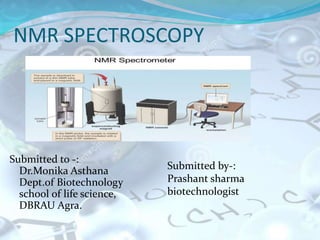
NMR SPECTROSCOPY
Submitted to -:
Dr.Monika Asthana
Dept.of Biotechnology
school of life science,
DBRAU Agra.
Submitted by-:
Prashant sharma
biotechnologist
INTRODUCTION
 NMR spectroscopy stands for nuclear magnetic
resonance spectroscopy
 NMR spectroscopy is a analytical technique which is
used in characterizing organic molecules by
identifying carbon hydrogen frameworks
 This technique utilizes the magnetic properties of
some nmr active substances
 Nmr spectroscopy works on the spin of the nucleus as
well as the standard absobtion phenomenon of
spectroscopy
HISTORY OF NMR
 The Purcell group at Harvard University and the Bloch
group at Stanford University independently developed
NMR spectroscopy in the late 1940s and early 1950s.
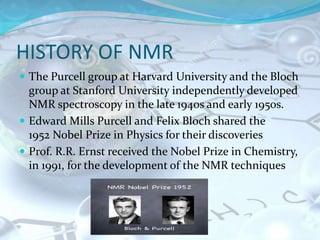
 Edward Mills Purcell and Felix Bloch shared the
1952 Nobel Prize in Physics for their discoveries
 Prof. R.R. Ernst received the Nobel Prize in Chemistry,
in 1991, for the development of the NMR techniques
TYPES OF NMR
 There are various types of NMR SPECTROSCOPY but
the most common are of two types which are
charachterized on the basis of atoms used
 1 H1 NMR -: it is used to study the types and number of
H atoms
 2 C13 NMR-: it is used to study the types of different
carbon atoms
Source of NMR
 The source of nmr is radio waves which have a ong
wavelength having more than 107 nm and thus low
frequency and energy
 When these low energy waves interact with a molecule
they can change the nuclear spins of the some
elements including 1H and 13C
PRINCIPLES OF NMR
 The principle behind NMR comes from
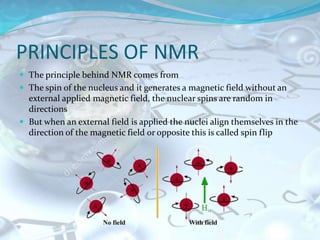
 The spin of the nucleus and it generates a magnetic field without an
external applied magnetic field, the nuclear spins are random in
directions
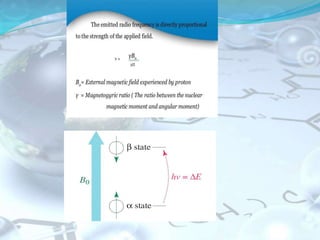
 But when an external field is applied the nuclei align themselves in the
direction of the magnetic field or opposite this is called spin flip
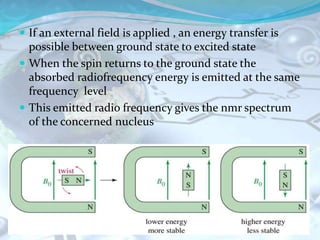
 If an external field is applied , an energy transfer is
possible between ground state to excited state
 When the spin returns to the ground state the
absorbed radiofrequency energy is emitted at the same
frequency level
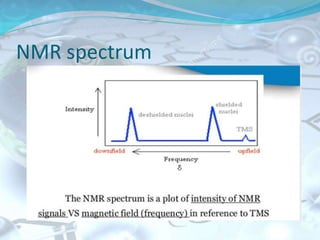
 This emitted radio frequency gives the nmr spectrum
of the concerned nucleus
NMR spectrum
INSTRUMENTATION
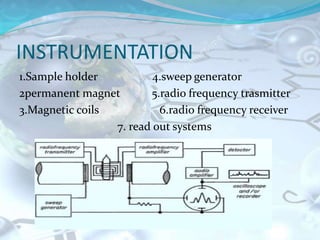
1.Sample holder 4.sweep generator
2permanent magnet 5.radio frequency trasmitter
3.Magnetic coils 6.radio frequency receiver
7. read out systems
.
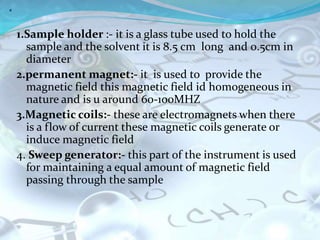
1.Sample holder :- it is a glass tube used to hold the
sample and the solvent it is 8.5 cm long and 0.5cm in
diameter
2.permanent magnet:- it is used to provide the
magnetic field this magnetic field id homogeneous in
nature and is u around 60-100MHZ
3.Magnetic coils:- these are electromagnets when there
is a flow of current these magnetic coils generate or
induce magnetic field
4. Sweep generator:- this part of the instrument is used
for maintaining a equal amount of magnetic field
passing through the sample
5.Radio frequency transmitter-: it is the radio
transmitter coil that produces a short powerfull pulse
of radio wave
6.Radio frequency receiver-: it is a radio coil that
detects the radio frequency emitted by the nuclei as
they relax to a lower energy state
7.Readout system-:it is the computer that records and
analyses the data and records are then shown in the
form of graph
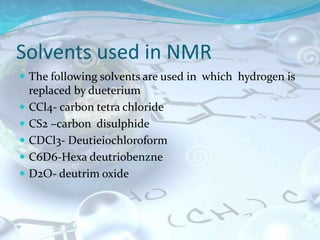
Solvents used in NMR
 The following solvents are used in which hydrogen is
replaced by dueterium
 CCl4- carbon tetra chloride
 CS2 –carbon disulphide
 CDCl3- Deutieiochloroform
 C6D6-Hexa deutriobenzne
 D2O- deutrim oxide
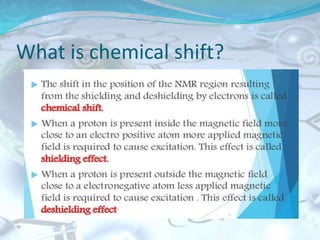
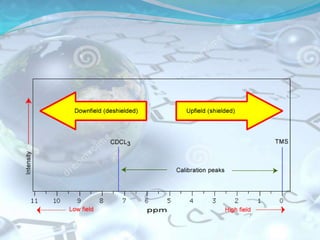
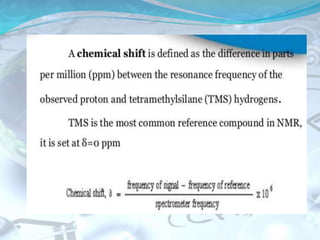
What is chemical shift?
Working of NMR
 The sample is dissolved in a solvent usually CDCl3and
placed in a magnetic field
 A radiofrequency generator then irradiates the sample
with a short pulse of radiation ,causing resonance of
the proton
 When the nuclie fall back to their lowest energy state
,the detector mausres the energy released and a
spectrum is recorded in the form of graph
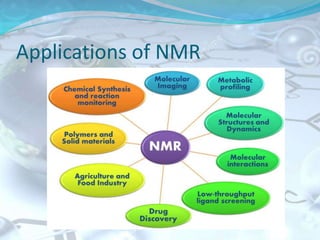
Applications of NMR
Nmr spectroscopy
Nmr spectroscopy

Nmr spectroscopy

  • 1.
    NMR SPECTROSCOPY Submitted to-: Dr.Monika Asthana Dept.of Biotechnology school of life science, DBRAU Agra. Submitted by-: Prashant sharma biotechnologist
  • 3.
    INTRODUCTION  NMR spectroscopystands for nuclear magnetic resonance spectroscopy  NMR spectroscopy is a analytical technique which is used in characterizing organic molecules by identifying carbon hydrogen frameworks  This technique utilizes the magnetic properties of some nmr active substances  Nmr spectroscopy works on the spin of the nucleus as well as the standard absobtion phenomenon of spectroscopy
  • 4.
    HISTORY OF NMR The Purcell group at Harvard University and the Bloch group at Stanford University independently developed NMR spectroscopy in the late 1940s and early 1950s.  Edward Mills Purcell and Felix Bloch shared the 1952 Nobel Prize in Physics for their discoveries  Prof. R.R. Ernst received the Nobel Prize in Chemistry, in 1991, for the development of the NMR techniques
  • 5.
    TYPES OF NMR There are various types of NMR SPECTROSCOPY but the most common are of two types which are charachterized on the basis of atoms used  1 H1 NMR -: it is used to study the types and number of H atoms  2 C13 NMR-: it is used to study the types of different carbon atoms
  • 6.
    Source of NMR The source of nmr is radio waves which have a ong wavelength having more than 107 nm and thus low frequency and energy  When these low energy waves interact with a molecule they can change the nuclear spins of the some elements including 1H and 13C
  • 7.
    PRINCIPLES OF NMR The principle behind NMR comes from  The spin of the nucleus and it generates a magnetic field without an external applied magnetic field, the nuclear spins are random in directions  But when an external field is applied the nuclei align themselves in the direction of the magnetic field or opposite this is called spin flip
  • 8.
     If anexternal field is applied , an energy transfer is possible between ground state to excited state  When the spin returns to the ground state the absorbed radiofrequency energy is emitted at the same frequency level  This emitted radio frequency gives the nmr spectrum of the concerned nucleus
  • 10.
  • 11.
    INSTRUMENTATION 1.Sample holder 4.sweepgenerator 2permanent magnet 5.radio frequency trasmitter 3.Magnetic coils 6.radio frequency receiver 7. read out systems
  • 12.
    . 1.Sample holder :-it is a glass tube used to hold the sample and the solvent it is 8.5 cm long and 0.5cm in diameter 2.permanent magnet:- it is used to provide the magnetic field this magnetic field id homogeneous in nature and is u around 60-100MHZ 3.Magnetic coils:- these are electromagnets when there is a flow of current these magnetic coils generate or induce magnetic field 4. Sweep generator:- this part of the instrument is used for maintaining a equal amount of magnetic field passing through the sample
  • 13.
    5.Radio frequency transmitter-:it is the radio transmitter coil that produces a short powerfull pulse of radio wave 6.Radio frequency receiver-: it is a radio coil that detects the radio frequency emitted by the nuclei as they relax to a lower energy state 7.Readout system-:it is the computer that records and analyses the data and records are then shown in the form of graph
  • 14.
    Solvents used inNMR  The following solvents are used in which hydrogen is replaced by dueterium  CCl4- carbon tetra chloride  CS2 –carbon disulphide  CDCl3- Deutieiochloroform  C6D6-Hexa deutriobenzne  D2O- deutrim oxide
  • 15.
  • 18.
    Working of NMR The sample is dissolved in a solvent usually CDCl3and placed in a magnetic field  A radiofrequency generator then irradiates the sample with a short pulse of radiation ,causing resonance of the proton  When the nuclie fall back to their lowest energy state ,the detector mausres the energy released and a spectrum is recorded in the form of graph
  • 19.