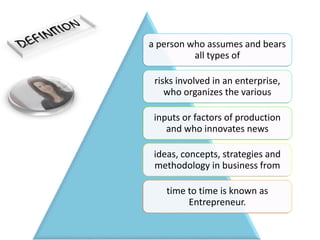
a person who assumes and bears
all types of
risks involved in an enterprise,
who organizes the various
inputs or factors of production
and who innovates news
ideas, concepts, strategies and
methodology in business from
time to time is known as
Entrepreneur.
Women’s equality is defined by women’s economic empowerment.
And the ultimate empowerment is through entrepreneurship.
Women-owned businesses are the fastest growing
force in the world’s economy.
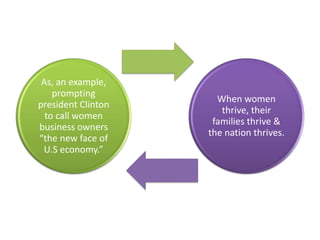
As, an example,
prompting
president Clinton
to call women
business owners
“the new face of
U.S economy.”
When women
thrive, their
families thrive &
the nation thrives.
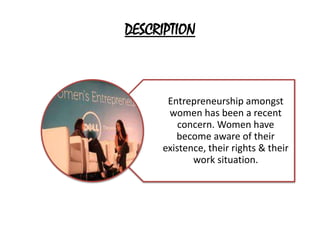
DESCRIPTION
Entrepreneurship amongst
women has been a recent
concern. Women have
become aware of their
existence, their rights & their
work situation.
Any understanding of Indian women, of their identity,
and especially of their role taking & breaking new paths,
will be incomplete without a walk down the corridors of
Indian history where women have paused, lived &
internalized various role models.
Some have taken entrepreneurship roles where
some have opted for employments,
some in entertainment field & some for
leadership roles while millions of others have
taken the role of ideal stereotyped social roles.
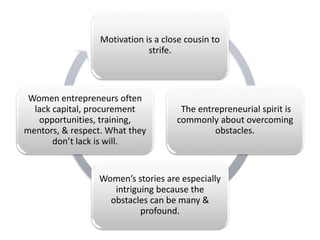
Motivation is a close cousin to
strife.
The entrepreneurial spirit is
commonly about overcoming
obstacles.
Women’s stories are especially
intriguing because the
obstacles can be many &
profound.
Women entrepreneurs often
lack capital, procurement
opportunities, training,
mentors, & respect. What they
don’t lack is will.
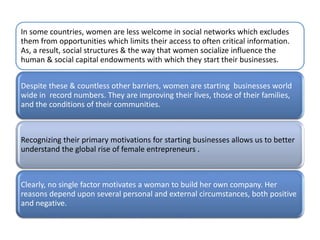
In some countries, women are less welcome in social networks which excludes
them from opportunities which limits their access to often critical information.
As, a result, social structures & the way that women socialize influence the
human & social capital endowments with which they start their businesses.
Despite these & countless other barriers, women are starting businesses world
wide in record numbers. They are improving their lives, those of their families,
and the conditions of their communities.
Recognizing their primary motivations for starting businesses allows us to better
understand the global rise of female entrepreneurs .
Clearly, no single factor motivates a woman to build her own company. Her
reasons depend upon several personal and external circumstances, both positive
and negative.
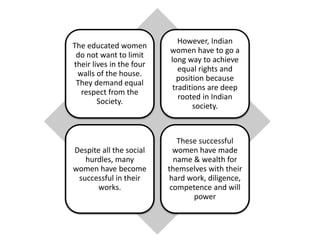
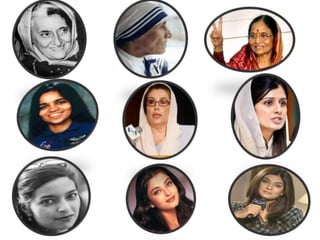
The educated women
do not want to limit
their lives in the four
walls of the house.
They demand equal
respect from the
Society.
However, Indian
women have to go a
long way to achieve
equal rights and
position because
traditions are deep
rooted in Indian
society.
Despite all the social
hurdles, many
women have become
successful in their
works.
These successful
women have made
name & wealth for
themselves with their
hard work, diligence,
competence and will
power
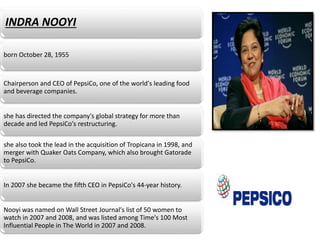
INDRA NOOYI
born October 28, 1955
Chairperson and CEO of PepsiCo, one of the worldʹs leading food
and beverage companies.
she has directed the companyʹs global strategy for more than
decade and led PepsiCoʹs restructuring.
she also took the lead in the acquisition of Tropicana in 1998, and
merger with Quaker Oats Company, which also brought Gatorade
to PepsiCo.
In 2007 she became the fifth CEO in PepsiCoʹs 44‐year history.
Nooyi was named on Wall Street Journalʹs list of 50 women to
watch in 2007 and 2008, and was listed among Timeʹs 100 Most
Influential People in The World in 2007 and 2008.
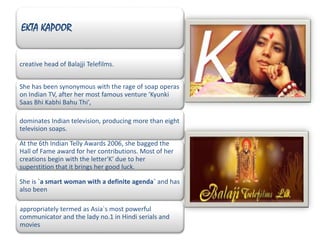
EKTA KAPOOR
creative head of Balajji Telefilms.
She has been synonymous with the rage of soap operas
on Indian TV, after her most famous venture ʹKyunki
Saas Bhi Kabhi Bahu Thiʹ,
dominates Indian television, producing more than eight
television soaps.
At the 6th Indian Telly Awards 2006, she bagged the
Hall of Fame award for her contributions. Most of her
creations begin with the letterʹKʹ due to her
superstition that it brings her good luck.
She is `a smart woman with a definite agenda` and has
also been
appropriately termed as Asia`s most powerful
communicator and the lady no.1 in Hindi serials and
movies
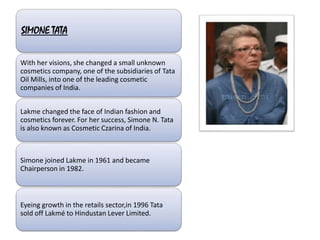
SIMONE TATA
With her visions, she changed a small unknown
cosmetics company, one of the subsidiaries of Tata
Oil Mills, into one of the leading cosmetic
companies of India.
Lakme changed the face of Indian fashion and
cosmetics forever. For her success, Simone N. Tata
is also known as Cosmetic Czarina of India.
Simone joined Lakme in 1961 and became
Chairperson in 1982.
Eyeing growth in the retails sector,in 1996 Tata
sold off Lakmé to Hindustan Lever Limited.
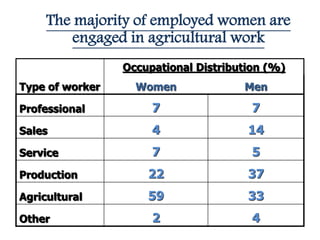
The majority of employed women are
engaged in agricultural work
Type of worker
Occupational Distribution (%)
Women Men
Professional 7 7
Sales 4 14
Service 7 5
Production 22 37
Agricultural 59 33
Other 2 4
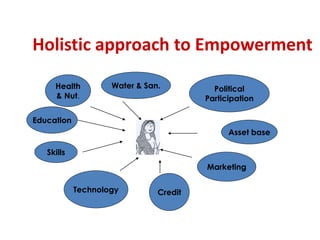
Holistic approach to Empowerment
Health
& Nut.
Education
Water & San.
Skills
Technology Credit
Political
Participation
Marketing
Asset base
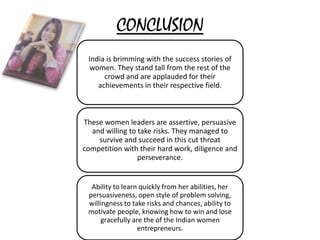
CONCLUSION
India is brimming with the success stories of
women. They stand tall from the rest of the
crowd and are applauded for their
achievements in their respective field.
These women leaders are assertive, persuasive
and willing to take risks. They managed to
survive and succeed in this cut throat
competition with their hard work, diligence and
perseverance.
Ability to learn quickly from her abilities, her
persuasiveness, open style of problem solving,
willingness to take risks and chances, ability to
motivate people, knowing how to win and lose
gracefully are the of the Indian women
entrepreneurs.
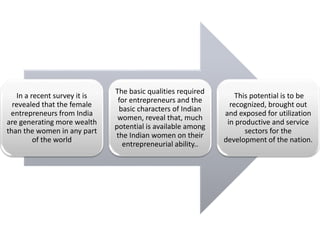
In a recent survey it is
revealed that the female
entrepreneurs from India
are generating more wealth
than the women in any part
of the world
The basic qualities required
for entrepreneurs and the
basic characters of Indian
women, reveal that, much
potential is available among
the Indian women on their
entrepreneurial ability..
This potential is to be
recognized, brought out
and exposed for utilization
in productive and service
sectors for the
development of the nation.
Knowing how to
win and lose
gracefully are the
of the Indian
women
entrepreneurs.
It can be said
that today we
are in a better
position wherein
women
participation in
the field of
entrepreneurship
is increasing.
• Here’s a lovely quote from Marianne Williamson, author
of A Woman’s Worth. Read it a few times to truly
appreciate all that she says.
• “Our deepest fear is not that we are inadequate. Our
deepest fear is that we are powerful beyond measure. It
is our light, not our darkness that most frightens us. We
ask ourselves, Who am I to be brilliant, gorgeous,
talented, fabulous? Actually, who are you not to be? You
are a child of God. Your playing small does not serve the
world. There is nothing enlightened about shrinking so
that other people won’t feel insecure around you. We
are all meant to shine, as children do. We were born to
make manifest the glory of God that is within us. It’s not
just in some of us; it’s in everyone. And as we let our
own light shine, we unconsciously give other people
permission to do the same. As we are liberated from our
own fear, our presence automatically liberates others.”
Wtp ppt
Wtp ppt

Wtp ppt

  • 2.
    a person whoassumes and bears all types of risks involved in an enterprise, who organizes the various inputs or factors of production and who innovates news ideas, concepts, strategies and methodology in business from time to time is known as Entrepreneur.
  • 3.
    Women’s equality isdefined by women’s economic empowerment. And the ultimate empowerment is through entrepreneurship. Women-owned businesses are the fastest growing force in the world’s economy.
  • 4.
    As, an example, prompting presidentClinton to call women business owners “the new face of U.S economy.” When women thrive, their families thrive & the nation thrives.
  • 5.
    DESCRIPTION Entrepreneurship amongst women hasbeen a recent concern. Women have become aware of their existence, their rights & their work situation.
  • 6.
    Any understanding ofIndian women, of their identity, and especially of their role taking & breaking new paths, will be incomplete without a walk down the corridors of Indian history where women have paused, lived & internalized various role models. Some have taken entrepreneurship roles where some have opted for employments, some in entertainment field & some for leadership roles while millions of others have taken the role of ideal stereotyped social roles.
  • 7.
    Motivation is aclose cousin to strife. The entrepreneurial spirit is commonly about overcoming obstacles. Women’s stories are especially intriguing because the obstacles can be many & profound. Women entrepreneurs often lack capital, procurement opportunities, training, mentors, & respect. What they don’t lack is will.
  • 8.
    In some countries,women are less welcome in social networks which excludes them from opportunities which limits their access to often critical information. As, a result, social structures & the way that women socialize influence the human & social capital endowments with which they start their businesses. Despite these & countless other barriers, women are starting businesses world wide in record numbers. They are improving their lives, those of their families, and the conditions of their communities. Recognizing their primary motivations for starting businesses allows us to better understand the global rise of female entrepreneurs . Clearly, no single factor motivates a woman to build her own company. Her reasons depend upon several personal and external circumstances, both positive and negative.
  • 9.
    The educated women donot want to limit their lives in the four walls of the house. They demand equal respect from the Society. However, Indian women have to go a long way to achieve equal rights and position because traditions are deep rooted in Indian society. Despite all the social hurdles, many women have become successful in their works. These successful women have made name & wealth for themselves with their hard work, diligence, competence and will power
  • 10.
    INDRA NOOYI born October28, 1955 Chairperson and CEO of PepsiCo, one of the worldʹs leading food and beverage companies. she has directed the companyʹs global strategy for more than decade and led PepsiCoʹs restructuring. she also took the lead in the acquisition of Tropicana in 1998, and merger with Quaker Oats Company, which also brought Gatorade to PepsiCo. In 2007 she became the fifth CEO in PepsiCoʹs 44‐year history. Nooyi was named on Wall Street Journalʹs list of 50 women to watch in 2007 and 2008, and was listed among Timeʹs 100 Most Influential People in The World in 2007 and 2008.
  • 11.
    EKTA KAPOOR creative headof Balajji Telefilms. She has been synonymous with the rage of soap operas on Indian TV, after her most famous venture ʹKyunki Saas Bhi Kabhi Bahu Thiʹ, dominates Indian television, producing more than eight television soaps. At the 6th Indian Telly Awards 2006, she bagged the Hall of Fame award for her contributions. Most of her creations begin with the letterʹKʹ due to her superstition that it brings her good luck. She is `a smart woman with a definite agenda` and has also been appropriately termed as Asia`s most powerful communicator and the lady no.1 in Hindi serials and movies
  • 12.
    SIMONE TATA With hervisions, she changed a small unknown cosmetics company, one of the subsidiaries of Tata Oil Mills, into one of the leading cosmetic companies of India. Lakme changed the face of Indian fashion and cosmetics forever. For her success, Simone N. Tata is also known as Cosmetic Czarina of India. Simone joined Lakme in 1961 and became Chairperson in 1982. Eyeing growth in the retails sector,in 1996 Tata sold off Lakmé to Hindustan Lever Limited.
  • 13.
    The majority ofemployed women are engaged in agricultural work Type of worker Occupational Distribution (%) Women Men Professional 7 7 Sales 4 14 Service 7 5 Production 22 37 Agricultural 59 33 Other 2 4
  • 14.
    Holistic approach toEmpowerment Health & Nut. Education Water & San. Skills Technology Credit Political Participation Marketing Asset base
  • 15.
    CONCLUSION India is brimmingwith the success stories of women. They stand tall from the rest of the crowd and are applauded for their achievements in their respective field. These women leaders are assertive, persuasive and willing to take risks. They managed to survive and succeed in this cut throat competition with their hard work, diligence and perseverance. Ability to learn quickly from her abilities, her persuasiveness, open style of problem solving, willingness to take risks and chances, ability to motivate people, knowing how to win and lose gracefully are the of the Indian women entrepreneurs.
  • 16.
    In a recentsurvey it is revealed that the female entrepreneurs from India are generating more wealth than the women in any part of the world The basic qualities required for entrepreneurs and the basic characters of Indian women, reveal that, much potential is available among the Indian women on their entrepreneurial ability.. This potential is to be recognized, brought out and exposed for utilization in productive and service sectors for the development of the nation.
  • 17.
    Knowing how to winand lose gracefully are the of the Indian women entrepreneurs. It can be said that today we are in a better position wherein women participation in the field of entrepreneurship is increasing.
  • 18.
    • Here’s alovely quote from Marianne Williamson, author of A Woman’s Worth. Read it a few times to truly appreciate all that she says. • “Our deepest fear is not that we are inadequate. Our deepest fear is that we are powerful beyond measure. It is our light, not our darkness that most frightens us. We ask ourselves, Who am I to be brilliant, gorgeous, talented, fabulous? Actually, who are you not to be? You are a child of God. Your playing small does not serve the world. There is nothing enlightened about shrinking so that other people won’t feel insecure around you. We are all meant to shine, as children do. We were born to make manifest the glory of God that is within us. It’s not just in some of us; it’s in everyone. And as we let our own light shine, we unconsciously give other people permission to do the same. As we are liberated from our own fear, our presence automatically liberates others.”