SUBMITTED BY: RAFA ZUBAIR N.V
I M.PHARM
(PHARMACOLOGY)
1)Introduction
2)Types of NMR
3) Proton NMR
4)Features of PNMR
5)Interpretation of PNMR
6)Applications
7)Difference between PNMR and C13 NMR
2
 It is the study of absorption of radiofrequency
radiation by nuclei in a magnetic field is called
Nuclear Magnetic Resonance.
 Nuclear magnetic resonance spectroscopy is
basically another form of absorption spectrometry.
It involve change of the spin state of a nucleus,
when the nucleus absorb electromagnetic radiation
in a strong magnetic field.
 The source of energy in NMR is radio waves which
have long wavelengths, and thus low energy and
frequency.
 When low-energy radio waves interact with a
molecule, they can change the nuclear spins of
some elements having spin state 1/2, including 1H
and 13C.
3
 Two common types of NMR spectroscopy are
used to characterize organic structure:
 1 H NMR:- Used to determine the type and
number of H atoms in a molecule.
 13 C NMR:- Used to determine the type of
carbon atoms in the molecule.
4
 It is a technique which is based on the
absorption of electromagnetic radiation in
the radio frequency region 4 to 900 MHz by
nuclei of the atoms.
 It is used to study a wide variety of nuclei:
1H ,15N, 19F, 13C, 31P.
 The most common form of NMR is based on
the hydrogen-1 (1H), nucleus or proton.
 It can give information about the structure
of any molecule containing hydrogen atoms.
5
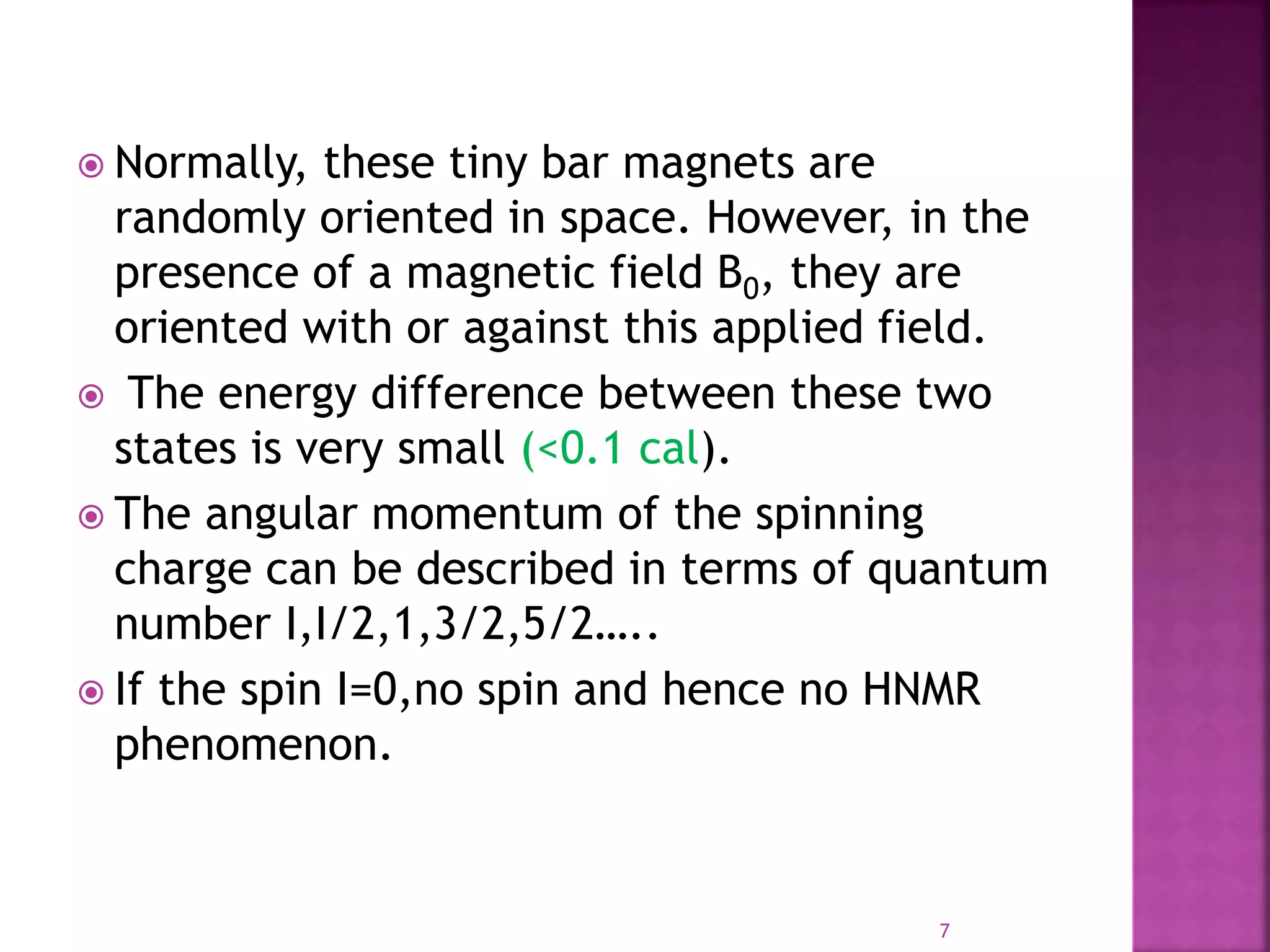
 When a charged particle such as a proton spins
on its axis, it creates a magnetic field. Thus,
the nucleus can be considered to be a tiny bar
magnet.
6
 Normally, these tiny bar magnets are
randomly oriented in space. However, in the
presence of a magnetic field B0, they are
oriented with or against this applied field.
 The energy difference between these two
states is very small (<0.1 cal).
 The angular momentum of the spinning
charge can be described in terms of quantum
number I,I/2,1,3/2,5/2…..
 If the spin I=0,no spin and hence no HNMR
phenomenon.
7
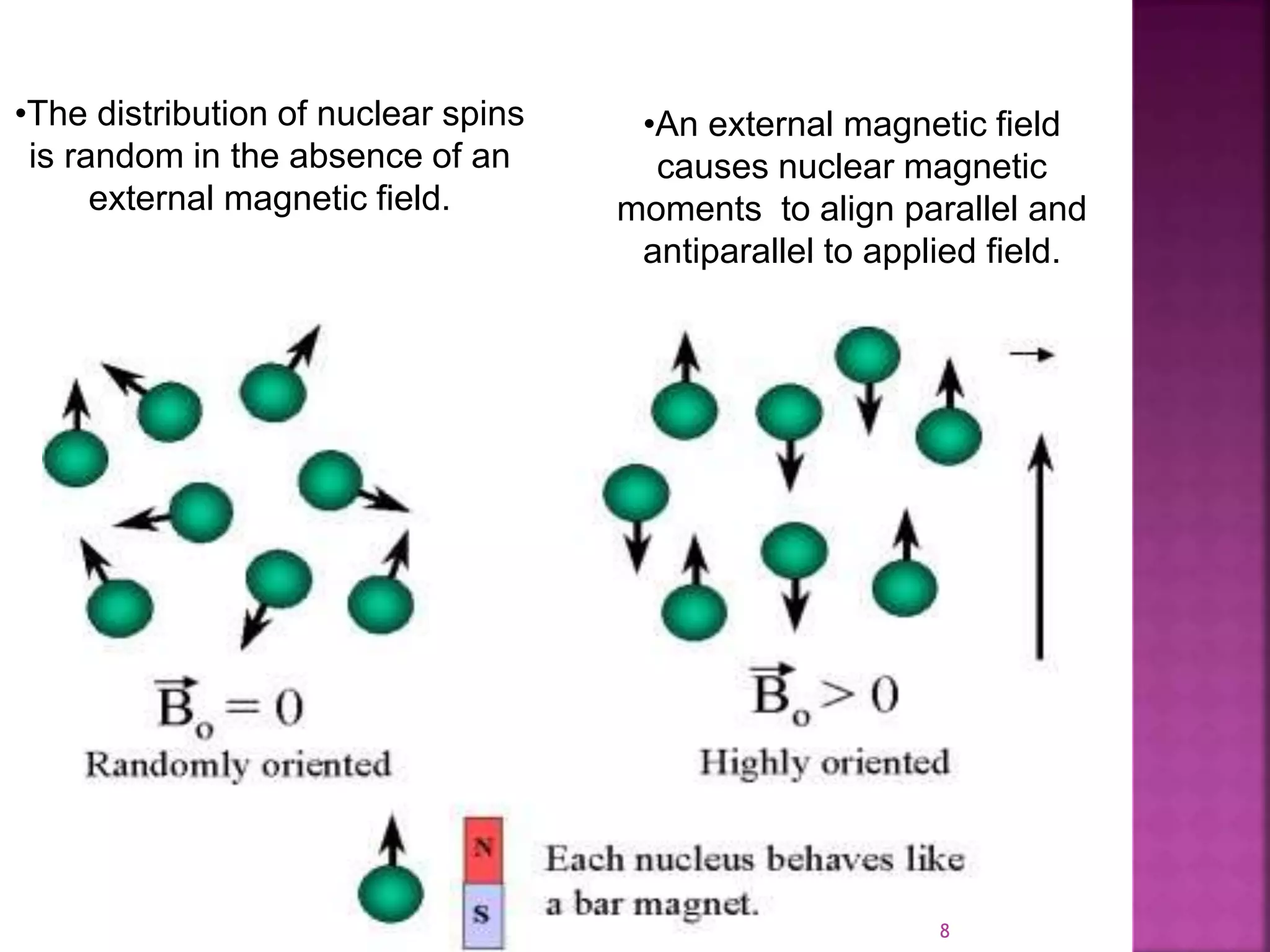
•The distribution of nuclear spins
is random in the absence of an
external magnetic field.
•An external magnetic field
causes nuclear magnetic
moments to align parallel and
antiparallel to applied field.
8
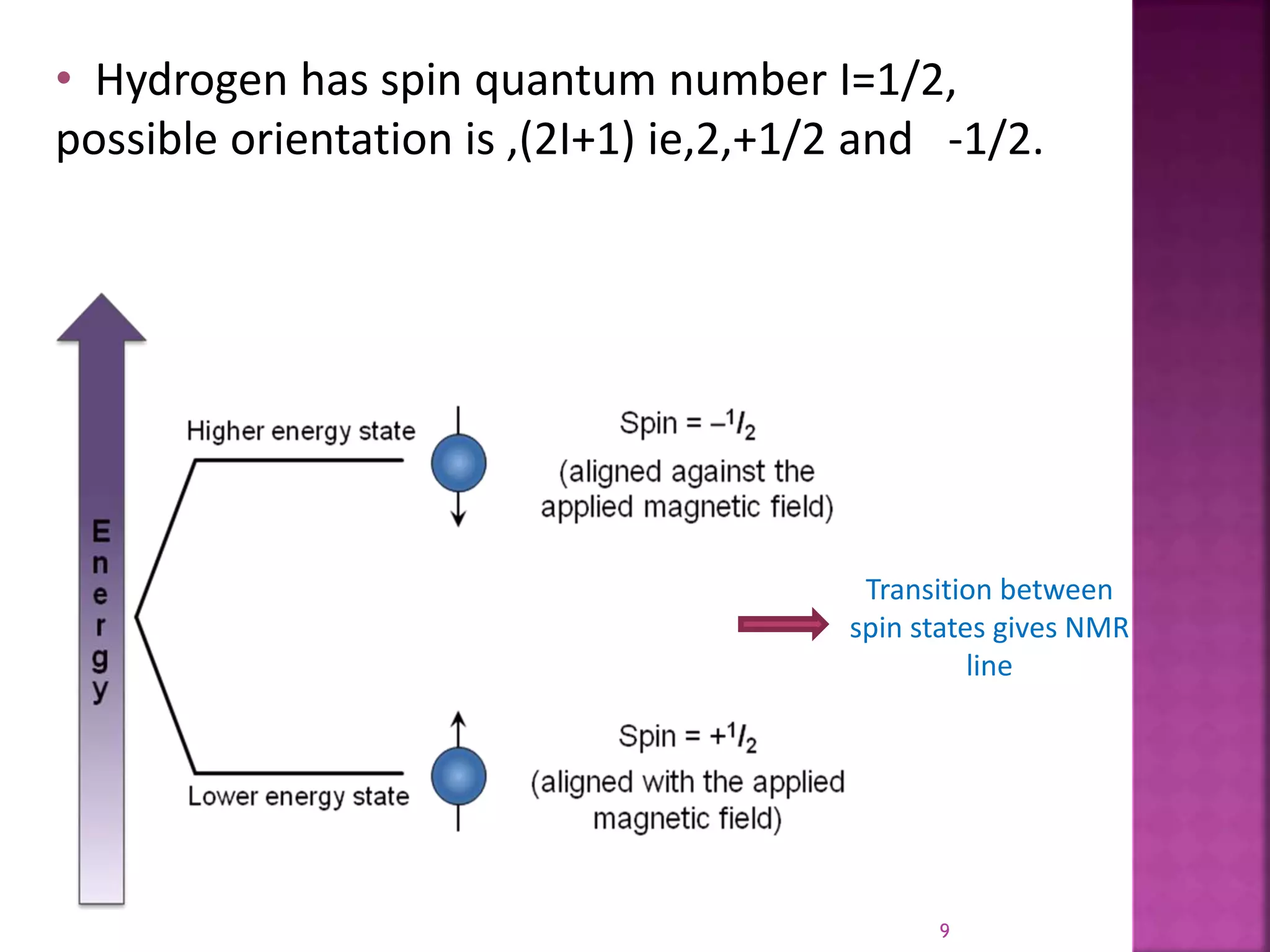
Transition between
spin states gives NMR
line
• Hydrogen has spin quantum number I=1/2,
possible orientation is ,(2I+1) ie,2,+1/2 and -1/2.
9
 Chemical Shift:
Chemical shift is the difference between the
absorption position of the sample proton and
the absorption position of reference
standard.
 Variations of the positions of NMR
absorptions due to the electronic shielding
and deshielding.
 Spin-spin coupling (splitting):
It is the interaction between the spins of
neighbouring nuclei in a molecule may cause
the splitting of NMR spectrum.
10
 Shielding and Deshielding:-
 The circulation of electron around the
protons itself generates field in a such way
that , it oppose the applied field.
 The field felt by the protons is thus
diminished and the proton is said to be
shielded and the absorption said to be
upfield.
 If the induced magnetic field reinforced the
applied magnetic field ,then the field felt by
the proton is augmented and the proton is
said to be deshielded and the absorption is
known as downfield.
11
 Natural abundance of 1H is 99.9844.
 PNMR is to determine type and number of H-
protons in a molecule.
 The source of energy in NMR is radio waves
which have long wavelengths, and thus low
energy and frequency
 The chemical shift range of PNMR is 0 to 14
ppm.
12
 PNMR is having coupling constant range 0 to 15
Hz.
 The solvent used for dissolving sample should
have following properties;
 Should not contain proton,
 Inexpensive
 Low boiling point and non polar in nature.
 Generally deuterated chloroform CDCl3 is used
as solvent.
13
 TMS is used as internal standard.
 Sodium salt of 3-(trimethyl silyl) propane
sulphonate is also used as solvent ,which is a
water soluble solvent.
 In PNMR ,continuous wave method is used.
 NMR absorptions appear as sharp peaks.
 There are three types of Proton isotopes
used in NMR,1Hydrogen,2Deuterium ,3Tritium.
14
1.Number of signals Indicate how many different
kinds of protons present.
2.Position of signals Indicate something about
(chemical shift), magnetic
(electronic) environment of
protons.
3.Relative intensity of signals Proportional to number of
protons present.
4.Splitting of signals
(spin spin coupling)
Indicatethe number of near by
nuclei usually protons.
15
 NMR spectrum of a substance gives very
valuable information about its molecular
structure.
 Hydrogen atoms in different environments
respond differently to the field
 Each different environment of protons
produce signal in a different positions
 Protons can classified as
1. Equivalent Protons
2.Non-Equivalent protons
 Equivalent protons will shows single signal
 Non – equivalent protons will shows more
than one signal.
16
 Equivalent Protons Non-Equivalent
EX. methane PROTONS
Ex.acetaldehyde
17
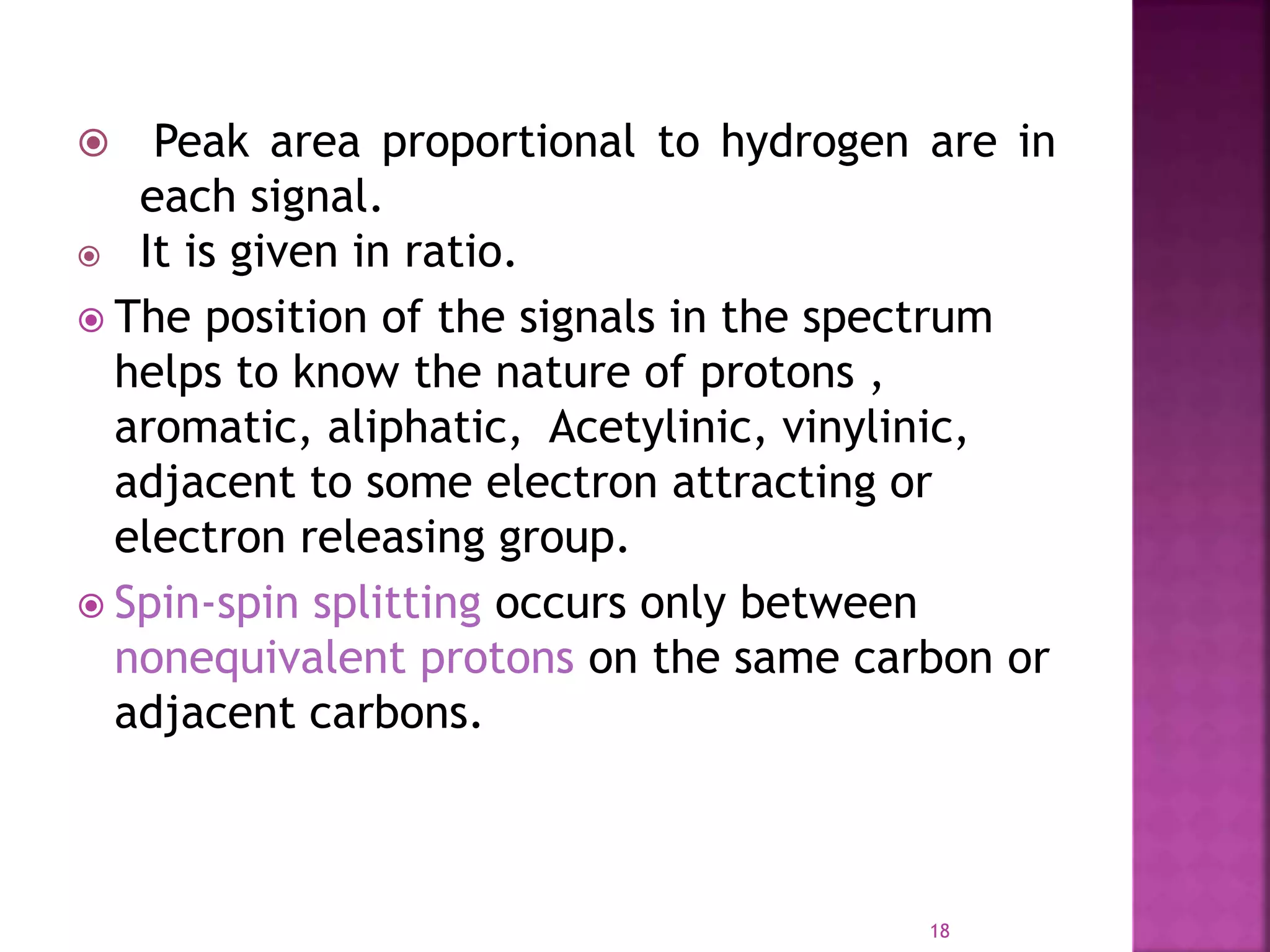
 Peak area proportional to hydrogen are in
each signal.
 It is given in ratio.
 The position of the signals in the spectrum
helps to know the nature of protons ,
aromatic, aliphatic, Acetylinic, vinylinic,
adjacent to some electron attracting or
electron releasing group.
 Spin-spin splitting occurs only between
nonequivalent protons on the same carbon or
adjacent carbons.
18
primary RCH3 0.9
secondary R2CH2 1.3
Tertiary R3CH 1.5
Allylic C=C-CH3 1.7
Vinylic C=C-H 4.6-5.9
Aromatic Ar-H 6-8.5
Ester R-OOR 2-2.2
Aldehyde R-CHO 9-10
Alcohol R-OH 3.4-4
Amide R-NH2 1-5
Ether R-O-R 3.3-4
Phenolic Ar-OH 4-12
Fluoride R-F 4-4.5
Chloride R-Cl 3-4
19
Chemical shifts for various types of protons with TMS as
standard reference
20
 Triplet = δ-1.7,3H (CH3 )
 Quartet= δ-3.4, 2H (CH2 )
1) Widely used for structure elucidation.
2) Inorganic solids-inorganic compounds are
investigated by solid state 1H-NMR.
Eg: CaSO4.H2O
3) Organic solids –solid 1H NMR constituents a
powerful approach to investigate the
hydrogen bonding and ionisation states of
small organic compounds.
direct correlation with hydrogen
bonding lengths could be demonstrated.
eg :for amino acid carboxyl groups.
21
4) Polymers and rubbers-examine hydrogen bonding
and acidity
5) Peptides and proteins
6) In vivo NMR studies
 concerned with 1H NMR
 spectroscopy of human brain
 many studies are concerned with altered levels of
metabolites in various brain diseases.
 to determine the spatial distribution of any given
metabolite detected spectroscopically .
7) Clinical and scientific research.
22
PNMR 13CNMR
1. It is study of spin changes of
proton nuclei.
1. It is study of spin changes of
carbon nuclei.
2. Chemical shift range is
0-14 ppm.
2. Chemical shift range is
0-240 ppm.
3. Continuous wave method is
used
3. Fourier transform Technique
is used.
4.slow process. 4.Very fast process.
5. Coupling constant range is
0-15Hz.
5. Coupling constant range is
125-250Hz.
6.Peak overlapping seen in
complex samples.
6.No peak overlapping seen in
spectrum.
23
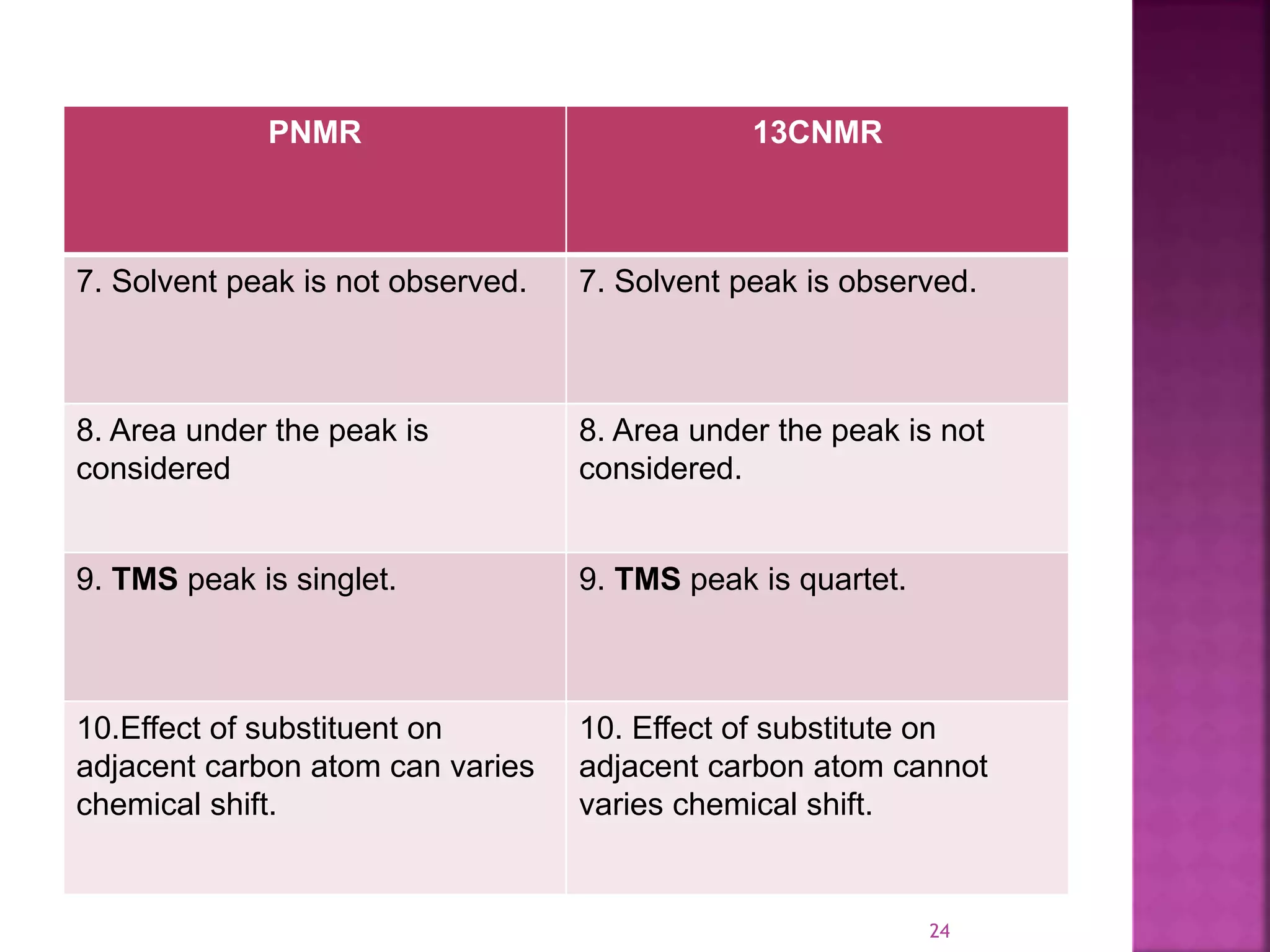
PNMR 13CNMR
7. Solvent peak is not observed. 7. Solvent peak is observed.
8. Area under the peak is
considered
8. Area under the peak is not
considered.
9. TMS peak is singlet. 9. TMS peak is quartet.
10.Effect of substituent on
adjacent carbon atom can varies
chemical shift.
10. Effect of substitute on
adjacent carbon atom cannot
varies chemical shift.
24
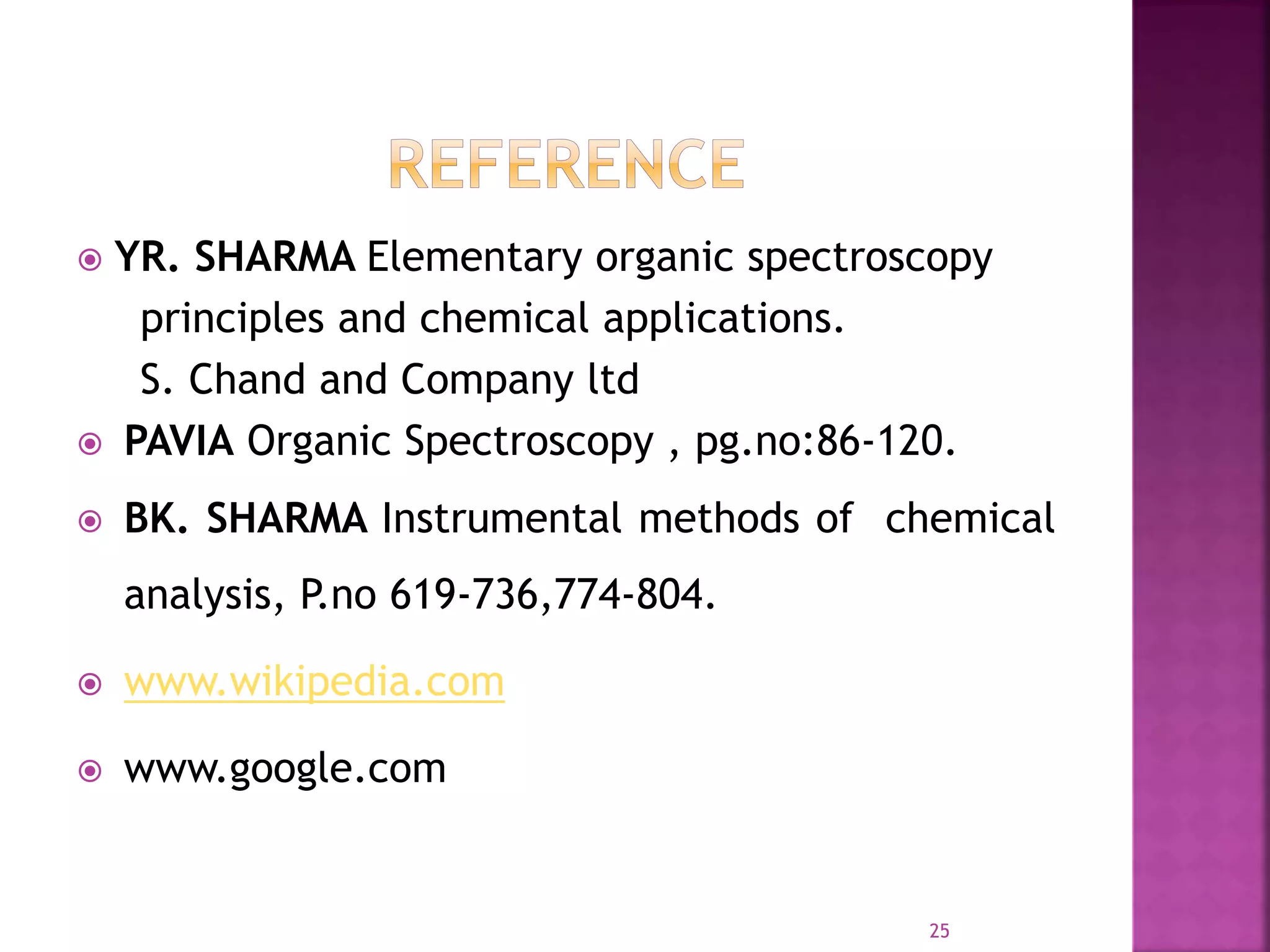
 YR. SHARMA Elementary organic spectroscopy
principles and chemical applications.
S. Chand and Company ltd
 PAVIA Organic Spectroscopy , pg.no:86-120.
 BK. SHARMA Instrumental methods of chemical
analysis, P.no 619-736,774-804.
 www.wikipedia.com
 www.google.com
25
26

Proton NMR

  • 1.
    SUBMITTED BY: RAFAZUBAIR N.V I M.PHARM (PHARMACOLOGY)
  • 2.
    1)Introduction 2)Types of NMR 3)Proton NMR 4)Features of PNMR 5)Interpretation of PNMR 6)Applications 7)Difference between PNMR and C13 NMR 2
  • 3.
     It isthe study of absorption of radiofrequency radiation by nuclei in a magnetic field is called Nuclear Magnetic Resonance.  Nuclear magnetic resonance spectroscopy is basically another form of absorption spectrometry. It involve change of the spin state of a nucleus, when the nucleus absorb electromagnetic radiation in a strong magnetic field.  The source of energy in NMR is radio waves which have long wavelengths, and thus low energy and frequency.  When low-energy radio waves interact with a molecule, they can change the nuclear spins of some elements having spin state 1/2, including 1H and 13C. 3
  • 4.
     Two commontypes of NMR spectroscopy are used to characterize organic structure:  1 H NMR:- Used to determine the type and number of H atoms in a molecule.  13 C NMR:- Used to determine the type of carbon atoms in the molecule. 4
  • 5.
     It isa technique which is based on the absorption of electromagnetic radiation in the radio frequency region 4 to 900 MHz by nuclei of the atoms.  It is used to study a wide variety of nuclei: 1H ,15N, 19F, 13C, 31P.  The most common form of NMR is based on the hydrogen-1 (1H), nucleus or proton.  It can give information about the structure of any molecule containing hydrogen atoms. 5
  • 6.
     When acharged particle such as a proton spins on its axis, it creates a magnetic field. Thus, the nucleus can be considered to be a tiny bar magnet. 6
  • 7.
     Normally, thesetiny bar magnets are randomly oriented in space. However, in the presence of a magnetic field B0, they are oriented with or against this applied field.  The energy difference between these two states is very small (<0.1 cal).  The angular momentum of the spinning charge can be described in terms of quantum number I,I/2,1,3/2,5/2…..  If the spin I=0,no spin and hence no HNMR phenomenon. 7
  • 8.
    •The distribution ofnuclear spins is random in the absence of an external magnetic field. •An external magnetic field causes nuclear magnetic moments to align parallel and antiparallel to applied field. 8
  • 9.
    Transition between spin statesgives NMR line • Hydrogen has spin quantum number I=1/2, possible orientation is ,(2I+1) ie,2,+1/2 and -1/2. 9
  • 10.
     Chemical Shift: Chemicalshift is the difference between the absorption position of the sample proton and the absorption position of reference standard.  Variations of the positions of NMR absorptions due to the electronic shielding and deshielding.  Spin-spin coupling (splitting): It is the interaction between the spins of neighbouring nuclei in a molecule may cause the splitting of NMR spectrum. 10
  • 11.
     Shielding andDeshielding:-  The circulation of electron around the protons itself generates field in a such way that , it oppose the applied field.  The field felt by the protons is thus diminished and the proton is said to be shielded and the absorption said to be upfield.  If the induced magnetic field reinforced the applied magnetic field ,then the field felt by the proton is augmented and the proton is said to be deshielded and the absorption is known as downfield. 11
  • 12.
     Natural abundanceof 1H is 99.9844.  PNMR is to determine type and number of H- protons in a molecule.  The source of energy in NMR is radio waves which have long wavelengths, and thus low energy and frequency  The chemical shift range of PNMR is 0 to 14 ppm. 12
  • 13.
     PNMR ishaving coupling constant range 0 to 15 Hz.  The solvent used for dissolving sample should have following properties;  Should not contain proton,  Inexpensive  Low boiling point and non polar in nature.  Generally deuterated chloroform CDCl3 is used as solvent. 13
  • 14.
     TMS isused as internal standard.  Sodium salt of 3-(trimethyl silyl) propane sulphonate is also used as solvent ,which is a water soluble solvent.  In PNMR ,continuous wave method is used.  NMR absorptions appear as sharp peaks.  There are three types of Proton isotopes used in NMR,1Hydrogen,2Deuterium ,3Tritium. 14
  • 15.
    1.Number of signalsIndicate how many different kinds of protons present. 2.Position of signals Indicate something about (chemical shift), magnetic (electronic) environment of protons. 3.Relative intensity of signals Proportional to number of protons present. 4.Splitting of signals (spin spin coupling) Indicatethe number of near by nuclei usually protons. 15
  • 16.
     NMR spectrumof a substance gives very valuable information about its molecular structure.  Hydrogen atoms in different environments respond differently to the field  Each different environment of protons produce signal in a different positions  Protons can classified as 1. Equivalent Protons 2.Non-Equivalent protons  Equivalent protons will shows single signal  Non – equivalent protons will shows more than one signal. 16
  • 17.
     Equivalent ProtonsNon-Equivalent EX. methane PROTONS Ex.acetaldehyde 17
  • 18.
     Peak areaproportional to hydrogen are in each signal.  It is given in ratio.  The position of the signals in the spectrum helps to know the nature of protons , aromatic, aliphatic, Acetylinic, vinylinic, adjacent to some electron attracting or electron releasing group.  Spin-spin splitting occurs only between nonequivalent protons on the same carbon or adjacent carbons. 18
  • 19.
    primary RCH3 0.9 secondaryR2CH2 1.3 Tertiary R3CH 1.5 Allylic C=C-CH3 1.7 Vinylic C=C-H 4.6-5.9 Aromatic Ar-H 6-8.5 Ester R-OOR 2-2.2 Aldehyde R-CHO 9-10 Alcohol R-OH 3.4-4 Amide R-NH2 1-5 Ether R-O-R 3.3-4 Phenolic Ar-OH 4-12 Fluoride R-F 4-4.5 Chloride R-Cl 3-4 19 Chemical shifts for various types of protons with TMS as standard reference
  • 20.
    20  Triplet =δ-1.7,3H (CH3 )  Quartet= δ-3.4, 2H (CH2 )
  • 21.
    1) Widely usedfor structure elucidation. 2) Inorganic solids-inorganic compounds are investigated by solid state 1H-NMR. Eg: CaSO4.H2O 3) Organic solids –solid 1H NMR constituents a powerful approach to investigate the hydrogen bonding and ionisation states of small organic compounds. direct correlation with hydrogen bonding lengths could be demonstrated. eg :for amino acid carboxyl groups. 21
  • 22.
    4) Polymers andrubbers-examine hydrogen bonding and acidity 5) Peptides and proteins 6) In vivo NMR studies  concerned with 1H NMR  spectroscopy of human brain  many studies are concerned with altered levels of metabolites in various brain diseases.  to determine the spatial distribution of any given metabolite detected spectroscopically . 7) Clinical and scientific research. 22
  • 23.
    PNMR 13CNMR 1. Itis study of spin changes of proton nuclei. 1. It is study of spin changes of carbon nuclei. 2. Chemical shift range is 0-14 ppm. 2. Chemical shift range is 0-240 ppm. 3. Continuous wave method is used 3. Fourier transform Technique is used. 4.slow process. 4.Very fast process. 5. Coupling constant range is 0-15Hz. 5. Coupling constant range is 125-250Hz. 6.Peak overlapping seen in complex samples. 6.No peak overlapping seen in spectrum. 23
  • 24.
    PNMR 13CNMR 7. Solventpeak is not observed. 7. Solvent peak is observed. 8. Area under the peak is considered 8. Area under the peak is not considered. 9. TMS peak is singlet. 9. TMS peak is quartet. 10.Effect of substituent on adjacent carbon atom can varies chemical shift. 10. Effect of substitute on adjacent carbon atom cannot varies chemical shift. 24
  • 25.
     YR. SHARMAElementary organic spectroscopy principles and chemical applications. S. Chand and Company ltd  PAVIA Organic Spectroscopy , pg.no:86-120.  BK. SHARMA Instrumental methods of chemical analysis, P.no 619-736,774-804.  www.wikipedia.com  www.google.com 25
  • 26.