Application of
Hyphenated
Techniques
in Drug Analysis
Presented By
Prof.(Dr.) Dinesh Kr. Mehta
MM College of Pharmacy,
Maharishi Markandeshwar
(Deemed to be University),
Mullana, Ambala
Hyphenated techniques
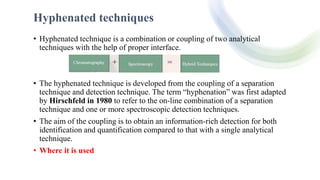
• Hyphenated technique is a combination or coupling of two analytical
techniques with the help of proper interface.
• The hyphenated technique is developed from the coupling of a separation
technique and detection technique. The term “hyphenation” was first adapted
by Hirschfeld in 1980 to refer to the on-line combination of a separation
technique and one or more spectroscopic detection techniques.
• The aim of the coupling is to obtain an information-rich detection for both
identification and quantification compared to that with a single analytical
technique.
• Where it is used
Advantages
For fast and accurate analysis
 A Higher degree of automation.
 Higher sample throughput.
 Better reproducibility.
 Reduction of contamination due to its closed system.
 Separation of quantification at the same time.
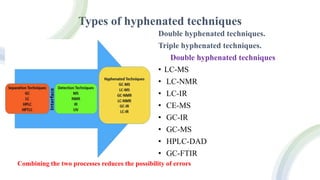
Types of hyphenated techniques
Double hyphenated techniques.
Triple hyphenated techniques.
Double hyphenated techniques
• LC-MS
• LC-NMR
• LC-IR
• CE-MS
• GC-IR
• GC-MS
• HPLC-DAD
• GC-FTIR
Combining the two processes reduces the possibility of errors
Hyphenated Technique(GC-MS)
CONTENTS
 General Introduction
 Principle
 Instrumentation
 GC-MS Setup
 Types of Mass Spectrometer detector
 Application
General Introduction
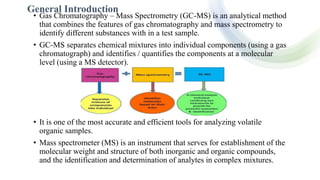
• Gas Chromatography – Mass Spectrometry (GC-MS) is an analytical method
that combines the features of gas chromatography and mass spectrometry to
identify different substances with in a test sample.
• GC-MS separates chemical mixtures into individual components (using a gas
chromatograph) and identifies / quantifies the components at a molecular
level (using a MS detector).
• It is one of the most accurate and efficient tools for analyzing volatile
organic samples.
• Mass spectrometer (MS) is an instrument that serves for establishment of the
molecular weight and structure of both inorganic and organic compounds,
and the identification and determination of analytes in complex mixtures.
Principle
GC-MS instrument separates chemical mixtures (the GC component) and
identifies the components at a molecular level (the MS component). GC
works on the principle that a mixture will separate into individual substances
when heated/ Partitioning of volatile sample with gaseous mobile phase and
liquid stationary phase. The heated gases are carried through a column with
an inert gas.
As the separated substances emerge from the column opening, they flow
into MS.
Mass spectrometry identifies compounds by the mass of the analyte
molecule.
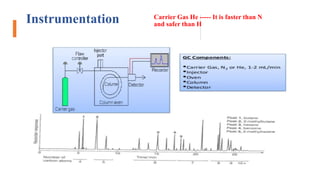
Instrumentation Carrier Gas He ----- It is faster than N
and safer than H
https://www.google.com/url?sa=i&url=https%3A%2F%2Fwww.researchgate.net%2Ffigure%2FSchematic-plot-of-the-main-
components-of-GC-MS-
instruments_fig1_273955959&psig=AOvVaw38bp7f0u3qQxHA6c6BAw2L&ust=1628829595992000&source=images&cd=vfe&ved
=0CAsQjRxqFwoTCNiO1fXVqvICFQAAAAAdAAAAABAO
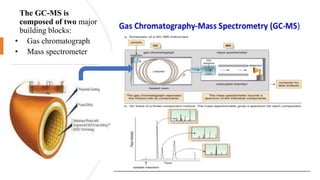
The GC-MS is
composed of two major
building blocks:
• Gas chromatograph
• Mass spectrometer
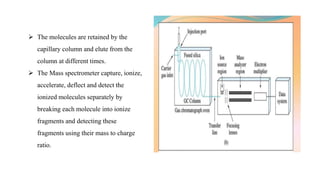
 The molecules are retained by the
capillary column and elute from the
column at different times.
 The Mass spectrometer capture, ionize,
accelerate, deflect and detect the
ionized molecules separately by
breaking each molecule into ionize
fragments and detecting these
fragments using their mass to charge
ratio.
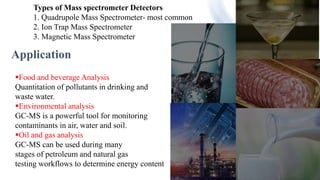
Food & beverage analysis
Types of Mass spectrometer Detectors
1. Quadrupole Mass Spectrometer- most common
2. Ion Trap Mass Spectrometer
3. Magnetic Mass Spectrometer
Application
Food and beverage Analysis
Quantitation of pollutants in drinking and
waste water.
Environmental analysis
GC-MS is a powerful tool for monitoring
contaminants in air, water and soil.
Oil and gas analysis
GC-MS can be used during many
stages of petroleum and natural gas
testing workflows to determine energy content
Application
 Identification of unknown organic compounds in hazardous
waste dumps and reaction products by synthetic organic
chemistry
 Quantitation of drug in metabolites and urine is done for the
pharmacological and forensic use.
 Used for drug analysis, pesticide and herbicide detection
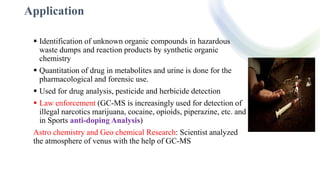
 Law enforcement (GC-MS is increasingly used for detection of
illegal narcotics marijuana, cocaine, opioids, piperazine, etc. and
in Sports anti-doping Analysis)
Astro chemistry and Geo chemical Research: Scientist analyzed
the atmosphere of venus with the help of GC-MS
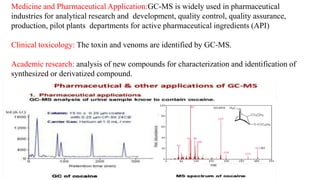
Medicine and Pharmaceutical Application:GC-MS is widely used in pharmaceutical
industries for analytical research and development, quality control, quality assurance,
production, pilot plants departments for active pharmaceutical ingredients (API)
Clinical toxicology: The toxin and venoms are identified by GC-MS.
Academic research: analysis of new compounds for characterization and identification of
synthesized or derivatized compound.
Academic research
Thank You
Email: drdineshmehta@mmumullana.org

Application of hyphenated techniques(GC-MS)

  • 1.
    Application of Hyphenated Techniques in DrugAnalysis Presented By Prof.(Dr.) Dinesh Kr. Mehta MM College of Pharmacy, Maharishi Markandeshwar (Deemed to be University), Mullana, Ambala
  • 2.
    Hyphenated techniques • Hyphenatedtechnique is a combination or coupling of two analytical techniques with the help of proper interface. • The hyphenated technique is developed from the coupling of a separation technique and detection technique. The term “hyphenation” was first adapted by Hirschfeld in 1980 to refer to the on-line combination of a separation technique and one or more spectroscopic detection techniques. • The aim of the coupling is to obtain an information-rich detection for both identification and quantification compared to that with a single analytical technique. • Where it is used
  • 3.
    Advantages For fast andaccurate analysis  A Higher degree of automation.  Higher sample throughput.  Better reproducibility.  Reduction of contamination due to its closed system.  Separation of quantification at the same time.
  • 4.
    Types of hyphenatedtechniques Double hyphenated techniques. Triple hyphenated techniques. Double hyphenated techniques • LC-MS • LC-NMR • LC-IR • CE-MS • GC-IR • GC-MS • HPLC-DAD • GC-FTIR Combining the two processes reduces the possibility of errors
  • 5.
    Hyphenated Technique(GC-MS) CONTENTS  GeneralIntroduction  Principle  Instrumentation  GC-MS Setup  Types of Mass Spectrometer detector  Application
  • 6.
    General Introduction • GasChromatography – Mass Spectrometry (GC-MS) is an analytical method that combines the features of gas chromatography and mass spectrometry to identify different substances with in a test sample. • GC-MS separates chemical mixtures into individual components (using a gas chromatograph) and identifies / quantifies the components at a molecular level (using a MS detector). • It is one of the most accurate and efficient tools for analyzing volatile organic samples. • Mass spectrometer (MS) is an instrument that serves for establishment of the molecular weight and structure of both inorganic and organic compounds, and the identification and determination of analytes in complex mixtures.
  • 7.
    Principle GC-MS instrument separateschemical mixtures (the GC component) and identifies the components at a molecular level (the MS component). GC works on the principle that a mixture will separate into individual substances when heated/ Partitioning of volatile sample with gaseous mobile phase and liquid stationary phase. The heated gases are carried through a column with an inert gas. As the separated substances emerge from the column opening, they flow into MS. Mass spectrometry identifies compounds by the mass of the analyte molecule.
  • 8.
    Instrumentation Carrier GasHe ----- It is faster than N and safer than H
  • 9.
  • 10.
     The moleculesare retained by the capillary column and elute from the column at different times.  The Mass spectrometer capture, ionize, accelerate, deflect and detect the ionized molecules separately by breaking each molecule into ionize fragments and detecting these fragments using their mass to charge ratio.
  • 11.
    Food & beverageanalysis Types of Mass spectrometer Detectors 1. Quadrupole Mass Spectrometer- most common 2. Ion Trap Mass Spectrometer 3. Magnetic Mass Spectrometer Application Food and beverage Analysis Quantitation of pollutants in drinking and waste water. Environmental analysis GC-MS is a powerful tool for monitoring contaminants in air, water and soil. Oil and gas analysis GC-MS can be used during many stages of petroleum and natural gas testing workflows to determine energy content
  • 12.
    Application  Identification ofunknown organic compounds in hazardous waste dumps and reaction products by synthetic organic chemistry  Quantitation of drug in metabolites and urine is done for the pharmacological and forensic use.  Used for drug analysis, pesticide and herbicide detection  Law enforcement (GC-MS is increasingly used for detection of illegal narcotics marijuana, cocaine, opioids, piperazine, etc. and in Sports anti-doping Analysis) Astro chemistry and Geo chemical Research: Scientist analyzed the atmosphere of venus with the help of GC-MS
  • 13.
    Medicine and PharmaceuticalApplication:GC-MS is widely used in pharmaceutical industries for analytical research and development, quality control, quality assurance, production, pilot plants departments for active pharmaceutical ingredients (API) Clinical toxicology: The toxin and venoms are identified by GC-MS. Academic research: analysis of new compounds for characterization and identification of synthesized or derivatized compound.
  • 14.
    Academic research Thank You Email:drdineshmehta@mmumullana.org