
Page 1
OVERVIEW


              There is a
                 great
             importance
             of the EEG
              as a non-
One of them
               invasive
is Epilepsy.
              diagnostic
               tool in a
              wealth of
             neurological
              disorders,


                            Page 2
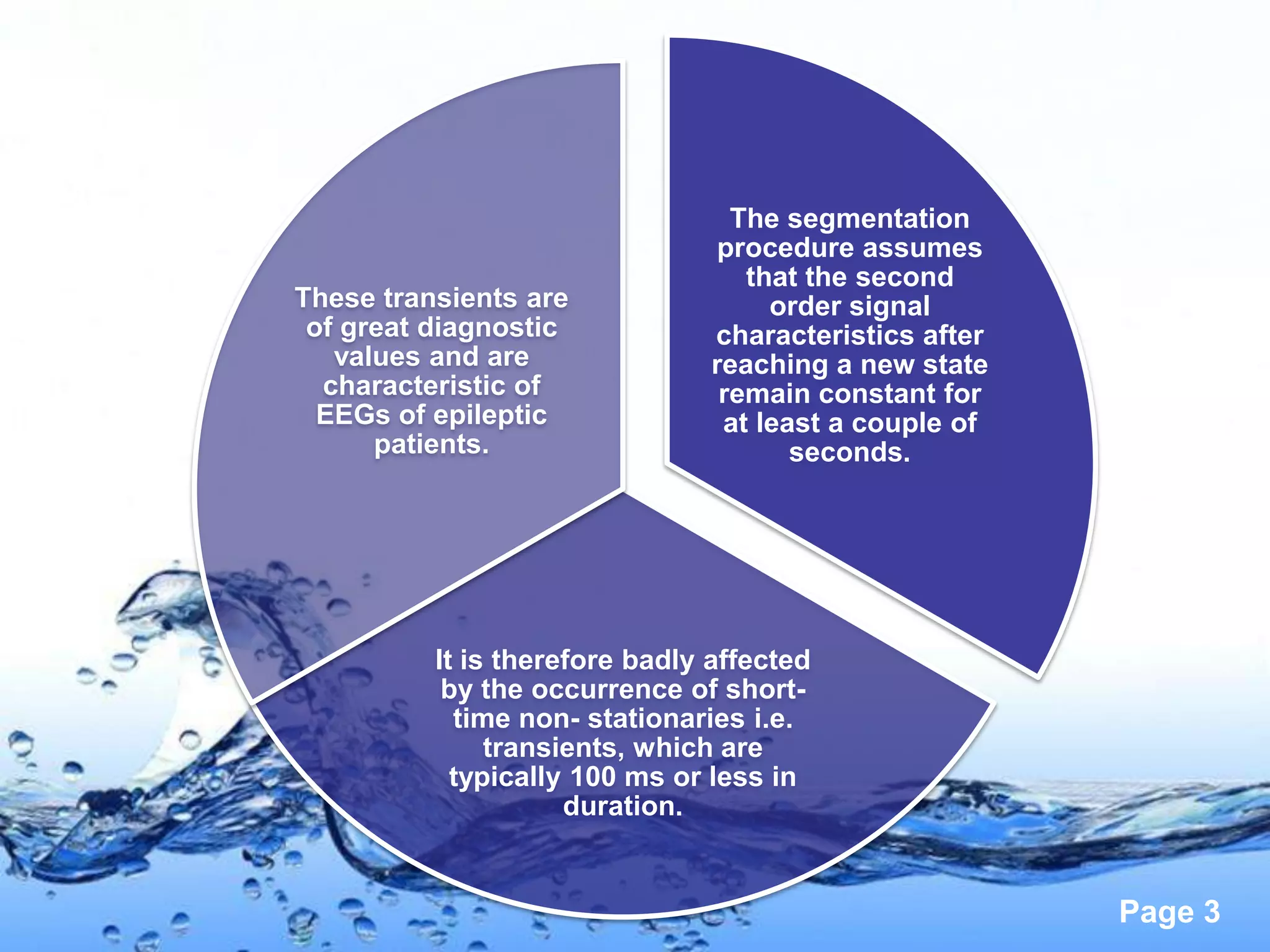
The segmentation
                                 procedure assumes
                                   that the second
These transients are                 order signal
 of great diagnostic            characteristics after
   values and are               reaching a new state
  characteristic of              remain constant for
  EEGs of epileptic              at least a couple of
      patients.                        seconds.


          It is therefore badly affected
           by the occurrence of short-
            time non- stationaries i.e.
               transients, which are
            typically 100 ms or less in
                     duration.


                                                        Page 3
Page 4
Page 5
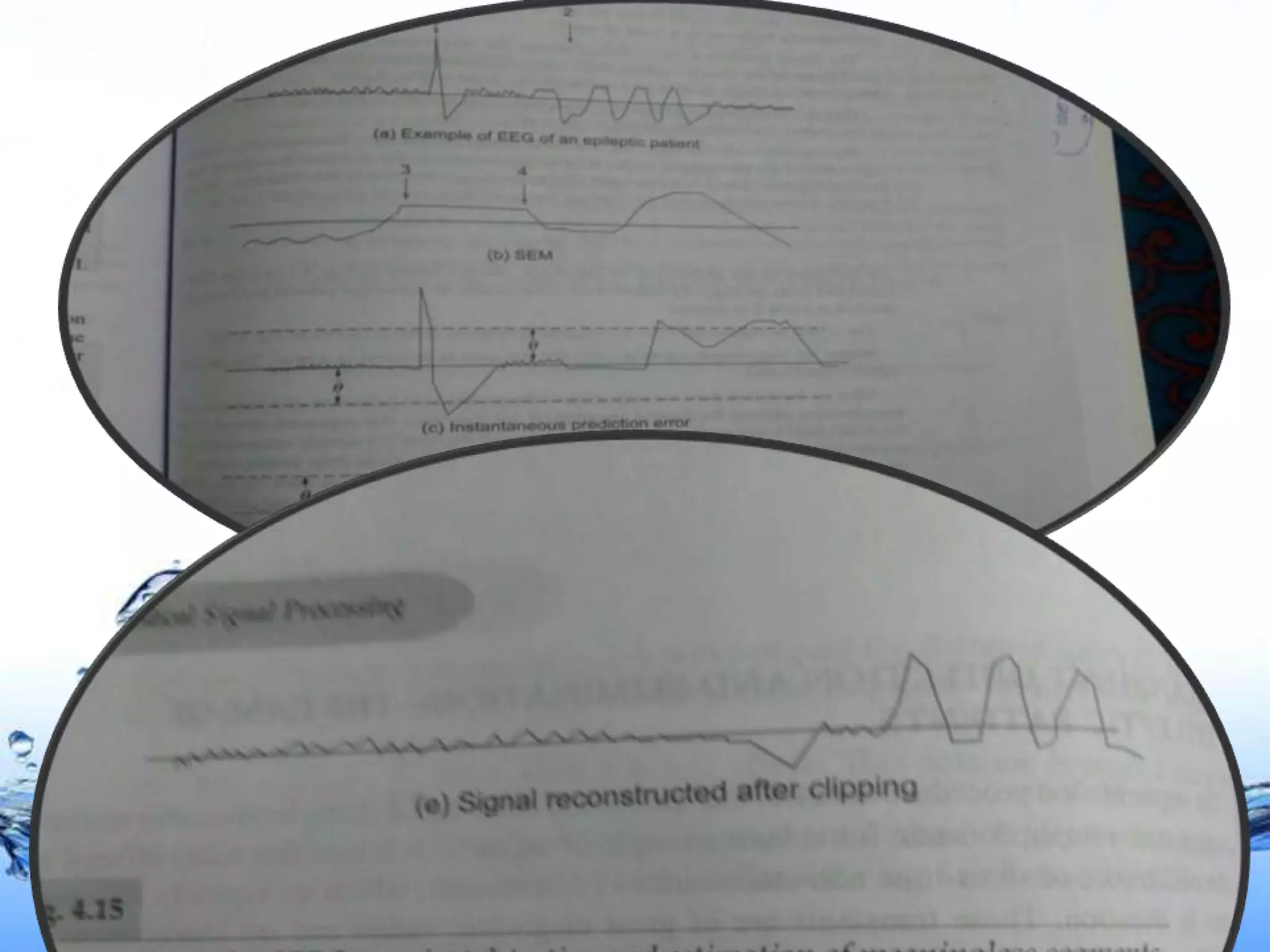
An example of above is in below figre, whiich
shows an EEG of the burst suppression type.


    Observe that the suppression period is
    interrupted by a sharp wave(event 1) and
    subsequently followed by a burst (event 2).


         The linear prediction filter adapted within the
         suppression period.


             The corresponding SEM fig. above clearly
             exhibits sharp jumps as the transient enters
             and leaves the moving window of 2 s length as
             indicated by the arrows 3 & 4(Fig. 4.15b).

                  Then this would lead to a meaningless
                  segmentation at event 3. The reason for this
                  behavior is seen when examining the
                  prediction error(fig. 4.15 c).                 Page 6
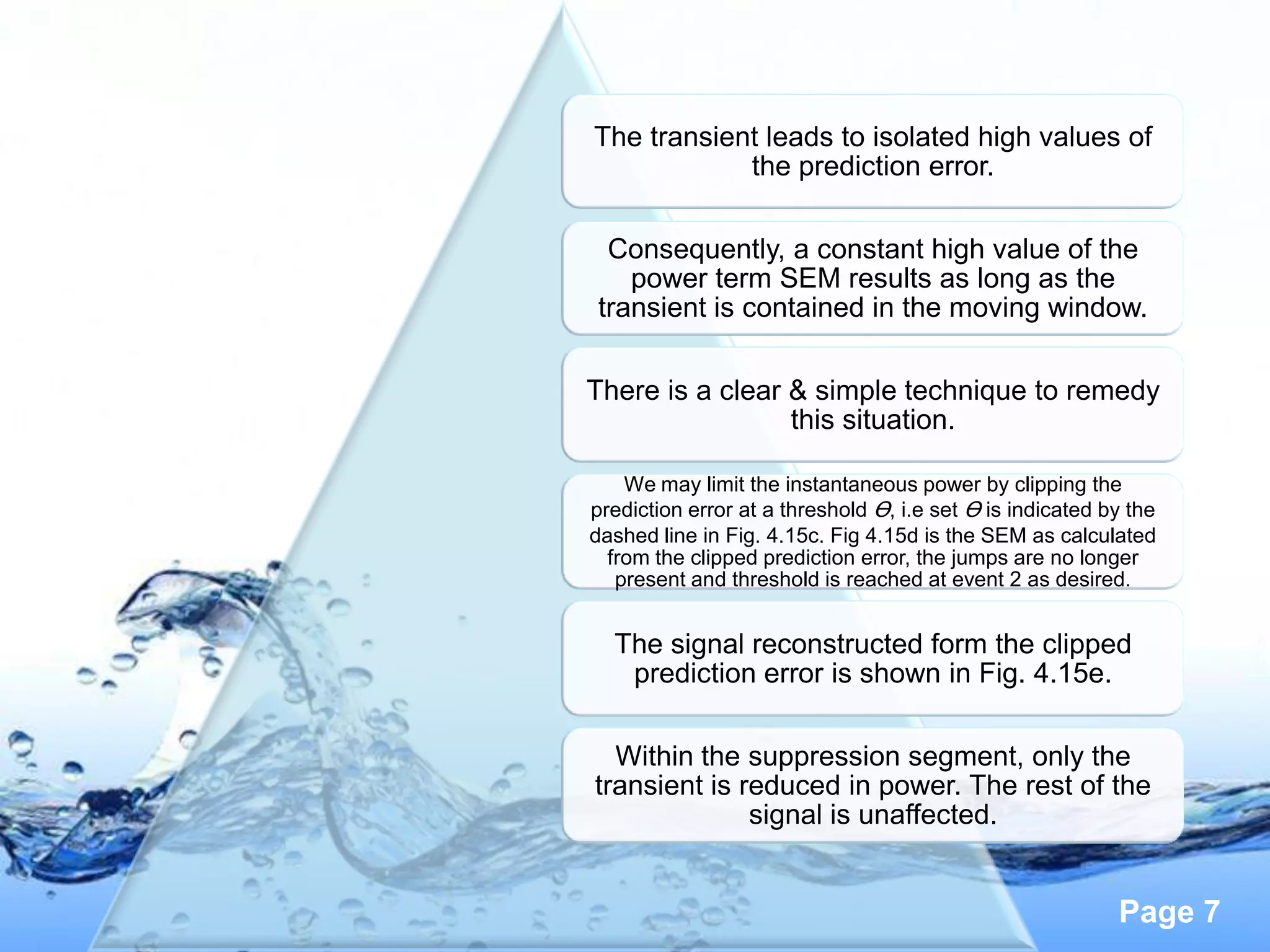
The transient leads to isolated high values of
            the prediction error.

 Consequently, a constant high value of the
   power term SEM results as long as the
transient is contained in the moving window.

There is a clear & simple technique to remedy
                 this situation.

    We may limit the instantaneous power by clipping the
prediction error at a threshold Ćź, i.e set Ćź is indicated by the
dashed line in Fig. 4.15c. Fig 4.15d is the SEM as calculated
  from the clipped prediction error, the jumps are no longer
   present and threshold is reached at event 2 as desired.


  The signal reconstructed form the clipped
   prediction error is shown in Fig. 4.15e.

  Within the suppression segment, only the
transient is reduced in power. The rest of the
              signal is unaffected.


                                                           Page 7
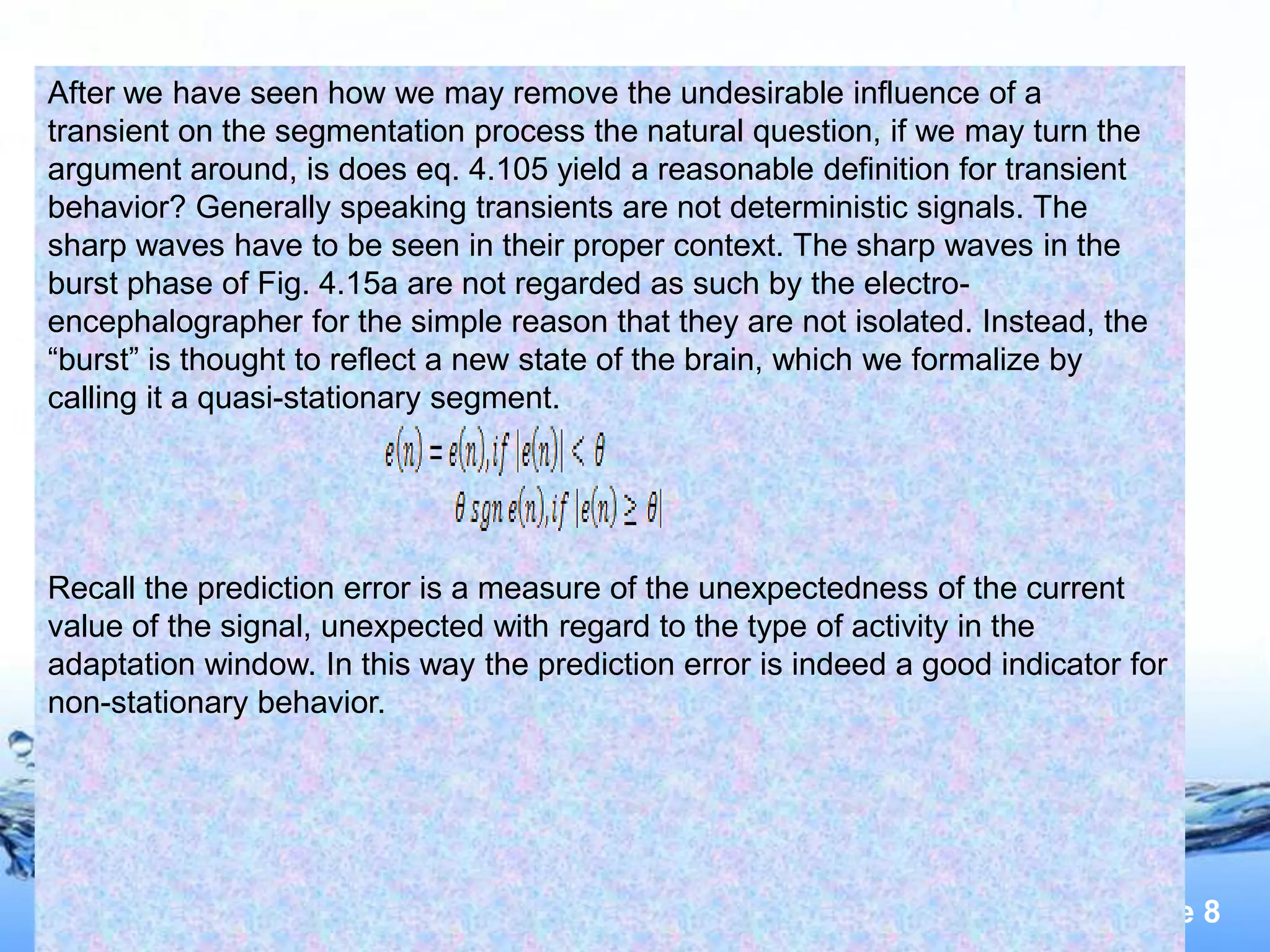
After we have seen how we may remove the undesirable influence of a
transient on the segmentation process the natural question, if we may turn the
argument around, is does eq. 4.105 yield a reasonable definition for transient
behavior? Generally speaking transients are not deterministic signals. The
sharp waves have to be seen in their proper context. The sharp waves in the
burst phase of Fig. 4.15a are not regarded as such by the electro-
encephalographer for the simple reason that they are not isolated. Instead, the
“burst” is thought to reflect a new state of the brain, which we formalize by
calling it a quasi-stationary segment.


Recall the prediction error is a measure of the unexpectedness of the current
value of the signal, unexpected with regard to the type of activity in the
adaptation window. In this way the prediction error is indeed a good indicator for
non-stationary behavior.


                                                                              Page 8
(n-1) +
(n-1)
=
          It will be sensitive to steep slopes & large amplitudes provided the wavelength
(n) +     is different from those encountered during adaptation. In this way clipping the
          prediction error provides us with the desired splitting of the signal into a quasi-
          stationary part (below threshold) and local non-stationaries(above threshold).
          However, experience has shown that criterion given by Eq. 4.105 with a
          threshold setting suitable for segmantation is far too sensitive for transient
          detection. EEG spikes generally have a duration of 50-100 ms. As a reasonable
          method for the elimination o ffalse alarm caused by random fluctuations in the
          prediction error it is the elimination of false alarm caused by random
          fluctuations in the prediction error power with this time constant. Accordingly,
          the following heuristic criterion is adopted as suggested in [1], i.e.
                     =    (n-1)+


                                                                                       Page 9
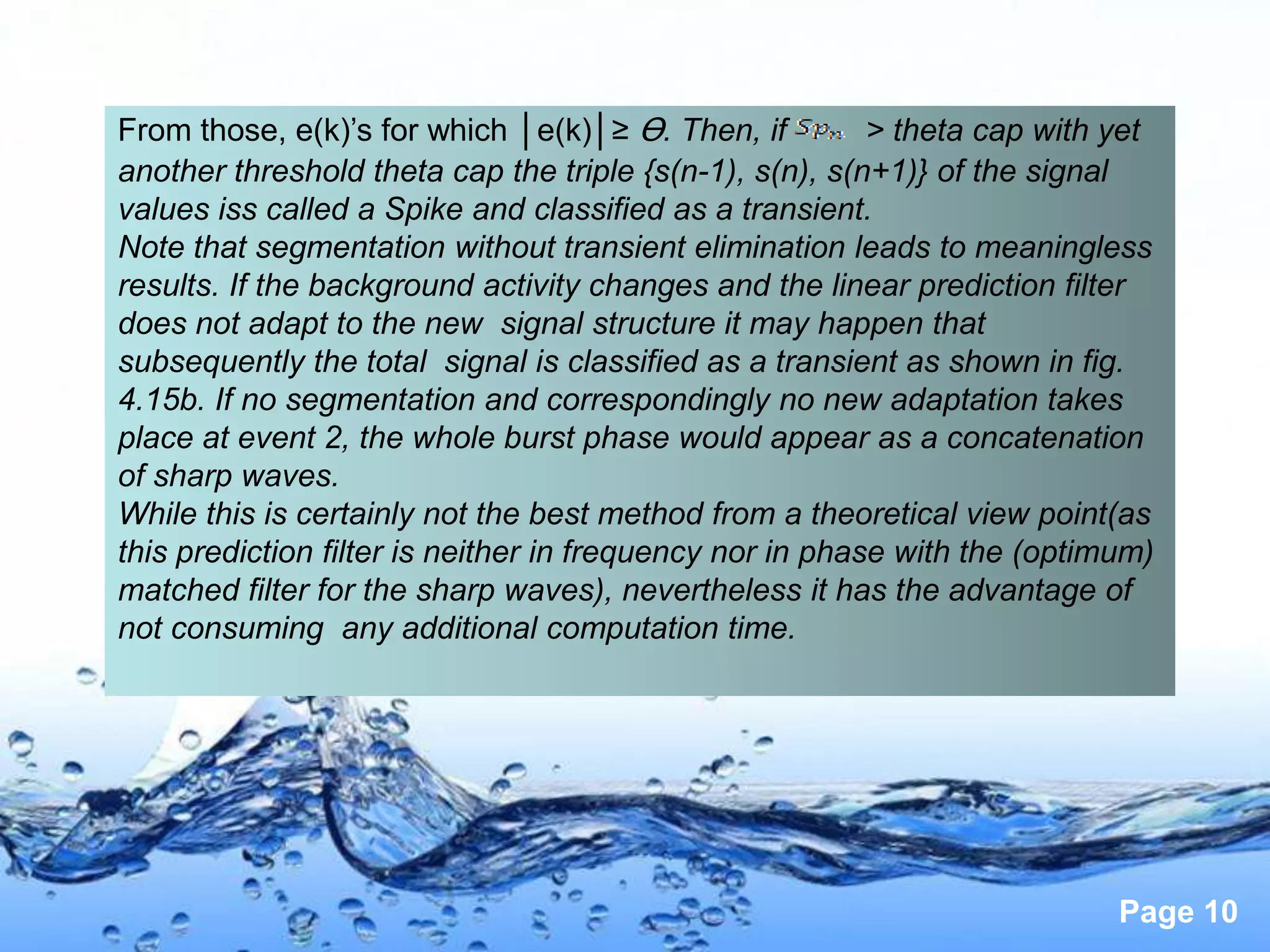
From those, e(k)’s for which │e(k)│≥ Ɵ. Then, if          > theta cap with yet
another threshold theta cap the triple {s(n-1), s(n), s(n+1)} of the signal
values iss called a Spike and classified as a transient.
Note that segmentation without transient elimination leads to meaningless
results. If the background activity changes and the linear prediction filter
does not adapt to the new signal structure it may happen that
subsequently the total signal is classified as a transient as shown in fig.
4.15b. If no segmentation and correspondingly no new adaptation takes
place at event 2, the whole burst phase would appear as a concatenation
of sharp waves.
While this is certainly not the best method from a theoretical view point(as
this prediction filter is neither in frequency nor in phase with the (optimum)
matched filter for the sharp waves), nevertheless it has the advantage of
not consuming any additional computation time.


                                                                           Page 10
For a demonstration of the detection of spikes in real life situations using the
above procedure we refer to the example discussed in [1] and given in detail in
Fig. 4.16.


                                                                              Page 11
OVERALL PERFORMANCE


 The only real way to find out would be to construct the entire algorithm
 which takes the EEG as input & produces a diagnosis, say healthy or
 sick, as output and then compare it with that given by the neurophysiologist.
 Nevertheless, we give an example, the most interesting, from a clinical
 stand point that demonstrates the effectiveness of the proposed method on
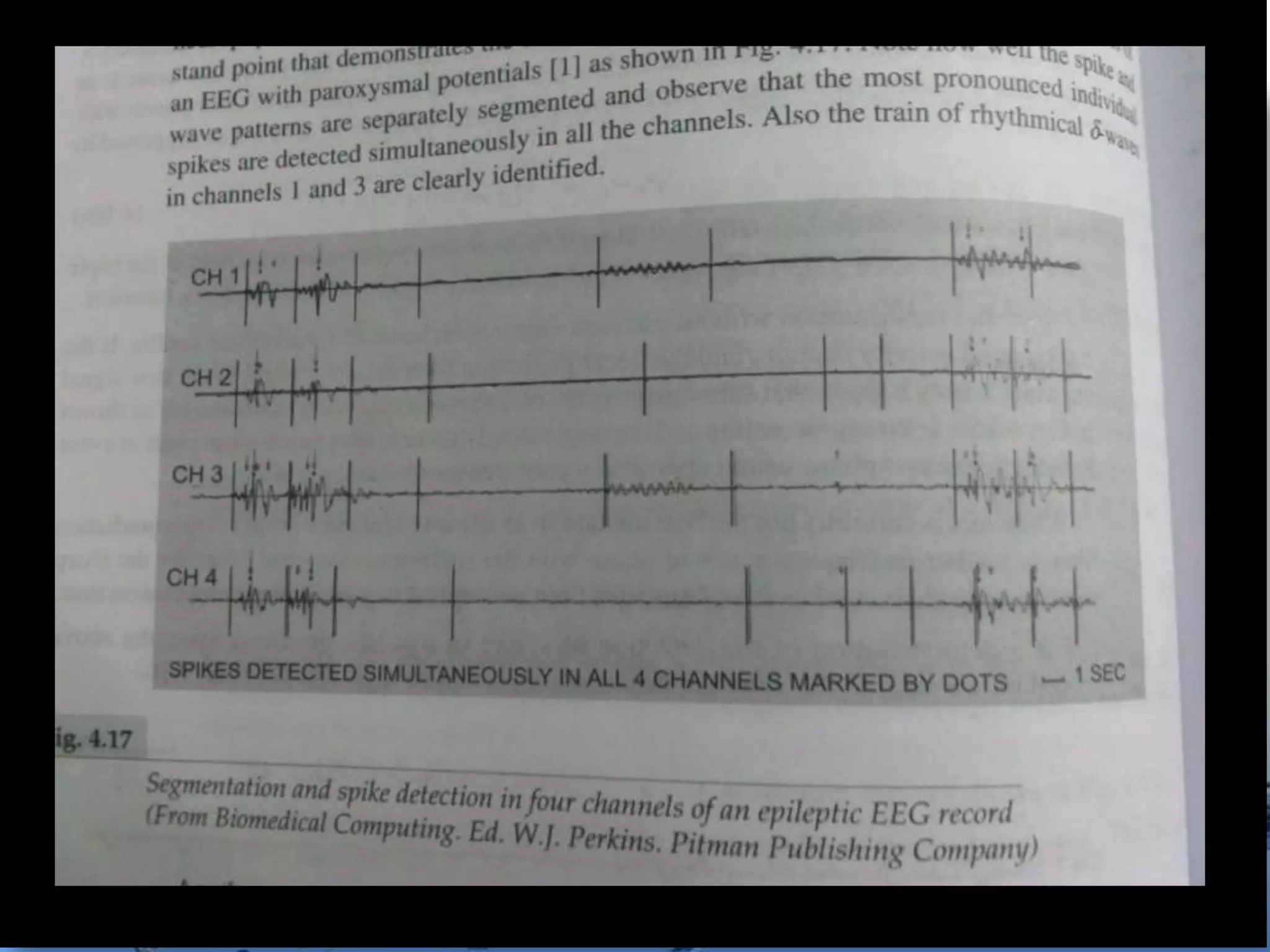
 four channels of an EEG with paroxysmal potentials[1] as shown in Fig.
 4.17. Note how well the spike and wave patterns are separately segmented
 and observe that the most pronounced individual spikes are detected
 simultaneously in all the channels. Also the train of rhythmical delta waves
 in channels 1 and 3 are clearly identified.


                                                                        Page 12
Page 13
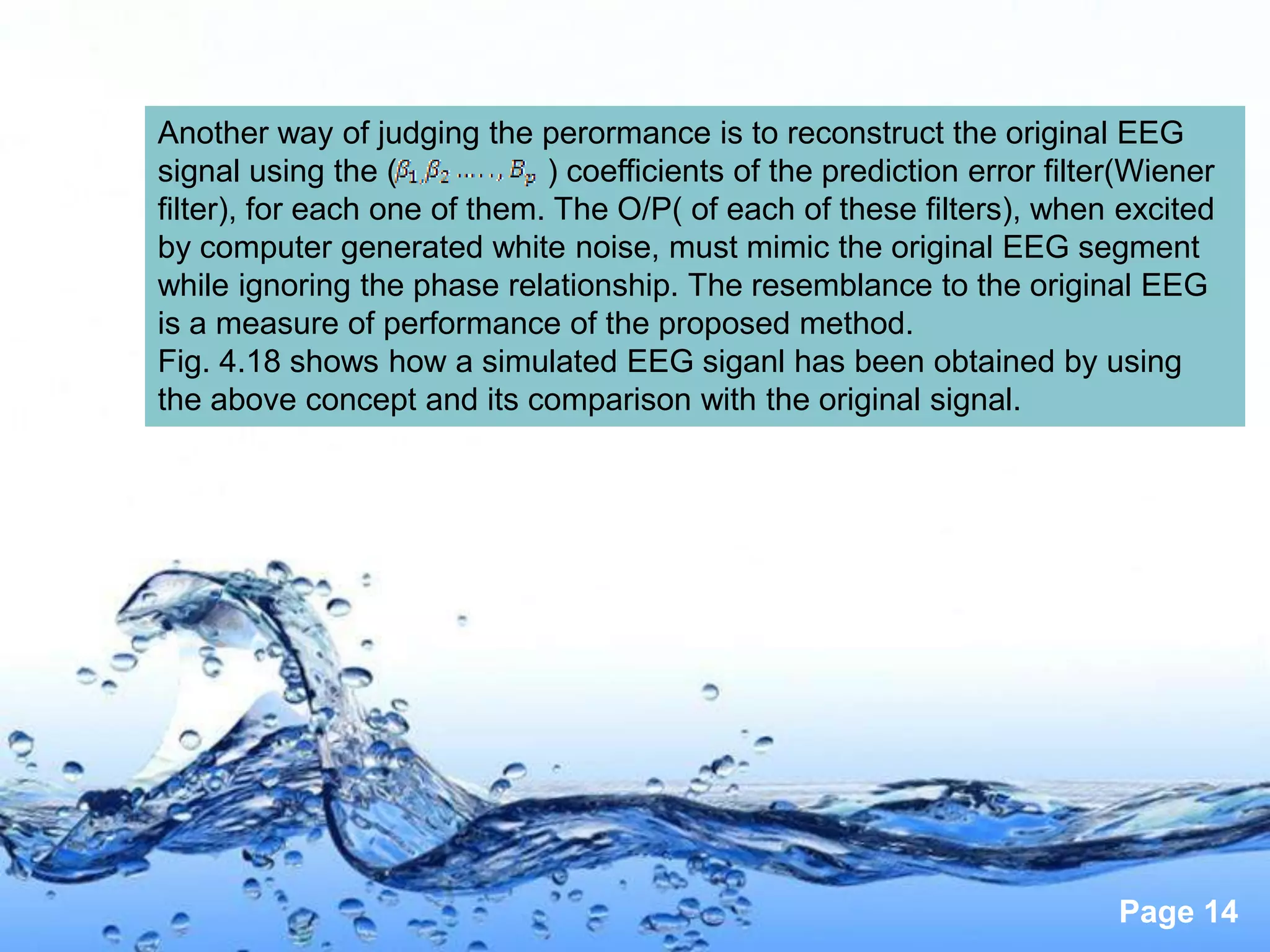
Another way of judging the perormance is to reconstruct the original EEG
signal using the (            ) coefficients of the prediction error filter(Wiener
filter), for each one of them. The O/P( of each of these filters), when excited
by computer generated white noise, must mimic the original EEG segment
while ignoring the phase relationship. The resemblance to the original EEG
is a measure of performance of the proposed method.
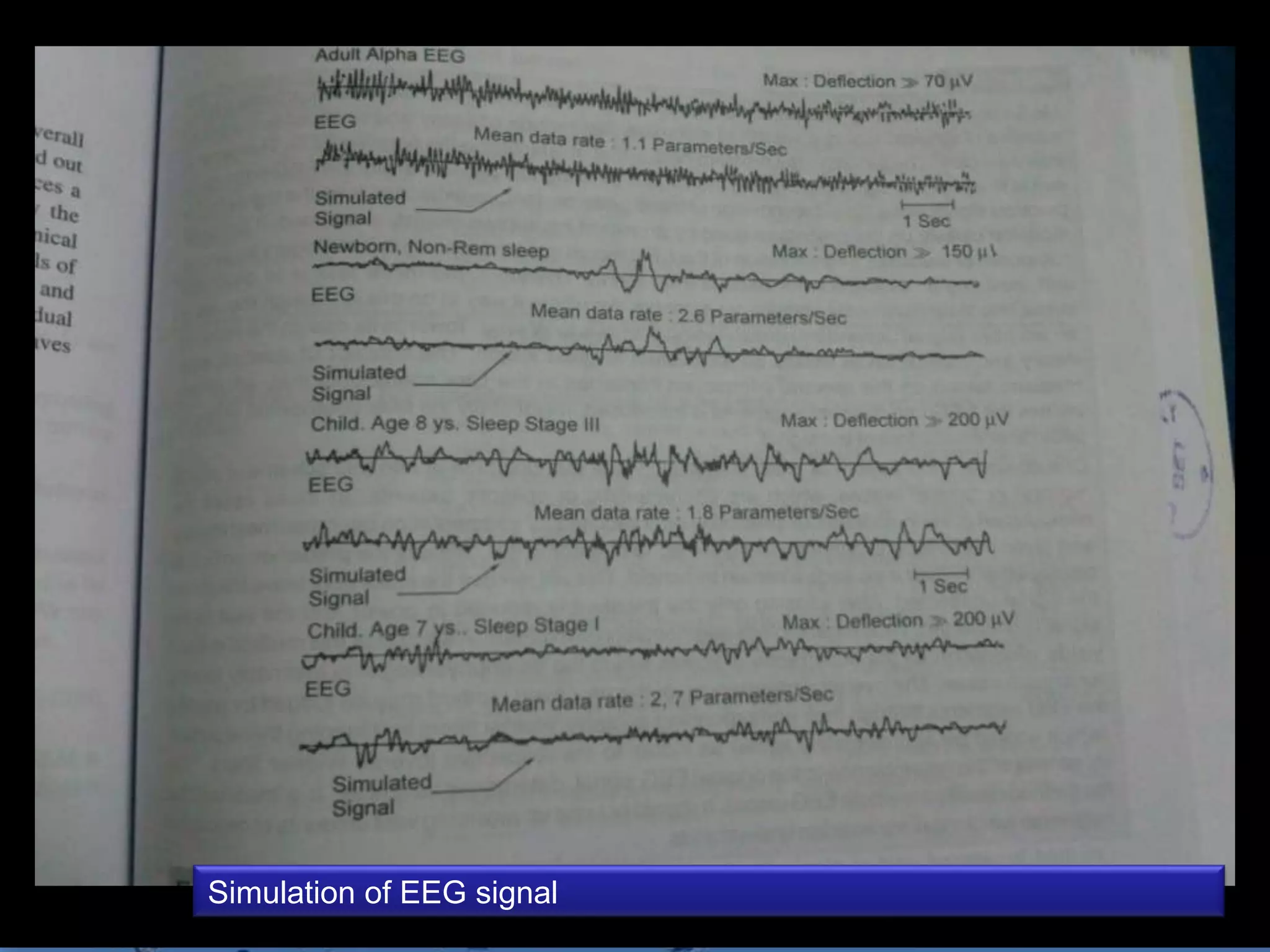
Fig. 4.18 shows how a simulated EEG siganl has been obtained by using
the above concept and its comparison with the original signal.


                                                                          Page 14
Simulation of EEG signal
                           Page 15
This brings to a close of our discussion on how one is not only able to
recognize and classify EEG waveforms but also detect paraoxysms,
i.e. transients associated with abnormalities.


                                                                          Page 16
Page 17

Bsp ppt

  • 1.
  • 2.
    OVERVIEW There is a great importance of the EEG as a non- One of them invasive is Epilepsy. diagnostic tool in a wealth of neurological disorders, Page 2
  • 3.
    The segmentation procedure assumes that the second These transients are order signal of great diagnostic characteristics after values and are reaching a new state characteristic of remain constant for EEGs of epileptic at least a couple of patients. seconds. It is therefore badly affected by the occurrence of short- time non- stationaries i.e. transients, which are typically 100 ms or less in duration. Page 3
  • 4.
  • 5.
  • 6.
    An example ofabove is in below figre, whiich shows an EEG of the burst suppression type. Observe that the suppression period is interrupted by a sharp wave(event 1) and subsequently followed by a burst (event 2). The linear prediction filter adapted within the suppression period. The corresponding SEM fig. above clearly exhibits sharp jumps as the transient enters and leaves the moving window of 2 s length as indicated by the arrows 3 & 4(Fig. 4.15b). Then this would lead to a meaningless segmentation at event 3. The reason for this behavior is seen when examining the prediction error(fig. 4.15 c). Page 6
  • 7.
    The transient leadsto isolated high values of the prediction error. Consequently, a constant high value of the power term SEM results as long as the transient is contained in the moving window. There is a clear & simple technique to remedy this situation. We may limit the instantaneous power by clipping the prediction error at a threshold Ćź, i.e set Ćź is indicated by the dashed line in Fig. 4.15c. Fig 4.15d is the SEM as calculated from the clipped prediction error, the jumps are no longer present and threshold is reached at event 2 as desired. The signal reconstructed form the clipped prediction error is shown in Fig. 4.15e. Within the suppression segment, only the transient is reduced in power. The rest of the signal is unaffected. Page 7
  • 8.
    After we haveseen how we may remove the undesirable influence of a transient on the segmentation process the natural question, if we may turn the argument around, is does eq. 4.105 yield a reasonable definition for transient behavior? Generally speaking transients are not deterministic signals. The sharp waves have to be seen in their proper context. The sharp waves in the burst phase of Fig. 4.15a are not regarded as such by the electro- encephalographer for the simple reason that they are not isolated. Instead, the “burst” is thought to reflect a new state of the brain, which we formalize by calling it a quasi-stationary segment. Recall the prediction error is a measure of the unexpectedness of the current value of the signal, unexpected with regard to the type of activity in the adaptation window. In this way the prediction error is indeed a good indicator for non-stationary behavior. Page 8
  • 9.
    (n-1) + (n-1) = It will be sensitive to steep slopes & large amplitudes provided the wavelength (n) + is different from those encountered during adaptation. In this way clipping the prediction error provides us with the desired splitting of the signal into a quasi- stationary part (below threshold) and local non-stationaries(above threshold). However, experience has shown that criterion given by Eq. 4.105 with a threshold setting suitable for segmantation is far too sensitive for transient detection. EEG spikes generally have a duration of 50-100 ms. As a reasonable method for the elimination o ffalse alarm caused by random fluctuations in the prediction error it is the elimination of false alarm caused by random fluctuations in the prediction error power with this time constant. Accordingly, the following heuristic criterion is adopted as suggested in [1], i.e. = (n-1)+ Page 9
  • 10.
    From those, e(k)’sfor which │e(k)│≥ Ɵ. Then, if > theta cap with yet another threshold theta cap the triple {s(n-1), s(n), s(n+1)} of the signal values iss called a Spike and classified as a transient. Note that segmentation without transient elimination leads to meaningless results. If the background activity changes and the linear prediction filter does not adapt to the new signal structure it may happen that subsequently the total signal is classified as a transient as shown in fig. 4.15b. If no segmentation and correspondingly no new adaptation takes place at event 2, the whole burst phase would appear as a concatenation of sharp waves. While this is certainly not the best method from a theoretical view point(as this prediction filter is neither in frequency nor in phase with the (optimum) matched filter for the sharp waves), nevertheless it has the advantage of not consuming any additional computation time. Page 10
  • 11.
    For a demonstrationof the detection of spikes in real life situations using the above procedure we refer to the example discussed in [1] and given in detail in Fig. 4.16. Page 11
  • 12.
    OVERALL PERFORMANCE Theonly real way to find out would be to construct the entire algorithm which takes the EEG as input & produces a diagnosis, say healthy or sick, as output and then compare it with that given by the neurophysiologist. Nevertheless, we give an example, the most interesting, from a clinical stand point that demonstrates the effectiveness of the proposed method on four channels of an EEG with paroxysmal potentials[1] as shown in Fig. 4.17. Note how well the spike and wave patterns are separately segmented and observe that the most pronounced individual spikes are detected simultaneously in all the channels. Also the train of rhythmical delta waves in channels 1 and 3 are clearly identified. Page 12
  • 13.
  • 14.
    Another way ofjudging the perormance is to reconstruct the original EEG signal using the ( ) coefficients of the prediction error filter(Wiener filter), for each one of them. The O/P( of each of these filters), when excited by computer generated white noise, must mimic the original EEG segment while ignoring the phase relationship. The resemblance to the original EEG is a measure of performance of the proposed method. Fig. 4.18 shows how a simulated EEG siganl has been obtained by using the above concept and its comparison with the original signal. Page 14
  • 15.
    Simulation of EEGsignal Page 15
  • 16.
    This brings toa close of our discussion on how one is not only able to recognize and classify EEG waveforms but also detect paraoxysms, i.e. transients associated with abnormalities. Page 16
  • 17.