NMR SPECTROSCOPY
Prepared by-
Sudhanshu Mishra
M.PHARM
Pharmaceutics
Contents
 Introduction
 Fundamental principle of NMR
 Interpretation
Chemical shift
Number of signals
Spin Spin coupling: Spliting of
signals
Coupling constant
Integrals
Introduction
 Nuclear Magnetic Resonance (NMR) is a spectroscopy
technique which is based on the absorption of the
electromagnetic radiation in the radio frequency
region 4 to 900 MHz by nuclei of the atoms.
 Nuclear magnetic resonance spectroscopy(NMR) is a
powerful analytical technique used to characterize
organic molecules by identifying carbon-hydrogen
frameworks within molecules.
 It is a research technique that exploits the magnetic
properties of certain atomic nuclei.
 It determines the physical and chemical properties
of atoms or the molecules in which they are
contained.
 Proton Nuclear Magnetic resonance spectroscopy is one of the most
powerful tools for elucidating the number of hydrogen or proton in the
compound.
 It is used to study wide variety of nuclei:
Principle of NMR
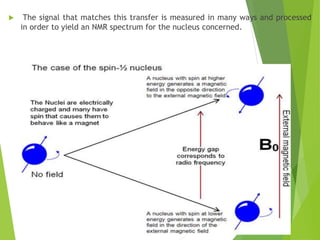
 The principle behind NMR is that many nuclei have spin
and all nuclei are electrically charged. If an external
magnetic field is applied, an energy transfer is possible
between the base energy to a higher energy level
(generally a single energy gap).
 The energy transfer takes place at a wavelength that
corresponds to radio frequencies and when the spin
returns to its base level, energy is emitted at the same
frequency.
 The signal that matches this transfer is measured in many ways and processed
in order to yield an NMR spectrum for the nucleus concerned.
Theory of NMR
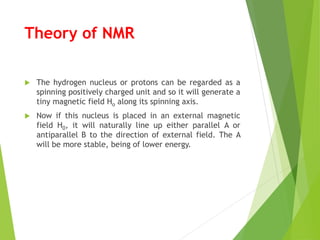
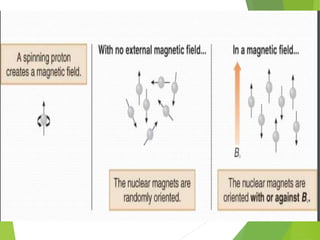
 The hydrogen nucleus or protons can be regarded as a
spinning positively charged unit and so it will generate a
tiny magnetic field Ho along its spinning axis.
 Now if this nucleus is placed in an external magnetic
field H0, it will naturally line up either parallel A or
antiparallel B to the direction of external field. The A
will be more stable, being of lower energy.
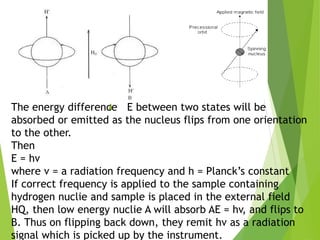
The energy difference E between two states will be
absorbed or emitted as the nucleus flips from one orientation
to the other.
Then
E = hv
where v = a radiation frequency and h = Planck’s constant
If correct frequency is applied to the sample containing
hydrogen nuclie and sample is placed in the external field
HQ, then low energy nuclie A will absorb AE = hv, and flips to
B. Thus on flipping back down, they remit hv as a radiation
signal which is picked up by the instrument.
Effect of magnetic field
 A nucleus is in resonance when it absorbs RF radiation
and “spin flips” to a higher energy state.
 Thus, two variables characterize NMR: an applied
magnetic field B0, the strength of which is measured in
tesla (T), and the frequency n of radiation used for
resonance, measured in hertz (Hz), or megahertz
(MHz).
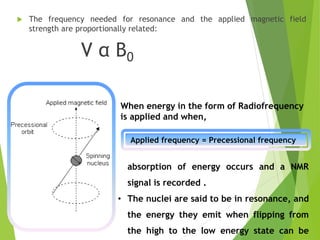
 The frequency needed for resonance and the applied magnetic field
strength are proportionally related:
V α B0
When energy in the form of Radiofrequency
is applied and when,
Applied frequency = Precessional frequency
absorption of energy occurs and a NMR
signal is recorded .
• The nuclei are said to be in resonance, and
the energy they emit when flipping from
the high to the low energy state can be
Types of solvent used
 A substance free from proton should be used as a
solvent i.e which does not give absorption of its own in
NMR spectrum. Moreover , the solvent should be
capable of dissolving at least 10% of the substance
under investigation.
 Following solvents are commonly used in NMR
spectroscopy
 Carbon tetrachloride (CCl4)
 Carbon Disulphide (CS4)
 Deuterochloroform (CDCl3)
 Hexachloroacetone (CCl3)2CO
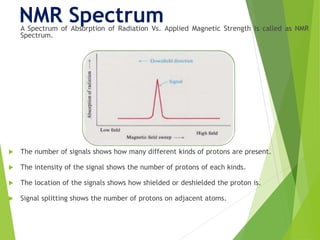
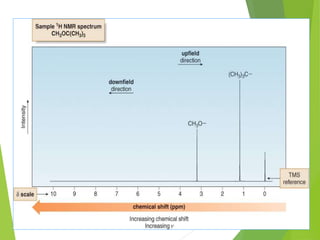
NMR SpectrumA Spectrum of Absorption of Radiation Vs. Applied Magnetic Strength is called as NMR
Spectrum.
 The number of signals shows how many different kinds of protons are present.
 The intensity of the signal shows the number of protons of each kinds.
 The location of the signals shows how shielded or deshielded the proton is.
 Signal splitting shows the number of protons on adjacent atoms.
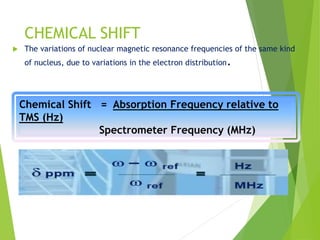
CHEMICAL SHIFT
 The variations of nuclear magnetic resonance frequencies of the same kind
of nucleus, due to variations in the electron distribution.
Chemical Shift = Absorption Frequency relative to
TMS (Hz)
Spectrometer Frequency (MHz)
 The relative energy of resonance of a particular nucleus resulting from its local
environment is called chemical shift.
 NMR spectra show applied field strength increasing from left to right, Left part
is downfield, the right is upfield.
 Nuclei that absorb on upfield side are strongly shielded where nuclei that absorb
on downfield side is weakly shielded.
 Chart calibrated versus a reference point, set as 0, tetramethylsilane [TMS].
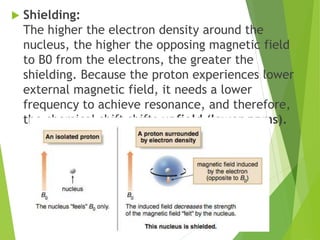
 Shielding:
The higher the electron density around the
nucleus, the higher the opposing magnetic field
to B0 from the electrons, the greater the
shielding. Because the proton experiences lower
external magnetic field, it needs a lower
frequency to achieve resonance, and therefore,
the chemical shift shifts upfield (lower ppms).
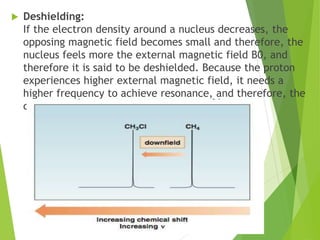
 Deshielding:
If the electron density around a nucleus decreases, the
opposing magnetic field becomes small and therefore, the
nucleus feels more the external magnetic field B0, and
therefore it is said to be deshielded. Because the proton
experiences higher external magnetic field, it needs a
higher frequency to achieve resonance, and therefore, the
chemical shift shifts downfield (higher ppms) .
Factor influencing chemical
shift
Both 1H and 13C Chemical shifts are related to the
following major factors:
Depends on Hydrogen bonding
Depends on adjacent group
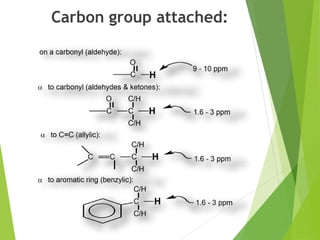
Depends on carbon group attached
Depends on hybridization
Depends on anisotropy
 Hydrogen Bonding:
Molecules having hydrogen bonding have higher
chemical shift and absorb radiation at low field.
That is due to the decrease of electronic density
around the nucleus
 Adjacent Group:
For protons on carbon attached to an
electronegative atom or group X( Cl , F ,Br ,I), the
chemical shift increases with the electro negativity
of X. This is due to the inductive effect on the
shielding of the protons and is apparent in the
methyl halides.
Carbon group attached:
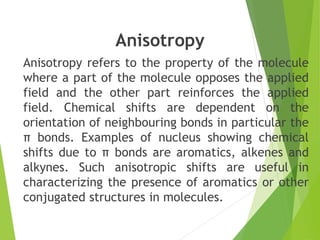
Anisotropy
Anisotropy refers to the property of the molecule
where a part of the molecule opposes the applied
field and the other part reinforces the applied
field. Chemical shifts are dependent on the
orientation of neighbouring bonds in particular the
π bonds. Examples of nucleus showing chemical
shifts due to π bonds are aromatics, alkenes and
alkynes. Such anisotropic shifts are useful in
characterizing the presence of aromatics or other
conjugated structures in molecules.
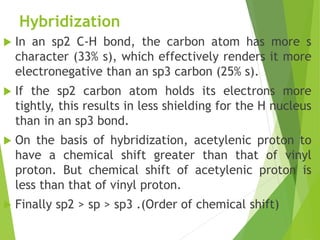
Hybridization
 In an sp2 C-H bond, the carbon atom has more s
character (33% s), which effectively renders it more
electronegative than an sp3 carbon (25% s).
 If the sp2 carbon atom holds its electrons more
tightly, this results in less shielding for the H nucleus
than in an sp3 bond.
 On the basis of hybridization, acetylenic proton to
have a chemical shift greater than that of vinyl
proton. But chemical shift of acetylenic proton is
less than that of vinyl proton.
 Finally sp2 > sp > sp3 .(Order of chemical shift)
Spin- Spin Coupling
 Spin-spin coupling is the interaction
between the spin magnetic moments
of different electrons and/or nuclei.
 In NMR spectroscopy it gives rise to
multiplet patterns, and cross-peaks in
two-dimensional NMR spectra.
Between electron and nuclear spins
this is termed the nuclear hyperfine
interaction. Between electron spins it
gives rise to relaxation effects and
splitting of the spectrum
FT NMR
 The Fourier Transformation is the basic
mathematical calculation necessary to convert the
data in time domain(interferogram) to frequency
domain(NMR Spectrum).
i.e, time domain - Intensity v/s Time.
Frequency domain - Intensity v/s Frequency.
Advantages of FT-NMR
 Dramatic increase in the sensitivity of NMR
measurements.
 Has widespread applications esp. for 13C NMR, 31P NMR
and 19F NMR giving high signal to noise ratio facilitating
rapid scanning.
 Can be obtained with less than 5 mg of the compound.
 The signals stand out clearly with almost no electronic
background noise.
 Used in engineering, industrial quality control and
medicine.
 MRI is most prominent FT NMR applications.
RELAXATION PROCESS
 Relaxation process involve some non radiative transition
by which a nucleus in an upper transition state return to
the lower spin state. Three kinds of relaxation process
are:
 Spin –Spin relaxation
 Spin – lattice relaxation
 Quadrapole relaxation
 Spin – Spin relaxation:
It is due to the mutual exchange of the spin by two
precessing nuclei which are in close proxemity to each
other. It involve the transfer of energy from one
nucleus to the other, there is no net loss of energy.
 Spin – lattice relaxation:
It involve the transfer of energy from the nucleus in
its higher energy state to the molecular lattice. The
energy is transfered to the component of the lattice as
the additional translational, vibrational and rotational
energy.
 Quadrapole Relaxation:
It is a prominent relaxation process for nuclie having
I > ½. The nuclie 14N, 17O, 11B etc.
2 DIMENSIONAL NMR
 Two-dimensional nuclear magnetic resonance
spectroscopy (2D NMR) is a set of nuclear magnetic
resonance spectroscopy (NMR) methods which give data
plotted in a space defined by two frequency axes rather
than one.
 Types of 2D NMR include correlation spectroscopy
(COSY), J-spectroscopy, exchange spectroscopy (EXSY),
and nuclearOverhauser effect spectroscopy (NOESY).
Correlation Spectroscopy
(COSY)
 It is used to identify spins which are coupled to each
other. It consists of a single RF pulse (p1) followed by
the specific evolution time (t1) followed by a second
followed by a measurement pulse (p2) period (t2).
 The two-dimensional spectrum that results from the
COSY experiment shows the frequencies for a single
isotope, most commonly hydrogen (1H) along both axes.
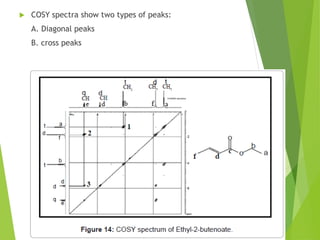
 COSY spectra show two types of peaks:
A. Diagonal peaks
B. cross peaks
Nuclear Over- Hauser effect
Spectroscopy (NOESY)
 The spectrum obtained is similar to COSY, with diagonal
peaks and cross peaks, however the cross peaks connect
resonances from nuclei that are spatially close rather
than those that are throughbond coupled to each other.
NOESY spectra also contain extra axial peaks which do
not provide extra information and can be eliminated
through a different experiment by reversing the phase
of the first pulse.
THANK YOU

NMR

  • 1.
    NMR SPECTROSCOPY Prepared by- SudhanshuMishra M.PHARM Pharmaceutics
  • 2.
    Contents  Introduction  Fundamentalprinciple of NMR  Interpretation Chemical shift Number of signals Spin Spin coupling: Spliting of signals Coupling constant Integrals
  • 3.
    Introduction  Nuclear MagneticResonance (NMR) is a spectroscopy technique which is based on the absorption of the electromagnetic radiation in the radio frequency region 4 to 900 MHz by nuclei of the atoms.  Nuclear magnetic resonance spectroscopy(NMR) is a powerful analytical technique used to characterize organic molecules by identifying carbon-hydrogen frameworks within molecules.  It is a research technique that exploits the magnetic properties of certain atomic nuclei.  It determines the physical and chemical properties of atoms or the molecules in which they are contained.
  • 4.
     Proton NuclearMagnetic resonance spectroscopy is one of the most powerful tools for elucidating the number of hydrogen or proton in the compound.  It is used to study wide variety of nuclei:
  • 5.
    Principle of NMR The principle behind NMR is that many nuclei have spin and all nuclei are electrically charged. If an external magnetic field is applied, an energy transfer is possible between the base energy to a higher energy level (generally a single energy gap).  The energy transfer takes place at a wavelength that corresponds to radio frequencies and when the spin returns to its base level, energy is emitted at the same frequency.
  • 6.
     The signalthat matches this transfer is measured in many ways and processed in order to yield an NMR spectrum for the nucleus concerned.
  • 7.
    Theory of NMR The hydrogen nucleus or protons can be regarded as a spinning positively charged unit and so it will generate a tiny magnetic field Ho along its spinning axis.  Now if this nucleus is placed in an external magnetic field H0, it will naturally line up either parallel A or antiparallel B to the direction of external field. The A will be more stable, being of lower energy.
  • 8.
    The energy differenceE between two states will be absorbed or emitted as the nucleus flips from one orientation to the other. Then E = hv where v = a radiation frequency and h = Planck’s constant If correct frequency is applied to the sample containing hydrogen nuclie and sample is placed in the external field HQ, then low energy nuclie A will absorb AE = hv, and flips to B. Thus on flipping back down, they remit hv as a radiation signal which is picked up by the instrument.
  • 10.
    Effect of magneticfield  A nucleus is in resonance when it absorbs RF radiation and “spin flips” to a higher energy state.  Thus, two variables characterize NMR: an applied magnetic field B0, the strength of which is measured in tesla (T), and the frequency n of radiation used for resonance, measured in hertz (Hz), or megahertz (MHz).
  • 11.
     The frequencyneeded for resonance and the applied magnetic field strength are proportionally related: V α B0 When energy in the form of Radiofrequency is applied and when, Applied frequency = Precessional frequency absorption of energy occurs and a NMR signal is recorded . • The nuclei are said to be in resonance, and the energy they emit when flipping from the high to the low energy state can be
  • 12.
    Types of solventused  A substance free from proton should be used as a solvent i.e which does not give absorption of its own in NMR spectrum. Moreover , the solvent should be capable of dissolving at least 10% of the substance under investigation.  Following solvents are commonly used in NMR spectroscopy  Carbon tetrachloride (CCl4)  Carbon Disulphide (CS4)  Deuterochloroform (CDCl3)  Hexachloroacetone (CCl3)2CO
  • 13.
    NMR SpectrumA Spectrumof Absorption of Radiation Vs. Applied Magnetic Strength is called as NMR Spectrum.  The number of signals shows how many different kinds of protons are present.  The intensity of the signal shows the number of protons of each kinds.  The location of the signals shows how shielded or deshielded the proton is.  Signal splitting shows the number of protons on adjacent atoms.
  • 14.
    CHEMICAL SHIFT  Thevariations of nuclear magnetic resonance frequencies of the same kind of nucleus, due to variations in the electron distribution. Chemical Shift = Absorption Frequency relative to TMS (Hz) Spectrometer Frequency (MHz)
  • 15.
     The relativeenergy of resonance of a particular nucleus resulting from its local environment is called chemical shift.  NMR spectra show applied field strength increasing from left to right, Left part is downfield, the right is upfield.  Nuclei that absorb on upfield side are strongly shielded where nuclei that absorb on downfield side is weakly shielded.  Chart calibrated versus a reference point, set as 0, tetramethylsilane [TMS].
  • 17.
     Shielding: The higherthe electron density around the nucleus, the higher the opposing magnetic field to B0 from the electrons, the greater the shielding. Because the proton experiences lower external magnetic field, it needs a lower frequency to achieve resonance, and therefore, the chemical shift shifts upfield (lower ppms).
  • 18.
     Deshielding: If theelectron density around a nucleus decreases, the opposing magnetic field becomes small and therefore, the nucleus feels more the external magnetic field B0, and therefore it is said to be deshielded. Because the proton experiences higher external magnetic field, it needs a higher frequency to achieve resonance, and therefore, the chemical shift shifts downfield (higher ppms) .
  • 19.
    Factor influencing chemical shift Both1H and 13C Chemical shifts are related to the following major factors: Depends on Hydrogen bonding Depends on adjacent group Depends on carbon group attached Depends on hybridization Depends on anisotropy
  • 20.
     Hydrogen Bonding: Moleculeshaving hydrogen bonding have higher chemical shift and absorb radiation at low field. That is due to the decrease of electronic density around the nucleus  Adjacent Group: For protons on carbon attached to an electronegative atom or group X( Cl , F ,Br ,I), the chemical shift increases with the electro negativity of X. This is due to the inductive effect on the shielding of the protons and is apparent in the methyl halides.
  • 21.
  • 22.
    Anisotropy Anisotropy refers tothe property of the molecule where a part of the molecule opposes the applied field and the other part reinforces the applied field. Chemical shifts are dependent on the orientation of neighbouring bonds in particular the π bonds. Examples of nucleus showing chemical shifts due to π bonds are aromatics, alkenes and alkynes. Such anisotropic shifts are useful in characterizing the presence of aromatics or other conjugated structures in molecules.
  • 23.
    Hybridization  In ansp2 C-H bond, the carbon atom has more s character (33% s), which effectively renders it more electronegative than an sp3 carbon (25% s).  If the sp2 carbon atom holds its electrons more tightly, this results in less shielding for the H nucleus than in an sp3 bond.  On the basis of hybridization, acetylenic proton to have a chemical shift greater than that of vinyl proton. But chemical shift of acetylenic proton is less than that of vinyl proton.  Finally sp2 > sp > sp3 .(Order of chemical shift)
  • 24.
    Spin- Spin Coupling Spin-spin coupling is the interaction between the spin magnetic moments of different electrons and/or nuclei.  In NMR spectroscopy it gives rise to multiplet patterns, and cross-peaks in two-dimensional NMR spectra. Between electron and nuclear spins this is termed the nuclear hyperfine interaction. Between electron spins it gives rise to relaxation effects and splitting of the spectrum
  • 25.
    FT NMR  TheFourier Transformation is the basic mathematical calculation necessary to convert the data in time domain(interferogram) to frequency domain(NMR Spectrum). i.e, time domain - Intensity v/s Time. Frequency domain - Intensity v/s Frequency.
  • 26.
    Advantages of FT-NMR Dramatic increase in the sensitivity of NMR measurements.  Has widespread applications esp. for 13C NMR, 31P NMR and 19F NMR giving high signal to noise ratio facilitating rapid scanning.  Can be obtained with less than 5 mg of the compound.  The signals stand out clearly with almost no electronic background noise.  Used in engineering, industrial quality control and medicine.  MRI is most prominent FT NMR applications.
  • 27.
    RELAXATION PROCESS  Relaxationprocess involve some non radiative transition by which a nucleus in an upper transition state return to the lower spin state. Three kinds of relaxation process are:  Spin –Spin relaxation  Spin – lattice relaxation  Quadrapole relaxation
  • 28.
     Spin –Spin relaxation: It is due to the mutual exchange of the spin by two precessing nuclei which are in close proxemity to each other. It involve the transfer of energy from one nucleus to the other, there is no net loss of energy.  Spin – lattice relaxation: It involve the transfer of energy from the nucleus in its higher energy state to the molecular lattice. The energy is transfered to the component of the lattice as the additional translational, vibrational and rotational energy.  Quadrapole Relaxation: It is a prominent relaxation process for nuclie having I > ½. The nuclie 14N, 17O, 11B etc.
  • 29.
    2 DIMENSIONAL NMR Two-dimensional nuclear magnetic resonance spectroscopy (2D NMR) is a set of nuclear magnetic resonance spectroscopy (NMR) methods which give data plotted in a space defined by two frequency axes rather than one.  Types of 2D NMR include correlation spectroscopy (COSY), J-spectroscopy, exchange spectroscopy (EXSY), and nuclearOverhauser effect spectroscopy (NOESY).
  • 30.
    Correlation Spectroscopy (COSY)  Itis used to identify spins which are coupled to each other. It consists of a single RF pulse (p1) followed by the specific evolution time (t1) followed by a second followed by a measurement pulse (p2) period (t2).  The two-dimensional spectrum that results from the COSY experiment shows the frequencies for a single isotope, most commonly hydrogen (1H) along both axes.
  • 31.
     COSY spectrashow two types of peaks: A. Diagonal peaks B. cross peaks
  • 32.
    Nuclear Over- Hausereffect Spectroscopy (NOESY)  The spectrum obtained is similar to COSY, with diagonal peaks and cross peaks, however the cross peaks connect resonances from nuclei that are spatially close rather than those that are throughbond coupled to each other. NOESY spectra also contain extra axial peaks which do not provide extra information and can be eliminated through a different experiment by reversing the phase of the first pulse.
  • 33.