NMR Interpretation
Prepared By :
Mahendra G S
M-Pharm,Pharmaceutical
Chemistry
JSSCP, MYSURU
Splitting Patterns of Common Multiplets
Number of equivalent Appearance Intensities of lines
protons to which H of multiplet in multiplet
is coupled
1 Doublet 1:1
2 Triplet 1:2:1
3 Quartet 1:3:3:1
4 Pentet 1:4:6:4:1
5 Sextet 1:5:10:10:5:1
6 Septet 1:6:15:20:15:6:1
Degree of unsaturation
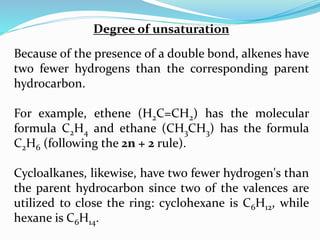
Because of the presence of a double bond, alkenes have
two fewer hydrogens than the corresponding parent
hydrocarbon.
For example, ethene (H2C=CH2) has the molecular
formula C2H4 and ethane (CH3CH3) has the formula
C2H6 (following the 2n + 2 rule).
Cycloalkanes, likewise, have two fewer hydrogen's than
the parent hydrocarbon since two of the valences are
utilized to close the ring: cyclohexane is C6H12, while
hexane is C6H14.
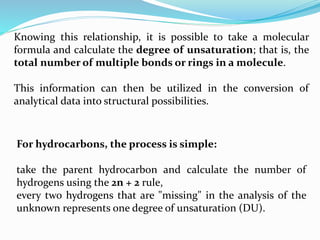
Knowing this relationship, it is possible to take a molecular
formula and calculate the degree of unsaturation; that is, the
total number of multiple bonds or rings in a molecule.
This information can then be utilized in the conversion of
analytical data into structural possibilities.
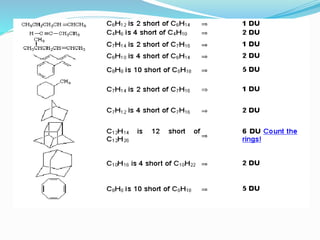
For hydrocarbons, the process is simple:
take the parent hydrocarbon and calculate the number of
hydrogens using the 2n + 2 rule,
every two hydrogens that are "missing" in the analysis of the
unknown represents one degree of unsaturation (DU).
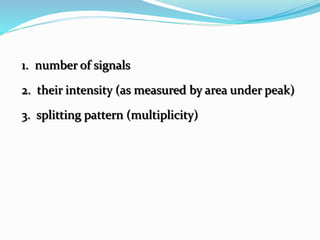
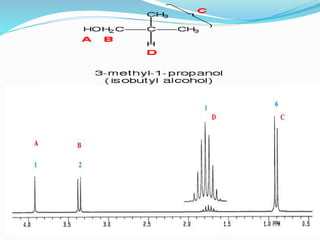
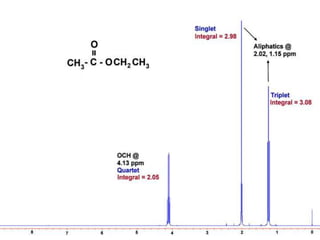
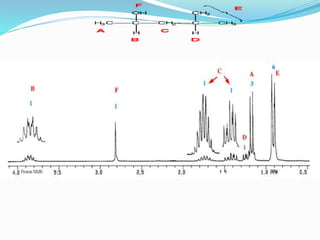
1. number of signals
2. their intensity (as measured by area under peak)
3. splitting pattern (multiplicity)
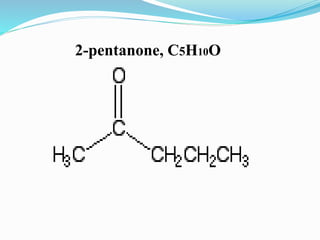
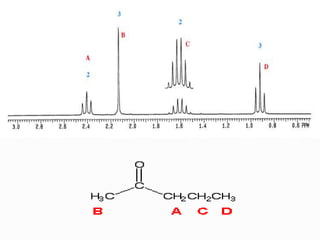
2-pentanone, C5H10O
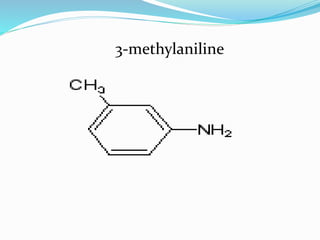
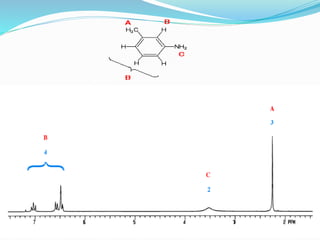
3-methylaniline
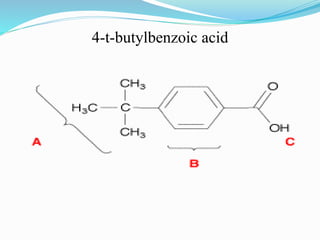
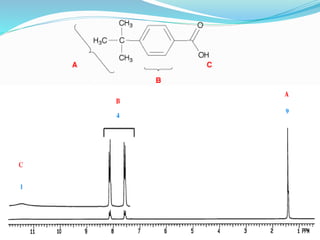
4-t-butylbenzoic acid
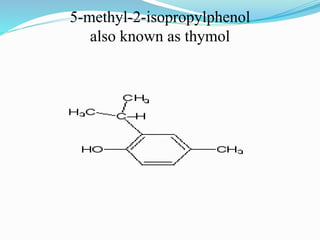
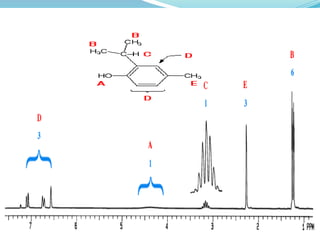
5-methyl-2-isopropylphenol
also known as thymol
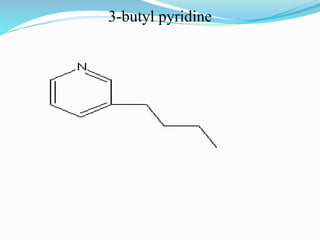
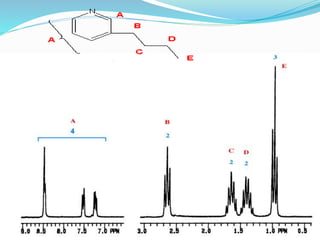
3-butyl pyridine
NMR Interpretation
NMR Interpretation
NMR Interpretation

NMR Interpretation

  • 1.
    NMR Interpretation Prepared By: Mahendra G S M-Pharm,Pharmaceutical Chemistry JSSCP, MYSURU
  • 3.
    Splitting Patterns ofCommon Multiplets Number of equivalent Appearance Intensities of lines protons to which H of multiplet in multiplet is coupled 1 Doublet 1:1 2 Triplet 1:2:1 3 Quartet 1:3:3:1 4 Pentet 1:4:6:4:1 5 Sextet 1:5:10:10:5:1 6 Septet 1:6:15:20:15:6:1
  • 4.
    Degree of unsaturation Becauseof the presence of a double bond, alkenes have two fewer hydrogens than the corresponding parent hydrocarbon. For example, ethene (H2C=CH2) has the molecular formula C2H4 and ethane (CH3CH3) has the formula C2H6 (following the 2n + 2 rule). Cycloalkanes, likewise, have two fewer hydrogen's than the parent hydrocarbon since two of the valences are utilized to close the ring: cyclohexane is C6H12, while hexane is C6H14.
  • 5.
    Knowing this relationship,it is possible to take a molecular formula and calculate the degree of unsaturation; that is, the total number of multiple bonds or rings in a molecule. This information can then be utilized in the conversion of analytical data into structural possibilities. For hydrocarbons, the process is simple: take the parent hydrocarbon and calculate the number of hydrogens using the 2n + 2 rule, every two hydrogens that are "missing" in the analysis of the unknown represents one degree of unsaturation (DU).
  • 7.
    1. number ofsignals 2. their intensity (as measured by area under peak) 3. splitting pattern (multiplicity)
  • 8.
  • 22.
  • 26.
  • 28.
  • 32.