Fragmentation of different
functional groups
Under the guidance of By-
Ashwin S Shetty
-Dr. Rajesh R
-Department of Pharmaceutical
Analysis
-Acharya & BM Reddy College of
Pharmacy
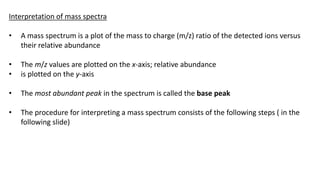
Interpretation of mass spectra
• A mass spectrum is a plot of the mass to charge (m/z) ratio of the detected ions versus
their relative abundance
• The m/z values are plotted on the x-axis; relative abundance
• is plotted on the y-axis
• The most abundant peak in the spectrum is called the base peak
• The procedure for interpreting a mass spectrum consists of the following steps ( in the
following slide)
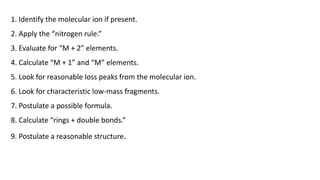
1. Identify the molecular ion if present.
2. Apply the “nitrogen rule.”
3. Evaluate for “M + 2” elements.
4. Calculate “M + 1” and “M” elements.
5. Look for reasonable loss peaks from the molecular ion.
6. Look for characteristic low-mass fragments.
7. Postulate a possible formula.
8. Calculate “rings + double bonds.”
9. Postulate a reasonable structure.
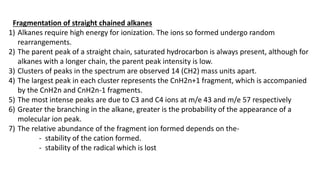
Fragmentation of straight chained alkanes
1) Alkanes require high energy for ionization. The ions so formed undergo random
rearrangements.
2) The parent peak of a straight chain, saturated hydrocarbon is always present, although for
alkanes with a longer chain, the parent peak intensity is low.
3) Clusters of peaks in the spectrum are observed 14 (CH2) mass units apart.
4) The largest peak in each cluster represents the CnH2n+1 fragment, which is accompanied
by the CnH2n and CnH2n-1 fragments.
5) The most intense peaks are due to C3 and C4 ions at m/e 43 and m/e 57 respectively
6) Greater the branching in the alkane, greater is the probability of the appearance of a
molecular ion peak.
7) The relative abundance of the fragment ion formed depends on the-
- stability of the cation formed.
- stability of the radical which is lost
The stability of the carbonium ion is in the following order-
Allylic > Tertiary > Secondary > Primary > Methyl
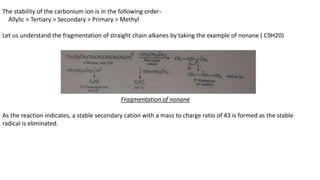
Let us understand the fragmentation of straight chain alkanes by taking the example of nonane ( C9H20)
Fragmentation of nonane
As the reaction indicates, a stable secondary cation with a mass to charge ratio of 43 is formed as the stable
radical is eliminated.
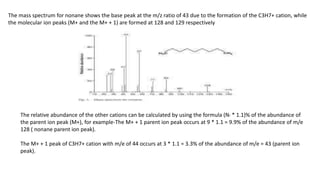
The mass spectrum for nonane shows the base peak at the m/z ratio of 43 due to the formation of the C3H7+ cation, while
the molecular ion peaks (M+ and the M+ + 1) are formed at 128 and 129 respectively
The relative abundance of the other cations can be calculated by using the formula (N! * 1.1)% of the abundance of
the parent ion peak (M+), for example-The M+ + 1 parent ion peak occurs at 9 * 1.1 = 9.9% of the abundance of m/e
128 ( nonane parent ion peak).
The M+ + 1 peak of C3H7+ cation with m/e of 44 occurs at 3 * 1.1 = 3.3% of the abundance of m/e = 43 (parent ion
peak).
Fragmentation of branched alkanes
Important features of their mass spectra are
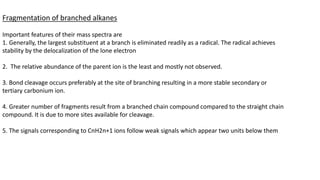
1. Generally, the largest substituent at a branch is eliminated readily as a radical. The radical achieves
stability by the delocalization of the lone electron
2. The relative abundance of the parent ion is the least and mostly not observed.
3. Bond cleavage occurs preferably at the site of branching resulting in a more stable secondary or
tertiary carbonium ion.
4. Greater number of fragments result from a branched chain compound compared to the straight chain
compound. It is due to more sites available for cleavage.
5. The signals corresponding to CnH2n+1 ions follow weak signals which appear two units below them
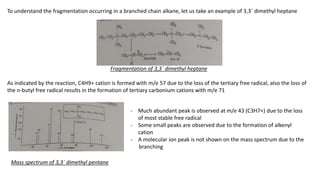
To understand the fragmentation occurring in a branched chain alkane, let us take an example of 3,3´ dimethyl heptane
Fragmentation of 3,3´ dimethyl heptane
As indicated by the reaction, C4H9+ cation is formed with m/e 57 due to the loss of the tertiary free radical, also the loss of
the n-butyl free radical results in the formation of tertiary carbonium cations with m/e 71
Mass spectrum of 3,3´ dimethyl pentane
- Much abundant peak is observed at m/e 43 (C3H7+) due to the loss
of most stable free radical
- Some small peaks are observed due to the formation of alkenyl
cation
- A molecular ion peak is not shown on the mass spectrum due to the
branching
Fragmentation of alcohols
Important features of their mass spectra
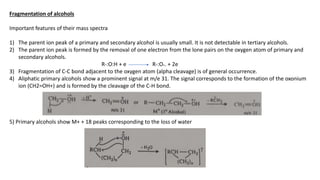
1) The parent ion peak of a primary and secondary alcohol is usually small. It is not detectable in tertiary alcohols.
2) The parent ion peak is formed by the removal of one electron from the lone pairs on the oxygen atom of primary and
secondary alcohols.
R-:O:H + e R-:O+. + 2e
3) Fragmentation of C-C bond adjacent to the oxygen atom (alpha cleavage) is of general occurrence.
4) Aliphatic primary alcohols show a prominent signal at m/e 31. The signal corresponds to the formation of the oxonium
ion (CH2=OH+) and is formed by the cleavage of the C-H bond.
5) Primary alcohols show M+ + 18 peaks corresponding to the loss of water
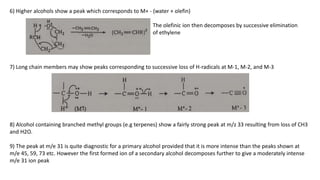
6) Higher alcohols show a peak which corresponds to M+ - (water + olefin)
The olefinic ion then decomposes by successive elimination
of ethylene
7) Long chain members may show peaks corresponding to successive loss of H-radicals at M-1, M-2, and M-3
8) Alcohol containing branched methyl groups (e.g terpenes) show a fairly strong peak at m/z 33 resulting from loss of CH3
and H2O.
9) The peak at m/e 31 is quite diagnostic for a primary alcohol provided that it is more intense than the peaks shown at
m/e 45, 59, 73 etc. However the first formed ion of a secondary alcohol decomposes further to give a moderately intense
m/e 31 ion peak
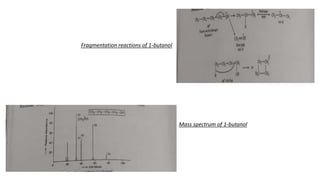
Mass spectrum of 1-butanol
Fragmentation reactions of 1-butanol
Fragmentation of aromatic alcohols
Some characteristics of mass spectrum of aromatic alcohols are:
1. Aromatic alcohols show fairly intense molecular ion peaks.
2. Some of the fragment modes of benzyl alcohol are loss of one, two or three H atoms.
3. The fragment ion, (M-H) further eliminates CHO radical.
4. The (M¹-H) fragment of benzyl alcohol also rearranges to form hydroxy tropylium ion.
5. The-OH group in benzylic position fragments in a way that favor charge retention on the aryl group.
6. The aromatic cluster at m/e 77, 78 and 79 resulting from complex disintegration is usually prominent.
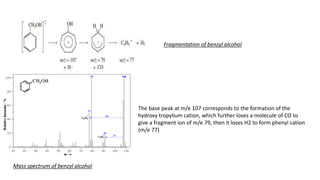
Fragmentation of benzyl alcohol
The base peak at m/e 107 corresponds to the formation of the
hydroxy tropylium cation, which further loses a molecule of CO to
give a fragment ion of m/e 79, then it loses H2 to form phenyl cation
(m/e 77)
Mass spectrum of benzyl alcohol
Fragmentation of aliphatic aldehydes and ketones
Important features of their mass spectra are
1. The intensity of the parent peak decreases as the alkyl chain length increases.
2. The main fragmentation processes are alpha- and beta-cleavage. In alpha-cleavage, the bigger group on either side of
the carbonyl group (ketone) is preferably lost.
3. In lower aldehydes, alpha-cleavage is prominent with retention of charge on oxygen.
4. In aldehydes and ketones containing gamma-H atom, McLafferty rearrangement ion is most significant. In an aldehyde
which is not a-substituted, a base peak due to this is formed at m/e 44.
5. The McLafferty rearrangement ion in methyl ketones which are not a-substituted appears at m/e 58
6. In C4 and higher aldehydes, cleavage of the C-C bond once removed from C=O group occurs with hydrogen
rearrangement to give a major peak at m/e 44, 58 or 72 etc. depending upon the a-substituents.
7. In straight chain aldehydes, other diagnostic peaks are at m/e 18 (loss of water), m/e28 (loss of C₂H4). m/e 43 (loss of
CH₂=CH-O) and m/e 44 (loss of CH₂=CH-OH).
8. In aldehydes, methyl or alkyl radical is preferably lost compared to hydrogen radical.
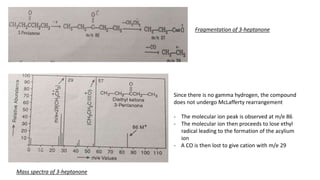
Fragmentation of 3-heptanone
Mass spectra of 3-heptanone
Since there is no gamma hydrogen, the compound
does not undergo McLafferty rearrangement
- The molecular ion peak is observed at m/e 86
- The molecular ion then proceeds to lose ethyl
radical leading to the formation of the acylium
ion
- A CO is then lost to give cation with m/e 29
Fragmentation of amines
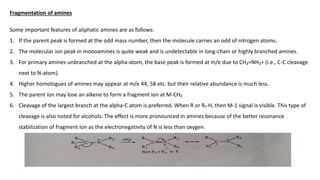
Some important features of aliphatic amines are as follows:
1. If the parent peak is formed at the odd mass number, then the molecule carries an odd of nitrogen atoms.
2. The molecular ion peak in monoamines is quite weak and is undetectable in long-chain or highly branched amines.
3. For primary amines unbranched at the alpha-atom, the base peak is formed at m/e due to CH₂=NH₂+ (i.e., C-C cleavage
next to N-atom).
4. Higher homologues of amines may appear at m/e 44, 58 etc. but their relative abundance is much less.
5. The parent ion may lose an alkene to form a fragment ion at M-CH₂
6. Cleavage of the largest branch at the alpha-C atom is preferred. When R or R₁-H, then M-1 signal is visible. This type of
cleavage is also noted for alcohols. The effect is more pronounced in amines because of the better resonance
stabilization of fragment ion as the electronegativity of N is less than oxygen.
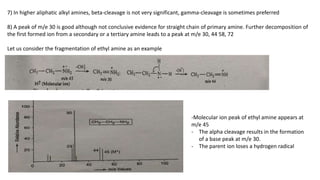
7) In higher aliphatic alkyl amines, beta-cleavage is not very significant, gamma-cleavage is sometimes preferred
8) A peak of m/e 30 is good although not conclusive evidence for straight chain of primary amine. Further decomposition of
the first formed ion from a secondary or a tertiary amine leads to a peak at m/e 30, 44 58, 72
Let us consider the fragmentation of ethyl amine as an example
-Molecular ion peak of ethyl amine appears at
m/e 45
- The alpha cleavage results in the formation
of a base peak at m/e 30.
- The parent ion loses a hydrogen radical
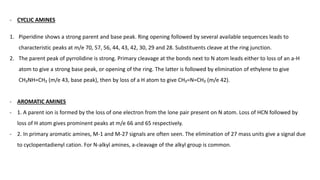
- CYCLIC AMINES
1. Piperidine shows a strong parent and base peak. Ring opening followed by several available sequences leads to
characteristic peaks at m/e 70, 57, 56, 44, 43, 42, 30, 29 and 28. Substituents cleave at the ring junction.
2. The parent peak of pyrrolidine is strong. Primary cleavage at the bonds next to N atom leads either to loss of an a-H
atom to give a strong base peak, or opening of the ring. The latter is followed by elimination of ethylene to give
CH₂NH=CH₂ (m/e 43, base peak), then by loss of a H atom to give CH₂=N=CH₂ (m/e 42).
- AROMATIC AMINES
- 1. A parent ion is formed by the loss of one electron from the lone pair present on N atom. Loss of HCN followed by
loss of H atom gives prominent peaks at m/e 66 and 65 respectively.
- 2. In primary aromatic amines, M-1 and M-27 signals are often seen. The elimination of 27 mass units give a signal due
to cyclopentadienyl cation. For N-alkyl amines, a-cleavage of the alkyl group is common.
Fragmentation of different functional groups

Fragmentation of different functional groups

  • 1.
    Fragmentation of different functionalgroups Under the guidance of By- Ashwin S Shetty -Dr. Rajesh R -Department of Pharmaceutical Analysis -Acharya & BM Reddy College of Pharmacy
  • 2.
    Interpretation of massspectra • A mass spectrum is a plot of the mass to charge (m/z) ratio of the detected ions versus their relative abundance • The m/z values are plotted on the x-axis; relative abundance • is plotted on the y-axis • The most abundant peak in the spectrum is called the base peak • The procedure for interpreting a mass spectrum consists of the following steps ( in the following slide)
  • 3.
    1. Identify themolecular ion if present. 2. Apply the “nitrogen rule.” 3. Evaluate for “M + 2” elements. 4. Calculate “M + 1” and “M” elements. 5. Look for reasonable loss peaks from the molecular ion. 6. Look for characteristic low-mass fragments. 7. Postulate a possible formula. 8. Calculate “rings + double bonds.” 9. Postulate a reasonable structure.
  • 4.
    Fragmentation of straightchained alkanes 1) Alkanes require high energy for ionization. The ions so formed undergo random rearrangements. 2) The parent peak of a straight chain, saturated hydrocarbon is always present, although for alkanes with a longer chain, the parent peak intensity is low. 3) Clusters of peaks in the spectrum are observed 14 (CH2) mass units apart. 4) The largest peak in each cluster represents the CnH2n+1 fragment, which is accompanied by the CnH2n and CnH2n-1 fragments. 5) The most intense peaks are due to C3 and C4 ions at m/e 43 and m/e 57 respectively 6) Greater the branching in the alkane, greater is the probability of the appearance of a molecular ion peak. 7) The relative abundance of the fragment ion formed depends on the- - stability of the cation formed. - stability of the radical which is lost
  • 5.
    The stability ofthe carbonium ion is in the following order- Allylic > Tertiary > Secondary > Primary > Methyl Let us understand the fragmentation of straight chain alkanes by taking the example of nonane ( C9H20) Fragmentation of nonane As the reaction indicates, a stable secondary cation with a mass to charge ratio of 43 is formed as the stable radical is eliminated.
  • 6.
    The mass spectrumfor nonane shows the base peak at the m/z ratio of 43 due to the formation of the C3H7+ cation, while the molecular ion peaks (M+ and the M+ + 1) are formed at 128 and 129 respectively The relative abundance of the other cations can be calculated by using the formula (N! * 1.1)% of the abundance of the parent ion peak (M+), for example-The M+ + 1 parent ion peak occurs at 9 * 1.1 = 9.9% of the abundance of m/e 128 ( nonane parent ion peak). The M+ + 1 peak of C3H7+ cation with m/e of 44 occurs at 3 * 1.1 = 3.3% of the abundance of m/e = 43 (parent ion peak).
  • 7.
    Fragmentation of branchedalkanes Important features of their mass spectra are 1. Generally, the largest substituent at a branch is eliminated readily as a radical. The radical achieves stability by the delocalization of the lone electron 2. The relative abundance of the parent ion is the least and mostly not observed. 3. Bond cleavage occurs preferably at the site of branching resulting in a more stable secondary or tertiary carbonium ion. 4. Greater number of fragments result from a branched chain compound compared to the straight chain compound. It is due to more sites available for cleavage. 5. The signals corresponding to CnH2n+1 ions follow weak signals which appear two units below them
  • 8.
    To understand thefragmentation occurring in a branched chain alkane, let us take an example of 3,3´ dimethyl heptane Fragmentation of 3,3´ dimethyl heptane As indicated by the reaction, C4H9+ cation is formed with m/e 57 due to the loss of the tertiary free radical, also the loss of the n-butyl free radical results in the formation of tertiary carbonium cations with m/e 71 Mass spectrum of 3,3´ dimethyl pentane - Much abundant peak is observed at m/e 43 (C3H7+) due to the loss of most stable free radical - Some small peaks are observed due to the formation of alkenyl cation - A molecular ion peak is not shown on the mass spectrum due to the branching
  • 9.
    Fragmentation of alcohols Importantfeatures of their mass spectra 1) The parent ion peak of a primary and secondary alcohol is usually small. It is not detectable in tertiary alcohols. 2) The parent ion peak is formed by the removal of one electron from the lone pairs on the oxygen atom of primary and secondary alcohols. R-:O:H + e R-:O+. + 2e 3) Fragmentation of C-C bond adjacent to the oxygen atom (alpha cleavage) is of general occurrence. 4) Aliphatic primary alcohols show a prominent signal at m/e 31. The signal corresponds to the formation of the oxonium ion (CH2=OH+) and is formed by the cleavage of the C-H bond. 5) Primary alcohols show M+ + 18 peaks corresponding to the loss of water
  • 10.
    6) Higher alcoholsshow a peak which corresponds to M+ - (water + olefin) The olefinic ion then decomposes by successive elimination of ethylene 7) Long chain members may show peaks corresponding to successive loss of H-radicals at M-1, M-2, and M-3 8) Alcohol containing branched methyl groups (e.g terpenes) show a fairly strong peak at m/z 33 resulting from loss of CH3 and H2O. 9) The peak at m/e 31 is quite diagnostic for a primary alcohol provided that it is more intense than the peaks shown at m/e 45, 59, 73 etc. However the first formed ion of a secondary alcohol decomposes further to give a moderately intense m/e 31 ion peak
  • 11.
    Mass spectrum of1-butanol Fragmentation reactions of 1-butanol
  • 12.
    Fragmentation of aromaticalcohols Some characteristics of mass spectrum of aromatic alcohols are: 1. Aromatic alcohols show fairly intense molecular ion peaks. 2. Some of the fragment modes of benzyl alcohol are loss of one, two or three H atoms. 3. The fragment ion, (M-H) further eliminates CHO radical. 4. The (M¹-H) fragment of benzyl alcohol also rearranges to form hydroxy tropylium ion. 5. The-OH group in benzylic position fragments in a way that favor charge retention on the aryl group. 6. The aromatic cluster at m/e 77, 78 and 79 resulting from complex disintegration is usually prominent.
  • 13.
    Fragmentation of benzylalcohol The base peak at m/e 107 corresponds to the formation of the hydroxy tropylium cation, which further loses a molecule of CO to give a fragment ion of m/e 79, then it loses H2 to form phenyl cation (m/e 77) Mass spectrum of benzyl alcohol
  • 14.
    Fragmentation of aliphaticaldehydes and ketones Important features of their mass spectra are 1. The intensity of the parent peak decreases as the alkyl chain length increases. 2. The main fragmentation processes are alpha- and beta-cleavage. In alpha-cleavage, the bigger group on either side of the carbonyl group (ketone) is preferably lost. 3. In lower aldehydes, alpha-cleavage is prominent with retention of charge on oxygen. 4. In aldehydes and ketones containing gamma-H atom, McLafferty rearrangement ion is most significant. In an aldehyde which is not a-substituted, a base peak due to this is formed at m/e 44. 5. The McLafferty rearrangement ion in methyl ketones which are not a-substituted appears at m/e 58 6. In C4 and higher aldehydes, cleavage of the C-C bond once removed from C=O group occurs with hydrogen rearrangement to give a major peak at m/e 44, 58 or 72 etc. depending upon the a-substituents. 7. In straight chain aldehydes, other diagnostic peaks are at m/e 18 (loss of water), m/e28 (loss of C₂H4). m/e 43 (loss of CH₂=CH-O) and m/e 44 (loss of CH₂=CH-OH). 8. In aldehydes, methyl or alkyl radical is preferably lost compared to hydrogen radical.
  • 15.
    Fragmentation of 3-heptanone Massspectra of 3-heptanone Since there is no gamma hydrogen, the compound does not undergo McLafferty rearrangement - The molecular ion peak is observed at m/e 86 - The molecular ion then proceeds to lose ethyl radical leading to the formation of the acylium ion - A CO is then lost to give cation with m/e 29
  • 16.
    Fragmentation of amines Someimportant features of aliphatic amines are as follows: 1. If the parent peak is formed at the odd mass number, then the molecule carries an odd of nitrogen atoms. 2. The molecular ion peak in monoamines is quite weak and is undetectable in long-chain or highly branched amines. 3. For primary amines unbranched at the alpha-atom, the base peak is formed at m/e due to CH₂=NH₂+ (i.e., C-C cleavage next to N-atom). 4. Higher homologues of amines may appear at m/e 44, 58 etc. but their relative abundance is much less. 5. The parent ion may lose an alkene to form a fragment ion at M-CH₂ 6. Cleavage of the largest branch at the alpha-C atom is preferred. When R or R₁-H, then M-1 signal is visible. This type of cleavage is also noted for alcohols. The effect is more pronounced in amines because of the better resonance stabilization of fragment ion as the electronegativity of N is less than oxygen.
  • 17.
    7) In higheraliphatic alkyl amines, beta-cleavage is not very significant, gamma-cleavage is sometimes preferred 8) A peak of m/e 30 is good although not conclusive evidence for straight chain of primary amine. Further decomposition of the first formed ion from a secondary or a tertiary amine leads to a peak at m/e 30, 44 58, 72 Let us consider the fragmentation of ethyl amine as an example -Molecular ion peak of ethyl amine appears at m/e 45 - The alpha cleavage results in the formation of a base peak at m/e 30. - The parent ion loses a hydrogen radical
  • 18.
    - CYCLIC AMINES 1.Piperidine shows a strong parent and base peak. Ring opening followed by several available sequences leads to characteristic peaks at m/e 70, 57, 56, 44, 43, 42, 30, 29 and 28. Substituents cleave at the ring junction. 2. The parent peak of pyrrolidine is strong. Primary cleavage at the bonds next to N atom leads either to loss of an a-H atom to give a strong base peak, or opening of the ring. The latter is followed by elimination of ethylene to give CH₂NH=CH₂ (m/e 43, base peak), then by loss of a H atom to give CH₂=N=CH₂ (m/e 42). - AROMATIC AMINES - 1. A parent ion is formed by the loss of one electron from the lone pair present on N atom. Loss of HCN followed by loss of H atom gives prominent peaks at m/e 66 and 65 respectively. - 2. In primary aromatic amines, M-1 and M-27 signals are often seen. The elimination of 27 mass units give a signal due to cyclopentadienyl cation. For N-alkyl amines, a-cleavage of the alkyl group is common.

Editor's Notes

  • #7 !- ‘N’ is the number of carbon atoms