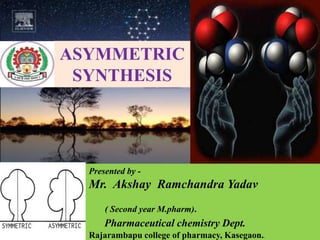
ASYMMETRIC
SYNTHESIS
Presented by -
Mr. Akshay Ramchandra Yadav
( Second year M.pharm).
Pharmaceutical chemistry Dept.
Rajarambapu college of pharmacy, Kasegaon..
Asymmetric synthesis
Methods of asymmetric synthesis using
chiral pool
Chiral auxiliaries and catalytic
asymmetric synthesis
Enantiopure seperation
 stereoselective synthesis
Recent advances
References
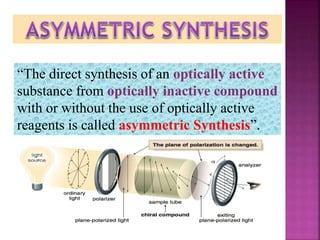
“The direct synthesis of an optically active
substance from optically inactive compound
with or without the use of optically active
reagents is called asymmetric Synthesis”.
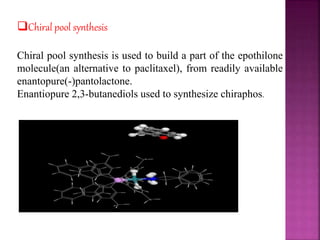
Chiral pool synthesis
Chiral pool synthesis is used to build a part of the epothilone
molecule(an alternative to paclitaxel), from readily available
enantopure(-)pantolactone.
Enantiopure 2,3-butanediols used to synthesize chiraphos.
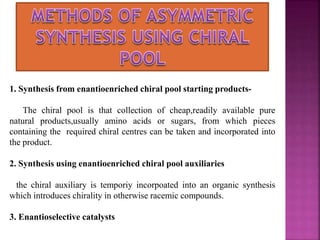
1. Synthesis from enantioenriched chiral pool starting products-
The chiral pool is that collection of cheap,readily available pure
natural products,usually amino acids or sugars, from which pieces
containing the required chiral centres can be taken and incorporated into
the product.
2. Synthesis using enantioenriched chiral pool auxiliaries
the chiral auxiliary is temporiy incorpoated into an organic synthesis
which introduces chirality in otherwise racemic compounds.
3. Enantioselective catalysts
R
R R
CH2OH
O
RR
CH2OHR
O
RR
CH2OHHOH 2C
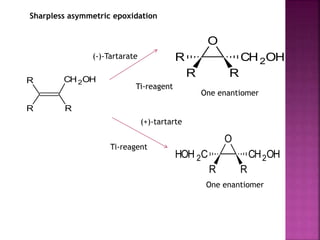
(-)-Tartarate
Ti-reagent
Ti-reagent
(+)-tartarte
One enantiomer
One enantiomer
Sharpless asymmetric epoxidation
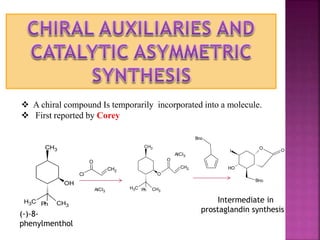
 A chiral compound Is temporarily incorporated into a molecule.
 First reported by Corey
CH3
CH3 CH3Ph
OH
Cl
CH2
O
AlCl3
AlCl3
CH3
CH3 CH3Ph
O
CH2
O
O O
Bno
OH
I
Bno
(-)-8-
phenylmenthol
Intermediate in
prostaglandin synthesis
– Evans oxazolidinone auxiliaries are the most well known chiral
auxiliaries
• Derive from amino acids
- Forms the (Z)-‐boron enolates
– High stereoselectivity is attributed to the relatively short boron–oxygen
bond length
– Form a tight,six membered chair like transition state,Carbonyl is
opposed to the enolate oxygen dipole.
O N
O
CH3
O
Bn
CO2H
Ph
Me
OH
O NH
CH2
Bn
Bu2BOTf
O N
O O
Bn
Ph
OH
Me
LiOH,H2O2
Phcho
+
(4S)-4-benzyl-3-propanoyl-1,3-oxazolidin-2-one
(4S)-4-benzyl-3-[(2S,3S)-3-hydroxy-2-methyl-3-phenylpropanoyl]-1,3-oxazolidin-2-one
(4S)-4-benzyl-2-methylidene-1,3-oxazolidine
(a) (b)
(a)
(b)
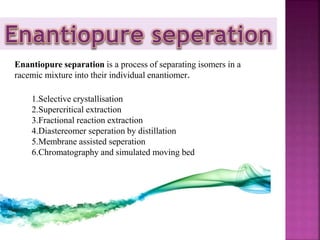
1.Selective crystallisation
2.Supercritical extraction
3.Fractional reaction extraction
4.Diastereomer seperation by distillation
5.Membrane assisted seperation
6.Chromatography and simulated moving bed
Enantiopure separation is a process of separating isomers in a
racemic mixture into their individual enantiomer.
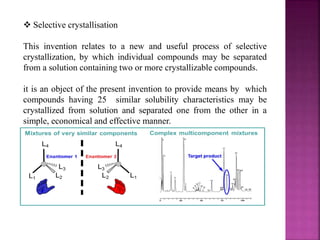
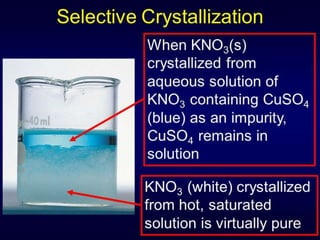
 Selective crystallisation
This invention relates to a new and useful process of selective
crystallization, by which individual compounds may be separated
from a solution containing two or more crystallizable compounds.
it is an object of the present invention to provide means by which
compounds having 25 similar solubility characteristics may be
crystallized from solution and separated one from the other in a
simple, economical and effective manner.
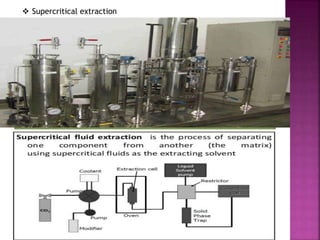
 Supercritical extraction
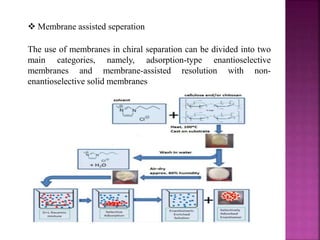
The use of membranes in chiral separation can be divided into two
main categories, namely, adsorption-type enantioselective
membranes and membrane-assisted resolution with non-
enantioselective solid membranes
 Membrane assisted seperation
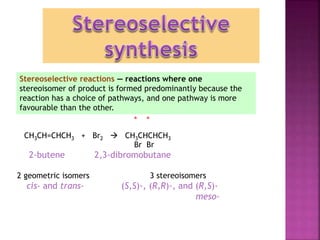
Stereoselective reactions — reactions where one
stereoisomer of product is formed predominantly because the
reaction has a choice of pathways, and one pathway is more
favourable than the other.
* *
CH3CH=CHCH3 + Br2  CH3CHCHCH3
Br Br
2-butene 2,3-dibromobutane
2 geometric isomers 3 stereoisomers
cis- and trans- (S,S)-, (R,R)-, and (R,S)-
meso-
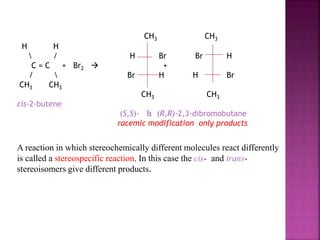
CH3 CH3
H H
 / H Br Br H
C = C + Br2  +
/  Br H H Br
CH3 CH3
CH3 CH3
cis-2-butene
(S,S)- & (R,R)-2,3-dibromobutane
racemic modification only products
A reaction in which stereochemically different molecules react differently
is called a stereospecific reaction. In this case the cis- and trans-
stereoisomers give different products.
The fact that the addition of halogens to
alkenes is both stereoselective and
stereospecific gives us additional
information about the stereochemistry of
the addition and the mechanism for the
reaction.
Catalytic enantioselective oxidative coupling of
saturated ethers with carboxylic acids derivatives.
Dual-catalytic transition metal systems for
functionalization of unreactive sites of molecules.
Pyrrolidines and piperidines bearing chiral tertiary
alcohols by nickel-catalyzed enantioselective
reductive cycliztion of N-alkynones.
1. Craner H, Groner E, Levy L, Agranat I. Trends in the development of chiral
drugs. Drug Discov Today 2004; 9: 105–110.
2. 2. Hutt AJ, Smith and Williams' Introduction to the principles of drug design
and action, 4th Edition, in Smith JH, Ed. (CRC Press LLC, Boca Raton, FL,
USA, 2006), pp 117–183.
3. 3. Simándi B, Keszei S, Fogassy E, Kemény S, Sawinsky J. Separation of
enantiomers by supercritical fluid extraction. J Supercrit Fluids 1998; 13:
331-336.
4. Bauza R, Ríos A, Valcarcel M. Enantioselective supercritical fluid extraction
from racemic mixtures by use of chiral selectors. Separ Sci Technol 2004;
39:459-478.
5. Székely E, Simándi B, Illés R, Molnár P, Gebefügi I, Kmecz I, et al.
Application of supercritical fluid extraction for fractionation of enantiomers.
J Supercrit Fluids 2004; 31: 33-40
Asymmetric synthesis

Asymmetric synthesis

  • 1.
    ASYMMETRIC SYNTHESIS Presented by - Mr.Akshay Ramchandra Yadav ( Second year M.pharm). Pharmaceutical chemistry Dept. Rajarambapu college of pharmacy, Kasegaon..
  • 2.
    Asymmetric synthesis Methods ofasymmetric synthesis using chiral pool Chiral auxiliaries and catalytic asymmetric synthesis Enantiopure seperation  stereoselective synthesis Recent advances References
  • 3.
    “The direct synthesisof an optically active substance from optically inactive compound with or without the use of optically active reagents is called asymmetric Synthesis”.
  • 4.
    Chiral pool synthesis Chiralpool synthesis is used to build a part of the epothilone molecule(an alternative to paclitaxel), from readily available enantopure(-)pantolactone. Enantiopure 2,3-butanediols used to synthesize chiraphos.
  • 5.
    1. Synthesis fromenantioenriched chiral pool starting products- The chiral pool is that collection of cheap,readily available pure natural products,usually amino acids or sugars, from which pieces containing the required chiral centres can be taken and incorporated into the product. 2. Synthesis using enantioenriched chiral pool auxiliaries the chiral auxiliary is temporiy incorpoated into an organic synthesis which introduces chirality in otherwise racemic compounds. 3. Enantioselective catalysts
  • 6.
  • 7.
     A chiralcompound Is temporarily incorporated into a molecule.  First reported by Corey CH3 CH3 CH3Ph OH Cl CH2 O AlCl3 AlCl3 CH3 CH3 CH3Ph O CH2 O O O Bno OH I Bno (-)-8- phenylmenthol Intermediate in prostaglandin synthesis
  • 8.
    – Evans oxazolidinoneauxiliaries are the most well known chiral auxiliaries • Derive from amino acids - Forms the (Z)-‐boron enolates – High stereoselectivity is attributed to the relatively short boron–oxygen bond length – Form a tight,six membered chair like transition state,Carbonyl is opposed to the enolate oxygen dipole. O N O CH3 O Bn CO2H Ph Me OH O NH CH2 Bn Bu2BOTf O N O O Bn Ph OH Me LiOH,H2O2 Phcho + (4S)-4-benzyl-3-propanoyl-1,3-oxazolidin-2-one (4S)-4-benzyl-3-[(2S,3S)-3-hydroxy-2-methyl-3-phenylpropanoyl]-1,3-oxazolidin-2-one (4S)-4-benzyl-2-methylidene-1,3-oxazolidine (a) (b) (a) (b)
  • 9.
    1.Selective crystallisation 2.Supercritical extraction 3.Fractionalreaction extraction 4.Diastereomer seperation by distillation 5.Membrane assisted seperation 6.Chromatography and simulated moving bed Enantiopure separation is a process of separating isomers in a racemic mixture into their individual enantiomer.
  • 10.
     Selective crystallisation Thisinvention relates to a new and useful process of selective crystallization, by which individual compounds may be separated from a solution containing two or more crystallizable compounds. it is an object of the present invention to provide means by which compounds having 25 similar solubility characteristics may be crystallized from solution and separated one from the other in a simple, economical and effective manner.
  • 12.
  • 13.
    The use ofmembranes in chiral separation can be divided into two main categories, namely, adsorption-type enantioselective membranes and membrane-assisted resolution with non- enantioselective solid membranes  Membrane assisted seperation
  • 14.
    Stereoselective reactions —reactions where one stereoisomer of product is formed predominantly because the reaction has a choice of pathways, and one pathway is more favourable than the other. * * CH3CH=CHCH3 + Br2  CH3CHCHCH3 Br Br 2-butene 2,3-dibromobutane 2 geometric isomers 3 stereoisomers cis- and trans- (S,S)-, (R,R)-, and (R,S)- meso-
  • 15.
    CH3 CH3 H H / H Br Br H C = C + Br2  + / Br H H Br CH3 CH3 CH3 CH3 cis-2-butene (S,S)- & (R,R)-2,3-dibromobutane racemic modification only products A reaction in which stereochemically different molecules react differently is called a stereospecific reaction. In this case the cis- and trans- stereoisomers give different products.
  • 16.
    The fact thatthe addition of halogens to alkenes is both stereoselective and stereospecific gives us additional information about the stereochemistry of the addition and the mechanism for the reaction.
  • 17.
    Catalytic enantioselective oxidativecoupling of saturated ethers with carboxylic acids derivatives. Dual-catalytic transition metal systems for functionalization of unreactive sites of molecules. Pyrrolidines and piperidines bearing chiral tertiary alcohols by nickel-catalyzed enantioselective reductive cycliztion of N-alkynones.
  • 18.
    1. Craner H,Groner E, Levy L, Agranat I. Trends in the development of chiral drugs. Drug Discov Today 2004; 9: 105–110. 2. 2. Hutt AJ, Smith and Williams' Introduction to the principles of drug design and action, 4th Edition, in Smith JH, Ed. (CRC Press LLC, Boca Raton, FL, USA, 2006), pp 117–183. 3. 3. Simándi B, Keszei S, Fogassy E, Kemény S, Sawinsky J. Separation of enantiomers by supercritical fluid extraction. J Supercrit Fluids 1998; 13: 331-336. 4. Bauza R, Ríos A, Valcarcel M. Enantioselective supercritical fluid extraction from racemic mixtures by use of chiral selectors. Separ Sci Technol 2004; 39:459-478. 5. Székely E, Simándi B, Illés R, Molnár P, Gebefügi I, Kmecz I, et al. Application of supercritical fluid extraction for fractionation of enantiomers. J Supercrit Fluids 2004; 31: 33-40