Side reaction in peptide
synthesis
Department Of Pharmaceutical Sciences
Rashtrasant Tukadoji Maharaj Nagpur University
Nagpur-440 033
Presented by
Mr.Suraj N. Wanjari
M. Pharm First Semester Pharmaceutical Chemistry
Content
 Introduction
 Initiation by proton abstraction
 Initiation by protonation
 Initiation by Overactivation
 Refrences
Introduction
 Peptide synthesis involves condensation of two or
more amino acids which seems to be easier but
requires Specialized techniques
 Since all the amino acids have basic skeleton but
vary in their side chains, and their nature such as
acidic, basic or neutral depending on the presence or
absence of functional groups, these side chains are
prone to side reactions during the process of
synthesis either due to interaction with the solvent
used for synthesis or during the process of the
deprotection of the specific groups.
Initiated by proton abstraction
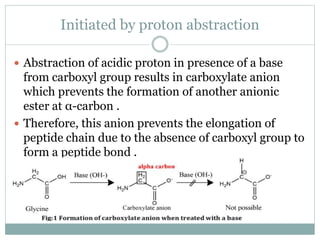
 Abstraction of acidic proton in presence of a base
from carboxyl group results in carboxylate anion
which prevents the formation of another anionic
ester at α-carbon .
 Therefore, this anion prevents the elongation of
peptide chain due to the absence of carboxyl group to
form a peptide bond .
Racemization
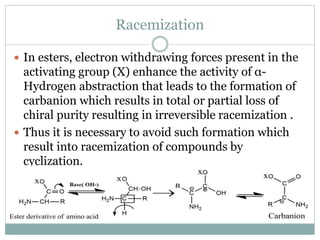
 In esters, electron withdrawing forces present in the
activating group (X) enhance the activity of α-
Hydrogen abstraction that leads to the formation of
carbanion which results in total or partial loss of
chiral purity resulting in irreversible racemization .
 Thus it is necessary to avoid such formation which
result into racemization of compounds by
cyclization.
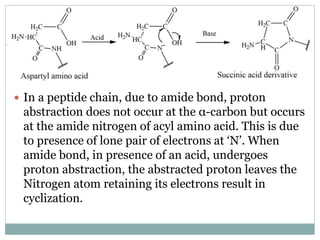
 In a peptide chain, due to amide bond, proton
abstraction does not occur at the α-carbon but occurs
at the amide nitrogen of acyl amino acid. This is due
to presence of lone pair of electrons at ‘N’. When
amide bond, in presence of an acid, undergoes
proton abstraction, the abstracted proton leaves the
Nitrogen atom retaining its electrons result in
cyclization.
Direct abstraction of α-proton
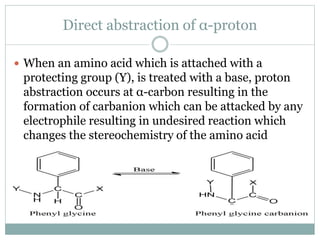
 When an amino acid which is attached with a
protecting group (Y), is treated with a base, proton
abstraction occurs at α-carbon resulting in the
formation of carbanion which can be attacked by any
electrophile resulting in undesired reaction which
changes the stereochemistry of the amino acid
By forming azlactones
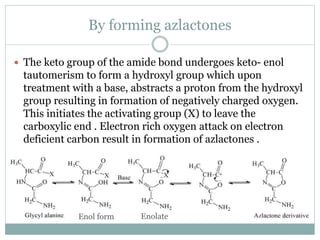
 The keto group of the amide bond undergoes keto- enol
tautomerism to form a hydroxyl group which upon
treatment with a base, abstracts a proton from the hydroxyl
group resulting in formation of negatively charged oxygen.
This initiates the activating group (X) to leave the
carboxylic end . Electron rich oxygen attack on electron
deficient carbon result in formation of azlactones .
Enol form Enolate
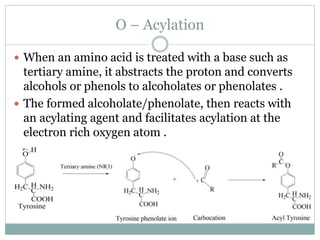
O – Acylation
 When an amino acid is treated with a base such as
tertiary amine, it abstracts the proton and converts
alcohols or phenols to alcoholates or phenolates .
 The formed alcoholate/phenolate, then reacts with
an acylating agent and facilitates acylation at the
electron rich oxygen atom .
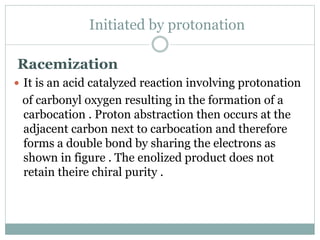
Initiated by protonation
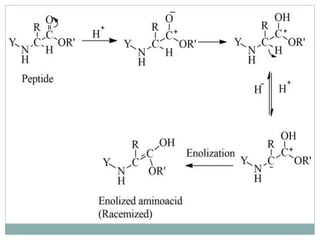
Racemization
 It is an acid catalyzed reaction involving protonation
of carbonyl oxygen resulting in the formation of a
carbocation . Proton abstraction then occurs at the
adjacent carbon next to carbocation and therefore
forms a double bond by sharing the electrons as
shown in figure . The enolized product does not
retain theire chiral purity .
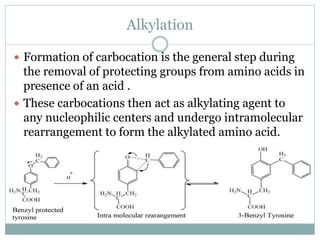
Alkylation
 Formation of carbocation is the general step during
the removal of protecting groups from amino acids in
presence of an acid .
 These carbocations then act as alkylating agent to
any nucleophilic centers and undergo intramolecular
rearrangement to form the alkylated amino acid.
Side reaction by overactivation
 Overactivation occurs in the process of acylation of
amino acid where the carboxyl component is too
powerful to be acylated. Therefore, acylation occurs
primarily at the amino group which is exposed for
peptide bond formation followed by acylation of
hydroxyl group of the carboxylic component .
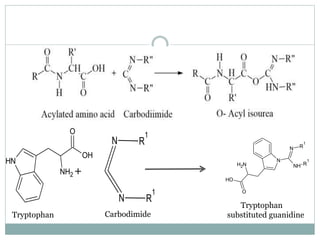
• Imidazole containing amino acids such as
tryptophan react with carbodiimide and forms
substituted guanidine and similar is the case with
that of histidine .
+
NH
NH2
OH
O
N
N
R
1
R
1
N
NH
R
1
R
1N
NH2
OH
O
Tryptophan Carbodimide
Tryptophan
substituted guanidine
References
 Ur Rehman M., Jabeen A.,Mariya M., Overview on
Side reaction in peptide synthesis .
 Bondanszky M., Kwei JZ., Side reaction in peptide
synthesis. Chemical Biology and Drug Design. 1978
Side reaction in peptide synthesis

Side reaction in peptide synthesis

  • 2.
    Side reaction inpeptide synthesis Department Of Pharmaceutical Sciences Rashtrasant Tukadoji Maharaj Nagpur University Nagpur-440 033 Presented by Mr.Suraj N. Wanjari M. Pharm First Semester Pharmaceutical Chemistry
  • 3.
    Content  Introduction  Initiationby proton abstraction  Initiation by protonation  Initiation by Overactivation  Refrences
  • 4.
    Introduction  Peptide synthesisinvolves condensation of two or more amino acids which seems to be easier but requires Specialized techniques  Since all the amino acids have basic skeleton but vary in their side chains, and their nature such as acidic, basic or neutral depending on the presence or absence of functional groups, these side chains are prone to side reactions during the process of synthesis either due to interaction with the solvent used for synthesis or during the process of the deprotection of the specific groups.
  • 5.
    Initiated by protonabstraction  Abstraction of acidic proton in presence of a base from carboxyl group results in carboxylate anion which prevents the formation of another anionic ester at α-carbon .  Therefore, this anion prevents the elongation of peptide chain due to the absence of carboxyl group to form a peptide bond .
  • 6.
    Racemization  In esters,electron withdrawing forces present in the activating group (X) enhance the activity of α- Hydrogen abstraction that leads to the formation of carbanion which results in total or partial loss of chiral purity resulting in irreversible racemization .  Thus it is necessary to avoid such formation which result into racemization of compounds by cyclization.
  • 7.
     In apeptide chain, due to amide bond, proton abstraction does not occur at the α-carbon but occurs at the amide nitrogen of acyl amino acid. This is due to presence of lone pair of electrons at ‘N’. When amide bond, in presence of an acid, undergoes proton abstraction, the abstracted proton leaves the Nitrogen atom retaining its electrons result in cyclization.
  • 8.
    Direct abstraction ofα-proton  When an amino acid which is attached with a protecting group (Y), is treated with a base, proton abstraction occurs at α-carbon resulting in the formation of carbanion which can be attacked by any electrophile resulting in undesired reaction which changes the stereochemistry of the amino acid
  • 9.
    By forming azlactones The keto group of the amide bond undergoes keto- enol tautomerism to form a hydroxyl group which upon treatment with a base, abstracts a proton from the hydroxyl group resulting in formation of negatively charged oxygen. This initiates the activating group (X) to leave the carboxylic end . Electron rich oxygen attack on electron deficient carbon result in formation of azlactones . Enol form Enolate
  • 10.
    O – Acylation When an amino acid is treated with a base such as tertiary amine, it abstracts the proton and converts alcohols or phenols to alcoholates or phenolates .  The formed alcoholate/phenolate, then reacts with an acylating agent and facilitates acylation at the electron rich oxygen atom .
  • 11.
    Initiated by protonation Racemization It is an acid catalyzed reaction involving protonation of carbonyl oxygen resulting in the formation of a carbocation . Proton abstraction then occurs at the adjacent carbon next to carbocation and therefore forms a double bond by sharing the electrons as shown in figure . The enolized product does not retain theire chiral purity .
  • 13.
    Alkylation  Formation ofcarbocation is the general step during the removal of protecting groups from amino acids in presence of an acid .  These carbocations then act as alkylating agent to any nucleophilic centers and undergo intramolecular rearrangement to form the alkylated amino acid.
  • 14.
    Side reaction byoveractivation  Overactivation occurs in the process of acylation of amino acid where the carboxyl component is too powerful to be acylated. Therefore, acylation occurs primarily at the amino group which is exposed for peptide bond formation followed by acylation of hydroxyl group of the carboxylic component . • Imidazole containing amino acids such as tryptophan react with carbodiimide and forms substituted guanidine and similar is the case with that of histidine .
  • 15.
  • 16.
    References  Ur RehmanM., Jabeen A.,Mariya M., Overview on Side reaction in peptide synthesis .  Bondanszky M., Kwei JZ., Side reaction in peptide synthesis. Chemical Biology and Drug Design. 1978