ADVANCED
MEDICINALCHEMISTRY
Mr. Akshay Ramchandra Yadav
( First year M.pharm).
Pharmaceutical chemistry Dept.
Rajarambapu college of pharmacy,
kasegaon..
1
DEFINITION-
A peptidomimetics is a small protein-like chain designed
to mimic a peptide.
 They are typically arise from modification of an exsisting peptide, or by
designing similar systems that mimic peptides, such as proteins and beta
peptides.
 For e.g-anticancer peptidomimetics can bind to target proteins in order
to induced cancer celles into a form of programmed cell death called
apoptosis by mimcking key interactions that activate apoptotic pathway
in specified cells. This shows that peptidomimetics can play vital role in
treatment of various type of cancer.
2
 TYPE –I PEPTIDOMIMETICS or PSEUDOMIMETICS-
 These are synthesized by structure based drug design.
 These peptidomimetics are closely similar to peptide backbone while retaining
functional groups that makes important contacts with binding sites of the
receptors.
 Type-II peptidomimetics or functional mimetics:
 These peptidomimetics are synthesized by molecular modeling and high
throughput screening (HTS) etc.
 These are small non-peptide molecule that binds to a peptide receptor.
 Morphine was the first well-characterized example of this type of
peptidomimetic.
3
Type-III peptidomimetics or topographical mimetics:
These are synthesized by structure based drug design which represents that they
possess novel templates, which appear unrelated to the original peptides but contain the
essential groups, positioned on a novel non-peptide scaffold to serve as topographical
mimetics.
Type-IV peptidomimetics or non-peptide mimetics:
These are synthesized by Group Replacement Assisted Binding (GRAB) technique of
drug design. These structures might share structural functional features of type I
peptidomimetics, but they bind to an enzyme form not accessible with type I
peptidomimetics for example piperidine inhibitors.
4
THERAPEUTIC VALUES OF
PEPTIDOMIMETICS
1. Anti-microbial activity
Srinivas et al. developed some novel peptidomimetic antibiotics based on the
antimicrobial peptide protegrin I to combat the growing health threat posed by
resistant pathogenic microorganisms. Several rounds of optimization gave a lead
compound that was active in the nanomolar range against Gram-negative
Pseudomonas species.
2. Anti-malarial activity
Ettari et al. synthesized some novel peptidomimetics bearing a protected aspartyl
aldehyde warhead leading to the thioacylal and the acylal derivatives.Both
Compounds proved to possess an increased antiplasmodial activity with respect to
the parent molecule.
5
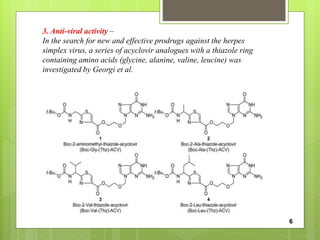
3. Anti-viral activity –
In the search for new and effective prodrugs against the herpes
simplex virus, a series of acyclovir analogues with a thiazole ring
containing amino acids (glycine, alanine, valine, leucine) was
investigated by Georgi et al.
6
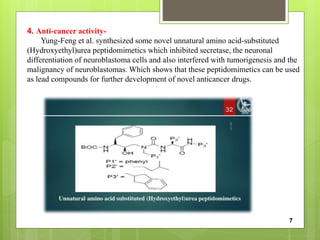
4. Anti-cancer activity-
Yung-Feng et al. synthesized some novel unnatural amino acid-substituted
(Hydroxyethyl)urea peptidomimetics which inhibited secretase, the neuronal
differentiation of neuroblastoma cells and also interfered with tumorigenesis and the
malignancy of neuroblastomas. Which shows that these peptidomimetics can be used
as lead compounds for further development of novel anticancer drugs.
7
8
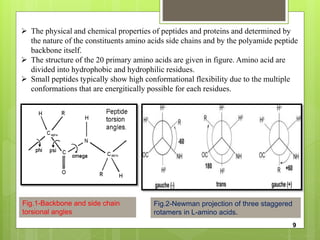
 The physical and chemical properties of peptides and proteins and determined by
the nature of the constituents amino acids side chains and by the polyamide peptide
backbone itself.
 The structure of the 20 primary amino acids are given in figure. Amino acid are
divided into hydrophobic and hydrophilic residues.
 Small peptides typically show high conformational flexibility due to the multiple
conformations that are energitically possible for each residues.
Fig.1-Backbone and side chain
torsional angles
Fig.2-Newman projection of three staggered
rotamers in L-amino acids.
9
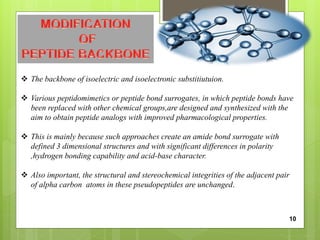
 The backbone of isoelectric and isoelectronic substitiutuion.
 Various peptidomimetics or peptide bond surrogates, in which peptide bonds have
been replaced with other chemical groups,are designed and synthesized with the
aim to obtain peptide analogs with improved pharmacological properties.
 This is mainly because such approaches create an amide bond surrogate with
defined 3 dimensional structures and with significant differences in polarity
,hydrogen bonding capability and acid-base character.
 Also important, the structural and stereochemical integrities of the adjacent pair
of alpha carbon atoms in these pseudopeptides are unchanged.
10
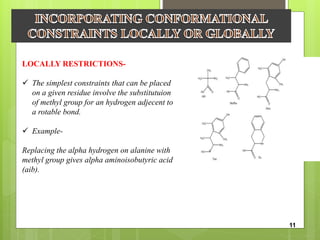
LOCALLY RESTRICTIONS-
 The simplest constraints that can be placed
on a given residue involve the substitutuion
of methyl group for an hydrogen adjecent to
a rotable bond.
 Example-
Replacing the alpha hydrogen on alanine with
methyl group gives alpha aminoisobutyric acid
(aib).
11
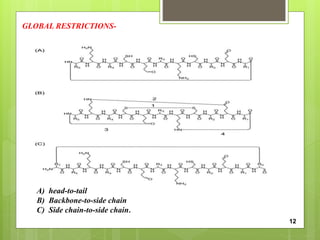
GLOBAL RESTRICTIONS-
A) head-to-tail
B) Backbone-to-side chain
C) Side chain-to-side chain.
12
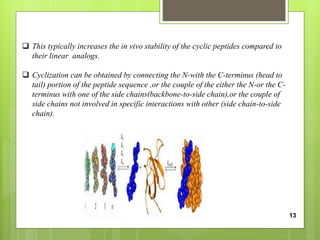
 This typically increases the in vivo stability of the cyclic peptides compared to
their linear analogs.
 Cyclization can be obtained by connecting the N-with the C-terminus (head to
tail) portion of the peptide sequence ,or the couple of the either the N-or the C-
terminus with one of the side chains(backbone-to-side chain),or the couple of
side chains not involved in specific interactions with other (side chain-to-side
chain).
13
15
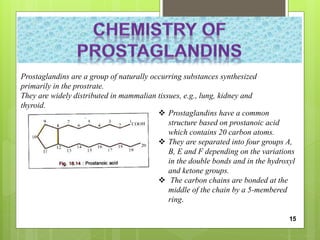
Prostaglandins are a group of naturally occurring substances synthesized
primarily in the prostrate.
They are widely distributed in mammalian tissues, e.g., lung, kidney and
thyroid.
 Prostaglandins have a common
structure based on prostanoic acid
which contains 20 carbon atoms.
 They are separated into four groups A,
B, E and F depending on the variations
in the double bonds and in the hydroxyl
and ketone groups.
 The carbon chains are bonded at the
middle of the chain by a 5-membered
ring.
15
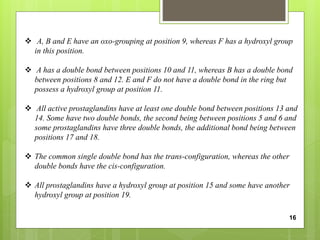
 A, B and E have an oxo-grouping at position 9, whereas F has a hydroxyl group
in this position.
 A has a double bond between positions 10 and 11, whereas B has a double bond
between positions 8 and 12. E and F do not have a double bond in the ring but
possess a hydroxyl group at position 11.
 All active prostaglandins have at least one double bond between positions 13 and
14. Some have two double bonds, the second being between positions 5 and 6 and
some prostaglandins have three double bonds, the additional bond being between
positions 17 and 18.
 The common single double bond has the trans-configuration, whereas the other
double bonds have the cis-configuration.
 All prostaglandins have a hydroxyl group at position 15 and some have another
hydroxyl group at position 19.
16
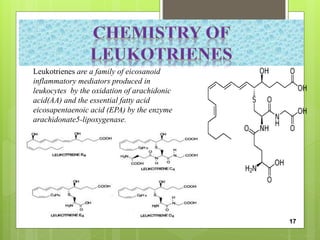
Leukotrienes are a family of eicosanoid
inflammatory mediators produced in
leukocytes by the oxidation of arachidonic
acid(AA) and the essential fatty acid
eicosapentaenoic acid (EPA) by the enzyme
arachidonate5-lipoxygenase.
17
 simple dehydration with a proton removed
from C-10 gives an epoxide ring at C-5 and
C-6, and three conjugated double bonds
between C-7 and C-12. This is leukotriene
A4 LTA4.
 The triene designation refers to the signature
ultraviolet spectrum due to three conjugated
double bonds. The subscript denotes the total
number of double bonds - four when derived
from arachidonate.
18
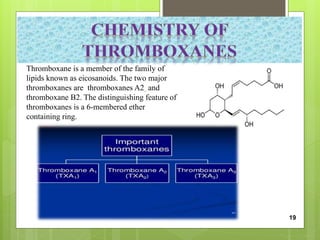
Thromboxane is a member of the family of
lipids known as eicosanoids. The two major
thromboxanes are thromboxanes A2 and
thromboxane B2. The distinguishing feature of
thromboxanes is a 6-membered ether
containing ring.
19
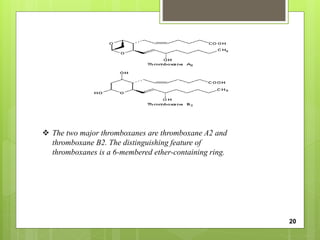
 The two major thromboxanes are thromboxane A2 and
thromboxane B2. The distinguishing feature of
thromboxanes is a 6-membered ether-containing ring.
20
21

Peptidomimetics

  • 1.
    ADVANCED MEDICINALCHEMISTRY Mr. Akshay RamchandraYadav ( First year M.pharm). Pharmaceutical chemistry Dept. Rajarambapu college of pharmacy, kasegaon.. 1
  • 2.
    DEFINITION- A peptidomimetics isa small protein-like chain designed to mimic a peptide.  They are typically arise from modification of an exsisting peptide, or by designing similar systems that mimic peptides, such as proteins and beta peptides.  For e.g-anticancer peptidomimetics can bind to target proteins in order to induced cancer celles into a form of programmed cell death called apoptosis by mimcking key interactions that activate apoptotic pathway in specified cells. This shows that peptidomimetics can play vital role in treatment of various type of cancer. 2
  • 3.
     TYPE –IPEPTIDOMIMETICS or PSEUDOMIMETICS-  These are synthesized by structure based drug design.  These peptidomimetics are closely similar to peptide backbone while retaining functional groups that makes important contacts with binding sites of the receptors.  Type-II peptidomimetics or functional mimetics:  These peptidomimetics are synthesized by molecular modeling and high throughput screening (HTS) etc.  These are small non-peptide molecule that binds to a peptide receptor.  Morphine was the first well-characterized example of this type of peptidomimetic. 3
  • 4.
    Type-III peptidomimetics ortopographical mimetics: These are synthesized by structure based drug design which represents that they possess novel templates, which appear unrelated to the original peptides but contain the essential groups, positioned on a novel non-peptide scaffold to serve as topographical mimetics. Type-IV peptidomimetics or non-peptide mimetics: These are synthesized by Group Replacement Assisted Binding (GRAB) technique of drug design. These structures might share structural functional features of type I peptidomimetics, but they bind to an enzyme form not accessible with type I peptidomimetics for example piperidine inhibitors. 4
  • 5.
    THERAPEUTIC VALUES OF PEPTIDOMIMETICS 1.Anti-microbial activity Srinivas et al. developed some novel peptidomimetic antibiotics based on the antimicrobial peptide protegrin I to combat the growing health threat posed by resistant pathogenic microorganisms. Several rounds of optimization gave a lead compound that was active in the nanomolar range against Gram-negative Pseudomonas species. 2. Anti-malarial activity Ettari et al. synthesized some novel peptidomimetics bearing a protected aspartyl aldehyde warhead leading to the thioacylal and the acylal derivatives.Both Compounds proved to possess an increased antiplasmodial activity with respect to the parent molecule. 5
  • 6.
    3. Anti-viral activity– In the search for new and effective prodrugs against the herpes simplex virus, a series of acyclovir analogues with a thiazole ring containing amino acids (glycine, alanine, valine, leucine) was investigated by Georgi et al. 6
  • 7.
    4. Anti-cancer activity- Yung-Fenget al. synthesized some novel unnatural amino acid-substituted (Hydroxyethyl)urea peptidomimetics which inhibited secretase, the neuronal differentiation of neuroblastoma cells and also interfered with tumorigenesis and the malignancy of neuroblastomas. Which shows that these peptidomimetics can be used as lead compounds for further development of novel anticancer drugs. 7
  • 8.
  • 9.
     The physicaland chemical properties of peptides and proteins and determined by the nature of the constituents amino acids side chains and by the polyamide peptide backbone itself.  The structure of the 20 primary amino acids are given in figure. Amino acid are divided into hydrophobic and hydrophilic residues.  Small peptides typically show high conformational flexibility due to the multiple conformations that are energitically possible for each residues. Fig.1-Backbone and side chain torsional angles Fig.2-Newman projection of three staggered rotamers in L-amino acids. 9
  • 10.
     The backboneof isoelectric and isoelectronic substitiutuion.  Various peptidomimetics or peptide bond surrogates, in which peptide bonds have been replaced with other chemical groups,are designed and synthesized with the aim to obtain peptide analogs with improved pharmacological properties.  This is mainly because such approaches create an amide bond surrogate with defined 3 dimensional structures and with significant differences in polarity ,hydrogen bonding capability and acid-base character.  Also important, the structural and stereochemical integrities of the adjacent pair of alpha carbon atoms in these pseudopeptides are unchanged. 10
  • 11.
    LOCALLY RESTRICTIONS-  Thesimplest constraints that can be placed on a given residue involve the substitutuion of methyl group for an hydrogen adjecent to a rotable bond.  Example- Replacing the alpha hydrogen on alanine with methyl group gives alpha aminoisobutyric acid (aib). 11
  • 12.
    GLOBAL RESTRICTIONS- A) head-to-tail B)Backbone-to-side chain C) Side chain-to-side chain. 12
  • 13.
     This typicallyincreases the in vivo stability of the cyclic peptides compared to their linear analogs.  Cyclization can be obtained by connecting the N-with the C-terminus (head to tail) portion of the peptide sequence ,or the couple of the either the N-or the C- terminus with one of the side chains(backbone-to-side chain),or the couple of side chains not involved in specific interactions with other (side chain-to-side chain). 13
  • 14.
  • 15.
    Prostaglandins are agroup of naturally occurring substances synthesized primarily in the prostrate. They are widely distributed in mammalian tissues, e.g., lung, kidney and thyroid.  Prostaglandins have a common structure based on prostanoic acid which contains 20 carbon atoms.  They are separated into four groups A, B, E and F depending on the variations in the double bonds and in the hydroxyl and ketone groups.  The carbon chains are bonded at the middle of the chain by a 5-membered ring. 15
  • 16.
     A, Band E have an oxo-grouping at position 9, whereas F has a hydroxyl group in this position.  A has a double bond between positions 10 and 11, whereas B has a double bond between positions 8 and 12. E and F do not have a double bond in the ring but possess a hydroxyl group at position 11.  All active prostaglandins have at least one double bond between positions 13 and 14. Some have two double bonds, the second being between positions 5 and 6 and some prostaglandins have three double bonds, the additional bond being between positions 17 and 18.  The common single double bond has the trans-configuration, whereas the other double bonds have the cis-configuration.  All prostaglandins have a hydroxyl group at position 15 and some have another hydroxyl group at position 19. 16
  • 17.
    Leukotrienes are afamily of eicosanoid inflammatory mediators produced in leukocytes by the oxidation of arachidonic acid(AA) and the essential fatty acid eicosapentaenoic acid (EPA) by the enzyme arachidonate5-lipoxygenase. 17
  • 18.
     simple dehydrationwith a proton removed from C-10 gives an epoxide ring at C-5 and C-6, and three conjugated double bonds between C-7 and C-12. This is leukotriene A4 LTA4.  The triene designation refers to the signature ultraviolet spectrum due to three conjugated double bonds. The subscript denotes the total number of double bonds - four when derived from arachidonate. 18
  • 19.
    Thromboxane is amember of the family of lipids known as eicosanoids. The two major thromboxanes are thromboxanes A2 and thromboxane B2. The distinguishing feature of thromboxanes is a 6-membered ether containing ring. 19
  • 20.
     The twomajor thromboxanes are thromboxane A2 and thromboxane B2. The distinguishing feature of thromboxanes is a 6-membered ether-containing ring. 20
  • 21.