Mass Spectrometry
Presented by:
Jacob Thon Bior
M. Pharm 1st year
Dep’t Of Pharmaceutical Chemistry.
KLE College of Pharmacy, Belagavi.
1
Department Of Pharmaceutical Chemistry, KLE Belgaum
Contents:
 Fragmentation and its Rules.
Rearrangements.
Mc Lafferty rearrangement.
Ring rule.
Isotopic peaks.
Interpretation of
Alkanes
Alkenes
Alkyl halides
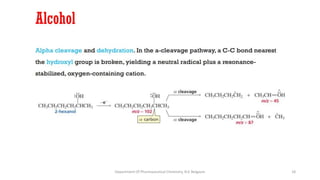
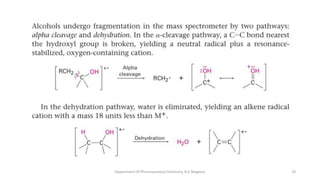
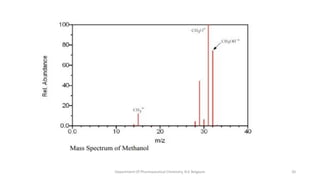
Alcohols
References 2
Department Of Pharmaceutical Chemistry, KLE Belgaum
Department Of Pharmaceutical Chemistry, KLE Belgaum 3
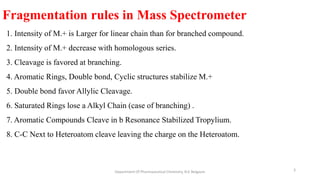
Fragmentation rules in Mass Spectrometer
1. Intensity of M.+ is Larger for linear chain than for branched compound.
2. Intensity of M.+ decrease with homologous series.
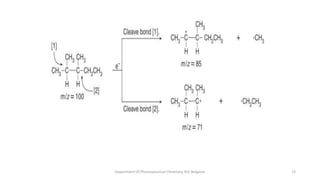
3. Cleavage is favored at branching.
4. Aromatic Rings, Double bond, Cyclic structures stabilize M.+
5. Double bond favor Allylic Cleavage.
6. Saturated Rings lose a Alkyl Chain (case of branching) .
7. Aromatic Compounds Cleave in b Resonance Stabilized Tropylium.
8. C-C Next to Heteroatom cleave leaving the charge on the Heteroatom.
Department Of Pharmaceutical Chemistry, KLE Belgaum 4
Rearrangement
Rearrangement ions are fragments whose origins cannot be described by simple cleavage
but are as result of intramolecular atomic rearrangement during fragmentation. Fragments
are the results of cleavage of multiple bonds and removal of water from alcohol is one
example.
Rearrangement involving migration of H-atoms in molecules.
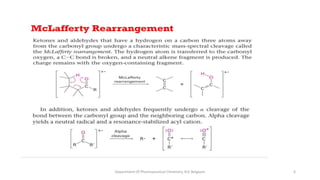
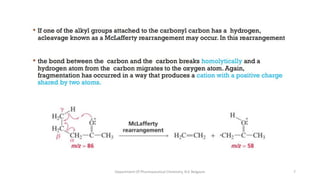
Example: Mc Lafferty rearrangement.
Rearrangement peaks:
Nitrogen rule help in identifying peak that are produced via a rearrangement.
If a molecular ion has an even molecular weight then generally peaks of even molecular
weight were created from a rearrangement.
If a molecule has an odd molecular weight, then its rearrangements peaks will be also odd.
5
Department Of Pharmaceutical Chemistry, KLE Belgaum
6
Department Of Pharmaceutical Chemistry, KLE Belgaum
7
Department Of Pharmaceutical Chemistry, KLE Belgaum
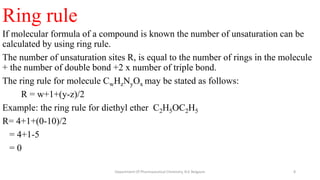
Ring rule
If molecular formula of a compound is known the number of unsaturation can be
calculated by using ring rule.
The number of unsaturation sites R, is equal to the number of rings in the molecule
+ the number of double bond +2 x number of triple bond.
The ring rule for molecule CwHzNyOx may be stated as follows:
R = w+1+(y-z)/2
Example: the ring rule for diethyl ether C2H5OC2H5
R= 4+1+(0-10)/2
= 4+1-5
= 0
8
Department Of Pharmaceutical Chemistry, KLE Belgaum
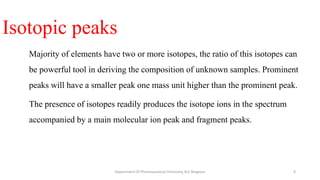
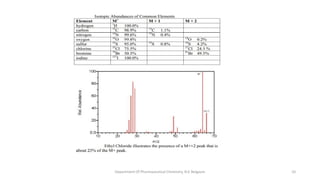
Isotopic peaks
Majority of elements have two or more isotopes, the ratio of this isotopes can
be powerful tool in deriving the composition of unknown samples. Prominent
peaks will have a smaller peak one mass unit higher than the prominent peak.
The presence of isotopes readily produces the isotope ions in the spectrum
accompanied by a main molecular ion peak and fragment peaks.
9
Department Of Pharmaceutical Chemistry, KLE Belgaum
10
Department Of Pharmaceutical Chemistry, KLE Belgaum
11
Department Of Pharmaceutical Chemistry, KLE Belgaum
12
Department Of Pharmaceutical Chemistry, KLE Belgaum
13
Department Of Pharmaceutical Chemistry, KLE Belgaum
Alkenes
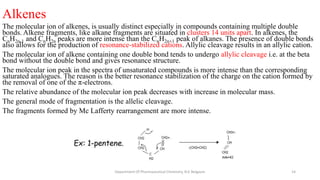
The molecular ion of alkenes, is usually distinct especially in compounds containing multiple double
bonds. Alkene fragments, like alkane fragments are situated in clusters 14 units apart. In alkenes, the
CnH2n-1 and CnH2n peaks are more intense than the CnH2n+1 peak of alkanes. The presence of double bonds
also allows for the production of resonance-stabilized cations. Allylic cleavage results in an allylic cation.
The molecular ion of alkene containing one double bond tends to undergo allylic cleavage i.e. at the beta
bond without the double bond and gives resonance structure.
The molecular ion peak in the spectra of unsaturated compounds is more intense than the corresponding
saturated analogues. The reason is the better resonance stabilization of the charge on the cation formed by
the removal of one of the π-electrons.
The relative abundance of the molecular ion peak decreases with increase in molecular mass.
The general mode of fragmentation is the allelic cleavage.
The fragments formed by Mc Lafferty rearrangement are more intense.
14
Department Of Pharmaceutical Chemistry, KLE Belgaum
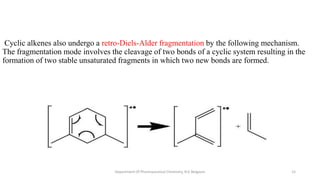
Cyclic alkenes also undergo a retro-Diels-Alder fragmentation by the following mechanism.
The fragmentation mode involves the cleavage of two bonds of a cyclic system resulting in the
formation of two stable unsaturated fragments in which two new bonds are formed.
15
Department Of Pharmaceutical Chemistry, KLE Belgaum
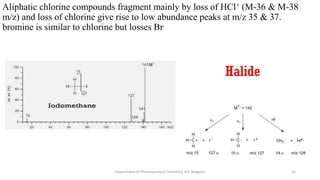
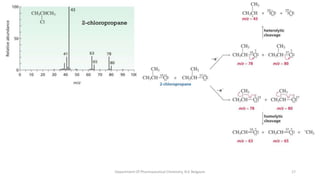
Aliphatic chlorine compounds fragment mainly by loss of HCl+ (M-36 & M-38
m/z) and loss of chlorine give rise to low abundance peaks at m/z 35 & 37.
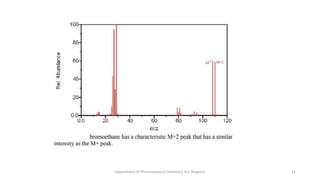
bromine is similar to chlorine but losses Br.
16
Department Of Pharmaceutical Chemistry, KLE Belgaum
17
Department Of Pharmaceutical Chemistry, KLE Belgaum
18
Department Of Pharmaceutical Chemistry, KLE Belgaum
19
Department Of Pharmaceutical Chemistry, KLE Belgaum
20
Department Of Pharmaceutical Chemistry, KLE Belgaum
References:
Organic spectroscopy William Kemp third edition
page number 286-325.
Mass Spectrometry, Second edition by James Barker.
 Elementary organic spectroscopy by Y.R. Sharma.
21
Department Of Pharmaceutical Chemistry, KLE Belgaum

Mass spectrometry

  • 1.
    Mass Spectrometry Presented by: JacobThon Bior M. Pharm 1st year Dep’t Of Pharmaceutical Chemistry. KLE College of Pharmacy, Belagavi. 1 Department Of Pharmaceutical Chemistry, KLE Belgaum
  • 2.
    Contents:  Fragmentation andits Rules. Rearrangements. Mc Lafferty rearrangement. Ring rule. Isotopic peaks. Interpretation of Alkanes Alkenes Alkyl halides Alcohols References 2 Department Of Pharmaceutical Chemistry, KLE Belgaum
  • 3.
    Department Of PharmaceuticalChemistry, KLE Belgaum 3 Fragmentation rules in Mass Spectrometer 1. Intensity of M.+ is Larger for linear chain than for branched compound. 2. Intensity of M.+ decrease with homologous series. 3. Cleavage is favored at branching. 4. Aromatic Rings, Double bond, Cyclic structures stabilize M.+ 5. Double bond favor Allylic Cleavage. 6. Saturated Rings lose a Alkyl Chain (case of branching) . 7. Aromatic Compounds Cleave in b Resonance Stabilized Tropylium. 8. C-C Next to Heteroatom cleave leaving the charge on the Heteroatom.
  • 4.
    Department Of PharmaceuticalChemistry, KLE Belgaum 4
  • 5.
    Rearrangement Rearrangement ions arefragments whose origins cannot be described by simple cleavage but are as result of intramolecular atomic rearrangement during fragmentation. Fragments are the results of cleavage of multiple bonds and removal of water from alcohol is one example. Rearrangement involving migration of H-atoms in molecules. Example: Mc Lafferty rearrangement. Rearrangement peaks: Nitrogen rule help in identifying peak that are produced via a rearrangement. If a molecular ion has an even molecular weight then generally peaks of even molecular weight were created from a rearrangement. If a molecule has an odd molecular weight, then its rearrangements peaks will be also odd. 5 Department Of Pharmaceutical Chemistry, KLE Belgaum
  • 6.
    6 Department Of PharmaceuticalChemistry, KLE Belgaum
  • 7.
    7 Department Of PharmaceuticalChemistry, KLE Belgaum
  • 8.
    Ring rule If molecularformula of a compound is known the number of unsaturation can be calculated by using ring rule. The number of unsaturation sites R, is equal to the number of rings in the molecule + the number of double bond +2 x number of triple bond. The ring rule for molecule CwHzNyOx may be stated as follows: R = w+1+(y-z)/2 Example: the ring rule for diethyl ether C2H5OC2H5 R= 4+1+(0-10)/2 = 4+1-5 = 0 8 Department Of Pharmaceutical Chemistry, KLE Belgaum
  • 9.
    Isotopic peaks Majority ofelements have two or more isotopes, the ratio of this isotopes can be powerful tool in deriving the composition of unknown samples. Prominent peaks will have a smaller peak one mass unit higher than the prominent peak. The presence of isotopes readily produces the isotope ions in the spectrum accompanied by a main molecular ion peak and fragment peaks. 9 Department Of Pharmaceutical Chemistry, KLE Belgaum
  • 10.
    10 Department Of PharmaceuticalChemistry, KLE Belgaum
  • 11.
    11 Department Of PharmaceuticalChemistry, KLE Belgaum
  • 12.
    12 Department Of PharmaceuticalChemistry, KLE Belgaum
  • 13.
    13 Department Of PharmaceuticalChemistry, KLE Belgaum
  • 14.
    Alkenes The molecular ionof alkenes, is usually distinct especially in compounds containing multiple double bonds. Alkene fragments, like alkane fragments are situated in clusters 14 units apart. In alkenes, the CnH2n-1 and CnH2n peaks are more intense than the CnH2n+1 peak of alkanes. The presence of double bonds also allows for the production of resonance-stabilized cations. Allylic cleavage results in an allylic cation. The molecular ion of alkene containing one double bond tends to undergo allylic cleavage i.e. at the beta bond without the double bond and gives resonance structure. The molecular ion peak in the spectra of unsaturated compounds is more intense than the corresponding saturated analogues. The reason is the better resonance stabilization of the charge on the cation formed by the removal of one of the π-electrons. The relative abundance of the molecular ion peak decreases with increase in molecular mass. The general mode of fragmentation is the allelic cleavage. The fragments formed by Mc Lafferty rearrangement are more intense. 14 Department Of Pharmaceutical Chemistry, KLE Belgaum
  • 15.
    Cyclic alkenes alsoundergo a retro-Diels-Alder fragmentation by the following mechanism. The fragmentation mode involves the cleavage of two bonds of a cyclic system resulting in the formation of two stable unsaturated fragments in which two new bonds are formed. 15 Department Of Pharmaceutical Chemistry, KLE Belgaum
  • 16.
    Aliphatic chlorine compoundsfragment mainly by loss of HCl+ (M-36 & M-38 m/z) and loss of chlorine give rise to low abundance peaks at m/z 35 & 37. bromine is similar to chlorine but losses Br. 16 Department Of Pharmaceutical Chemistry, KLE Belgaum
  • 17.
    17 Department Of PharmaceuticalChemistry, KLE Belgaum
  • 18.
    18 Department Of PharmaceuticalChemistry, KLE Belgaum
  • 19.
    19 Department Of PharmaceuticalChemistry, KLE Belgaum
  • 20.
    20 Department Of PharmaceuticalChemistry, KLE Belgaum
  • 21.
    References: Organic spectroscopy WilliamKemp third edition page number 286-325. Mass Spectrometry, Second edition by James Barker.  Elementary organic spectroscopy by Y.R. Sharma. 21 Department Of Pharmaceutical Chemistry, KLE Belgaum