NITROGEN FIXATION
Presented By: Muhammad Uzair Siddique
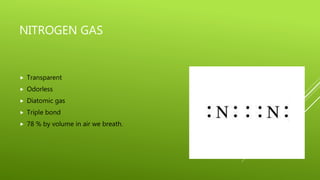
NITROGEN GAS
 Transparent
 Odorless
 Diatomic gas
 Triple bond
 78 % by volume in air we breath.
ROLE OF NITROGEN IN PLANTS
 Healthy plants contain 3 to 4 percent nitrogen
 Major substance in plants next to water
 Important in plant growth, development and reproduction
 Constituent element of
»Chlorophyll
»Amino acids
»Alkaloids
»Many vitamins
 And the building blocks of protein
NITROGEN
FIXATION
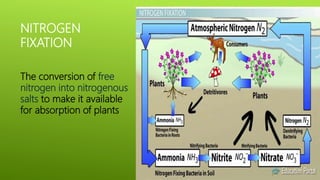
The conversion of free
nitrogen into nitrogenous
salts to make it available
for absorption of plants
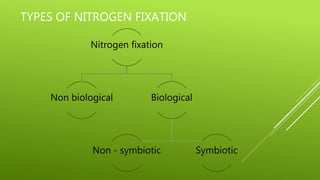
TYPES OF NITROGEN FIXATION
Nitrogen fixation
Non biological Biological
Non - symbiotic Symbiotic
NON-BIOLOGICAL NITROGEN FIXATION
 Also known as electro chemical or photochemical nitrogen fixation.
 The conversion of atmospheric nitrogen into NO2, NO3, NH3 with help of
`lightning and radiation.
 These lightning and radiations splits the molecular nitrogen into nitrogen
atom.
 It then combines with hydrogen or oxygen of atmospheric water forming the
ammonia or nitric oxides or nitrous oxides.
 These oxides then get hydrated and form nitrous and nitric acid, these acids
and ammonia is washed of along with rain into the soil. There these acids
combine with metallic ions to form metallic nitrites or nitrates.
BIOLOGICAL NITROGEN FIXATION
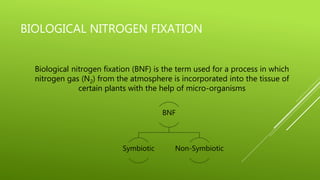
Biological nitrogen fixation (BNF) is the term used for a process in which
nitrogen gas (N2) from the atmosphere is incorporated into the tissue of
certain plants with the help of micro-organisms
BNF
Symbiotic Non-Symbiotic
NON SYMBIOTIC NITROGEN FIXATION
 The fixation of free nitrogen of the soil by all the microorganisms living freely
or outside the plant cell is called non-symbiotic biological Nitrogen fixation.
 It is performed by the aerobic and anaerobic bacteria and blue green algae
SYMBIOTIC NITROGEN FIXATION
Fixation of free nitrogen by micro-organisms in soil living
symbiotically inside the plants
Three categories
Nodule formation in leguminous plants
Nodule formation in non-leguminous plants
Non nodulation
NITROGEN FIXATION THROUGH NODULE
FORMATION IN NON-LEGUMINOUS PLANTS
 There are many plants belonging non- Leguminous families, specially
shrubs and plants produce root nodules. i.e. by actinomycetes in
angiosperms
NITROGEN FIXATION THROUGH NON-
NODULATION
 In some plants root nodules are not formed but symbiotic nitrogen fixation
takes place.
 Example:- Lichens live as symbiotic relationship with photosynthetic
cyanobacteria
NODULE FORMATION IN LEGUMINOUS PLANTS
 2500 species of family leguminosae ( Cicer arientium, Pisum,
Cajanus, Arachis) produce root nodules with Rhizobium spp.
 Root nodules are formed due to infection of Rhizobium
 Free living bacteria growing near root of legumes unable to fix
nitrogen in free condition
 Roots of the legumes secrete some growth factors helps in fast
multiplication of bacteria (E.g.) Pisum sativum secretes
carbohydrate containing Lectins over their surface
 Rhizobial cells have carbohydrate receptor on their surface
 Lectins interact with the carbohydrate receptor of rhizobial cells
 This helps in recognition and attachment of rhizobial cells
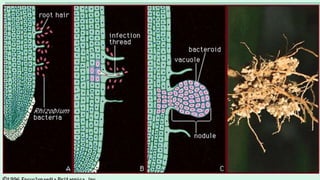
 Bacteria enter the roots through soft infected root hairs
 Tips are deformed and curved
 Tubular infection thread is formed in the root hair cell and bacteria enters into it
 After entry, new cell wall is formed and Bacteria starts multiplication.
 It grows much and reaches the inner layers of cortex
 It induces the cortical cells to multiply which result in the formation of nodule
on the surface
 The bacterial cells multiplies and colonize in the multiplying host cells
 After host cells are completely filled, bacterial cells becomes dormant
 In response to the roots being colonized by nitrogen-fixing bacteria a reddish
pigment leghaemoglobin is produced in cytoplasm of host cells
 Nitrogenous compounds synthesized is translocated through vascular tissues
 The rhizobia create ammonia from nitrogen in the air, which is used by the plant
to create amino acids and nucleotides. The plant provides the bacteria with
sugars.
NITROGENASE AND HYDROGENASE
ENZYME
Nitrogenase
 Plays key role
 Active in anaerobic condition
 Nitrogenase is used to separate nitrogen gas, N2, and transforms it into
ammonia, NH3 in the reaction
Hydrogenase
• Hydrogen produced is catalyzed into protons and electrons by
hydrogenase
H2 2H+ + 2e-
N2 + 6H+ + 6e- 2NH3
CROP LB/ACRE NITROGEN
Alfalfa 196
Ladino Clover 178
Sweet Clover 116
Red Clover 112
White Clover 103
Soybeans 98
Cowpeas 89
Lespedeza 85
Vetch 80
Garden Peas 71
Winter Peas 54
Peanuts 42
ADVANTAGES
 Nitrogen is a very essential component of photosynthesis process
 Plants with efficient nitrogen would have better seeds and better fruiting
 Nitrogen is also very essential in metabolic activities in plants
 In humans Nitrogen is important, as it is used to make proteins, good
immune system and even making hormones
 It is also a part of DNA
DISADVANTAGES
Slower process in producing fertility
Increases a possible source of vegetative competition among
other crop species
Nitrogen fixation

Nitrogen fixation

  • 1.
    NITROGEN FIXATION Presented By:Muhammad Uzair Siddique
  • 2.
    NITROGEN GAS  Transparent Odorless  Diatomic gas  Triple bond  78 % by volume in air we breath.
  • 3.
    ROLE OF NITROGENIN PLANTS  Healthy plants contain 3 to 4 percent nitrogen  Major substance in plants next to water  Important in plant growth, development and reproduction  Constituent element of »Chlorophyll »Amino acids »Alkaloids »Many vitamins  And the building blocks of protein
  • 4.
    NITROGEN FIXATION The conversion offree nitrogen into nitrogenous salts to make it available for absorption of plants
  • 5.
    TYPES OF NITROGENFIXATION Nitrogen fixation Non biological Biological Non - symbiotic Symbiotic
  • 6.
    NON-BIOLOGICAL NITROGEN FIXATION Also known as electro chemical or photochemical nitrogen fixation.  The conversion of atmospheric nitrogen into NO2, NO3, NH3 with help of `lightning and radiation.  These lightning and radiations splits the molecular nitrogen into nitrogen atom.  It then combines with hydrogen or oxygen of atmospheric water forming the ammonia or nitric oxides or nitrous oxides.  These oxides then get hydrated and form nitrous and nitric acid, these acids and ammonia is washed of along with rain into the soil. There these acids combine with metallic ions to form metallic nitrites or nitrates.
  • 7.
    BIOLOGICAL NITROGEN FIXATION Biologicalnitrogen fixation (BNF) is the term used for a process in which nitrogen gas (N2) from the atmosphere is incorporated into the tissue of certain plants with the help of micro-organisms BNF Symbiotic Non-Symbiotic
  • 8.
    NON SYMBIOTIC NITROGENFIXATION  The fixation of free nitrogen of the soil by all the microorganisms living freely or outside the plant cell is called non-symbiotic biological Nitrogen fixation.  It is performed by the aerobic and anaerobic bacteria and blue green algae
  • 9.
    SYMBIOTIC NITROGEN FIXATION Fixationof free nitrogen by micro-organisms in soil living symbiotically inside the plants Three categories Nodule formation in leguminous plants Nodule formation in non-leguminous plants Non nodulation
  • 10.
    NITROGEN FIXATION THROUGHNODULE FORMATION IN NON-LEGUMINOUS PLANTS  There are many plants belonging non- Leguminous families, specially shrubs and plants produce root nodules. i.e. by actinomycetes in angiosperms
  • 11.
    NITROGEN FIXATION THROUGHNON- NODULATION  In some plants root nodules are not formed but symbiotic nitrogen fixation takes place.  Example:- Lichens live as symbiotic relationship with photosynthetic cyanobacteria
  • 12.
    NODULE FORMATION INLEGUMINOUS PLANTS  2500 species of family leguminosae ( Cicer arientium, Pisum, Cajanus, Arachis) produce root nodules with Rhizobium spp.  Root nodules are formed due to infection of Rhizobium  Free living bacteria growing near root of legumes unable to fix nitrogen in free condition  Roots of the legumes secrete some growth factors helps in fast multiplication of bacteria (E.g.) Pisum sativum secretes carbohydrate containing Lectins over their surface
  • 13.
     Rhizobial cellshave carbohydrate receptor on their surface  Lectins interact with the carbohydrate receptor of rhizobial cells  This helps in recognition and attachment of rhizobial cells  Bacteria enter the roots through soft infected root hairs  Tips are deformed and curved  Tubular infection thread is formed in the root hair cell and bacteria enters into it
  • 15.
     After entry,new cell wall is formed and Bacteria starts multiplication.  It grows much and reaches the inner layers of cortex  It induces the cortical cells to multiply which result in the formation of nodule on the surface  The bacterial cells multiplies and colonize in the multiplying host cells  After host cells are completely filled, bacterial cells becomes dormant  In response to the roots being colonized by nitrogen-fixing bacteria a reddish pigment leghaemoglobin is produced in cytoplasm of host cells
  • 17.
     Nitrogenous compoundssynthesized is translocated through vascular tissues  The rhizobia create ammonia from nitrogen in the air, which is used by the plant to create amino acids and nucleotides. The plant provides the bacteria with sugars.
  • 18.
    NITROGENASE AND HYDROGENASE ENZYME Nitrogenase Plays key role  Active in anaerobic condition  Nitrogenase is used to separate nitrogen gas, N2, and transforms it into ammonia, NH3 in the reaction Hydrogenase • Hydrogen produced is catalyzed into protons and electrons by hydrogenase
  • 19.
    H2 2H+ +2e- N2 + 6H+ + 6e- 2NH3
  • 21.
    CROP LB/ACRE NITROGEN Alfalfa196 Ladino Clover 178 Sweet Clover 116 Red Clover 112 White Clover 103 Soybeans 98 Cowpeas 89 Lespedeza 85 Vetch 80 Garden Peas 71 Winter Peas 54 Peanuts 42
  • 22.
    ADVANTAGES  Nitrogen isa very essential component of photosynthesis process  Plants with efficient nitrogen would have better seeds and better fruiting  Nitrogen is also very essential in metabolic activities in plants  In humans Nitrogen is important, as it is used to make proteins, good immune system and even making hormones  It is also a part of DNA
  • 23.
    DISADVANTAGES Slower process inproducing fertility Increases a possible source of vegetative competition among other crop species

Editor's Notes

  • #13 Small, knob-like protuberances-root nodules Size and shape varies Spherical, flat, finger-like or elongated From Pin head to one centimeter in size Various spp. Of Rhizobium noted
  • #16 Leghemoglobin is a nitrogen or oxygen carrier, because naturally occurring oxygen and nitrogen interact similarly with this protein. In plants infected with Rhizobium, the presence of oxygen in the root nodules would reduce the activity of the oxygen-sensitive nitrogenase - an enzyme responsible for the fixation of atmospheric nitrogen. Leghemoglobin buffers the concentration of free oxygen in the cytoplasm of infected plant cells to ensure the proper function of root nodules