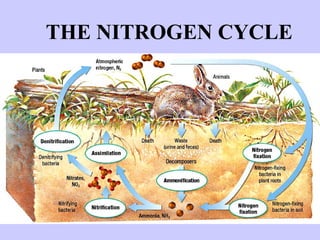
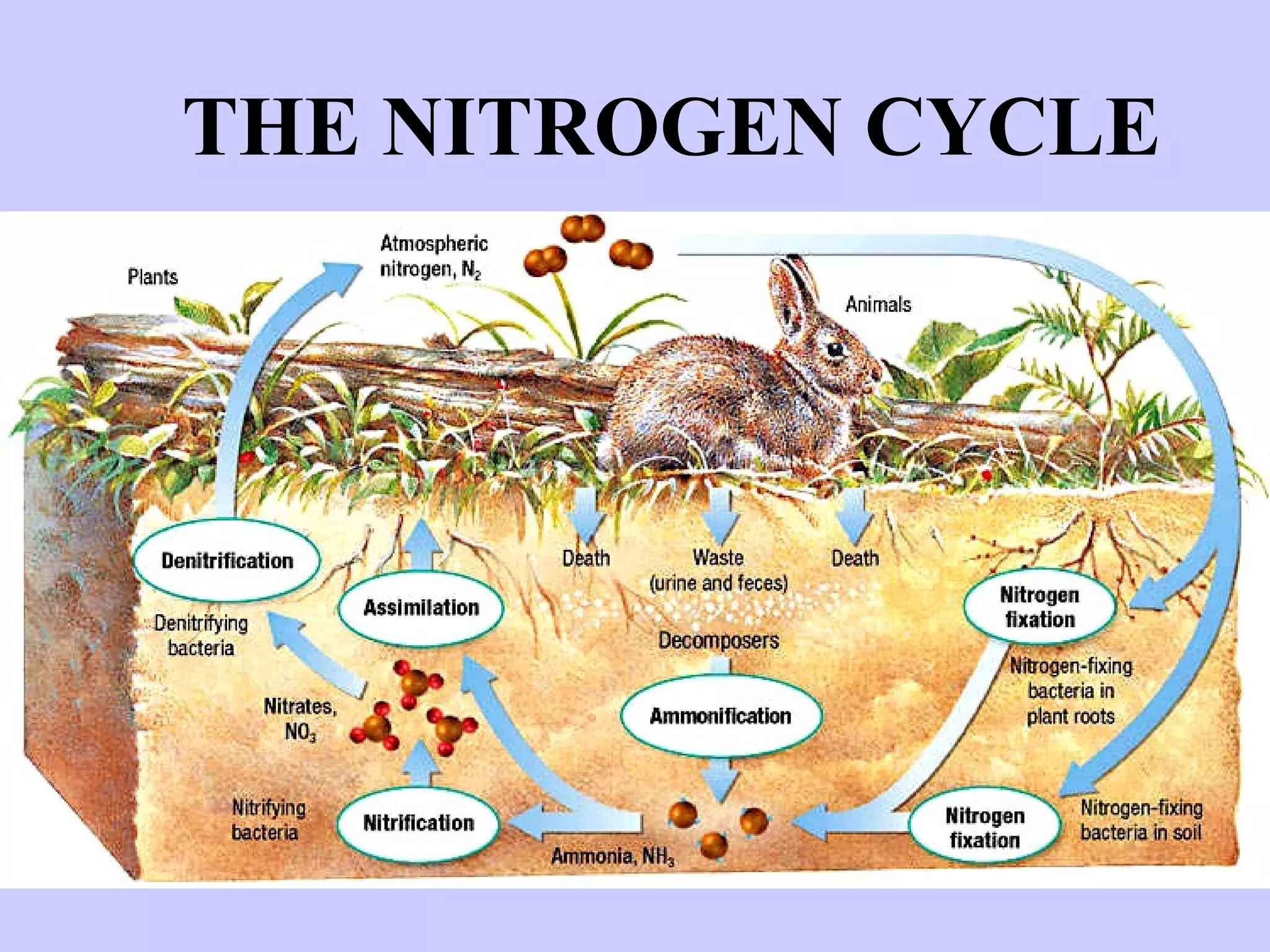
THE NITROGEN CYCLE
Where is  nitrogen  found in the environment?
The largest single source of  nitrogen  is in the  atmosphere . Nitrogen makes up 78% of our air!
What happens to  atmospheric nitrogen (N 2 )  in the nitrogen cycle? N N N N N N
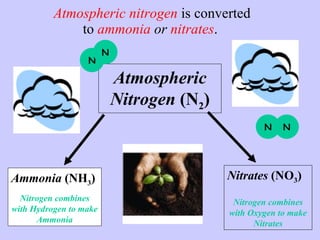
Atmospheric nitrogen  is converted to  ammonia  or  nitrates .  Ammonia  (NH 3 ) Nitrogen combines with Hydrogen to make Ammonia Nitrates  (NO 3 ) Nitrogen combines with Oxygen to make Nitrates Atmospheric Nitrogen  (N 2 ) N N N N
Why does  atmospheric nitrogen  need to be converted?   N N N N N N
It is one of nature’s great ironies… Nitrogen  is an essential component of DNA and proteins—the building blocks of life.  Although the majority of the air we breathe is  nitrogen , most living organisms are  unable to use   nitrogen  as it exists in the  atmosphere !
How does  atmospheric   nitrogen  get changed into a form that can be used by most living organisms? N N
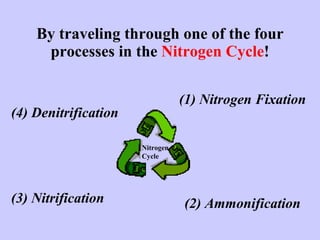
By traveling through one of the four processes in the  Nitrogen Cycle ! (1) Nitrogen Fixation (3) Nitrification (2) Ammonification (4) Denitrification Nitrogen Cycle
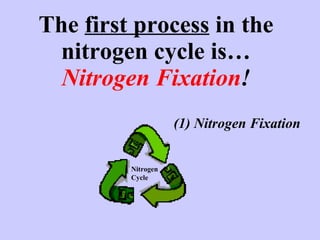
The  first process  in the nitrogen cycle is… Nitrogen Fixation ! (1) Nitrogen Fixation Nitrogen Cycle
What is  “nitrogen fixation”   and  what does it mean  to say   nitrogen gets   “fixed”?   N N
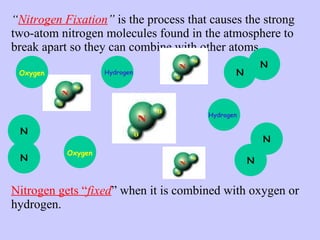
“ Nitrogen Fixation ”  is the process that causes the strong two-atom nitrogen molecules found in the atmosphere to break apart so they can combine with other atoms.       Nitrogen gets “ fixed ” when it is combined with oxygen or hydrogen. N N N N N Oxygen Hydrogen Oxygen Hydrogen N
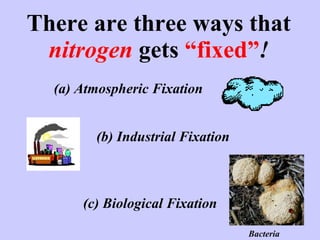
There are three ways that  nitrogen  gets  “fixed” ! (a) Atmospheric Fixation (b) Industrial Fixation (c) Biological Fixation Bacteria
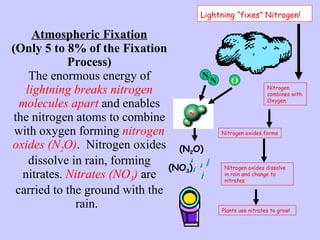
Atmospheric Fixation (Only 5 to 8% of the Fixation Process) The enormous energy of  lightning breaks nitrogen molecules apart  and enables the nitrogen atoms to combine with oxygen forming  nitrogen oxides (N 2 O) .  Nitrogen oxides dissolve in rain, forming nitrates.  Nitrates   (NO 3 )  are carried to the ground with the rain.   Lightning “fixes” Nitrogen!   Nitrogen combines with Oxygen Nitrogen oxides forms Nitrogen oxides dissolve in rain and change to nitrates Plants use nitrates to grow! (NO 3 ) N N O (N 2 O)
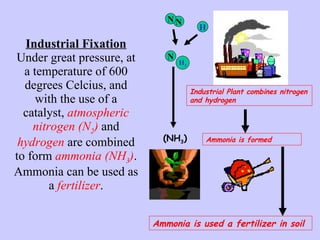
Industrial Fixation Under great pressure, at a temperature of 600 degrees Celcius, and with the use of a catalyst,  atmospheric   nitrogen (N 2 )  and  hydrogen  are combined to form  ammonia (NH 3 ) . Ammonia can be used as a  fertilizer .   Industrial Plant combines nitrogen and hydrogen Ammonia is formed Ammonia is used a   fertilizer in soil (NH 3 ) N N H N H 3
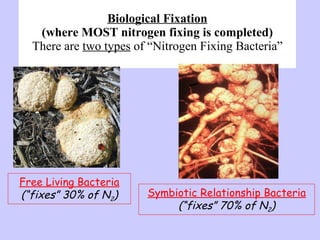
Biological Fixation (where MOST nitrogen fixing is completed) There are  two types  of “ Nitrogen Fixing Bacteria” Free Living Bacteria (“fixes”   30% of N 2 ) Symbiotic Relationship Bacteria (“fixes”   70% of N 2 )
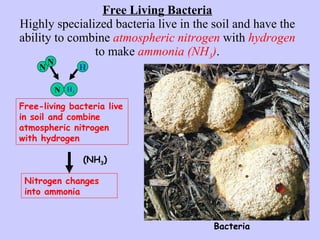
Free Living Bacteria Highly specialized bacteria live in the soil and have the ability to combine  atmospheric nitrogen  with  hydrogen  to make   ammonia (NH 3 ) . Free-living bacteria live in soil and combine atmospheric nitrogen with hydrogen Nitrogen changes into ammonia N N H N H 3 (NH 3 ) Bacteria
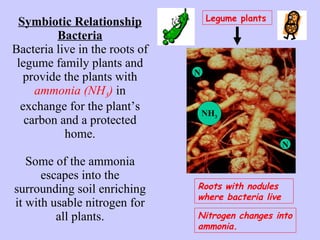
Symbiotic Relationship Bacteria Bacteria live in the roots of legume family plants and provide the plants with  ammonia (NH 3 )  in exchange for the plant’s carbon and a protected home. Some of the ammonia escapes into the surrounding soil enriching it with usable nitrogen for all plants. Legume plants Roots with nodules where bacteria live Nitrogen changes into ammonia. NH 3 N N
Most  atmospheric nitrogen (N 2 )  is  “fixed”  and changed to  ammonia (NH 3 ) .  Ammonia is highly toxic to many  organisms.   Can plants use  ammonia?
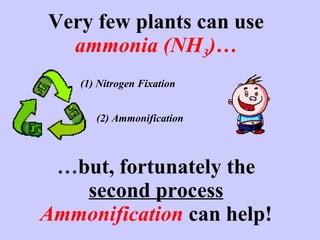
Very few plants can use  ammonia (NH 3 )…  … but, fortunately the  second process Ammonification   can help! (1) Nitrogen Fixation (2) Ammonification
What is  ammonification ?
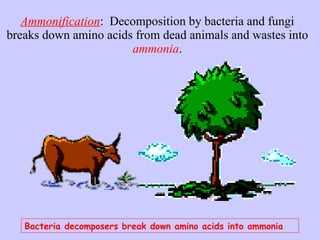
Ammonification :  Decomposition by bacteria and fungi breaks down amino acids from dead animals and wastes into  ammonia . Bacteria decomposers break down amino acids into ammonia
Why is  ammonification  necessary?
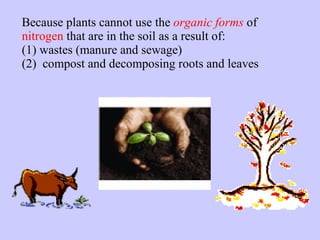
Because plants cannot use the  organic forms  of  nitrogen  that are in the soil as a result of: (1) wastes (manure and sewage) (2)  compost and decomposing roots and leaves
How does  ammonification  occur?
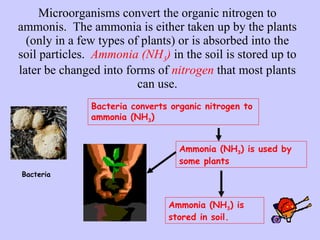
Microorganisms convert the organic nitrogen to ammonis.  The ammonia is either taken up by the plants (only in a few types of plants) or is absorbed into the soil particles.  Ammonia (NH 3 )  in the soil is stored up to later be changed into forms of  nitrogen  that most plants can use. Ammonia (NH 3 ) is stored in soil. Bacteria converts organic nitrogen to ammonia (NH 3 ) Ammonia (NH 3 ) is used by some plants Bacteria
What happens to  ammonia (NH 3 )  stored in the soil?
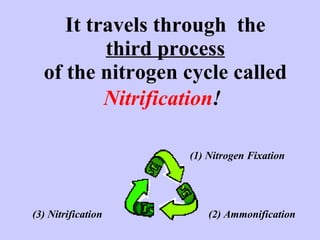
It travels through  the third process of the nitrogen cycle called   Nitrification !   (1) Nitrogen Fixation (2) Ammonification (3) Nitrification
Let’s “run through” a  general  overview of the  Nitrification Process
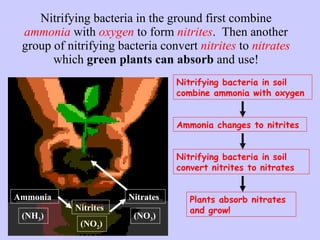
Nitrifying bacteria in the ground first combine  ammonia  with  oxygen  to form  nitrites .  Then another group of nitrifying bacteria convert  nitrites  to  nitrates  which  green plants can absorb  and use! Nitrifying bacteria in soil combine ammonia with oxygen Ammonia changes to nitrites Nitrifying bacteria in soil convert nitrites to nitrates Plants absorb nitrates and grow! Ammonia Nitrites Nitrates (NH 3 ) (NO 3 ) (NO 2 )
How does  nitrogen  reenter the  atmosphere  in the nitrogen  cycle?
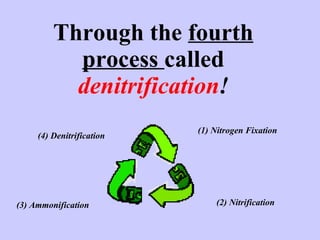
Through the  fourth process  called  denitrification ! (1) Nitrogen Fixation (2) Nitrification (3) Ammonification (4) Denitrification
What does  denitrification   do ?
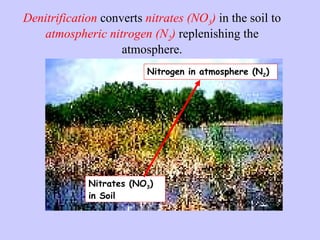
Denitrification   converts  nitrates (NO 3 )  in the soil to  atmospheric nitrogen (N 2 )  replenishing the atmosphere. Nitrates (NO 3 ) in Soil Nitrogen in atmosphere (N 2 )
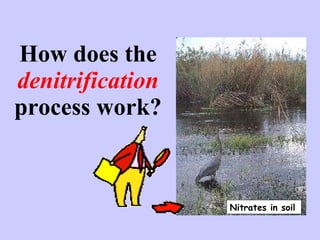
How does the  denitrification  process work? Nitrates in soil
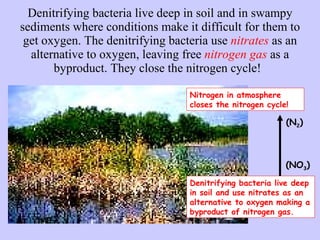
Denitrifying bacteria live deep in soil and in swampy sediments where conditions make it difficult for them to get oxygen. The denitrifying bacteria use  nitrates  as an alternative to oxygen, leaving free  nitrogen gas  as a byproduct. They close the nitrogen cycle!   Denitrifying bacteria live deep in soil and use nitrates as an alternative to oxygen making a byproduct of nitrogen gas. Nitrogen in atmosphere closes the nitrogen cycle! (NO 3 ) (N 2 )
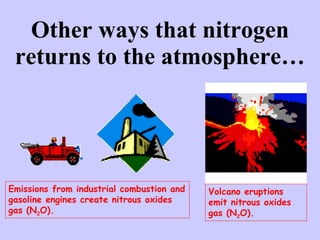
Other ways that nitrogen returns to the atmosphere… Emissions from industrial combustion and gasoline engines create nitrous oxides gas (N 2 O). Volcano eruptions emit nitrous oxides gas (N 2 O).
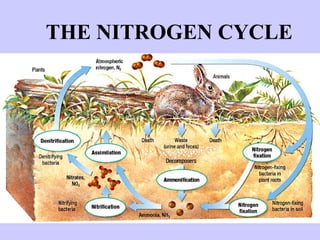
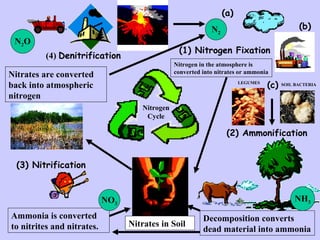
(1) Nitrogen Fixation (3) Nitrification (2) Ammonification (4)  Denitrification Nitrogen Cycle Nitrates in Soil Ammonia is converted to nitrites and nitrates. Decomposition converts dead material into ammonia (a) (b) (c) N 2 NH 3 NO 3 N 2 O Nitrates are converted back into atmospheric nitrogen Nitrogen in the atmosphere is converted into nitrates or ammonia LEGUMES SOIL BACTERIA
 
THE NITROGEN CYCLE

Nitrogen cycle

  • 1.
  • 2.
    Where is nitrogen found in the environment?
  • 3.
    The largest singlesource of nitrogen is in the atmosphere . Nitrogen makes up 78% of our air!
  • 4.
    What happens to atmospheric nitrogen (N 2 ) in the nitrogen cycle? N N N N N N
  • 5.
    Atmospheric nitrogen is converted to ammonia or nitrates . Ammonia (NH 3 ) Nitrogen combines with Hydrogen to make Ammonia Nitrates (NO 3 ) Nitrogen combines with Oxygen to make Nitrates Atmospheric Nitrogen (N 2 ) N N N N
  • 6.
    Why does atmospheric nitrogen need to be converted? N N N N N N
  • 7.
    It is oneof nature’s great ironies… Nitrogen is an essential component of DNA and proteins—the building blocks of life. Although the majority of the air we breathe is nitrogen , most living organisms are unable to use nitrogen as it exists in the atmosphere !
  • 8.
    How does atmospheric nitrogen get changed into a form that can be used by most living organisms? N N
  • 9.
    By traveling throughone of the four processes in the Nitrogen Cycle ! (1) Nitrogen Fixation (3) Nitrification (2) Ammonification (4) Denitrification Nitrogen Cycle
  • 10.
    The firstprocess in the nitrogen cycle is… Nitrogen Fixation ! (1) Nitrogen Fixation Nitrogen Cycle
  • 11.
    What is “nitrogen fixation” and what does it mean to say nitrogen gets “fixed”? N N
  • 12.
    “ Nitrogen Fixation” is the process that causes the strong two-atom nitrogen molecules found in the atmosphere to break apart so they can combine with other atoms. Nitrogen gets “ fixed ” when it is combined with oxygen or hydrogen. N N N N N Oxygen Hydrogen Oxygen Hydrogen N
  • 13.
    There are threeways that nitrogen gets “fixed” ! (a) Atmospheric Fixation (b) Industrial Fixation (c) Biological Fixation Bacteria
  • 14.
    Atmospheric Fixation (Only5 to 8% of the Fixation Process) The enormous energy of lightning breaks nitrogen molecules apart and enables the nitrogen atoms to combine with oxygen forming nitrogen oxides (N 2 O) . Nitrogen oxides dissolve in rain, forming nitrates. Nitrates (NO 3 ) are carried to the ground with the rain. Lightning “fixes” Nitrogen! Nitrogen combines with Oxygen Nitrogen oxides forms Nitrogen oxides dissolve in rain and change to nitrates Plants use nitrates to grow! (NO 3 ) N N O (N 2 O)
  • 15.
    Industrial Fixation Undergreat pressure, at a temperature of 600 degrees Celcius, and with the use of a catalyst, atmospheric nitrogen (N 2 ) and hydrogen are combined to form ammonia (NH 3 ) . Ammonia can be used as a fertilizer . Industrial Plant combines nitrogen and hydrogen Ammonia is formed Ammonia is used a fertilizer in soil (NH 3 ) N N H N H 3
  • 16.
    Biological Fixation (whereMOST nitrogen fixing is completed) There are two types of “ Nitrogen Fixing Bacteria” Free Living Bacteria (“fixes” 30% of N 2 ) Symbiotic Relationship Bacteria (“fixes” 70% of N 2 )
  • 17.
    Free Living BacteriaHighly specialized bacteria live in the soil and have the ability to combine atmospheric nitrogen with hydrogen to make ammonia (NH 3 ) . Free-living bacteria live in soil and combine atmospheric nitrogen with hydrogen Nitrogen changes into ammonia N N H N H 3 (NH 3 ) Bacteria
  • 18.
    Symbiotic Relationship BacteriaBacteria live in the roots of legume family plants and provide the plants with ammonia (NH 3 ) in exchange for the plant’s carbon and a protected home. Some of the ammonia escapes into the surrounding soil enriching it with usable nitrogen for all plants. Legume plants Roots with nodules where bacteria live Nitrogen changes into ammonia. NH 3 N N
  • 19.
    Most atmosphericnitrogen (N 2 ) is “fixed” and changed to ammonia (NH 3 ) . Ammonia is highly toxic to many organisms. Can plants use ammonia?
  • 20.
    Very few plantscan use ammonia (NH 3 )… … but, fortunately the second process Ammonification can help! (1) Nitrogen Fixation (2) Ammonification
  • 21.
    What is ammonification ?
  • 22.
    Ammonification : Decomposition by bacteria and fungi breaks down amino acids from dead animals and wastes into ammonia . Bacteria decomposers break down amino acids into ammonia
  • 23.
    Why is ammonification necessary?
  • 24.
    Because plants cannotuse the organic forms of nitrogen that are in the soil as a result of: (1) wastes (manure and sewage) (2) compost and decomposing roots and leaves
  • 25.
    How does ammonification occur?
  • 26.
    Microorganisms convert theorganic nitrogen to ammonis. The ammonia is either taken up by the plants (only in a few types of plants) or is absorbed into the soil particles. Ammonia (NH 3 ) in the soil is stored up to later be changed into forms of nitrogen that most plants can use. Ammonia (NH 3 ) is stored in soil. Bacteria converts organic nitrogen to ammonia (NH 3 ) Ammonia (NH 3 ) is used by some plants Bacteria
  • 27.
    What happens to ammonia (NH 3 ) stored in the soil?
  • 28.
    It travels through the third process of the nitrogen cycle called Nitrification ! (1) Nitrogen Fixation (2) Ammonification (3) Nitrification
  • 29.
    Let’s “run through”a general overview of the Nitrification Process
  • 30.
    Nitrifying bacteria inthe ground first combine ammonia with oxygen to form nitrites . Then another group of nitrifying bacteria convert nitrites to nitrates which green plants can absorb and use! Nitrifying bacteria in soil combine ammonia with oxygen Ammonia changes to nitrites Nitrifying bacteria in soil convert nitrites to nitrates Plants absorb nitrates and grow! Ammonia Nitrites Nitrates (NH 3 ) (NO 3 ) (NO 2 )
  • 31.
    How does nitrogen reenter the atmosphere in the nitrogen cycle?
  • 32.
    Through the fourth process called denitrification ! (1) Nitrogen Fixation (2) Nitrification (3) Ammonification (4) Denitrification
  • 33.
    What does denitrification do ?
  • 34.
    Denitrification converts nitrates (NO 3 ) in the soil to atmospheric nitrogen (N 2 ) replenishing the atmosphere. Nitrates (NO 3 ) in Soil Nitrogen in atmosphere (N 2 )
  • 35.
    How does the denitrification process work? Nitrates in soil
  • 36.
    Denitrifying bacteria livedeep in soil and in swampy sediments where conditions make it difficult for them to get oxygen. The denitrifying bacteria use nitrates as an alternative to oxygen, leaving free nitrogen gas as a byproduct. They close the nitrogen cycle! Denitrifying bacteria live deep in soil and use nitrates as an alternative to oxygen making a byproduct of nitrogen gas. Nitrogen in atmosphere closes the nitrogen cycle! (NO 3 ) (N 2 )
  • 37.
    Other ways thatnitrogen returns to the atmosphere… Emissions from industrial combustion and gasoline engines create nitrous oxides gas (N 2 O). Volcano eruptions emit nitrous oxides gas (N 2 O).
  • 38.
    (1) Nitrogen Fixation(3) Nitrification (2) Ammonification (4) Denitrification Nitrogen Cycle Nitrates in Soil Ammonia is converted to nitrites and nitrates. Decomposition converts dead material into ammonia (a) (b) (c) N 2 NH 3 NO 3 N 2 O Nitrates are converted back into atmospheric nitrogen Nitrogen in the atmosphere is converted into nitrates or ammonia LEGUMES SOIL BACTERIA
  • 39.
  • 40.