SRI PARAMAKALYANI COLLEGE
Reaccredited with B Grade with a CGPA of 2.71 in the second cycle of NAAC
affiliated to manonmanium sundaranar university, Tirunelveli.
ALWARKURICHI – 627 412
Post graduate and Research Centre – Department of Microbiology
(Government aided)
ACADEMIC YEAR 2021 – 2022
I SEM CORE: PHYSIOLOGY AND METABOLISM
UNIT IV
NITROGENASE ENZYME
SUBMITTED BY,
K. RAMKUMAR
REG NO: 20211232516122
I M.SC MICROBIOLOGY
SUBMITTED TO
GUIDE: DR.S.VISWANATHAN
ASSISTANT PROFESSOR AND
HEAD OF DEPARTMENT
Synopsis
 Introduction
 Classification
 Structure
 Nitrogenase
 Mechanism
 Organisms synthesize
Introduction
 Nitrogenase are enzymes, that are produced by certain bacteria (such as cyanobacteria and
rhizobacteria).
 These enzymes are responsible for the reduction of nitrogen (N2) to ammonia (NH3).
 Nitrogenases are the only family of enzymes known to catalyze this reaction, which is a key
step in the process of Nitrogen fixation.
 Nitrogen fixation is required for all forms of life, with nitrogen being essential for
the biosynthesis of molecules (nucleotides, amino acids) that create plants, animals and other
organisms.
 They are encoded by the Nif genes or homologs. They are related to protochlorophyllide
reductase.
Classification
Molybdenum nitrogenase (Mo)
Vanadium nitrogenase (V)
Iron-only nitrogenase.
Structure
 Although the equilibrium of ammonia from molecular hydrogen and
nitrogen has an overall negative enthalpy of reaction, the activation
energy is very high.
 Nitrogenase acts as a catalyst.
 Consists of two components:
I. The heterotetrameric MoFe protein, a nitrogenase which uses the
electrons provided to reduce
II. The homodimeric Fe-only protein, the reductase which has a
high reducing power and is responsible for the the supply of electrons.
Structure:
Nitrogenase
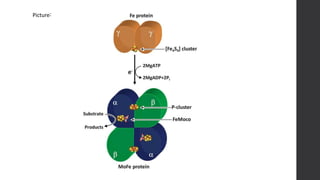
 The MoFe protein is a heterotetramer consisting of two α subunits and two
β subunits, with a mass of approximately 240-250kDa.
 The MoFe protein also contains two iron–sulfur clusters, known as P-
clusters, located at the interface between the α and β subunits and two FeMo
cofactors, within the α subunits.
 The oxidation state of Mo in these nitrogenases was formerly thought
Mo(V), but more recent evidence is for Mo(III).
 Molybdenum in other enzymes is generally bound to molybdopterin as fully
oxidized Mo(VI).
The core (Fe8S7) of the P-cluster takes the form of two [Fe4S3] cubes linked
by a central carbon atom. Each P-cluster is covalently linked to the MoFe
protein by six cysteine residues.
 Each FeMo cofactor (Fe7MoS9C) consists of two non-identical clusters: [Fe4S3] and
[MoFe3S3], which are linked by three sulfide ions. Each FeMo cofactor is covalently linked
to the α subunit of the protein by one cysteine residue and one histidine residue.
 Electrons from the Fe protein enter the MoFe protein at the P-clusters, which then
transfer the electrons to the FeMo cofactors. Each FeMo cofactor then acts as a site for
nitrogen fixation, with N2 binding in the central cavity of the cofactor.
Mechanism
 Nitrogenase is an enzyme responsible for catalyzing nitrogen fixation,
which is the reduction of nitrogen (N2) to ammonia (NH3) and a process vital
to sustaining life on Earth.
 There are three types of nitrogenase found in various nitrogen-fixing
bacteria: molybdenum (Mo) nitrogenase, vanadium (V) nitrogenase, and
iron-only (Fe) nitrogenase.
 Molybdenum nitrogenase, which can be found in diazotrophs such
as legume-associated rhizobia, is the nitrogenase that has been studied the
most extensively and thus is the most well characterized.
 The crystal structure and key catalytic components of molybdenum
nitrogenase extracted from Azotobacter vinelandii.
 Vanadium nitrogenase and iron-only nitrogenase can both be found in select
species of Azotobacter as an alternative nitrogenase.
Function:
 Equations 1 and 2 show the balanced reactions of nitrogen fixation in
molybdenum nitrogenase and vanadium nitrogenase respectively.
N2 + 14 H+ + 12 e− + 40 MgATP → 2 NH4
+ + 3 H2 + 40 MgADP + 40 Pi
N2 + 8 H+
+ 8 e−
+ 16 MgATP → 2 NH3 + H2 + 16 MgADP + 16 Pi
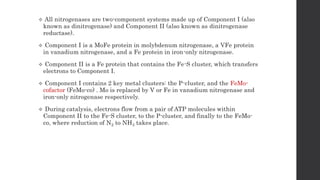
 All nitrogenases are two-component systems made up of Component I (also
known as dinitrogenase) and Component II (also known as dinitrogenase
reductase).
 Component I is a MoFe protein in molybdenum nitrogenase, a VFe protein
in vanadium nitrogenase, and a Fe protein in iron-only nitrogenase.
 Component II is a Fe protein that contains the Fe-S cluster, which transfers
electrons to Component I.
 Component I contains 2 key metal clusters: the P-cluster, and the FeMo-
cofactor (FeMo-co) . Mo is replaced by V or Fe in vanadium nitrogenase and
iron-only nitrogenase respectively.
 During catalysis, electrons flow from a pair of ATP molecules within
Component II to the Fe-S cluster, to the P-cluster, and finally to the FeMo-
co, where reduction of N2 to NH3 takes place.
Picture:
Organisms synthesize
 Symbiotic bacteria – Example: Rhizobium, spirillum, Frankia
 Non symbiotic bacteria – Example: cyanobacteria, azotobacter, Green s
bacteria.

Nitrogenase.pptx

  • 1.
    SRI PARAMAKALYANI COLLEGE Reaccreditedwith B Grade with a CGPA of 2.71 in the second cycle of NAAC affiliated to manonmanium sundaranar university, Tirunelveli. ALWARKURICHI – 627 412 Post graduate and Research Centre – Department of Microbiology (Government aided) ACADEMIC YEAR 2021 – 2022 I SEM CORE: PHYSIOLOGY AND METABOLISM UNIT IV NITROGENASE ENZYME SUBMITTED BY, K. RAMKUMAR REG NO: 20211232516122 I M.SC MICROBIOLOGY SUBMITTED TO GUIDE: DR.S.VISWANATHAN ASSISTANT PROFESSOR AND HEAD OF DEPARTMENT
  • 2.
    Synopsis  Introduction  Classification Structure  Nitrogenase  Mechanism  Organisms synthesize
  • 3.
    Introduction  Nitrogenase areenzymes, that are produced by certain bacteria (such as cyanobacteria and rhizobacteria).  These enzymes are responsible for the reduction of nitrogen (N2) to ammonia (NH3).  Nitrogenases are the only family of enzymes known to catalyze this reaction, which is a key step in the process of Nitrogen fixation.  Nitrogen fixation is required for all forms of life, with nitrogen being essential for the biosynthesis of molecules (nucleotides, amino acids) that create plants, animals and other organisms.  They are encoded by the Nif genes or homologs. They are related to protochlorophyllide reductase.
  • 4.
    Classification Molybdenum nitrogenase (Mo) Vanadiumnitrogenase (V) Iron-only nitrogenase.
  • 5.
    Structure  Although theequilibrium of ammonia from molecular hydrogen and nitrogen has an overall negative enthalpy of reaction, the activation energy is very high.  Nitrogenase acts as a catalyst.  Consists of two components: I. The heterotetrameric MoFe protein, a nitrogenase which uses the electrons provided to reduce II. The homodimeric Fe-only protein, the reductase which has a high reducing power and is responsible for the the supply of electrons.
  • 6.
  • 7.
    Nitrogenase  The MoFeprotein is a heterotetramer consisting of two α subunits and two β subunits, with a mass of approximately 240-250kDa.  The MoFe protein also contains two iron–sulfur clusters, known as P- clusters, located at the interface between the α and β subunits and two FeMo cofactors, within the α subunits.  The oxidation state of Mo in these nitrogenases was formerly thought Mo(V), but more recent evidence is for Mo(III).  Molybdenum in other enzymes is generally bound to molybdopterin as fully oxidized Mo(VI). The core (Fe8S7) of the P-cluster takes the form of two [Fe4S3] cubes linked by a central carbon atom. Each P-cluster is covalently linked to the MoFe protein by six cysteine residues.
  • 8.
     Each FeMocofactor (Fe7MoS9C) consists of two non-identical clusters: [Fe4S3] and [MoFe3S3], which are linked by three sulfide ions. Each FeMo cofactor is covalently linked to the α subunit of the protein by one cysteine residue and one histidine residue.  Electrons from the Fe protein enter the MoFe protein at the P-clusters, which then transfer the electrons to the FeMo cofactors. Each FeMo cofactor then acts as a site for nitrogen fixation, with N2 binding in the central cavity of the cofactor.
  • 9.
    Mechanism  Nitrogenase isan enzyme responsible for catalyzing nitrogen fixation, which is the reduction of nitrogen (N2) to ammonia (NH3) and a process vital to sustaining life on Earth.  There are three types of nitrogenase found in various nitrogen-fixing bacteria: molybdenum (Mo) nitrogenase, vanadium (V) nitrogenase, and iron-only (Fe) nitrogenase.  Molybdenum nitrogenase, which can be found in diazotrophs such as legume-associated rhizobia, is the nitrogenase that has been studied the most extensively and thus is the most well characterized.  The crystal structure and key catalytic components of molybdenum nitrogenase extracted from Azotobacter vinelandii.  Vanadium nitrogenase and iron-only nitrogenase can both be found in select species of Azotobacter as an alternative nitrogenase.
  • 10.
  • 11.
     Equations 1and 2 show the balanced reactions of nitrogen fixation in molybdenum nitrogenase and vanadium nitrogenase respectively. N2 + 14 H+ + 12 e− + 40 MgATP → 2 NH4 + + 3 H2 + 40 MgADP + 40 Pi N2 + 8 H+ + 8 e− + 16 MgATP → 2 NH3 + H2 + 16 MgADP + 16 Pi
  • 12.
     All nitrogenasesare two-component systems made up of Component I (also known as dinitrogenase) and Component II (also known as dinitrogenase reductase).  Component I is a MoFe protein in molybdenum nitrogenase, a VFe protein in vanadium nitrogenase, and a Fe protein in iron-only nitrogenase.  Component II is a Fe protein that contains the Fe-S cluster, which transfers electrons to Component I.  Component I contains 2 key metal clusters: the P-cluster, and the FeMo- cofactor (FeMo-co) . Mo is replaced by V or Fe in vanadium nitrogenase and iron-only nitrogenase respectively.  During catalysis, electrons flow from a pair of ATP molecules within Component II to the Fe-S cluster, to the P-cluster, and finally to the FeMo- co, where reduction of N2 to NH3 takes place.
  • 13.
  • 14.
    Organisms synthesize  Symbioticbacteria – Example: Rhizobium, spirillum, Frankia  Non symbiotic bacteria – Example: cyanobacteria, azotobacter, Green s bacteria.