Sujata N. Dandale
Ph.D (Plant Pathology)
Deptt. of Plant Pathology
PGI,Dr. P.D.K.V., Akola
Biological Nitrogen
fixation
by Rhizobium
Role of nitrogen in plants
» Major substance in plants next to water.
» Building blocks.
» Constituent element of
» Chlorophyll
» Cytochromes
» Alkaloids
» Many vitamins
» Plays important role in metabolism, growth,
reproduction and heredity.
Sources of nitrogen
• Atmospheric Nitrogen
– 78% of atmosphere
– Plants cannot utilize this form
– Some Bacteria, Blue Green Algae, leguminous plants
• Nitrates, Nitrites and Ammonia
– Nitrate is chief form
• Amino acids in the soil
– Many soil organisms use this form
– Higher plants can also taken by higher plants
• Organic Nitrogenous compounds in
insects
– Insectivorous plants
Nitrogen fixation
• The conversion of free nitrogen into
nitrogenous salts to make it available for
absorption of plants
Types of nitrogen fixation
Nitrogen fixation
Non biological Biological
Non - symbiotic Symbiotic
Non biological fixation
• The micro-organisms do not take place
• Found in rainy season during lightning
1. N2 + O2 lightning 2 NO
(Nitric oxide)
2. 2NO + O2 oxidation 2NO2
( Nitrogen per oxide)
3. 2NO2 + H2O HNO2 + HNO3
4. 4NO2 + 2H2O + O2 4HNO3
(Nitric acid)
5. CaO + 2HNO3 Ca (NO3)2 + H2O
(Calcium nitrate)
6. HNO3 + NH3 NH4NO3
(Ammonium nitrate)
7. HNO2 + NH3 NH4NO2
(Ammonium nitrite)
Biological fixation
• Fixation of atmospheric Nitrogen into
nitrogenous salts with the help of micro-
organisms
• Two types
– Symbiotic
– Non-symbiotic
Non-symbiotic
o Fixation carried out by free living micro-
organisms
o Aerobic, anaerobic and blue green algae
o Bacteria: special type (nitrogen fixing bacteria)
types -
oFree living aerobic : Azotobacter, Beijerenckia
oFree living anaerobic : Clostridium.
oFree living photosynthetic : Chlorobium.
Rhodopseudomonas
oFree living chemosynthetic
:Desulfovibro,Thiobacillus
Contd..
o Free living fungi: yeasts and Pillularia
o Blue green algae:
o unicellular – Gloeothece, Synechococcus
o Filamentous (non heterocystous) -Oscillatoria
o Filamentous (heterocystous) – Tolypothrix,
Nostoc, Anabaena
Symbiotic
• Fixation of free nitrogen by micro-organisms in
soil living symbiotically inside the plants
• ‘Symbiosis’ – coined by DeBary
• Three categories
– Nodule formation in leguminous plants
– Nodule formation in non-leguminous plants
– Non nodulation
Nodule formation in leguminous
plants
• 2500 spp. Of family leguminosae ( Cicer
arientium, Pisum, Cajanus, Arachis) produce root
nodules with Rhizobium spp.
• They fix Nitrogen only inside the root nodules
• Association provides-food and shelter to
bacteria
-bacteria supply fixed
nitrogen to plant
• Nodules may buried in soil even after harvesting
– continue nitrogen fixation
Nodule formation in non-
leguminous plants
• Some other plants also produces root
nodules
– Causuarina equisetifolia – Frankia
– Alnus – Frankia
– Myrica gale – Frankia
– Parasponia – Rhizobium
• Leaf nodules are also noted
– Dioscorea, Psychotria
• Gymnosperms – root – Podocarpus,
- leaves – Pavetta zinumermanniana,
Chomelia
Non-nodulation
• Lichens - cyanobacteria
• Anthoceros - Nostoc
• Azolla – Anabaena azollae
• Cycas – Nostoc and anabaene
• Gunnera macrophylla - Nostoc
• Digitaria, Maize and Sorghum – Spirillum
notatum
• Paspalum notatum – Azotobacter paspali
Symbiotic nitrogen fixation
• Small, knob-like protuberances-root nodules
• Size and shape varies
• Spherical, flat, finger-like or elongated
• From Pin head to one centimeter in size
• Various spp. Of Rhizobium noted
• Named after the host plant
– Pea – Rhizobium leguminosarum
– Beans – R. phaseoli
– Soyabeans – R. japonicum
– Lupins – R. lupini
• Two types of Rhizobium-
– Bradyrhizobium – slow growing spp.
– Rhizobium - fast growing spp.
RHIZOBIUM (root living)
• Gram negative
• Non spore forming
• Micro-aerobic
• Show a degree of specificity
• The two partners (Bacteria and Host)
recognized by chemical substance
LECTINS - phytoagglutinins
(carbohydrate containing plant
protein)
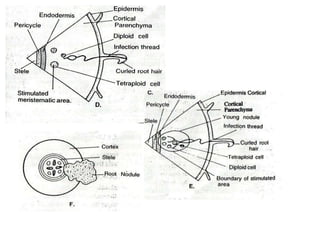
Formation of root nodules in legumes
• Root nodules formed due to infection of
Rhizobium
• Free living bacteria growing near root of legumes
unable to fix nitrogen in free condition
• Roots of the legumes secrete some growth
factors helps in fast multiplication of bacteria
• (E.g.) Pisum sativum secretes homo serine also
carbohydrate containing protein Lectins over
their surface
• This helps in recognition and attachment of
rhizobial cells
• Rhizobial cells have carbohydrate receptor on
their surface
• Lectins interact with the carbohydrate receptor
of rhizobial cells
• Occur between root hairs and young root hair
• Bacteria enter the roots through soft infected
root hairs
• Tips are deformed and curved
• Tubular infection thread is formed in the root
hair cell and bacteria enters into it
Contd..
• After entry, new cell wall is formed
• Tubular infection contains
mucopolysaccharides where bacteria
embedded and start multiplication
• It grows much and reaches the inner layers of
cortex and the bacteria is released
• It induces the cortical cells to multiply which
result in the formation of nodule on the
surface
• The bacterial cells multiplies and colonize in
the multiplying host cells
• After host cells are completely filled, bacterial
cells becomes dormant-bacteroids
• Float in leghaemoglobin – reddish pigment in
cytoplasm of host cells
- Efficient O2 scavenger
- Maintains steady state of oxygen
- Stimulates ATP production
• Present studies indicates that leghaemoglobin
is not essential
• Nitrogenous compounds synthesized is
translocated through vascular tissues
• Groups of rhizobia surrounded by double
membrane originated from host cell wall
• Bacteroids lack firm wall (osmotically liable)
Biochemistry of Nitrogen fixation
• Basic requirements for Nitrogen fixation
• Nitrogenase and hydrogenase enzyme
• Protective mechanism against Oxygen
• Ferrodoxin
• Hydrogen releasing system or electron donor
(Pyruvic acid or glucose/sucrose)
• Constant supply of ATP
• Coenzymes and cofactors -TPP, CoA, inorganic
phosphate and Mg+2
• Cobalt and Molybdenum
• A carbon compound
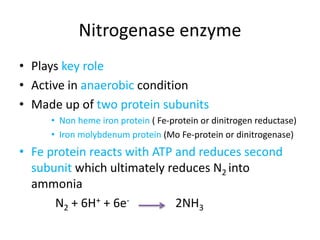
Nitrogenase enzyme
• Plays key role
• Active in anaerobic condition
• Made up of two protein subunits
• Non heme iron protein ( Fe-protein or dinitrogen reductase)
• Iron molybdenum protein (Mo Fe-protein or dinitrogenase)
• Fe protein reacts with ATP and reduces second
subunit which ultimately reduces N2 into
ammonia
N2 + 6H+ + 6e- 2NH3
Contd..
• The reduction of N2 into NH3 requires 6
protons and 6 electrons
• 12 mols of ATP required
• One pair of electron requires 4 ATP
• The modified equation
N2 + 8H+ + 8e- 2NH3 + H2
• Hydrogen produced is catalyzed into
protons and electrons by hydrogenase
hydrogenase
H2 2H+ + 2e-
Pathway of nitrogen fixation in root
nodules
• Glucose-6-phosphate acts as a electron donor
• Glucose-6-phosphate is converted to
phosphogluconic acid
Glucose-6-phosphate + NADP+ + H2O 6- phosphogluconic acid + NADPH + H+
• NADPH donates electrons to ferrodoxin. Protons
released and ferrodoxin is reduced
• Reduced ferrodoxin acts as electron carrier.
Donate electron to Fe-protein to reduce it.
Electrons released from ferrodoxin thus oxidized
Sucrose
(synthesized
in leaves)
Sucrose ( in
roots )
Glucose and
fructose
Glucose-6-
phosphate
Contd..
• Reduced Fe-protein combines with ATP in
the presence of Mg +2
• Second sub unit is activated and reduced
• It donates electrons to N2 to NH3
• Enzyme set free after complete reduction
of N2 to NH3 Mo – N=NH
Mo=N-NH2
MoΞN+NH3
Mo + NH3
NΞN
Mo-NΞN
Nitrogenase actually consists of two proteins that work in tandem: the
iron (Fe) protein and the molybdenum-iron (MoFe) protein. During the
catalytic reduction of dinitrogen, the electrons are transferred from the
Fe-protein to the MoFe-protein.
Nitrogenase is extremely sensitive to oxygen. Root nodules of
nitrogen‐fixing plants contain the oxygen‐binding protein,
leghemoglobin, which protects nitrogenase by binding molecular
oxygen.
Rhizobium is a genus of Gram negative soil bacteria that fix
nitrogen.Rhizobium forms an endosymbiotic nitrogen
fixing association with roots of legumes and Parasponia.
The bacteria colonize plant cells within root
nodules where they convert atmospheric nitrogen
into ammonia and then provide organic nitrogenous
compounds such as glutamine or ureides to the plant.
The plant in turn provides the bacteria with organic
compounds made by photosynthesis.
This mutually beneficial relationship is true of all of
the rhizobia, of which the Rhizobium genus is a typical
example.
Kingdom: Bacteria
Phylum: Proteobacteria
Class: Alphaproteobacteria
Order: Rhizobiales
Family: Rhizobiaceae
Genus:
Rhizobium
Frank 1889
Beijerinck in the Netherlands was the first to isolate and cultivate
a microorganism from the nodules of legumes in 1888. He named it Bacillus
radicicola, which is now placed in Bergey's Manual of Determinative
Bacteriology under the genus Rhizobium.
Culture of Rhizobium on agar plate
Rhizobia are nitrogen-fixing bacteria that form root nodules on legume
plants.
Most of these bacterial species are in the Rhizobiacae family in the alpha-
proteobacteria and are in either the Rhizobium, Mesorhizobium, Ensifer,
or Bradyrhizobium genera.
However recent research has shown that there are many other rhizobial
species in addition to these.
In some cases these new species have arisen through lateral gene transfer
of symbiotic genes. The list below is not 'official' by any means, and it is
merely my compilation and interpretation of the literature.
An alternative list is maintained by the "ICSP Subcommittee on the
taxonomy of Rhizobium and Agrobacterium".
Class: Alphaproteobacteria
Order: Rhizobiales
Family: Rhizobiaceae
Rhizobium alamii Rhizobium freirei
Rhizobium alkalisoli Rhizobium galegae
Rhizobium azibense Rhizobium gallicum
Rhizobium calliandrae Rhizobium giardinii
Rhizobium cauense Rhizobium grahamii
Rhizobium cellulosilyticum Rhizobium hainanense
Rhizobium daejeonense Rhizobium halophytocola
Rhizobium endophyticum Rhizobium herbae
Rhizobium etli Rhizobium huautlense
Rhizobium fabae Rhizobium indigoferae
The genus Rhizobium (Frank 1889) was the first named (from
Latin meaning 'root living'), and for many years this was a
'catch all' genus for all rhizobia. Some species were later moved
in to new genera based on phylogenetic analyses. It currently
consists of 49 rhizobial species (and 11 non rhizobial species).
Rhizobium jaguaris Rhizobium phaseoli
Rhizobium laguerreae Rhizobium pisi
Rhizobium leguminosarum Rhizobium tibeticum
Rhizobium leucaenae Rhizobium sophorae
Rhizobium loessense Rhizobium sophoriradicis
Rhizobium lusitanum Rhizobium sphaerophysae
Rhizobium mayense Rhizobium sullae
Rhizobium mesoamericanum Rhizobium taibaishanense
Rhizobium mesosinicum Rhizobium tropici
Rhizobium miluonense Rhizobium tubonense
Rhizobium mongolense Rhizobium undicola
Rhizobium multihospitium Rhizobium vallis
Rhizobium oryzae Rhizobium vignae
Rhizobium paranaense Rhizobium yanglingense
Rhizobium petrolearium
Class: Alphaproteobacteria
Order: Rhizobiales
Family: Phyllobacteriaceae
The genus Mesorhizobium was described by Jarvis et al.
in 1997. Several Rhizobium species were transferred to
this genus. It currently consists of 21 rhizobia species
(and 1 non-rhizobial species).
Mesorhizobium abyssinicae Mesorhizobium chacoense
Mesorhizobium albiziae Mesorhizobium ciceri
Mesorhizobium alhagi Mesorhizobium erdmanii
Mesorhizobium amorphae Mesorhizobium gobiense
Mesorhizobium australicum Mesorhizobium hawassense
Mesorhizobium camelthorni Mesorhizobium huakuii
Mesorhizobium caraganae Mesorhizobium jarvisii
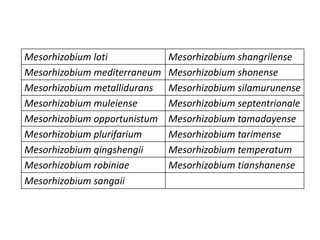
Mesorhizobium loti Mesorhizobium shangrilense
Mesorhizobium mediterraneum Mesorhizobium shonense
Mesorhizobium metallidurans Mesorhizobium silamurunense
Mesorhizobium muleiense Mesorhizobium septentrionale
Mesorhizobium opportunistum Mesorhizobium tamadayense
Mesorhizobium plurifarium Mesorhizobium tarimense
Mesorhizobium qingshengii Mesorhizobium temperatum
Mesorhizobium robiniae Mesorhizobium tianshanense
Mesorhizobium sangaii
class: Alphaproteobacteria
order: Rhizobiales
family: Rhizobiaceae
The Sinorhizobium genus was described by Chen et al. in 1988.
However some recent studies show that Sinorhizobium and the
genus Ensifer (Casida, 1982) belong to a single taxon. Ensiferis the
earlier heterotypic synonym (it was named first) and thus takes
priority (Young, 2003). This means that all Sinorhizobium spp. must
be renamed as Ensifer spp. according to the Bacteriological code.
There has been some discussion in the literature
if Ensifer or Sinorhizobium is correct Young (2010), this website
follows the opinion of the Judicial Commission, and will use Ensifer.
The genus currently consists of 17 species.
Ensifer abri Ensifer meliloti
Sinorhizobium americanum Ensifer mexicanus
Ensifer arboris 'Sinorhizobium morelense'
Ensifer fredii Ensifer adhaerens
Ensifer garamanticus Ensifer numidicus
Ensifer indiaense Ensifer saheli
Ensifer kostiensis Ensifer sojae
Ensifer kummerowiae Ensifer terangae
Ensifer medicae
class: Alphaproteobacteria
order: Rhizobiales
family: Bradyrhizobiaceae
The Bradyrhizobium genus was described by Jordan
in 1982. It currently consists of 9 rhizobia species
(and 1 non rhizobial species).
Bradyrhizobium canariense Bradyrhizobium japonicum
Bradyrhizobium cytisi Bradyrhizobium jicamae
Bradyrhizobium denitrificans Bradyrhizobium liaoningense
Bradyrhizobium elkanii Bradyrhizobium pachyrhizi
Bradyrhizobium iriomotense Bradyrhizobium yuanmingense
class: Betaproteobacteria
order: Burkholderiales
family: Burkholderiaceae
The Burkholderia genus currently contains
seven named rhizobial members and others
as Burkholderia sp.
Burkholderia caribensis
Burkholderia cepacia
Burkholderia mimosarum
Burkholderia nodosa
Burkholderia phymatum
Burkholderia sabiae
Burkholderia tuberum
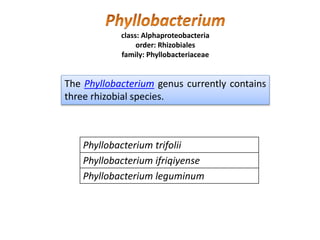
class: Alphaproteobacteria
order: Rhizobiales
family: Phyllobacteriaceae
The Phyllobacterium genus currently contains
three rhizobial species.
Phyllobacterium trifolii
Phyllobacterium ifriqiyense
Phyllobacterium leguminum
class: Alphaproteobacteria
order: Rhizobiales
family: Methylobacteriaceae
The Azorhizobium genus was described by Dreyfus et al.
in 1988. It currently consists of 2 species.
Azorhizobium caulinodans
Azorhizobium doebereinerae
class: Alphaproteobacteria
order: Rhizobiales
family: Brucellaceae
The Ochrobactrum genus currently contains
two rhizobial species.
Ochrobactrum cytisi
Ochrobactrum lupini
class: Alphaproteobacteria
order: Rhizobiales
family: Methylobacteriaceae
Methylobacterium nodulans
class: Betaproteobacteria
order: Burkholderiales
family: Burkholderiaceae
Cupriavidus taiwanensis
class: Alphaproteobacteria
order: Rhizobiales
family: Hyphomicrobiaceae
Devosia neptuniae
class: Alphaproteobacteria
order: Rhizobiales
family: Rhizobiacea
Shinella kummerowiae
Root nodules occur on the roots of plants (primarily Fabaceae) that
associate with symbiotic nitrogen-fixing bacteria.
Undernitrogen-limiting conditions, capable plants form a symbiotic
relationship with a host-specific strain of bacteria known as rhizobia.
This process has evolved multiple times within the Fabaceae, as well
as in other species found within the Rosidclade.
The Fabaceae include legume crops such as beans and peas.
Within legume nodules, nitrogen gas from the atmosphere is
converted into ammonia, which is then assimilated into amino
acids (the building blocks of proteins), nucleotides (the building
blocks of DNA and RNA as well as the important energy
molecule ATP), and other cellular constituents such
as vitamins, flavones, and hormones.
Cross section though a soybean (Glycine max'Essex') root nodule. The
bacterium, Bradyrhizobium japonicum, colonizes the roots and
establishes a nitrogen fixing symbiosis. This high magnification image
shows part of a cell with single bacteroids within their symbiosomes. In
this image, endoplasmic reticulum, dictysome and cell wall can be seen.
Their ability to fix gaseous nitrogen makes legumes an ideal
agricultural organism as their requirement for nitrogen
fertilizer is reduced.
Indeed high nitrogen content blocks nodule development as
there is no benefit for the plant of forming the symbiosis. The
energy for splitting the nitrogen gas in the nodule comes from
sugar that is translocated from the leaf (a product
of photosynthesis).
Malate as a breakdown product of sucrose is the direct carbon
source for the bacteroid. Nitrogen fixation in the nodule is very
oxygen sensitive.
Legume nodules harbor an iron containing protein
called leghaemoglobin, closely related to animal myoglobin, to
facilitate the conversion of nitrogen gas to ammonia.
Legume family
Plants that contribute to nitrogen fixation include the legume family – Fabaceae –
with taxa such as kudzu, clovers, soybeans, alfalfa, lupines, peanuts, and rooibos.
They contain symbiotic bacteria called rhizobia within the nodules, producing
nitrogen compounds that help the plant to grow and compete with other plants.
When the plant dies, the fixed nitrogen is released, making it available to other
plants and this helps to fertilize the soil.
The great majority of legumes have this association, but a few genera
(e.g.,Styphnolobium) do not.
In many traditional and organic farming practices, fields are rotated through
various types of crops, which usually includes one consisting mainly or entirely of
clover or buckwheat (non-legume family Polygonaceae), which are often referred
to as "green manure".
Inga alley farming relies on the leguminous genus Inga, a small tropical, tough-
leaved, nitrogen-fixing tree.[4]
Non-leguminous
Although by far the majority of plants able to form
nitrogen-fixing root nodules are in the legume
family Fabaceae, there are a few exceptions:
•Parasponia, a tropical genus in the Cannabaceae also
able to interact with rhizobia and form nitrogen-fixing
nodules
•Actinorhizal plants such as alder and bayberry can also
form nitrogen-fixing nodules, thanks to a symbiotic
association with Frankiabacteria. These plants belong to
25 genera distributed among 8 plant families.
The ability to fix nitrogen is far from universally present
in these families. For instance, of 122 genera in
the Rosaceae, only 4 genera are capable of fixing
nitrogen. All these families belong to
the orders Cucurbitales, Fagales, and Rosales, which
together with the Fabales form a clade of eurosids.
A sectioned alder tree
root nodule.
Two main types of nodule have been described: determinate and
indeterminate.
Determinate nodules are found on certain tribes of tropical legume such as
those of the genera Glycine (soybean), Phaseolus (common bean),
and Vigna. and on some temperate legumes such as Lotus.
These determinate nodules lose meristematic activity shortly after initiation,
thus growth is due to cell expansion resulting in mature nodules which are
spherical in shape.
Another types of determinate nodule is found in a wide range of herbs,
shrubs and trees, such as Arachis (peanut).
These are always associated with the axils of lateral or adventitious roots and
are formed following infection via cracks where these roots emerge and not
using root hairs. Their internal structure is quite different from those of the
soybean type of nodule.
Determinate Nodules
Formed on tropical legumes by Rhizobium and Bradyrhizobium
Meristematic activity not persistent - present only during early stage of nodule formation;
after that, cells simply expand rather than divide, to form globose nodules.
Nodules arise just below epidermis; largely internal vascular system.
Uninfected cells dispersed throughout nodule;
quipped to assimilate NH4+ as ureides (allantoin and
allantoic acid)
Indeterminate nodules are found in the majority of legumes from
all three sub-families, whether in temperate regions or in the
tropics.
They can be seen in papilioinoid legumes such
as Pisum (pea), Medicago (alfalfa), Trifolium (clover),
and Vicia (vetch) and all mimosoid legumes such as acacias
(mimosas), the few nodulated caesalpinioid legumes such as
partridge pea they earned the name "indeterminate" because
they maintain an active apical meristem that produces new cells
for growth over the life of the nodule.
This results in the nodule having a generally cylindrical shape,
which may be extensively branched.
Because they are actively growing, indeterminate nodules
manifest zones which demarcate different stages of
development/symbiosis.
Formed on temperate legumes (pea, clover,
alfalfa);
typically by Rhizobium spp.
Cylindrical nodules with a persistent meristem;
nodule growth creates zones of different
developmental Stages
Nodule arises near endodermis, and nodule
vasculature clearly connected with root vascular
system
Uninfected cells of indeterminate nodules
assimilate NH4+ as amides (asparagine,
glutamine)
Indeterminate Nodules
Diagram illustrating the different zones of an
indeterminate root nodule
Zone I—the active meristem. This is where new nodule tissue is formed
which will later differentiate into the other zones of the nodule.
Zone II—the infection zone. This zone is permeated with infection
threads full of bacteria. The plant cells are larger than in the
previous zone and cell division is halted.
Interzone II–III—Here the bacteria have entered the plant cells, which
contain amyloplasts. They elongate and begin terminally
differentiating into symbiotic, nitrogen-fixing bacteroids.
Zone III—the nitrogen fixation zone. Each cell in this zone contains a
large, central vacuole and the cytoplasm is filled with fully
differentiated bacteroids which are actively fixing nitrogen. The
plant provides these cells with leghemoglobin, resulting in a distinct
pink color.
Zone IV—the senescent zone. Here plant cells and their
bacteroid contents are being degraded.
The breakdown of the heme component of leghemoglobin
results in a visible greening at the base of the nodule.
This is the most widely studied type of nodule, but the details
are quite different in nodules of peanut and relatives and some
other important crops such as lupins where the nodule is
formed following direct infection of rhizobia through the
epidermis and where infection threads are never formed.
Nodules grow around the root, forming a collar-like structure.
In these nodules and in the peanut type the central infected
tissue is uniform, lacking the uninfected ells seen in nodules of
soybean and many indeterminate types such as peas and
clovers.
Nodulation is controlled by a variety of processes, both external (heat, acidic
soils, drought, nitrate) and internal (autoregulation of nodulation, ethylene).
Autoregulation of nodulation controls nodule numbers per plant through a
systemic process involving the leaf. Leaf tissue senses the early nodulation
events in the root through an unknown chemical signal, then restricts further
nodule development in newly developing root tissue.
The Leucine rich repeat (LRR) receptor kinases (NARK in soybean (Glycine
max); HAR1 in Lotus japonicus, SUNN in Medicago truncatula) are essential
for autoregulation of nodulation (AON). Mutation leading to loss of function
in these AON receptor kinases leads to supernodulation or hypernodulation.
Often root growth abnormalities accompany the loss of AON receptor kinase
activity, suggesting that nodule growth and root development are
functionally linked. Investigations into the mechanisms of nodule formation
showed that theENOD40 gene, coding for a 12–13 amino acid protein [41], is
up-regulated during nodule formation [3].
Fast-growing Rhizobium spp. whose nodulation functions(nif, fix) are encoded
on their symbiotic megaplasmids (pSym)
Slow-growing Bradyrhizobium spp. whose N-fixationand nodulation functions
are encoded on their chromosome.
Process of Nodule Formation
 Recognition of the correct partner by both plant and bacterium and
attachment of the bacterium to the root hairs.
 Secretion of oligosaccharide signaling molecules (nod factors) by the
bacterium.
 Bacterial invasion of the root hair.
Movement of bacteria to the main root by way of the infection thread.
 Formation of modified bacterial cells (bacteroids) within the plant
cells and development of the N2-fixing state.
Continued plant and bacterial cell division, forming the mature root
nodule.
The roots of legumes secrete organic compounds that stimulate the
growth of a diverse rhizosphere microbial community.
If rhizobia of the correct cross-inoculation group are in soil, they form
large populations and attach to the root hairs extending from the roots
of the plant.
An adhesion protein called rhicadhesin is present on the cell surfaces
of rhizobia.
Other substances, such as carbohydrate-containing proteins called
lectins and specific receptors in the plant cytoplasmic membrane, also
play roles in plant–bacterium attachment.
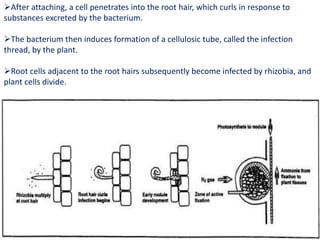
After attaching, a cell penetrates into the root hair, which curls in response to
substances excreted by the bacterium.
The bacterium then induces formation of a cellulosic tube, called the infection
thread, by the plant.
Root cells adjacent to the root hairs subsequently become infected by rhizobia, and
plant cells divide.
Continued plant cell division forms the tumor -like nodule.
Nodule Development
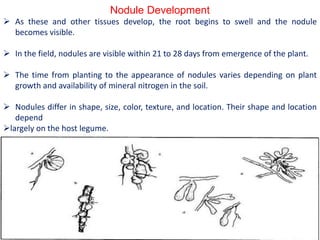
 As these and other tissues develop, the root begins to swell and the nodule
becomes visible.
 In the field, nodules are visible within 21 to 28 days from emergence of the plant.
 The time from planting to the appearance of nodules varies depending on plant
growth and availability of mineral nitrogen in the soil.
 Nodules differ in shape, size, color, texture, and location. Their shape and location
depend
largely on the host legume.
Nodule Function
The rhizobia multiply rapidly within the plant cells and become transformed into
swollen, misshapen, and branched cells called bacteroids.
A microcolony of bacteroids becomes surrounded by parts of the plant
cytoplasmic membrane to form a structure called the symbiosome , and only after
it forms does N2 fixation begin.
The bacteroids produce the enzyme nitrogenase.
The ammonia attaches to a compound provided by the plant, forming amino
acids. These amino acids move out of the nodule to other parts of the plant where
they undergo further changes.
 It is estimated that the legume-rhizobia symbiosis requires about 10 kg of
carbohydrates for each kg of N2 fixed.
 Energy-expensive.
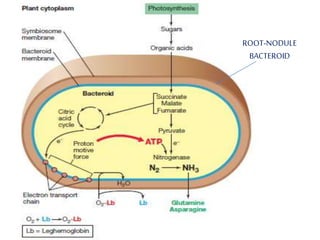
ROOT-NODULE
BACTEROID
Synthesis Of Amino Acid
It was thought that bacteria and higher plants assimilate ammonia
into glutamate via the GDH pathway, as in certain fungi and yeasts.
NH3 + 2-oxoglutarate + NADPH + H+ <---> glutamate + NADP+
An alternative pathway of ammonia assimilation [involving glutamine
synthetase (GS) [ and an NADPH-dependent glutamine:2-oxoglutarate
amidotransferase (GOGAT), must be operating when ammonia is
present in the growth medium at low levels.
NH3 + glutamate + ATP ---> glutamine + ADP + Pi
glutamine + 2-oxoglutarate + NADPH + H+ ---> 2 glutamate + NADP+
Nodule Senescence
 Eventually nodules age and decay.
 Their life span is largely determined by four factors: the physiological
condition of the legume, the moisture content of the soil, the presence of
any parasites, and the strain of rhizobia forming the nodule.
 As the plant puts more energy into seed production, the nitrogen-fixing
activity of the bacteroids decreases.
 Eventually the nodules stop functioning and disintegrate, releasing
bacteroids into the soil.
 These rhizobia may survive and infect new plants during the next cropping
season.
Nodules on Groundnut Soyabean Bengal gram
Clover Guar
Nod Genes, Nod Proteins and Nod Factors
Rhizobial genes that direct the steps in nodulation of a legume are called nod
genes.
Horizontal transfer of such genes as nod and nif that are located on plasmids or
transferable regions of chromosomal DNA has taken place.
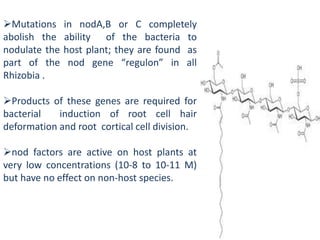
The nodABC genes encode proteins that produce oligosaccharides called nod
factors; these induce root hair curling and trigger cell division in the pea plant,
eventually leading to formation of the nodule.
Nod factors consist of a backbone of N-acetylglucosamine to which various
substituents are bonded.
The structure of the nod factor determines which plants a given rhizobial species
can infect.
Each Cross-inoculation group contains
nod genes that encode proteins that
chemically modify the nod factor backbone
to form its species-specific molecule.
nodD encodes the regulatory protein
NodD, which controls transcription of other
nod genes.
After interacting with inducer molecules,
NodD promotes transcription and is thus a
positive regulatory protein.
NodD inducers are plant flavonoids,
organic molecules that are widely excreted
by plants
Luteolin
(nodD gene
expression inducer)
Genistein
(nodD gene
expression
inhibitor)
Flavonoids
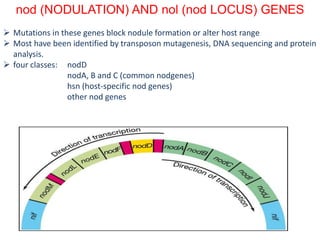
nod (NODULATION) AND nol (nod LOCUS) GENES
 Mutations in these genes block nodule formation or alter host range
 Most have been identified by transposon mutagenesis, DNA sequencing and protein
analysis.
 four classes: nodD
nodA, B and C (common nodgenes)
hsn (host-specific nod genes)
other nod genes
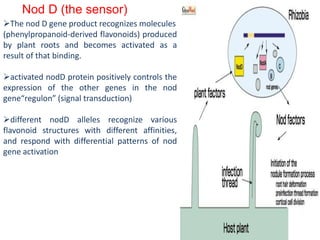
Nod D (the sensor)
The nod D gene product recognizes molecules
(phenylpropanoid-derived flavonoids) produced
by plant roots and becomes activated as a
result of that binding.
activated nodD protein positively controls the
expression of the other genes in the nod
gene“regulon” (signal transduction)
different nodD alleles recognize various
flavonoid structures with different affinities,
and respond with differential patterns of nod
gene activation
Mutations in nodA,B or C completely
abolish the ability of the bacteria to
nodulate the host plant; they are found as
part of the nod gene “regulon” in all
Rhizobia .
Products of these genes are required for
bacterial induction of root cell hair
deformation and root cortical cell division.
nod factors are active on host plants at
very low concentrations (10-8 to 10-11 M)
but have no effect on non-host species.
Host-specific nod genes
Mutations in these genes elicit abnormal root reactions on their usual
hosts, and sometimes elicit root hair deformation reactions on plants
that are not usually hosts.
loss of nodH function in R. meliloti results in synthesis of a nod factor
that is no longer effective on alfalfa but has gained activity on vetch.
The role of the nodH gene product is therefore to add a specific
sulfate group, and thereby change host specificity.
May be involved in the attachment of the bacteria to the plant
surface, or in export of signal molecules.
exo (EXOPOLYSACCHARIDE) GENES
Exopolysaccharides may provide substrate for signal production,
osmotic matrix needed during invasion, and/or a recognition or
masking function during invasion.
In Rhizobium-legume interactions leading to indeterminate nodules,
exo mutants cannot invade the plant properly. They do provoke the
typical plant cell division pattern and root deformation, leading to
nodule formation, although these are often empty (no bacteroids).
In interactions that usually produce determinate nodules, exo
mutations tend to have no effect on the process.
nif (NITROGEN FIXATION) GENES
 Gene products required for symbiotic nitrogen fixation, and for
nitrogen fixation in free-living N-fixing species.
 Example: subunits of Nitrogenase
fix (FIXATION) GENES
Gene products required to successfully establish a functional N-fixing
nodule.
Regulatory proteins that monitor and control oxygen levels within the
bacteroids.
EXAMPLE: FixL senses the oxygen level; at low oxygen tensions, it acts
as a kinase on FixJ, which regulates expression of two more
transcriptional regulators:
NifA, the upstream activator of nif and some fix genes; FixK, the
regulator of fixN
Low oxygen tension activates nif gene transcription and permits the
oxygen-sensitive nitrogenase to function.
Rhizobium ppt

Rhizobium ppt

  • 1.
    Sujata N. Dandale Ph.D(Plant Pathology) Deptt. of Plant Pathology PGI,Dr. P.D.K.V., Akola
  • 2.
  • 3.
    Role of nitrogenin plants » Major substance in plants next to water. » Building blocks. » Constituent element of » Chlorophyll » Cytochromes » Alkaloids » Many vitamins » Plays important role in metabolism, growth, reproduction and heredity.
  • 4.
    Sources of nitrogen •Atmospheric Nitrogen – 78% of atmosphere – Plants cannot utilize this form – Some Bacteria, Blue Green Algae, leguminous plants • Nitrates, Nitrites and Ammonia – Nitrate is chief form • Amino acids in the soil – Many soil organisms use this form – Higher plants can also taken by higher plants • Organic Nitrogenous compounds in insects – Insectivorous plants
  • 5.
    Nitrogen fixation • Theconversion of free nitrogen into nitrogenous salts to make it available for absorption of plants
  • 6.
    Types of nitrogenfixation Nitrogen fixation Non biological Biological Non - symbiotic Symbiotic
  • 7.
    Non biological fixation •The micro-organisms do not take place • Found in rainy season during lightning 1. N2 + O2 lightning 2 NO (Nitric oxide) 2. 2NO + O2 oxidation 2NO2 ( Nitrogen per oxide) 3. 2NO2 + H2O HNO2 + HNO3 4. 4NO2 + 2H2O + O2 4HNO3 (Nitric acid) 5. CaO + 2HNO3 Ca (NO3)2 + H2O (Calcium nitrate) 6. HNO3 + NH3 NH4NO3 (Ammonium nitrate) 7. HNO2 + NH3 NH4NO2 (Ammonium nitrite)
  • 8.
    Biological fixation • Fixationof atmospheric Nitrogen into nitrogenous salts with the help of micro- organisms • Two types – Symbiotic – Non-symbiotic
  • 9.
    Non-symbiotic o Fixation carriedout by free living micro- organisms o Aerobic, anaerobic and blue green algae o Bacteria: special type (nitrogen fixing bacteria) types - oFree living aerobic : Azotobacter, Beijerenckia oFree living anaerobic : Clostridium. oFree living photosynthetic : Chlorobium. Rhodopseudomonas oFree living chemosynthetic :Desulfovibro,Thiobacillus
  • 10.
    Contd.. o Free livingfungi: yeasts and Pillularia o Blue green algae: o unicellular – Gloeothece, Synechococcus o Filamentous (non heterocystous) -Oscillatoria o Filamentous (heterocystous) – Tolypothrix, Nostoc, Anabaena
  • 11.
    Symbiotic • Fixation offree nitrogen by micro-organisms in soil living symbiotically inside the plants • ‘Symbiosis’ – coined by DeBary • Three categories – Nodule formation in leguminous plants – Nodule formation in non-leguminous plants – Non nodulation
  • 12.
    Nodule formation inleguminous plants • 2500 spp. Of family leguminosae ( Cicer arientium, Pisum, Cajanus, Arachis) produce root nodules with Rhizobium spp. • They fix Nitrogen only inside the root nodules • Association provides-food and shelter to bacteria -bacteria supply fixed nitrogen to plant • Nodules may buried in soil even after harvesting – continue nitrogen fixation
  • 13.
    Nodule formation innon- leguminous plants • Some other plants also produces root nodules – Causuarina equisetifolia – Frankia – Alnus – Frankia – Myrica gale – Frankia – Parasponia – Rhizobium • Leaf nodules are also noted – Dioscorea, Psychotria • Gymnosperms – root – Podocarpus, - leaves – Pavetta zinumermanniana, Chomelia
  • 14.
    Non-nodulation • Lichens -cyanobacteria • Anthoceros - Nostoc • Azolla – Anabaena azollae • Cycas – Nostoc and anabaene • Gunnera macrophylla - Nostoc • Digitaria, Maize and Sorghum – Spirillum notatum • Paspalum notatum – Azotobacter paspali
  • 15.
    Symbiotic nitrogen fixation •Small, knob-like protuberances-root nodules • Size and shape varies • Spherical, flat, finger-like or elongated • From Pin head to one centimeter in size • Various spp. Of Rhizobium noted • Named after the host plant – Pea – Rhizobium leguminosarum – Beans – R. phaseoli – Soyabeans – R. japonicum – Lupins – R. lupini • Two types of Rhizobium- – Bradyrhizobium – slow growing spp. – Rhizobium - fast growing spp.
  • 16.
    RHIZOBIUM (root living) •Gram negative • Non spore forming • Micro-aerobic • Show a degree of specificity • The two partners (Bacteria and Host) recognized by chemical substance LECTINS - phytoagglutinins (carbohydrate containing plant protein)
  • 17.
    Formation of rootnodules in legumes • Root nodules formed due to infection of Rhizobium • Free living bacteria growing near root of legumes unable to fix nitrogen in free condition • Roots of the legumes secrete some growth factors helps in fast multiplication of bacteria • (E.g.) Pisum sativum secretes homo serine also carbohydrate containing protein Lectins over their surface
  • 18.
    • This helpsin recognition and attachment of rhizobial cells • Rhizobial cells have carbohydrate receptor on their surface • Lectins interact with the carbohydrate receptor of rhizobial cells • Occur between root hairs and young root hair • Bacteria enter the roots through soft infected root hairs • Tips are deformed and curved • Tubular infection thread is formed in the root hair cell and bacteria enters into it
  • 22.
    Contd.. • After entry,new cell wall is formed • Tubular infection contains mucopolysaccharides where bacteria embedded and start multiplication • It grows much and reaches the inner layers of cortex and the bacteria is released • It induces the cortical cells to multiply which result in the formation of nodule on the surface • The bacterial cells multiplies and colonize in the multiplying host cells
  • 23.
    • After hostcells are completely filled, bacterial cells becomes dormant-bacteroids • Float in leghaemoglobin – reddish pigment in cytoplasm of host cells - Efficient O2 scavenger - Maintains steady state of oxygen - Stimulates ATP production • Present studies indicates that leghaemoglobin is not essential • Nitrogenous compounds synthesized is translocated through vascular tissues • Groups of rhizobia surrounded by double membrane originated from host cell wall • Bacteroids lack firm wall (osmotically liable)
  • 24.
    Biochemistry of Nitrogenfixation • Basic requirements for Nitrogen fixation • Nitrogenase and hydrogenase enzyme • Protective mechanism against Oxygen • Ferrodoxin • Hydrogen releasing system or electron donor (Pyruvic acid or glucose/sucrose) • Constant supply of ATP • Coenzymes and cofactors -TPP, CoA, inorganic phosphate and Mg+2 • Cobalt and Molybdenum • A carbon compound
  • 25.
    Nitrogenase enzyme • Playskey role • Active in anaerobic condition • Made up of two protein subunits • Non heme iron protein ( Fe-protein or dinitrogen reductase) • Iron molybdenum protein (Mo Fe-protein or dinitrogenase) • Fe protein reacts with ATP and reduces second subunit which ultimately reduces N2 into ammonia N2 + 6H+ + 6e- 2NH3
  • 26.
    Contd.. • The reductionof N2 into NH3 requires 6 protons and 6 electrons • 12 mols of ATP required • One pair of electron requires 4 ATP • The modified equation N2 + 8H+ + 8e- 2NH3 + H2 • Hydrogen produced is catalyzed into protons and electrons by hydrogenase hydrogenase H2 2H+ + 2e-
  • 27.
    Pathway of nitrogenfixation in root nodules • Glucose-6-phosphate acts as a electron donor • Glucose-6-phosphate is converted to phosphogluconic acid Glucose-6-phosphate + NADP+ + H2O 6- phosphogluconic acid + NADPH + H+ • NADPH donates electrons to ferrodoxin. Protons released and ferrodoxin is reduced • Reduced ferrodoxin acts as electron carrier. Donate electron to Fe-protein to reduce it. Electrons released from ferrodoxin thus oxidized Sucrose (synthesized in leaves) Sucrose ( in roots ) Glucose and fructose Glucose-6- phosphate
  • 28.
    Contd.. • Reduced Fe-proteincombines with ATP in the presence of Mg +2 • Second sub unit is activated and reduced • It donates electrons to N2 to NH3 • Enzyme set free after complete reduction of N2 to NH3 Mo – N=NH Mo=N-NH2 MoΞN+NH3 Mo + NH3 NΞN Mo-NΞN
  • 29.
    Nitrogenase actually consistsof two proteins that work in tandem: the iron (Fe) protein and the molybdenum-iron (MoFe) protein. During the catalytic reduction of dinitrogen, the electrons are transferred from the Fe-protein to the MoFe-protein. Nitrogenase is extremely sensitive to oxygen. Root nodules of nitrogen‐fixing plants contain the oxygen‐binding protein, leghemoglobin, which protects nitrogenase by binding molecular oxygen.
  • 30.
    Rhizobium is agenus of Gram negative soil bacteria that fix nitrogen.Rhizobium forms an endosymbiotic nitrogen fixing association with roots of legumes and Parasponia.
  • 31.
    The bacteria colonizeplant cells within root nodules where they convert atmospheric nitrogen into ammonia and then provide organic nitrogenous compounds such as glutamine or ureides to the plant. The plant in turn provides the bacteria with organic compounds made by photosynthesis. This mutually beneficial relationship is true of all of the rhizobia, of which the Rhizobium genus is a typical example.
  • 32.
    Kingdom: Bacteria Phylum: Proteobacteria Class:Alphaproteobacteria Order: Rhizobiales Family: Rhizobiaceae Genus: Rhizobium Frank 1889 Beijerinck in the Netherlands was the first to isolate and cultivate a microorganism from the nodules of legumes in 1888. He named it Bacillus radicicola, which is now placed in Bergey's Manual of Determinative Bacteriology under the genus Rhizobium.
  • 33.
    Culture of Rhizobiumon agar plate
  • 34.
    Rhizobia are nitrogen-fixingbacteria that form root nodules on legume plants. Most of these bacterial species are in the Rhizobiacae family in the alpha- proteobacteria and are in either the Rhizobium, Mesorhizobium, Ensifer, or Bradyrhizobium genera. However recent research has shown that there are many other rhizobial species in addition to these. In some cases these new species have arisen through lateral gene transfer of symbiotic genes. The list below is not 'official' by any means, and it is merely my compilation and interpretation of the literature. An alternative list is maintained by the "ICSP Subcommittee on the taxonomy of Rhizobium and Agrobacterium".
  • 35.
    Class: Alphaproteobacteria Order: Rhizobiales Family:Rhizobiaceae Rhizobium alamii Rhizobium freirei Rhizobium alkalisoli Rhizobium galegae Rhizobium azibense Rhizobium gallicum Rhizobium calliandrae Rhizobium giardinii Rhizobium cauense Rhizobium grahamii Rhizobium cellulosilyticum Rhizobium hainanense Rhizobium daejeonense Rhizobium halophytocola Rhizobium endophyticum Rhizobium herbae Rhizobium etli Rhizobium huautlense Rhizobium fabae Rhizobium indigoferae The genus Rhizobium (Frank 1889) was the first named (from Latin meaning 'root living'), and for many years this was a 'catch all' genus for all rhizobia. Some species were later moved in to new genera based on phylogenetic analyses. It currently consists of 49 rhizobial species (and 11 non rhizobial species).
  • 36.
    Rhizobium jaguaris Rhizobiumphaseoli Rhizobium laguerreae Rhizobium pisi Rhizobium leguminosarum Rhizobium tibeticum Rhizobium leucaenae Rhizobium sophorae Rhizobium loessense Rhizobium sophoriradicis Rhizobium lusitanum Rhizobium sphaerophysae Rhizobium mayense Rhizobium sullae Rhizobium mesoamericanum Rhizobium taibaishanense Rhizobium mesosinicum Rhizobium tropici Rhizobium miluonense Rhizobium tubonense Rhizobium mongolense Rhizobium undicola Rhizobium multihospitium Rhizobium vallis Rhizobium oryzae Rhizobium vignae Rhizobium paranaense Rhizobium yanglingense Rhizobium petrolearium
  • 37.
    Class: Alphaproteobacteria Order: Rhizobiales Family:Phyllobacteriaceae The genus Mesorhizobium was described by Jarvis et al. in 1997. Several Rhizobium species were transferred to this genus. It currently consists of 21 rhizobia species (and 1 non-rhizobial species). Mesorhizobium abyssinicae Mesorhizobium chacoense Mesorhizobium albiziae Mesorhizobium ciceri Mesorhizobium alhagi Mesorhizobium erdmanii Mesorhizobium amorphae Mesorhizobium gobiense Mesorhizobium australicum Mesorhizobium hawassense Mesorhizobium camelthorni Mesorhizobium huakuii Mesorhizobium caraganae Mesorhizobium jarvisii
  • 38.
    Mesorhizobium loti Mesorhizobiumshangrilense Mesorhizobium mediterraneum Mesorhizobium shonense Mesorhizobium metallidurans Mesorhizobium silamurunense Mesorhizobium muleiense Mesorhizobium septentrionale Mesorhizobium opportunistum Mesorhizobium tamadayense Mesorhizobium plurifarium Mesorhizobium tarimense Mesorhizobium qingshengii Mesorhizobium temperatum Mesorhizobium robiniae Mesorhizobium tianshanense Mesorhizobium sangaii
  • 39.
    class: Alphaproteobacteria order: Rhizobiales family:Rhizobiaceae The Sinorhizobium genus was described by Chen et al. in 1988. However some recent studies show that Sinorhizobium and the genus Ensifer (Casida, 1982) belong to a single taxon. Ensiferis the earlier heterotypic synonym (it was named first) and thus takes priority (Young, 2003). This means that all Sinorhizobium spp. must be renamed as Ensifer spp. according to the Bacteriological code. There has been some discussion in the literature if Ensifer or Sinorhizobium is correct Young (2010), this website follows the opinion of the Judicial Commission, and will use Ensifer. The genus currently consists of 17 species.
  • 40.
    Ensifer abri Ensifermeliloti Sinorhizobium americanum Ensifer mexicanus Ensifer arboris 'Sinorhizobium morelense' Ensifer fredii Ensifer adhaerens Ensifer garamanticus Ensifer numidicus Ensifer indiaense Ensifer saheli Ensifer kostiensis Ensifer sojae Ensifer kummerowiae Ensifer terangae Ensifer medicae
  • 41.
    class: Alphaproteobacteria order: Rhizobiales family:Bradyrhizobiaceae The Bradyrhizobium genus was described by Jordan in 1982. It currently consists of 9 rhizobia species (and 1 non rhizobial species). Bradyrhizobium canariense Bradyrhizobium japonicum Bradyrhizobium cytisi Bradyrhizobium jicamae Bradyrhizobium denitrificans Bradyrhizobium liaoningense Bradyrhizobium elkanii Bradyrhizobium pachyrhizi Bradyrhizobium iriomotense Bradyrhizobium yuanmingense
  • 42.
    class: Betaproteobacteria order: Burkholderiales family:Burkholderiaceae The Burkholderia genus currently contains seven named rhizobial members and others as Burkholderia sp. Burkholderia caribensis Burkholderia cepacia Burkholderia mimosarum Burkholderia nodosa Burkholderia phymatum Burkholderia sabiae Burkholderia tuberum
  • 43.
    class: Alphaproteobacteria order: Rhizobiales family:Phyllobacteriaceae The Phyllobacterium genus currently contains three rhizobial species. Phyllobacterium trifolii Phyllobacterium ifriqiyense Phyllobacterium leguminum
  • 44.
    class: Alphaproteobacteria order: Rhizobiales family:Methylobacteriaceae The Azorhizobium genus was described by Dreyfus et al. in 1988. It currently consists of 2 species. Azorhizobium caulinodans Azorhizobium doebereinerae
  • 45.
    class: Alphaproteobacteria order: Rhizobiales family:Brucellaceae The Ochrobactrum genus currently contains two rhizobial species. Ochrobactrum cytisi Ochrobactrum lupini
  • 46.
    class: Alphaproteobacteria order: Rhizobiales family:Methylobacteriaceae Methylobacterium nodulans class: Betaproteobacteria order: Burkholderiales family: Burkholderiaceae Cupriavidus taiwanensis
  • 47.
    class: Alphaproteobacteria order: Rhizobiales family:Hyphomicrobiaceae Devosia neptuniae class: Alphaproteobacteria order: Rhizobiales family: Rhizobiacea Shinella kummerowiae
  • 48.
    Root nodules occuron the roots of plants (primarily Fabaceae) that associate with symbiotic nitrogen-fixing bacteria. Undernitrogen-limiting conditions, capable plants form a symbiotic relationship with a host-specific strain of bacteria known as rhizobia. This process has evolved multiple times within the Fabaceae, as well as in other species found within the Rosidclade. The Fabaceae include legume crops such as beans and peas. Within legume nodules, nitrogen gas from the atmosphere is converted into ammonia, which is then assimilated into amino acids (the building blocks of proteins), nucleotides (the building blocks of DNA and RNA as well as the important energy molecule ATP), and other cellular constituents such as vitamins, flavones, and hormones.
  • 49.
    Cross section thougha soybean (Glycine max'Essex') root nodule. The bacterium, Bradyrhizobium japonicum, colonizes the roots and establishes a nitrogen fixing symbiosis. This high magnification image shows part of a cell with single bacteroids within their symbiosomes. In this image, endoplasmic reticulum, dictysome and cell wall can be seen.
  • 50.
    Their ability tofix gaseous nitrogen makes legumes an ideal agricultural organism as their requirement for nitrogen fertilizer is reduced. Indeed high nitrogen content blocks nodule development as there is no benefit for the plant of forming the symbiosis. The energy for splitting the nitrogen gas in the nodule comes from sugar that is translocated from the leaf (a product of photosynthesis). Malate as a breakdown product of sucrose is the direct carbon source for the bacteroid. Nitrogen fixation in the nodule is very oxygen sensitive. Legume nodules harbor an iron containing protein called leghaemoglobin, closely related to animal myoglobin, to facilitate the conversion of nitrogen gas to ammonia.
  • 51.
    Legume family Plants thatcontribute to nitrogen fixation include the legume family – Fabaceae – with taxa such as kudzu, clovers, soybeans, alfalfa, lupines, peanuts, and rooibos. They contain symbiotic bacteria called rhizobia within the nodules, producing nitrogen compounds that help the plant to grow and compete with other plants. When the plant dies, the fixed nitrogen is released, making it available to other plants and this helps to fertilize the soil. The great majority of legumes have this association, but a few genera (e.g.,Styphnolobium) do not. In many traditional and organic farming practices, fields are rotated through various types of crops, which usually includes one consisting mainly or entirely of clover or buckwheat (non-legume family Polygonaceae), which are often referred to as "green manure". Inga alley farming relies on the leguminous genus Inga, a small tropical, tough- leaved, nitrogen-fixing tree.[4]
  • 52.
    Non-leguminous Although by farthe majority of plants able to form nitrogen-fixing root nodules are in the legume family Fabaceae, there are a few exceptions: •Parasponia, a tropical genus in the Cannabaceae also able to interact with rhizobia and form nitrogen-fixing nodules •Actinorhizal plants such as alder and bayberry can also form nitrogen-fixing nodules, thanks to a symbiotic association with Frankiabacteria. These plants belong to 25 genera distributed among 8 plant families. The ability to fix nitrogen is far from universally present in these families. For instance, of 122 genera in the Rosaceae, only 4 genera are capable of fixing nitrogen. All these families belong to the orders Cucurbitales, Fagales, and Rosales, which together with the Fabales form a clade of eurosids. A sectioned alder tree root nodule.
  • 53.
    Two main typesof nodule have been described: determinate and indeterminate. Determinate nodules are found on certain tribes of tropical legume such as those of the genera Glycine (soybean), Phaseolus (common bean), and Vigna. and on some temperate legumes such as Lotus. These determinate nodules lose meristematic activity shortly after initiation, thus growth is due to cell expansion resulting in mature nodules which are spherical in shape. Another types of determinate nodule is found in a wide range of herbs, shrubs and trees, such as Arachis (peanut). These are always associated with the axils of lateral or adventitious roots and are formed following infection via cracks where these roots emerge and not using root hairs. Their internal structure is quite different from those of the soybean type of nodule.
  • 54.
    Determinate Nodules Formed ontropical legumes by Rhizobium and Bradyrhizobium Meristematic activity not persistent - present only during early stage of nodule formation; after that, cells simply expand rather than divide, to form globose nodules. Nodules arise just below epidermis; largely internal vascular system. Uninfected cells dispersed throughout nodule; quipped to assimilate NH4+ as ureides (allantoin and allantoic acid)
  • 55.
    Indeterminate nodules arefound in the majority of legumes from all three sub-families, whether in temperate regions or in the tropics. They can be seen in papilioinoid legumes such as Pisum (pea), Medicago (alfalfa), Trifolium (clover), and Vicia (vetch) and all mimosoid legumes such as acacias (mimosas), the few nodulated caesalpinioid legumes such as partridge pea they earned the name "indeterminate" because they maintain an active apical meristem that produces new cells for growth over the life of the nodule. This results in the nodule having a generally cylindrical shape, which may be extensively branched. Because they are actively growing, indeterminate nodules manifest zones which demarcate different stages of development/symbiosis.
  • 56.
    Formed on temperatelegumes (pea, clover, alfalfa); typically by Rhizobium spp. Cylindrical nodules with a persistent meristem; nodule growth creates zones of different developmental Stages Nodule arises near endodermis, and nodule vasculature clearly connected with root vascular system Uninfected cells of indeterminate nodules assimilate NH4+ as amides (asparagine, glutamine) Indeterminate Nodules
  • 57.
    Diagram illustrating thedifferent zones of an indeterminate root nodule
  • 58.
    Zone I—the activemeristem. This is where new nodule tissue is formed which will later differentiate into the other zones of the nodule. Zone II—the infection zone. This zone is permeated with infection threads full of bacteria. The plant cells are larger than in the previous zone and cell division is halted. Interzone II–III—Here the bacteria have entered the plant cells, which contain amyloplasts. They elongate and begin terminally differentiating into symbiotic, nitrogen-fixing bacteroids. Zone III—the nitrogen fixation zone. Each cell in this zone contains a large, central vacuole and the cytoplasm is filled with fully differentiated bacteroids which are actively fixing nitrogen. The plant provides these cells with leghemoglobin, resulting in a distinct pink color.
  • 59.
    Zone IV—the senescentzone. Here plant cells and their bacteroid contents are being degraded. The breakdown of the heme component of leghemoglobin results in a visible greening at the base of the nodule. This is the most widely studied type of nodule, but the details are quite different in nodules of peanut and relatives and some other important crops such as lupins where the nodule is formed following direct infection of rhizobia through the epidermis and where infection threads are never formed. Nodules grow around the root, forming a collar-like structure. In these nodules and in the peanut type the central infected tissue is uniform, lacking the uninfected ells seen in nodules of soybean and many indeterminate types such as peas and clovers.
  • 61.
    Nodulation is controlledby a variety of processes, both external (heat, acidic soils, drought, nitrate) and internal (autoregulation of nodulation, ethylene). Autoregulation of nodulation controls nodule numbers per plant through a systemic process involving the leaf. Leaf tissue senses the early nodulation events in the root through an unknown chemical signal, then restricts further nodule development in newly developing root tissue. The Leucine rich repeat (LRR) receptor kinases (NARK in soybean (Glycine max); HAR1 in Lotus japonicus, SUNN in Medicago truncatula) are essential for autoregulation of nodulation (AON). Mutation leading to loss of function in these AON receptor kinases leads to supernodulation or hypernodulation. Often root growth abnormalities accompany the loss of AON receptor kinase activity, suggesting that nodule growth and root development are functionally linked. Investigations into the mechanisms of nodule formation showed that theENOD40 gene, coding for a 12–13 amino acid protein [41], is up-regulated during nodule formation [3].
  • 62.
    Fast-growing Rhizobium spp.whose nodulation functions(nif, fix) are encoded on their symbiotic megaplasmids (pSym) Slow-growing Bradyrhizobium spp. whose N-fixationand nodulation functions are encoded on their chromosome.
  • 63.
    Process of NoduleFormation  Recognition of the correct partner by both plant and bacterium and attachment of the bacterium to the root hairs.  Secretion of oligosaccharide signaling molecules (nod factors) by the bacterium.  Bacterial invasion of the root hair. Movement of bacteria to the main root by way of the infection thread.  Formation of modified bacterial cells (bacteroids) within the plant cells and development of the N2-fixing state. Continued plant and bacterial cell division, forming the mature root nodule.
  • 64.
    The roots oflegumes secrete organic compounds that stimulate the growth of a diverse rhizosphere microbial community. If rhizobia of the correct cross-inoculation group are in soil, they form large populations and attach to the root hairs extending from the roots of the plant. An adhesion protein called rhicadhesin is present on the cell surfaces of rhizobia. Other substances, such as carbohydrate-containing proteins called lectins and specific receptors in the plant cytoplasmic membrane, also play roles in plant–bacterium attachment.
  • 65.
    After attaching, acell penetrates into the root hair, which curls in response to substances excreted by the bacterium. The bacterium then induces formation of a cellulosic tube, called the infection thread, by the plant. Root cells adjacent to the root hairs subsequently become infected by rhizobia, and plant cells divide. Continued plant cell division forms the tumor -like nodule.
  • 66.
    Nodule Development  Asthese and other tissues develop, the root begins to swell and the nodule becomes visible.  In the field, nodules are visible within 21 to 28 days from emergence of the plant.  The time from planting to the appearance of nodules varies depending on plant growth and availability of mineral nitrogen in the soil.  Nodules differ in shape, size, color, texture, and location. Their shape and location depend largely on the host legume.
  • 67.
    Nodule Function The rhizobiamultiply rapidly within the plant cells and become transformed into swollen, misshapen, and branched cells called bacteroids. A microcolony of bacteroids becomes surrounded by parts of the plant cytoplasmic membrane to form a structure called the symbiosome , and only after it forms does N2 fixation begin. The bacteroids produce the enzyme nitrogenase. The ammonia attaches to a compound provided by the plant, forming amino acids. These amino acids move out of the nodule to other parts of the plant where they undergo further changes.  It is estimated that the legume-rhizobia symbiosis requires about 10 kg of carbohydrates for each kg of N2 fixed.  Energy-expensive.
  • 68.
  • 69.
    Synthesis Of AminoAcid It was thought that bacteria and higher plants assimilate ammonia into glutamate via the GDH pathway, as in certain fungi and yeasts. NH3 + 2-oxoglutarate + NADPH + H+ <---> glutamate + NADP+ An alternative pathway of ammonia assimilation [involving glutamine synthetase (GS) [ and an NADPH-dependent glutamine:2-oxoglutarate amidotransferase (GOGAT), must be operating when ammonia is present in the growth medium at low levels. NH3 + glutamate + ATP ---> glutamine + ADP + Pi glutamine + 2-oxoglutarate + NADPH + H+ ---> 2 glutamate + NADP+
  • 71.
    Nodule Senescence  Eventuallynodules age and decay.  Their life span is largely determined by four factors: the physiological condition of the legume, the moisture content of the soil, the presence of any parasites, and the strain of rhizobia forming the nodule.  As the plant puts more energy into seed production, the nitrogen-fixing activity of the bacteroids decreases.  Eventually the nodules stop functioning and disintegrate, releasing bacteroids into the soil.  These rhizobia may survive and infect new plants during the next cropping season.
  • 72.
    Nodules on GroundnutSoyabean Bengal gram Clover Guar
  • 73.
    Nod Genes, NodProteins and Nod Factors Rhizobial genes that direct the steps in nodulation of a legume are called nod genes. Horizontal transfer of such genes as nod and nif that are located on plasmids or transferable regions of chromosomal DNA has taken place. The nodABC genes encode proteins that produce oligosaccharides called nod factors; these induce root hair curling and trigger cell division in the pea plant, eventually leading to formation of the nodule. Nod factors consist of a backbone of N-acetylglucosamine to which various substituents are bonded. The structure of the nod factor determines which plants a given rhizobial species can infect.
  • 74.
    Each Cross-inoculation groupcontains nod genes that encode proteins that chemically modify the nod factor backbone to form its species-specific molecule. nodD encodes the regulatory protein NodD, which controls transcription of other nod genes. After interacting with inducer molecules, NodD promotes transcription and is thus a positive regulatory protein. NodD inducers are plant flavonoids, organic molecules that are widely excreted by plants Luteolin (nodD gene expression inducer) Genistein (nodD gene expression inhibitor) Flavonoids
  • 75.
    nod (NODULATION) ANDnol (nod LOCUS) GENES  Mutations in these genes block nodule formation or alter host range  Most have been identified by transposon mutagenesis, DNA sequencing and protein analysis.  four classes: nodD nodA, B and C (common nodgenes) hsn (host-specific nod genes) other nod genes
  • 76.
    Nod D (thesensor) The nod D gene product recognizes molecules (phenylpropanoid-derived flavonoids) produced by plant roots and becomes activated as a result of that binding. activated nodD protein positively controls the expression of the other genes in the nod gene“regulon” (signal transduction) different nodD alleles recognize various flavonoid structures with different affinities, and respond with differential patterns of nod gene activation
  • 77.
    Mutations in nodA,Bor C completely abolish the ability of the bacteria to nodulate the host plant; they are found as part of the nod gene “regulon” in all Rhizobia . Products of these genes are required for bacterial induction of root cell hair deformation and root cortical cell division. nod factors are active on host plants at very low concentrations (10-8 to 10-11 M) but have no effect on non-host species.
  • 78.
    Host-specific nod genes Mutationsin these genes elicit abnormal root reactions on their usual hosts, and sometimes elicit root hair deformation reactions on plants that are not usually hosts. loss of nodH function in R. meliloti results in synthesis of a nod factor that is no longer effective on alfalfa but has gained activity on vetch. The role of the nodH gene product is therefore to add a specific sulfate group, and thereby change host specificity. May be involved in the attachment of the bacteria to the plant surface, or in export of signal molecules.
  • 79.
    exo (EXOPOLYSACCHARIDE) GENES Exopolysaccharidesmay provide substrate for signal production, osmotic matrix needed during invasion, and/or a recognition or masking function during invasion. In Rhizobium-legume interactions leading to indeterminate nodules, exo mutants cannot invade the plant properly. They do provoke the typical plant cell division pattern and root deformation, leading to nodule formation, although these are often empty (no bacteroids). In interactions that usually produce determinate nodules, exo mutations tend to have no effect on the process.
  • 81.
    nif (NITROGEN FIXATION)GENES  Gene products required for symbiotic nitrogen fixation, and for nitrogen fixation in free-living N-fixing species.  Example: subunits of Nitrogenase
  • 83.
    fix (FIXATION) GENES Geneproducts required to successfully establish a functional N-fixing nodule. Regulatory proteins that monitor and control oxygen levels within the bacteroids. EXAMPLE: FixL senses the oxygen level; at low oxygen tensions, it acts as a kinase on FixJ, which regulates expression of two more transcriptional regulators: NifA, the upstream activator of nif and some fix genes; FixK, the regulator of fixN Low oxygen tension activates nif gene transcription and permits the oxygen-sensitive nitrogenase to function.