PLANT HORMONE :AUXIN
CONTENTS
• Introduction of plant hormones
• History of Auxin
• Structure of Auxin
• Biosynthesis of Auxin
• Mechanism of Auxin action
• Physiological effects of Auxin
Introduction
• Plant hormones :
Plant hormones are regulators
produced by plant which in low concentration
regulate a Physiological plant processes.
• Hormones usually move within plant form a site of
production to site of action.
• Thimann (1948) suggested using the term
“Phytohormone” for hormones of plant.
Classification
• It is accepted that there are two major classes of
plant hormones :
1.Growth Pramotors :Auxins
Cytokinins
Gibberellins
2.Growth Inhibitors : Ethylene
Abscisic Acid (ABA)
Jasmonic Acid
History
• Auxins were the first hormones discovered.
• Charles Darwin was among the first scientists to
dabble in plant hormone reaserch.
• In his book “The Power of Movement In Plants”
presented in 1980 .
• The term “Auxin” is derived from the greek word “to
increase or grow”.
• This was the first group of plant hormones
discovered.
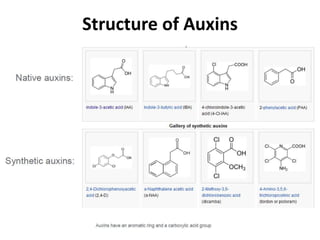
Structure of Auxins
Biosynthesis of Auxin
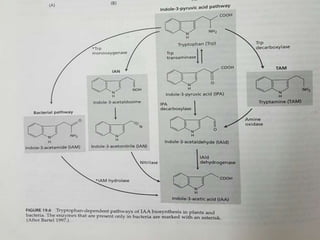
• There is a two pathways in Biosynthesis of
Auxin :
1.Tryptophan dependent pathway
-IPA Pathway
-TAM Pathway
-IAN Pathway
-Bacterial pathway
2.Tryptophan Independent pathway
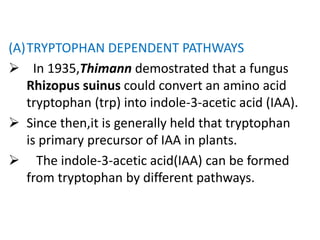
(A)TRYPTOPHAN DEPENDENT PATHWAYS
 In 1935,Thimann demostrated that a fungus
Rhizopus suinus could convert an amino acid
tryptophan (trp) into indole-3-acetic acid (IAA).
 Since then,it is generally held that tryptophan
is primary precursor of IAA in plants.
 The indole-3-acetic acid(IAA) can be formed
from tryptophan by different pathways.
a.IPA(Indole-3-pyruvic acid) pathway
Tryptophan is determinated to form indole-
3-pyruvic acid(IPA) followed by decarboxylate
of the latter resulting in the formation of
indole-3-acetaldehyde(Iald).
 The enzymes involved are tryptophan
transminase and indole pyruvate
decarboxylase.
 One of the above two methods (sometimes
both) is most common pathway of formation
of IAA in plants.
b.TAM(Tryptamine) pathway
Tryptophan is decarboxylated to form
tryptamine followed by deamination of the
latter resulting in the formation of indole-3-
acetaldehyde (Iald).
 The enzymes involved are tryptophan
decarboxylase and tryptamine oxidase
respectively.
 Iald is readily oxidised to indole-3-acetic acid
(IAA) by the enzyme Iald dehydrogenase.
c. IAN (Indole-3-acetonitrile) pathway
It occurs in some plants especially those
belonging to families Brassicaceae,Poaceae
and Musaceae.
 Tryptophan is converted into IAA in the
presence of the enzyme nitrilase.
 Indole-3-acetaldoxime and indole -3-
acetonitrile(IAN) are the intermidiates.
d. Bacterial pathway
In some pathogenic bacteria such as
Agrobacterium tumefaciens and Pseudomonas
savastanoi, tryptophan is first converted into
indole-3-acetamine (IAM) in the presence of
tryptophan monooxygenase.
 IAM is then hydrolysed to IAA in the presence of
the enzyme IAM hydrolyse.
 The auxin(IAA) produced in this way often
causes morphological changes in the host plant
cells.
(B) TRYPTOPHAN INDEPENDENT PATHWAYS
In recent years, experimental evidences for
the existance of tryptophan independent
pathways of IAA biosynthesis in higher plants
have been obtained from mutants of maize
and Arabidopsis (family Brassicaceae).
 The branch point for biosynthesis of IAA may
be either indole or indole-3-glycerol
phosphate with IAN and IPA as the possible
intermidiates.
However, neither the immediate precursor of
IAA in this pathway has yet been
identified,not relative importance of
tryptophan dependent and independent
pathways is clearly understood.
Mechanism action of auxin
• Auxin(IAA) causes wide range of physiological
effects in plants.
• Some of these effects such as cell elongation
in shoot occur in minutes in response to auxin
while others such as abscission occur in days
in response to auxin treatment.
• Most studies of auxin induced growth in
plants have been carried out on excised
sections of dicot stems(such as soyabean
hypocotyls and pea epicotyls).
• And coleoptile such as oat(Avena) and maize
coleoptile.
• But , in recent years auxin- induced growth has
also been demonstrated in intact auxin-deficient
mutants of pea.
• The target sites of auxin action in dicot stems are
the outer tissue including epidermis and outer
cortex.
• In coleoptile, all non vascular tissues
I.e.,epidermis and mesophyll are responsive to
auxin treatment.
1.Presence of auxin-binding receptor :
A possible auxin-binding receptor
protein has been identified in plants which is called
as auxin-binding protein 1 (ABP 1).
• This protein appers to be a dimer made of two
polypeptides of about 22 kD each.
• ABP 1 is located in lumen of endoplasmic
reticulum(ER) , but it is belived to be active on
surface cell.
2.Minimum lag time for auxin induced growth
is 10 minutes :
When coleoptile or stem sections
are excised and placed in sensitive growth
measuring device, the growth response to
auxin can be measured with high degree of
precision.
• If auxin is absent in the medium, the growth
rate declines rapidly.
• Addition of auxin on the other hand, markedly
stimulates growth rate (measured in terms of
elongation or % increase in length) after a lag
period of 10-12 minutes only.
• In both types of tissues the maximum growth
is attained after half an hour to one hour of
auxin treatment.
3.Auxin causes Rapid increase in cell wall
Extensibility :
Cell wall enlargement in plants
involves two steps ,(1)Osmatic uptake of water
across the plasma membrane resulting in
increased turgor pressure of the cell and
(2)Extension of cell wall in response to increased
turgor pressure.
• It is generally believed that auxin causes an
increase in plastic(i.e.,irreversible) extensibility of
the cell wall by wall loosening events that require
continuous input of metabolic energy.
4.Auxin –Induced oroton (H+) extrusion
acidifies the cell wall , resulting in wall
loosening-the acid growth hypothesis :
Rayle and Cleland (1970) in USA and
Hager,Manzel and Cross (1971) in Germany
first proposed independently that protons(H+)
may be involved in Auxin-induced cell wall
loosening.
• Auxin causes responsive cells to extrude
protons(H+ ions) actively from cytoplasm to
cell wall resulting in decrease of cell wall pH.
• The law apoplastic pH activates cell wall
loosening enzymes which break the load-bearing
bounds, thus increasing extensibility of the cell
wall and the extrusion of protons is faciliated by
H+- ATPases located in plasma-membrane.
• 5.Acid induced wall loosening is mediated by
specific proteins called expansins :
Previously,hydrolytic enzymes such as
celluloses,hemi-celluloses and pectinases were
considered as well loosening enzymes which
were activated by low pH during auxin-induced
growth.
• But, while these enzymes loosen cell walls
irreversibly , the auxin-induced growth is
reversible with metabolic inhibitors.
• Therefore, these hydrolytic enzymes are not
involved in wall-loosening during auxin-induced
growth.
• There are now compelling evidences to suggest
that a group of cell wall proteins called
expansions causes cell wall loosening in
response to acidic pH.
6.Auxin maintains the capacity for acid
induced wall loosening by synthesis of new
wall polysaccharides :
Auxin-induced Acidification and loosening
of cell walls is accompanied by biosynthesis of
new wall polysacchrides so that growth may
continue for longer period especially in
coleoptile.
Auxin is known to increase activites of certain
enzymes which are involved in biosynthesis of
cell wall polysacchrides.
• A constant supply of new cell materials
maintains the capacity for acid induced wall
loosening (CAWL) in response to auxin.
• Cell walls of sections treated with auxin have
grater capacity for acid stimulated growth
than these of control sections or sections
treated with fungal phytotoxin fusicoccin.
• Polysacchrides synthesis and CAWL do not
correlate well with rapid kinetics of growth
and are therefore, parts of long term growth
responses to auxin.
Physiological Effects Of Auxin
• The following points highlight the physiological
effects of auxin in plants.
1.Cell Elongation
2.Apical Dominance
3.Root Initiation
4.Prevention of Abscission
5.Parthenocarpy
6.Respiration
7.Callus Formation
8.Vascular Differentiation.
1.Cell Elongation
• The primary physiological effect of auxin in plants is
to stimulate the elongation of cells in shoot.
• A very common example of this can be observed in
phototropic curvatures where the unilateral light
unequally distributes the auxin in the stem tip
(i.e.,More auxin on shaded side that on illuminated
side).
• Many theories have been proposed to explain the
mechanism of cell elongation probably :
By reducing the wall pressure,
By increasing the permeability of cells to water,
By an increase in the wall synthesis and,
By inducing the synthesis of RNA and Protein which
turn lead to an increase in cell wall plasticity and
extension.
2.Apical Dominance
• Apical or terminal buds of many vascular plants are
very active while the lateral buds remain inactive.
• Removal of apical buds promotes lateral buds to
grow.
• Apical dominance is due to much higher auxin
content in the apical buds than lateral buds.
• Skoog and Thimann(1934) first pointed out that the
apical dominance might be under the control of
auxin produced at the terminal bud and which is
transported downward through the stem to the
Lateral buds and hinders their growth.
• They removed the apical bud of broad bean plant
and replaced it with agar block.
• This resulted in rapid growth of lateral buds.
• But ,when they replaced the apical bud with agar
block containing auxin lateral buds remained
suppressed and did not grow.
• It is now generally held that inhibitory effect of
auxin from shoot apex on lateral buds is not direct
but in indirect possibly through the involvement of
other growth hormones such as cytokinins & ABA.
3.Root Initiation
• In contrast to the stem,the higher concentration of
inhibits the elongation of root but the number of
lateral branch roots is considerably increased i.e.
the higher conc. of auxin initiates more lateral
branch roots.
• Application of IAA in lanolin paste to the cut end
of a young stem results is an early and extensive
rooting.
• This fact is of great practical importance and has
been widely utilised to promote root formation in
economically useful plants which are propagated
by cuttings.
4.Prevention of Abscission
• Natural auxins have controlling influence on the
abscission of leaves , fruits etc..
5.Parthenocarpy
• Auxin can induce the formation of parthenocarpic
fruits.
• In nature also,this phenomenon is not uncommon
and in such cases the concentration of auxins in
the ovaries has been found to be higher than in
the ovaries of plants which produce fruits only
after fertilization.
• In the latter cases, the concentration of the auxin
in ovaries increases after pollination and
fertilization.
6.Respiration
• It has been established that the auxin stimulates
respiration and there is a correlation between
auxin induced growth and an increased
respiration rate.
• According to French and Beevers (1953),the
auxin may increase the rate of respiration
indirectly though increased supply of
ADP(Adenosine diphosphate) by rapidly utilizing
the ATP in the expanding cells.
7.Callus Formation
• Besides cell elongation the auxin may also be
active in cell division.
• In fact,in many tissue cultures where the callus
growth is quite normal, the continued growth of
such callus takes place only after the addition of
auxin.
8.Vascular Difference
• Auxin induces vascular differentiation in plant.
• This has also been confirmed in tissue culture
experiments and form studies with transgenic
plants.
• Cytokinins are also known to participate in
differentiation of vascular tissues and it is belived
that vascular differentiation in plants is probably
under the control of both auxin and cytokinins.
Reference
• Fundamentals of Plant Physiology – V.K.JAIN.
• Figure Reference – TAIZ & ZEIGER
Thank you

Plant hormone auxin

  • 1.
  • 2.
    CONTENTS • Introduction ofplant hormones • History of Auxin • Structure of Auxin • Biosynthesis of Auxin • Mechanism of Auxin action • Physiological effects of Auxin
  • 3.
    Introduction • Plant hormones: Plant hormones are regulators produced by plant which in low concentration regulate a Physiological plant processes. • Hormones usually move within plant form a site of production to site of action. • Thimann (1948) suggested using the term “Phytohormone” for hormones of plant.
  • 4.
    Classification • It isaccepted that there are two major classes of plant hormones : 1.Growth Pramotors :Auxins Cytokinins Gibberellins 2.Growth Inhibitors : Ethylene Abscisic Acid (ABA) Jasmonic Acid
  • 5.
    History • Auxins werethe first hormones discovered. • Charles Darwin was among the first scientists to dabble in plant hormone reaserch. • In his book “The Power of Movement In Plants” presented in 1980 . • The term “Auxin” is derived from the greek word “to increase or grow”. • This was the first group of plant hormones discovered.
  • 6.
  • 7.
    Biosynthesis of Auxin •There is a two pathways in Biosynthesis of Auxin : 1.Tryptophan dependent pathway -IPA Pathway -TAM Pathway -IAN Pathway -Bacterial pathway 2.Tryptophan Independent pathway
  • 8.
    (A)TRYPTOPHAN DEPENDENT PATHWAYS In 1935,Thimann demostrated that a fungus Rhizopus suinus could convert an amino acid tryptophan (trp) into indole-3-acetic acid (IAA).  Since then,it is generally held that tryptophan is primary precursor of IAA in plants.  The indole-3-acetic acid(IAA) can be formed from tryptophan by different pathways.
  • 10.
    a.IPA(Indole-3-pyruvic acid) pathway Tryptophanis determinated to form indole- 3-pyruvic acid(IPA) followed by decarboxylate of the latter resulting in the formation of indole-3-acetaldehyde(Iald).  The enzymes involved are tryptophan transminase and indole pyruvate decarboxylase.  One of the above two methods (sometimes both) is most common pathway of formation of IAA in plants.
  • 11.
    b.TAM(Tryptamine) pathway Tryptophan isdecarboxylated to form tryptamine followed by deamination of the latter resulting in the formation of indole-3- acetaldehyde (Iald).  The enzymes involved are tryptophan decarboxylase and tryptamine oxidase respectively.  Iald is readily oxidised to indole-3-acetic acid (IAA) by the enzyme Iald dehydrogenase.
  • 12.
    c. IAN (Indole-3-acetonitrile)pathway It occurs in some plants especially those belonging to families Brassicaceae,Poaceae and Musaceae.  Tryptophan is converted into IAA in the presence of the enzyme nitrilase.  Indole-3-acetaldoxime and indole -3- acetonitrile(IAN) are the intermidiates.
  • 13.
    d. Bacterial pathway Insome pathogenic bacteria such as Agrobacterium tumefaciens and Pseudomonas savastanoi, tryptophan is first converted into indole-3-acetamine (IAM) in the presence of tryptophan monooxygenase.  IAM is then hydrolysed to IAA in the presence of the enzyme IAM hydrolyse.  The auxin(IAA) produced in this way often causes morphological changes in the host plant cells.
  • 14.
    (B) TRYPTOPHAN INDEPENDENTPATHWAYS In recent years, experimental evidences for the existance of tryptophan independent pathways of IAA biosynthesis in higher plants have been obtained from mutants of maize and Arabidopsis (family Brassicaceae).  The branch point for biosynthesis of IAA may be either indole or indole-3-glycerol phosphate with IAN and IPA as the possible intermidiates.
  • 15.
    However, neither theimmediate precursor of IAA in this pathway has yet been identified,not relative importance of tryptophan dependent and independent pathways is clearly understood.
  • 16.
    Mechanism action ofauxin • Auxin(IAA) causes wide range of physiological effects in plants. • Some of these effects such as cell elongation in shoot occur in minutes in response to auxin while others such as abscission occur in days in response to auxin treatment. • Most studies of auxin induced growth in plants have been carried out on excised sections of dicot stems(such as soyabean hypocotyls and pea epicotyls).
  • 17.
    • And coleoptilesuch as oat(Avena) and maize coleoptile. • But , in recent years auxin- induced growth has also been demonstrated in intact auxin-deficient mutants of pea. • The target sites of auxin action in dicot stems are the outer tissue including epidermis and outer cortex. • In coleoptile, all non vascular tissues I.e.,epidermis and mesophyll are responsive to auxin treatment.
  • 18.
    1.Presence of auxin-bindingreceptor : A possible auxin-binding receptor protein has been identified in plants which is called as auxin-binding protein 1 (ABP 1). • This protein appers to be a dimer made of two polypeptides of about 22 kD each. • ABP 1 is located in lumen of endoplasmic reticulum(ER) , but it is belived to be active on surface cell.
  • 19.
    2.Minimum lag timefor auxin induced growth is 10 minutes : When coleoptile or stem sections are excised and placed in sensitive growth measuring device, the growth response to auxin can be measured with high degree of precision. • If auxin is absent in the medium, the growth rate declines rapidly.
  • 20.
    • Addition ofauxin on the other hand, markedly stimulates growth rate (measured in terms of elongation or % increase in length) after a lag period of 10-12 minutes only. • In both types of tissues the maximum growth is attained after half an hour to one hour of auxin treatment.
  • 21.
    3.Auxin causes Rapidincrease in cell wall Extensibility : Cell wall enlargement in plants involves two steps ,(1)Osmatic uptake of water across the plasma membrane resulting in increased turgor pressure of the cell and (2)Extension of cell wall in response to increased turgor pressure. • It is generally believed that auxin causes an increase in plastic(i.e.,irreversible) extensibility of the cell wall by wall loosening events that require continuous input of metabolic energy.
  • 22.
    4.Auxin –Induced oroton(H+) extrusion acidifies the cell wall , resulting in wall loosening-the acid growth hypothesis : Rayle and Cleland (1970) in USA and Hager,Manzel and Cross (1971) in Germany first proposed independently that protons(H+) may be involved in Auxin-induced cell wall loosening. • Auxin causes responsive cells to extrude protons(H+ ions) actively from cytoplasm to cell wall resulting in decrease of cell wall pH.
  • 23.
    • The lawapoplastic pH activates cell wall loosening enzymes which break the load-bearing bounds, thus increasing extensibility of the cell wall and the extrusion of protons is faciliated by H+- ATPases located in plasma-membrane. • 5.Acid induced wall loosening is mediated by specific proteins called expansins : Previously,hydrolytic enzymes such as celluloses,hemi-celluloses and pectinases were considered as well loosening enzymes which were activated by low pH during auxin-induced growth.
  • 24.
    • But, whilethese enzymes loosen cell walls irreversibly , the auxin-induced growth is reversible with metabolic inhibitors. • Therefore, these hydrolytic enzymes are not involved in wall-loosening during auxin-induced growth. • There are now compelling evidences to suggest that a group of cell wall proteins called expansions causes cell wall loosening in response to acidic pH.
  • 25.
    6.Auxin maintains thecapacity for acid induced wall loosening by synthesis of new wall polysaccharides : Auxin-induced Acidification and loosening of cell walls is accompanied by biosynthesis of new wall polysacchrides so that growth may continue for longer period especially in coleoptile. Auxin is known to increase activites of certain enzymes which are involved in biosynthesis of cell wall polysacchrides.
  • 26.
    • A constantsupply of new cell materials maintains the capacity for acid induced wall loosening (CAWL) in response to auxin. • Cell walls of sections treated with auxin have grater capacity for acid stimulated growth than these of control sections or sections treated with fungal phytotoxin fusicoccin. • Polysacchrides synthesis and CAWL do not correlate well with rapid kinetics of growth and are therefore, parts of long term growth responses to auxin.
  • 27.
    Physiological Effects OfAuxin • The following points highlight the physiological effects of auxin in plants. 1.Cell Elongation 2.Apical Dominance 3.Root Initiation 4.Prevention of Abscission 5.Parthenocarpy 6.Respiration 7.Callus Formation 8.Vascular Differentiation.
  • 28.
    1.Cell Elongation • Theprimary physiological effect of auxin in plants is to stimulate the elongation of cells in shoot. • A very common example of this can be observed in phototropic curvatures where the unilateral light unequally distributes the auxin in the stem tip (i.e.,More auxin on shaded side that on illuminated side). • Many theories have been proposed to explain the mechanism of cell elongation probably :
  • 29.
    By reducing thewall pressure, By increasing the permeability of cells to water, By an increase in the wall synthesis and, By inducing the synthesis of RNA and Protein which turn lead to an increase in cell wall plasticity and extension.
  • 30.
    2.Apical Dominance • Apicalor terminal buds of many vascular plants are very active while the lateral buds remain inactive. • Removal of apical buds promotes lateral buds to grow. • Apical dominance is due to much higher auxin content in the apical buds than lateral buds. • Skoog and Thimann(1934) first pointed out that the apical dominance might be under the control of auxin produced at the terminal bud and which is transported downward through the stem to the
  • 31.
    Lateral buds andhinders their growth. • They removed the apical bud of broad bean plant and replaced it with agar block. • This resulted in rapid growth of lateral buds. • But ,when they replaced the apical bud with agar block containing auxin lateral buds remained suppressed and did not grow. • It is now generally held that inhibitory effect of auxin from shoot apex on lateral buds is not direct but in indirect possibly through the involvement of other growth hormones such as cytokinins & ABA.
  • 32.
    3.Root Initiation • Incontrast to the stem,the higher concentration of inhibits the elongation of root but the number of lateral branch roots is considerably increased i.e. the higher conc. of auxin initiates more lateral branch roots. • Application of IAA in lanolin paste to the cut end of a young stem results is an early and extensive rooting. • This fact is of great practical importance and has been widely utilised to promote root formation in economically useful plants which are propagated by cuttings.
  • 33.
    4.Prevention of Abscission •Natural auxins have controlling influence on the abscission of leaves , fruits etc..
  • 34.
    5.Parthenocarpy • Auxin caninduce the formation of parthenocarpic fruits. • In nature also,this phenomenon is not uncommon and in such cases the concentration of auxins in the ovaries has been found to be higher than in the ovaries of plants which produce fruits only after fertilization. • In the latter cases, the concentration of the auxin in ovaries increases after pollination and fertilization.
  • 35.
    6.Respiration • It hasbeen established that the auxin stimulates respiration and there is a correlation between auxin induced growth and an increased respiration rate. • According to French and Beevers (1953),the auxin may increase the rate of respiration indirectly though increased supply of ADP(Adenosine diphosphate) by rapidly utilizing the ATP in the expanding cells.
  • 36.
    7.Callus Formation • Besidescell elongation the auxin may also be active in cell division. • In fact,in many tissue cultures where the callus growth is quite normal, the continued growth of such callus takes place only after the addition of auxin.
  • 37.
    8.Vascular Difference • Auxininduces vascular differentiation in plant. • This has also been confirmed in tissue culture experiments and form studies with transgenic plants. • Cytokinins are also known to participate in differentiation of vascular tissues and it is belived that vascular differentiation in plants is probably under the control of both auxin and cytokinins.
  • 38.
    Reference • Fundamentals ofPlant Physiology – V.K.JAIN. • Figure Reference – TAIZ & ZEIGER
  • 39.