Biological nitrogen fixation
Presented by:
Uday Kumar Lodh
M.Sc. Forestry (Plantation Technology)
ICAR JRF (AIR-2)
Nitrogen fixation
 Nitrogen fixation is a process in which nitrogen (N2) in
the atmosphere is converted into ammonia (NH3).
 Atmospheric nitrogen or molecular di-nitrogen (N2) is relatively inert:
it does not easily react with other chemicals to form new compounds.
 The fixation process frees nitrogen atoms from their triply bonded
diatomic form (N≡N) to be used in other ways.
 Nitrogen fixation is natural and synthetic and is essential for all forms
of life because nitrogen is required to biosynthesize basic building
blocks of plants, animals and other life forms.
 E.g.,nucleotides for DNA and RNA and amino acids for proteins.
Therefore, as part of the nitrogen cycle, it is essential
for agriculture and the manufacture of fertilizer. It is also an important
process in the manufacture of explosives
(e.g. gunpowder, dynamite, TNT, etc.).
 Nitrogen fixation occurs naturally in the soil by nitrogen fixing bacteria
affiliated with some plants (Azotobacter and legumes). It also occurs
naturally in the air by means of lightning.
 All biological nitrogen fixation is done by way
of nitrogenase metalloenzymes which contain iron, molybdenum,
or vanadium.
 Microorganisms that can fix nitrogen are prokaryotes
(both bacteria and archaea) called diazotrophs. Some higher plants, and
some animals (termites), have formed associations (symbiosis) with
diazotrophs.
Nitrogen cycle and fixation
Biological nitrogen fixation
 Biological nitrogen fixation was discovered by the
German agronomist Hermann Hellriegel and
Dutch microbiologist Martinus Beijerinck.
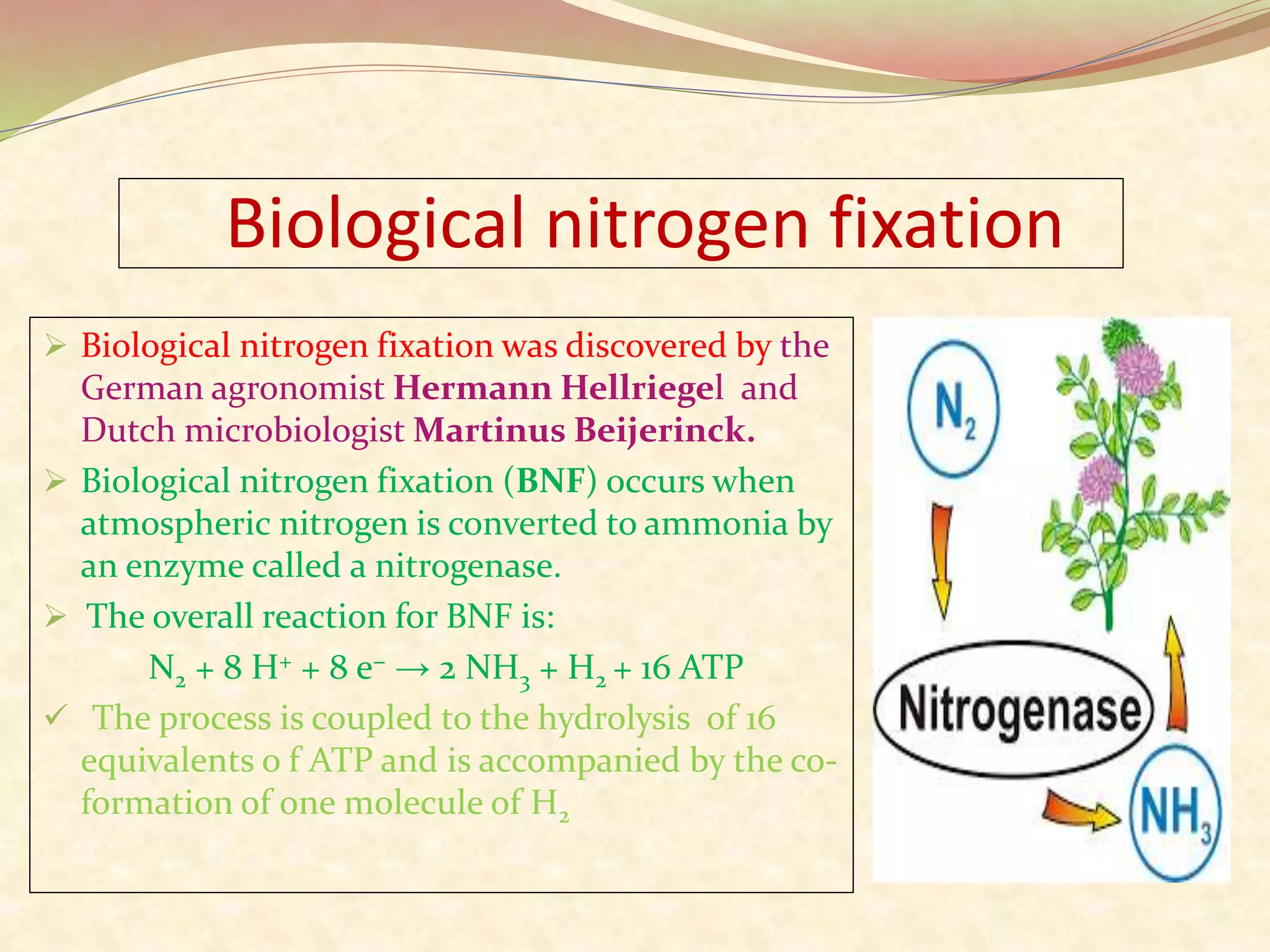
 Biological nitrogen fixation (BNF) occurs when
atmospheric nitrogen is converted to ammonia by
an enzyme called a nitrogenase.
 The overall reaction for BNF is:
N2 + 8 H+ + 8 e− → 2 NH3 + H2 + 16 ATP
 The process is coupled to the hydrolysis of 16
equivalents o f ATP and is accompanied by the co-
formation of one molecule of H2
 The conversion of N2 into ammonia occurs at a cluster called FeMoco
(iron-molybdenum cofactor.) The mechanism proceeds through series
of protonation and reduction steps wherein the FeMoco active site
hydrogenates the N2 substrate.
 In free-living diazotrophs, the nitrogenase-generated ammonium is
assimilated into glutamate through the glutamine synthetase/glutamate
synthase pathway.
 Enzymes responsible for nitrogenase action are very susceptible to
destruction by oxygen. For this reason, many bacteria cease production of
the enzyme in the presence of oxygen. Many nitrogen-fixing organisms
exist only in anaerobic conditions, respiring to draw down oxygen levels, or
binding the oxygen with a protein such as leghaemoglobin.
1.Edaphic Factors:
a. Excessive moisture and waterlogging prevent the development of root
hair and sites of nodulation, and interfere with a normal diffusion of O2 in
the root system of plants.
b. Drought reduces the number of rhizobia in soils, and inhibits nodulation
and N2 fixation. Prolonged drought will promote nodule decay. Deep-
rooted legumes exploiting moisture in lower soil layers can continue fixing
N2 when the soil is drying.
c. Soil acidity and related problems of Ca deficiency and aluminum and
manganese toxicity adversely affect nodulation, N2 fixation and plant
growth.
d. Phosphorus deficiency is commonly takes place in tropical Africa and
reduces nodulation, N2 fixation and plant growth.
e. Mineral N inhibits the Rhizobium infection process and also inhibits
N2 fixation.
Factors limiting Biological Nitrogen Fixation
2.Climatic factors
a. Extreme temperatures affect N2 fixation adversely. This is easy to
understand because N2 fixation is an enzymatic process. However, there
are differences between symbiotic systems in their ability to tolerate high
(>35°C) and low (<25°C) temperatures.
b. The availability of light regulates photosynthesis, upon which biological
nitrogen fixation depends. This is demonstrated by diurnal variations in
nitrogenase activity. A very few plants can grow and fix N2 under shade.
(e.g., Flemingia congesta under plantation canopy)
3. Biotic Factors
a. Excessive defoliation of host plant:Defoliation (e.g., pruning and lopping)
decreases the photosynthetic ability of legumes. It impairs N2 fixation and
can lead to nodule decay. For perennial legumes, nodule decay sheds a
high number of rhizobia in the root zone
b. crop competition:Intercropping legumes with non-leguminous crops can
result in competition for water and nutrients. This competition can affect
N2 fixation negatively.
c. Insects and nematodes:Insects and nematodes have also been reported to
interfere with nodule formation, development, and functions.
Biological
nitrogen
fixation
Symbiotic
Legumes Non-legumes
Non-
symbiotic
Types of Biological nitrogen fixation
 Diazotrophs are a diverse group of prokaryotes that includes cyanobacteria
like Trichodesmium and Cyanothece, green sulfur bacteria, and diazotrophs
like Azotobacteraceae, rhizobia and Frankia.
 In general, cyanobacteria are able to utilize a variety of inorganic and
organic sources of combined nitrogen,
like nitrate, nitrite, ammonium, urea, or some amino acids.
 Nitrogen fixation by cyanobacteria in coral reefs can fix twice the amount
of nitrogen than on land—around 1.8 kg of nitrogen is fixed per hectare per
day. The colonial marine cyanobacterium Trichodesmium is thought to fix
nitrogen on such a scale that it accounts for almost half of the nitrogen
fixation in marine systems on a global scale.
1.Microorganisms that fix nitrogen
 Plants that contribute to nitrogen fixation include the legume family –
Fabaceae – with taxa such
as kudzu, clovers, soybeans, alfalfa, lupines, peanuts
 They contain symbiotic bacteria called rhizobia within nodules in their root
systems, producing nitrogen compounds that help the plant to grow and
compete with other plants. When the plant dies, the fixed nitrogen is
released, making it available to other plants; this helps to fertilize the soil.
 The great majority of legumes have this association, but a few genera
(e.g.,Styphnolobium) do not. In many traditional and organic farming
practices, fields are rotated through various types of crops, which usually
include one consisting mainly or entirely of clover or buckwheat (non-
legume family Polygonaceae), often referred to as "green manure".
2. Root nodule symbiosis: Legume family
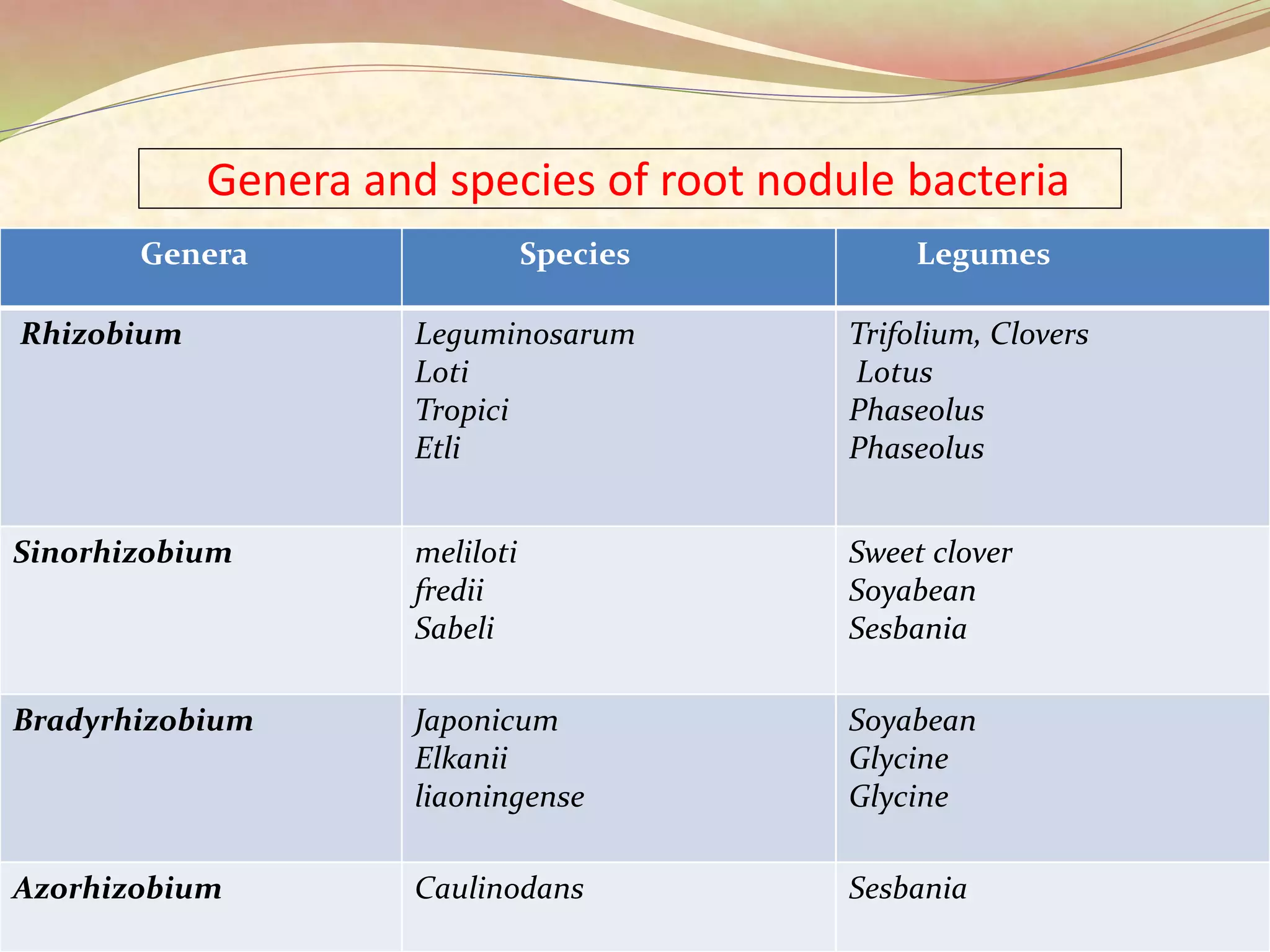
Genera and species of root nodule bacteria
Genera Species Legumes
Rhizobium Leguminosarum
Loti
Tropici
Etli
Trifolium, Clovers
Lotus
Phaseolus
Phaseolus
Sinorhizobium meliloti
fredii
Sabeli
Sweet clover
Soyabean
Sesbania
Bradyrhizobium Japonicum
Elkanii
liaoningense
Soyabean
Glycine
Glycine
Azorhizobium Caulinodans Sesbania
3. Non- legumes that fix Nitrogen
 Although by far the majority of plants able to form nitrogen-fixing root
nodules are in the legume family Fabaceae, there are a few exceptions:
 Parasponia, a tropical genus in the Cannabaceae also able to interact with
rhizobia and form nitrogen-fixing nodules.
 Actinorhizal plants such as alder and bayberry can also form nitrogen-
fixing nodules, there is a symbiotic association with Frankia bacteria.
These plants belong to 25 generadistributed among 8 plant families.
 There are also several nitrogen-fixing symbiotic associations that
involve cyanobacteria (such as Nostoc): Some lichens such
as Lobaria and Peltigera Mosquito fern (Azolla species) Cycads Gunnera
How this Biological nitrogen
fixation occurs?????????????....
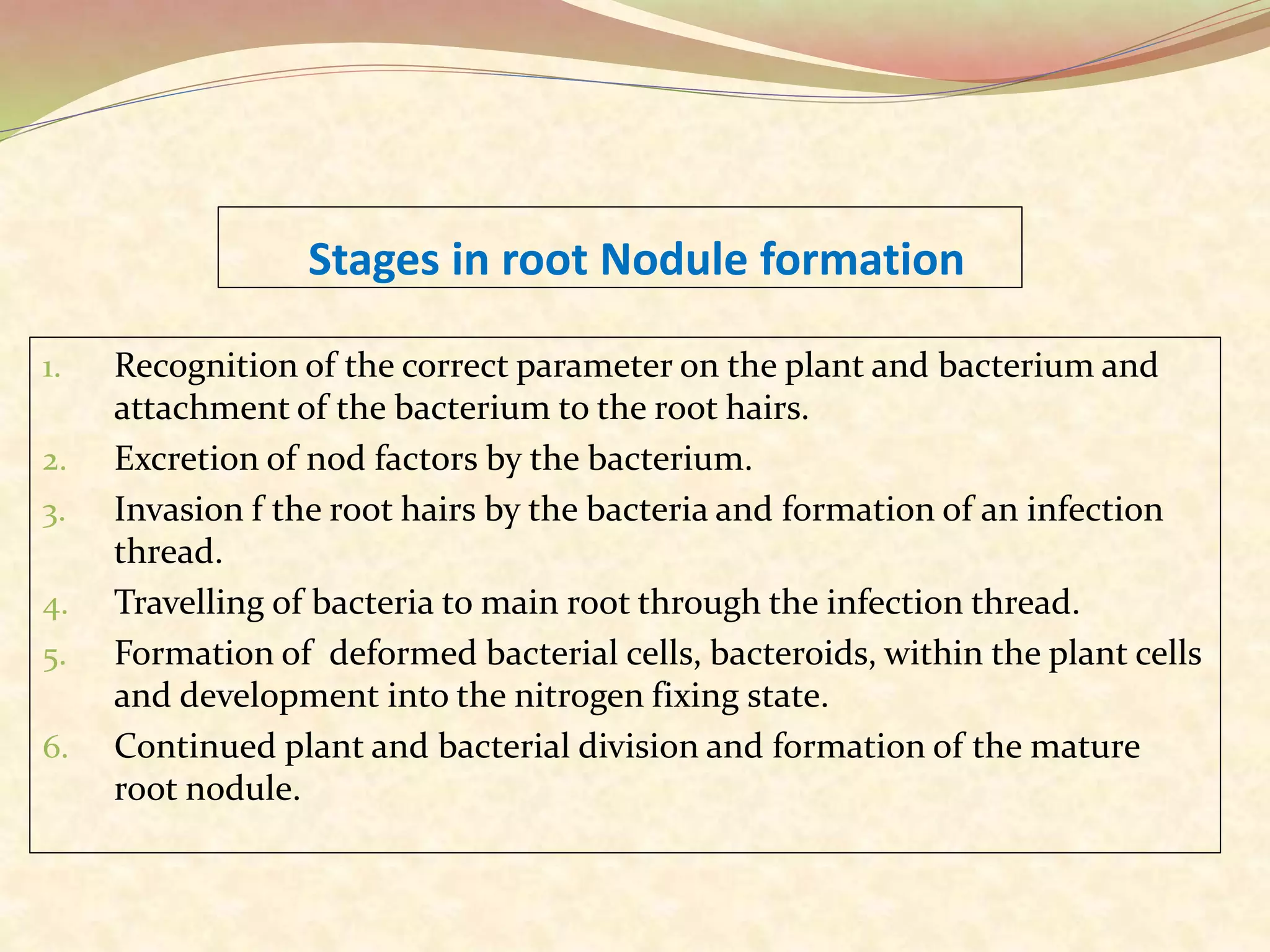
Stages in root Nodule formation
1. Recognition of the correct parameter on the plant and bacterium and
attachment of the bacterium to the root hairs.
2. Excretion of nod factors by the bacterium.
3. Invasion f the root hairs by the bacteria and formation of an infection
thread.
4. Travelling of bacteria to main root through the infection thread.
5. Formation of deformed bacterial cells, bacteroids, within the plant cells
and development into the nitrogen fixing state.
6. Continued plant and bacterial division and formation of the mature
root nodule.
 The roots of leguminous plant secrets a variety of organic compounds that
stimulates the growth of a rhizosphere microflora.
 This stimulation is not restricted to rhizobia but occurs with variety of
rhizosphere bacteria.
 Attachment of bacterium to the plant in the legume rhizobium symbiosis is
the first step in the formation of root nodule.
 A specific adhesion protein is called Rhicadhesin (Ca binding protein on
the root hairs) is present on the surface of all species of Rhizobium and
Bradyrhizobium.
 Other substances like carbohydrates containing protein called lectins also
play role in plant bacterium attachmnet.
 The Rhizobium multiply rapidly withi the plant cells and are formed into
swollen, mis-shapen and branched forms called bacetoid.
 When the plant dies, the nodules can be deteriorated, releasing bacteria
into the soil and bacteria can initiate the infection in other roots or
maintain a free living existence in the cells.
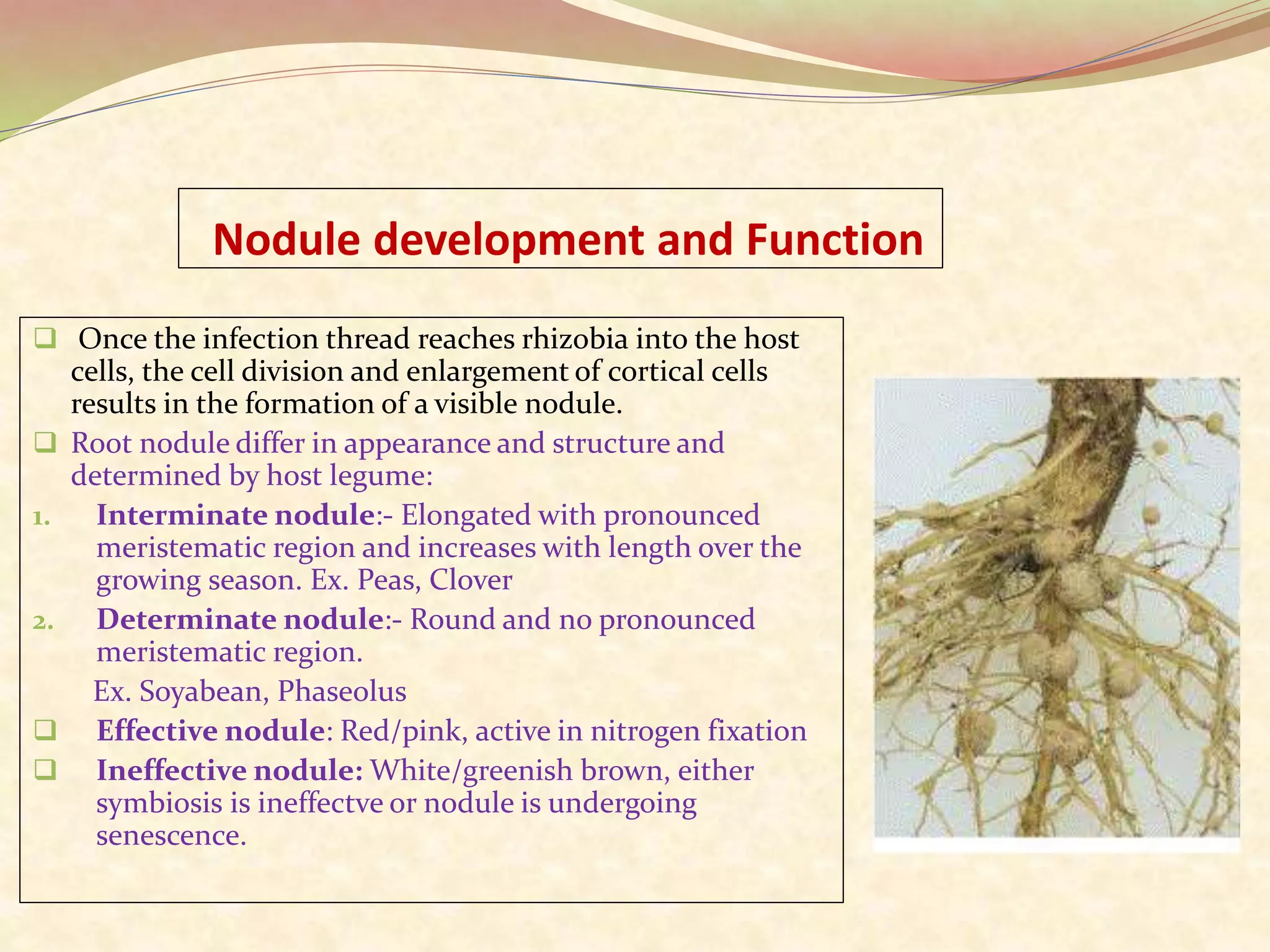
Nodule development and Function
 Once the infection thread reaches rhizobia into the host
cells, the cell division and enlargement of cortical cells
results in the formation of a visible nodule.
 Root nodule differ in appearance and structure and
determined by host legume:
1. Interminate nodule:- Elongated with pronounced
meristematic region and increases with length over the
growing season. Ex. Peas, Clover
2. Determinate nodule:- Round and no pronounced
meristematic region.
Ex. Soyabean, Phaseolus
 Effective nodule: Red/pink, active in nitrogen fixation
 Ineffective nodule: White/greenish brown, either
symbiosis is ineffectve or nodule is undergoing
senescence.
 The core of mature nodule is bacteroid (site
of N fixation) zone which is surrounded by
several layers of cortical cells.
 Depending on the legume, each bacteroid or
group of bacteria are surrounded by
membrane envelop and is called as
peribacteroid membrane which plays special
role in two-way transport of metabolites
between symbionts.
 Glutamine is converted into glutamate by
glutamine-oxoglutarate amidotransferase
(GOGAT).
 A part of glutamate is used to transaminate
oxaloacetate to aspartate and forms
aspargine.
 Some part of glutamate is used to form
glutamine by combining with Ammonium.
 Transport of Amino acids from Nitrogen
fixation to shoot.
The role of biological nitrogen fixation in land reclamation, agro
ecology and sustainability of tropical agriculture
Franco et al. 1990
CASE STUDY-1
Biological nitrogen fixation and Agro forestry
CASE STUDY-2
Nair et al., 1984
Biological nitrogen fixation by Red alder
CASE STUDY-3
Binkley et al., 1994
 Since nitrogen is commonly the most limiting plant nutrient in arable
farming in the tropics and also the most expensive element as a mineral
fertilizer, biological nitrogen fixation (BNF) holds great promise for
smallholder, farmers.
 Biological nitrogen fixation is the process of capturing atmospheric
nitrogen by biological processes. It is accomplished by certain
microorganisms and plant-microbe interactions.
 Legumes are N-fixing systems that have long been used for biological
nitrogen fixation in agriculture.
 A number of edaphic, climatic, and biotic factors inhibit N2 fixation, among
these, the absence of specific and effective rhizobia in the soil is the most
important.
Biological nitrogen fixation.pptx

Biological nitrogen fixation.pptx

  • 2.
    Biological nitrogen fixation Presentedby: Uday Kumar Lodh M.Sc. Forestry (Plantation Technology) ICAR JRF (AIR-2)
  • 3.
    Nitrogen fixation  Nitrogenfixation is a process in which nitrogen (N2) in the atmosphere is converted into ammonia (NH3).  Atmospheric nitrogen or molecular di-nitrogen (N2) is relatively inert: it does not easily react with other chemicals to form new compounds.  The fixation process frees nitrogen atoms from their triply bonded diatomic form (N≡N) to be used in other ways.  Nitrogen fixation is natural and synthetic and is essential for all forms of life because nitrogen is required to biosynthesize basic building blocks of plants, animals and other life forms.  E.g.,nucleotides for DNA and RNA and amino acids for proteins. Therefore, as part of the nitrogen cycle, it is essential for agriculture and the manufacture of fertilizer. It is also an important process in the manufacture of explosives (e.g. gunpowder, dynamite, TNT, etc.).
  • 4.
     Nitrogen fixationoccurs naturally in the soil by nitrogen fixing bacteria affiliated with some plants (Azotobacter and legumes). It also occurs naturally in the air by means of lightning.  All biological nitrogen fixation is done by way of nitrogenase metalloenzymes which contain iron, molybdenum, or vanadium.  Microorganisms that can fix nitrogen are prokaryotes (both bacteria and archaea) called diazotrophs. Some higher plants, and some animals (termites), have formed associations (symbiosis) with diazotrophs.
  • 6.
  • 7.
    Biological nitrogen fixation Biological nitrogen fixation was discovered by the German agronomist Hermann Hellriegel and Dutch microbiologist Martinus Beijerinck.  Biological nitrogen fixation (BNF) occurs when atmospheric nitrogen is converted to ammonia by an enzyme called a nitrogenase.  The overall reaction for BNF is: N2 + 8 H+ + 8 e− → 2 NH3 + H2 + 16 ATP  The process is coupled to the hydrolysis of 16 equivalents o f ATP and is accompanied by the co- formation of one molecule of H2
  • 10.
     The conversionof N2 into ammonia occurs at a cluster called FeMoco (iron-molybdenum cofactor.) The mechanism proceeds through series of protonation and reduction steps wherein the FeMoco active site hydrogenates the N2 substrate.  In free-living diazotrophs, the nitrogenase-generated ammonium is assimilated into glutamate through the glutamine synthetase/glutamate synthase pathway.  Enzymes responsible for nitrogenase action are very susceptible to destruction by oxygen. For this reason, many bacteria cease production of the enzyme in the presence of oxygen. Many nitrogen-fixing organisms exist only in anaerobic conditions, respiring to draw down oxygen levels, or binding the oxygen with a protein such as leghaemoglobin.
  • 11.
    1.Edaphic Factors: a. Excessivemoisture and waterlogging prevent the development of root hair and sites of nodulation, and interfere with a normal diffusion of O2 in the root system of plants. b. Drought reduces the number of rhizobia in soils, and inhibits nodulation and N2 fixation. Prolonged drought will promote nodule decay. Deep- rooted legumes exploiting moisture in lower soil layers can continue fixing N2 when the soil is drying. c. Soil acidity and related problems of Ca deficiency and aluminum and manganese toxicity adversely affect nodulation, N2 fixation and plant growth. d. Phosphorus deficiency is commonly takes place in tropical Africa and reduces nodulation, N2 fixation and plant growth. e. Mineral N inhibits the Rhizobium infection process and also inhibits N2 fixation. Factors limiting Biological Nitrogen Fixation
  • 12.
    2.Climatic factors a. Extremetemperatures affect N2 fixation adversely. This is easy to understand because N2 fixation is an enzymatic process. However, there are differences between symbiotic systems in their ability to tolerate high (>35°C) and low (<25°C) temperatures. b. The availability of light regulates photosynthesis, upon which biological nitrogen fixation depends. This is demonstrated by diurnal variations in nitrogenase activity. A very few plants can grow and fix N2 under shade. (e.g., Flemingia congesta under plantation canopy)
  • 13.
    3. Biotic Factors a.Excessive defoliation of host plant:Defoliation (e.g., pruning and lopping) decreases the photosynthetic ability of legumes. It impairs N2 fixation and can lead to nodule decay. For perennial legumes, nodule decay sheds a high number of rhizobia in the root zone b. crop competition:Intercropping legumes with non-leguminous crops can result in competition for water and nutrients. This competition can affect N2 fixation negatively. c. Insects and nematodes:Insects and nematodes have also been reported to interfere with nodule formation, development, and functions.
  • 14.
  • 15.
     Diazotrophs area diverse group of prokaryotes that includes cyanobacteria like Trichodesmium and Cyanothece, green sulfur bacteria, and diazotrophs like Azotobacteraceae, rhizobia and Frankia.  In general, cyanobacteria are able to utilize a variety of inorganic and organic sources of combined nitrogen, like nitrate, nitrite, ammonium, urea, or some amino acids.  Nitrogen fixation by cyanobacteria in coral reefs can fix twice the amount of nitrogen than on land—around 1.8 kg of nitrogen is fixed per hectare per day. The colonial marine cyanobacterium Trichodesmium is thought to fix nitrogen on such a scale that it accounts for almost half of the nitrogen fixation in marine systems on a global scale. 1.Microorganisms that fix nitrogen
  • 16.
     Plants thatcontribute to nitrogen fixation include the legume family – Fabaceae – with taxa such as kudzu, clovers, soybeans, alfalfa, lupines, peanuts  They contain symbiotic bacteria called rhizobia within nodules in their root systems, producing nitrogen compounds that help the plant to grow and compete with other plants. When the plant dies, the fixed nitrogen is released, making it available to other plants; this helps to fertilize the soil.  The great majority of legumes have this association, but a few genera (e.g.,Styphnolobium) do not. In many traditional and organic farming practices, fields are rotated through various types of crops, which usually include one consisting mainly or entirely of clover or buckwheat (non- legume family Polygonaceae), often referred to as "green manure". 2. Root nodule symbiosis: Legume family
  • 18.
    Genera and speciesof root nodule bacteria Genera Species Legumes Rhizobium Leguminosarum Loti Tropici Etli Trifolium, Clovers Lotus Phaseolus Phaseolus Sinorhizobium meliloti fredii Sabeli Sweet clover Soyabean Sesbania Bradyrhizobium Japonicum Elkanii liaoningense Soyabean Glycine Glycine Azorhizobium Caulinodans Sesbania
  • 19.
    3. Non- legumesthat fix Nitrogen  Although by far the majority of plants able to form nitrogen-fixing root nodules are in the legume family Fabaceae, there are a few exceptions:  Parasponia, a tropical genus in the Cannabaceae also able to interact with rhizobia and form nitrogen-fixing nodules.  Actinorhizal plants such as alder and bayberry can also form nitrogen- fixing nodules, there is a symbiotic association with Frankia bacteria. These plants belong to 25 generadistributed among 8 plant families.  There are also several nitrogen-fixing symbiotic associations that involve cyanobacteria (such as Nostoc): Some lichens such as Lobaria and Peltigera Mosquito fern (Azolla species) Cycads Gunnera
  • 20.
    How this Biologicalnitrogen fixation occurs?????????????....
  • 21.
    Stages in rootNodule formation 1. Recognition of the correct parameter on the plant and bacterium and attachment of the bacterium to the root hairs. 2. Excretion of nod factors by the bacterium. 3. Invasion f the root hairs by the bacteria and formation of an infection thread. 4. Travelling of bacteria to main root through the infection thread. 5. Formation of deformed bacterial cells, bacteroids, within the plant cells and development into the nitrogen fixing state. 6. Continued plant and bacterial division and formation of the mature root nodule.
  • 24.
     The rootsof leguminous plant secrets a variety of organic compounds that stimulates the growth of a rhizosphere microflora.  This stimulation is not restricted to rhizobia but occurs with variety of rhizosphere bacteria.  Attachment of bacterium to the plant in the legume rhizobium symbiosis is the first step in the formation of root nodule.  A specific adhesion protein is called Rhicadhesin (Ca binding protein on the root hairs) is present on the surface of all species of Rhizobium and Bradyrhizobium.  Other substances like carbohydrates containing protein called lectins also play role in plant bacterium attachmnet.  The Rhizobium multiply rapidly withi the plant cells and are formed into swollen, mis-shapen and branched forms called bacetoid.  When the plant dies, the nodules can be deteriorated, releasing bacteria into the soil and bacteria can initiate the infection in other roots or maintain a free living existence in the cells.
  • 27.
    Nodule development andFunction  Once the infection thread reaches rhizobia into the host cells, the cell division and enlargement of cortical cells results in the formation of a visible nodule.  Root nodule differ in appearance and structure and determined by host legume: 1. Interminate nodule:- Elongated with pronounced meristematic region and increases with length over the growing season. Ex. Peas, Clover 2. Determinate nodule:- Round and no pronounced meristematic region. Ex. Soyabean, Phaseolus  Effective nodule: Red/pink, active in nitrogen fixation  Ineffective nodule: White/greenish brown, either symbiosis is ineffectve or nodule is undergoing senescence.
  • 28.
     The coreof mature nodule is bacteroid (site of N fixation) zone which is surrounded by several layers of cortical cells.  Depending on the legume, each bacteroid or group of bacteria are surrounded by membrane envelop and is called as peribacteroid membrane which plays special role in two-way transport of metabolites between symbionts.  Glutamine is converted into glutamate by glutamine-oxoglutarate amidotransferase (GOGAT).  A part of glutamate is used to transaminate oxaloacetate to aspartate and forms aspargine.  Some part of glutamate is used to form glutamine by combining with Ammonium.  Transport of Amino acids from Nitrogen fixation to shoot.
  • 30.
    The role ofbiological nitrogen fixation in land reclamation, agro ecology and sustainability of tropical agriculture Franco et al. 1990 CASE STUDY-1
  • 31.
    Biological nitrogen fixationand Agro forestry CASE STUDY-2 Nair et al., 1984
  • 32.
    Biological nitrogen fixationby Red alder CASE STUDY-3 Binkley et al., 1994
  • 33.
     Since nitrogenis commonly the most limiting plant nutrient in arable farming in the tropics and also the most expensive element as a mineral fertilizer, biological nitrogen fixation (BNF) holds great promise for smallholder, farmers.  Biological nitrogen fixation is the process of capturing atmospheric nitrogen by biological processes. It is accomplished by certain microorganisms and plant-microbe interactions.  Legumes are N-fixing systems that have long been used for biological nitrogen fixation in agriculture.  A number of edaphic, climatic, and biotic factors inhibit N2 fixation, among these, the absence of specific and effective rhizobia in the soil is the most important.