Nitrate Assimilation
Ajay Prakash Uniyal
M.Sc Plant Sciences
Central University of Punjab
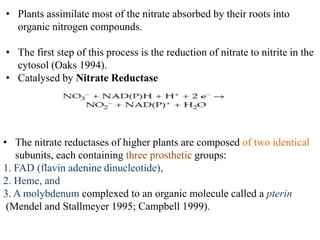
• Plants assimilate most of the nitrate absorbed by their roots into
organic nitrogen compounds.
• The first step of this process is the reduction of nitrate to nitrite in the
cytosol (Oaks 1994).
• Catalysed by Nitrate Reductase
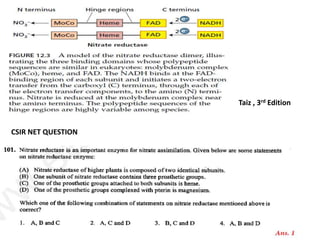
• The nitrate reductases of higher plants are composed of two identical
subunits, each containing three prosthetic groups:
1. FAD (flavin adenine dinucleotide),
2. Heme, and
3. A molybdenum complexed to an organic molecule called a pterin
(Mendel and Stallmeyer 1995; Campbell 1999).
Taiz , 3rd Edition
CSIR NET QUESTION
Nitrite Reductase Converts Nitrite to Ammonium
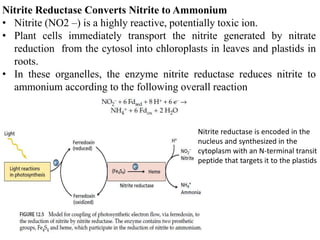
• Nitrite (NO2 –) is a highly reactive, potentially toxic ion.
• Plant cells immediately transport the nitrite generated by nitrate
reduction from the cytosol into chloroplasts in leaves and plastids in
roots.
• In these organelles, the enzyme nitrite reductase reduces nitrite to
ammonium according to the following overall reaction
Nitrite reductase is encoded in the
nucleus and synthesized in the
cytoplasm with an N-terminal transit
peptide that targets it to the plastids
Ammonium assimilated by GS/GOGAT Pathway
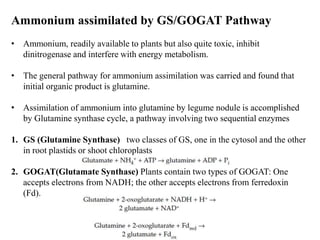
• Ammonium, readily available to plants but also quite toxic, inhibit
dinitrogenase and interfere with energy metabolism.
• The general pathway for ammonium assimilation was carried and found that
initial organic product is glutamine.
• Assimilation of ammonium into glutamine by legume nodule is accomplished
by Glutamine synthase cycle, a pathway involving two sequential enzymes
1. GS (Glutamine Synthase) two classes of GS, one in the cytosol and the other
in root plastids or shoot chloroplasts
2. GOGAT(Glutamate Synthase) Plants contain two types of GOGAT: One
accepts electrons from NADH; the other accepts electrons from ferredoxin
(Fd).
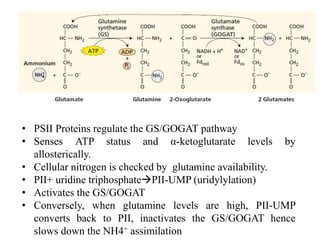
• PSII Proteins regulate the GS/GOGAT pathway
• Senses ATP status and α-ketoglutarate levels by
allosterically.
• Cellular nitrogen is checked by glutamine availability.
• PII+ uridine triphosphatePII-UMP (uridylylation)
• Activates the GS/GOGAT
• Conversely, when glutamine levels are high, PII-UMP
converts back to PII, inactivates the GS/GOGAT hence
slows down the NH4+ assimilation
BIOLOGICAL NITROGEN FIXATION
Biological nitrogen fixation accounts for most of the fixation of atmospheric
N2 into ammonium, thus representing the key entry point of molecular nitrogen
into the biogeochemical cycle of nitrogen.
Establishing Symbiosis Requires an Exchange of Signals
• Under nitrogen-limited conditions, the symbionts seek out one another
through an elaborate exchange of signals.
• The first stage in the formation of the symbiotic relationship between the
nitrogen-fixing bacteria and their host is migration of the bacteria toward the
roots of the host plant.
• This migration is a chemotactic response mediated by chemical attractants,
especially (iso)flavonoids and betaines, secreted by the roots.
• These attractants activate the rhizobial NodD protein, which then induces
transcription of the other nod genes (Phillips and Kapulnik 1995).
• Binding of the activated NodD to the nod box induces transcription of the
other nod genes.
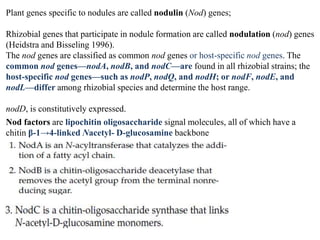
Plant genes specific to nodules are called nodulin (Nod) genes;
Rhizobial genes that participate in nodule formation are called nodulation (nod) genes
(Heidstra and Bisseling 1996).
The nod genes are classified as common nod genes or host-specific nod genes. The
common nod genes—nodA, nodB, and nodC—are found in all rhizobial strains; the
host-specific nod genes—such as nodP, nodQ, and nodH; or nodF, nodE, and
nodL—differ among rhizobial species and determine the host range.
nodD, is constitutively expressed.
Nod factors are lipochitin oligosaccharide signal molecules, all of which have a
chitin β-1→4-linked Nacetyl- D-glucosamine backbone
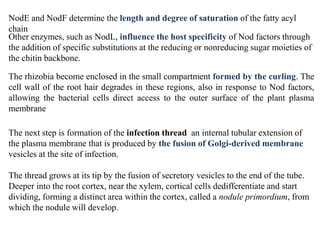
NodE and NodF determine the length and degree of saturation of the fatty acyl
chain
Other enzymes, such as NodL, influence the host specificity of Nod factors through
the addition of specific substitutions at the reducing or nonreducing sugar moieties of
the chitin backbone.
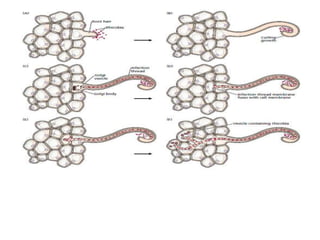
The rhizobia become enclosed in the small compartment formed by the curling. The
cell wall of the root hair degrades in these regions, also in response to Nod factors,
allowing the bacterial cells direct access to the outer surface of the plant plasma
membrane
The next step is formation of the infection thread an internal tubular extension of
the plasma membrane that is produced by the fusion of Golgi-derived membrane
vesicles at the site of infection.
The thread grows at its tip by the fusion of secretory vesicles to the end of the tube.
Deeper into the root cortex, near the xylem, cortical cells dedifferentiate and start
dividing, forming a distinct area within the cortex, called a nodule primordium, from
which the nodule will develop.
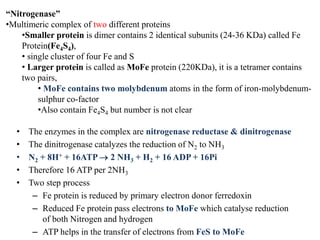
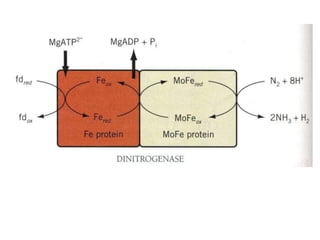
“Nitrogenase”
•Multimeric complex of two different proteins
•Smaller protein is dimer contains 2 identical subunits (24-36 KDa) called Fe
Protein(Fe4S4),
• single cluster of four Fe and S
• Larger protein is called as MoFe protein (220KDa), it is a tetramer contains
two pairs,
• MoFe contains two molybdenum atoms in the form of iron-molybdenum-
sulphur co-factor
•Also contain Fe4S4 but number is not clear
• The enzymes in the complex are nitrogenase reductase & dinitrogenase
• The dinitrogenase catalyzes the reduction of N2 to NH3
• N2 + 8H+ + 16ATP  2 NH3 + H2 + 16 ADP + 16Pi
• Therefore 16 ATP per 2NH3
• Two step process
– Fe protein is reduced by primary electron donor ferredoxin
– Reduced Fe protein pass electrons to MoFe which catalyse reduction
of both Nitrogen and hydrogen
– ATP helps in the transfer of electrons from FeS to MoFe
Nitrate assimilation

Nitrate assimilation

  • 1.
    Nitrate Assimilation Ajay PrakashUniyal M.Sc Plant Sciences Central University of Punjab
  • 2.
    • Plants assimilatemost of the nitrate absorbed by their roots into organic nitrogen compounds. • The first step of this process is the reduction of nitrate to nitrite in the cytosol (Oaks 1994). • Catalysed by Nitrate Reductase • The nitrate reductases of higher plants are composed of two identical subunits, each containing three prosthetic groups: 1. FAD (flavin adenine dinucleotide), 2. Heme, and 3. A molybdenum complexed to an organic molecule called a pterin (Mendel and Stallmeyer 1995; Campbell 1999).
  • 3.
    Taiz , 3rdEdition CSIR NET QUESTION
  • 4.
    Nitrite Reductase ConvertsNitrite to Ammonium • Nitrite (NO2 –) is a highly reactive, potentially toxic ion. • Plant cells immediately transport the nitrite generated by nitrate reduction from the cytosol into chloroplasts in leaves and plastids in roots. • In these organelles, the enzyme nitrite reductase reduces nitrite to ammonium according to the following overall reaction Nitrite reductase is encoded in the nucleus and synthesized in the cytoplasm with an N-terminal transit peptide that targets it to the plastids
  • 5.
    Ammonium assimilated byGS/GOGAT Pathway • Ammonium, readily available to plants but also quite toxic, inhibit dinitrogenase and interfere with energy metabolism. • The general pathway for ammonium assimilation was carried and found that initial organic product is glutamine. • Assimilation of ammonium into glutamine by legume nodule is accomplished by Glutamine synthase cycle, a pathway involving two sequential enzymes 1. GS (Glutamine Synthase) two classes of GS, one in the cytosol and the other in root plastids or shoot chloroplasts 2. GOGAT(Glutamate Synthase) Plants contain two types of GOGAT: One accepts electrons from NADH; the other accepts electrons from ferredoxin (Fd).
  • 6.
    • PSII Proteinsregulate the GS/GOGAT pathway • Senses ATP status and α-ketoglutarate levels by allosterically. • Cellular nitrogen is checked by glutamine availability. • PII+ uridine triphosphatePII-UMP (uridylylation) • Activates the GS/GOGAT • Conversely, when glutamine levels are high, PII-UMP converts back to PII, inactivates the GS/GOGAT hence slows down the NH4+ assimilation
  • 7.
    BIOLOGICAL NITROGEN FIXATION Biologicalnitrogen fixation accounts for most of the fixation of atmospheric N2 into ammonium, thus representing the key entry point of molecular nitrogen into the biogeochemical cycle of nitrogen. Establishing Symbiosis Requires an Exchange of Signals • Under nitrogen-limited conditions, the symbionts seek out one another through an elaborate exchange of signals. • The first stage in the formation of the symbiotic relationship between the nitrogen-fixing bacteria and their host is migration of the bacteria toward the roots of the host plant. • This migration is a chemotactic response mediated by chemical attractants, especially (iso)flavonoids and betaines, secreted by the roots. • These attractants activate the rhizobial NodD protein, which then induces transcription of the other nod genes (Phillips and Kapulnik 1995). • Binding of the activated NodD to the nod box induces transcription of the other nod genes.
  • 8.
    Plant genes specificto nodules are called nodulin (Nod) genes; Rhizobial genes that participate in nodule formation are called nodulation (nod) genes (Heidstra and Bisseling 1996). The nod genes are classified as common nod genes or host-specific nod genes. The common nod genes—nodA, nodB, and nodC—are found in all rhizobial strains; the host-specific nod genes—such as nodP, nodQ, and nodH; or nodF, nodE, and nodL—differ among rhizobial species and determine the host range. nodD, is constitutively expressed. Nod factors are lipochitin oligosaccharide signal molecules, all of which have a chitin β-1→4-linked Nacetyl- D-glucosamine backbone
  • 9.
    NodE and NodFdetermine the length and degree of saturation of the fatty acyl chain Other enzymes, such as NodL, influence the host specificity of Nod factors through the addition of specific substitutions at the reducing or nonreducing sugar moieties of the chitin backbone. The rhizobia become enclosed in the small compartment formed by the curling. The cell wall of the root hair degrades in these regions, also in response to Nod factors, allowing the bacterial cells direct access to the outer surface of the plant plasma membrane The next step is formation of the infection thread an internal tubular extension of the plasma membrane that is produced by the fusion of Golgi-derived membrane vesicles at the site of infection. The thread grows at its tip by the fusion of secretory vesicles to the end of the tube. Deeper into the root cortex, near the xylem, cortical cells dedifferentiate and start dividing, forming a distinct area within the cortex, called a nodule primordium, from which the nodule will develop.
  • 11.
    “Nitrogenase” •Multimeric complex oftwo different proteins •Smaller protein is dimer contains 2 identical subunits (24-36 KDa) called Fe Protein(Fe4S4), • single cluster of four Fe and S • Larger protein is called as MoFe protein (220KDa), it is a tetramer contains two pairs, • MoFe contains two molybdenum atoms in the form of iron-molybdenum- sulphur co-factor •Also contain Fe4S4 but number is not clear • The enzymes in the complex are nitrogenase reductase & dinitrogenase • The dinitrogenase catalyzes the reduction of N2 to NH3 • N2 + 8H+ + 16ATP  2 NH3 + H2 + 16 ADP + 16Pi • Therefore 16 ATP per 2NH3 • Two step process – Fe protein is reduced by primary electron donor ferredoxin – Reduced Fe protein pass electrons to MoFe which catalyse reduction of both Nitrogen and hydrogen – ATP helps in the transfer of electrons from FeS to MoFe