SHRI SHANKARACHARYA
MAHAVIDYALAYA, JUNWANI,BHILAI
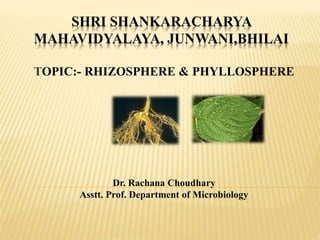
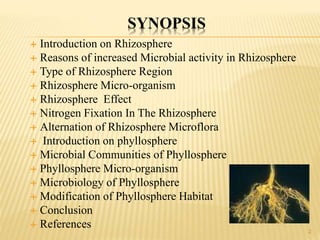
TOPIC:- RHIZOSPHERE & PHYLLOSPHERE
Dr. Rachana Choudhary
Asstt. Prof. Department of Microbiology
SYNOPSIS
 Introduction on Rhizosphere
 Reasons of increased Microbial activity in Rhizosphere
 Type of Rhizosphere Region
 Rhizosphere Micro-organism
 Rhizosphere Effect
 Nitrogen Fixation In The Rhizosphere
 Alternation of Rhizosphere Microflora
 Introduction on phyllosphere
 Microbial Communities of Phyllosphere
 Phyllosphere Micro-organism
 Microbiology of Phyllosphere
 Modification of Phyllosphere Habitat
 Conclusion
 References 2
3
INTRODUCTION
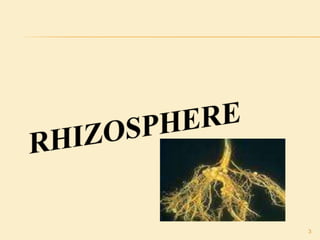
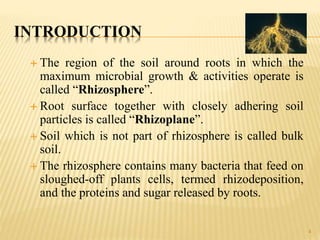
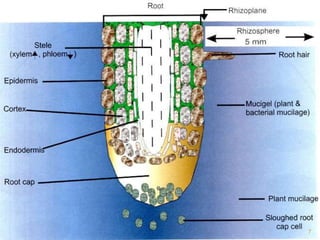
 The region of the soil around roots in which the
maximum microbial growth & activities operate is
called “Rhizosphere”.
 Root surface together with closely adhering soil
particles is called “Rhizoplane”.
 Soil which is not part of rhizosphere is called bulk
soil.
 The rhizosphere contains many bacteria that feed on
sloughed-off plants cells, termed rhizodeposition,
and the proteins and sugar released by roots.
4
REASONS OF INCREASED MICROBIALACTIVITY IN
RHIZOSPHERE
 Accumulation of Organic & inorganic
Compounds
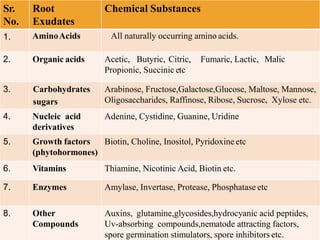
 Composition of Root Exudates
 Factors Affecting Exudation
5
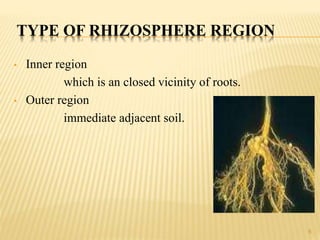
TYPE OF RHIZOSPHERE REGION
• Inner region
which is an closed vicinity of roots.
• Outer region
immediate adjacent soil.
6
7
8
Sr.
No.
Root
Exudates
Chemical Substances
1. AminoAcids All naturally occurring amino acids.
2. Organic acids Acetic, Butyric, Citric, Fumaric, Lactic, Malic
Propionic, Succinic etc
3. Carbohydrates
sugars
Arabinose, Fructose,Galactose,Glucose, Maltose, Mannose,
Oligosaccharides, Raffinose, Ribose, Sucrose, Xylose etc.
4. Nucleic acid
derivatives
Adenine, Cystidine, Guanine, Uridine
5. Growth factors
(phytohormones)
Biotin, Choline, Inositol, Pyridoxineetc
6. Vitamins Thiamine, Nicotinic Acid, Biotin etc.
7. Enzymes Amylase, Invertase, Protease, Phosphatase etc
8. Other
Compounds
Auxins, glutamine,glycosides,hydrocyanic acid peptides,
Uv-absorbing compounds,nematode attracting factors,
spore germination stimulators, spore inhibitors etc.
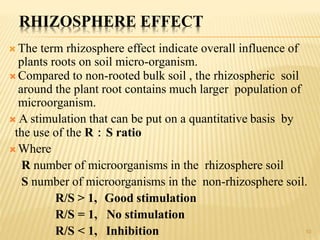
RHIZOSPHERE MICRO-ORGANISMS
• Microbial population in the rhizosphere also have
pronounced direct & indirect effects on growth of plants
in different ways.
• Chief bacteria genera in rhizosphere are:-
Pseudomonas
Bacillus
Streptomyces
• Chief fungi genera are:-
• Trichoderma
• Penicillium
• Glioladium
• Fusarium
9
RHIZOSPHERE EFFECT
 The term rhizosphere effect indicate overall influence of
plants roots on soil micro-organism.
 Compared to non-rooted bulk soil , the rhizospheric soil
around the plant root contains much larger population of
microorganism.
 A stimulation that can be put on a quantitative basis by
the use of the R:S ratio
 Where
R number of microorganisms in the rhizosphere soil
S number of microorganisms in the non-rhizosphere soil.
R/S > 1, Good stimulation
R/S = 1, No stimulation
R/S < 1, Inhibition 10
Factors Affecting Microbial Flora of the Rhizosphere /
Rhizosphere Effect
A. Soil type and its moisture
B. Soil amendments and fertilizers
C. Soil PH/ Rhizosphere PH
D. Root / exudates /excretion
E. Proximity of root with Soil
F. Age of Plant
G. Plant Species
11
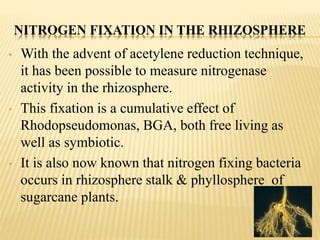
NITROGEN FIXATION IN THE RHIZOSPHERE
• With the advent of acetylene reduction technique,
it has been possible to measure nitrogenase
activity in the rhizosphere.
• This fixation is a cumulative effect of
Rhodopseudomonas, BGA, both free living as
well as symbiotic.
• It is also now known that nitrogen fixing bacteria
occurs in rhizosphere stalk & phyllosphere of
sugarcane plants.
12
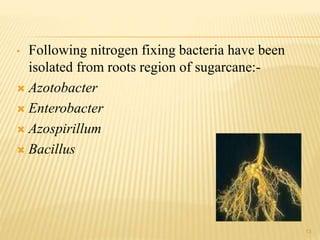
• Following nitrogen fixing bacteria have been
isolated from roots region of sugarcane:-
 Azotobacter
 Enterobacter
 Azospirillum
 Bacillus
13
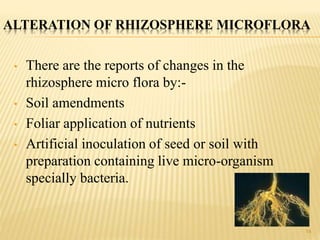
ALTERATION OF RHIZOSPHERE MICROFLORA
• There are the reports of changes in the
rhizosphere micro flora by:-
• Soil amendments
• Foliar application of nutrients
• Artificial inoculation of seed or soil with
preparation containing live micro-organism
specially bacteria.
14
15
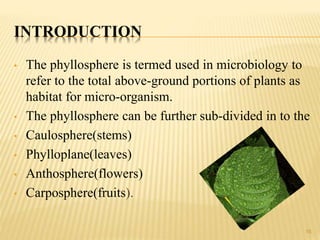
INTRODUCTION
• The phyllosphere is termed used in microbiology to
refer to the total above-ground portions of plants as
habitat for micro-organism.
• The phyllosphere can be further sub-divided in to the
• Caulosphere(stems)
• Phylloplane(leaves)
• Anthosphere(flowers)
• Carposphere(fruits).
16
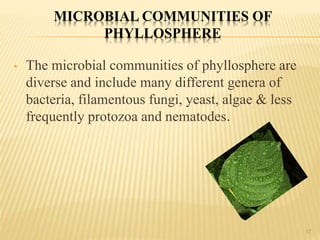
MICROBIAL COMMUNITIES OF
PHYLLOSPHERE
• The microbial communities of phyllosphere are
diverse and include many different genera of
bacteria, filamentous fungi, yeast, algae & less
frequently protozoa and nematodes.
17
PHYLLOSPHERE MICRO-ORGANISM
• The common genera of bacteria are:-
• Pseudomonas
• Bacillus
• Erwinia
• Some of the fungi are:-
• Aspergillus
• Actinomycetes
• Streptomyces
• Trichoderma
18
MICROBIOLOGY OF PHYLLOSPHERE
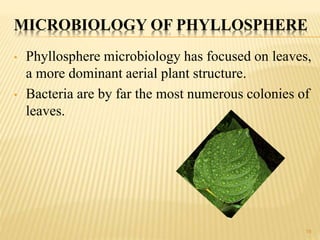
• Phyllosphere microbiology has focused on leaves,
a more dominant aerial plant structure.
• Bacteria are by far the most numerous colonies of
leaves.
19
MODIFICATION OF PHYLLOSPHERE
HABITAT
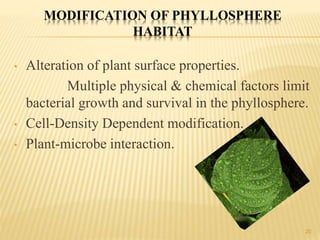
• Alteration of plant surface properties.
Multiple physical & chemical factors limit
bacterial growth and survival in the phyllosphere.
• Cell-Density Dependent modification.
• Plant-microbe interaction.
20
CONCLUSION
• The concept of the rhizosphere has been
significant to ecological, biological,
agronomical, and forestry science.
• The phyllosphere is both scientifically &
economically an important habitat in which to
study microbial ecology.
• Epiphytes are involved in processes in large
scale as the carbon cycle and the nitrogen cycle.
21
REFERENCES
• Microbiology By Dubey & Maheshwari.
• Microbiology By R. P. Singh
• Soil Microbiology By N.S. Subba Rao
22
23

Rhizosphere & phyllosphere

  • 1.
    SHRI SHANKARACHARYA MAHAVIDYALAYA, JUNWANI,BHILAI TOPIC:-RHIZOSPHERE & PHYLLOSPHERE Dr. Rachana Choudhary Asstt. Prof. Department of Microbiology
  • 2.
    SYNOPSIS  Introduction onRhizosphere  Reasons of increased Microbial activity in Rhizosphere  Type of Rhizosphere Region  Rhizosphere Micro-organism  Rhizosphere Effect  Nitrogen Fixation In The Rhizosphere  Alternation of Rhizosphere Microflora  Introduction on phyllosphere  Microbial Communities of Phyllosphere  Phyllosphere Micro-organism  Microbiology of Phyllosphere  Modification of Phyllosphere Habitat  Conclusion  References 2
  • 3.
  • 4.
    INTRODUCTION  The regionof the soil around roots in which the maximum microbial growth & activities operate is called “Rhizosphere”.  Root surface together with closely adhering soil particles is called “Rhizoplane”.  Soil which is not part of rhizosphere is called bulk soil.  The rhizosphere contains many bacteria that feed on sloughed-off plants cells, termed rhizodeposition, and the proteins and sugar released by roots. 4
  • 5.
    REASONS OF INCREASEDMICROBIALACTIVITY IN RHIZOSPHERE  Accumulation of Organic & inorganic Compounds  Composition of Root Exudates  Factors Affecting Exudation 5
  • 6.
    TYPE OF RHIZOSPHEREREGION • Inner region which is an closed vicinity of roots. • Outer region immediate adjacent soil. 6
  • 7.
  • 8.
    8 Sr. No. Root Exudates Chemical Substances 1. AminoAcidsAll naturally occurring amino acids. 2. Organic acids Acetic, Butyric, Citric, Fumaric, Lactic, Malic Propionic, Succinic etc 3. Carbohydrates sugars Arabinose, Fructose,Galactose,Glucose, Maltose, Mannose, Oligosaccharides, Raffinose, Ribose, Sucrose, Xylose etc. 4. Nucleic acid derivatives Adenine, Cystidine, Guanine, Uridine 5. Growth factors (phytohormones) Biotin, Choline, Inositol, Pyridoxineetc 6. Vitamins Thiamine, Nicotinic Acid, Biotin etc. 7. Enzymes Amylase, Invertase, Protease, Phosphatase etc 8. Other Compounds Auxins, glutamine,glycosides,hydrocyanic acid peptides, Uv-absorbing compounds,nematode attracting factors, spore germination stimulators, spore inhibitors etc.
  • 9.
    RHIZOSPHERE MICRO-ORGANISMS • Microbialpopulation in the rhizosphere also have pronounced direct & indirect effects on growth of plants in different ways. • Chief bacteria genera in rhizosphere are:- Pseudomonas Bacillus Streptomyces • Chief fungi genera are:- • Trichoderma • Penicillium • Glioladium • Fusarium 9
  • 10.
    RHIZOSPHERE EFFECT  Theterm rhizosphere effect indicate overall influence of plants roots on soil micro-organism.  Compared to non-rooted bulk soil , the rhizospheric soil around the plant root contains much larger population of microorganism.  A stimulation that can be put on a quantitative basis by the use of the R:S ratio  Where R number of microorganisms in the rhizosphere soil S number of microorganisms in the non-rhizosphere soil. R/S > 1, Good stimulation R/S = 1, No stimulation R/S < 1, Inhibition 10
  • 11.
    Factors Affecting MicrobialFlora of the Rhizosphere / Rhizosphere Effect A. Soil type and its moisture B. Soil amendments and fertilizers C. Soil PH/ Rhizosphere PH D. Root / exudates /excretion E. Proximity of root with Soil F. Age of Plant G. Plant Species 11
  • 12.
    NITROGEN FIXATION INTHE RHIZOSPHERE • With the advent of acetylene reduction technique, it has been possible to measure nitrogenase activity in the rhizosphere. • This fixation is a cumulative effect of Rhodopseudomonas, BGA, both free living as well as symbiotic. • It is also now known that nitrogen fixing bacteria occurs in rhizosphere stalk & phyllosphere of sugarcane plants. 12
  • 13.
    • Following nitrogenfixing bacteria have been isolated from roots region of sugarcane:-  Azotobacter  Enterobacter  Azospirillum  Bacillus 13
  • 14.
    ALTERATION OF RHIZOSPHEREMICROFLORA • There are the reports of changes in the rhizosphere micro flora by:- • Soil amendments • Foliar application of nutrients • Artificial inoculation of seed or soil with preparation containing live micro-organism specially bacteria. 14
  • 15.
  • 16.
    INTRODUCTION • The phyllosphereis termed used in microbiology to refer to the total above-ground portions of plants as habitat for micro-organism. • The phyllosphere can be further sub-divided in to the • Caulosphere(stems) • Phylloplane(leaves) • Anthosphere(flowers) • Carposphere(fruits). 16
  • 17.
    MICROBIAL COMMUNITIES OF PHYLLOSPHERE •The microbial communities of phyllosphere are diverse and include many different genera of bacteria, filamentous fungi, yeast, algae & less frequently protozoa and nematodes. 17
  • 18.
    PHYLLOSPHERE MICRO-ORGANISM • Thecommon genera of bacteria are:- • Pseudomonas • Bacillus • Erwinia • Some of the fungi are:- • Aspergillus • Actinomycetes • Streptomyces • Trichoderma 18
  • 19.
    MICROBIOLOGY OF PHYLLOSPHERE •Phyllosphere microbiology has focused on leaves, a more dominant aerial plant structure. • Bacteria are by far the most numerous colonies of leaves. 19
  • 20.
    MODIFICATION OF PHYLLOSPHERE HABITAT •Alteration of plant surface properties. Multiple physical & chemical factors limit bacterial growth and survival in the phyllosphere. • Cell-Density Dependent modification. • Plant-microbe interaction. 20
  • 21.
    CONCLUSION • The conceptof the rhizosphere has been significant to ecological, biological, agronomical, and forestry science. • The phyllosphere is both scientifically & economically an important habitat in which to study microbial ecology. • Epiphytes are involved in processes in large scale as the carbon cycle and the nitrogen cycle. 21
  • 22.
    REFERENCES • Microbiology ByDubey & Maheshwari. • Microbiology By R. P. Singh • Soil Microbiology By N.S. Subba Rao 22
  • 23.