Analysis and
presentation
of data
Presented by,
M.Uma Maheshwari, M.Sc.,
M.Phil.
Analysis of data
 Is of two types

 Qualitative analysis
 Quantitative analysis
Qualitative analysis
 Process of interpreting data collected
during qualitative research
 Analysis depends on its type
 Presenting and interpreting numerical
data
 Includes descriptive analysis and
inferential statistics
 Descriptive statistics include measures of
central tendency and measures of
variability
 Inferential statistics is to test hypotheses
set and relating findings to the sample or
population
Quantitative analysis
Descriptive statistics
 Quantitative research gives masses of
data, in order to give an idea of typical
values in the data and their variation
 Two main descriptive statistics are
 Measures of central tendency
 Measures of dispersion
Measures of central
tendency
“A measure of central tendency is a typical value
around which other figures congregate” –
Simpson and Kafka
 Types
 Arithmetic mean
 Geometric mean mathematical averages
 Harmonic mean calculated averages
 Median
 Mode
Measures of dispersion
“Dispersion is the measure of the variation of the items”
– A.L.Bowley
 Types
 Absolute measures
 Range
 Quartile deviation
 Mean deviation
 Standard deviation
 Relative measures
 Coefficient of range
 Coefficient of quartile deviation
 Coefficient of mean deviation
 Coefficient of standard deviation
 Coefficient of range
Inferential statistics
 It is impossible to measure every item in the
population
 There is an uncertainty as to how well the
sample results reflects the population
 Two aspects of statistical inference are
 Estimation
 Hypothesis testing using statistical tests
Graphical presentation of
data
The statistical data
represented in graph
Graphs
 Used to explain the relationship
between different variables
 Geometrical image of data
 Drawn on graph paper
 Has two intersecting lines called axis-
horizontal line called X-axis and vertical
axis-Y axis
 A suitable scale is given
 Independent values are in X-axis and
dependent values on Y-axis
 A title is given
 The values corresponding to X and Y
axis are plotted
 The points are joined with straight or
curved lines.
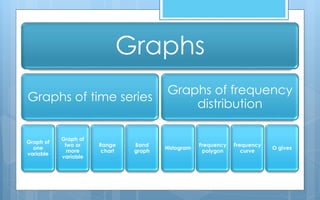
Graphs
Graphs of time series
Graph of
one
variable
Graph of
two or
more
variable
Range
chart
Band
graph
Graphs of frequency
distribution
Histogram
Frequency
polygon
Frequency
curve
O gives
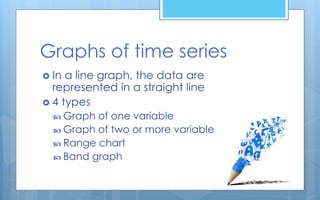
Graphs of time series
 In a line graph, the data are
represented in a straight line
 4 types
 Graph of one variable
 Graph of two or more variable
 Range chart
 Band graph
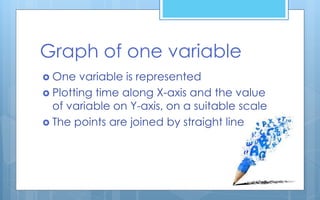
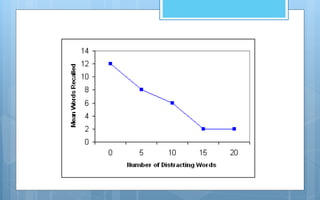
Graph of one variable
 One variable is represented
 Plotting time along X-axis and the value
of variable on Y-axis, on a suitable scale
 The points are joined by straight line
Graph of two or more
variable
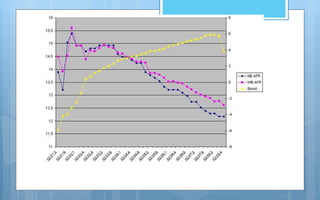
 Two or more variable are taken
 Comparison is easier in this type of
graph
Range chart
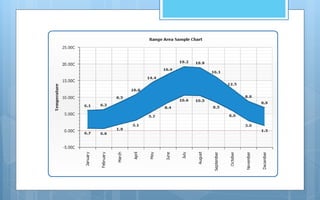
 Used to exhibit the minimum and
maximum values of a variable
 Eg., range of variation in temperature
on different days
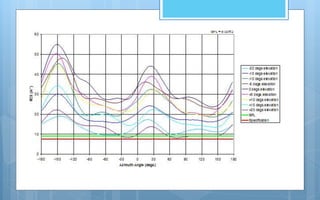
Band graph
 The various component parts are
represented
 Also called component part line chart
or layer chart
 The various component parts are
plotted and gaps between then are
shaded with different colours
Graphs of frequency
distribution
 Frequency distribution is represented
graphically
 4 types
 Histogram
 Frequency polygon
 Frequency curve
 O give
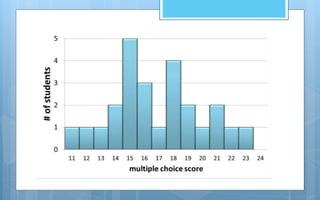
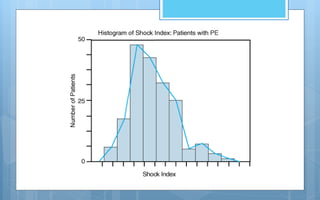
Histogram
 Graph with frequency as vertical
rectangles
 It is an area diagram
 X-axis with class intervals
 Y-axis with frequencies
 Vertical rectangles are to the height of
the frequencies
 Width equal to the range of the class
 It is two dimensional
Uses of histogram
 Gives clear of entire data
 Simplifies complex data
 Attractive and impressive
 Facilitates comparison
 Gives pattern distribution of variables in
the population
Frequency polygon
 Curve consisting of straight line
 Lines drawn by connecting points located
above the mid points of the intervals of
heights corresponding to frequencies
 Class intervals on X-axis and frequencies on
Y-axis
 Midpoint of various class intervals are taken
 The frequencies corresponding to each
midpoint and all points are joined
Uses of frequency polygon
 Used to locate mode of frequency
distribution easily
 It facilitates comparison of two or more
frequency distribution on the same
graph
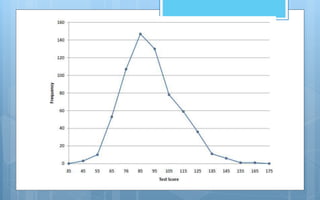
Frequency curve
 Drawn through various points of the
polygon
 Also called smoothed curve
 Smoothening of frequency polygon
gives frequency curve
 Should begin and end at OX axis
O gives
 They are cumulative frequency curve
 When frequencies re added called
cumulative frequencies
 Two methods
 ‘less than’ method
 ‘more than’ method
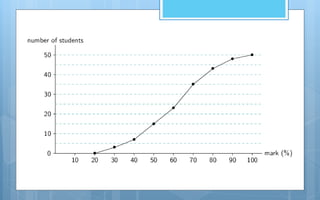
‘less than’ method
 we have to plot the less than cumulative
frequencies against upper class
boundaries
 Joining the points by a smooth free hand
gives ‘less than’ O gives
 Sloping from left to right
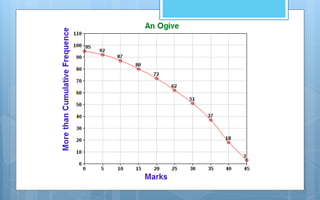
‘more than’ method
 we have to plot the more than
cumulative frequencies against upper
class boundaries
 Joining the points by a smooth free
hand gives ‘less than’ O gives
 Sloping from right to left
analysis and presentation of data

analysis and presentation of data

  • 1.
    Analysis and presentation of data Presentedby, M.Uma Maheshwari, M.Sc., M.Phil.
  • 3.
    Analysis of data Is of two types  Qualitative analysis  Quantitative analysis
  • 4.
    Qualitative analysis  Processof interpreting data collected during qualitative research  Analysis depends on its type
  • 5.
     Presenting andinterpreting numerical data  Includes descriptive analysis and inferential statistics  Descriptive statistics include measures of central tendency and measures of variability  Inferential statistics is to test hypotheses set and relating findings to the sample or population Quantitative analysis
  • 6.
    Descriptive statistics  Quantitativeresearch gives masses of data, in order to give an idea of typical values in the data and their variation  Two main descriptive statistics are  Measures of central tendency  Measures of dispersion
  • 7.
    Measures of central tendency “Ameasure of central tendency is a typical value around which other figures congregate” – Simpson and Kafka  Types  Arithmetic mean  Geometric mean mathematical averages  Harmonic mean calculated averages  Median  Mode
  • 8.
    Measures of dispersion “Dispersionis the measure of the variation of the items” – A.L.Bowley  Types  Absolute measures  Range  Quartile deviation  Mean deviation  Standard deviation  Relative measures  Coefficient of range  Coefficient of quartile deviation  Coefficient of mean deviation  Coefficient of standard deviation  Coefficient of range
  • 9.
    Inferential statistics  Itis impossible to measure every item in the population  There is an uncertainty as to how well the sample results reflects the population  Two aspects of statistical inference are  Estimation  Hypothesis testing using statistical tests
  • 11.
    Graphical presentation of data Thestatistical data represented in graph
  • 12.
    Graphs  Used toexplain the relationship between different variables  Geometrical image of data  Drawn on graph paper  Has two intersecting lines called axis- horizontal line called X-axis and vertical axis-Y axis
  • 13.
     A suitablescale is given  Independent values are in X-axis and dependent values on Y-axis  A title is given  The values corresponding to X and Y axis are plotted  The points are joined with straight or curved lines.
  • 14.
    Graphs Graphs of timeseries Graph of one variable Graph of two or more variable Range chart Band graph Graphs of frequency distribution Histogram Frequency polygon Frequency curve O gives
  • 15.
    Graphs of timeseries  In a line graph, the data are represented in a straight line  4 types  Graph of one variable  Graph of two or more variable  Range chart  Band graph
  • 16.
    Graph of onevariable  One variable is represented  Plotting time along X-axis and the value of variable on Y-axis, on a suitable scale  The points are joined by straight line
  • 18.
    Graph of twoor more variable  Two or more variable are taken  Comparison is easier in this type of graph
  • 20.
    Range chart  Usedto exhibit the minimum and maximum values of a variable  Eg., range of variation in temperature on different days
  • 22.
    Band graph  Thevarious component parts are represented  Also called component part line chart or layer chart  The various component parts are plotted and gaps between then are shaded with different colours
  • 24.
    Graphs of frequency distribution Frequency distribution is represented graphically  4 types  Histogram  Frequency polygon  Frequency curve  O give
  • 25.
    Histogram  Graph withfrequency as vertical rectangles  It is an area diagram  X-axis with class intervals  Y-axis with frequencies  Vertical rectangles are to the height of the frequencies  Width equal to the range of the class  It is two dimensional
  • 26.
    Uses of histogram Gives clear of entire data  Simplifies complex data  Attractive and impressive  Facilitates comparison  Gives pattern distribution of variables in the population
  • 28.
    Frequency polygon  Curveconsisting of straight line  Lines drawn by connecting points located above the mid points of the intervals of heights corresponding to frequencies  Class intervals on X-axis and frequencies on Y-axis  Midpoint of various class intervals are taken  The frequencies corresponding to each midpoint and all points are joined
  • 29.
    Uses of frequencypolygon  Used to locate mode of frequency distribution easily  It facilitates comparison of two or more frequency distribution on the same graph
  • 31.
    Frequency curve  Drawnthrough various points of the polygon  Also called smoothed curve  Smoothening of frequency polygon gives frequency curve  Should begin and end at OX axis
  • 33.
    O gives  Theyare cumulative frequency curve  When frequencies re added called cumulative frequencies  Two methods  ‘less than’ method  ‘more than’ method
  • 34.
    ‘less than’ method we have to plot the less than cumulative frequencies against upper class boundaries  Joining the points by a smooth free hand gives ‘less than’ O gives  Sloping from left to right
  • 36.
    ‘more than’ method we have to plot the more than cumulative frequencies against upper class boundaries  Joining the points by a smooth free hand gives ‘less than’ O gives  Sloping from right to left