Phosphate solubilization by Microorganism
INTRODUCTION
• Phosphorous is a major growth limiting nutrient. As like nitrogen, there is no large
atmospheric source that can be made biologically available .
• Phosphorous (P) plays an important role in plant growth and is the major plant growth
limiting nutrient despite its abundance in soils in both inorganic and organic forms .
• Phosphorus being a structural component of many coenzymes, phospho-proteins,
phospholipids and also forms a part of the genetic memory “DNA” of all living
organisms. It is involved in the transfer and storage of energy which is used for growth
and reproduction.
• Also, it plays the vital role in root elongation, proliferation, and its deficiency affects root
architecture seed development and normal crop maturity.
Phosphate solubilizing microorganism
• A large number of microbial organisms including bacteria,fungi,
actinomycetes, and algae exhibit P solubilization and mineralization
ability. Soil bacteria that have been reported to mobilize poorly
available phosphorus via solubilization and mineralization include
Pseudomonas spp., Agrobacterium spp., and Bacillus circulans.
• Soil fungi have been reported to be able to traverse long distances
within the soil more easily than bacteria and may be more important to
the solubilization of inorganic phosphate in soils as they typically
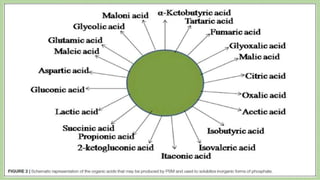
produce and secrete more acids, such as gluconic, citric, lactic, 2-
ketogluconic, oxalic, tartaric and acetic acid, than bacteria.
Diversity of PSM
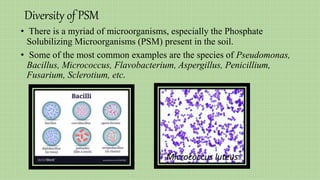
• There is a myriad of microorganisms, especially the Phosphate
Solubilizing Microorganisms (PSM) present in the soil.
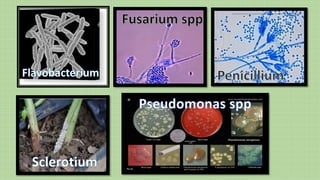
• Some of the most common examples are the species of Pseudomonas,
Bacillus, Micrococcus, Flavobacterium, Aspergillus, Penicillium,
Fusarium, Sclerotium, etc.
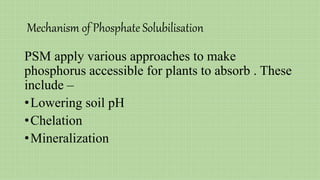
Micrococcus luteus
Mechanism of action of PSM
• Plants absorbs Phosphorus in only two soluble forms, the
monobasic(HPO4ˉ )and the dibasic(H2PO4ˉ ).
• Solubilizing Bacteria (PSB) enhance the solubilization of insoluble
phosphorous compounds through the release of organic acids and
phosphatase and phytase enzymes[4] which is present in a wide variety of
soil microorganisms.
• During the conversion process, a part of phosphorous is assimilated by
microorganisms, but the amount made soluble and released is in excess to
the requirement of the microorganisms.
• The excess amount thus released is made available to plants. During this
conversion process, organic acids play an important role.
• Equally important are nitric acid and sulphuric acid. As a result, these
organic and inorganic acids convert calcium phosphate to di or monobasic
phosphates and are then easily made available to plants phosphates .
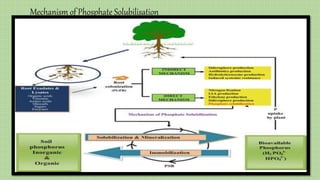
Mechanism of Phosphate Solubilisation
PSM apply various approaches to make
phosphorus accessible for plants to absorb . These
include –
•Lowering soil pH
•Chelation
•Mineralization
Mechanism of Phosphate Solubilisation
MECHANISMS OF INORGANIC
PHOSPHATE SOLUBILIZATION BY PSM
• The principal mechanism is the production of mineral dissolving
compounds such as organic acids, siderophores, protons,hydroxyl ions
and CO2.
• Organic acids produced together with their carboxyl and hydroxyl ions
chelate cations or reduce the pH to release P.
• The excretion of these organic acids is accompanied by a drop in pH
that results in the acidification of the microbial cells and the
surroundings, hence, P ions are released by substitution of H+ for
Ca2+
Why phosphorus is important for plants?
Phosphorus is a component of the complex nucleic acid structure of plants,
which regulates protein synthesis.
Phosphorus is, therefore, important in cell division and development of new
tissue. Phosphorus is also associated with complex energy transformations in
the plant.
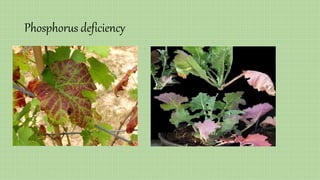
Plants deficient in phosphorus are stunted in growth and often have an
abnormal dark-green color.
Sugars can accumulate and cause anthocyanin pigments to develop,
producing a reddish-purple color. This can sometimes be seen in early spring on
low phosphorus sites. These symptoms usually only persist on extremely low
phosphorus soils.
Phosphorus deficiency
FACTORS INFLUENCING MICROBIAL
PHOSPHATE SOLUBILIZATION
• The nutritional richness of the soil, and the physiological and growth status
of the organism.
• PSM from soils from environmental extremes such as saline alkaline soils,
soil with a high level of nutrient deficiency, or soil from extreme
temperature environments have the tendency to solubilize more phosphate
than PSM from soils from more moderate conditions
• There has been a conflicting report on the influence of temperature on
phosphorus solubilization by microbes. White et al. (1997) found 20–25C as
the optimum temperature for maximum microbial phosphorus solubilization
• interactions with other microorganisms in the soil, the extent of vegetation,
ecological conditions, climatic zone soil types, plant types, agronomic
practices, land use systems,and the soil’s physicochemical properties such
as organic matter and soil pH.
BENEFITS OF PHOSPHORUS
SOLUBILIZING MICROORGANISM
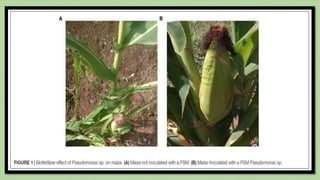
• Phosphorus accumulated in soils, PSMs that are capable of
transforming insoluble phosphorus to soluble forms can function as
biofertilizers.
• This increases the soluble phosphorus content .The use of phosphorus
biofertilizers is a promising approach to improving food production
through enhancing agricultural yield as it is better to use an
environmentally friendly approach to solve the problems of infertile
soil.
Conclusion
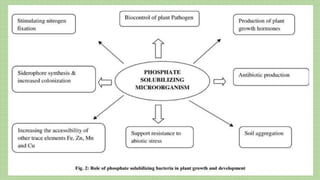
• It is attractive to speculate that PSM through their mechanism of
action can stimulate plant's nutritional intake capacity and growth as
well.
• Because of phosphate solubilization, auxin, and HCN production
ability, it is very obvious that these microorganisms (PSM) should be
exploited more and could be used as an efficient alternative to
inorganic phosphate fertilizers in future.
• Extensive research work needed to be done to achieve methods how to
commercialize these PSM as biofertilizers. Greater attention should be
paid towards the improvement of PSM strains
Saif ppt phosphate solubilisation

Saif ppt phosphate solubilisation

  • 1.
  • 2.
    INTRODUCTION • Phosphorous isa major growth limiting nutrient. As like nitrogen, there is no large atmospheric source that can be made biologically available . • Phosphorous (P) plays an important role in plant growth and is the major plant growth limiting nutrient despite its abundance in soils in both inorganic and organic forms . • Phosphorus being a structural component of many coenzymes, phospho-proteins, phospholipids and also forms a part of the genetic memory “DNA” of all living organisms. It is involved in the transfer and storage of energy which is used for growth and reproduction. • Also, it plays the vital role in root elongation, proliferation, and its deficiency affects root architecture seed development and normal crop maturity.
  • 4.
    Phosphate solubilizing microorganism •A large number of microbial organisms including bacteria,fungi, actinomycetes, and algae exhibit P solubilization and mineralization ability. Soil bacteria that have been reported to mobilize poorly available phosphorus via solubilization and mineralization include Pseudomonas spp., Agrobacterium spp., and Bacillus circulans. • Soil fungi have been reported to be able to traverse long distances within the soil more easily than bacteria and may be more important to the solubilization of inorganic phosphate in soils as they typically produce and secrete more acids, such as gluconic, citric, lactic, 2- ketogluconic, oxalic, tartaric and acetic acid, than bacteria.
  • 5.
    Diversity of PSM •There is a myriad of microorganisms, especially the Phosphate Solubilizing Microorganisms (PSM) present in the soil. • Some of the most common examples are the species of Pseudomonas, Bacillus, Micrococcus, Flavobacterium, Aspergillus, Penicillium, Fusarium, Sclerotium, etc. Micrococcus luteus
  • 7.
    Mechanism of actionof PSM • Plants absorbs Phosphorus in only two soluble forms, the monobasic(HPO4ˉ )and the dibasic(H2PO4ˉ ). • Solubilizing Bacteria (PSB) enhance the solubilization of insoluble phosphorous compounds through the release of organic acids and phosphatase and phytase enzymes[4] which is present in a wide variety of soil microorganisms. • During the conversion process, a part of phosphorous is assimilated by microorganisms, but the amount made soluble and released is in excess to the requirement of the microorganisms. • The excess amount thus released is made available to plants. During this conversion process, organic acids play an important role. • Equally important are nitric acid and sulphuric acid. As a result, these organic and inorganic acids convert calcium phosphate to di or monobasic phosphates and are then easily made available to plants phosphates .
  • 8.
    Mechanism of PhosphateSolubilisation PSM apply various approaches to make phosphorus accessible for plants to absorb . These include – •Lowering soil pH •Chelation •Mineralization
  • 9.
    Mechanism of PhosphateSolubilisation
  • 10.
    MECHANISMS OF INORGANIC PHOSPHATESOLUBILIZATION BY PSM • The principal mechanism is the production of mineral dissolving compounds such as organic acids, siderophores, protons,hydroxyl ions and CO2. • Organic acids produced together with their carboxyl and hydroxyl ions chelate cations or reduce the pH to release P. • The excretion of these organic acids is accompanied by a drop in pH that results in the acidification of the microbial cells and the surroundings, hence, P ions are released by substitution of H+ for Ca2+
  • 11.
    Why phosphorus isimportant for plants? Phosphorus is a component of the complex nucleic acid structure of plants, which regulates protein synthesis. Phosphorus is, therefore, important in cell division and development of new tissue. Phosphorus is also associated with complex energy transformations in the plant. Plants deficient in phosphorus are stunted in growth and often have an abnormal dark-green color. Sugars can accumulate and cause anthocyanin pigments to develop, producing a reddish-purple color. This can sometimes be seen in early spring on low phosphorus sites. These symptoms usually only persist on extremely low phosphorus soils.
  • 12.
  • 14.
    FACTORS INFLUENCING MICROBIAL PHOSPHATESOLUBILIZATION • The nutritional richness of the soil, and the physiological and growth status of the organism. • PSM from soils from environmental extremes such as saline alkaline soils, soil with a high level of nutrient deficiency, or soil from extreme temperature environments have the tendency to solubilize more phosphate than PSM from soils from more moderate conditions • There has been a conflicting report on the influence of temperature on phosphorus solubilization by microbes. White et al. (1997) found 20–25C as the optimum temperature for maximum microbial phosphorus solubilization • interactions with other microorganisms in the soil, the extent of vegetation, ecological conditions, climatic zone soil types, plant types, agronomic practices, land use systems,and the soil’s physicochemical properties such as organic matter and soil pH.
  • 15.
    BENEFITS OF PHOSPHORUS SOLUBILIZINGMICROORGANISM • Phosphorus accumulated in soils, PSMs that are capable of transforming insoluble phosphorus to soluble forms can function as biofertilizers. • This increases the soluble phosphorus content .The use of phosphorus biofertilizers is a promising approach to improving food production through enhancing agricultural yield as it is better to use an environmentally friendly approach to solve the problems of infertile soil.
  • 18.
    Conclusion • It isattractive to speculate that PSM through their mechanism of action can stimulate plant's nutritional intake capacity and growth as well. • Because of phosphate solubilization, auxin, and HCN production ability, it is very obvious that these microorganisms (PSM) should be exploited more and could be used as an efficient alternative to inorganic phosphate fertilizers in future. • Extensive research work needed to be done to achieve methods how to commercialize these PSM as biofertilizers. Greater attention should be paid towards the improvement of PSM strains