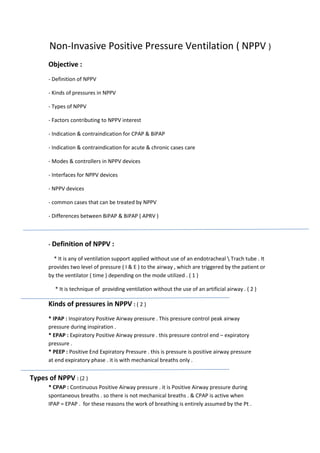
Non-Invasive Positive Pressure Ventilation ( NPPV )
Objective :
- Definition of NPPV
- Kinds of pressures in NPPV
- Types of NPPV
- Factors contributing to NPPV interest
- Indication & contraindication for CPAP & BiPAP
- Indication & contraindication for acute & chronic cases care
- Modes & controllers in NPPV devices
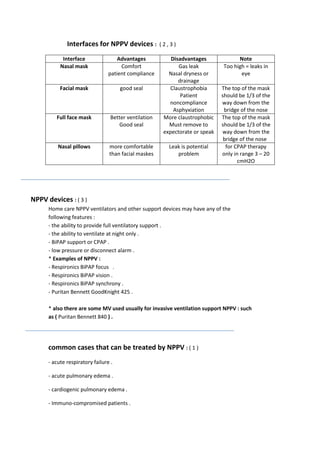
- Interfaces for NPPV devices
- NPPV devices
- common cases that can be treated by NPPV
- Differences between BiPAP & BiPAP ( APRV )

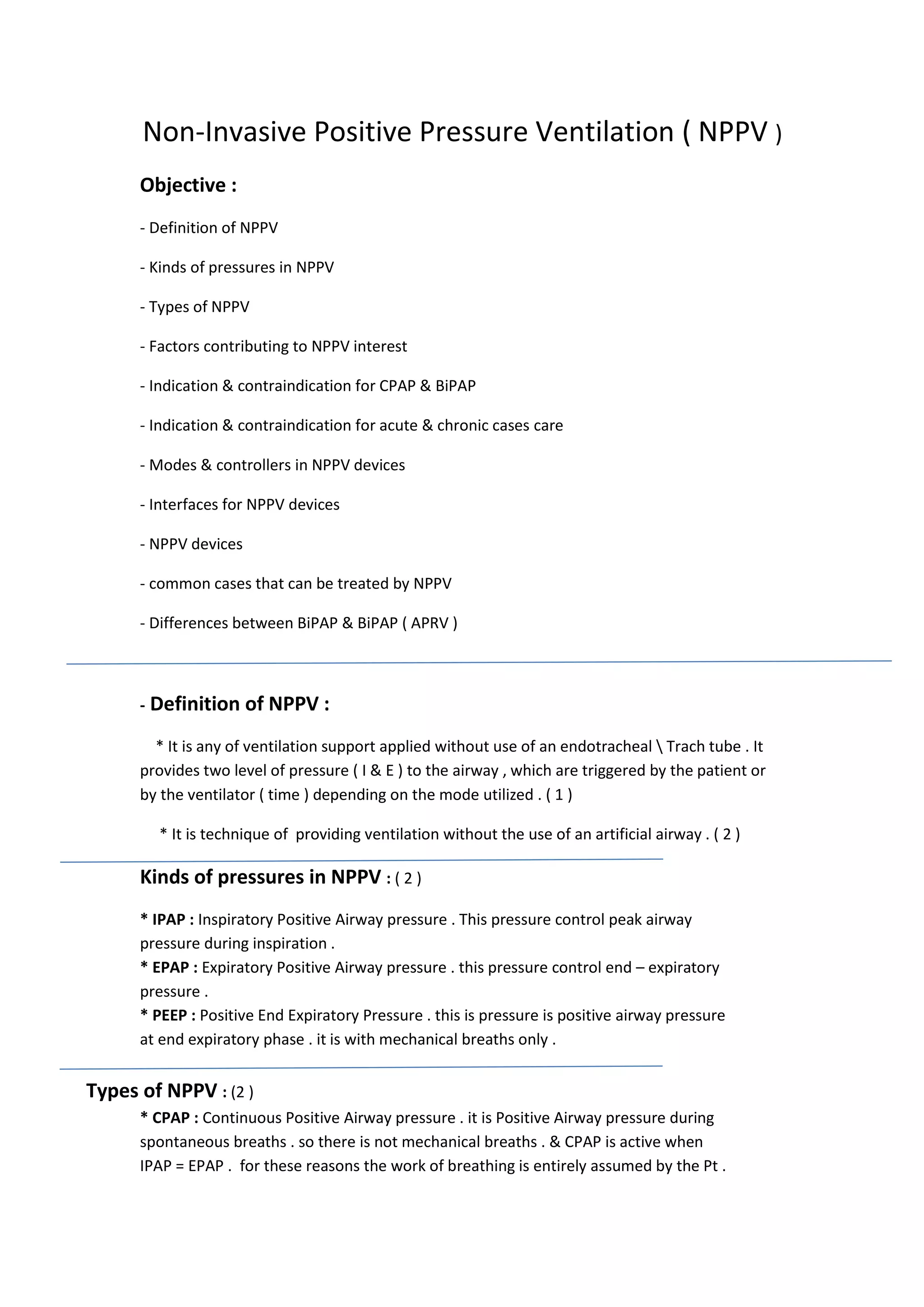
- Definition of NPPV :
* It is any of ventilation support applied without use of an endotracheal  Trach tube . It
provides two level of pressure ( I & E ) to the airway , which are triggered by the patient or
by the ventilator ( time ) depending on the mode utilized . ( 1 )
* It is technique of providing ventilation without the use of an artificial airway . ( 2 )

Kinds of pressures in NPPV : ( 2 )
* IPAP : Inspiratory Positive Airway pressure . This pressure control peak airway
pressure during inspiration .
* EPAP : Expiratory Positive Airway pressure . this pressure control end – expiratory
pressure .
* PEEP : Positive End Expiratory Pressure . this is pressure is positive airway pressure
at end expiratory phase . it is with mechanical breaths only .

Types of NPPV : (2 )
* CPAP : Continuous Positive Airway pressure . it is Positive Airway pressure during
spontaneous breaths . so there is not mechanical breaths . & CPAP is active when
IPAP = EPAP . for these reasons the work of breathing is entirely assumed by the Pt .
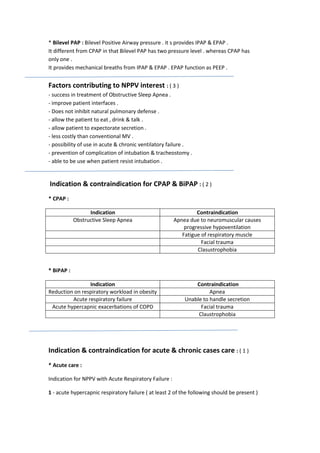
* Bilevel PAP : Bilevel Positive Airway pressure . it s provides IPAP & EPAP .
It different from CPAP in that Bilevel PAP has two pressure level . whereas CPAP has
only one .
It provides mechanical breaths from IPAP & EPAP . EPAP function as PEEP .

Factors contributing to NPPV interest : ( 3 )
- success in treatment of Obstructive Sleep Apnea .
- improve patient interfaces .
- Does not inhibit natural pulmonary defense .
- allow the patient to eat , drink & talk .
- allow patient to expectorate secretion .
- less costly than conventional MV .
- possibility of use in acute & chronic ventilatory failure .
- prevention of complication of intubation & tracheostomy .
- able to be use when patient resist intubation .

Indication & contraindication for CPAP & BiPAP : ( 2 )
* CPAP :
Indication
Obstructive Sleep Apnea

Contraindication
Apnea due to neuromuscular causes
progressive hypoventilation
Fatigue of respiratory muscle
Facial trauma
Clasustrophobia

Indication
Reduction on respiratory workload in obesity
Acute respiratory failure
Acute hypercapnic exacerbations of COPD

Contraindication
Apnea
Unable to handle secretion
Facial trauma
Claustrophobia

* BiPAP :

Indication & contraindication for acute & chronic cases care : ( 1 )
* Acute care :
Indication for NPPV with Acute Respiratory Failure :
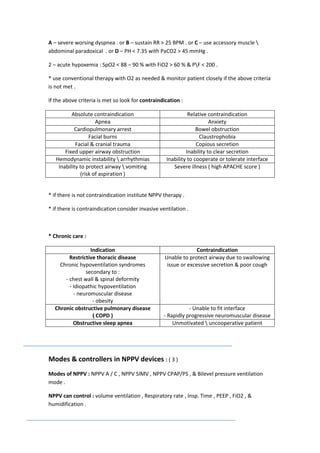
1 - acute hypercapnic respiratory failure ( at least 2 of the following should be present )
A – severe worsing dyspnea . or B – sustain RR > 25 BPM . or C – use accessory muscle 
abdominal paradoxical . or D – PH < 7.35 with PaCO2 > 45 mmHg .
2 – acute hypoxemia : SpO2 < 88 – 90 % with FiO2 > 60 % & PF < 200 .
* use conventional therapy with O2 as needed & monitor patient closely if the above criteria
is not met .
If the above criteria is met so look for contraindication :
Absolute contraindication
Apnea
Cardiopulmonary arrest
Facial burns
Facial & cranial trauma
Fixed upper airway obstruction
Hemodynamic instability  arrhythmias
Inability to protect airway  vomiting
(risk of aspiration )

Relative contraindication
Anxiety
Bowel obstruction
Claustrophobia
Copious secretion
Inability to clear secretion
Inability to cooperate or tolerate interface
Severe illness ( high APACHE score )

* if there is not contraindication institute NPPV therapy .
* if there is contraindication consider invasive ventilation .

* Chronic care :
Indication
Restrictive thoracic disease
Chronic hypoventilation syndromes
secondary to :
- chest wall & spinal deformity
- Idiopathic hypoventilation
- neuromuscular disease
- obesity
Chronic obstructive pulmonary disease
( COPD )
Obstructive sleep apnea

Contraindication
Unable to protect airway due to swallowing
issue or excessive secretion & poor cough

- Unable to fit interface
- Rapidly progressive neuromuscular disease
Unmotivated  uncooperative patient

Modes & controllers in NPPV devices : ( 3 )
Modes of NPPV : NPPV A / C , NPPV SIMV , NPPV CPAP/PS , & Bilevel pressure ventilation
mode .
NPPV can control : volume ventilation , Respiratory rate , Insp. Time , PEEP , FiO2 , &
humidification .
Interfaces for NPPV devices :
Interface
Nasal mask

Advantages
Comfort
patient compliance

Facial mask

good seal

Full face mask

Better ventilation
Good seal

Nasal pillows

more comfortable
than facial maskes

(2,3)
Disadvantages
Gas leak
Nasal dryness or
drainage
Claustrophobia
Patient
noncompliance
Asphyxiation
More claustrophobic
Must remove to
expectorate or speak
Leak is potential
problem

Note
Too high = leaks in
eye
The top of the mask
should be 1/3 of the
way down from the
bridge of the nose
The top of the mask
should be 1/3 of the
way down from the
bridge of the nose
for CPAP therapy
only in range 3 – 20
cmH2O

NPPV devices : ( 3 )
Home care NPPV ventilators and other support devices may have any of the
following features :
- the ability to provide full ventilatory support .
- the ability to ventilate at night only .
- BiPAP support or CPAP .
- low pressure or disconnect alarm .
* Examples of NPPV :
- Respironics BiPAP focus .
- Respironics BiPAP vision .
- Respironics BiPAP synchrony .
- Puritan Bennett GoodKnight 425 .
* also there are some MV used usually for invasive ventilation support NPPV : such
as ( Puritan Bennett 840 ) .

common cases that can be treated by NPPV : ( 1 )
- acute respiratory failure .
- acute pulmonary edema .
- cardiogenic pulmonary edema .
- Immuno-compromised patients .
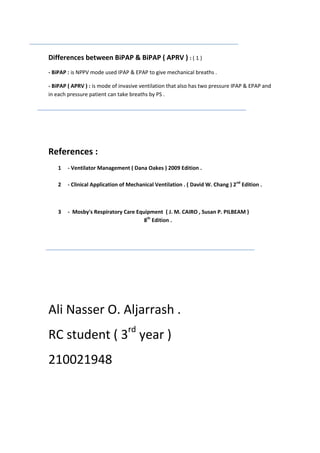
Differences between BiPAP & BiPAP ( APRV ) : ( 1 )
- BiPAP : is NPPV mode used IPAP & EPAP to give mechanical breaths .
- BiPAP ( APRV ) : is mode of invasive ventilation that also has two pressure IPAP & EPAP and
in each pressure patient can take breaths by PS .

References :
1

- Ventilator Management ( Dana Oakes ) 2009 Edition .

2

- Clinical Application of Mechanical Ventilation . ( David W. Chang ) 2nd Edition .

3

- Mosby's Respiratory Care Equipment ( J. M. CAIRO , Susan P. PILBEAM )
8th Edition .

Ali Nasser O. Aljarrash .
RC student ( 3rd year )
210021948

NIPPV by Ali Nasser O. Aljarrash

  • 1.
    Non-Invasive Positive PressureVentilation ( NPPV ) Objective : - Definition of NPPV - Kinds of pressures in NPPV - Types of NPPV - Factors contributing to NPPV interest - Indication & contraindication for CPAP & BiPAP - Indication & contraindication for acute & chronic cases care - Modes & controllers in NPPV devices - Interfaces for NPPV devices - NPPV devices - common cases that can be treated by NPPV - Differences between BiPAP & BiPAP ( APRV ) - Definition of NPPV : * It is any of ventilation support applied without use of an endotracheal Trach tube . It provides two level of pressure ( I & E ) to the airway , which are triggered by the patient or by the ventilator ( time ) depending on the mode utilized . ( 1 ) * It is technique of providing ventilation without the use of an artificial airway . ( 2 ) Kinds of pressures in NPPV : ( 2 ) * IPAP : Inspiratory Positive Airway pressure . This pressure control peak airway pressure during inspiration . * EPAP : Expiratory Positive Airway pressure . this pressure control end – expiratory pressure . * PEEP : Positive End Expiratory Pressure . this is pressure is positive airway pressure at end expiratory phase . it is with mechanical breaths only . Types of NPPV : (2 ) * CPAP : Continuous Positive Airway pressure . it is Positive Airway pressure during spontaneous breaths . so there is not mechanical breaths . & CPAP is active when IPAP = EPAP . for these reasons the work of breathing is entirely assumed by the Pt .
  • 2.
    * Bilevel PAP: Bilevel Positive Airway pressure . it s provides IPAP & EPAP . It different from CPAP in that Bilevel PAP has two pressure level . whereas CPAP has only one . It provides mechanical breaths from IPAP & EPAP . EPAP function as PEEP . Factors contributing to NPPV interest : ( 3 ) - success in treatment of Obstructive Sleep Apnea . - improve patient interfaces . - Does not inhibit natural pulmonary defense . - allow the patient to eat , drink & talk . - allow patient to expectorate secretion . - less costly than conventional MV . - possibility of use in acute & chronic ventilatory failure . - prevention of complication of intubation & tracheostomy . - able to be use when patient resist intubation . Indication & contraindication for CPAP & BiPAP : ( 2 ) * CPAP : Indication Obstructive Sleep Apnea Contraindication Apnea due to neuromuscular causes progressive hypoventilation Fatigue of respiratory muscle Facial trauma Clasustrophobia Indication Reduction on respiratory workload in obesity Acute respiratory failure Acute hypercapnic exacerbations of COPD Contraindication Apnea Unable to handle secretion Facial trauma Claustrophobia * BiPAP : Indication & contraindication for acute & chronic cases care : ( 1 ) * Acute care : Indication for NPPV with Acute Respiratory Failure : 1 - acute hypercapnic respiratory failure ( at least 2 of the following should be present )
  • 3.
    A – severeworsing dyspnea . or B – sustain RR > 25 BPM . or C – use accessory muscle abdominal paradoxical . or D – PH < 7.35 with PaCO2 > 45 mmHg . 2 – acute hypoxemia : SpO2 < 88 – 90 % with FiO2 > 60 % & PF < 200 . * use conventional therapy with O2 as needed & monitor patient closely if the above criteria is not met . If the above criteria is met so look for contraindication : Absolute contraindication Apnea Cardiopulmonary arrest Facial burns Facial & cranial trauma Fixed upper airway obstruction Hemodynamic instability arrhythmias Inability to protect airway vomiting (risk of aspiration ) Relative contraindication Anxiety Bowel obstruction Claustrophobia Copious secretion Inability to clear secretion Inability to cooperate or tolerate interface Severe illness ( high APACHE score ) * if there is not contraindication institute NPPV therapy . * if there is contraindication consider invasive ventilation . * Chronic care : Indication Restrictive thoracic disease Chronic hypoventilation syndromes secondary to : - chest wall & spinal deformity - Idiopathic hypoventilation - neuromuscular disease - obesity Chronic obstructive pulmonary disease ( COPD ) Obstructive sleep apnea Contraindication Unable to protect airway due to swallowing issue or excessive secretion & poor cough - Unable to fit interface - Rapidly progressive neuromuscular disease Unmotivated uncooperative patient Modes & controllers in NPPV devices : ( 3 ) Modes of NPPV : NPPV A / C , NPPV SIMV , NPPV CPAP/PS , & Bilevel pressure ventilation mode . NPPV can control : volume ventilation , Respiratory rate , Insp. Time , PEEP , FiO2 , & humidification .
  • 4.
    Interfaces for NPPVdevices : Interface Nasal mask Advantages Comfort patient compliance Facial mask good seal Full face mask Better ventilation Good seal Nasal pillows more comfortable than facial maskes (2,3) Disadvantages Gas leak Nasal dryness or drainage Claustrophobia Patient noncompliance Asphyxiation More claustrophobic Must remove to expectorate or speak Leak is potential problem Note Too high = leaks in eye The top of the mask should be 1/3 of the way down from the bridge of the nose The top of the mask should be 1/3 of the way down from the bridge of the nose for CPAP therapy only in range 3 – 20 cmH2O NPPV devices : ( 3 ) Home care NPPV ventilators and other support devices may have any of the following features : - the ability to provide full ventilatory support . - the ability to ventilate at night only . - BiPAP support or CPAP . - low pressure or disconnect alarm . * Examples of NPPV : - Respironics BiPAP focus . - Respironics BiPAP vision . - Respironics BiPAP synchrony . - Puritan Bennett GoodKnight 425 . * also there are some MV used usually for invasive ventilation support NPPV : such as ( Puritan Bennett 840 ) . common cases that can be treated by NPPV : ( 1 ) - acute respiratory failure . - acute pulmonary edema . - cardiogenic pulmonary edema . - Immuno-compromised patients .
  • 5.
    Differences between BiPAP& BiPAP ( APRV ) : ( 1 ) - BiPAP : is NPPV mode used IPAP & EPAP to give mechanical breaths . - BiPAP ( APRV ) : is mode of invasive ventilation that also has two pressure IPAP & EPAP and in each pressure patient can take breaths by PS . References : 1 - Ventilator Management ( Dana Oakes ) 2009 Edition . 2 - Clinical Application of Mechanical Ventilation . ( David W. Chang ) 2nd Edition . 3 - Mosby's Respiratory Care Equipment ( J. M. CAIRO , Susan P. PILBEAM ) 8th Edition . Ali Nasser O. Aljarrash . RC student ( 3rd year ) 210021948