Less invasive methods of
advanced
hemodynamic monitoring
DR GHALEB ALMEKHLAFI
CONSULTANT CCM
PSMMC AUG 2014
1
Introduction
•Hemodynamics is
concerned with the
forces generated in the
cardiovascular system
2
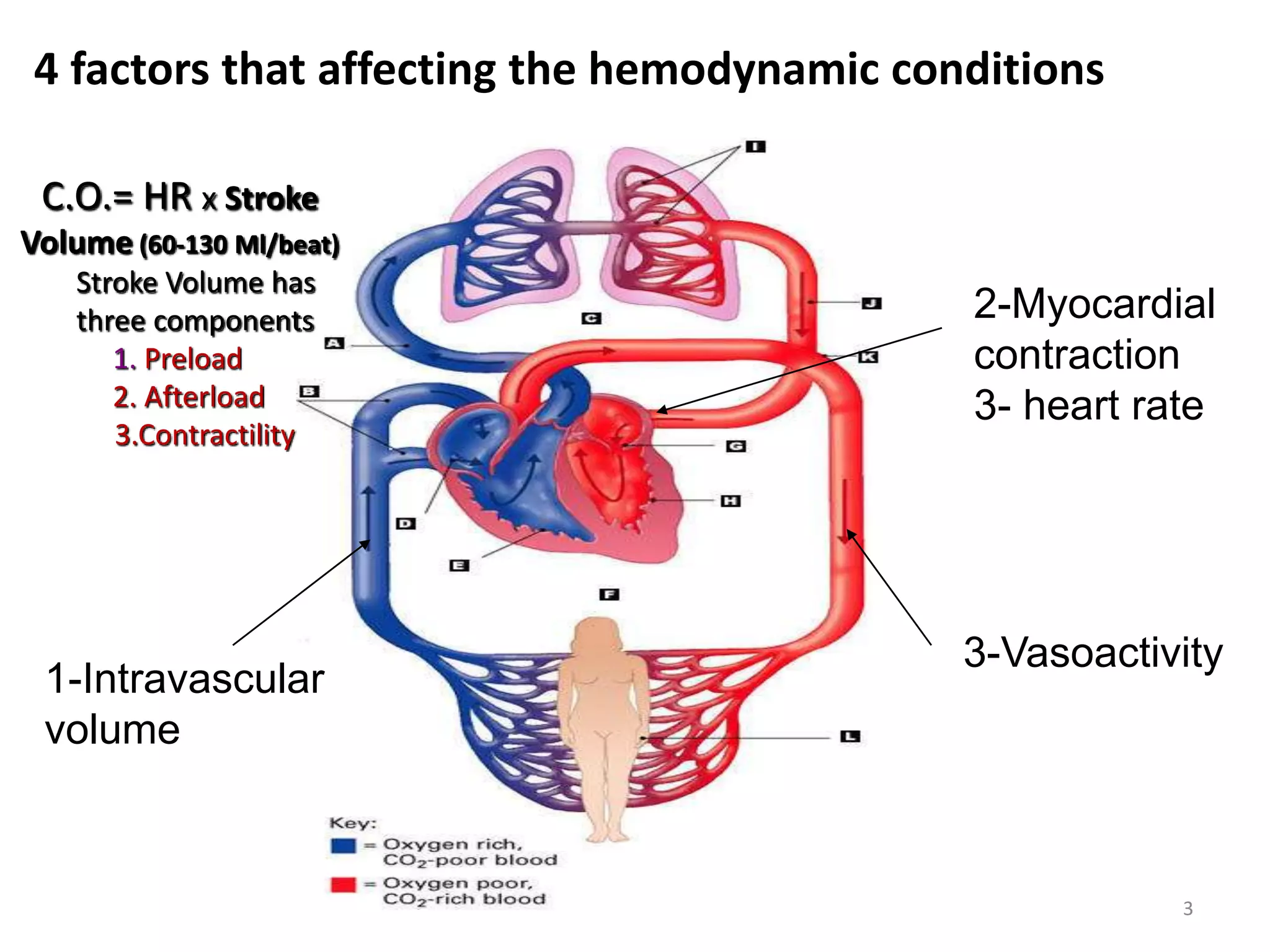
1-Intravascular
volume
2-Myocardial
contraction
3- heart rate
3-Vasoactivity
4 factors that affecting the hemodynamic conditions
C.O.= HR x Stroke
Volume (60-130 Ml/beat)
Stroke Volume has
three components
1. Preload
2. Afterload
3.Contractility
3
Hemodynamic Monitoring Truth
•No monitoring device will
improve outcome, Unless
coupled to a treatment,
which improves outcome.
Pinsky & Payen. Functional Hemodynamic Monitoring, Springer, 2004
4
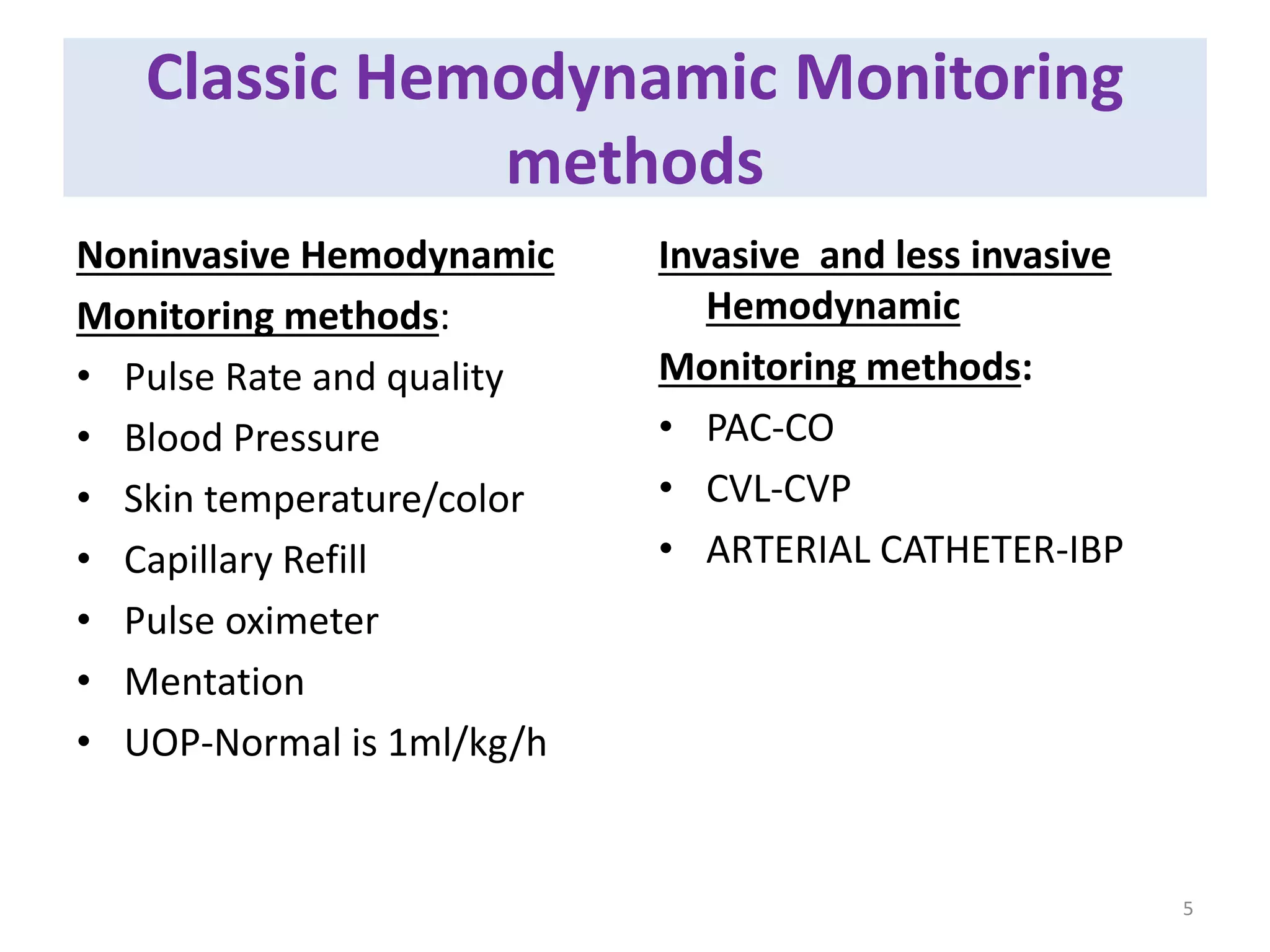
Classic Hemodynamic Monitoring
methods
Noninvasive Hemodynamic
Monitoring methods:
• Pulse Rate and quality
• Blood Pressure
• Skin temperature/color
• Capillary Refill
• Pulse oximeter
• Mentation
• UOP-Normal is 1ml/kg/h
Invasive and less invasive
Hemodynamic
Monitoring methods:
• PAC-CO
• CVL-CVP
• ARTERIAL CATHETER-IBP
5
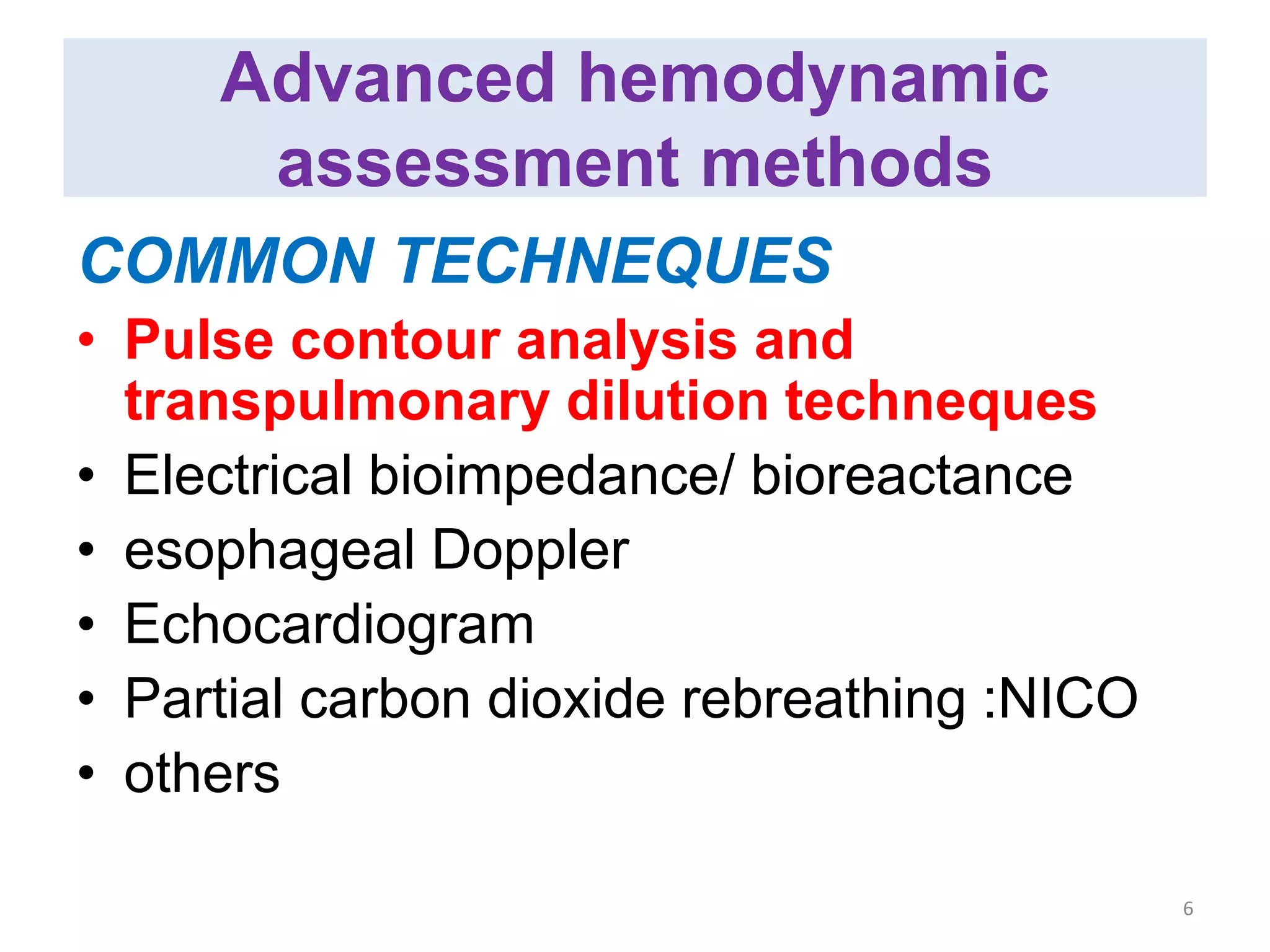
Advanced hemodynamic
assessment methods
COMMON TECHNEQUES
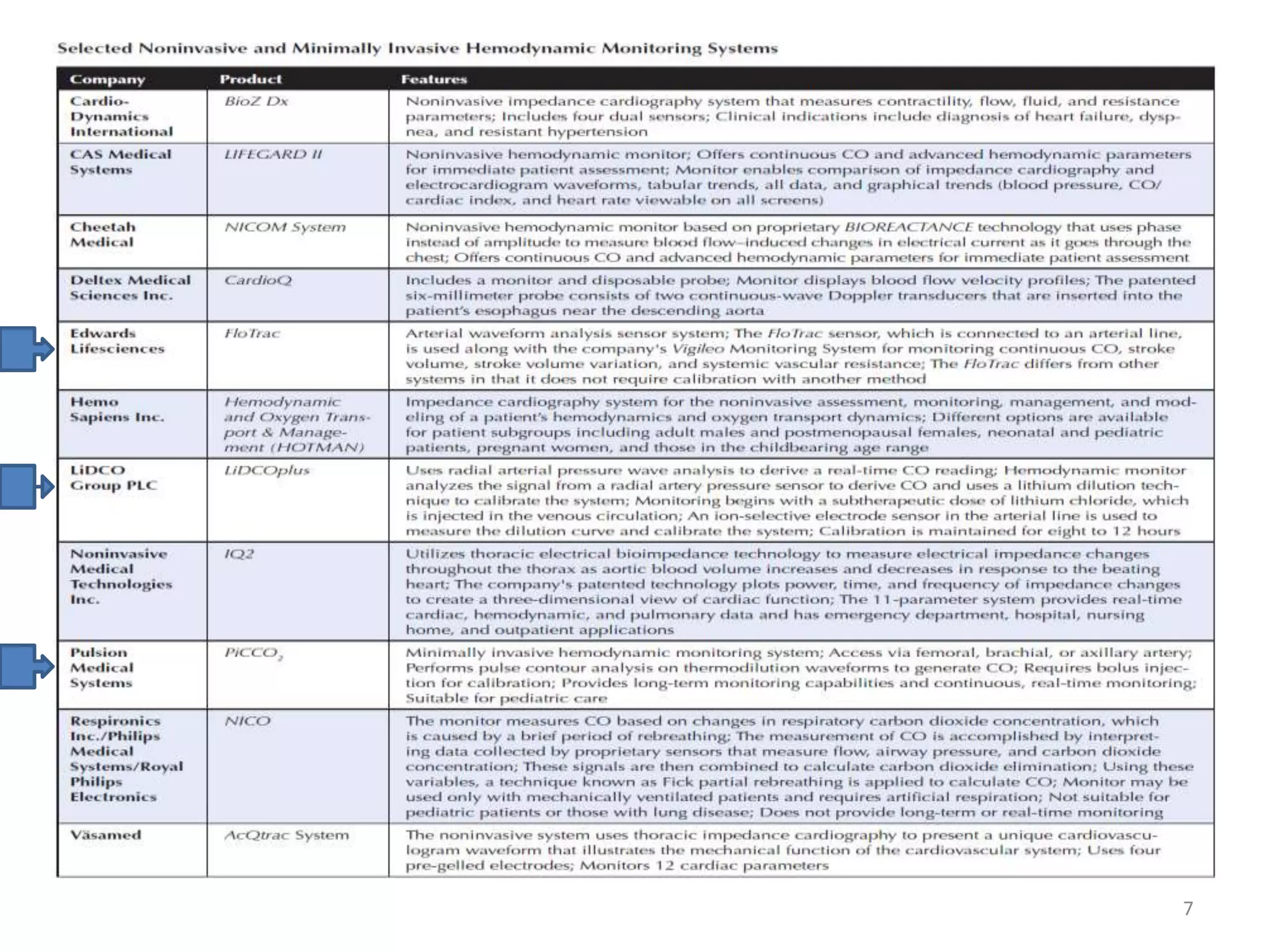
• Pulse contour analysis and
transpulmonary dilution techneques
• Electrical bioimpedance/ bioreactance
• esophageal Doppler
• Echocardiogram
• Partial carbon dioxide rebreathing :NICO
• others
6
7
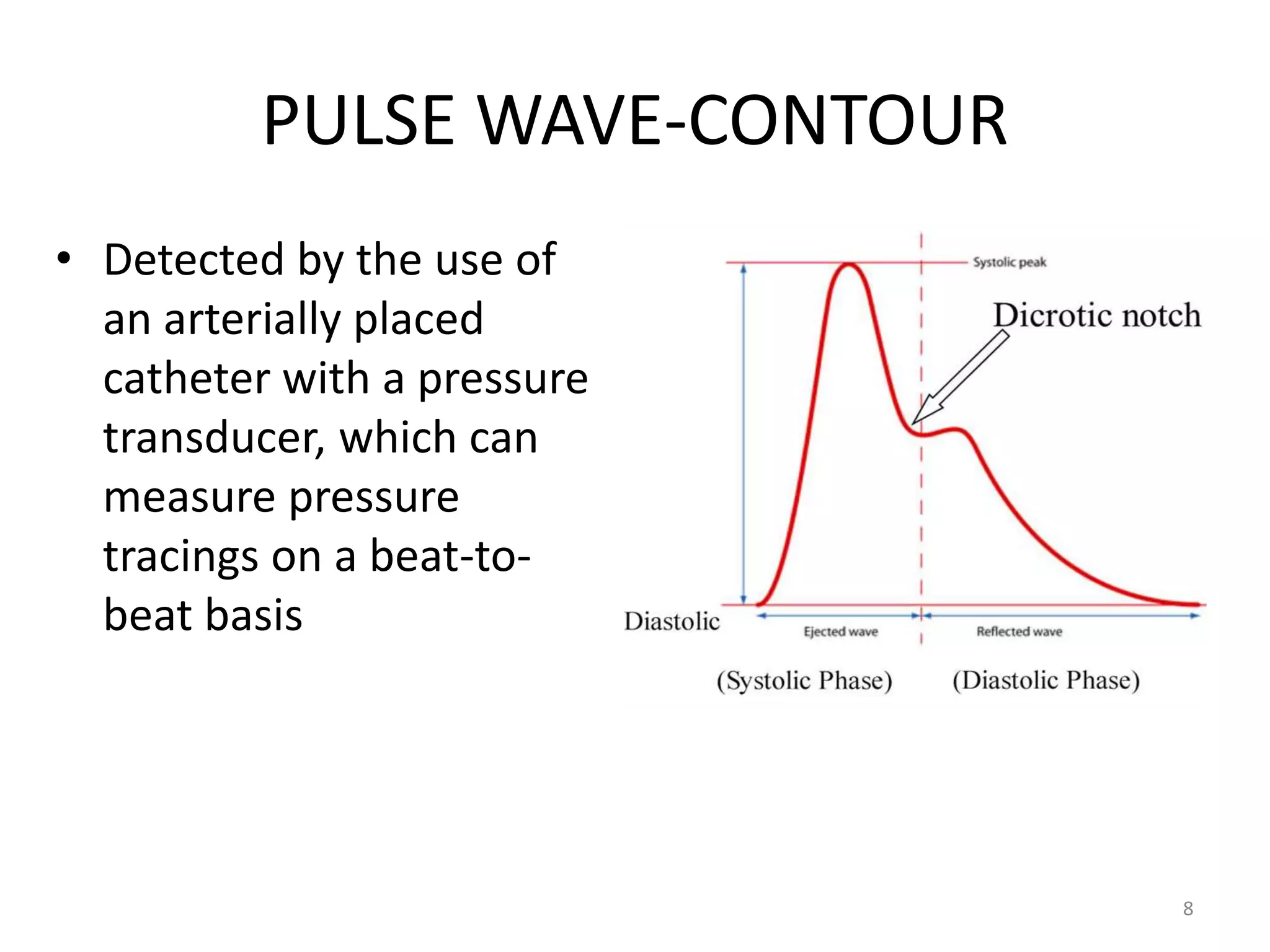
PULSE WAVE-CONTOUR
• Detected by the use of
an arterially placed
catheter with a pressure
transducer, which can
measure pressure
tracings on a beat-to-
beat basis
8
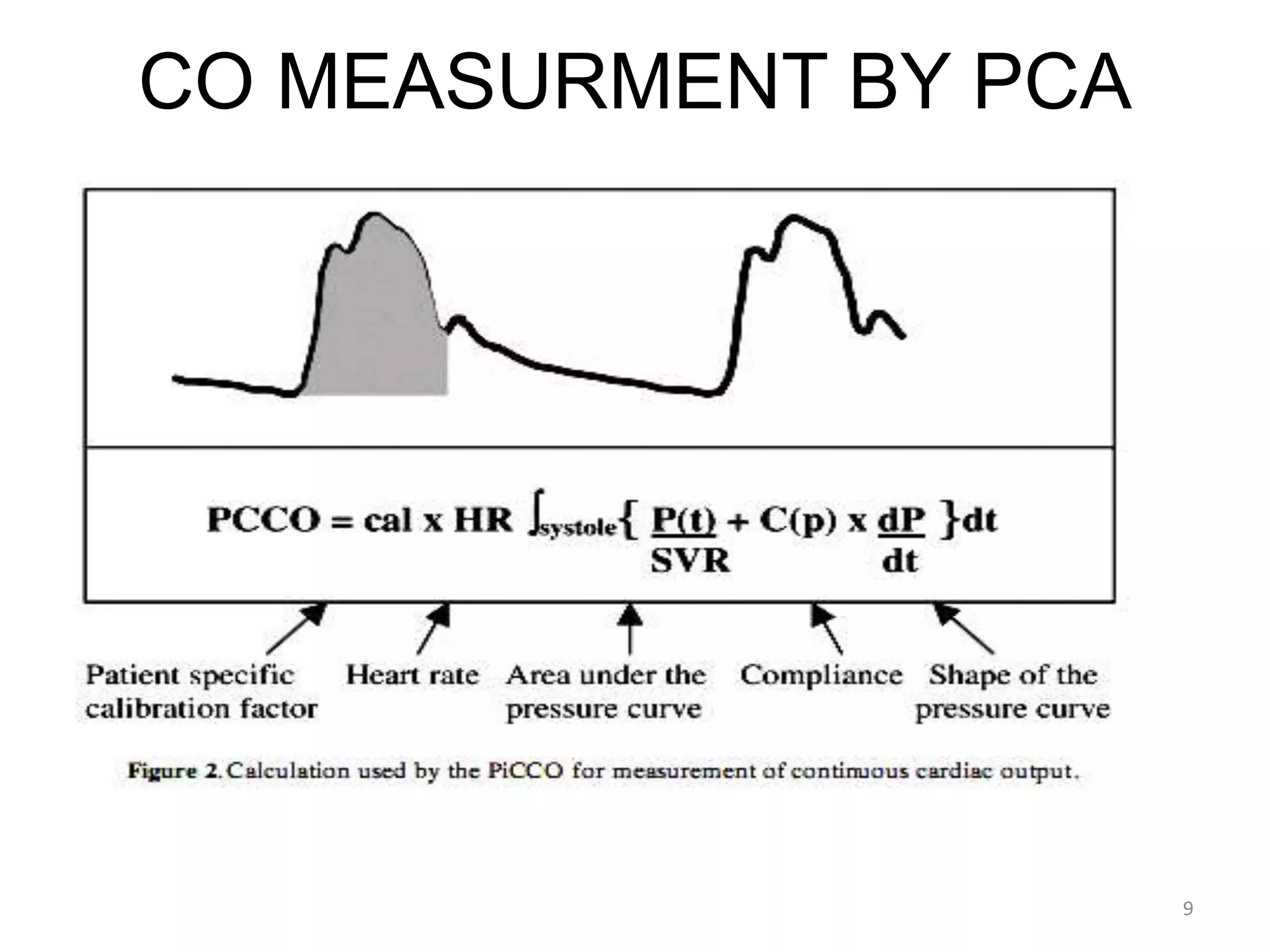
CO MEASURMENT BY PCA
9
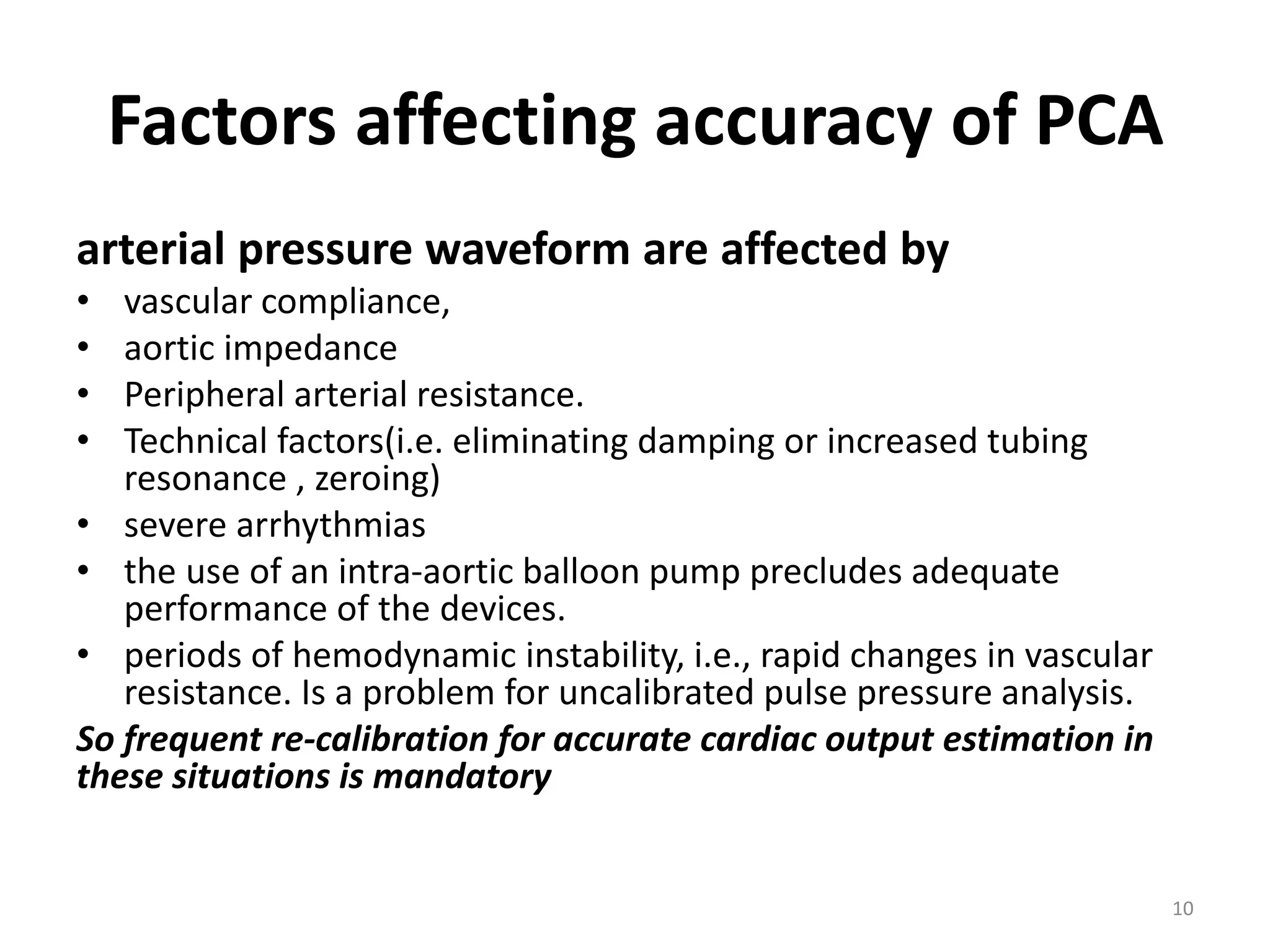
Factors affecting accuracy of PCA
arterial pressure waveform are affected by
• vascular compliance,
• aortic impedance
• Peripheral arterial resistance.
• Technical factors(i.e. eliminating damping or increased tubing
resonance , zeroing)
• severe arrhythmias
• the use of an intra-aortic balloon pump precludes adequate
performance of the devices.
• periods of hemodynamic instability, i.e., rapid changes in vascular
resistance. Is a problem for uncalibrated pulse pressure analysis.
So frequent re-calibration for accurate cardiac output estimation in
these situations is mandatory
10
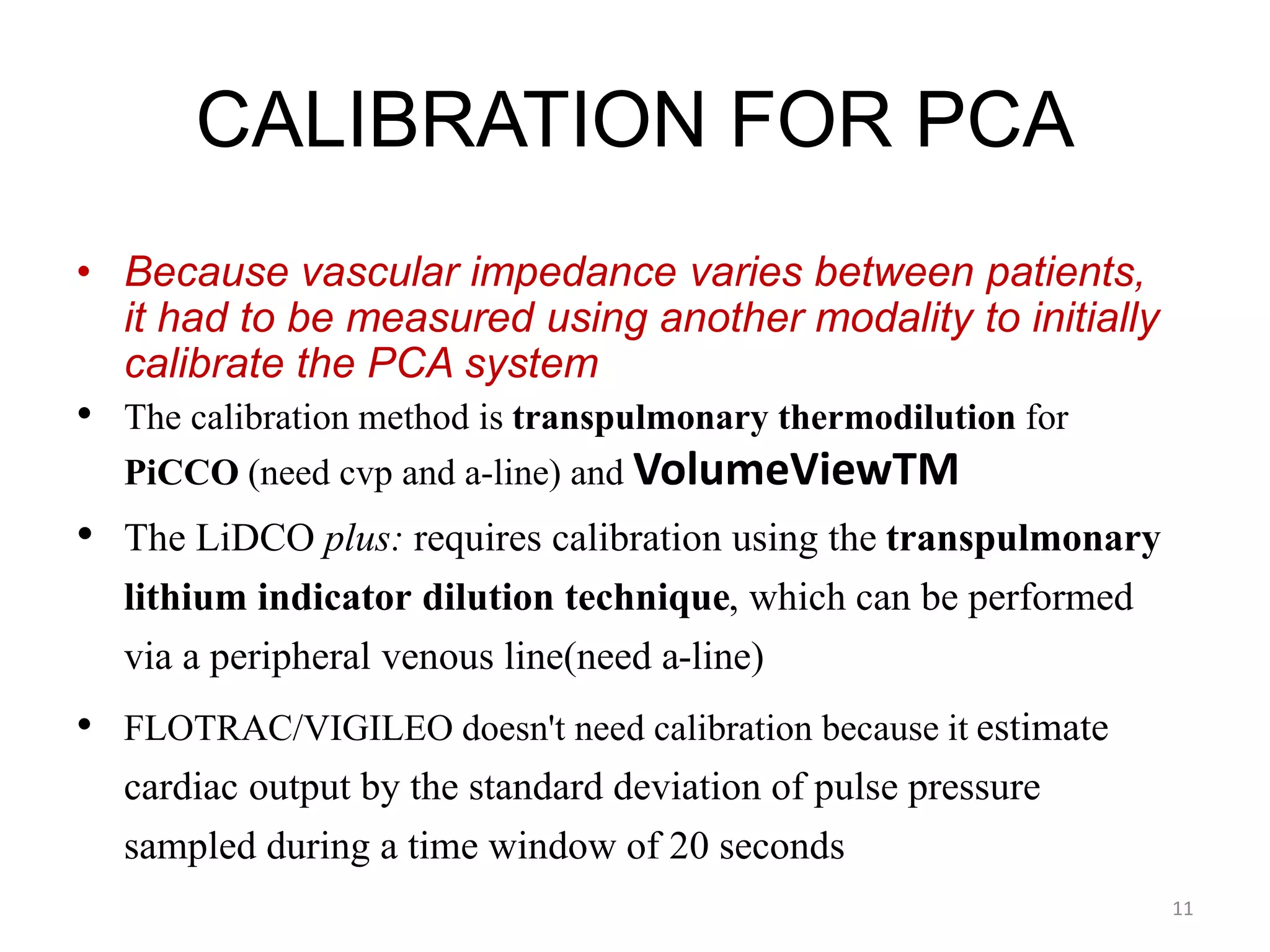
CALIBRATION FOR PCA
• Because vascular impedance varies between patients,
it had to be measured using another modality to initially
calibrate the PCA system
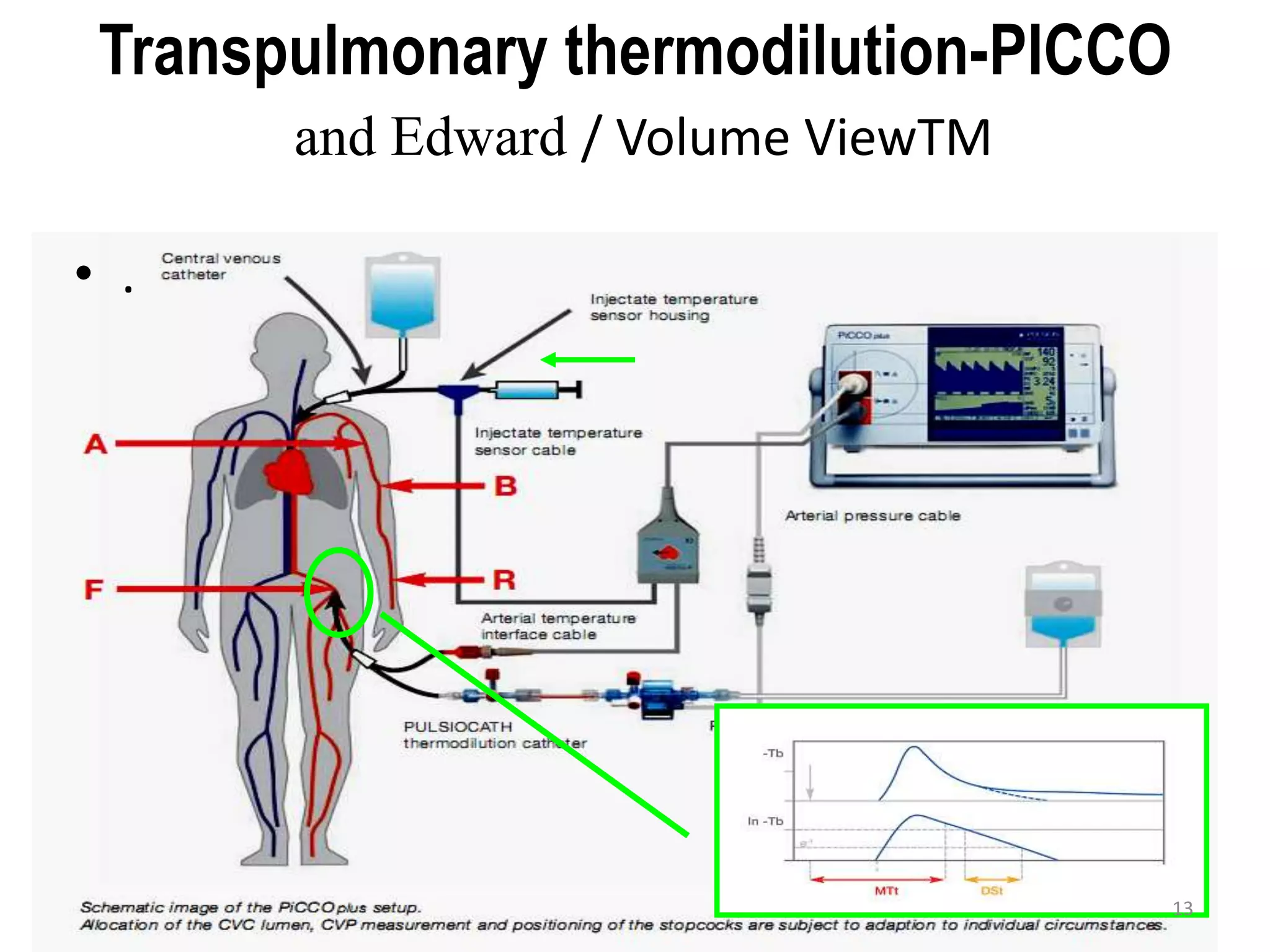
• The calibration method is transpulmonary thermodilution for
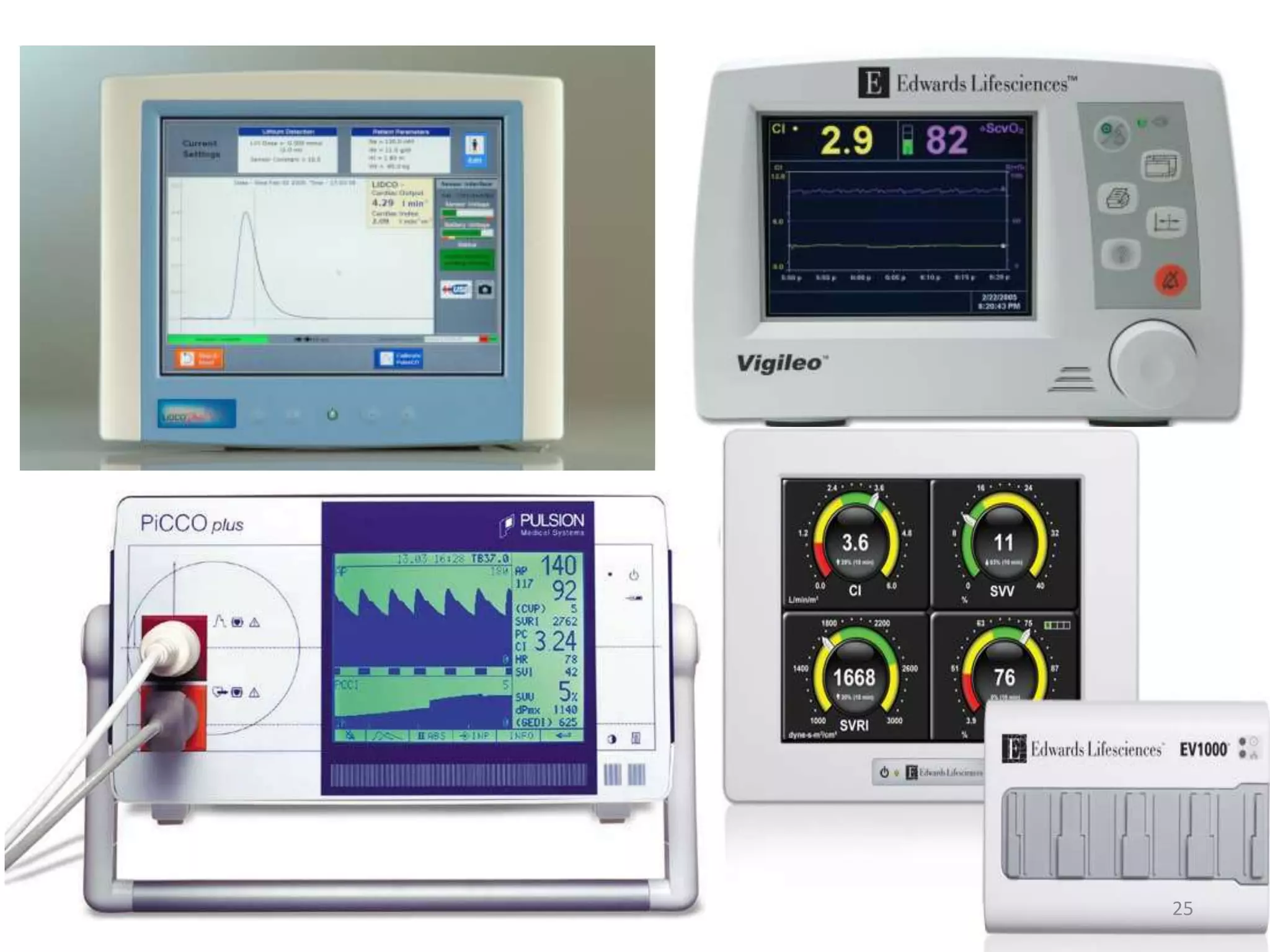
PiCCO (need cvp and a-line) and VolumeViewTM
• The LiDCO plus: requires calibration using the transpulmonary
lithium indicator dilution technique, which can be performed
via a peripheral venous line(need a-line)
• FLOTRAC/VIGILEO doesn't need calibration because it estimate
cardiac output by the standard deviation of pulse pressure
sampled during a time window of 20 seconds
11
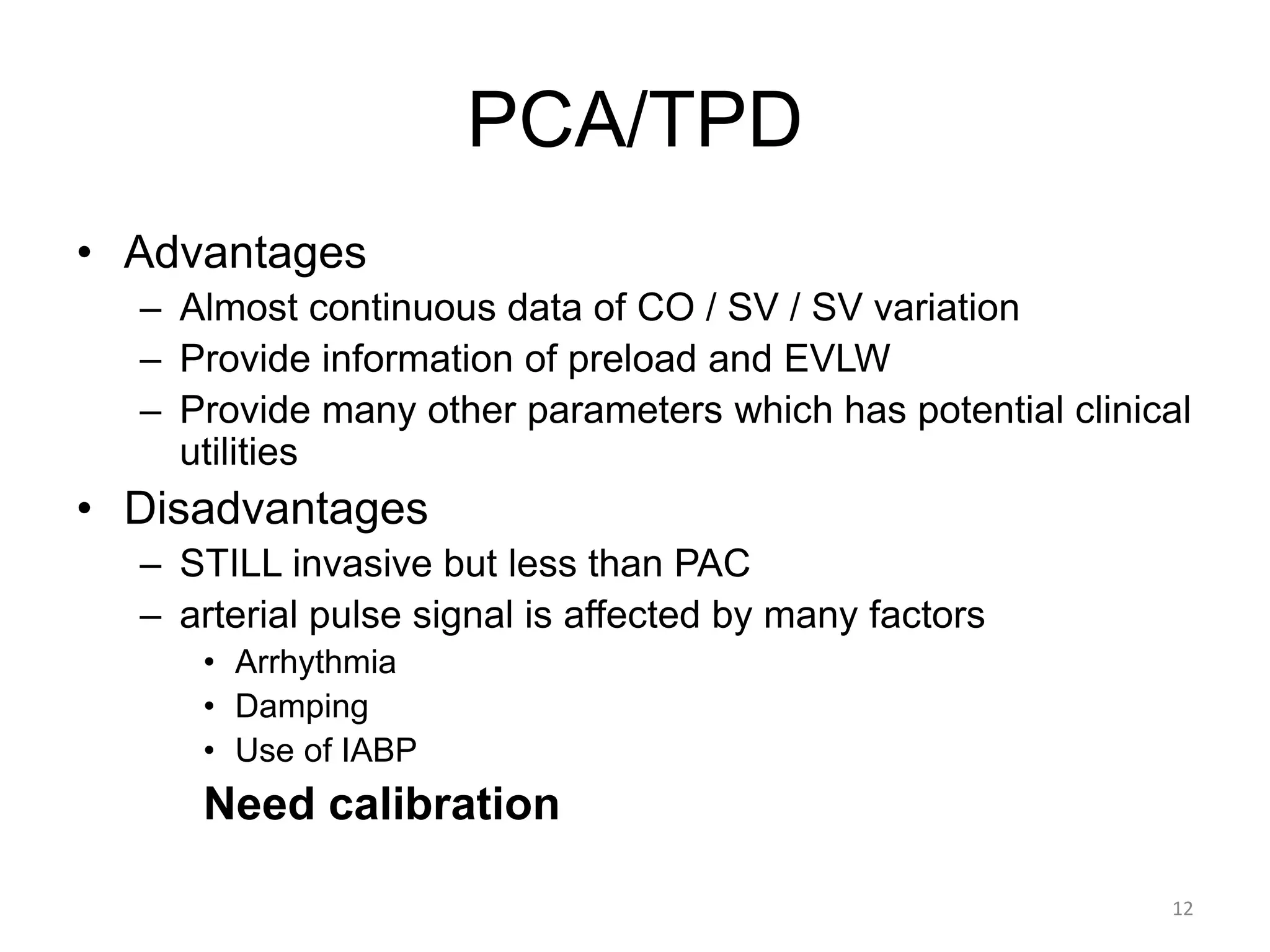
PCA/TPD
• Advantages
– Almost continuous data of CO / SV / SV variation
– Provide information of preload and EVLW
– Provide many other parameters which has potential clinical
utilities
• Disadvantages
– STILL invasive but less than PAC
– arterial pulse signal is affected by many factors
• Arrhythmia
• Damping
• Use of IABP
Need calibration
12
Transpulmonary thermodilution-PICCO
and Edward / Volume ViewTM
• .
13
Tb
injection
t
 


dtT
KV)T(T
CO
b
iib
TDa
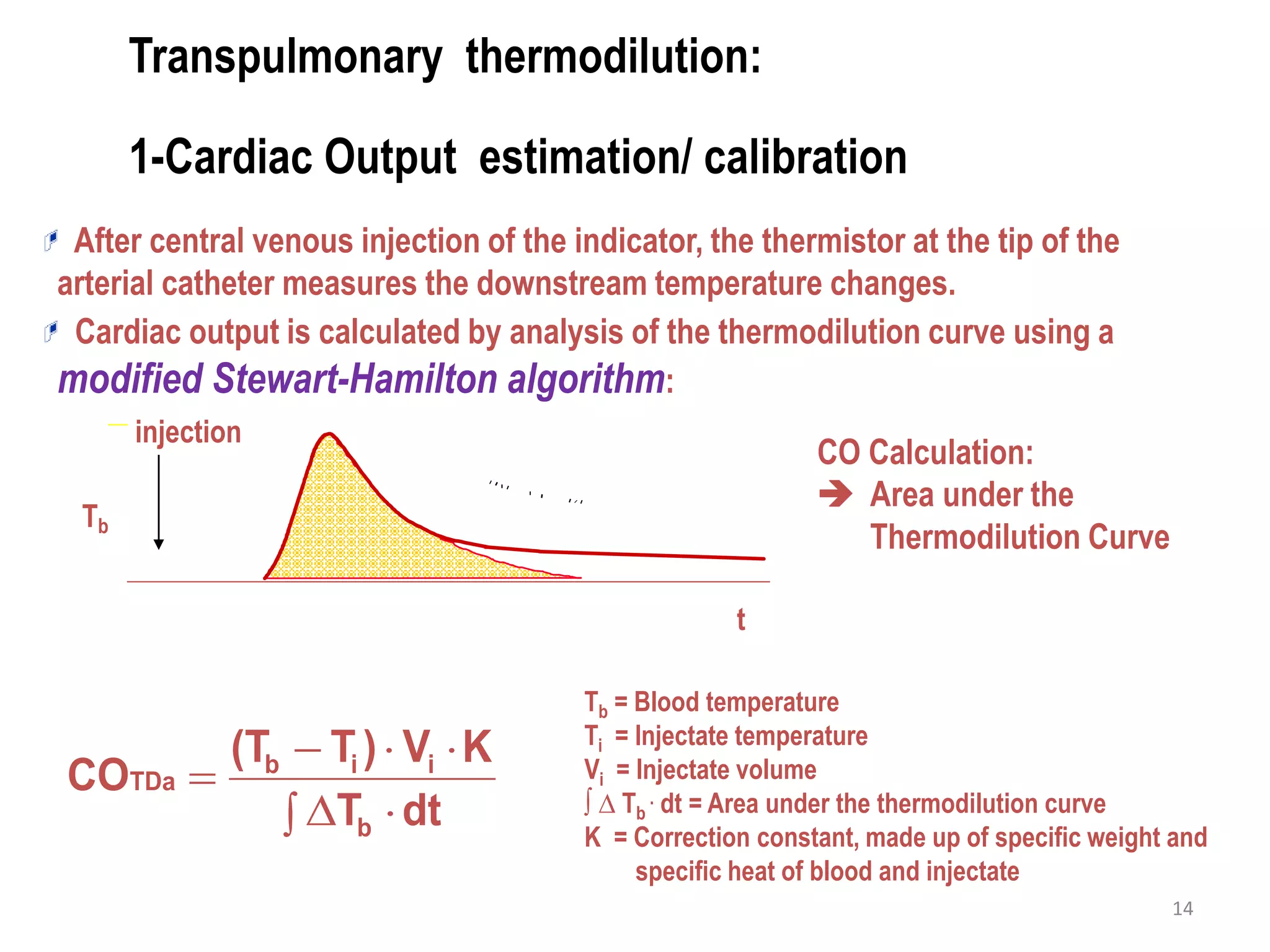
Transpulmonary thermodilution:
1-Cardiac Output estimation/ calibration
Tb = Blood temperature
Ti = Injectate temperature
Vi = Injectate volume
∫ ∆ Tb
. dt = Area under the thermodilution curve
K = Correction constant, made up of specific weight and
specific heat of blood and injectate
CO Calculation:
 Area under the
Thermodilution Curve
After central venous injection of the indicator, the thermistor at the tip of the
arterial catheter measures the downstream temperature changes.
Cardiac output is calculated by analysis of the thermodilution curve using a
modified Stewart-Hamilton algorithm:
14
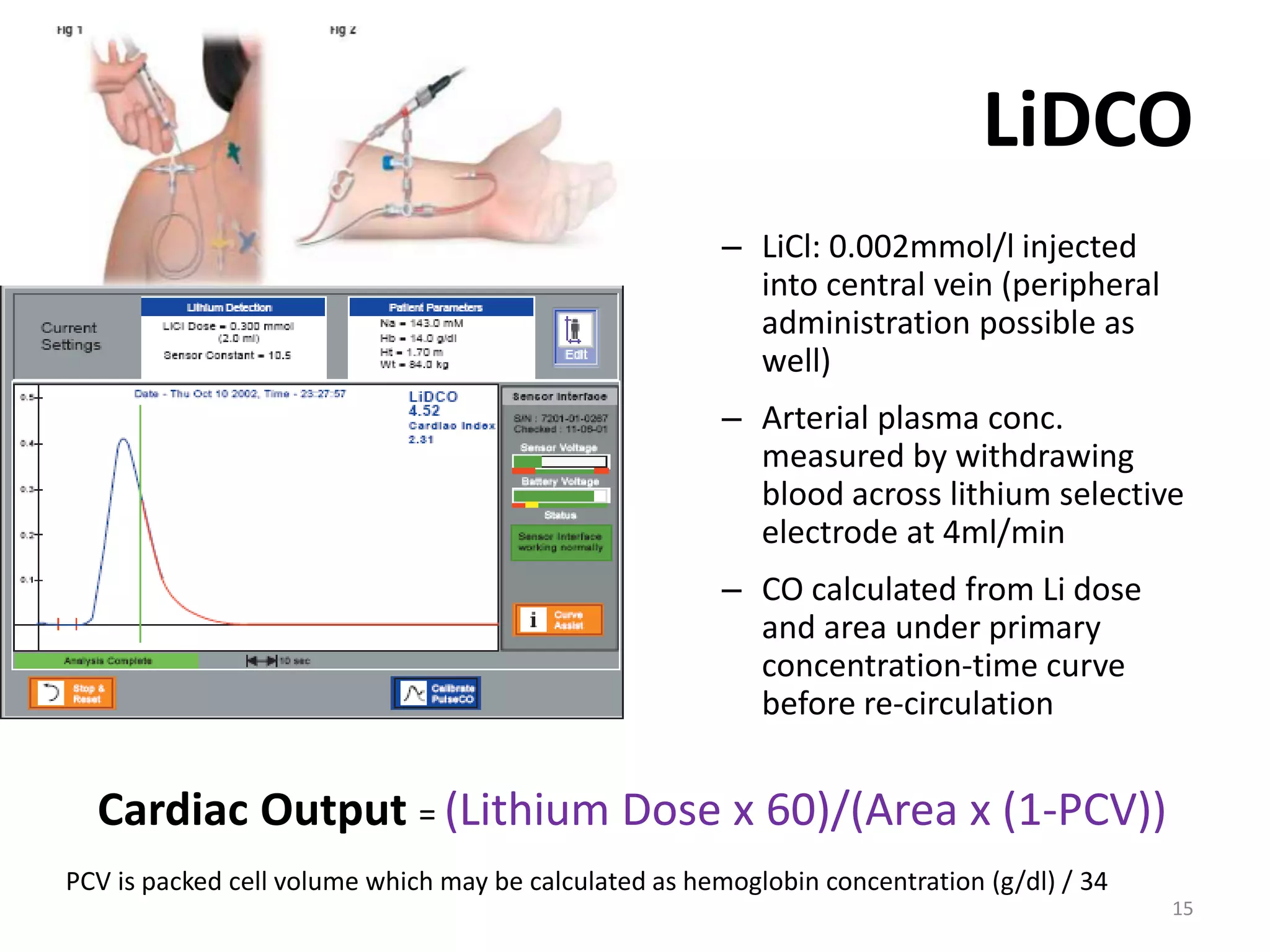
LiDCO
– LiCl: 0.002mmol/l injected
into central vein (peripheral
administration possible as
well)
– Arterial plasma conc.
measured by withdrawing
blood across lithium selective
electrode at 4ml/min
– CO calculated from Li dose
and area under primary
concentration-time curve
before re-circulation
PCV is packed cell volume which may be calculated as hemoglobin concentration (g/dl) / 34
Cardiac Output = (Lithium Dose x 60)/(Area x (1-PCV))
15
Advanced Thermodilution Curve Analysis
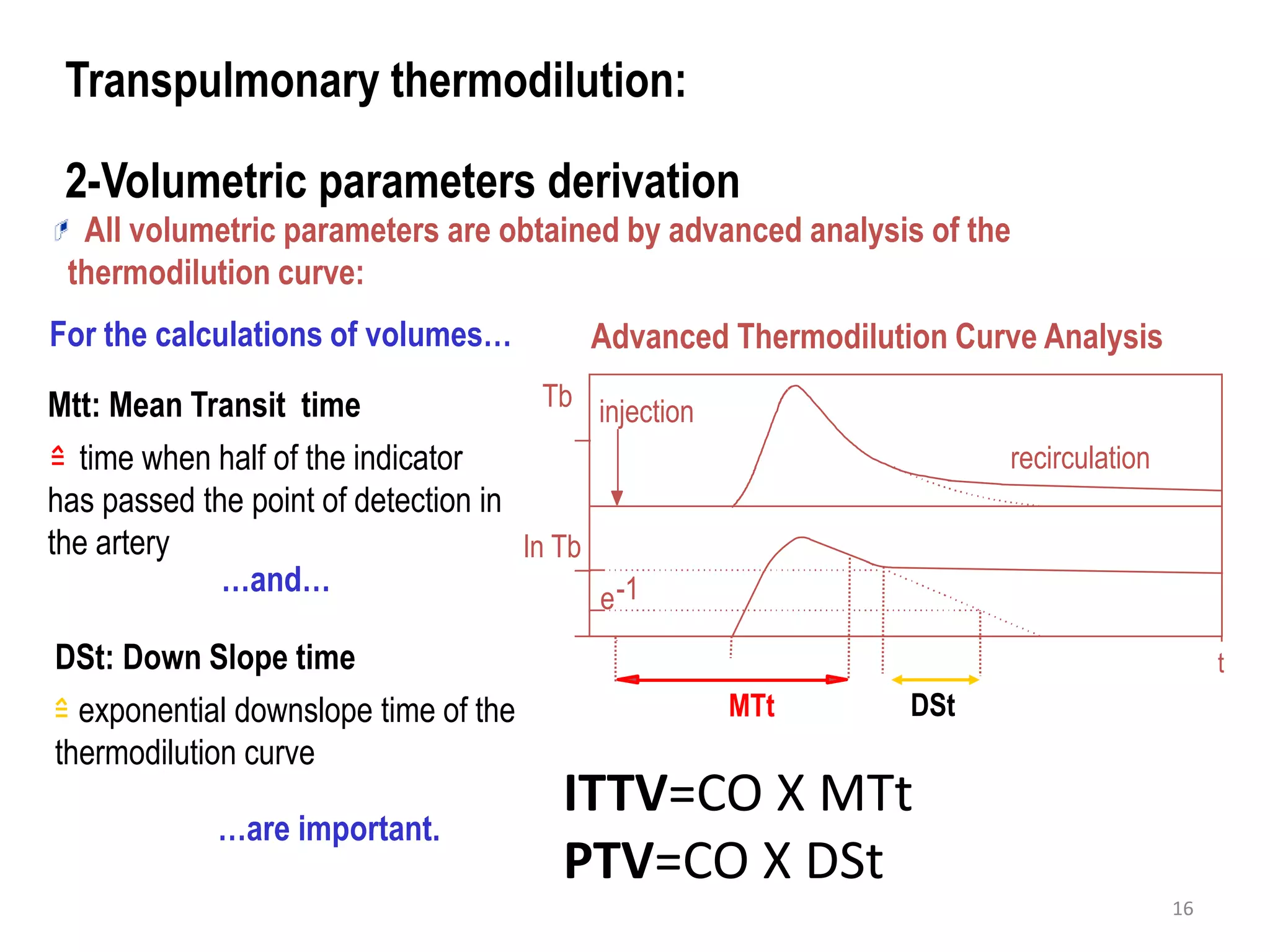
Transpulmonary thermodilution:
2-Volumetric parameters derivation
Mtt: Mean Transit time
time when half of the indicator
has passed the point of detection in
the artery
DSt: Down Slope time
exponential downslope time of the
thermodilution curve
For the calculations of volumes…
ln Tb
injection
recirculation
MTt
t
e-1
DSt
Tb
…are important.
…and…
All volumetric parameters are obtained by advanced analysis of the
thermodilution curve:
ITTV=CO X MTt
PTV=CO X DSt
16
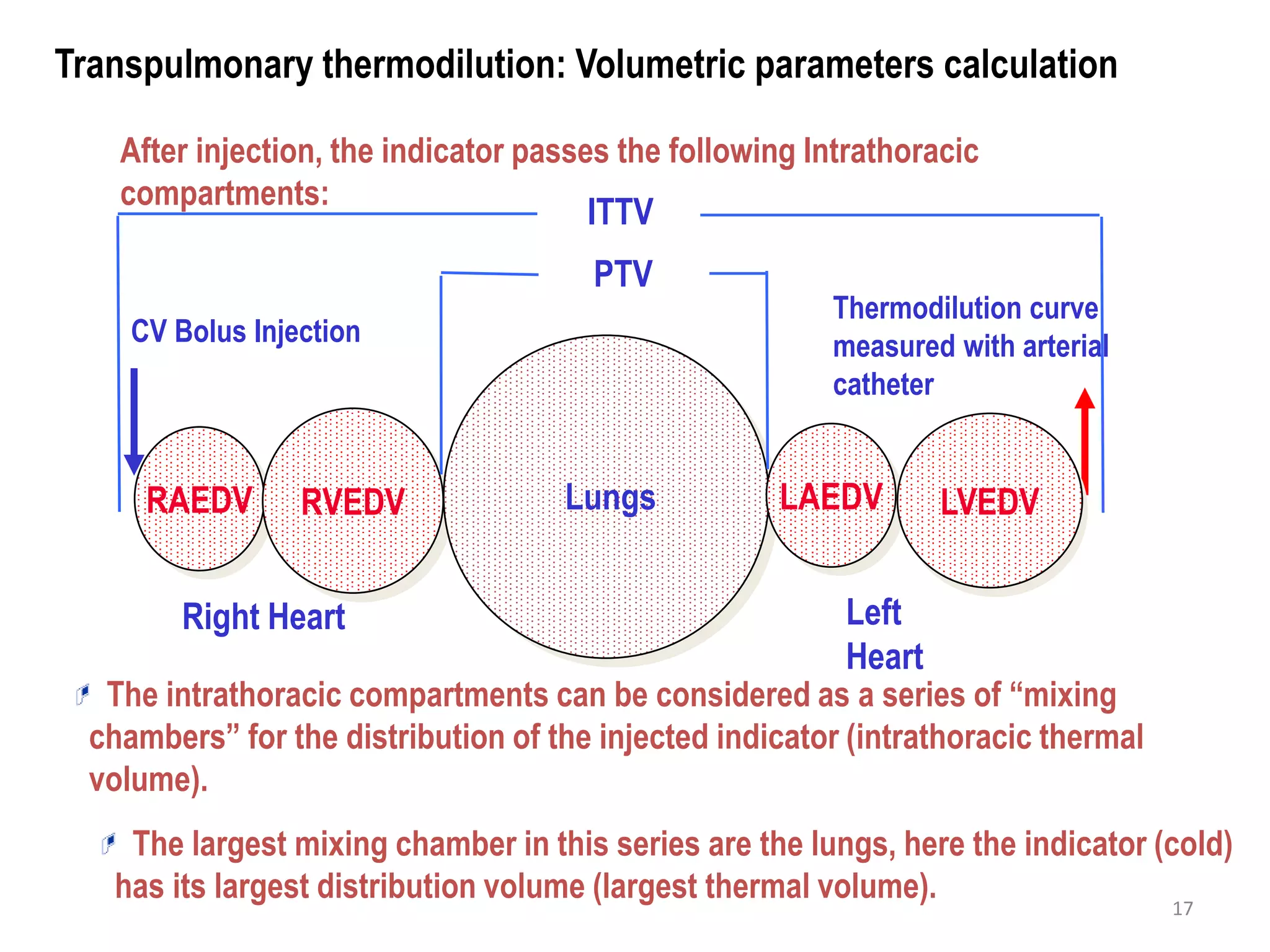
RAEDV
Thermodilution curve
measured with arterial
catheter
CV Bolus Injection
LAEDV LVEDVRVEDV
Right Heart Left
Heart
Lungs
After injection, the indicator passes the following Intrathoracic
compartments:
The intrathoracic compartments can be considered as a series of “mixing
chambers” for the distribution of the injected indicator (intrathoracic thermal
volume).
ITTV
PTV
The largest mixing chamber in this series are the lungs, here the indicator (cold)
has its largest distribution volume (largest thermal volume).
Transpulmonary thermodilution: Volumetric parameters calculation
17
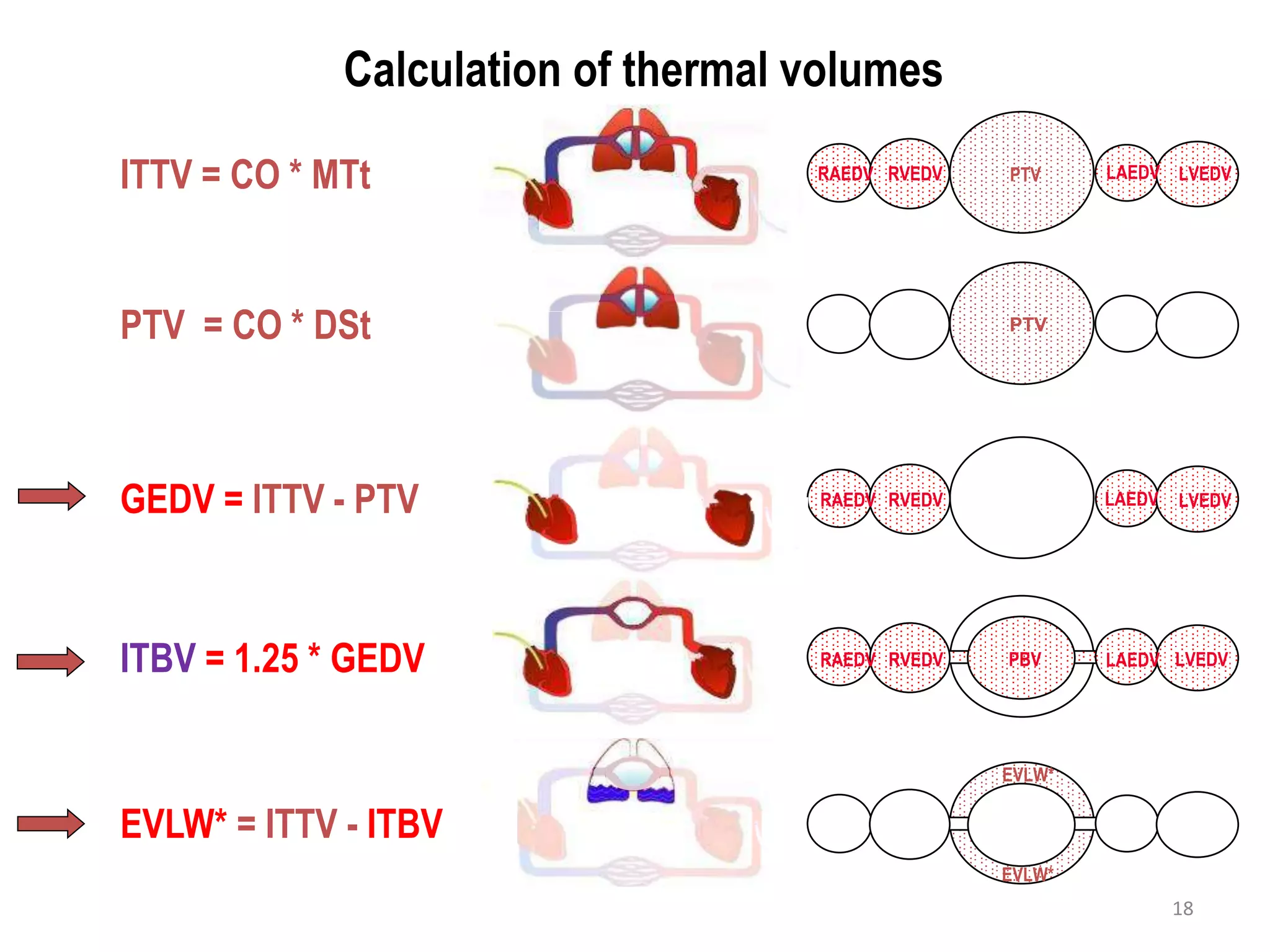
ITTV = CO * MTt
PTV = CO * DSt
ITBV = 1.25 * GEDV
EVLW* = ITTV - ITBV
GEDV = ITTV - PTV RAEDV RVEDV LAEDV LVEDV
RAEDV RVEDV LAEDV LVEDVPBV
RAEDV RVEDV LAEDV LVEDVPTV
PTV
EVLW*
EVLW*
Calculation of thermal volumes
18
Index of Left Ventricular Contractility*
t [s]
P [mm Hg]
dPmx* =dP/dtmax of arterial pressure curve
dPmx* represents left ventricular pressure velocity increase and thus is a
parameter of myocardial contractility
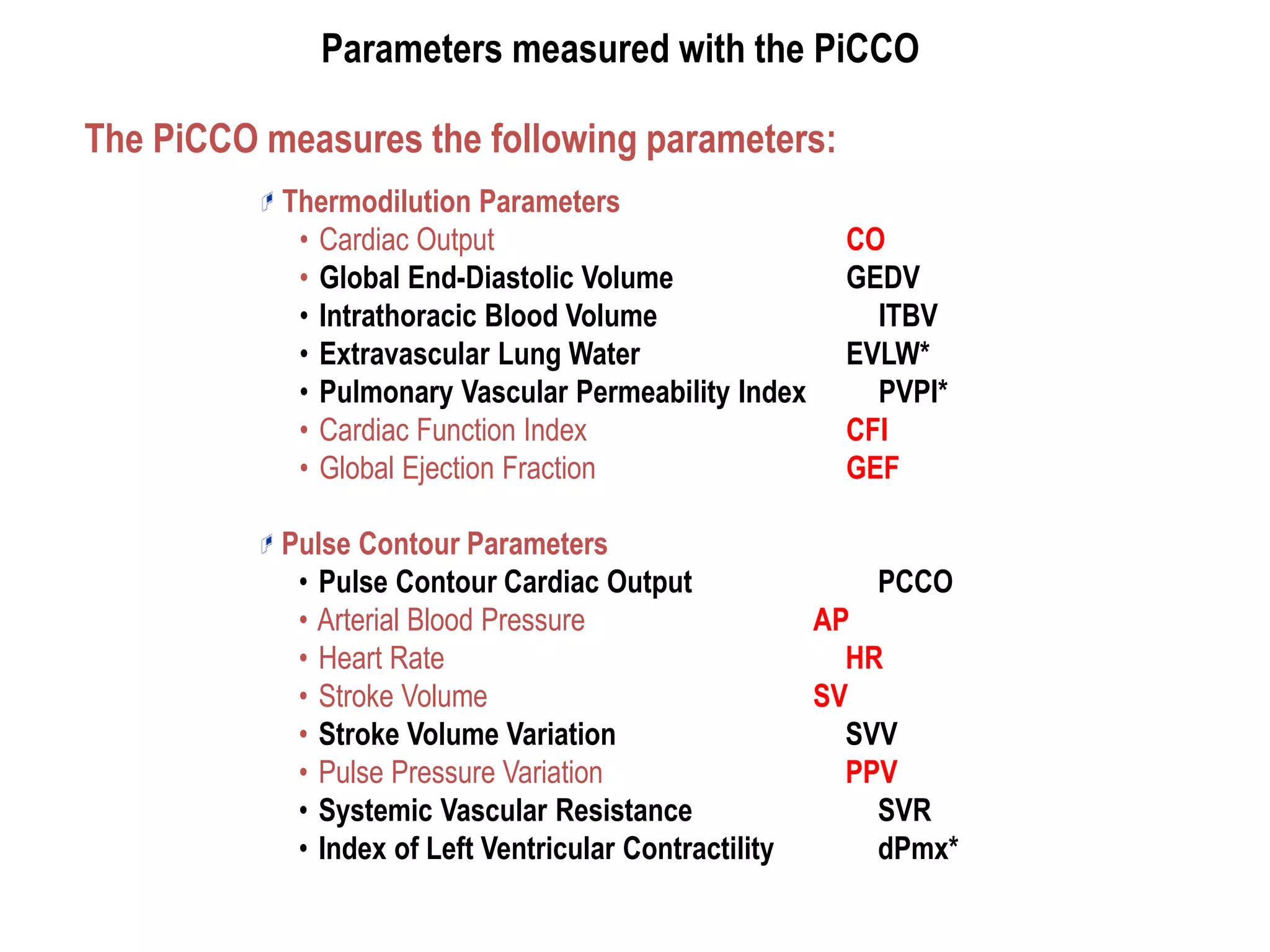
Thermodilution Parameters
• Cardiac Output CO
• Global End-Diastolic Volume GEDV
• Intrathoracic Blood Volume ITBV
• Extravascular Lung Water EVLW*
• Pulmonary Vascular Permeability Index PVPI*
• Cardiac Function Index CFI
• Global Ejection Fraction GEF
The PiCCO measures the following parameters:
Pulse Contour Parameters
• Pulse Contour Cardiac Output PCCO
• Arterial Blood Pressure AP
• Heart Rate HR
• Stroke Volume SV
• Stroke Volume Variation SVV
• Pulse Pressure Variation PPV
• Systemic Vascular Resistance SVR
• Index of Left Ventricular Contractility dPmx*
Parameters measured with the PiCCO-Technology
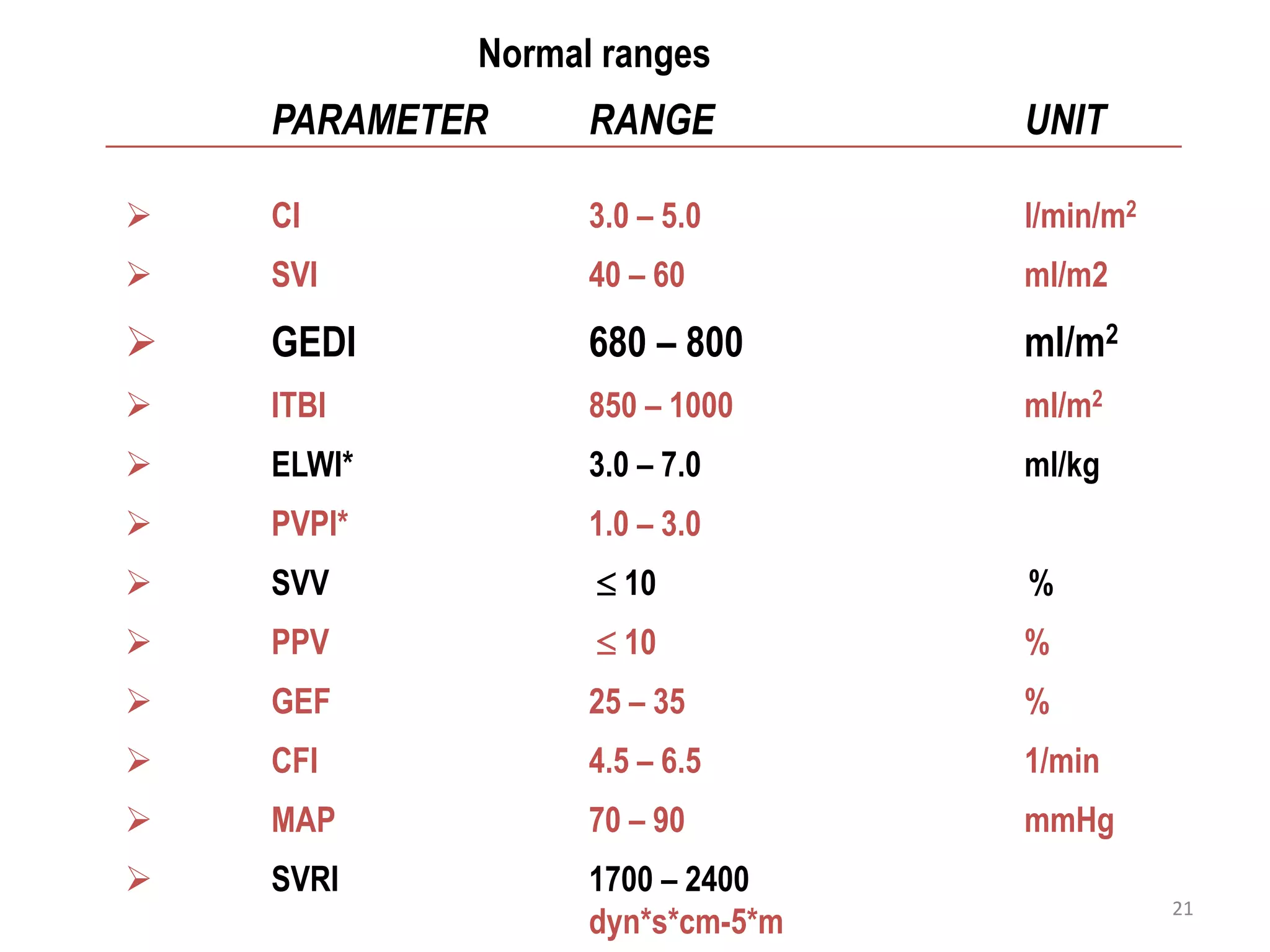
Normal ranges
PARAMETER RANGE UNIT
 CI 3.0 – 5.0 l/min/m2
 SVI 40 – 60 ml/m2
 GEDI 680 – 800 ml/m2
 ITBI 850 – 1000 ml/m2
 ELWI* 3.0 – 7.0 ml/kg
 PVPI* 1.0 – 3.0
 SVV  10 %
 PPV  10 %
 GEF 25 – 35 %
 CFI 4.5 – 6.5 1/min
 MAP 70 – 90 mmHg
 SVRI 1700 – 2400
dyn*s*cm-5*m
21
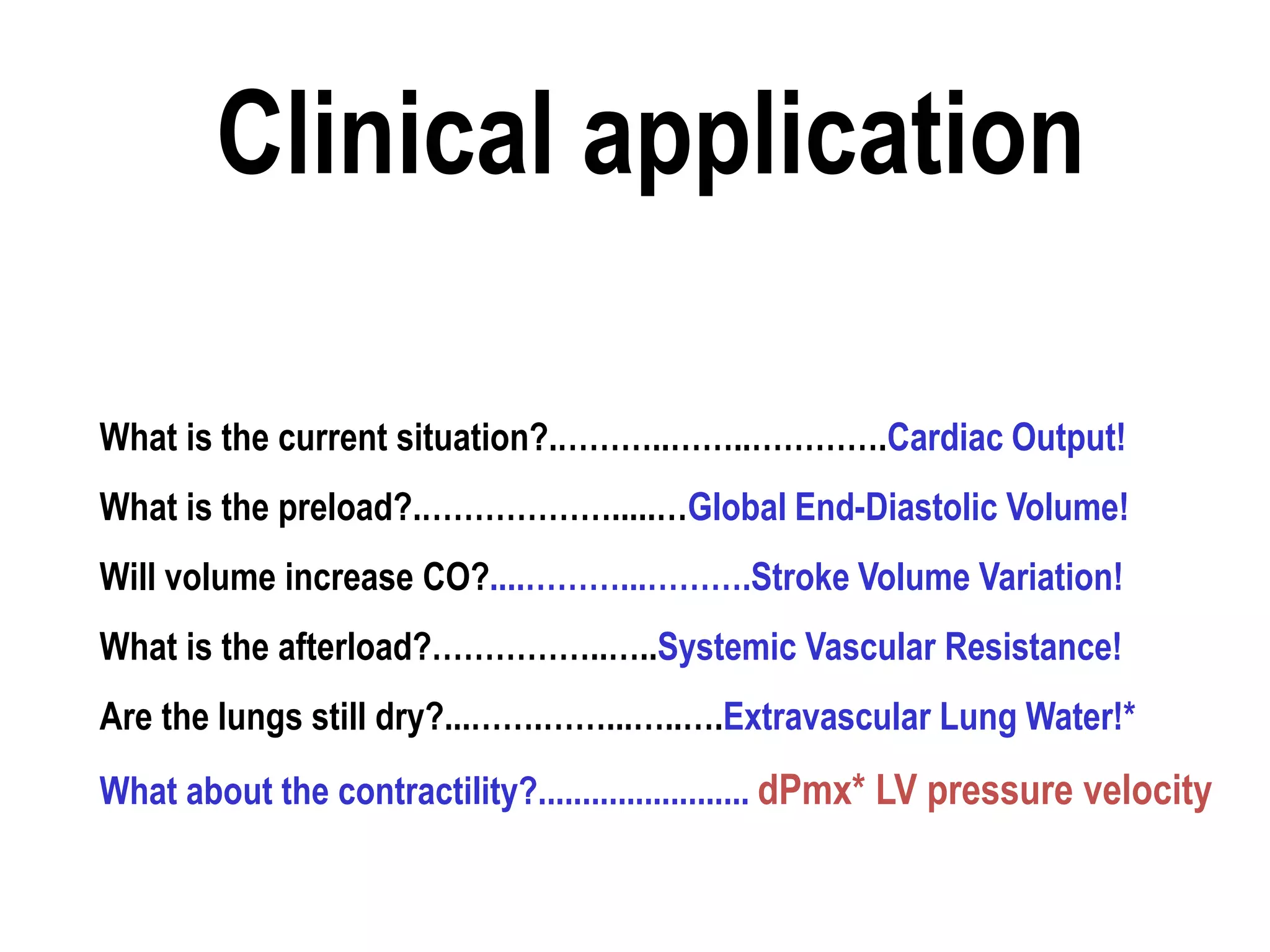
What is the current situation?.………..……..………….Cardiac Output!
What is the preload?.……………….....…Global End-Diastolic Volume!
Will volume increase CO?....………...……….Stroke Volume Variation!
What is the afterload?……………..…..Systemic Vascular Resistance!
Are the lungs still dry?...…….……...…..….Extravascular Lung Water!*
What about the contractility?........................ dPmx* LV pressure velocity
Clinical application
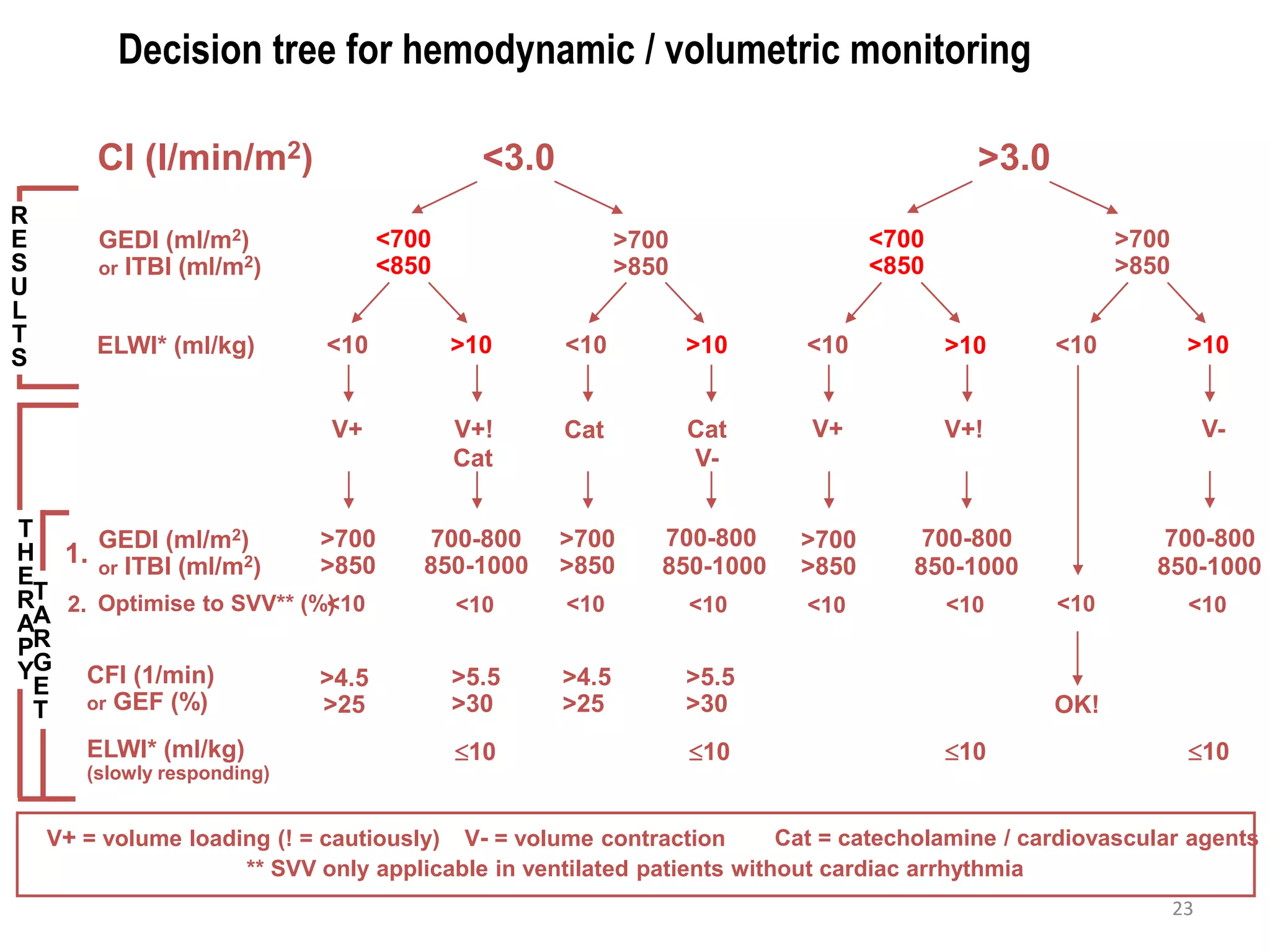
Decision tree for hemodynamic / volumetric monitoring
CI (l/min/m2)
GEDI (ml/m2)
or ITBI (ml/m2)
ELWI* (ml/kg)
(slowly responding)
>3.0<3.0
>700
>850
<700
<850
>700
>850
<700
<850
ELWI* (ml/kg)
GEDI (ml/m2)
or ITBI (ml/m2)
CFI (1/min)
or GEF (%)
<10 >10 <10 <10 <10>10 >10 >10
V+ V+! V+!V+Cat Cat
OK!
V-
>700
>850
700-800
850-1000
>4.5
>25
>5.5
>30
>4.5
>25
700-800
850-1000
Cat
>5.5
>30
>700
>850
700-800
850-1000
700-800
850-1000
10 10 10 10
V-
V+ = volume loading (! = cautiously) V- = volume contraction Cat = catecholamine / cardiovascular agents
** SVV only applicable in ventilated patients without cardiac arrhythmia
>700
>850
<10Optimise to SVV** (%)<10 <10 <10
R
E
S
U
L
T
S
T
A
R
G
E
T
T
H
E
R
A
P
Y
1.
2. <10 <10 <10 <10
23
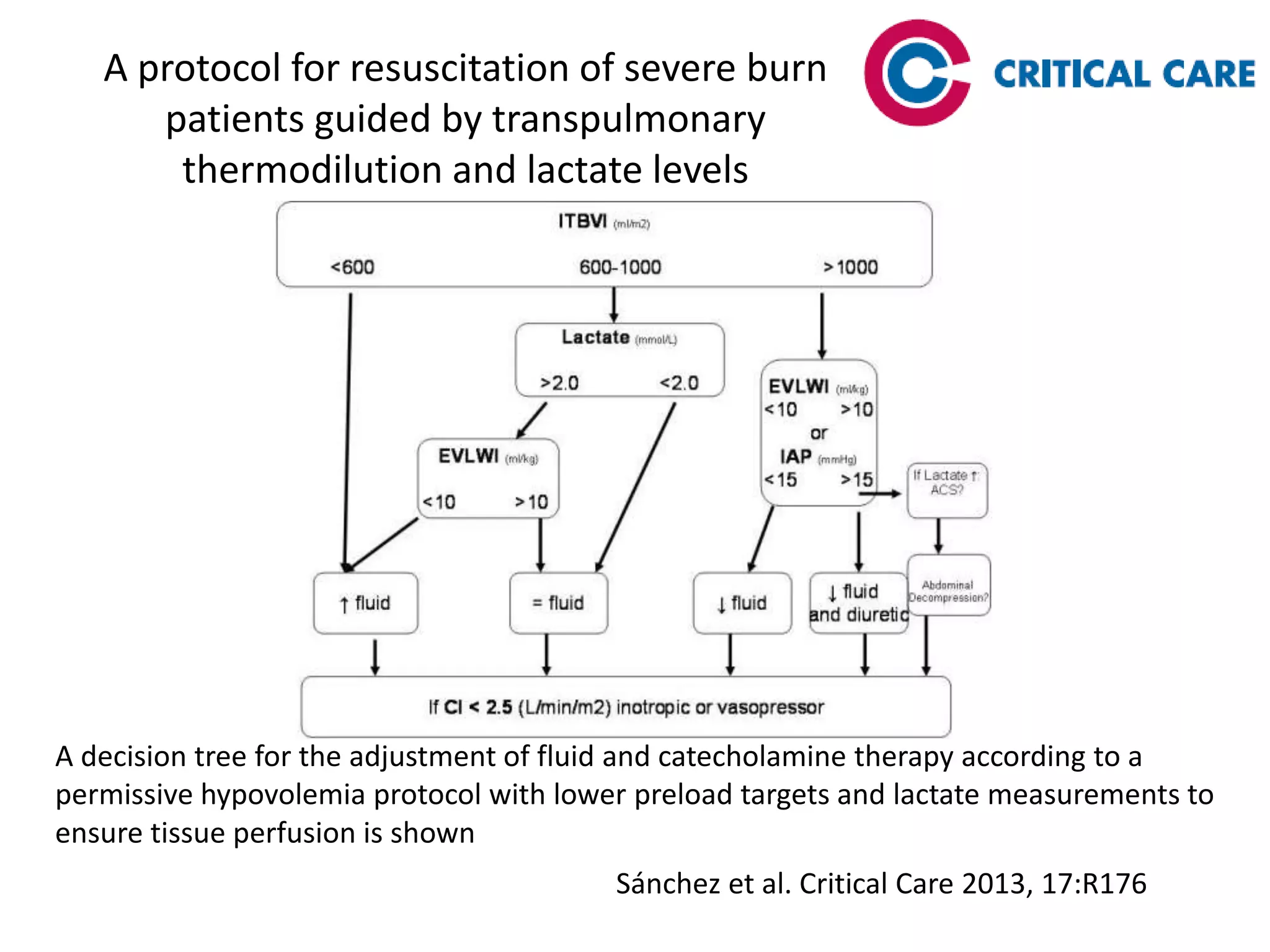
A protocol for resuscitation of severe burn
patients guided by transpulmonary
thermodilution and lactate levels
A decision tree for the adjustment of fluid and catecholamine therapy according to a
permissive hypovolemia protocol with lower preload targets and lactate measurements to
ensure tissue perfusion is shown
Sánchez et al. Critical Care 2013, 17:R176
25
In conclusion
• Hemodynamic monitoring enable early
detection of change in patient’s conditions
• New techniques provide reasonably good
results and less invasive
• Always correlate the readings / findings
with clinical pictures in order to provide
the best treatment options
26
HEMODYNAMIC MONITORING
COURSE AND WORKSHOP
• One-day course
• 7 lectures
• 4-station workshop
• 8 CME hours
• On September 11/every 3 months
• In PSMMC rec. center
27
questions?

Advanced hemodynamic monitoring

  • 1.
    Less invasive methodsof advanced hemodynamic monitoring DR GHALEB ALMEKHLAFI CONSULTANT CCM PSMMC AUG 2014 1
  • 2.
    Introduction •Hemodynamics is concerned withthe forces generated in the cardiovascular system 2
  • 3.
    1-Intravascular volume 2-Myocardial contraction 3- heart rate 3-Vasoactivity 4factors that affecting the hemodynamic conditions C.O.= HR x Stroke Volume (60-130 Ml/beat) Stroke Volume has three components 1. Preload 2. Afterload 3.Contractility 3
  • 4.
    Hemodynamic Monitoring Truth •Nomonitoring device will improve outcome, Unless coupled to a treatment, which improves outcome. Pinsky & Payen. Functional Hemodynamic Monitoring, Springer, 2004 4
  • 5.
    Classic Hemodynamic Monitoring methods NoninvasiveHemodynamic Monitoring methods: • Pulse Rate and quality • Blood Pressure • Skin temperature/color • Capillary Refill • Pulse oximeter • Mentation • UOP-Normal is 1ml/kg/h Invasive and less invasive Hemodynamic Monitoring methods: • PAC-CO • CVL-CVP • ARTERIAL CATHETER-IBP 5
  • 6.
    Advanced hemodynamic assessment methods COMMONTECHNEQUES • Pulse contour analysis and transpulmonary dilution techneques • Electrical bioimpedance/ bioreactance • esophageal Doppler • Echocardiogram • Partial carbon dioxide rebreathing :NICO • others 6
  • 7.
  • 8.
    PULSE WAVE-CONTOUR • Detectedby the use of an arterially placed catheter with a pressure transducer, which can measure pressure tracings on a beat-to- beat basis 8
  • 9.
  • 10.
    Factors affecting accuracyof PCA arterial pressure waveform are affected by • vascular compliance, • aortic impedance • Peripheral arterial resistance. • Technical factors(i.e. eliminating damping or increased tubing resonance , zeroing) • severe arrhythmias • the use of an intra-aortic balloon pump precludes adequate performance of the devices. • periods of hemodynamic instability, i.e., rapid changes in vascular resistance. Is a problem for uncalibrated pulse pressure analysis. So frequent re-calibration for accurate cardiac output estimation in these situations is mandatory 10
  • 11.
    CALIBRATION FOR PCA •Because vascular impedance varies between patients, it had to be measured using another modality to initially calibrate the PCA system • The calibration method is transpulmonary thermodilution for PiCCO (need cvp and a-line) and VolumeViewTM • The LiDCO plus: requires calibration using the transpulmonary lithium indicator dilution technique, which can be performed via a peripheral venous line(need a-line) • FLOTRAC/VIGILEO doesn't need calibration because it estimate cardiac output by the standard deviation of pulse pressure sampled during a time window of 20 seconds 11
  • 12.
    PCA/TPD • Advantages – Almostcontinuous data of CO / SV / SV variation – Provide information of preload and EVLW – Provide many other parameters which has potential clinical utilities • Disadvantages – STILL invasive but less than PAC – arterial pulse signal is affected by many factors • Arrhythmia • Damping • Use of IABP Need calibration 12
  • 13.
  • 14.
    Tb injection t     dtT KV)T(T CO b iib TDa Transpulmonary thermodilution: 1-CardiacOutput estimation/ calibration Tb = Blood temperature Ti = Injectate temperature Vi = Injectate volume ∫ ∆ Tb . dt = Area under the thermodilution curve K = Correction constant, made up of specific weight and specific heat of blood and injectate CO Calculation:  Area under the Thermodilution Curve After central venous injection of the indicator, the thermistor at the tip of the arterial catheter measures the downstream temperature changes. Cardiac output is calculated by analysis of the thermodilution curve using a modified Stewart-Hamilton algorithm: 14
  • 15.
    LiDCO – LiCl: 0.002mmol/linjected into central vein (peripheral administration possible as well) – Arterial plasma conc. measured by withdrawing blood across lithium selective electrode at 4ml/min – CO calculated from Li dose and area under primary concentration-time curve before re-circulation PCV is packed cell volume which may be calculated as hemoglobin concentration (g/dl) / 34 Cardiac Output = (Lithium Dose x 60)/(Area x (1-PCV)) 15
  • 16.
    Advanced Thermodilution CurveAnalysis Transpulmonary thermodilution: 2-Volumetric parameters derivation Mtt: Mean Transit time time when half of the indicator has passed the point of detection in the artery DSt: Down Slope time exponential downslope time of the thermodilution curve For the calculations of volumes… ln Tb injection recirculation MTt t e-1 DSt Tb …are important. …and… All volumetric parameters are obtained by advanced analysis of the thermodilution curve: ITTV=CO X MTt PTV=CO X DSt 16
  • 17.
    RAEDV Thermodilution curve measured witharterial catheter CV Bolus Injection LAEDV LVEDVRVEDV Right Heart Left Heart Lungs After injection, the indicator passes the following Intrathoracic compartments: The intrathoracic compartments can be considered as a series of “mixing chambers” for the distribution of the injected indicator (intrathoracic thermal volume). ITTV PTV The largest mixing chamber in this series are the lungs, here the indicator (cold) has its largest distribution volume (largest thermal volume). Transpulmonary thermodilution: Volumetric parameters calculation 17
  • 18.
    ITTV = CO* MTt PTV = CO * DSt ITBV = 1.25 * GEDV EVLW* = ITTV - ITBV GEDV = ITTV - PTV RAEDV RVEDV LAEDV LVEDV RAEDV RVEDV LAEDV LVEDVPBV RAEDV RVEDV LAEDV LVEDVPTV PTV EVLW* EVLW* Calculation of thermal volumes 18
  • 19.
    Index of LeftVentricular Contractility* t [s] P [mm Hg] dPmx* =dP/dtmax of arterial pressure curve dPmx* represents left ventricular pressure velocity increase and thus is a parameter of myocardial contractility
  • 20.
    Thermodilution Parameters • CardiacOutput CO • Global End-Diastolic Volume GEDV • Intrathoracic Blood Volume ITBV • Extravascular Lung Water EVLW* • Pulmonary Vascular Permeability Index PVPI* • Cardiac Function Index CFI • Global Ejection Fraction GEF The PiCCO measures the following parameters: Pulse Contour Parameters • Pulse Contour Cardiac Output PCCO • Arterial Blood Pressure AP • Heart Rate HR • Stroke Volume SV • Stroke Volume Variation SVV • Pulse Pressure Variation PPV • Systemic Vascular Resistance SVR • Index of Left Ventricular Contractility dPmx* Parameters measured with the PiCCO-Technology
  • 21.
    Normal ranges PARAMETER RANGEUNIT  CI 3.0 – 5.0 l/min/m2  SVI 40 – 60 ml/m2  GEDI 680 – 800 ml/m2  ITBI 850 – 1000 ml/m2  ELWI* 3.0 – 7.0 ml/kg  PVPI* 1.0 – 3.0  SVV  10 %  PPV  10 %  GEF 25 – 35 %  CFI 4.5 – 6.5 1/min  MAP 70 – 90 mmHg  SVRI 1700 – 2400 dyn*s*cm-5*m 21
  • 22.
    What is thecurrent situation?.………..……..………….Cardiac Output! What is the preload?.……………….....…Global End-Diastolic Volume! Will volume increase CO?....………...……….Stroke Volume Variation! What is the afterload?……………..…..Systemic Vascular Resistance! Are the lungs still dry?...…….……...…..….Extravascular Lung Water!* What about the contractility?........................ dPmx* LV pressure velocity Clinical application
  • 23.
    Decision tree forhemodynamic / volumetric monitoring CI (l/min/m2) GEDI (ml/m2) or ITBI (ml/m2) ELWI* (ml/kg) (slowly responding) >3.0<3.0 >700 >850 <700 <850 >700 >850 <700 <850 ELWI* (ml/kg) GEDI (ml/m2) or ITBI (ml/m2) CFI (1/min) or GEF (%) <10 >10 <10 <10 <10>10 >10 >10 V+ V+! V+!V+Cat Cat OK! V- >700 >850 700-800 850-1000 >4.5 >25 >5.5 >30 >4.5 >25 700-800 850-1000 Cat >5.5 >30 >700 >850 700-800 850-1000 700-800 850-1000 10 10 10 10 V- V+ = volume loading (! = cautiously) V- = volume contraction Cat = catecholamine / cardiovascular agents ** SVV only applicable in ventilated patients without cardiac arrhythmia >700 >850 <10Optimise to SVV** (%)<10 <10 <10 R E S U L T S T A R G E T T H E R A P Y 1. 2. <10 <10 <10 <10 23
  • 24.
    A protocol forresuscitation of severe burn patients guided by transpulmonary thermodilution and lactate levels A decision tree for the adjustment of fluid and catecholamine therapy according to a permissive hypovolemia protocol with lower preload targets and lactate measurements to ensure tissue perfusion is shown Sánchez et al. Critical Care 2013, 17:R176
  • 25.
  • 26.
    In conclusion • Hemodynamicmonitoring enable early detection of change in patient’s conditions • New techniques provide reasonably good results and less invasive • Always correlate the readings / findings with clinical pictures in order to provide the best treatment options 26
  • 27.
    HEMODYNAMIC MONITORING COURSE ANDWORKSHOP • One-day course • 7 lectures • 4-station workshop • 8 CME hours • On September 11/every 3 months • In PSMMC rec. center 27
  • 28.