PAEDIATRIC
BREATHING CIRCUIT’s
DEFINITION:
Assembly of components which
connects the patient’s airway to the
anaesthetic machine creating an
artificial atmosphere, from and into
which the patient breathes.
A breathing system converts continuous
flow from the machine to a intermittent
flow.
INTRODUCTION
Any resemblance to a breathing system was
developed by Barth (1907)
 The Mapleson A (Magill) system was
designed by Sir Ivan Magill in the 1930's
 In 1926 , Brian Sword introduced the circle
system
 Ayre’s T-piece was introduced in 1937
 Bain Circuit was introduced in 1972 by Bain
and Spoerel.

CRITERIA FOR IDEAL SYSTEM
ESSENTIAL:1.Delivery of gas from machine to the
alveoli in same concentration as set
and in shortest possible time
2.Effective elimination of CO2
3.Minimal dead space
4.Minimal resistance
DESIRABLE:1.Economy of fresh gas
2.Conservation of heat
3. Adequate humidification
4. Efficient during spontaneous and
controlled ventilation
5. Efficient for adult, pediatrics and
with mechanical ventilators
6. Light weight
7. Less theater pollution
8. Convenient during use.
COMPONENTS
1.Bushings(mount)
2.Sleeves
3.Connectors & Adaptors
4.FGF inlet
5.Breathing tube
6.Reservoir Bag
7.Valve’s
8.Filters
9.CO2 absorber
CLASSIFICATION OF BREATHING
SYSTEMS


McMohan in 1951
Open
- no rebreathing
Semiclosed - partial rebreathing
Closed
- total rebreathing



Dripps et al have classified them as
Insufflation, Open, Semi-open,
Semi-closed and Closed
Conway suggested a functional
classification
1.

Breathing systems with CO2
absorber

2.

Breathing systems without CO2
absorber.
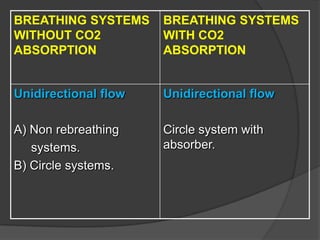
BREATHING SYSTEMS
WITHOUT CO2
ABSORPTION

BREATHING SYSTEMS
WITH CO2
ABSORPTION

Unidirectional flow

Unidirectional flow

A) Non rebreathing
systems.
B) Circle systems.

Circle system with
absorber.
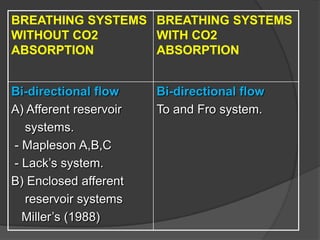
BREATHING SYSTEMS BREATHING SYSTEMS
WITHOUT CO2
WITH CO2
ABSORPTION
ABSORPTION

Bi-directional flow
A) Afferent reservoir
systems.
- Mapleson A,B,C
- Lack’s system.
B) Enclosed afferent
reservoir systems
Miller’s (1988)

Bi-directional flow
To and Fro system.
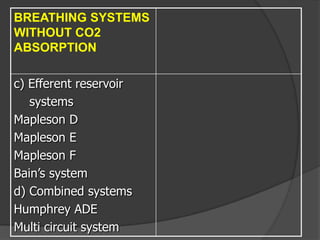
BREATHING SYSTEMS
WITHOUT CO2
ABSORPTION

c) Efferent reservoir
systems
Mapleson D
Mapleson E
Mapleson F
Bain’s system
d) Combined systems
Humphrey ADE
Multi circuit system
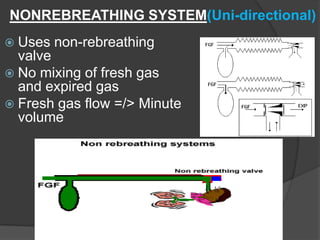
NONREBREATHING SYSTEM(Uni-directional)
 Uses

non-rebreathing

valve
 No mixing of fresh gas
and expired gas
 Fresh gas flow =/> Minute
volume
Disadvantage:
FGF has to be constantly adjusted
so uneconomical
No humidification
No conservation of heat
Not convenient because of bulk of
valve

Valve malfunctioning due to
condensation of moisture
Bi-Directional Flow system
extensively used
 depend on the FGF for effective
elimination of CO2
FGF
- No FGF - suffocated
- Low FGF - does not eliminate CO2
- High FGF – wastage


FGF should be delivered as near the
patient’s airway as possible.
Mapleson systems


1954 by Professor W W Mapleson

- Maplesons A-(magills )
- Maplesons B
- Maplesons C
- Maplesons D
- Maplesons E (T-piece)
- Maplesons F (Jackson-Rees modification of
the T-piece)
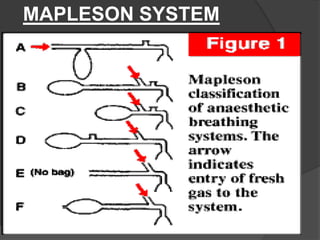
MAPLESON SYSTEM
Functional classification
Afferent reservoir system (ARS).
 Enclosed afferent reservoir systems
(EARS).
 Efferent reservoir systems (ERS).
 Combined systems.


Enclosed afferent reservoir system has
been described by Miller and Miller.


afferent limb - delivers the fresh gas from
the machine to the patient.



efferent limb - expired gas from the patient
and vents it to the atmosphere through the
expiratory valve/port
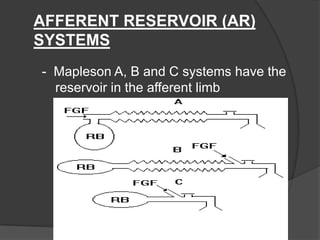
AFFERENT RESERVOIR (AR)
SYSTEMS
- Mapleson A, B and C systems have the
reservoir in the afferent limb


AR systems - spontaneous breathing

- the expiratory valve is separated from the
reservoir bag
- FGF should be atleast one MV
- apparatus dead space is minimal.


Not efficient - controlled ventilation

FGF close to the expiratory valve (Mapleson
B & C) , the system is inefficient both during
spontaneous and controlled ventilation
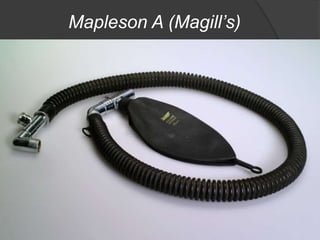
Mapleson A (Magill’s)
MAPLESON A


Also known as “MAGILLS SYSTEM”



Best for spontaneous ventilation



Depend on FGF for CO2 washout so also
known as “FLOW CONTROLLED
BREATHING SYSTEM”



No rebreathing if FGF=minute volume



No separation of inspired and expired gases



Monitoring of ETCO2 is must.






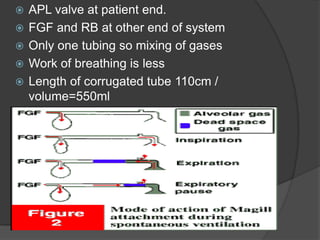
APL valve at patient end.
FGF and RB at other end of system
Only one tubing so mixing of gases
Work of breathing is less
Length of corrugated tube 110cm /
volume=550ml
FGF requirements
Spontaneous
FGF = Minute volume
FGF of 51-85ml/kg/min advised to
prevent re-breathing
Controlled
FGF = 2.5 x MV
Mapleson A




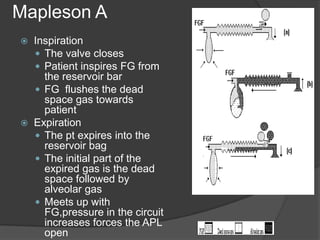
Inspiration
 The valve closes
 Patient inspires FG from
the reservoir bar
 FG flushes the dead
space gas towards
patient
Expiration
 The pt expires into the
reservoir bag
 The initial part of the
expired gas is the dead
space followed by
alveolar gas
 Meets up with
FG,pressure in the circuit
increases forces the APL
open
Mapleson A


Controlled Ventilation
 The Mapleson A is inefficient during controlled

ventilation.
 Venting of gas in the circuit occurs during the
inspiratory phase, and the alveolar gases are
retained in the tubing during expiration phase
 Hence the alveolar gas is rebreathed before the
pressure in the system increases sufficiently
enough to force the expiratory valve open
 A Fresh gas flow of >20l/min is required to
prevent rebreathing during controlled ventilation
This system differs from other circuits in that
the fresh gas does not enter the system near
the patient but near the reservoir bag.

Hazard:- should not be used with mechanical
ventilator coz entire system becomes dead
space
Test for Mapelson “A”
Occlude patient end, close APL valve,
pressurize system – maintaining
pressure confirms integritiy
LACK’S MODIFICATION







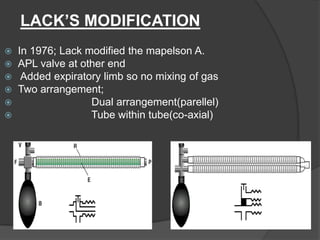
In 1976; Lack modified the mapelson A.
APL valve at other end
Added expiratory limb so no mixing of gas
Two arrangement;
Dual arrangement(parellel)
Tube within tube(co-axial)
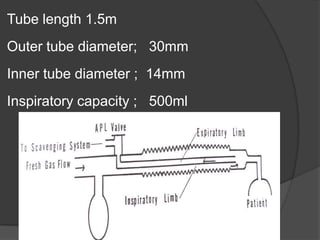
Tube length 1.5m
Outer tube diameter; 30mm

Inner tube diameter ; 14mm
Inspiratory capacity ; 500ml
TESTING


1)Attach tracheal tube to inner tube at
patient end ; blowing down the tube with
APL valve closed will produce bag
movement if there is leak between two
tubes



2) Occlude both limbs at patient end with
APL valve open; squeeze the bag; if there
is leak in inner tube; gas will escape from
APL valve and bag will collapse
Advantages:Location of APL valve- facilitates IPPV / scavenging.

Disadvantages:Slight increase in work of breathing.
Break / disconnection of inner tube- entire reservoir
tube becomes dead pace.
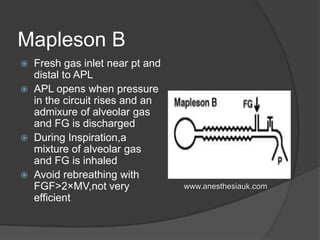
Mapleson B
Fresh gas inlet near pt and
distal to APL
 APL opens when pressure
in the circuit rises and an
admixure of alveolar gas
and FG is discharged
 During Inspiration,a
mixture of alveolar gas
and FG is inhaled
 Avoid rebreathing with
FGF>2×MV,not very
efficient


www.anesthesiauk.com
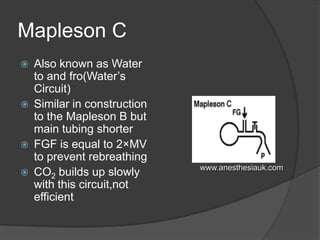
Mapleson C







Also known as Water
to and fro(Water’s
Circuit)
Similar in construction
to the Mapleson B but
main tubing shorter
FGF is equal to 2×MV
to prevent rebreathing
CO2 builds up slowly
with this circuit,not
efficient

www.anesthesiauk.com
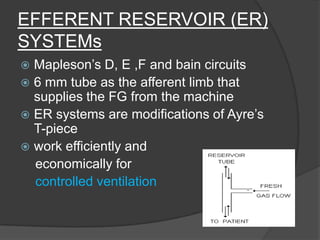
EFFERENT RESERVOIR (ER)
SYSTEMs
Mapleson’s D, E ,F and bain circuits
 6 mm tube as the afferent limb that
supplies the FG from the machine
 ER systems are modifications of Ayre’s
T-piece
 work efficiently and
economically for
controlled ventilation

MAPELSON D


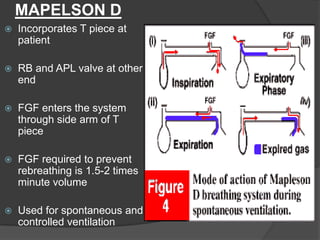
Incorporates T piece at
patient



RB and APL valve at other
end



FGF enters the system
through side arm of T
piece



FGF required to prevent
rebreathing is 1.5-2 times
minute volume



Used for spontaneous and
controlled ventilation
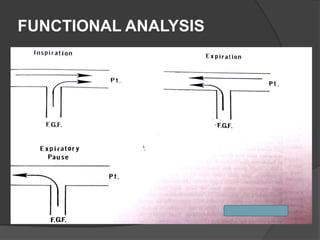
FUNCTIONAL ANALYSIS
BAIN’S SYSTEM


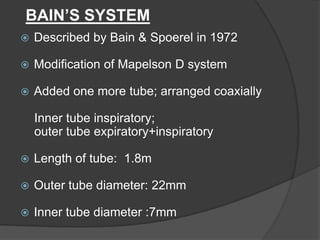
Described by Bain & Spoerel in 1972



Modification of Mapelson D system



Added one more tube; arranged coaxially
Inner tube inspiratory;
outer tube expiratory+inspiratory



Length of tube: 1.8m



Outer tube diameter: 22mm



Inner tube diameter :7mm
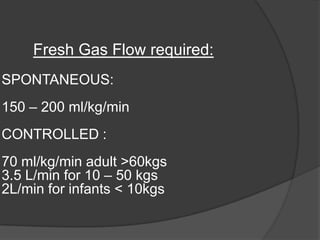
Fresh Gas Flow required:
SPONTANEOUS:
150 – 200 ml/kg/min

CONTROLLED :
70 ml/kg/min adult >60kgs
3.5 L/min for 10 – 50 kgs
2L/min for infants < 10kgs
ADVANTAGE:










Useful for pediatric as will as adult patient
Allows warming & humidification of gases
useful for spontaneous as will as controlled
ventilation
Easily dismantled; sterilised; so useful in infected
cases
Facilitates scavenging
Length of tubing is long so machine can be taken
away from patient ; useful in head & neck &
Neurosurgery.
Light weight
Can be used with ventilator
DISADVANTAGE:


High fresh gas flow requirements



Cannot be used with intermittent flow
machine.



Disconnection ,kink ,break, leak, at
inner tube may go unnoticed – entire
exhalation limb becomes dead space
Functional Analysis:During controlled ventilation
-when FGF is high, PaCO2 becomes ventilatory
dependent.
-when MV exceeds FGF , PaCO2 becomes
dependent on FGF
TESTING

(For inner tube)
A) Foex-Crempton Smith test
 Set low flow of O2 on flow meter , close APL valve
 Occlude the inner tube with a finger or barrel of
syringe at pt end .

Observe flow meter indicator
 If inner tube is intact and correctly connected flow
meter will fall
B) Pathik test
 Close APL valve, Activate O2 flush
 Observe the bag
 Due to venturi effect , Bag will deflate .
TESTING (for outer tube)
Close APL valve, occlude the patient end &
pressurize the system. If no leak pressure will be
maintained.
When APL valve is opened the bag will deflate
easily.
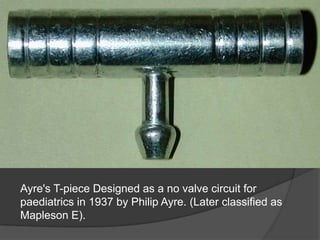
Ayre's T-piece Designed as a no valve circuit for
paediatrics in 1937 by Philip Ayre. (Later classified as
Mapleson E).
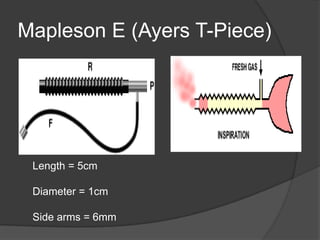
Mapleson E (Ayers T-Piece)

Length = 5cm

Diameter = 1cm
Side arms = 6mm
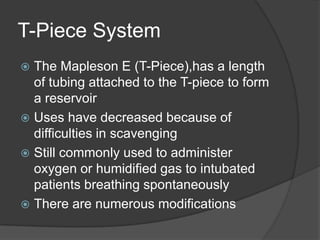
T-Piece System
The Mapleson E (T-Piece),has a length
of tubing attached to the T-piece to form
a reservoir
 Uses have decreased because of
difficulties in scavenging
 Still commonly used to administer
oxygen or humidified gas to intubated
patients breathing spontaneously
 There are numerous modifications

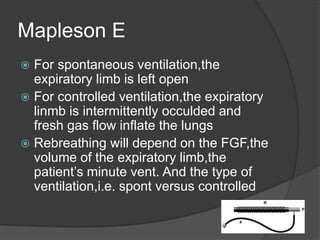
Mapleson E
For spontaneous ventilation,the
expiratory limb is left open
 For controlled ventilation,the expiratory
linmb is intermittently occulded and
fresh gas flow inflate the lungs
 Rebreathing will depend on the FGF,the
volume of the expiratory limb,the
patient’s minute vent. And the type of
ventilation,i.e. spont versus controlled

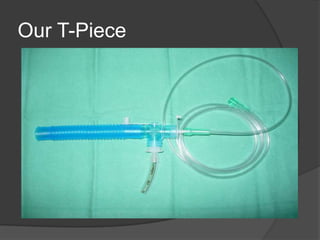
Our T-Piece
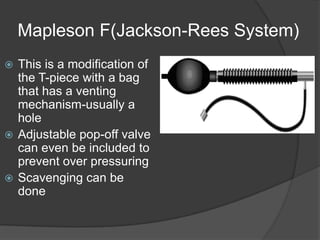
Mapleson F(Jackson-Rees System)
This is a modification of
the T-piece with a bag
that has a venting
mechanism-usually a
hole
 Adjustable pop-off valve
can even be included to
prevent over pressuring
 Scavenging can be
done

Mapleson F(Jackson Rees)


For spontaneous ventilation the relief mechanism is
usually left open



For assisted of controlled ventilation, the relief
mechanism is occluded sufficient enough to distend
the bag, respiration can then be controlled by
squeezing the bag



The volume of the reservoir bag should be
approximately the patient’s tidal volume, if the
volume is too large re-breathing may occur and if
too small ambient air may be entrained



To prevent rebreathing the system requires an FGF
of 2.5-3 × the patients Minute volume
FGF requirements:Spontaneous2-3 times MV
Minimum flow 3L/min
Controlled1000ml + 100ml/kg
Advantages







Compact
Cheap
No valves
Minimal dead space
Minimal resistance
to breathing.
Ventilator can be
used

Disadvantages




The bag may
become twisted and
impede breathing
High gas flow
requirements
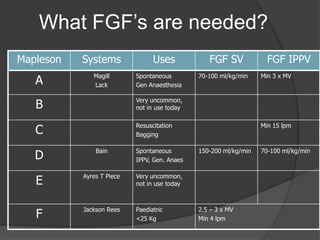
What FGF’s are needed?
Mapleson

Systems

A

Magill
Lack

Uses
Spontaneous
Gen Anaesthesia

B

70-100 ml/kg/min

Resuscitation
Bagging

FGF IPPV
Min 3 x MV

Very uncommon,
not in use today

C

FGF SV

D

Bain

Spontaneous
IPPV, Gen. Anaes

E

Ayres T Piece

Very uncommon,
not in use today

F

Jackson Rees

Paediatric
<25 Kg

Min 15 lpm

150-200 ml/kg/min

2.5 – 3 x MV
Min 4 lpm

70-100 ml/kg/min
Relative Efficiency of rebreathing among
various Mapleson circuits


Spontaneous Ventilation-A>DFE>CB



Controlled Ventilation-DFE>BC>A



Mapleson A is most efficient during spontaneous
ventilation,but it is the worst for controlled
ventilation



Mapleson D is most efficient during controlled
ventilation
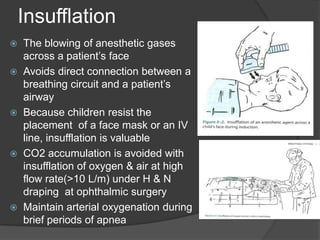
Insufflation









The blowing of anesthetic gases
across a patient’s face
Avoids direct connection between a
breathing circuit and a patient’s
airway
Because children resist the
placement of a face mask or an IV
line, insufflation is valuable
CO2 accumulation is avoided with
insufflation of oxygen & air at high
flow rate(>10 L/m) under H & N
draping at ophthalmic surgery
Maintain arterial oxygenation during
brief periods of apnea
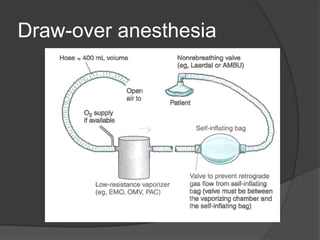
Draw-over anesthesia
Draw-over anestheaia
Nonrebreathing circuits
 Use ambient air as the carrier gas
 Inspired vapor and oxygen
concentrations are predictable &
controllable
 Advantage; simplicity, portability
 Disadvantage; absence of reservoir bag
-> not well appreciating the depth of TV
during spontaneous ventilation

Disadvantages of the
insufflation & draw-over
systems

Poor control of inspired gas
concentration & depth of anesthesia
 Inability to assist or control ventilation
 No conservation of exhaled heat or
humidity
 Difficult airway management during
head & neck surgery
 Pollution of the operating room with
large volumes of waste gas

COMBINED SYSTEM
HUMPHREY’S ADE system:


To overcome the difficulties of changing breathing
system for different modes of ventilation this system
is developed



Two reservoir bag; one in afferent limb; other in
efferent limb; only one is in use at a time



System can be changed from ARS to ERS by
changing the position of lever



Used for adults as will as children



Functional Analysis same as MAP-A in ARS& as
BAIN in ERS
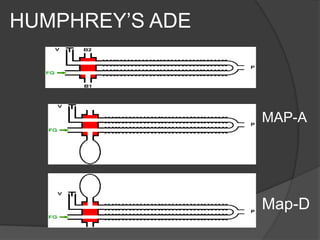
HUMPHREY’S ADE

MAP-A

Map-D
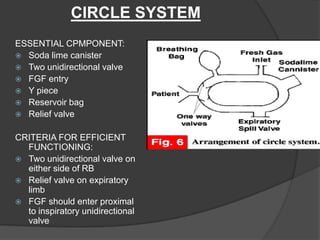
CIRCLE SYSTEM
ESSENTIAL CPMPONENT:
 Soda lime canister
 Two unidirectional valve
 FGF entry
 Y piece
 Reservoir bag
 Relief valve

CRITERIA FOR EFFICIENT
FUNCTIONING:
 Two unidirectional valve on
either side of RB
 Relief valve on expiratory
limb
 FGF should enter proximal
to inspiratory unidirectional
valve
TESTING







Set all the gas flows to zero.
Close APL valve
Occlude Y piece
Pressurize system to 30cm of with Oxygen
flush
Pressure should remain fixed for at least
10 sec.
Open APL valve and ensure pressure
decrease
CIRCLE SYSTEM ctd.
ADVANTAGES








Exhaled gas –co2 used again and again
Constant inspired concentration
Conservation of heat & humidity
Useful for all ages
Useful for low flow ;reduces cost of Anaesthesia
Low resistance
Less OT pollution
DISADVANTAGES:

Increased dead space
 Malfunctioning of unidirectional valve
 Exhausted soda lime; danger of hypercarbia


Breathing circuit's

  • 1.
  • 2.
    DEFINITION: Assembly of componentswhich connects the patient’s airway to the anaesthetic machine creating an artificial atmosphere, from and into which the patient breathes. A breathing system converts continuous flow from the machine to a intermittent flow.
  • 3.
    INTRODUCTION Any resemblance toa breathing system was developed by Barth (1907)  The Mapleson A (Magill) system was designed by Sir Ivan Magill in the 1930's  In 1926 , Brian Sword introduced the circle system  Ayre’s T-piece was introduced in 1937  Bain Circuit was introduced in 1972 by Bain and Spoerel. 
  • 4.
    CRITERIA FOR IDEALSYSTEM ESSENTIAL:1.Delivery of gas from machine to the alveoli in same concentration as set and in shortest possible time 2.Effective elimination of CO2 3.Minimal dead space 4.Minimal resistance
  • 5.
    DESIRABLE:1.Economy of freshgas 2.Conservation of heat 3. Adequate humidification 4. Efficient during spontaneous and controlled ventilation 5. Efficient for adult, pediatrics and with mechanical ventilators 6. Light weight 7. Less theater pollution 8. Convenient during use.
  • 6.
    COMPONENTS 1.Bushings(mount) 2.Sleeves 3.Connectors & Adaptors 4.FGFinlet 5.Breathing tube 6.Reservoir Bag 7.Valve’s 8.Filters 9.CO2 absorber
  • 7.
    CLASSIFICATION OF BREATHING SYSTEMS  McMohanin 1951 Open - no rebreathing Semiclosed - partial rebreathing Closed - total rebreathing  Dripps et al have classified them as Insufflation, Open, Semi-open, Semi-closed and Closed
  • 8.
    Conway suggested afunctional classification 1. Breathing systems with CO2 absorber 2. Breathing systems without CO2 absorber.
  • 9.
    BREATHING SYSTEMS WITHOUT CO2 ABSORPTION BREATHINGSYSTEMS WITH CO2 ABSORPTION Unidirectional flow Unidirectional flow A) Non rebreathing systems. B) Circle systems. Circle system with absorber.
  • 10.
    BREATHING SYSTEMS BREATHINGSYSTEMS WITHOUT CO2 WITH CO2 ABSORPTION ABSORPTION Bi-directional flow A) Afferent reservoir systems. - Mapleson A,B,C - Lack’s system. B) Enclosed afferent reservoir systems Miller’s (1988) Bi-directional flow To and Fro system.
  • 11.
    BREATHING SYSTEMS WITHOUT CO2 ABSORPTION c)Efferent reservoir systems Mapleson D Mapleson E Mapleson F Bain’s system d) Combined systems Humphrey ADE Multi circuit system
  • 12.
    NONREBREATHING SYSTEM(Uni-directional)  Uses non-rebreathing valve No mixing of fresh gas and expired gas  Fresh gas flow =/> Minute volume
  • 13.
    Disadvantage: FGF has tobe constantly adjusted so uneconomical No humidification No conservation of heat Not convenient because of bulk of valve Valve malfunctioning due to condensation of moisture
  • 14.
    Bi-Directional Flow system extensivelyused  depend on the FGF for effective elimination of CO2 FGF - No FGF - suffocated - Low FGF - does not eliminate CO2 - High FGF – wastage  FGF should be delivered as near the patient’s airway as possible.
  • 15.
    Mapleson systems  1954 byProfessor W W Mapleson - Maplesons A-(magills ) - Maplesons B - Maplesons C - Maplesons D - Maplesons E (T-piece) - Maplesons F (Jackson-Rees modification of the T-piece)
  • 16.
  • 17.
    Functional classification Afferent reservoirsystem (ARS).  Enclosed afferent reservoir systems (EARS).  Efferent reservoir systems (ERS).  Combined systems.  Enclosed afferent reservoir system has been described by Miller and Miller.
  • 18.
     afferent limb -delivers the fresh gas from the machine to the patient.  efferent limb - expired gas from the patient and vents it to the atmosphere through the expiratory valve/port
  • 19.
    AFFERENT RESERVOIR (AR) SYSTEMS -Mapleson A, B and C systems have the reservoir in the afferent limb
  • 20.
     AR systems -spontaneous breathing - the expiratory valve is separated from the reservoir bag - FGF should be atleast one MV - apparatus dead space is minimal.  Not efficient - controlled ventilation FGF close to the expiratory valve (Mapleson B & C) , the system is inefficient both during spontaneous and controlled ventilation
  • 21.
  • 22.
    MAPLESON A  Also knownas “MAGILLS SYSTEM”  Best for spontaneous ventilation  Depend on FGF for CO2 washout so also known as “FLOW CONTROLLED BREATHING SYSTEM”  No rebreathing if FGF=minute volume  No separation of inspired and expired gases  Monitoring of ETCO2 is must.
  • 23.
         APL valve atpatient end. FGF and RB at other end of system Only one tubing so mixing of gases Work of breathing is less Length of corrugated tube 110cm / volume=550ml
  • 24.
    FGF requirements Spontaneous FGF =Minute volume FGF of 51-85ml/kg/min advised to prevent re-breathing Controlled FGF = 2.5 x MV
  • 25.
    Mapleson A   Inspiration  Thevalve closes  Patient inspires FG from the reservoir bar  FG flushes the dead space gas towards patient Expiration  The pt expires into the reservoir bag  The initial part of the expired gas is the dead space followed by alveolar gas  Meets up with FG,pressure in the circuit increases forces the APL open
  • 26.
    Mapleson A  Controlled Ventilation The Mapleson A is inefficient during controlled ventilation.  Venting of gas in the circuit occurs during the inspiratory phase, and the alveolar gases are retained in the tubing during expiration phase  Hence the alveolar gas is rebreathed before the pressure in the system increases sufficiently enough to force the expiratory valve open  A Fresh gas flow of >20l/min is required to prevent rebreathing during controlled ventilation
  • 27.
    This system differsfrom other circuits in that the fresh gas does not enter the system near the patient but near the reservoir bag. Hazard:- should not be used with mechanical ventilator coz entire system becomes dead space
  • 28.
    Test for Mapelson“A” Occlude patient end, close APL valve, pressurize system – maintaining pressure confirms integritiy
  • 29.
    LACK’S MODIFICATION       In 1976;Lack modified the mapelson A. APL valve at other end Added expiratory limb so no mixing of gas Two arrangement; Dual arrangement(parellel) Tube within tube(co-axial)
  • 30.
    Tube length 1.5m Outertube diameter; 30mm Inner tube diameter ; 14mm Inspiratory capacity ; 500ml
  • 31.
    TESTING  1)Attach tracheal tubeto inner tube at patient end ; blowing down the tube with APL valve closed will produce bag movement if there is leak between two tubes  2) Occlude both limbs at patient end with APL valve open; squeeze the bag; if there is leak in inner tube; gas will escape from APL valve and bag will collapse
  • 32.
    Advantages:Location of APLvalve- facilitates IPPV / scavenging. Disadvantages:Slight increase in work of breathing. Break / disconnection of inner tube- entire reservoir tube becomes dead pace.
  • 33.
    Mapleson B Fresh gasinlet near pt and distal to APL  APL opens when pressure in the circuit rises and an admixure of alveolar gas and FG is discharged  During Inspiration,a mixture of alveolar gas and FG is inhaled  Avoid rebreathing with FGF>2×MV,not very efficient  www.anesthesiauk.com
  • 34.
    Mapleson C     Also knownas Water to and fro(Water’s Circuit) Similar in construction to the Mapleson B but main tubing shorter FGF is equal to 2×MV to prevent rebreathing CO2 builds up slowly with this circuit,not efficient www.anesthesiauk.com
  • 35.
    EFFERENT RESERVOIR (ER) SYSTEMs Mapleson’sD, E ,F and bain circuits  6 mm tube as the afferent limb that supplies the FG from the machine  ER systems are modifications of Ayre’s T-piece  work efficiently and economically for controlled ventilation 
  • 36.
    MAPELSON D  Incorporates Tpiece at patient  RB and APL valve at other end  FGF enters the system through side arm of T piece  FGF required to prevent rebreathing is 1.5-2 times minute volume  Used for spontaneous and controlled ventilation
  • 37.
  • 38.
    BAIN’S SYSTEM  Described byBain & Spoerel in 1972  Modification of Mapelson D system  Added one more tube; arranged coaxially Inner tube inspiratory; outer tube expiratory+inspiratory  Length of tube: 1.8m  Outer tube diameter: 22mm  Inner tube diameter :7mm
  • 39.
    Fresh Gas Flowrequired: SPONTANEOUS: 150 – 200 ml/kg/min CONTROLLED : 70 ml/kg/min adult >60kgs 3.5 L/min for 10 – 50 kgs 2L/min for infants < 10kgs
  • 40.
    ADVANTAGE:         Useful for pediatricas will as adult patient Allows warming & humidification of gases useful for spontaneous as will as controlled ventilation Easily dismantled; sterilised; so useful in infected cases Facilitates scavenging Length of tubing is long so machine can be taken away from patient ; useful in head & neck & Neurosurgery. Light weight Can be used with ventilator
  • 41.
    DISADVANTAGE:  High fresh gasflow requirements  Cannot be used with intermittent flow machine.  Disconnection ,kink ,break, leak, at inner tube may go unnoticed – entire exhalation limb becomes dead space
  • 42.
    Functional Analysis:During controlledventilation -when FGF is high, PaCO2 becomes ventilatory dependent. -when MV exceeds FGF , PaCO2 becomes dependent on FGF
  • 43.
    TESTING (For inner tube) A)Foex-Crempton Smith test  Set low flow of O2 on flow meter , close APL valve  Occlude the inner tube with a finger or barrel of syringe at pt end .  Observe flow meter indicator  If inner tube is intact and correctly connected flow meter will fall B) Pathik test  Close APL valve, Activate O2 flush  Observe the bag  Due to venturi effect , Bag will deflate .
  • 44.
    TESTING (for outertube) Close APL valve, occlude the patient end & pressurize the system. If no leak pressure will be maintained. When APL valve is opened the bag will deflate easily.
  • 45.
    Ayre's T-piece Designedas a no valve circuit for paediatrics in 1937 by Philip Ayre. (Later classified as Mapleson E).
  • 46.
    Mapleson E (AyersT-Piece) Length = 5cm Diameter = 1cm Side arms = 6mm
  • 47.
    T-Piece System The MaplesonE (T-Piece),has a length of tubing attached to the T-piece to form a reservoir  Uses have decreased because of difficulties in scavenging  Still commonly used to administer oxygen or humidified gas to intubated patients breathing spontaneously  There are numerous modifications 
  • 48.
    Mapleson E For spontaneousventilation,the expiratory limb is left open  For controlled ventilation,the expiratory linmb is intermittently occulded and fresh gas flow inflate the lungs  Rebreathing will depend on the FGF,the volume of the expiratory limb,the patient’s minute vent. And the type of ventilation,i.e. spont versus controlled 
  • 49.
  • 50.
    Mapleson F(Jackson-Rees System) Thisis a modification of the T-piece with a bag that has a venting mechanism-usually a hole  Adjustable pop-off valve can even be included to prevent over pressuring  Scavenging can be done 
  • 51.
    Mapleson F(Jackson Rees)  Forspontaneous ventilation the relief mechanism is usually left open  For assisted of controlled ventilation, the relief mechanism is occluded sufficient enough to distend the bag, respiration can then be controlled by squeezing the bag  The volume of the reservoir bag should be approximately the patient’s tidal volume, if the volume is too large re-breathing may occur and if too small ambient air may be entrained  To prevent rebreathing the system requires an FGF of 2.5-3 × the patients Minute volume
  • 52.
    FGF requirements:Spontaneous2-3 timesMV Minimum flow 3L/min Controlled1000ml + 100ml/kg
  • 53.
    Advantages       Compact Cheap No valves Minimal deadspace Minimal resistance to breathing. Ventilator can be used Disadvantages   The bag may become twisted and impede breathing High gas flow requirements
  • 54.
    What FGF’s areneeded? Mapleson Systems A Magill Lack Uses Spontaneous Gen Anaesthesia B 70-100 ml/kg/min Resuscitation Bagging FGF IPPV Min 3 x MV Very uncommon, not in use today C FGF SV D Bain Spontaneous IPPV, Gen. Anaes E Ayres T Piece Very uncommon, not in use today F Jackson Rees Paediatric <25 Kg Min 15 lpm 150-200 ml/kg/min 2.5 – 3 x MV Min 4 lpm 70-100 ml/kg/min
  • 55.
    Relative Efficiency ofrebreathing among various Mapleson circuits  Spontaneous Ventilation-A>DFE>CB  Controlled Ventilation-DFE>BC>A  Mapleson A is most efficient during spontaneous ventilation,but it is the worst for controlled ventilation  Mapleson D is most efficient during controlled ventilation
  • 56.
    Insufflation      The blowing ofanesthetic gases across a patient’s face Avoids direct connection between a breathing circuit and a patient’s airway Because children resist the placement of a face mask or an IV line, insufflation is valuable CO2 accumulation is avoided with insufflation of oxygen & air at high flow rate(>10 L/m) under H & N draping at ophthalmic surgery Maintain arterial oxygenation during brief periods of apnea
  • 57.
  • 58.
    Draw-over anestheaia Nonrebreathing circuits Use ambient air as the carrier gas  Inspired vapor and oxygen concentrations are predictable & controllable  Advantage; simplicity, portability  Disadvantage; absence of reservoir bag -> not well appreciating the depth of TV during spontaneous ventilation 
  • 59.
    Disadvantages of the insufflation& draw-over systems Poor control of inspired gas concentration & depth of anesthesia  Inability to assist or control ventilation  No conservation of exhaled heat or humidity  Difficult airway management during head & neck surgery  Pollution of the operating room with large volumes of waste gas 
  • 60.
    COMBINED SYSTEM HUMPHREY’S ADEsystem:  To overcome the difficulties of changing breathing system for different modes of ventilation this system is developed  Two reservoir bag; one in afferent limb; other in efferent limb; only one is in use at a time  System can be changed from ARS to ERS by changing the position of lever  Used for adults as will as children  Functional Analysis same as MAP-A in ARS& as BAIN in ERS
  • 61.
  • 62.
    CIRCLE SYSTEM ESSENTIAL CPMPONENT: Soda lime canister  Two unidirectional valve  FGF entry  Y piece  Reservoir bag  Relief valve CRITERIA FOR EFFICIENT FUNCTIONING:  Two unidirectional valve on either side of RB  Relief valve on expiratory limb  FGF should enter proximal to inspiratory unidirectional valve
  • 63.
    TESTING       Set all thegas flows to zero. Close APL valve Occlude Y piece Pressurize system to 30cm of with Oxygen flush Pressure should remain fixed for at least 10 sec. Open APL valve and ensure pressure decrease
  • 64.
    CIRCLE SYSTEM ctd. ADVANTAGES        Exhaledgas –co2 used again and again Constant inspired concentration Conservation of heat & humidity Useful for all ages Useful for low flow ;reduces cost of Anaesthesia Low resistance Less OT pollution DISADVANTAGES: Increased dead space  Malfunctioning of unidirectional valve  Exhausted soda lime; danger of hypercarbia 