Non-invasive Positive Pressure
Ventilation (NPPV)
Bach Mai Hospital
Sean M. Caples
College of Medicine
Mayo Clinic
Outline
 “NPPV” = BiLevel and/or CPAP
 Historical Overview
 Rationale for use of NPPV, physiology
 Review of important studies in selected
clinical situations
 COPD exacerbation
 Acute cardiogenic pulmonary edema
 Hypoxic resp. failure/ARDS/lung injury
 Post-operative setting
 Extubation failure
 Proposed Algorithm
Outline
History
 Negative pressure ventilation (Iron Lung)
 Invasive ventilation with polio epidemic
 IPPB-intermittent positive pressure breathing by
mouthpiece to deliver aerosol medications
 Sullivan-CPAP for obstructive sleep apnea 1981
Why Use NPPV ?
Avoid the complications of endotracheal
intubation:
1. Acute placement of the tube: trauma, aspiration,
hypotension
2. Nosocomial infection: VAP-ventilator associated
pneumonia, sinusitis
3. Post-extubation: hoarseness, tracheal stenosis, vocal
cord dysfunction
4. Patient Factors: Allows swallowing and speech
NPPV for Acute Respiratory
Failure at Mayo Clinic
0
100
200
300
400
500
600
700
800
900
1000
1993
1995
1997
1999
2001
2003
2005
Pts.
From Peter Gay, MD
NPPV: Mechanisms of Action in
Acute Respiratory Failure
 Respiratory Muscle Unloading resulting in:
 Decrease PaCO2
 Increase PaO2
 Decrease respiratory rate
NPPV for Acute Exacerbation of
COPD- A randomized trial
Brochard et al, NEJM 1995;333:817-22
 Randomized, 5 European Centers
 Usual Care (UC) vs. NPPV
 Inclusion Criteria = RR>30, PaCO2>45, pH<7.30
 Exclusion Criteria = Need For ETT, Extreme Dyspnea
 NPPV group:
 Less intubation (26 vs 74%)
 Less complications (16 vs 48%)
 Shorter hospital stay (23+17 vs 35+33 days)
 Lower mortality (9 vs 29%)
Largest Trial-14 UK Hospitals
Conducted on the Wards (not ICU)
•Physiologic improvements of similar magnitude, but occur earlier with NPPV
•26 mins average nursing care burden/day on the wards
•Still, a high rate of death with NIV if more acidotic (? Better in the ICU)
Meta-Analysis
NPPV in COPD Exacerbations
Keenan S, Ann Intern Med, 2003
•NPPV best for severe exacerbations of COPD
(hypercapnia)
•Little evidence to support use of NPPV in milder
Exacerbations (PaCO2 < 45)
 Expertise of available resources
 Fewer complicating illnesses (esp. pneumonia)
 Hypercapnic Acidosis (pH  7.30)
 Prompt initiation of treatment with rapid
improvement in gas exchange and respiratory rate
 Many questions remain-
 Sedation- what’s the right amount?
 Patient cooperation- how much do you need?
NPPV for Acute Exacerbation of
COPD- Determinants of success
Mehta S, Hill NS, State of the Art: Noninvasive Ventilation. AJRCCM 163:540-77, 2001
NPPV (CPAP or Bi-Level) for
Acute Cardiogenic Pulmonary
Edema
Mechanisms of Action
 Opens flooded/collapsed alveoli
 (↑ functional residual capacity, improves gas
exchange)
 Decreases cardiac preload
 Decreases cardiac afterload
 Overcomes resistance related to upper airway
edema
CPAP unloads the left ventricle and inspiratory
muscles of patients with CHF…
Naughton et al. Circ 1995
CPAP May Reduce Ventricular Volumes
Mehta, AJRCCM, 2000
 Bi-Level may more effectively unload respiratory
muscles Chadda, et al. Crit Care Med, 2002
 Bi-Level may improve physiologic indices more
rapidly Mehta, et al. Crit Care Med, 1997
BiLevel
CPAP
Enthusiasm for Bi-Level
tempered in 1997
p = 0.06
•More patients with chest pain were
randomized to the Bilevel group
•Higher intrathoracic pressures may occur
with BiPAP, particularly with increasing resp.
rates
•Hemodynamic effects could be exaggerated
Subsequent Trials have not
replicated such problems with Bi-
Level
 ER based, 38 pts (Levitt M, J Emerg Med 21(4): 2001)
 Lower intubation for BiPAP= 23.8% vs. O2= 41.2%
 No difference in ABGs, pH, and AMI rate was 19% in
the BiPAP and 29.4% for O2 (NS)
 CHF & hypercapnia AJRCCM 2003 Vol 168
 More rapid relief of distress, better gas exchange, and
reduced intubation rate but no mortality change
Lancet, 2006
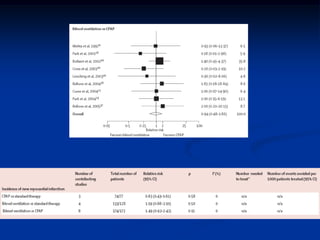
Effect of NPPV on
Mortality
Number needed
to treat (NNT)
with CPAP to save
one life: 10
Effect of NIPPV on the
need for invasive
mechanical ventilation
NNT = 6
NNT = 7
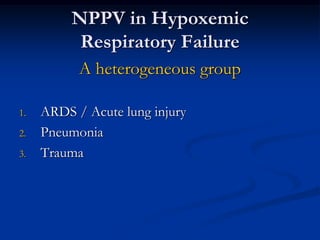
NPPV in Hypoxemic
Respiratory Failure
A heterogeneous group
1. ARDS / Acute lung injury
2. Pneumonia
3. Trauma
L’Her, AJRCCM 2005
 How does NPPV compare with
conventional mechanical ventilation in
hypoxemic respiratory failure
 Design- Randomized 64 pts. to Bi-Level
NPPV or endotracheal intubation
 Non-COPD pts with Hypoxic ARF
Comparison of NPPV & Conventional
Mechanical Ventilation in Pts with ARF
Antonelli M, NEJM; 339: 429-435, 1998
ETT NPPV p<
% ICU Mortality 47 28 0.19
ICU Stay (days) 16+17 9+7 0.04
%Serious complications 66 38 0.02
%ETT rel. pneum/sinus 31 3 0.003
RESULTS
Comparison of NPPV & Conventional
Mechanical Ventilation in Pts with ARF
Antonelli M, NEJM; 339: 429-435, 1998
 Conclusions-
 ICU stay and ventilator complications reduced in
pts. with ARF who initially try NPPV
 10/32 pts. failed NPPV- age 47 vs. 66 (p<.006)
 Overall gas exchange improvement similar
 If ETT is avoided, pneumonia is rare
 High mortality if NPPV then ETT(90%)
Comparison of NPPV & Conventional
Mechanical Ventilation in Pts with ARF
Antonelli M, NEJM; 339: 429-435, 1998
 Do those without chronic lung disease and free of
hypercapnia respond to CPAP?
 123 Patients with acute lung injury (Pneumonia 50%)
stratified for cardiac disease Mean PaO2/FiO2~ 145
 CPAP 5 to 10 vs. high flow oxygen
 After 1 hr, sig responses greater with CPAP:
 Subjective responses e.g. dyspnea (P<.001)
 PaO2/FiO2= 203 vs. 151 mmHg (P= .02)
Treatment of Hypoxemic, Non-hypercapnic ARF
with CPAP- Randomized Controlled Trial
Delclaux C; (Brochard group) JAMA 284:2352-2360 2000
 But, higher overall number of serious adverse events occurred
with CPAP= 18 vs 6 (P= .01)
 Results- No differences in CPAP vs. Std Care:
 Intubation rate= 34% vs. 39% (P= .53)
 Hospital mortality= 31% vs. 30% (P= .89)
 ICU length of stay= 6.5 vs 6.0 days (P= .43)
 Conclusion- Despite early physiologic improvements, CPAP did
not improve outcomes in patients with hypoxia alone
Treatment of Hypoxemic, Non-hypercapnic ARF with
CPAP- Randomized Controlled Trial
Delclaux C; JAMA 284:2352-2360 2000
Failure of non-invasive ventilation in patients with
acute lung injury: observational cohort study
Rana S, Gay P, Buck C, Hubmayr R, Gajic O, Crit Care. 2006
 Design:
 Observational cohort study of 79 cons pts with ALI
initially treated with NIPPV- 25 excluded (23 DNR).
 Results:
 54 pts, 38 (70.3%) failed NIPPV, including all 19 pts that
had shock
 Successful pts had:
 Lower Apache III scores (55.5 vs 81.5; p<0.01)
 Less metabolic acidosis (base deficit: 0.52 vs -4.01;
p=0.02) or
 Severe hypoxemia (PaO2/FIO2: 147 vs 112; p= 0.02)
Post-operative Use of
NPPV
CPAP for Treatment of
Postoperative Hypoxemia
Squadrone, JAMA 2005;293:589-595.
Randomize 209 subjects
Post-Abdominal Surgery
(Cancer and non-cancer)
Probably reverses atelectasis
Auriant, AJRCCM, 2001
Bi-Level NPPV to attain
tidal volume of
8 to 10 ml/kg
 Randomized 40 solid organ transplant pts
 NPPV pts had better gas exchange and:
 Lower intubation rate (20% vs. 70%; p=0.002)
 Less fatal complications (20% vs. 50%; p= 0.05)
 Lower ICU mortality (20% vs. 50%; p= 0.05), but
hospital mortality same
 Consider NPPV use in these types of patient
NPPV Post-op failure
with Organ Transplantation
Antonelli M, JAMA; 283: 235-241, 2000
 Fever, lung infiltrates and early hypoxemic
respiratory failure
 26 NPPV vs. 26 standard-treatment (oxygen)
 NPPV group:
 Reduced intubation (12 vs. 20, p=0.03)
 Less serious complications (13 vs. 21, p=0.02),
 Fewer ICU (10 vs. 18, p=0.03) or hospital deaths (13
vs. 21, p=0.02)
NPPV with Immunosuppression
Hilbert G, NEJM 344: 481-487, 2001
NPPV following extubation
from conventional ventilator
(ET tube)
 When to apply NPPV after extubation
 ? Routinely- resource intensive
 ? Wait for respiratory distress—it may be too late
 ? Prevention in selected high risk patients
 Adjunct to weaning: Early extubation for
prolonged weaning failure
NPPV for Post-extubation Respiratory
Distress: Randomized Controlled Trial
Keenan SP, JAMA 287:3238-3244, 2002
 Patients- Single Center in Canada
 Mixed Medical and Surgical ICU
 Patients intubated for ≥ 48 hrs, extubated by
standard criteria (n=81)
 Randomization to standard medical therapy
alone vs. NPPV (Bi-level ST) by face mask when
respiratory distress develops:
RR > 30, or > than 50% from baseline, or use
of accessory muscles of respiration or abdominal paradox
NPPV for Post-extubation Respiratory
Distress: Randomized Controlled Trial
Keenan SP, JAMA 287:3238-3244, 2002
 Results- No difference
 Rate of reintubation (72% vs 69%)
 Hospital mortality (31% for both)
 Duration of MV (8.4 vs 17.5 days; p=0.11)
 Length of ICU (11.9 vs 10.8 days)
 Hospital stay (32.2 vs 29.8 days)
 Conclusions- NPPV no benefit in unselected
patients with respiratory distress <48 hours
after planned extubation
NPPV for Post-extubation Respiratory
Distress
Keenan et al, JAMA 2002
COMMENTS-
 Excluded COPD pts
after first yr
 Used I/E 9/4 cm
H20
 Single center
 Selection bias
 Probably “too little
too late”
0
10
20
30
40
50
60
70
80
90
Reintubated ICU surv Hosp surv Pneumonia
NIV
Control
% pts
NPPV with Early Signs of Extubation
Failure
Esteban et al, NEJM 2004; 350:2452
 37 ICUs, 8 countries, N = 993 MV>48h
 228 dev resp distress within 48h of extubation
 Separate randomization for COPD
 Randomization (within 48h of extubation) if:
 Hypercapnia (PaCO2>45 or >20% from pre-extubation)
 Clinical signs of resp muscle fatigue or increased WOB
 Resp rate >25 (for 2 hours)
 Resp acidosis: pH < 7.30 with PaCO2 > 50
 Hypoxemia: SpO2 < 90% or PaO2 < 80 on FiO2 > 0.50
NPPV with Early Signs of Extubation
Failure
No diff in age, SAPS II, duration of vent (10 v 11d),
initial cause for RF or pre-extub resp variables
0
5
10
15
20
25
30
35
40
45
50
Reintub ICU LOS d ICU mort Hosp mort Vent Time
Control
NIV
* *
Esteban et al, NEJM 2004; 350:2452
Higher Mortality in NPPV Failure
Average time to intubation following failure:
NPPV: 12 hours
Standard: 2.5 hours
May NPPV Be Detrimental?
 Very few COPD patients (13%)
 Relatively mild respiratory failure at time of
randomization: RR 29, pH 7.39, PaCO2 46,
PaO2 79
 Delay in definitive treatment (whether NPPV or
intubation) may be costly
NPPV to Prevent Respiratory
Failure after Extubation
 Hypothesis: Identify “at-risk” patients before
extubation and apply NPPV prophylactically
(age > 65, cardiogenic edema, high Apache)
 Upon extubation: Supplemental oxygen or
immediate BiPAP for 24 hrs
 No more than 4 hrs of NPPV use if signs of
failure and need for re-intubation
Early NIV Averts Extubation Failure
in Pts at Risk
M Ferrer, AJRCCM Vol 173: 164-170, (2006)
Early NIV Averts Extubation Failure
in Pts at Risk
M Ferrer, AJRCCM Vol 173: 164-170, (2006).
NPPV to Prevent Extubation Failure:
Recommendations
•Routine (self-extubated)- No
•Overt, severe post-extubation failure;
unstable cardiac/other medical problems- No
•In Post-operative patients or Selected High
Risk Patients - Possibly
Delay of reintubation, if needed, beyond 2 – 4
hours may be detrimental
Proposed
Mayo
NPPV
Algorithm
SUMMARY
NPPV for ARF
 NPPV benefit for COPD exacerbation, CHF
 NPPV vs endotracheal intubation:
 Reduces complications, especially nosocomial
pneumonia for many causes of ARF
 Absolute efficacy for hypoxic ARF or CAP
without COPD is less clear
 NPPV probably beneficial for selected patients
for failed extubation

2 caples nppv hanoi_2008_4_8_08

  • 1.
    Non-invasive Positive Pressure Ventilation(NPPV) Bach Mai Hospital Sean M. Caples College of Medicine Mayo Clinic
  • 2.
    Outline  “NPPV” =BiLevel and/or CPAP  Historical Overview  Rationale for use of NPPV, physiology
  • 3.
     Review ofimportant studies in selected clinical situations  COPD exacerbation  Acute cardiogenic pulmonary edema  Hypoxic resp. failure/ARDS/lung injury  Post-operative setting  Extubation failure  Proposed Algorithm Outline
  • 4.
    History  Negative pressureventilation (Iron Lung)  Invasive ventilation with polio epidemic  IPPB-intermittent positive pressure breathing by mouthpiece to deliver aerosol medications  Sullivan-CPAP for obstructive sleep apnea 1981
  • 5.
    Why Use NPPV? Avoid the complications of endotracheal intubation: 1. Acute placement of the tube: trauma, aspiration, hypotension 2. Nosocomial infection: VAP-ventilator associated pneumonia, sinusitis 3. Post-extubation: hoarseness, tracheal stenosis, vocal cord dysfunction 4. Patient Factors: Allows swallowing and speech
  • 6.
    NPPV for AcuteRespiratory Failure at Mayo Clinic 0 100 200 300 400 500 600 700 800 900 1000 1993 1995 1997 1999 2001 2003 2005 Pts. From Peter Gay, MD
  • 9.
    NPPV: Mechanisms ofAction in Acute Respiratory Failure  Respiratory Muscle Unloading resulting in:  Decrease PaCO2  Increase PaO2  Decrease respiratory rate
  • 10.
    NPPV for AcuteExacerbation of COPD- A randomized trial Brochard et al, NEJM 1995;333:817-22  Randomized, 5 European Centers  Usual Care (UC) vs. NPPV  Inclusion Criteria = RR>30, PaCO2>45, pH<7.30  Exclusion Criteria = Need For ETT, Extreme Dyspnea  NPPV group:  Less intubation (26 vs 74%)  Less complications (16 vs 48%)  Shorter hospital stay (23+17 vs 35+33 days)  Lower mortality (9 vs 29%)
  • 11.
    Largest Trial-14 UKHospitals Conducted on the Wards (not ICU) •Physiologic improvements of similar magnitude, but occur earlier with NPPV •26 mins average nursing care burden/day on the wards •Still, a high rate of death with NIV if more acidotic (? Better in the ICU)
  • 12.
    Meta-Analysis NPPV in COPDExacerbations Keenan S, Ann Intern Med, 2003 •NPPV best for severe exacerbations of COPD (hypercapnia) •Little evidence to support use of NPPV in milder Exacerbations (PaCO2 < 45)
  • 13.
     Expertise ofavailable resources  Fewer complicating illnesses (esp. pneumonia)  Hypercapnic Acidosis (pH  7.30)  Prompt initiation of treatment with rapid improvement in gas exchange and respiratory rate  Many questions remain-  Sedation- what’s the right amount?  Patient cooperation- how much do you need? NPPV for Acute Exacerbation of COPD- Determinants of success Mehta S, Hill NS, State of the Art: Noninvasive Ventilation. AJRCCM 163:540-77, 2001
  • 14.
    NPPV (CPAP orBi-Level) for Acute Cardiogenic Pulmonary Edema
  • 15.
    Mechanisms of Action Opens flooded/collapsed alveoli  (↑ functional residual capacity, improves gas exchange)  Decreases cardiac preload  Decreases cardiac afterload  Overcomes resistance related to upper airway edema
  • 16.
    CPAP unloads theleft ventricle and inspiratory muscles of patients with CHF… Naughton et al. Circ 1995
  • 17.
    CPAP May ReduceVentricular Volumes Mehta, AJRCCM, 2000
  • 18.
     Bi-Level maymore effectively unload respiratory muscles Chadda, et al. Crit Care Med, 2002  Bi-Level may improve physiologic indices more rapidly Mehta, et al. Crit Care Med, 1997 BiLevel CPAP
  • 19.
    Enthusiasm for Bi-Level temperedin 1997 p = 0.06 •More patients with chest pain were randomized to the Bilevel group •Higher intrathoracic pressures may occur with BiPAP, particularly with increasing resp. rates •Hemodynamic effects could be exaggerated
  • 20.
    Subsequent Trials havenot replicated such problems with Bi- Level  ER based, 38 pts (Levitt M, J Emerg Med 21(4): 2001)  Lower intubation for BiPAP= 23.8% vs. O2= 41.2%  No difference in ABGs, pH, and AMI rate was 19% in the BiPAP and 29.4% for O2 (NS)  CHF & hypercapnia AJRCCM 2003 Vol 168  More rapid relief of distress, better gas exchange, and reduced intubation rate but no mortality change
  • 21.
  • 23.
    Effect of NPPVon Mortality Number needed to treat (NNT) with CPAP to save one life: 10
  • 25.
    Effect of NIPPVon the need for invasive mechanical ventilation NNT = 6 NNT = 7
  • 27.
    NPPV in Hypoxemic RespiratoryFailure A heterogeneous group 1. ARDS / Acute lung injury 2. Pneumonia 3. Trauma
  • 28.
  • 29.
     How doesNPPV compare with conventional mechanical ventilation in hypoxemic respiratory failure  Design- Randomized 64 pts. to Bi-Level NPPV or endotracheal intubation  Non-COPD pts with Hypoxic ARF Comparison of NPPV & Conventional Mechanical Ventilation in Pts with ARF Antonelli M, NEJM; 339: 429-435, 1998
  • 31.
    ETT NPPV p< %ICU Mortality 47 28 0.19 ICU Stay (days) 16+17 9+7 0.04 %Serious complications 66 38 0.02 %ETT rel. pneum/sinus 31 3 0.003 RESULTS Comparison of NPPV & Conventional Mechanical Ventilation in Pts with ARF Antonelli M, NEJM; 339: 429-435, 1998
  • 32.
     Conclusions-  ICUstay and ventilator complications reduced in pts. with ARF who initially try NPPV  10/32 pts. failed NPPV- age 47 vs. 66 (p<.006)  Overall gas exchange improvement similar  If ETT is avoided, pneumonia is rare  High mortality if NPPV then ETT(90%) Comparison of NPPV & Conventional Mechanical Ventilation in Pts with ARF Antonelli M, NEJM; 339: 429-435, 1998
  • 33.
     Do thosewithout chronic lung disease and free of hypercapnia respond to CPAP?  123 Patients with acute lung injury (Pneumonia 50%) stratified for cardiac disease Mean PaO2/FiO2~ 145  CPAP 5 to 10 vs. high flow oxygen  After 1 hr, sig responses greater with CPAP:  Subjective responses e.g. dyspnea (P<.001)  PaO2/FiO2= 203 vs. 151 mmHg (P= .02) Treatment of Hypoxemic, Non-hypercapnic ARF with CPAP- Randomized Controlled Trial Delclaux C; (Brochard group) JAMA 284:2352-2360 2000
  • 34.
     But, higheroverall number of serious adverse events occurred with CPAP= 18 vs 6 (P= .01)  Results- No differences in CPAP vs. Std Care:  Intubation rate= 34% vs. 39% (P= .53)  Hospital mortality= 31% vs. 30% (P= .89)  ICU length of stay= 6.5 vs 6.0 days (P= .43)  Conclusion- Despite early physiologic improvements, CPAP did not improve outcomes in patients with hypoxia alone Treatment of Hypoxemic, Non-hypercapnic ARF with CPAP- Randomized Controlled Trial Delclaux C; JAMA 284:2352-2360 2000
  • 36.
    Failure of non-invasiveventilation in patients with acute lung injury: observational cohort study Rana S, Gay P, Buck C, Hubmayr R, Gajic O, Crit Care. 2006  Design:  Observational cohort study of 79 cons pts with ALI initially treated with NIPPV- 25 excluded (23 DNR).  Results:  54 pts, 38 (70.3%) failed NIPPV, including all 19 pts that had shock  Successful pts had:  Lower Apache III scores (55.5 vs 81.5; p<0.01)  Less metabolic acidosis (base deficit: 0.52 vs -4.01; p=0.02) or  Severe hypoxemia (PaO2/FIO2: 147 vs 112; p= 0.02)
  • 37.
  • 38.
    CPAP for Treatmentof Postoperative Hypoxemia Squadrone, JAMA 2005;293:589-595. Randomize 209 subjects Post-Abdominal Surgery (Cancer and non-cancer) Probably reverses atelectasis
  • 39.
    Auriant, AJRCCM, 2001 Bi-LevelNPPV to attain tidal volume of 8 to 10 ml/kg
  • 40.
     Randomized 40solid organ transplant pts  NPPV pts had better gas exchange and:  Lower intubation rate (20% vs. 70%; p=0.002)  Less fatal complications (20% vs. 50%; p= 0.05)  Lower ICU mortality (20% vs. 50%; p= 0.05), but hospital mortality same  Consider NPPV use in these types of patient NPPV Post-op failure with Organ Transplantation Antonelli M, JAMA; 283: 235-241, 2000
  • 41.
     Fever, lunginfiltrates and early hypoxemic respiratory failure  26 NPPV vs. 26 standard-treatment (oxygen)  NPPV group:  Reduced intubation (12 vs. 20, p=0.03)  Less serious complications (13 vs. 21, p=0.02),  Fewer ICU (10 vs. 18, p=0.03) or hospital deaths (13 vs. 21, p=0.02) NPPV with Immunosuppression Hilbert G, NEJM 344: 481-487, 2001
  • 42.
    NPPV following extubation fromconventional ventilator (ET tube)  When to apply NPPV after extubation  ? Routinely- resource intensive  ? Wait for respiratory distress—it may be too late  ? Prevention in selected high risk patients  Adjunct to weaning: Early extubation for prolonged weaning failure
  • 43.
    NPPV for Post-extubationRespiratory Distress: Randomized Controlled Trial Keenan SP, JAMA 287:3238-3244, 2002  Patients- Single Center in Canada  Mixed Medical and Surgical ICU  Patients intubated for ≥ 48 hrs, extubated by standard criteria (n=81)  Randomization to standard medical therapy alone vs. NPPV (Bi-level ST) by face mask when respiratory distress develops: RR > 30, or > than 50% from baseline, or use of accessory muscles of respiration or abdominal paradox
  • 44.
    NPPV for Post-extubationRespiratory Distress: Randomized Controlled Trial Keenan SP, JAMA 287:3238-3244, 2002  Results- No difference  Rate of reintubation (72% vs 69%)  Hospital mortality (31% for both)  Duration of MV (8.4 vs 17.5 days; p=0.11)  Length of ICU (11.9 vs 10.8 days)  Hospital stay (32.2 vs 29.8 days)  Conclusions- NPPV no benefit in unselected patients with respiratory distress <48 hours after planned extubation
  • 45.
    NPPV for Post-extubationRespiratory Distress Keenan et al, JAMA 2002 COMMENTS-  Excluded COPD pts after first yr  Used I/E 9/4 cm H20  Single center  Selection bias  Probably “too little too late” 0 10 20 30 40 50 60 70 80 90 Reintubated ICU surv Hosp surv Pneumonia NIV Control % pts
  • 46.
    NPPV with EarlySigns of Extubation Failure Esteban et al, NEJM 2004; 350:2452  37 ICUs, 8 countries, N = 993 MV>48h  228 dev resp distress within 48h of extubation  Separate randomization for COPD  Randomization (within 48h of extubation) if:  Hypercapnia (PaCO2>45 or >20% from pre-extubation)  Clinical signs of resp muscle fatigue or increased WOB  Resp rate >25 (for 2 hours)  Resp acidosis: pH < 7.30 with PaCO2 > 50  Hypoxemia: SpO2 < 90% or PaO2 < 80 on FiO2 > 0.50
  • 47.
    NPPV with EarlySigns of Extubation Failure No diff in age, SAPS II, duration of vent (10 v 11d), initial cause for RF or pre-extub resp variables 0 5 10 15 20 25 30 35 40 45 50 Reintub ICU LOS d ICU mort Hosp mort Vent Time Control NIV * * Esteban et al, NEJM 2004; 350:2452
  • 48.
    Higher Mortality inNPPV Failure Average time to intubation following failure: NPPV: 12 hours Standard: 2.5 hours
  • 49.
    May NPPV BeDetrimental?  Very few COPD patients (13%)  Relatively mild respiratory failure at time of randomization: RR 29, pH 7.39, PaCO2 46, PaO2 79  Delay in definitive treatment (whether NPPV or intubation) may be costly
  • 50.
    NPPV to PreventRespiratory Failure after Extubation
  • 51.
     Hypothesis: Identify“at-risk” patients before extubation and apply NPPV prophylactically (age > 65, cardiogenic edema, high Apache)  Upon extubation: Supplemental oxygen or immediate BiPAP for 24 hrs  No more than 4 hrs of NPPV use if signs of failure and need for re-intubation Early NIV Averts Extubation Failure in Pts at Risk M Ferrer, AJRCCM Vol 173: 164-170, (2006)
  • 52.
    Early NIV AvertsExtubation Failure in Pts at Risk M Ferrer, AJRCCM Vol 173: 164-170, (2006).
  • 56.
    NPPV to PreventExtubation Failure: Recommendations •Routine (self-extubated)- No •Overt, severe post-extubation failure; unstable cardiac/other medical problems- No •In Post-operative patients or Selected High Risk Patients - Possibly Delay of reintubation, if needed, beyond 2 – 4 hours may be detrimental
  • 57.
  • 58.
    SUMMARY NPPV for ARF NPPV benefit for COPD exacerbation, CHF  NPPV vs endotracheal intubation:  Reduces complications, especially nosocomial pneumonia for many causes of ARF  Absolute efficacy for hypoxic ARF or CAP without COPD is less clear  NPPV probably beneficial for selected patients for failed extubation