NIV in emergency department 
Dr.Venugopalan.P.P 
DA,DNB,MNAMS,MEM[GWU] 
Director ,Emergency Medicine, Aster –DM health care 
Site Director ,MEM program –GWU 
Deputy Director –MIMS Academy 
Founder and Executive Director -ANGELS 
Emcon2014 Mumbai November 6 to 9
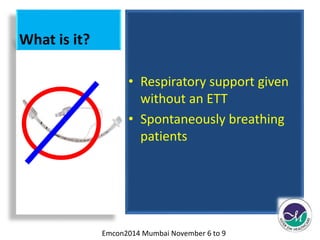
What is it? 
• Respiratory support given 
without an ETT 
• Spontaneously breathing 
patients 
Emcon2014 Mumbai November 6 to 9
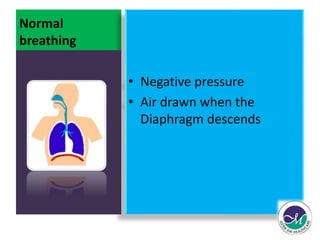
Normal 
breathing 
• Negative pressure 
• Air drawn when the 
Diaphragm descends
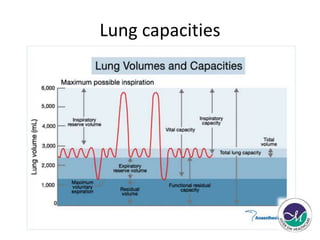
Lung capacities
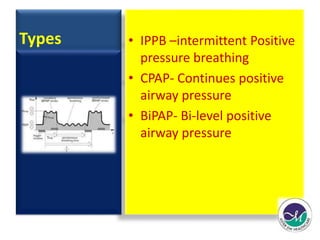
Types • IPPB –intermittent Positive 
pressure breathing 
• CPAP- Continues positive 
airway pressure 
• BiPAP- Bi-level positive 
airway pressure
CPAP 
• High flow oxygen plus PEEP 
• Raises FRC away from Residual volume 
• Splints alveoli open 
-Reduce work of breathing 
-Increase PaO2 
Re-expands atlectasis 
• Resolution of pulmonary edema
BiPAP 
• IPAP +EPAP 
• EPAP =PEEP 
• Inspirtory pressure increases Tidal volume 
Decreases PaCO2 
Increases PaO2 
Decreases WOB
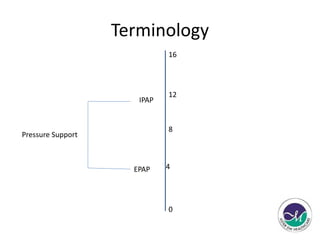
Terminology 
16 
12 
8 
4 
0 
IPAP 
EPAP 
Pressure Support
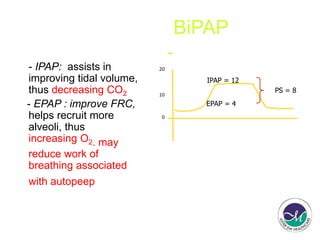
- IPAP: assists in 
improving tidal volume, 
thus decreasing CO2 
- EPAP : improve FRC, 
helps recruit more 
alveoli, thus 
increasing O2. may 
reduce work of 
breathing associated 
with autopeep 
20 
10 
0 
IPAP = 12 
EPAP = 4 
PS = 8 
BiPAP
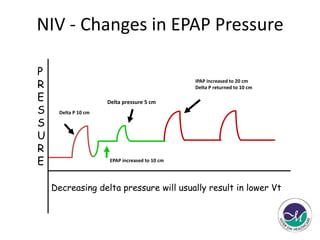
NIV - Changes in EPAP Pressure 
15 cm 
5 cm 
Delta P 10 cm 
10 cm 
Delta pressure 5 cm 
EPAP increased to 10 cm 
IPAP increased to 20 cm 
Delta P returned to 10 cm 
P 
R 
E 
S 
S 
U 
R 
E 
Decreasing delta pressure will usually result in lower Vt
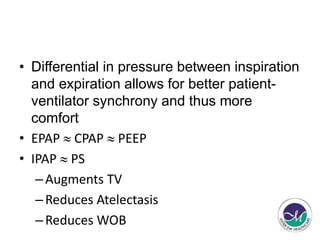
• Differential in pressure between inspiration 
and expiration allows for better patient-ventilator 
synchrony and thus more 
comfort 
• EPAP  CPAP  PEEP 
• IPAP  PS 
–Augments TV 
– Reduces Atelectasis 
– Reduces WOB
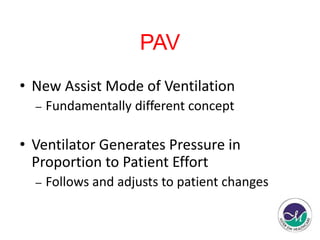
PAV 
• New Assist Mode of Ventilation 
– Fundamentally different concept 
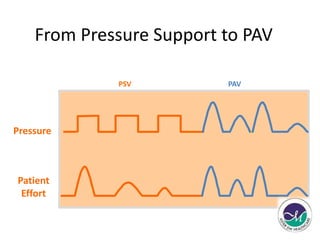
• Ventilator Generates Pressure in 
Proportion to Patient Effort 
– Follows and adjusts to patient changes
From Pressure Support to PAV 
Pressure 
Patient 
Effort 
PSV PAV
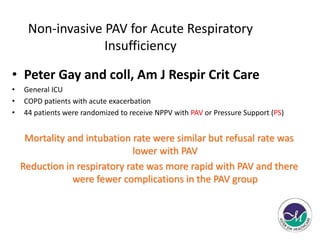
Non-invasive PAV for Acute Respiratory 
Insufficiency 
• Peter Gay and coll, Am J Respir Crit Care 
• General ICU 
• COPD patients with acute exacerbation 
• 44 patients were randomized to receive NPPV with PAV or Pressure Support (PS) 
Mortality and intubation rate were similar but refusal rate was 
lower with PAV 
Reduction in respiratory rate was more rapid with PAV and there 
were fewer complications in the PAV group
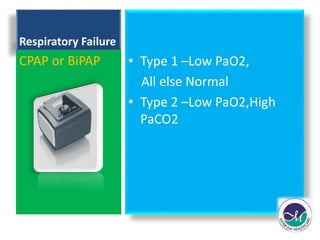
Respiratory Failure 
• Type 1 –Low PaO2, 
All else Normal 
• Type 2 –Low PaO2,High 
PaCO2 
CPAP or BiPAP
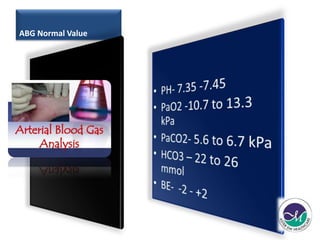
ABG Normal Value
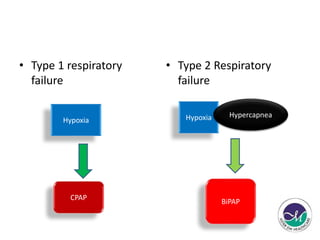
• Type 1 respiratory 
failure 
• Type 2 Respiratory 
failure 
Hypoxia 
CPAP 
Hypoxia Hypercapnea 
BiPAP
Clinical Benefits 
• Type 1 respiratory failure 
• Type 2 respiratory failure 
• Pulmonary Edema
Clinical Benefits 
• Weaning 
• Post intubation 
Sub acute
Clinical Benefits 
• Sleep apnea 
• Type 2 respiratory failure 
COPD 
CF 
Neuromuscular Disease
Precautions • Impaired conscious level 
• Agitation ,Confusion 
• Consolidation 
• Copious secretions 
• Inability to protect airway 
• Hemodynamic instability 
• Bowel obstruction 
• Recent GI surgery
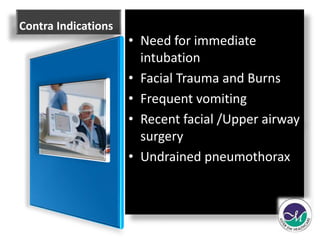
Contra Indications 
• Need for immediate 
intubation 
• Facial Trauma and Burns 
• Frequent vomiting 
• Recent facial /Upper airway 
surgery 
• Undrained pneumothorax
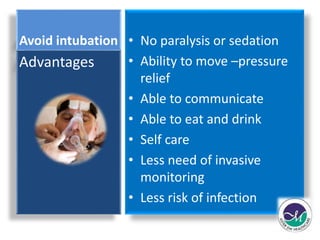
Avoid intubation • No paralysis or sedation 
• Ability to move –pressure 
relief 
• Able to communicate 
• Able to eat and drink 
• Self care 
• Less need of invasive 
monitoring 
• Less risk of infection 
Advantages
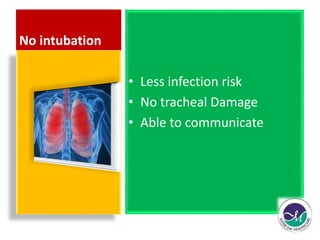
No intubation 
• Less infection risk 
• No tracheal Damage 
• Able to communicate
Decreased need 
of ICU admin 
• Cost 
• Patient and Care givers 
experience 
• Less debilitating
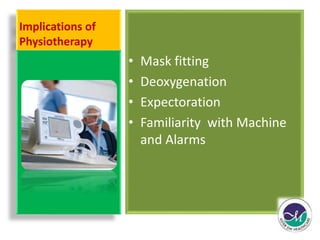
Implications of 
Physiotherapy 
• Mask fitting 
• Deoxygenation 
• Expectoration 
• Familiarity with Machine 
and Alarms
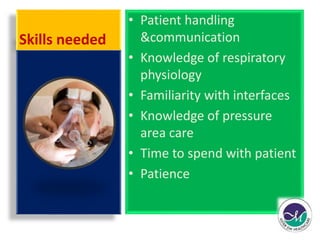
Skills needed 
• Patient handling 
&communication 
• Knowledge of respiratory 
physiology 
• Familiarity with interfaces 
• Knowledge of pressure 
area care 
• Time to spend with patient 
• Patience
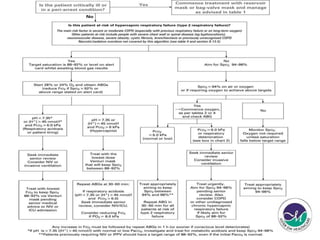
NIPPV in COPD 
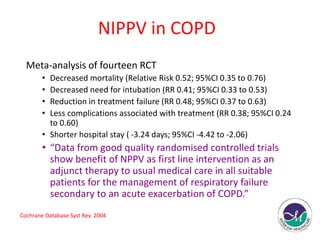
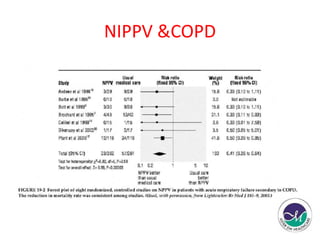
Meta-analysis of fourteen RCT 
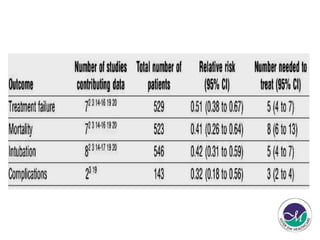
• Decreased mortality (Relative Risk 0.52; 95%CI 0.35 to 0.76) 
• Decreased need for intubation (RR 0.41; 95%CI 0.33 to 0.53) 
• Reduction in treatment failure (RR 0.48; 95%CI 0.37 to 0.63) 
• Less complications associated with treatment (RR 0.38; 95%CI 0.24 
to 0.60) 
• Shorter hospital stay ( -3.24 days; 95%CI -4.42 to -2.06) 
• “Data from good quality randomised controlled trials 
show benefit of NPPV as first line intervention as an 
adjunct therapy to usual medical care in all suitable 
patients for the management of respiratory failure 
secondary to an acute exacerbation of COPD.” 
Cochrane Database Syst Rev. 2004
NIPPV &COPD
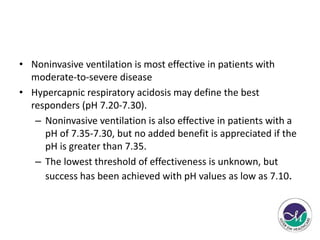
• Noninvasive ventilation is most effective in patients with 
moderate-to-severe disease 
• Hypercapnic respiratory acidosis may define the best 
responders (pH 7.20-7.30). 
– Noninvasive ventilation is also effective in patients with a 
pH of 7.35-7.30, but no added benefit is appreciated if the 
pH is greater than 7.35. 
– The lowest threshold of effectiveness is unknown, but 
success has been achieved with pH values as low as 7.10.
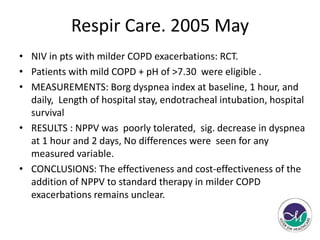
Respir Care. 2005 May 
• NIV in pts with milder COPD exacerbations: RCT. 
• Patients with mild COPD + pH of >7.30 were eligible . 
• MEASUREMENTS: Borg dyspnea index at baseline, 1 hour, and 
daily, Length of hospital stay, endotracheal intubation, hospital 
survival 
• RESULTS : NPPV was poorly tolerated, sig. decrease in dyspnea 
at 1 hour and 2 days, No differences were seen for any 
measured variable. 
• CONCLUSIONS: The effectiveness and cost-effectiveness of the 
addition of NPPV to standard therapy in milder COPD 
exacerbations remains unclear.
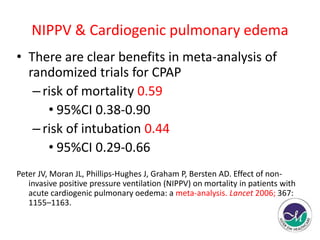
NIPPV & Cardiogenic pulmonary edema 
• There are clear benefits in meta-analysis of 
randomized trials for CPAP 
– risk of mortality 0.59 
• 95%CI 0.38-0.90 
– risk of intubation 0.44 
• 95%CI 0.29-0.66 
Peter JV, Moran JL, Phillips-Hughes J, Graham P, Bersten AD. Effect of non-invasive 
positive pressure ventilation (NIPPV) on mortality in patients with 
acute cardiogenic pulmonary oedema: a meta-analysis. Lancet 2006; 367: 
1155–1163.
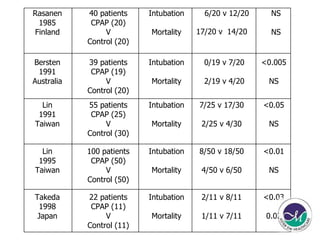
Rasanen 
1985 
Finland 
40 patients 
CPAP (20) 
V 
Control (20) 
Intubation 
Mortality 
6/20 v 12/20 
17/20 v 14/20 
NS 
NS 
Bersten 
1991 
Australia 
39 patients 
CPAP (19) 
V 
Control (20) 
Intubation 
Mortality 
0/19 v 7/20 
2/19 v 4/20 
<0.005 
NS 
Lin 
1991 
Taiwan 
55 patients 
CPAP (25) 
V 
Control (30) 
Intubation 
Mortality 
7/25 v 17/30 
2/25 v 4/30 
<0.05 
NS 
Lin 
1995 
Taiwan 
100 patients 
CPAP (50) 
V 
Control (50) 
Intubation 
Mortality 
8/50 v 18/50 
4/50 v 6/50 
<0.01 
NS 
Takeda 
1998 
Japan 
22 patients 
CPAP (11) 
V 
Control (11) 
Intubation 
Mortality 
2/11 v 8/11 
1/11 v 7/11 
<0.03 
0.02
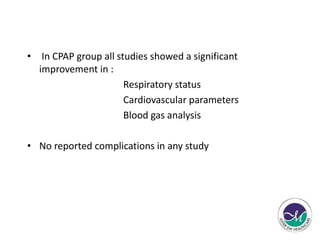
• In CPAP group all studies showed a significant 
improvement in : 
Respiratory status 
Cardiovascular parameters 
Blood gas analysis 
• No reported complications in any study
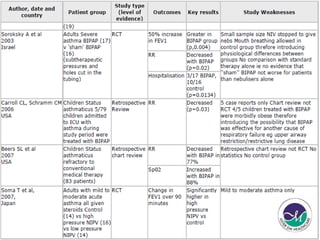
Asthma &NIPPV 
• Number of studies investigating the use of NPPV in 
acute asthma exacerbations is limited 
• Available data suggests that it is safe . 
• There are some studies to support the use of BiPAP 
for acute asthma exacerbations in the pediatric 
population .
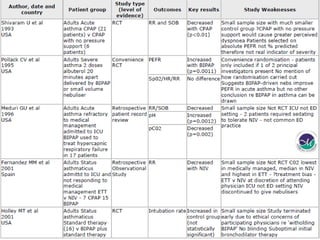
• Lot of papers that address the question there are 
• Only 3 completed RCTs and all these have relatively 
small numbers. 
 Addition of NIV in treating status asthmaticus is safe 
and well tolerated. 
 NIV shows promise as a beneficial adjunct to 
conventional medical treatment. 
 further prospective investigation is warranted
NIPPV & Pneumonia 
– Noninvasive ventilation not established to be 
beneficial 
– Secretions may be limiting factor 
– Improvement with noninvasive ventilation best 
achieved in patients also with COPD 
– Hypercapnic respiratory acidosis may define group 
likely to respond 
– Decrease in intubation rate and mortality may be 
limited to those also with COPD
Conclusion 
• Judicious use of NIV is a useful tool to manage 
respiratory emergencies 
• Close observation and timely interference is 
absolutely essentials. 
• EP and EMS should familiar with equipment , 
usages and guidelines
www.drvenu.net 
www.emergencymedicinemims.com
Niv in emergency department ebm

Niv in emergency department ebm

  • 1.
    NIV in emergencydepartment Dr.Venugopalan.P.P DA,DNB,MNAMS,MEM[GWU] Director ,Emergency Medicine, Aster –DM health care Site Director ,MEM program –GWU Deputy Director –MIMS Academy Founder and Executive Director -ANGELS Emcon2014 Mumbai November 6 to 9
  • 2.
    What is it? • Respiratory support given without an ETT • Spontaneously breathing patients Emcon2014 Mumbai November 6 to 9
  • 3.
    Normal breathing •Negative pressure • Air drawn when the Diaphragm descends
  • 4.
  • 5.
    Types • IPPB–intermittent Positive pressure breathing • CPAP- Continues positive airway pressure • BiPAP- Bi-level positive airway pressure
  • 6.
    CPAP • Highflow oxygen plus PEEP • Raises FRC away from Residual volume • Splints alveoli open -Reduce work of breathing -Increase PaO2 Re-expands atlectasis • Resolution of pulmonary edema
  • 7.
    BiPAP • IPAP+EPAP • EPAP =PEEP • Inspirtory pressure increases Tidal volume Decreases PaCO2 Increases PaO2 Decreases WOB
  • 8.
    Terminology 16 12 8 4 0 IPAP EPAP Pressure Support
  • 9.
    - IPAP: assistsin improving tidal volume, thus decreasing CO2 - EPAP : improve FRC, helps recruit more alveoli, thus increasing O2. may reduce work of breathing associated with autopeep 20 10 0 IPAP = 12 EPAP = 4 PS = 8 BiPAP
  • 10.
    NIV - Changesin EPAP Pressure 15 cm 5 cm Delta P 10 cm 10 cm Delta pressure 5 cm EPAP increased to 10 cm IPAP increased to 20 cm Delta P returned to 10 cm P R E S S U R E Decreasing delta pressure will usually result in lower Vt
  • 11.
    • Differential inpressure between inspiration and expiration allows for better patient-ventilator synchrony and thus more comfort • EPAP  CPAP  PEEP • IPAP  PS –Augments TV – Reduces Atelectasis – Reduces WOB
  • 12.
    PAV • NewAssist Mode of Ventilation – Fundamentally different concept • Ventilator Generates Pressure in Proportion to Patient Effort – Follows and adjusts to patient changes
  • 13.
    From Pressure Supportto PAV Pressure Patient Effort PSV PAV
  • 14.
    Non-invasive PAV forAcute Respiratory Insufficiency • Peter Gay and coll, Am J Respir Crit Care • General ICU • COPD patients with acute exacerbation • 44 patients were randomized to receive NPPV with PAV or Pressure Support (PS) Mortality and intubation rate were similar but refusal rate was lower with PAV Reduction in respiratory rate was more rapid with PAV and there were fewer complications in the PAV group
  • 15.
    Respiratory Failure •Type 1 –Low PaO2, All else Normal • Type 2 –Low PaO2,High PaCO2 CPAP or BiPAP
  • 16.
  • 17.
    • Type 1respiratory failure • Type 2 Respiratory failure Hypoxia CPAP Hypoxia Hypercapnea BiPAP
  • 18.
    Clinical Benefits •Type 1 respiratory failure • Type 2 respiratory failure • Pulmonary Edema
  • 19.
    Clinical Benefits •Weaning • Post intubation Sub acute
  • 20.
    Clinical Benefits •Sleep apnea • Type 2 respiratory failure COPD CF Neuromuscular Disease
  • 21.
    Precautions • Impairedconscious level • Agitation ,Confusion • Consolidation • Copious secretions • Inability to protect airway • Hemodynamic instability • Bowel obstruction • Recent GI surgery
  • 22.
    Contra Indications •Need for immediate intubation • Facial Trauma and Burns • Frequent vomiting • Recent facial /Upper airway surgery • Undrained pneumothorax
  • 23.
    Avoid intubation •No paralysis or sedation • Ability to move –pressure relief • Able to communicate • Able to eat and drink • Self care • Less need of invasive monitoring • Less risk of infection Advantages
  • 24.
    No intubation •Less infection risk • No tracheal Damage • Able to communicate
  • 25.
    Decreased need ofICU admin • Cost • Patient and Care givers experience • Less debilitating
  • 26.
    Implications of Physiotherapy • Mask fitting • Deoxygenation • Expectoration • Familiarity with Machine and Alarms
  • 27.
    Skills needed •Patient handling &communication • Knowledge of respiratory physiology • Familiarity with interfaces • Knowledge of pressure area care • Time to spend with patient • Patience
  • 30.
    NIPPV in COPD Meta-analysis of fourteen RCT • Decreased mortality (Relative Risk 0.52; 95%CI 0.35 to 0.76) • Decreased need for intubation (RR 0.41; 95%CI 0.33 to 0.53) • Reduction in treatment failure (RR 0.48; 95%CI 0.37 to 0.63) • Less complications associated with treatment (RR 0.38; 95%CI 0.24 to 0.60) • Shorter hospital stay ( -3.24 days; 95%CI -4.42 to -2.06) • “Data from good quality randomised controlled trials show benefit of NPPV as first line intervention as an adjunct therapy to usual medical care in all suitable patients for the management of respiratory failure secondary to an acute exacerbation of COPD.” Cochrane Database Syst Rev. 2004
  • 31.
  • 33.
    • Noninvasive ventilationis most effective in patients with moderate-to-severe disease • Hypercapnic respiratory acidosis may define the best responders (pH 7.20-7.30). – Noninvasive ventilation is also effective in patients with a pH of 7.35-7.30, but no added benefit is appreciated if the pH is greater than 7.35. – The lowest threshold of effectiveness is unknown, but success has been achieved with pH values as low as 7.10.
  • 34.
    Respir Care. 2005May • NIV in pts with milder COPD exacerbations: RCT. • Patients with mild COPD + pH of >7.30 were eligible . • MEASUREMENTS: Borg dyspnea index at baseline, 1 hour, and daily, Length of hospital stay, endotracheal intubation, hospital survival • RESULTS : NPPV was poorly tolerated, sig. decrease in dyspnea at 1 hour and 2 days, No differences were seen for any measured variable. • CONCLUSIONS: The effectiveness and cost-effectiveness of the addition of NPPV to standard therapy in milder COPD exacerbations remains unclear.
  • 35.
    NIPPV & Cardiogenicpulmonary edema • There are clear benefits in meta-analysis of randomized trials for CPAP – risk of mortality 0.59 • 95%CI 0.38-0.90 – risk of intubation 0.44 • 95%CI 0.29-0.66 Peter JV, Moran JL, Phillips-Hughes J, Graham P, Bersten AD. Effect of non-invasive positive pressure ventilation (NIPPV) on mortality in patients with acute cardiogenic pulmonary oedema: a meta-analysis. Lancet 2006; 367: 1155–1163.
  • 36.
    Rasanen 1985 Finland 40 patients CPAP (20) V Control (20) Intubation Mortality 6/20 v 12/20 17/20 v 14/20 NS NS Bersten 1991 Australia 39 patients CPAP (19) V Control (20) Intubation Mortality 0/19 v 7/20 2/19 v 4/20 <0.005 NS Lin 1991 Taiwan 55 patients CPAP (25) V Control (30) Intubation Mortality 7/25 v 17/30 2/25 v 4/30 <0.05 NS Lin 1995 Taiwan 100 patients CPAP (50) V Control (50) Intubation Mortality 8/50 v 18/50 4/50 v 6/50 <0.01 NS Takeda 1998 Japan 22 patients CPAP (11) V Control (11) Intubation Mortality 2/11 v 8/11 1/11 v 7/11 <0.03 0.02
  • 37.
    • In CPAPgroup all studies showed a significant improvement in : Respiratory status Cardiovascular parameters Blood gas analysis • No reported complications in any study
  • 38.
    Asthma &NIPPV •Number of studies investigating the use of NPPV in acute asthma exacerbations is limited • Available data suggests that it is safe . • There are some studies to support the use of BiPAP for acute asthma exacerbations in the pediatric population .
  • 41.
    • Lot ofpapers that address the question there are • Only 3 completed RCTs and all these have relatively small numbers.  Addition of NIV in treating status asthmaticus is safe and well tolerated.  NIV shows promise as a beneficial adjunct to conventional medical treatment.  further prospective investigation is warranted
  • 42.
    NIPPV & Pneumonia – Noninvasive ventilation not established to be beneficial – Secretions may be limiting factor – Improvement with noninvasive ventilation best achieved in patients also with COPD – Hypercapnic respiratory acidosis may define group likely to respond – Decrease in intubation rate and mortality may be limited to those also with COPD
  • 44.
    Conclusion • Judicioususe of NIV is a useful tool to manage respiratory emergencies • Close observation and timely interference is absolutely essentials. • EP and EMS should familiar with equipment , usages and guidelines
  • 45.