Chapter 2   Neuroscience, Genetics and Behavior
Neural Communication Biological Psychology branch of psychology concerned with the links between biology and behavior some biological psychologists call themselves behavioral neuroscientists, neuropsychologists, behavior geneticists, physiological psychologist, or biopsychologists Neuron a nerve cell the basic building block of the nervous system
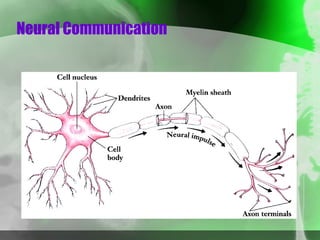
Neural Communication Dendrite the bushy, branching extensions of a neuron that receive messages and conduct impulses toward the cell body Axon the extension of a neuron, ending in branching terminal fibers, through which messages are sent to other neurons or to muscles or glands Myelin Sheath   a layer of fatty cells segmentally encasing the fibers of many neurons makes possible vastly greater transmission speed of neutral impulses
Neural Communication
Neural Communication Action Potential   a neural impulse;  a brief electrical charge that travels down an axon generated by the movement of positively charges atoms in and out of channels in the axon’s membrane Threshold   the level of stimulation required to trigger a neural impulse
Neural Communication Synapse junction between the axon tip of the sending neuron and the dendrite or cell body of the receiving neuron tiny gap at this junction is called the synaptic gap or cleft Neurotransmitters chemical messengers that traverse the synaptic gaps between neurons when released by the sending neuron, neuro-transmitters travel across the synapse and bind to receptor sites on the receiving neuron, thereby influencing whether it will generate a neural impulse
Neural Communication Acetylcholine a neurotransmitter that, among its functions, triggers muscle contraction Endorphins “ morphine within”  natural, opiate-like neurotransmitters linked to pain control and to pleasure
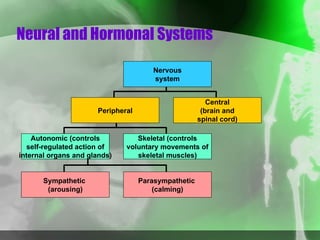
Neural and Hormonal Systems Nervous System   the body’s speedy, electrochemical communication system  consists of all the nerve cells of the peripheral and central nervous systems Central Nervous System (CNS)   the brain and spinal cord Peripheral Nervous System (PNS)   the sensory and motor neurons that connect the central nervous system (CNS) to the rest of the body
Neural and Hormonal Systems Central (brain and spinal cord) Nervous system Autonomic (controls self-regulated action of internal organs and glands) Skeletal (controls voluntary movements of skeletal muscles) Sympathetic  (arousing) Parasympathetic  (calming) Peripheral
Neural and Hormonal Systems Nerves  neural “cables” containing many axons part of the peripheral nervous system connect the central nervous system with muscles, glands, and sense organs Sensory Neurons   neurons that carry incoming information from the sense receptors to the central nervous system
Neural and Hormonal Systems Interneurons  CNS neurons that internally communicate and intervene between the sensory inputs and motor outputs Motor Neurons carry outgoing information from the CNS to muscles and glands Skeletal Nervous System the division of the peripheral nervous system that controls the body’s skeletal muscles
Neural and Hormonal Systems Autonomic Nervous System   the part of the peripheral nervous system that controls the glands and the muscles of the internal organs (such as the heart) Sympathetic Nervous System   division of the autonomic nervous system that arouses the body, mobilizing its energy in stressful situations Parasympathetic Nervous System   division of the autonomic nervous system that calms the body, conserving its energy
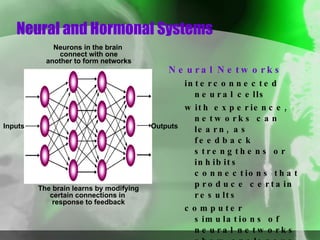
Neural and Hormonal Systems Neural Networks interconnected neural cells  with experience, networks can learn, as feedback strengthens or inhibits connections that produce certain results  computer simulations of neural networks show analogous learning Inputs Outputs Neurons in the brain  connect with one another to form networks The brain learns by modifying certain connections in  response to feedback
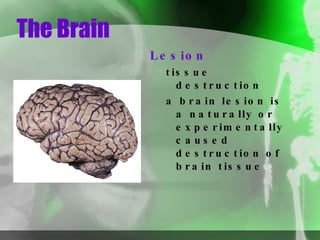
The Brain Lesion tissue destruction  a brain lesion is a naturally or experimentally caused destruction of brain tissue
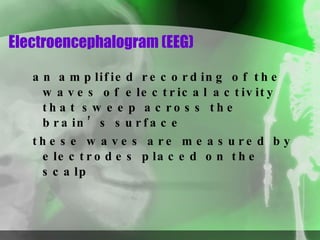
Electroencephalogram (EEG) an amplified recording of the waves of electrical activity that sweep across the brain’s surface these waves are measured by electrodes placed on the scalp
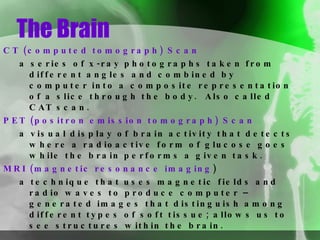
The Brain CT (computed tomograph) Scan a series of x-ray photographs taken from different angles and combined by computer into a composite representation of a slice through the body.  Also called CAT scan. PET (positron emission tomograph) Scan   a visual display of brain activity that detects where a radioactive form of glucose goes while the brain performs a given task. MRI (magnetic resonance imaging )  a technique that uses magnetic fields and radio waves to produce computer – generated images that distinguish among different types of soft tissue; allows us to see structures within the brain.
The Brain Brainstem  the oldest part and central core of the brain, beginning where the spinal cord swells as it enters the skull  responsible for automatic survival functions Medulla base of the brainstem controls heartbeat and breathing
The Brain Reticular Formation a nerve network in the brainstem that plays an important role in controlling arousal Thalamus the brain’s sensory switchboard, located on top of the brainstem it directs messages to the sensory receiving areas in the cortex and transmits replies to the cerebellum and medulla
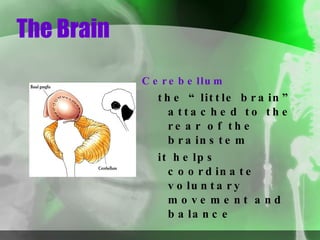
The Brain Cerebellum the “little brain” attached to the rear of the brainstem it helps coordinate voluntary movement and balance
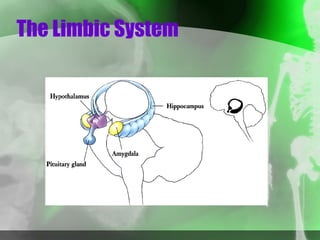
The Brain Limbic System a doughnut-shaped system of neural structures at the border of the brainstem and cerebral hemispheres associated with emotions such as fear and aggression and drives such as those for food and sex  includes the hippocampus, amygdala, and hypothalamus. Amygdala two almond-shaped neural clusters that are components of the limbic system and are linked to emotion
The Limbic System Hypothalamus neural structure lying below (hypo) the thalamus directs several maintenance activities eating drinking body temperature helps govern the endocrine system via the pituitary gland is linked to emotion
The Limbic System
The Cerebral Cortex Cerebral Cortex   the intricate fabric of interconnected neural cells that covers the cerebral hemispheres the body’s ultimate control and information processing center Glial Cells   cells in the nervous system that are not neurons but that support, nourish, and protect neurons
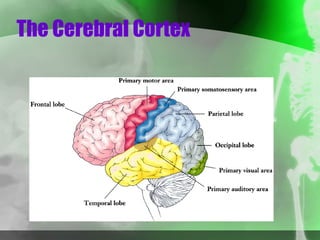
The Cerebral Cortex Frontal Lobes   involved in speaking and muscle movements and in making plans and judgments Parietal Lobes   include the sensory cortex Occipital Lobes   include the visual areas, which receive visual information from the opposite visual field Temporal Lobes   include the auditory areas
The Cerebral Cortex
The Cerebral Cortex Motor Cortex area at the rear of the frontal lobes that controls voluntary movements Sensory Cortex area at the front of the parietal lobes that registers and processes body sensations
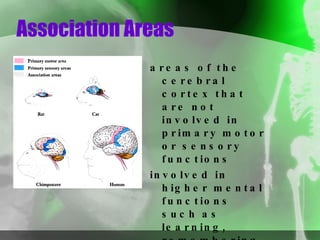
Association Areas areas of the cerebral cortex that are not involved in primary motor or sensory functions involved in higher mental functions such as learning, remembering, thinking, and speaking
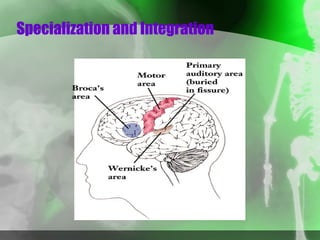
The Cerebral Cortex Aphasia impairment of language, usually caused by left hemisphere damage either to Broca’s area (impairing speaking) or to Wernicke’s area (impairing understanding) Broca’s Area   an area of the left frontal lobe that directs the muscle movements involved in speech Wernicke’s Area   an area of the left temporal lobe involved in language comprehension
Specialization and Integration
Brain Reorganization Plasticity the brain’s capacity for modification as evident in brain reorganization following damage (especially in children) and in experiments on the effects of experience on brain development
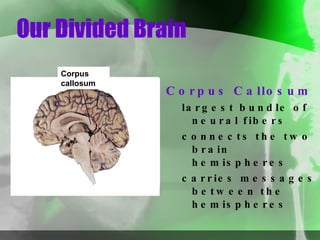
Our Divided Brain Corpus Callosum largest bundle of neural fibers connects the two brain hemispheres  carries messages between the hemispheres Corpus callosum
Split Brain a condition in which the two hemispheres of the brain are isolated by cutting the connecting fibers (mainly those of the corpus callosum) between them
Neural and Hormonal Systems Hormones chemical messengers, mostly those manufactured by the endocrine glands, that are produced in one tissue and affect another Adrenal Glands   a pair of endocrine glands just above the kidneys secrete the hormones epinephrine (adrenaline) and norepinephrine (noradrenaline), which help to arouse the body in times of stress Pituitary Gland under the influence of the hypothalamus, the pituitary regulates growth and controls other endocrine glands

Neuroscience, Genetics and Behavior

  • 1.
    Chapter 2 Neuroscience, Genetics and Behavior
  • 2.
    Neural Communication BiologicalPsychology branch of psychology concerned with the links between biology and behavior some biological psychologists call themselves behavioral neuroscientists, neuropsychologists, behavior geneticists, physiological psychologist, or biopsychologists Neuron a nerve cell the basic building block of the nervous system
  • 3.
    Neural Communication Dendritethe bushy, branching extensions of a neuron that receive messages and conduct impulses toward the cell body Axon the extension of a neuron, ending in branching terminal fibers, through which messages are sent to other neurons or to muscles or glands Myelin Sheath a layer of fatty cells segmentally encasing the fibers of many neurons makes possible vastly greater transmission speed of neutral impulses
  • 4.
  • 5.
    Neural Communication ActionPotential a neural impulse; a brief electrical charge that travels down an axon generated by the movement of positively charges atoms in and out of channels in the axon’s membrane Threshold the level of stimulation required to trigger a neural impulse
  • 6.
    Neural Communication Synapsejunction between the axon tip of the sending neuron and the dendrite or cell body of the receiving neuron tiny gap at this junction is called the synaptic gap or cleft Neurotransmitters chemical messengers that traverse the synaptic gaps between neurons when released by the sending neuron, neuro-transmitters travel across the synapse and bind to receptor sites on the receiving neuron, thereby influencing whether it will generate a neural impulse
  • 7.
    Neural Communication Acetylcholinea neurotransmitter that, among its functions, triggers muscle contraction Endorphins “ morphine within” natural, opiate-like neurotransmitters linked to pain control and to pleasure
  • 8.
    Neural and HormonalSystems Nervous System the body’s speedy, electrochemical communication system consists of all the nerve cells of the peripheral and central nervous systems Central Nervous System (CNS) the brain and spinal cord Peripheral Nervous System (PNS) the sensory and motor neurons that connect the central nervous system (CNS) to the rest of the body
  • 9.
    Neural and HormonalSystems Central (brain and spinal cord) Nervous system Autonomic (controls self-regulated action of internal organs and glands) Skeletal (controls voluntary movements of skeletal muscles) Sympathetic (arousing) Parasympathetic (calming) Peripheral
  • 10.
    Neural and HormonalSystems Nerves neural “cables” containing many axons part of the peripheral nervous system connect the central nervous system with muscles, glands, and sense organs Sensory Neurons neurons that carry incoming information from the sense receptors to the central nervous system
  • 11.
    Neural and HormonalSystems Interneurons CNS neurons that internally communicate and intervene between the sensory inputs and motor outputs Motor Neurons carry outgoing information from the CNS to muscles and glands Skeletal Nervous System the division of the peripheral nervous system that controls the body’s skeletal muscles
  • 12.
    Neural and HormonalSystems Autonomic Nervous System the part of the peripheral nervous system that controls the glands and the muscles of the internal organs (such as the heart) Sympathetic Nervous System division of the autonomic nervous system that arouses the body, mobilizing its energy in stressful situations Parasympathetic Nervous System division of the autonomic nervous system that calms the body, conserving its energy
  • 13.
    Neural and HormonalSystems Neural Networks interconnected neural cells with experience, networks can learn, as feedback strengthens or inhibits connections that produce certain results computer simulations of neural networks show analogous learning Inputs Outputs Neurons in the brain connect with one another to form networks The brain learns by modifying certain connections in response to feedback
  • 14.
    The Brain Lesiontissue destruction a brain lesion is a naturally or experimentally caused destruction of brain tissue
  • 15.
    Electroencephalogram (EEG) anamplified recording of the waves of electrical activity that sweep across the brain’s surface these waves are measured by electrodes placed on the scalp
  • 16.
    The Brain CT(computed tomograph) Scan a series of x-ray photographs taken from different angles and combined by computer into a composite representation of a slice through the body. Also called CAT scan. PET (positron emission tomograph) Scan a visual display of brain activity that detects where a radioactive form of glucose goes while the brain performs a given task. MRI (magnetic resonance imaging ) a technique that uses magnetic fields and radio waves to produce computer – generated images that distinguish among different types of soft tissue; allows us to see structures within the brain.
  • 17.
    The Brain Brainstem the oldest part and central core of the brain, beginning where the spinal cord swells as it enters the skull responsible for automatic survival functions Medulla base of the brainstem controls heartbeat and breathing
  • 18.
    The Brain ReticularFormation a nerve network in the brainstem that plays an important role in controlling arousal Thalamus the brain’s sensory switchboard, located on top of the brainstem it directs messages to the sensory receiving areas in the cortex and transmits replies to the cerebellum and medulla
  • 19.
    The Brain Cerebellumthe “little brain” attached to the rear of the brainstem it helps coordinate voluntary movement and balance
  • 20.
    The Brain LimbicSystem a doughnut-shaped system of neural structures at the border of the brainstem and cerebral hemispheres associated with emotions such as fear and aggression and drives such as those for food and sex includes the hippocampus, amygdala, and hypothalamus. Amygdala two almond-shaped neural clusters that are components of the limbic system and are linked to emotion
  • 21.
    The Limbic SystemHypothalamus neural structure lying below (hypo) the thalamus directs several maintenance activities eating drinking body temperature helps govern the endocrine system via the pituitary gland is linked to emotion
  • 22.
  • 23.
    The Cerebral CortexCerebral Cortex the intricate fabric of interconnected neural cells that covers the cerebral hemispheres the body’s ultimate control and information processing center Glial Cells cells in the nervous system that are not neurons but that support, nourish, and protect neurons
  • 24.
    The Cerebral CortexFrontal Lobes involved in speaking and muscle movements and in making plans and judgments Parietal Lobes include the sensory cortex Occipital Lobes include the visual areas, which receive visual information from the opposite visual field Temporal Lobes include the auditory areas
  • 25.
  • 26.
    The Cerebral CortexMotor Cortex area at the rear of the frontal lobes that controls voluntary movements Sensory Cortex area at the front of the parietal lobes that registers and processes body sensations
  • 27.
    Association Areas areasof the cerebral cortex that are not involved in primary motor or sensory functions involved in higher mental functions such as learning, remembering, thinking, and speaking
  • 28.
    The Cerebral CortexAphasia impairment of language, usually caused by left hemisphere damage either to Broca’s area (impairing speaking) or to Wernicke’s area (impairing understanding) Broca’s Area an area of the left frontal lobe that directs the muscle movements involved in speech Wernicke’s Area an area of the left temporal lobe involved in language comprehension
  • 29.
  • 30.
    Brain Reorganization Plasticitythe brain’s capacity for modification as evident in brain reorganization following damage (especially in children) and in experiments on the effects of experience on brain development
  • 31.
    Our Divided BrainCorpus Callosum largest bundle of neural fibers connects the two brain hemispheres carries messages between the hemispheres Corpus callosum
  • 32.
    Split Brain acondition in which the two hemispheres of the brain are isolated by cutting the connecting fibers (mainly those of the corpus callosum) between them
  • 33.
    Neural and HormonalSystems Hormones chemical messengers, mostly those manufactured by the endocrine glands, that are produced in one tissue and affect another Adrenal Glands a pair of endocrine glands just above the kidneys secrete the hormones epinephrine (adrenaline) and norepinephrine (noradrenaline), which help to arouse the body in times of stress Pituitary Gland under the influence of the hypothalamus, the pituitary regulates growth and controls other endocrine glands