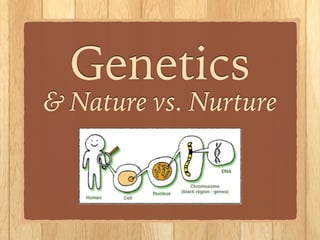
Genetics
& Nature vs. Nurture
Nature vs. Nurture
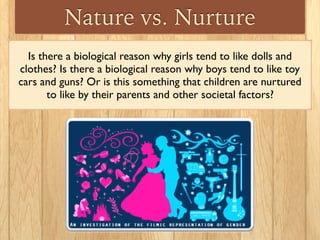
Is there a biological reason why girls tend to like dolls and
clothes? Is there a biological reason why boys tend to like toy
cars and guns? Or is this something that children are nurtured
to like by their parents and other societal factors?
Nature vs. Nurture Debate
Nature:
Our genetics
determine our
behavior. Our
personality traits and
abilities are in our
“nature.”
Nurture:
Our environment,
upbringing, and life
experiences determine
our behavior. We are
“nurtured” to behave
in certain ways.
Nature vs. Nurture Debate
Nature:
We genetically inherit
physical traits from our
parents, but we also
inherit personality traits,
intelligence, and
preferences.
Nurture:
The household and city we
grew up in, how we were
raised by our parents,
teachers, and friends -
these are environmental
factors that determine
who we are.
Nature vs. Nurture Debate
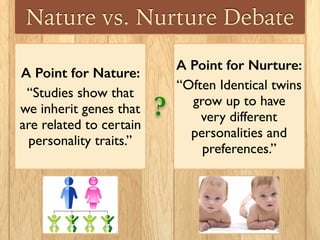
A Point for Nature:
“Studies show that
we inherit genes that
are related to certain
personality traits.”
A Point for Nurture:
“Often Identical twins
grow up to have
very different
personalities and
preferences.”
?
Nature vs. Nurture Debate
Today we know that nature and nurture
BOTH help shape our behavior.The question
for today’s debate is this:
Which one has the GREATER influence on
human behavior?
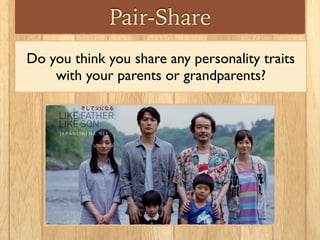
Pair-Share
Do you think you share any personality traits
with your parents or grandparents?
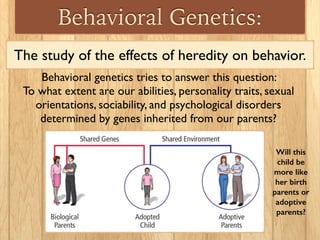
Behavioral Genetics:
The study of the effects of heredity on behavior.
Behavioral genetics tries to answer this question:
To what extent are our abilities, personality traits, sexual
orientations, sociability, and psychological disorders
determined by genes inherited from our parents?
Will this
child be
more like
her birth
parents or
adoptive
parents?
Twin Studies
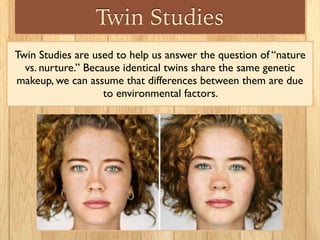
Twin Studies are used to help us answer the question of “nature
vs. nurture.” Because identical twins share the same genetic
makeup, we can assume that differences between them are due
to environmental factors.
Twin Studies
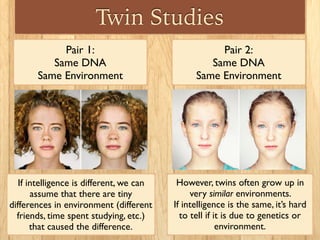
Pair 1:
Same DNA
Same Environment
However, twins often grow up in
very similar environments.
If intelligence is the same, it’s hard
to tell if it is due to genetics or
environment.
Pair 2:
Same DNA
Same Environment
If intelligence is different, we can
assume that there are tiny
differences in environment (different
friends, time spent studying, etc.)
that caused the difference.
Twin Studies
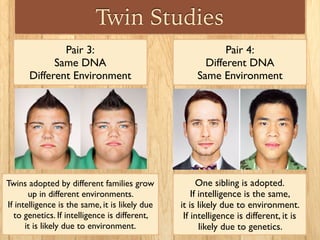
Pair 4:
Different DNA
Same Environment
One sibling is adopted.
If intelligence is the same,
it is likely due to environment.
If intelligence is different, it is
likely due to genetics.
Pair 3:
Same DNA
Different Environment
Twins adopted by different families grow
up in different environments.
If intelligence is the same, it is likely due
to genetics. If intelligence is different,
it is likely due to environment.
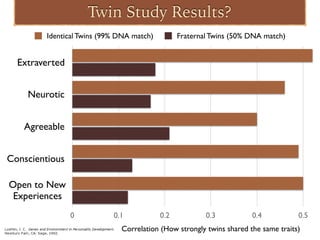
Twin Study Results?
Extraverted
Neurotic
Agreeable
Conscientious
Correlation (How strongly twins shared the same traits)
0 0.1 0.2 0.3 0.4 0.5
Identical Twins (99% DNA match) Fraternal Twins (50% DNA match)
Open to New
Experiences
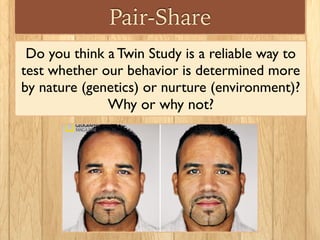
Pair-Share
Do you think a Twin Study is a reliable way to
test whether our behavior is determined more
by nature (genetics) or nurture (environment)?
Why or why not?
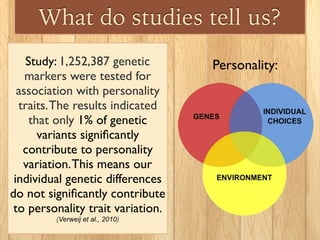
What do studies tell us?
Study: 1,252,387 genetic
markers were tested for
association with personality
traits.The results indicated
that only 1% of genetic
variants signicantly
contribute to personality
variation.This means our
individual genetic differences
do not signicantly contribute
to personality trait variation.
(Verweij et al., 2010)
Personality:
What do studies tell us?
Study: 1,252,387 genetic
markers were tested for
association with personality
traits.The results indicated
that only 1% of genetic
variants signicantly
contribute to personality
variation.This means our
individual genetic differences
do not signicantly contribute
to personality trait variation.
(Verweij et al., 2010)
This was NOT a twin
study: it was a genome-
wide association study
done in 2010.This is
where each person gives
a sample of DNA, from
which millions of genetic
variants are read in order
to see if certain genes are
associated with diseases
or personality traits.
Other Studies
That relate to the “nature, nurture” question
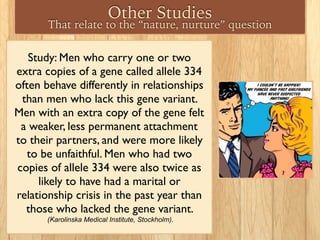
Study: Men who carry one or two
extra copies of a gene called allele 334
often behave differently in relationships
than men who lack this gene variant.
Men with an extra copy of the gene felt
a weaker, less permanent attachment
to their partners, and were more likely
to be unfaithful. Men who had two
copies of allele 334 were also twice as
likely to have had a marital or
relationship crisis in the past year than
those who lacked the gene variant.
(Karolinska Medical Institute, Stockholm).
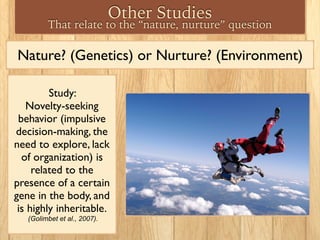
Nature? (Genetics) or Nurture? (Environment)
Study:
Novelty-seeking
behavior (impulsive
decision-making, the
need to explore, lack
of organization) is
related to the
presence of a certain
gene in the body, and
is highly inheritable.
(Golimbet et al., 2007).
Other Studies
That relate to the “nature, nurture” question
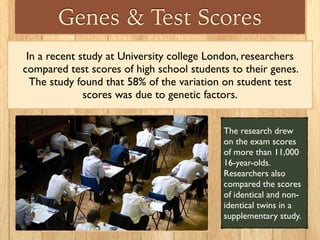
Genes & Test Scores
In a recent study at University college London, researchers
compared test scores of high school students to their genes.
The study found that 58% of the variation on student test
scores was due to genetic factors.
The research drew
on the exam scores
of more than 11,000
16-year-olds.
Researchers also
compared the scores
of identical and non-
identical twins in a
supplementary study.
Genes & Success
Does having amazing genes lead to future
career success and wealth?
This boy had genius
parents.
Do you think his genes
will have a greater
impact on his life, or his
environment?
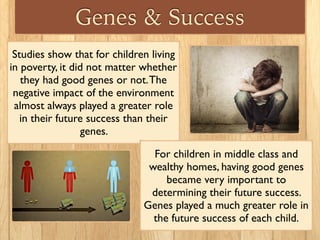
Genes & Success
Studies show that for children living
in poverty, it did not matter whether
they had good genes or not.The
negative impact of the environment
almost always played a greater role
in their future success than their
genes.
For children in middle class and
wealthy homes, having good genes
became very important to
determining their future success.
Genes played a much greater role in
the future success of each child.
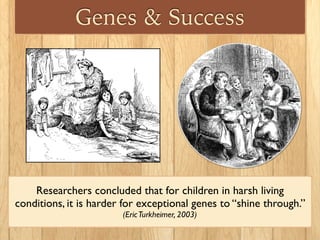
Genes & Success
Researchers concluded that for children in harsh living
conditions, it is harder for exceptional genes to “shine through.”
(EricTurkheimer, 2003)
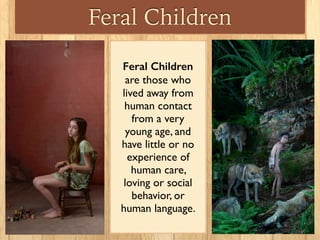
Feral Children
Feral Children
are those who
lived away from
human contact
from a very
young age, and
have little or no
experience of
human care,
loving or social
behavior, or
human language.
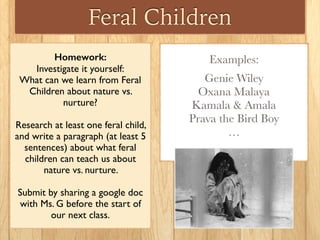
Feral Children
Homework:
Investigate it yourself:
What can we learn from Feral
Children about nature vs.
nurture?
Research at least one feral child,
and write a paragraph (at least 5
sentences) about what feral
children can teach us about
nature vs. nurture.
Submit by sharing a google doc
with Ms. G before the start of
our next class.
Examples:
Genie Wiley
Oxana Malaya
Kamala & Amala
Prava the Bird Boy
…

Genetics & Behavior

  • 1.
  • 2.
    Nature vs. Nurture Isthere a biological reason why girls tend to like dolls and clothes? Is there a biological reason why boys tend to like toy cars and guns? Or is this something that children are nurtured to like by their parents and other societal factors?
  • 3.
    Nature vs. NurtureDebate Nature: Our genetics determine our behavior. Our personality traits and abilities are in our “nature.” Nurture: Our environment, upbringing, and life experiences determine our behavior. We are “nurtured” to behave in certain ways.
  • 4.
    Nature vs. NurtureDebate Nature: We genetically inherit physical traits from our parents, but we also inherit personality traits, intelligence, and preferences. Nurture: The household and city we grew up in, how we were raised by our parents, teachers, and friends - these are environmental factors that determine who we are.
  • 5.
    Nature vs. NurtureDebate A Point for Nature: “Studies show that we inherit genes that are related to certain personality traits.” A Point for Nurture: “Often Identical twins grow up to have very different personalities and preferences.” ?
  • 6.
    Nature vs. NurtureDebate Today we know that nature and nurture BOTH help shape our behavior.The question for today’s debate is this: Which one has the GREATER influence on human behavior?
  • 7.
    Pair-Share Do you thinkyou share any personality traits with your parents or grandparents?
  • 8.
    Behavioral Genetics: The studyof the effects of heredity on behavior. Behavioral genetics tries to answer this question: To what extent are our abilities, personality traits, sexual orientations, sociability, and psychological disorders determined by genes inherited from our parents? Will this child be more like her birth parents or adoptive parents?
  • 9.
    Twin Studies Twin Studiesare used to help us answer the question of “nature vs. nurture.” Because identical twins share the same genetic makeup, we can assume that differences between them are due to environmental factors.
  • 10.
    Twin Studies Pair 1: SameDNA Same Environment However, twins often grow up in very similar environments. If intelligence is the same, it’s hard to tell if it is due to genetics or environment. Pair 2: Same DNA Same Environment If intelligence is different, we can assume that there are tiny differences in environment (different friends, time spent studying, etc.) that caused the difference.
  • 11.
    Twin Studies Pair 4: DifferentDNA Same Environment One sibling is adopted. If intelligence is the same, it is likely due to environment. If intelligence is different, it is likely due to genetics. Pair 3: Same DNA Different Environment Twins adopted by different families grow up in different environments. If intelligence is the same, it is likely due to genetics. If intelligence is different, it is likely due to environment.
  • 12.
    Twin Study Results? Extraverted Neurotic Agreeable Conscientious Correlation(How strongly twins shared the same traits) 0 0.1 0.2 0.3 0.4 0.5 Identical Twins (99% DNA match) Fraternal Twins (50% DNA match) Open to New Experiences
  • 13.
    Pair-Share Do you thinka Twin Study is a reliable way to test whether our behavior is determined more by nature (genetics) or nurture (environment)? Why or why not?
  • 14.
    What do studiestell us? Study: 1,252,387 genetic markers were tested for association with personality traits.The results indicated that only 1% of genetic variants signicantly contribute to personality variation.This means our individual genetic differences do not signicantly contribute to personality trait variation. (Verweij et al., 2010) Personality:
  • 15.
    What do studiestell us? Study: 1,252,387 genetic markers were tested for association with personality traits.The results indicated that only 1% of genetic variants signicantly contribute to personality variation.This means our individual genetic differences do not signicantly contribute to personality trait variation. (Verweij et al., 2010) This was NOT a twin study: it was a genome- wide association study done in 2010.This is where each person gives a sample of DNA, from which millions of genetic variants are read in order to see if certain genes are associated with diseases or personality traits.
  • 16.
    Other Studies That relateto the “nature, nurture” question Study: Men who carry one or two extra copies of a gene called allele 334 often behave differently in relationships than men who lack this gene variant. Men with an extra copy of the gene felt a weaker, less permanent attachment to their partners, and were more likely to be unfaithful. Men who had two copies of allele 334 were also twice as likely to have had a marital or relationship crisis in the past year than those who lacked the gene variant. (Karolinska Medical Institute, Stockholm).
  • 17.
    Nature? (Genetics) orNurture? (Environment) Study: Novelty-seeking behavior (impulsive decision-making, the need to explore, lack of organization) is related to the presence of a certain gene in the body, and is highly inheritable. (Golimbet et al., 2007). Other Studies That relate to the “nature, nurture” question
  • 18.
    Genes & TestScores In a recent study at University college London, researchers compared test scores of high school students to their genes. The study found that 58% of the variation on student test scores was due to genetic factors. The research drew on the exam scores of more than 11,000 16-year-olds. Researchers also compared the scores of identical and non- identical twins in a supplementary study.
  • 19.
    Genes & Success Doeshaving amazing genes lead to future career success and wealth? This boy had genius parents. Do you think his genes will have a greater impact on his life, or his environment?
  • 20.
    Genes & Success Studiesshow that for children living in poverty, it did not matter whether they had good genes or not.The negative impact of the environment almost always played a greater role in their future success than their genes. For children in middle class and wealthy homes, having good genes became very important to determining their future success. Genes played a much greater role in the future success of each child.
  • 21.
    Genes & Success Researchersconcluded that for children in harsh living conditions, it is harder for exceptional genes to “shine through.” (EricTurkheimer, 2003)
  • 22.
    Feral Children Feral Children arethose who lived away from human contact from a very young age, and have little or no experience of human care, loving or social behavior, or human language.
  • 23.
    Feral Children Homework: Investigate ityourself: What can we learn from Feral Children about nature vs. nurture? Research at least one feral child, and write a paragraph (at least 5 sentences) about what feral children can teach us about nature vs. nurture. Submit by sharing a google doc with Ms. G before the start of our next class. Examples: Genie Wiley Oxana Malaya Kamala & Amala Prava the Bird Boy …