The Biology of Mind
 
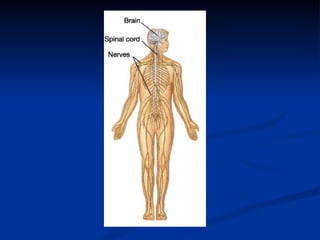
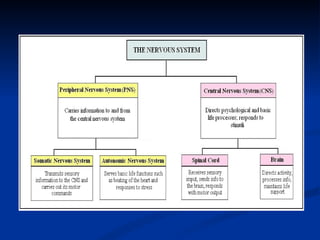
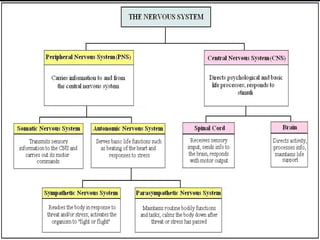
Nervous System Relays electrical signals through the body, directs behavior and movement and controls physiological processes  The nervous system can be broken down into two parts: Central nervous system (CNS) Brain and spinal cord Peripheral nervous system (PNS)   Touch, taste, smell nerve cells
 
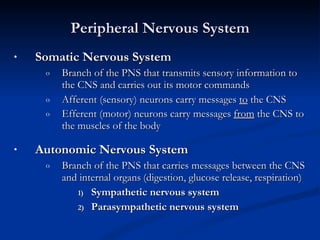
Peripheral Nervous System Somatic Nervous System Branch of the PNS that transmits sensory information to  the CNS and carries out its motor commands Afferent (sensory) neurons carry messages  to  the CNS Efferent (motor) neurons carry messages  from  the CNS to the muscles of the body   Autonomic Nervous System Branch of the PNS that carries messages between the CNS and internal organs   (digestion, glucose release, respiration)  Sympathetic nervous system Parasympathetic nervous system
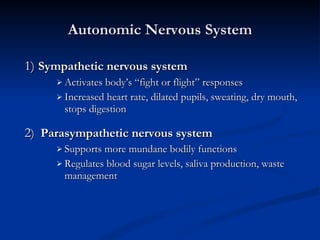
1)   Sympathetic nervous system Activates body’s “fight or flight” responses Increased heart rate, dilated pupils, sweating, dry mouth, stops digestion  2 )  Parasympathetic nervous system Supports more mundane bodily functions Regulates blood sugar levels, saliva production, waste management Autonomic Nervous System
 
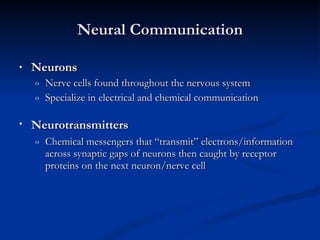
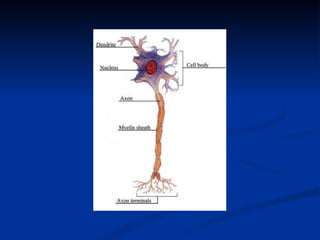
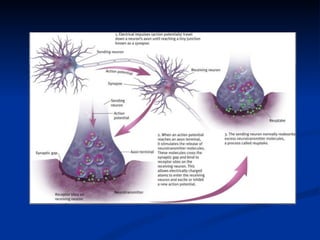
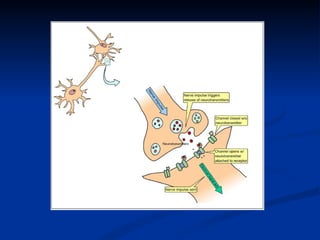
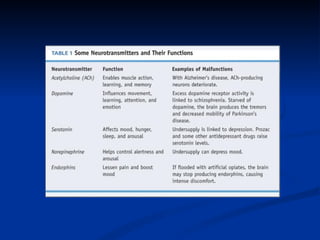
Neural Communication Neurons Nerve cells found throughout the nervous system  Specialize in electrical and chemical communication Neurotransmitters   Chemical messengers that “transmit” electrons/information across synaptic gaps of neurons then caught by receptor proteins on the next neuron/nerve cell


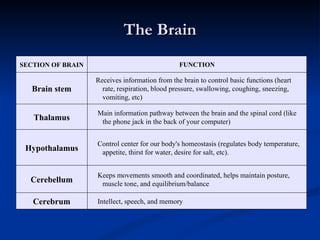
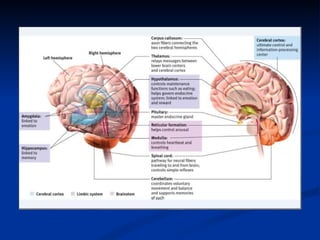
The Brain SECTION OF BRAIN   FUNCTION Brain stem Receives information from the brain to control basic functions (heart rate, respiration, blood pressure, swallowing, coughing, sneezing, vomiting, etc) Thalamus Main information pathway between the brain and the spinal cord (like the phone jack in the back of your computer) Hypothalamus Control center for our body's homeostasis (regulates body temperature, appetite, thirst for water, desire for salt, etc).  Cerebellum Keeps movements smooth and coordinated, helps maintain posture, muscle tone, and equilibrium/balance Cerebrum Intellect, speech, and memory


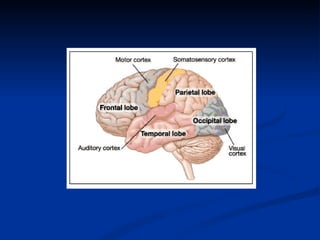
The Brain Occipital Lobe Specialized for vision  Parietal Lobe Sense of touch, spatial orientation, awareness Temporal Lobe Hearing and language functions, visual pattern recognition Frontal lobe Movement, attention, planning, abstract thinking
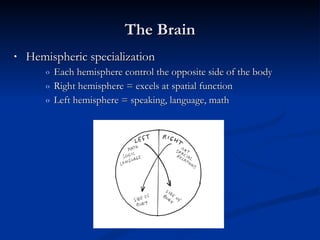
The Brain Hemispheric specialization Each hemisphere control the opposite side of the body Right hemisphere = excels at spatial function Left hemisphere = speaking, language, math
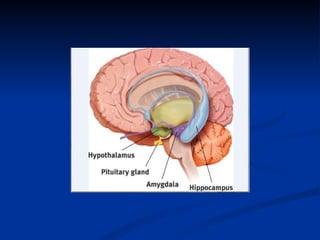
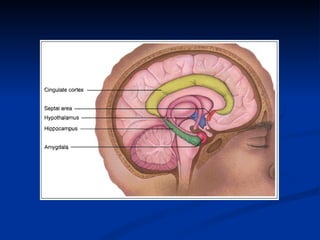
Limbic System Area of the brain that involves emotion and motivation Fully developed only in mammals Consists of: Amygdala  - emotional processes; attaches emotional      significance to emotional events) Hypothalamus  - regulates the autonomic system  Hippocampus  - memory, storing new information
 
Endocrine System Collection of glands throughout the body that secrete chemicals (called hormones) directly into bloodstream Guide metabolism, growth, and sexual development Hypothalamus links brain to pituitary gland which in turn activates other glands in endocrine system Hormones such as adrenaline/noradrenalin trigger  physiological arousal (re: danger) Hormones (adrenaline) are similar to neurotransmitters (norepinephrine) related to anxiety/fear Endocrine system uses hormone secretion to “broadcast” via  bloodstream (highway) vs. neurotransmitters which “talk” to one neuron then another in rapid succession
Brain Technology ESB  Electronic stimulation of the brain (in animals) Electrode planted in an area of the brain to stimulate that  region (IV) to determine any changes in behavior (DV) EEG  Used to study electrical activity of the brain  Electrodes placed on scalp and brain becomes “mapped” as areas “light up” CAT  Computerized axial tomography (MRI, PET) Assembles three dimensional picture of brain from x-rays Detection of abnormalities of mass (tumors)
Brain Disorders Delirium Disturbance of brain metabolic function Symptoms include disorientation, hallucinating, disturbed sleep, incoherent speech  Treatment entails removing the underlying cause, detoxification, rehydration, etc. Common in dying patients as organs shut down
Dementia Loss of mental capacity in adulthood  “ Senile dementia” = 10 - 20% of people > 65 years Causes include Alzheimer’s disease, vascular problems, alcoholism, paresis  Symptoms include poor awareness of time, depression, paranoia, parts of the brain maintaining everyday functions shut down (incontinence) Brain Disorders
Alzheimer’s Disease Progressive and incurable Cause by tangled neurons that disrupt functioning of the cortex Low level of neurotransmitters (ACH) which plays a role in memory function Neurons in the brain are destroyed, severely impairing memory, reasoning, perception, language, behavior, etc. Genetic causes (chromosome 21)? Brain Disorders

Unit 3+4

  • 1.
  • 2.
  • 3.
    Nervous System Relayselectrical signals through the body, directs behavior and movement and controls physiological processes The nervous system can be broken down into two parts: Central nervous system (CNS) Brain and spinal cord Peripheral nervous system (PNS) Touch, taste, smell nerve cells
  • 4.
  • 5.
    Peripheral Nervous SystemSomatic Nervous System Branch of the PNS that transmits sensory information to the CNS and carries out its motor commands Afferent (sensory) neurons carry messages to the CNS Efferent (motor) neurons carry messages from the CNS to the muscles of the body Autonomic Nervous System Branch of the PNS that carries messages between the CNS and internal organs (digestion, glucose release, respiration) Sympathetic nervous system Parasympathetic nervous system
  • 6.
    1) Sympathetic nervous system Activates body’s “fight or flight” responses Increased heart rate, dilated pupils, sweating, dry mouth, stops digestion 2 ) Parasympathetic nervous system Supports more mundane bodily functions Regulates blood sugar levels, saliva production, waste management Autonomic Nervous System
  • 7.
  • 8.
    Neural Communication NeuronsNerve cells found throughout the nervous system Specialize in electrical and chemical communication Neurotransmitters Chemical messengers that “transmit” electrons/information across synaptic gaps of neurons then caught by receptor proteins on the next neuron/nerve cell
  • 9.
  • 10.
  • 11.
  • 12.
  • 13.
    The Brain SECTIONOF BRAIN FUNCTION Brain stem Receives information from the brain to control basic functions (heart rate, respiration, blood pressure, swallowing, coughing, sneezing, vomiting, etc) Thalamus Main information pathway between the brain and the spinal cord (like the phone jack in the back of your computer) Hypothalamus Control center for our body's homeostasis (regulates body temperature, appetite, thirst for water, desire for salt, etc). Cerebellum Keeps movements smooth and coordinated, helps maintain posture, muscle tone, and equilibrium/balance Cerebrum Intellect, speech, and memory
  • 14.
  • 15.
  • 16.
  • 17.
    The Brain OccipitalLobe Specialized for vision Parietal Lobe Sense of touch, spatial orientation, awareness Temporal Lobe Hearing and language functions, visual pattern recognition Frontal lobe Movement, attention, planning, abstract thinking
  • 18.
    The Brain Hemisphericspecialization Each hemisphere control the opposite side of the body Right hemisphere = excels at spatial function Left hemisphere = speaking, language, math
  • 19.
    Limbic System Areaof the brain that involves emotion and motivation Fully developed only in mammals Consists of: Amygdala - emotional processes; attaches emotional significance to emotional events) Hypothalamus - regulates the autonomic system Hippocampus - memory, storing new information
  • 20.
  • 21.
    Endocrine System Collectionof glands throughout the body that secrete chemicals (called hormones) directly into bloodstream Guide metabolism, growth, and sexual development Hypothalamus links brain to pituitary gland which in turn activates other glands in endocrine system Hormones such as adrenaline/noradrenalin trigger physiological arousal (re: danger) Hormones (adrenaline) are similar to neurotransmitters (norepinephrine) related to anxiety/fear Endocrine system uses hormone secretion to “broadcast” via bloodstream (highway) vs. neurotransmitters which “talk” to one neuron then another in rapid succession
  • 22.
    Brain Technology ESB Electronic stimulation of the brain (in animals) Electrode planted in an area of the brain to stimulate that region (IV) to determine any changes in behavior (DV) EEG Used to study electrical activity of the brain Electrodes placed on scalp and brain becomes “mapped” as areas “light up” CAT Computerized axial tomography (MRI, PET) Assembles three dimensional picture of brain from x-rays Detection of abnormalities of mass (tumors)
  • 23.
    Brain Disorders DeliriumDisturbance of brain metabolic function Symptoms include disorientation, hallucinating, disturbed sleep, incoherent speech Treatment entails removing the underlying cause, detoxification, rehydration, etc. Common in dying patients as organs shut down
  • 24.
    Dementia Loss ofmental capacity in adulthood “ Senile dementia” = 10 - 20% of people > 65 years Causes include Alzheimer’s disease, vascular problems, alcoholism, paresis Symptoms include poor awareness of time, depression, paranoia, parts of the brain maintaining everyday functions shut down (incontinence) Brain Disorders
  • 25.
    Alzheimer’s Disease Progressiveand incurable Cause by tangled neurons that disrupt functioning of the cortex Low level of neurotransmitters (ACH) which plays a role in memory function Neurons in the brain are destroyed, severely impairing memory, reasoning, perception, language, behavior, etc. Genetic causes (chromosome 21)? Brain Disorders