Nervous System
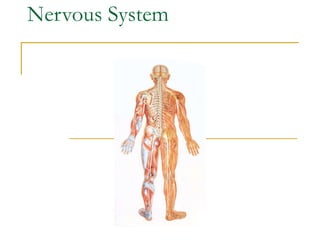
The  nervous system  is a  network  of specialized cells that communicate information about an animal's surroundings and itself. It processes this information and causes reactions in other parts of the body. It is composed of  neurons  and other specialized cells called  glia , that aid in the function of the neurons.
Neurons
The body is made up of billions of cells. Cells of the nervous system, called neurons. Neurons are electrically excitable cells in the nervous system that process and transmit information.
Structure Of Neuron
Neurons are consist of: SOMA : The soma is the central part of the neuron.  DENDRITES: The dendrites of a neuron are cellular extensions with many branches, and metaphorically this overall shape and structure is referred to as a dendrites tree.  AXON: The axon is a finer, cable-like projection which can extend tens, hundreds, or even tens of thousands of times the diameter of the soma in length.  AXON TERMINAL: The axon terminal contains synapses, specialized structures where neurotransmitter chemicals are released in order to communicate with target neurons.
Types Of Neuron
Bipolar Neurons have two processes extending from the cell body (examples: retinal cells, olfactory epithelium cells). Uni-polar cells (example: dorsal root ganglion cells). Actually, these cells have 2 axons rather than an axon and dendrite. One axon extends centrally toward the spinal cord, the other axon extends toward the skin or muscle. Multi-polar Neurons have many processes extending from the cell body, although only one of these is the axon (examples: spinal motor neurons, pyramidal neurons, Purkinje cells).
Nerve Cell
Synapse The junction between the axon terminals of a neuron and the receiving cell is called a  synapse .
 
Neurotransmitters
Neurotransmitters  are chemicals that are used to relay, amplify and modulate signals between a neuron and another cell.
Dopamine  – neurotransmitter of pleasure and pain, acts on the sympathetic nervous system producing effects such as increased heart rate and blood pressure, and is necessary for mental alertness, relaxation, pain relief and happiness. Parkinson's disease (PD) is believed to be caused by a deficiency of dopamine.  Dopamine  Imbalances Cause Sleep Disorders In Animal Models Of Parkinson's Disease And Schizophrenia.
Serotonin  - the master neurotransmitter. A molecule of happiness. It is found all over the body, with large concentration (95%) in digestive track and is necessary to balance the levels of the stress hormones. Serotonin is a precursor of melatonin, the hormone that is release at night, when you are asleep. Serotonin also regulates  mood  and  appetite.
Norepinephrine  – also known as a  noradrenaline.   A hormone – neurotransmitter release by adrenal glands in response to perceived threat. High levels of this hormone result in  anxiety  and  insomnia . Norepinephrine also regulates  metabolic processes  (heart beat, blood pressure),  calmness ,  relaxation and focus .
Epinephrine  – also known as adrenalin.  A "fight or flight" hormone - neurotransmitter secreted by the adrenal and released into the bloodstream in response to physical or mental stress, as from fear or injury. It initiates many bodily responses, including the stimulation of heart action and an increase in blood pressure, metabolic rate, and blood glucose concentration. Helps with focus, attention and productivity.
CENTRAL NERVOUS SYSTEM
The  central nervous system  ( CNS ) is the part of the nervous system that functions to coordinate the activity of all parts of the bodies of multicellular organisms. In vertebrates, the central nervous system is enclosed in the meninges. It contains the majority of the nervous system and consists of the brain (in vertebrates which have them), and the spinal cord.
THE BRAIN
 
The brain is the part of the central nervous system located in the skull. It controls the mental processes and physical actions of a human being.
BRAIN STEM
Brainstem -  The lower extension of the brain where it connects to the spinal cord. Neurological functions located in the brainstem include those necessary for survival (breathing, digestion, heart rate, blood pressure) and for arousal (being awake and alert). Most of the cranial nerves come from the brainstem. The brainstem is the pathway for all fiber tracts passing up and down from peripheral nerves and spinal cord to the highest parts of the brain.
INTERESTING FACTS ABOUT BRAIN. Your brain is the most  energy-consuming  part of your body. The brain represents only 2% of the body weight, but it uses up to 20 percent of the body’s energy production. The energy is used for cell-health maintenance and to fuel electrical impulses that neurons employ to communicate with one another. It is estimated that the human brain has a raw computational power between  1013 and 1016 operations per second . It is far more that  1 million times  the number of people on Earth.
Your brain contains about  100 billion neurons  which is about 16 times the number of people on Earth. Each of them links to as many as 10,000 other neurons. This  huge  number of connections opens the way to massive parallel processing within the brain. The neocortex (a section of the brain involved with language and consciousness) accounts for about 76% of the mass of the human brain. Human  neocortex is much larger  than any animals. It gives humans unique mental capacities although its brain architecture is similar to that of more primitive species.
Humans  do not  use only 10%  or less of their brain. This is a common misconception. Even though many mysteries of brain function persist, every part of the brain has a known function. 750ml of blood pumps through your brain every minute which is  15-20% of blood flow  from the heart. The human brain is about  75% water .   Your brain consumes  25 watts of power  while you’re awake. This amount of energy is enough to illuminate a lightbulb.
LIMBIC SYSTEM
The  limbic system  is a set of brain structures including the hippocampus, amygdala, anterior thalamic nuclei, and limbic cortex, which support a variety of functions including emotion, behavior, long term memory, and olfaction.
CEREBRAL PARTS
LOBES
 
 
FRONTAL LOBE Located in front of the central sulcus.  Concerned with reasoning, planning, parts of speech and movement (motor cortex), emotions, and problem-solving. PARIETAL LOBE Located behind the central sulcus.  Concerned with perception of stimuli related to touch, pressure, temperature and pain.
TEMPORAL LOBE Located below the lateral fissure.  Concerned with perception and recognition of auditory stimuli (hearing) and memory (hippocampus). OCCIPITAL LOBE Located at the back of the brain, behind the parietal lobe and temporal lobe.  Concerned with many aspects of vision.
SPINAL CORD
The spinal cord is the main pathway for information connecting the brain and peripheral nervous system. The length of the spinal cord is much shorter than the length of the bony spinal column. The human spinal cord extends from the medulla oblongata and continues through the conus medullaris near the first or second lumbar vertebrae, terminating in a fibrous extension known as the filum terminale.
AUTONOMIC NERVOUS SYSTEM
The  autonomic nervous system  ( ANS ) (or  visceral nervous system ) is the part of the  peripheral nervous system  that acts as a  control system , maintaining  homeostasis  in the body. These activities are generally performed without conscious control. [1]  The ANS affects heart rate, digestion, respiration rate, salivation, perspiration, diameter of the pupils, micturition (urinationand  sexual arousal . Whereas most of its actions are involuntary, some, such as breathing, work in tandem with the conscious mind. It can be divided by subsystems into the  parasympathetic nervous system  and  sympathetic nervous system .
 
Sympathetic nervous system:  A part of the nervous system that serves to accelerate the heart rate, constrict blood vessels, and raise blood pressure.
PARASYMPETHETIC NERVOUS    SYSTEM
The parasympathetic nervous system promotes digestion, synthesizes  glycogen , and allows for normal function and behavior.
METHODS TO STUDY BRAIN CAT EEG MRI PET
CAT SCAN
Results of CAT scan
Computed Axial Tomography" is the process of using computers to generate a three-dimensional image from flat (i.e, two-dimensional) x-ray pictures, one slice at a time.
EEG
 
The EEG is used to show the electrical activity of the brain. Brain cells send messages to each other using small electrical impulses (or brainwaves). These can be measured to make sure everything is normal.
MRI
RESULTS OF MRI
 
MRI stands for magnetic resonance imaging. An MRI scan uses a strong magnetic field and radio waves to create pictures on a computer of tissues, organs and other structures inside your body.
PET SCAN
 
Positron Emission Tomography  or  PET  is the most advanced medical diagnostic imaging technology available today for the early and accurate detection of cancer and its recurrence.
the endocrine system is in charge of body processes that happen slowly, such as cell growth. Faster processes like breathing and body movement are controlled by the nervous system. But even though the nervous system and endocrine system are separate systems, they often work together to help the body function properly.
Endocrine Glands  are glands of the  endocrine system  that secrete their products,  hormones , directly into the  blood  rather than through a duct. The main endocrine glands include the  pituitary gland ,  pancreas ,  ovaries ,  testes ,  thyroid gland , and  adrenal glands .
The pituitary gland hangs from the base of the  brain  by a stalk and is enclosed by bone. It consists of a hormone-producing glandular portion (anterior pituitary) and a neural portion (posterior pituitary), which is an extension of the  hypothalamus .  The thyroid gland is located in the anterior throat. Thyroid follicles store colloid containing  thyroglobulin , a glycoprotein from which thyroid hormone is derived.
The parathyroid glands, located on the dorsal aspect of the thyroid gland, secrete  parathyroid hormone  (PTH), which causes an increase in blood calcium levels by targeting bone, the intestine, and the kidneys.  The paired adrenal (suprarenal) glands sit atop the kidneys. Each adrenal gland has two functional portions, the cortex and the medulla. The pancreas, located in the abdomen close to the stomach, is both an  exocrine  and an endocrine gland. The endocrine portion (pancreatic islets) releases insulin and glucagon and smaller amounts of other hormones to the blood.
The  ovary  is an  ovum -producing reproductive organ, often found in pairs as part of the  vertebrate   female   reproductive system .  Testis is the male reproductive organ.

Nervous system

  • 1.
  • 2.
    The nervoussystem is a network of specialized cells that communicate information about an animal's surroundings and itself. It processes this information and causes reactions in other parts of the body. It is composed of neurons and other specialized cells called glia , that aid in the function of the neurons.
  • 3.
  • 4.
    The body ismade up of billions of cells. Cells of the nervous system, called neurons. Neurons are electrically excitable cells in the nervous system that process and transmit information.
  • 5.
  • 6.
    Neurons are consistof: SOMA : The soma is the central part of the neuron. DENDRITES: The dendrites of a neuron are cellular extensions with many branches, and metaphorically this overall shape and structure is referred to as a dendrites tree. AXON: The axon is a finer, cable-like projection which can extend tens, hundreds, or even tens of thousands of times the diameter of the soma in length. AXON TERMINAL: The axon terminal contains synapses, specialized structures where neurotransmitter chemicals are released in order to communicate with target neurons.
  • 7.
  • 8.
    Bipolar Neurons havetwo processes extending from the cell body (examples: retinal cells, olfactory epithelium cells). Uni-polar cells (example: dorsal root ganglion cells). Actually, these cells have 2 axons rather than an axon and dendrite. One axon extends centrally toward the spinal cord, the other axon extends toward the skin or muscle. Multi-polar Neurons have many processes extending from the cell body, although only one of these is the axon (examples: spinal motor neurons, pyramidal neurons, Purkinje cells).
  • 9.
  • 10.
    Synapse The junctionbetween the axon terminals of a neuron and the receiving cell is called a synapse .
  • 11.
  • 12.
  • 13.
    Neurotransmitters arechemicals that are used to relay, amplify and modulate signals between a neuron and another cell.
  • 14.
    Dopamine –neurotransmitter of pleasure and pain, acts on the sympathetic nervous system producing effects such as increased heart rate and blood pressure, and is necessary for mental alertness, relaxation, pain relief and happiness. Parkinson's disease (PD) is believed to be caused by a deficiency of dopamine. Dopamine Imbalances Cause Sleep Disorders In Animal Models Of Parkinson's Disease And Schizophrenia.
  • 15.
    Serotonin -the master neurotransmitter. A molecule of happiness. It is found all over the body, with large concentration (95%) in digestive track and is necessary to balance the levels of the stress hormones. Serotonin is a precursor of melatonin, the hormone that is release at night, when you are asleep. Serotonin also regulates mood and appetite.
  • 16.
    Norepinephrine –also known as a noradrenaline.  A hormone – neurotransmitter release by adrenal glands in response to perceived threat. High levels of this hormone result in anxiety and insomnia . Norepinephrine also regulates metabolic processes (heart beat, blood pressure), calmness , relaxation and focus .
  • 17.
    Epinephrine –also known as adrenalin.  A "fight or flight" hormone - neurotransmitter secreted by the adrenal and released into the bloodstream in response to physical or mental stress, as from fear or injury. It initiates many bodily responses, including the stimulation of heart action and an increase in blood pressure, metabolic rate, and blood glucose concentration. Helps with focus, attention and productivity.
  • 18.
  • 19.
    The centralnervous system ( CNS ) is the part of the nervous system that functions to coordinate the activity of all parts of the bodies of multicellular organisms. In vertebrates, the central nervous system is enclosed in the meninges. It contains the majority of the nervous system and consists of the brain (in vertebrates which have them), and the spinal cord.
  • 20.
  • 21.
  • 22.
    The brain isthe part of the central nervous system located in the skull. It controls the mental processes and physical actions of a human being.
  • 23.
  • 24.
    Brainstem - The lower extension of the brain where it connects to the spinal cord. Neurological functions located in the brainstem include those necessary for survival (breathing, digestion, heart rate, blood pressure) and for arousal (being awake and alert). Most of the cranial nerves come from the brainstem. The brainstem is the pathway for all fiber tracts passing up and down from peripheral nerves and spinal cord to the highest parts of the brain.
  • 25.
    INTERESTING FACTS ABOUTBRAIN. Your brain is the most energy-consuming part of your body. The brain represents only 2% of the body weight, but it uses up to 20 percent of the body’s energy production. The energy is used for cell-health maintenance and to fuel electrical impulses that neurons employ to communicate with one another. It is estimated that the human brain has a raw computational power between 1013 and 1016 operations per second . It is far more that 1 million times the number of people on Earth.
  • 26.
    Your brain containsabout 100 billion neurons which is about 16 times the number of people on Earth. Each of them links to as many as 10,000 other neurons. This huge number of connections opens the way to massive parallel processing within the brain. The neocortex (a section of the brain involved with language and consciousness) accounts for about 76% of the mass of the human brain. Human neocortex is much larger than any animals. It gives humans unique mental capacities although its brain architecture is similar to that of more primitive species.
  • 27.
    Humans donot use only 10% or less of their brain. This is a common misconception. Even though many mysteries of brain function persist, every part of the brain has a known function. 750ml of blood pumps through your brain every minute which is 15-20% of blood flow from the heart. The human brain is about 75% water . Your brain consumes 25 watts of power while you’re awake. This amount of energy is enough to illuminate a lightbulb.
  • 28.
  • 29.
    The limbicsystem is a set of brain structures including the hippocampus, amygdala, anterior thalamic nuclei, and limbic cortex, which support a variety of functions including emotion, behavior, long term memory, and olfaction.
  • 30.
  • 31.
  • 32.
  • 33.
  • 34.
    FRONTAL LOBE Locatedin front of the central sulcus. Concerned with reasoning, planning, parts of speech and movement (motor cortex), emotions, and problem-solving. PARIETAL LOBE Located behind the central sulcus. Concerned with perception of stimuli related to touch, pressure, temperature and pain.
  • 35.
    TEMPORAL LOBE Locatedbelow the lateral fissure. Concerned with perception and recognition of auditory stimuli (hearing) and memory (hippocampus). OCCIPITAL LOBE Located at the back of the brain, behind the parietal lobe and temporal lobe. Concerned with many aspects of vision.
  • 36.
  • 37.
    The spinal cordis the main pathway for information connecting the brain and peripheral nervous system. The length of the spinal cord is much shorter than the length of the bony spinal column. The human spinal cord extends from the medulla oblongata and continues through the conus medullaris near the first or second lumbar vertebrae, terminating in a fibrous extension known as the filum terminale.
  • 38.
  • 39.
    The autonomicnervous system ( ANS ) (or visceral nervous system ) is the part of the peripheral nervous system that acts as a control system , maintaining homeostasis in the body. These activities are generally performed without conscious control. [1] The ANS affects heart rate, digestion, respiration rate, salivation, perspiration, diameter of the pupils, micturition (urinationand sexual arousal . Whereas most of its actions are involuntary, some, such as breathing, work in tandem with the conscious mind. It can be divided by subsystems into the parasympathetic nervous system and sympathetic nervous system .
  • 40.
  • 41.
    Sympathetic nervous system: A part of the nervous system that serves to accelerate the heart rate, constrict blood vessels, and raise blood pressure.
  • 42.
  • 43.
    The parasympathetic nervoussystem promotes digestion, synthesizes glycogen , and allows for normal function and behavior.
  • 44.
    METHODS TO STUDYBRAIN CAT EEG MRI PET
  • 45.
  • 46.
  • 47.
    Computed Axial Tomography"is the process of using computers to generate a three-dimensional image from flat (i.e, two-dimensional) x-ray pictures, one slice at a time.
  • 48.
  • 49.
  • 50.
    The EEG isused to show the electrical activity of the brain. Brain cells send messages to each other using small electrical impulses (or brainwaves). These can be measured to make sure everything is normal.
  • 51.
  • 52.
  • 53.
  • 54.
    MRI stands formagnetic resonance imaging. An MRI scan uses a strong magnetic field and radio waves to create pictures on a computer of tissues, organs and other structures inside your body.
  • 55.
  • 56.
  • 57.
    Positron Emission Tomography or PET is the most advanced medical diagnostic imaging technology available today for the early and accurate detection of cancer and its recurrence.
  • 58.
    the endocrine systemis in charge of body processes that happen slowly, such as cell growth. Faster processes like breathing and body movement are controlled by the nervous system. But even though the nervous system and endocrine system are separate systems, they often work together to help the body function properly.
  • 59.
    Endocrine Glands are glands of the endocrine system that secrete their products, hormones , directly into the blood rather than through a duct. The main endocrine glands include the pituitary gland , pancreas , ovaries , testes , thyroid gland , and adrenal glands .
  • 60.
    The pituitary glandhangs from the base of the brain by a stalk and is enclosed by bone. It consists of a hormone-producing glandular portion (anterior pituitary) and a neural portion (posterior pituitary), which is an extension of the hypothalamus . The thyroid gland is located in the anterior throat. Thyroid follicles store colloid containing thyroglobulin , a glycoprotein from which thyroid hormone is derived.
  • 61.
    The parathyroid glands,located on the dorsal aspect of the thyroid gland, secrete parathyroid hormone (PTH), which causes an increase in blood calcium levels by targeting bone, the intestine, and the kidneys. The paired adrenal (suprarenal) glands sit atop the kidneys. Each adrenal gland has two functional portions, the cortex and the medulla. The pancreas, located in the abdomen close to the stomach, is both an exocrine and an endocrine gland. The endocrine portion (pancreatic islets) releases insulin and glucagon and smaller amounts of other hormones to the blood.
  • 62.
    The ovary is an ovum -producing reproductive organ, often found in pairs as part of the vertebrate female reproductive system . Testis is the male reproductive organ.