THE NERVOUS SYTEM
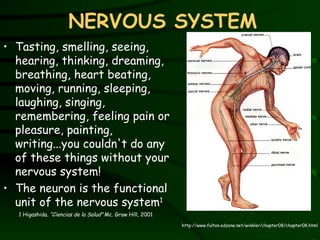
NERVOUS SYSTEM Tasting, smelling, seeing, hearing, thinking, dreaming, breathing, heart beating, moving, running, sleeping, laughing, singing, remembering, feeling pain or pleasure, painting, writing...you couldn't do any of these things without your nervous system!  The neuron is the functional unit of the nervous system 1 http://www.fulton.edzone.net/winkler/chapter08/chapter08.html 1 Higashida.  “Ciencias de la Salud”  Mc. Graw Hill, 2001
THE NEURON Three basic functions  are  performed  by nervous systems:  Receive sensory input from internal and external environments .   Sensory input can be in many forms, including pressure, taste, sound, light, blood pH, or hormone levels, that are converted to a signal and sent to the brain or spinal cord.  Integrate the input .  In the sensory centers of the brain or in the spinal cord, the barrage of input is integrated and a response is generated.  Respond to stimuli .  The response, a motor output, is a signal transmitted to organs than can convert the signal into some form of action, such as movement, changes in heart rate, release of hormones, etc.  http://www.emc.maricopa.edu/faculty/farabee/BIOBK/BioBookNERV.html
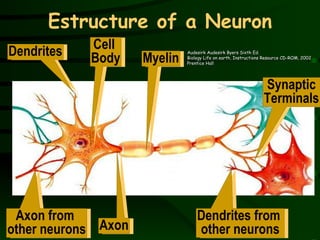
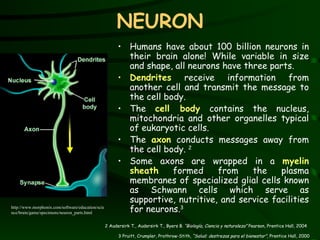
Estructure of a Neuron Cell  Body Dendrites Axon from  other neurons Axon Myelin Dendrites from  other neurons Audesirk Audesirk Byers Sixth Ed. Biology Life on earth, Instructions Resource CD-ROM, 2002 Prentice Hall Synaptic Terminals
NEURON Humans have about 100 billion neurons in their brain alone! While variable in size and shape, all neurons have three parts.  Dendrites  receive information from another cell and transmit the message to the cell body.  The  cell body  contains the nucleus, mitochondria and other organelles typical of eukaryotic cells.  The  axon  conducts messages away from the cell body.  2 Some axons are wrapped in a  myelin sheath  formed from the plasma membranes of specialized glial cells known as Schwann cells which serve as supportive, nutritive, and service facilities for neurons. 3 2 Audersirk T., Audersirk T., Byers B.  “Biología, Ciencia y naturaleza”  Pearson, Prentice Hall, 2004 3 Pruitt, Crumpler, Prothrow-Stith,  “Salud: destrezas para el bienestar” , Prentice Hall, 2000 http://www.morphonix.com/software/education/science/brain/game/specimens/neuron_parts.html
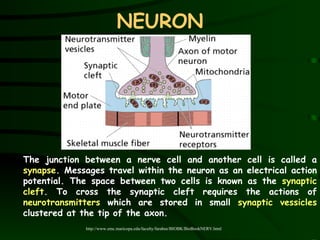
NEURON The junction between a nerve cell and another cell is called a  synapse . Messages travel within the neuron as an electrical action potential. The space between two cells is known as the  synaptic cleft . To cross the synaptic cleft requires the actions of  neurotransmitters   which   are stored in small  synaptic vessicles  clustered at the tip of the axon.  http://www.emc.maricopa.edu/faculty/farabee/BIOBK/BioBookNERV.html
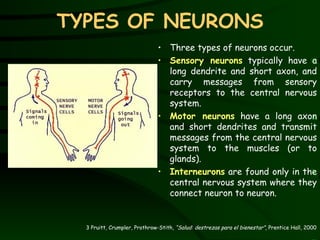
TYPES OF NEURONS Three types of neurons occur.  Sensory neurons  typically have a long dendrite and short axon, and carry messages from sensory receptors to the central nervous system.  Motor neurons  have a long axon and short dendrites and transmit messages from the central nervous system to the muscles (or to glands).  Interneurons   are found only in the central nervous system where they connect neuron to neuron. 3 Pruitt, Crumpler, Prothrow-Stith,  “Salud: destrezas para el bienestar” , Prentice Hall, 2000
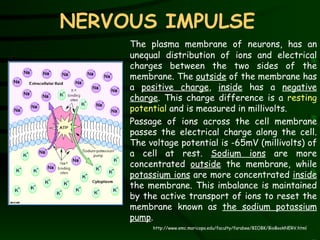
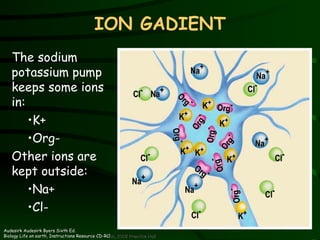
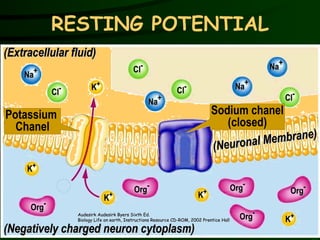
NERVOUS IMPULSE The plasma membrane of neurons, has an unequal distribution of ions and electrical charges between the two sides of the membrane. The  outside  of the membrane has a  positive charge ,  inside  has a  negative charge . This charge difference is a  resting potential  and is measured in millivolts.  Passage of ions across the cell membrane passes the electrical charge along the cell. The voltage potential is -65mV (millivolts) of a cell at rest.  Sodium ions  are more concentrated  outside  the membrane, while  potassium ions  are more concentrated  inside  the membrane. This imbalance is maintained by the active transport of ions to reset the membrane known as  the sodium potassium pump .  http://www.emc.maricopa.edu/faculty/farabee/BIOBK/BioBookNERV.html
ION GADIENT Org - Org - Org - Org - Org - Org - Org - Org - Org - K + K + K + K + K + K + K + Na + Na + Na + Na + Na + Na + Cl - Cl - Cl - Cl - Cl - Cl - The sodium potassium pump keeps some ions in: K+ Org- Other ions are kept outside: Na+ Cl- Audesirk Audesirk Byers Sixth Ed. Biology Life on earth, Instructions Resource CD-RO M, 2002 Prentice Hall
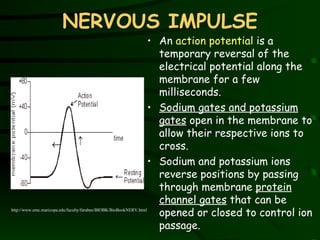
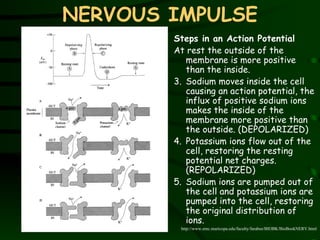
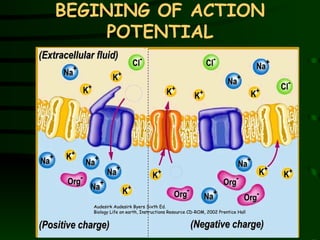
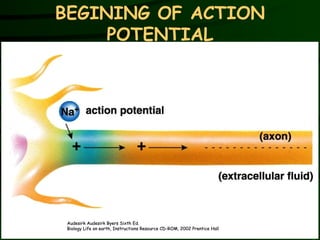
NERVOUS IMPULSE An  action potential  is a temporary reversal of the electrical potential along the membrane for a few milliseconds.  Sodium gates and potassium gates  open in the membrane to allow their respective ions to cross.  Sodium and potassium ions reverse positions by passing through membrane  protein channel gates  that can be opened or closed to control ion passage.  http://www.emc.maricopa.edu/faculty/farabee/BIOBK/BioBookNERV.html
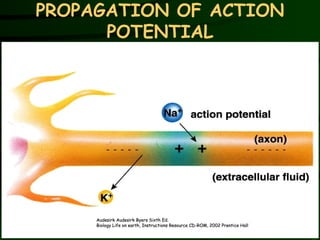
NERVOUS IMPULSE Steps in an Action Potential At rest the outside of the membrane is more positive than the inside.  Sodium moves inside the cell causing an action potential, the influx of positive sodium ions makes the inside of the membrane more positive than the outside.  (DEPOLARIZED) Potassium ions flow out of the cell, restoring the resting potential net charges.  (REPOLARIZED) Sodium ions are pumped out of the cell and potassium ions are pumped into the cell, restoring the original distribution of ions.  http://www.emc.maricopa.edu/faculty/farabee/BIOBK/BioBookNERV.html
RESTING POTENTIAL ( Extracellular fluid ) (Negatively charge d  neuron cytoplasm) ( Neuronal Membrane )  Org - Na + Org - Org - Org - Org - K + K + K + K + K + Cl - Cl - Cl - Cl - Na + Na + Na + Potassium  Chanel Sodium chanel (c losed ) Audesirk Audesirk Byers Sixth Ed. Biology Life on earth, Instructions Resource CD-ROM, 2002 Prentice Hall
BEGINING OF ACTION POTENTIAL Org - K + K + K + Cl - Na + Na + K + Na + Na + Na + ( Extracellular fluid) ( Positive charge ) ( Negative charge ) Audesirk Audesirk Byers Sixth Ed. Biology Life on earth, Instructions Resource CD-ROM, 2002 Prentice Hall Org - Na + Org - Org - K + K + Cl - Na + K + K + K + K + Na + Na + Cl -
BEGINING OF ACTION POTENTIAL Audesirk Audesirk Byers Sixth Ed. Biology Life on earth, Instructions Resource CD-ROM, 2002 Prentice Hall
PROPAGATION OF ACTION POTENTIAL Audesirk Audesirk Byers Sixth Ed. Biology Life on earth, Instructions Resource CD-ROM, 2002 Prentice Hall
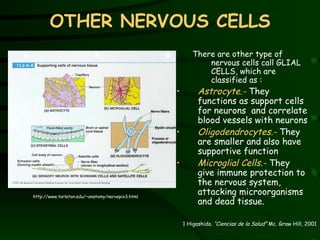
OTHER NERVOUS CELLS There are other type of nervous cells call GLIAL CELLS, which are classified as : Astrocyte.-  They functions as support cells for neurons  and correlate blood vessels with neurons  Oligodendrocytes.-  They are smaller and also have supportive function Microglial Cells.-  They give immune protection to the nervous system, attacking microorganisms and dead tissue. http://www.tarleton.edu/~anatomy/nervepix3.html 1 Higashida.  “Ciencias de la Salud”  Mc. Graw Hill, 2001
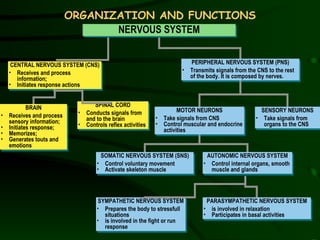
ORGANIZATION AND FUNCTIONS CENTRAL NERVOUS SYSTEM (CNS) Receives and process information; Initiates response actions BRAIN Receives and process sensory information; Initiates response; Memorizes; Generates touts and emotions SPINAL CORD Conducts signals from and to the brain Controls reflex activities PERIPHERAL NERVOUS SYSTEM (PNS) Transmits signals from the CNS to the rest of the body. It is composed by nerves. SENSORY NEURONS Take signals from organs to the CNS MOTOR NEURONS Take signals from CNS Control muscular and endocrine activities SOMATIC NERVOUS SYSTEM (SNS) Control voluntary movement Activate skeleton muscle AUTONOMIC NERVOUS SYSTEM Control internal organs, smooth muscle and glands SYMPATHETIC NERVOUS SYSTEM Prepares the body to stressfull situations is involved in the fight or  run  response  PARASYMPATHETIC NERVOUS SYSTEM is involved in relaxation  Participates in basal activities NERVOUS SYSTEM
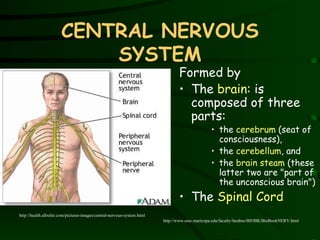
CENTRAL NERVOUS SYSTEM Formed by The  brain :  is composed of three parts:  the  cerebrum  (seat of consciousness),  the  cerebellum , and  the  brain steam  (these latter two are "part of the unconscious brain") The  Spinal Cord http://health.allrefer.com/pictures-images/central-nervous-system.html http://www.emc.maricopa.edu/faculty/farabee/BIOBK/BioBookNERV.html
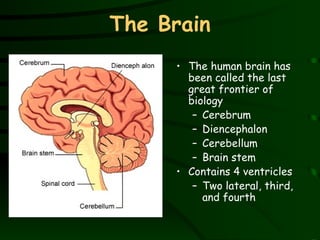
The Brain The human brain has been called the last great frontier of biology Cerebrum Diencephalon Cerebellum  Brain stem Contains 4 ventricles Two lateral, third, and fourth
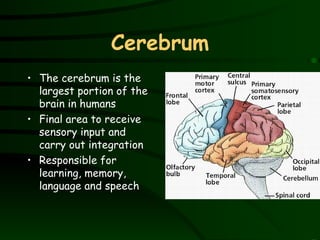
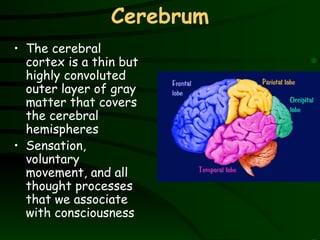
Cerebrum The cerebrum is the largest portion of the brain in humans Final area to receive sensory input and carry out integration Responsible for learning, memory, language and speech
Cerebrum The cerebral cortex is a thin but highly convoluted outer layer of gray matter that covers the cerebral hemispheres Sensation, voluntary movement, and all thought processes that we associate with consciousness
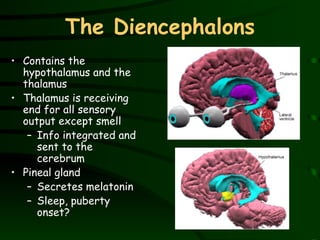
The Diencephalons Contains the hypothalamus and the thalamus Thalamus is receiving end for all sensory output except smell Info integrated and sent to the cerebrum Pineal gland Secretes melatonin Sleep, puberty onset?
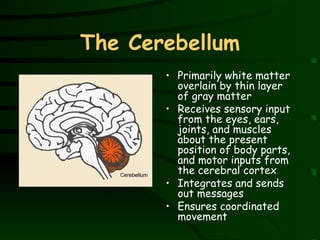
The Cerebellum Primarily white matter overlain by thin layer of gray matter Receives sensory input from the eyes, ears, joints, and muscles about the present position of body parts, and motor inputs from the cerebral cortex Integrates and sends out messages Ensures coordinated movement
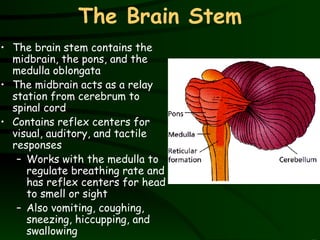
The Brain Stem The brain stem contains the midbrain, the pons, and the medulla oblongata The midbrain acts as a relay station from cerebrum to spinal cord Contains reflex centers for visual, auditory, and tactile responses Works with the medulla to regulate breathing rate and has reflex centers for head to smell or sight Also vomiting, coughing, sneezing, hiccupping, and swallowing
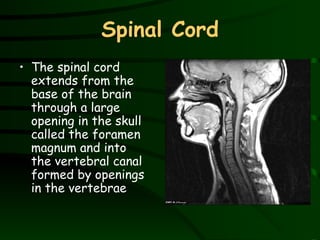
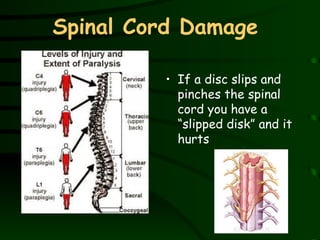
Spinal Cord The spinal cord extends from the base of the brain through a large opening in the skull called the foramen magnum and into the vertebral canal formed by openings in the vertebrae
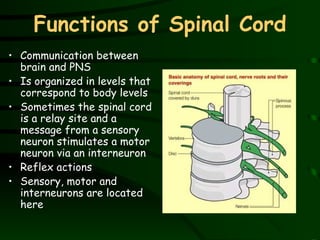
Functions of Spinal Cord Communication between brain and PNS Is organized in levels that correspond to body levels Sometimes the spinal cord is a relay site and a message from a sensory neuron stimulates a motor neuron via an interneuron Reflex actions Sensory, motor and interneurons are located here
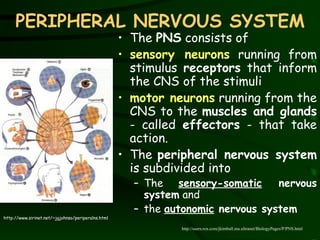
PERIPHERAL NERVOUS SYSTEM The  PNS  consists of  sensory neurons  running from stimulus  receptors  that inform the CNS of the stimuli  motor neurons  running from the CNS to the  muscles and glands  - called  effectors  - that take action. The  peripheral nervous system  is subdivided into  The   sensory-somatic  nervous system  and  the  autonomic  nervous system   http://www.sirinet.net/~jgjohnso/periperalns.html http://users.rcn.com/jkimball.ma.ultranet/BiologyPages/P/PNS.html
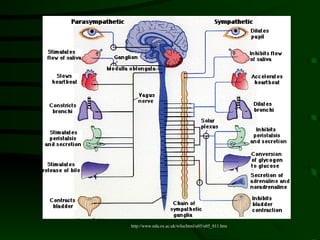
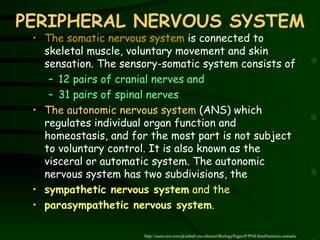
PERIPHERAL NERVOUS SYSTEM The somatic nervous system  is connected to skeletal muscle, voluntary movement and skin sensation.  The sensory-somatic system consists of  12 pairs of cranial nerves and  31 pairs of spinal nerves The autonomic nervous system  (ANS) which regulates individual organ function and homeostasis, and for the most part is not subject to voluntary control. It is also known as the visceral or automatic system .  The autonomic nervous system has two subdivisions, the  sympathetic nervous system  and the  parasympathetic nervous system .  http://users.rcn.com/jkimball.ma.ultranet/BiologyPages/P/PNS.html#sensory-somatic
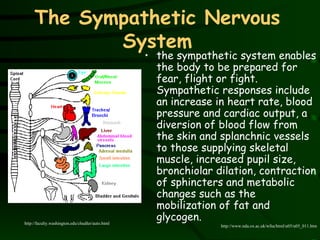
The Sympathetic Nervous System the sympathetic system enables the body to be prepared for fear, flight or fight. Sympathetic responses include an increase in heart rate, blood pressure and cardiac output, a diversion of blood flow from the skin and splanchnic vessels to those supplying skeletal muscle, increased pupil size, bronchiolar dilation, contraction of sphincters and metabolic changes such as the mobilization of fat and glycogen.  http://www.nda.ox.ac.uk/wfsa/html/u05/u05_011.htm http://faculty.washington.edu/chudler/auto.html
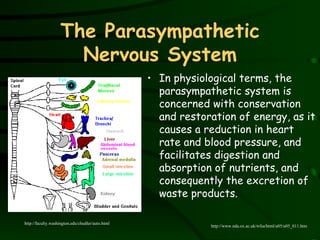
The Parasympathetic Nervous System In physiological terms, the parasympathetic system is concerned with conservation and restoration of energy, as it causes a reduction in heart rate and blood pressure, and facilitates digestion and absorption of nutrients, and consequently the excretion of waste products.  http://www.nda.ox.ac.uk/wfsa/html/u05/u05_011.htm http://faculty.washington.edu/chudler/auto.html
http://www.nda.ox.ac.uk/wfsa/html/u05/u05_011.htm
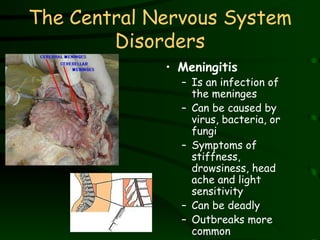
The Central Nervous System Disorders Meningitis Is an infection of the meninges Can be caused by virus, bacteria, or fungi Symptoms of stiffness, drowsiness, head ache and light sensitivity Can be deadly Outbreaks more common
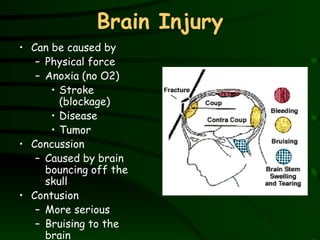
Brain Injury Can be caused by Physical force Anoxia (no O2) Stroke (blockage) Disease  Tumor Concussion  Caused by brain bouncing off the skull Contusion More serious Bruising to the brain
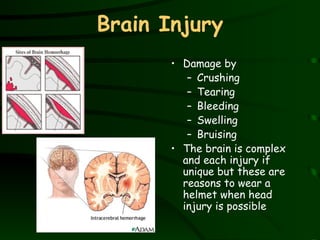
Brain Injury Damage by Crushing Tearing Bleeding Swelling Bruising The brain is complex and each injury if unique but these are reasons to wear a helmet when head injury is possible
Spinal Cord Damage  If a disc slips and pinches the spinal cord you have a “slipped disk” and it hurts

Nervous System

  • 1.
  • 2.
    NERVOUS SYSTEM Tasting,smelling, seeing, hearing, thinking, dreaming, breathing, heart beating, moving, running, sleeping, laughing, singing, remembering, feeling pain or pleasure, painting, writing...you couldn't do any of these things without your nervous system! The neuron is the functional unit of the nervous system 1 http://www.fulton.edzone.net/winkler/chapter08/chapter08.html 1 Higashida. “Ciencias de la Salud” Mc. Graw Hill, 2001
  • 3.
    THE NEURON Threebasic functions are performed by nervous systems: Receive sensory input from internal and external environments . Sensory input can be in many forms, including pressure, taste, sound, light, blood pH, or hormone levels, that are converted to a signal and sent to the brain or spinal cord. Integrate the input . In the sensory centers of the brain or in the spinal cord, the barrage of input is integrated and a response is generated. Respond to stimuli . The response, a motor output, is a signal transmitted to organs than can convert the signal into some form of action, such as movement, changes in heart rate, release of hormones, etc. http://www.emc.maricopa.edu/faculty/farabee/BIOBK/BioBookNERV.html
  • 4.
    Estructure of aNeuron Cell Body Dendrites Axon from other neurons Axon Myelin Dendrites from other neurons Audesirk Audesirk Byers Sixth Ed. Biology Life on earth, Instructions Resource CD-ROM, 2002 Prentice Hall Synaptic Terminals
  • 5.
    NEURON Humans haveabout 100 billion neurons in their brain alone! While variable in size and shape, all neurons have three parts. Dendrites receive information from another cell and transmit the message to the cell body. The cell body contains the nucleus, mitochondria and other organelles typical of eukaryotic cells. The axon conducts messages away from the cell body. 2 Some axons are wrapped in a myelin sheath formed from the plasma membranes of specialized glial cells known as Schwann cells which serve as supportive, nutritive, and service facilities for neurons. 3 2 Audersirk T., Audersirk T., Byers B. “Biología, Ciencia y naturaleza” Pearson, Prentice Hall, 2004 3 Pruitt, Crumpler, Prothrow-Stith, “Salud: destrezas para el bienestar” , Prentice Hall, 2000 http://www.morphonix.com/software/education/science/brain/game/specimens/neuron_parts.html
  • 6.
    NEURON The junctionbetween a nerve cell and another cell is called a synapse . Messages travel within the neuron as an electrical action potential. The space between two cells is known as the synaptic cleft . To cross the synaptic cleft requires the actions of neurotransmitters which are stored in small synaptic vessicles clustered at the tip of the axon. http://www.emc.maricopa.edu/faculty/farabee/BIOBK/BioBookNERV.html
  • 7.
    TYPES OF NEURONSThree types of neurons occur. Sensory neurons typically have a long dendrite and short axon, and carry messages from sensory receptors to the central nervous system. Motor neurons have a long axon and short dendrites and transmit messages from the central nervous system to the muscles (or to glands). Interneurons are found only in the central nervous system where they connect neuron to neuron. 3 Pruitt, Crumpler, Prothrow-Stith, “Salud: destrezas para el bienestar” , Prentice Hall, 2000
  • 8.
    NERVOUS IMPULSE Theplasma membrane of neurons, has an unequal distribution of ions and electrical charges between the two sides of the membrane. The outside of the membrane has a positive charge , inside has a negative charge . This charge difference is a resting potential and is measured in millivolts. Passage of ions across the cell membrane passes the electrical charge along the cell. The voltage potential is -65mV (millivolts) of a cell at rest. Sodium ions are more concentrated outside the membrane, while potassium ions are more concentrated inside the membrane. This imbalance is maintained by the active transport of ions to reset the membrane known as the sodium potassium pump . http://www.emc.maricopa.edu/faculty/farabee/BIOBK/BioBookNERV.html
  • 9.
    ION GADIENT Org- Org - Org - Org - Org - Org - Org - Org - Org - K + K + K + K + K + K + K + Na + Na + Na + Na + Na + Na + Cl - Cl - Cl - Cl - Cl - Cl - The sodium potassium pump keeps some ions in: K+ Org- Other ions are kept outside: Na+ Cl- Audesirk Audesirk Byers Sixth Ed. Biology Life on earth, Instructions Resource CD-RO M, 2002 Prentice Hall
  • 10.
    NERVOUS IMPULSE An action potential is a temporary reversal of the electrical potential along the membrane for a few milliseconds. Sodium gates and potassium gates open in the membrane to allow their respective ions to cross. Sodium and potassium ions reverse positions by passing through membrane protein channel gates that can be opened or closed to control ion passage. http://www.emc.maricopa.edu/faculty/farabee/BIOBK/BioBookNERV.html
  • 11.
    NERVOUS IMPULSE Stepsin an Action Potential At rest the outside of the membrane is more positive than the inside. Sodium moves inside the cell causing an action potential, the influx of positive sodium ions makes the inside of the membrane more positive than the outside. (DEPOLARIZED) Potassium ions flow out of the cell, restoring the resting potential net charges. (REPOLARIZED) Sodium ions are pumped out of the cell and potassium ions are pumped into the cell, restoring the original distribution of ions. http://www.emc.maricopa.edu/faculty/farabee/BIOBK/BioBookNERV.html
  • 12.
    RESTING POTENTIAL (Extracellular fluid ) (Negatively charge d neuron cytoplasm) ( Neuronal Membrane ) Org - Na + Org - Org - Org - Org - K + K + K + K + K + Cl - Cl - Cl - Cl - Na + Na + Na + Potassium Chanel Sodium chanel (c losed ) Audesirk Audesirk Byers Sixth Ed. Biology Life on earth, Instructions Resource CD-ROM, 2002 Prentice Hall
  • 13.
    BEGINING OF ACTIONPOTENTIAL Org - K + K + K + Cl - Na + Na + K + Na + Na + Na + ( Extracellular fluid) ( Positive charge ) ( Negative charge ) Audesirk Audesirk Byers Sixth Ed. Biology Life on earth, Instructions Resource CD-ROM, 2002 Prentice Hall Org - Na + Org - Org - K + K + Cl - Na + K + K + K + K + Na + Na + Cl -
  • 14.
    BEGINING OF ACTIONPOTENTIAL Audesirk Audesirk Byers Sixth Ed. Biology Life on earth, Instructions Resource CD-ROM, 2002 Prentice Hall
  • 15.
    PROPAGATION OF ACTIONPOTENTIAL Audesirk Audesirk Byers Sixth Ed. Biology Life on earth, Instructions Resource CD-ROM, 2002 Prentice Hall
  • 16.
    OTHER NERVOUS CELLSThere are other type of nervous cells call GLIAL CELLS, which are classified as : Astrocyte.- They functions as support cells for neurons and correlate blood vessels with neurons Oligodendrocytes.- They are smaller and also have supportive function Microglial Cells.- They give immune protection to the nervous system, attacking microorganisms and dead tissue. http://www.tarleton.edu/~anatomy/nervepix3.html 1 Higashida. “Ciencias de la Salud” Mc. Graw Hill, 2001
  • 17.
    ORGANIZATION AND FUNCTIONSCENTRAL NERVOUS SYSTEM (CNS) Receives and process information; Initiates response actions BRAIN Receives and process sensory information; Initiates response; Memorizes; Generates touts and emotions SPINAL CORD Conducts signals from and to the brain Controls reflex activities PERIPHERAL NERVOUS SYSTEM (PNS) Transmits signals from the CNS to the rest of the body. It is composed by nerves. SENSORY NEURONS Take signals from organs to the CNS MOTOR NEURONS Take signals from CNS Control muscular and endocrine activities SOMATIC NERVOUS SYSTEM (SNS) Control voluntary movement Activate skeleton muscle AUTONOMIC NERVOUS SYSTEM Control internal organs, smooth muscle and glands SYMPATHETIC NERVOUS SYSTEM Prepares the body to stressfull situations is involved in the fight or run response PARASYMPATHETIC NERVOUS SYSTEM is involved in relaxation Participates in basal activities NERVOUS SYSTEM
  • 18.
    CENTRAL NERVOUS SYSTEMFormed by The brain : is composed of three parts: the cerebrum (seat of consciousness), the cerebellum , and the brain steam (these latter two are "part of the unconscious brain") The Spinal Cord http://health.allrefer.com/pictures-images/central-nervous-system.html http://www.emc.maricopa.edu/faculty/farabee/BIOBK/BioBookNERV.html
  • 19.
    The Brain Thehuman brain has been called the last great frontier of biology Cerebrum Diencephalon Cerebellum Brain stem Contains 4 ventricles Two lateral, third, and fourth
  • 20.
    Cerebrum The cerebrumis the largest portion of the brain in humans Final area to receive sensory input and carry out integration Responsible for learning, memory, language and speech
  • 21.
    Cerebrum The cerebralcortex is a thin but highly convoluted outer layer of gray matter that covers the cerebral hemispheres Sensation, voluntary movement, and all thought processes that we associate with consciousness
  • 22.
    The Diencephalons Containsthe hypothalamus and the thalamus Thalamus is receiving end for all sensory output except smell Info integrated and sent to the cerebrum Pineal gland Secretes melatonin Sleep, puberty onset?
  • 23.
    The Cerebellum Primarilywhite matter overlain by thin layer of gray matter Receives sensory input from the eyes, ears, joints, and muscles about the present position of body parts, and motor inputs from the cerebral cortex Integrates and sends out messages Ensures coordinated movement
  • 24.
    The Brain StemThe brain stem contains the midbrain, the pons, and the medulla oblongata The midbrain acts as a relay station from cerebrum to spinal cord Contains reflex centers for visual, auditory, and tactile responses Works with the medulla to regulate breathing rate and has reflex centers for head to smell or sight Also vomiting, coughing, sneezing, hiccupping, and swallowing
  • 25.
    Spinal Cord Thespinal cord extends from the base of the brain through a large opening in the skull called the foramen magnum and into the vertebral canal formed by openings in the vertebrae
  • 26.
    Functions of SpinalCord Communication between brain and PNS Is organized in levels that correspond to body levels Sometimes the spinal cord is a relay site and a message from a sensory neuron stimulates a motor neuron via an interneuron Reflex actions Sensory, motor and interneurons are located here
  • 27.
    PERIPHERAL NERVOUS SYSTEMThe PNS consists of sensory neurons running from stimulus receptors that inform the CNS of the stimuli motor neurons running from the CNS to the muscles and glands - called effectors - that take action. The peripheral nervous system is subdivided into The sensory-somatic nervous system and the autonomic nervous system http://www.sirinet.net/~jgjohnso/periperalns.html http://users.rcn.com/jkimball.ma.ultranet/BiologyPages/P/PNS.html
  • 28.
    PERIPHERAL NERVOUS SYSTEMThe somatic nervous system is connected to skeletal muscle, voluntary movement and skin sensation. The sensory-somatic system consists of 12 pairs of cranial nerves and 31 pairs of spinal nerves The autonomic nervous system (ANS) which regulates individual organ function and homeostasis, and for the most part is not subject to voluntary control. It is also known as the visceral or automatic system . The autonomic nervous system has two subdivisions, the sympathetic nervous system and the parasympathetic nervous system . http://users.rcn.com/jkimball.ma.ultranet/BiologyPages/P/PNS.html#sensory-somatic
  • 29.
    The Sympathetic NervousSystem the sympathetic system enables the body to be prepared for fear, flight or fight. Sympathetic responses include an increase in heart rate, blood pressure and cardiac output, a diversion of blood flow from the skin and splanchnic vessels to those supplying skeletal muscle, increased pupil size, bronchiolar dilation, contraction of sphincters and metabolic changes such as the mobilization of fat and glycogen. http://www.nda.ox.ac.uk/wfsa/html/u05/u05_011.htm http://faculty.washington.edu/chudler/auto.html
  • 30.
    The Parasympathetic NervousSystem In physiological terms, the parasympathetic system is concerned with conservation and restoration of energy, as it causes a reduction in heart rate and blood pressure, and facilitates digestion and absorption of nutrients, and consequently the excretion of waste products. http://www.nda.ox.ac.uk/wfsa/html/u05/u05_011.htm http://faculty.washington.edu/chudler/auto.html
  • 31.
  • 32.
    The Central NervousSystem Disorders Meningitis Is an infection of the meninges Can be caused by virus, bacteria, or fungi Symptoms of stiffness, drowsiness, head ache and light sensitivity Can be deadly Outbreaks more common
  • 33.
    Brain Injury Canbe caused by Physical force Anoxia (no O2) Stroke (blockage) Disease Tumor Concussion Caused by brain bouncing off the skull Contusion More serious Bruising to the brain
  • 34.
    Brain Injury Damageby Crushing Tearing Bleeding Swelling Bruising The brain is complex and each injury if unique but these are reasons to wear a helmet when head injury is possible
  • 35.
    Spinal Cord Damage If a disc slips and pinches the spinal cord you have a “slipped disk” and it hurts