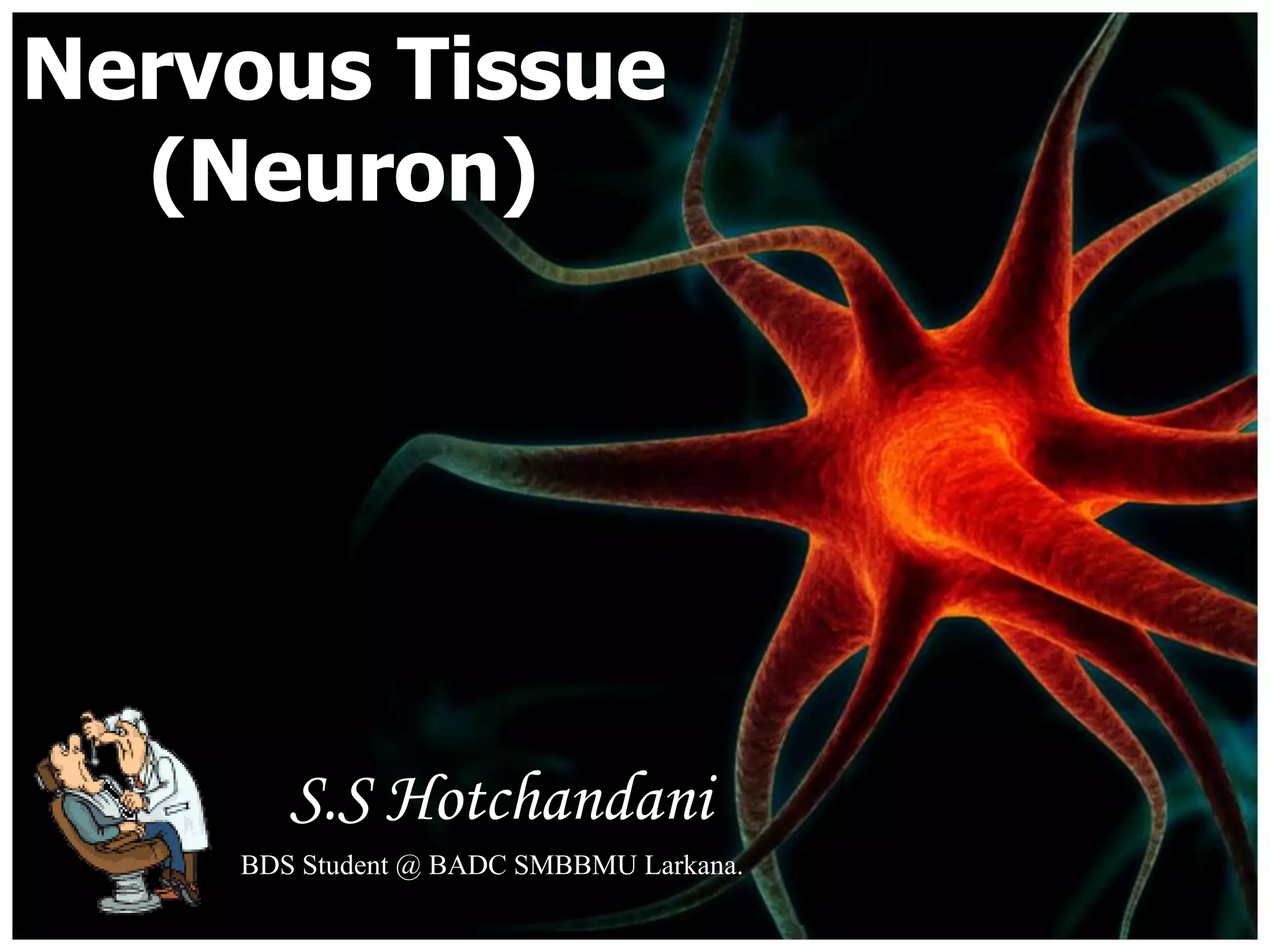
Nervous Tissue
  (Neuron)


       S.S Hotchandani
    BDS Student @ BADC SMBBMU Larkana.
Introduction
• Nervous Tissue is four of major class of tissue.
• Neuron.
• Supporting Cells.
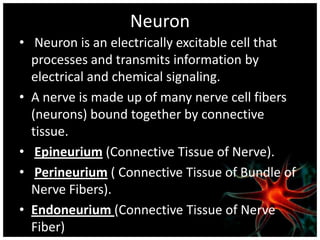
Neuron
• Neuron is an electrically excitable cell that
  processes and transmits information by
  electrical and chemical signaling.
• A nerve is made up of many nerve cell fibers
  (neurons) bound together by connective
  tissue.
• Epineurium (Connective Tissue of Nerve).
• Perineurium ( Connective Tissue of Bundle of
  Nerve Fibers).
• Endoneurium (Connective Tissue of Nerve
  Fiber)
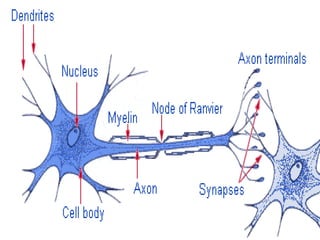
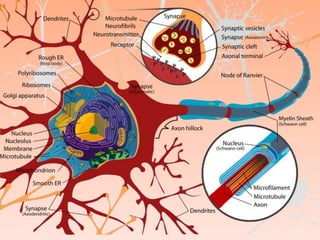
Structure of Neuron
• Cell body (soma).
  -> Nucleus.
  ->Perikaryon (Cytoplasm).
  ->Neurolema (Plasma Membrane).
• Dendrites.
• Axon.
• Synapse.
Cell Body (Soma)
• The neuronal cell body is the site where almost all
  of the metabolic and biosynthetic machinery is
  located.
• Mostly in C.N.S.
• 4 to 100 micrometers in diameter.
• The soma is the central part of the neuron. It
  contains the nucleus and Organells of the cell, and
  therefore is where most protein synthesis occurs.
• The nucleus ranges from 3 to 18 micrometers in
  diameter.
Dendrites
• A branched protoplasmic extension of a nerve cell
  that conducts nerve impulses from adjacent cells
  inward toward the cell body; a single nerve may
  possess many dendrites; typically dendrites are
  relative short.
Axon
• An axon is a special cellular extension that
  arises from the cell body at a site called the
  axon hillock.
• Some axons are enveloped by Schwan Cells
  which provide structural and metabolic
  support.
• These are classified on Basis of
  Presence/Absence of Myeline Sheath.
  -> Myelinated ( Concentric Layers of Schwan
  Cells) E.g Longer Axons
  -> Non-Myelinated ( No Concentration).
Myelin
• Myelin is a fatty covering which envelops many
  axons and permits action potentials to be
  propagated at a much greater velocity.
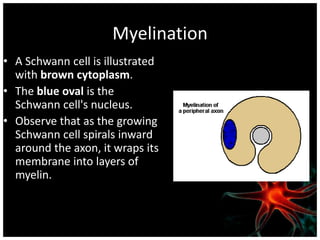
Myelination
• A Schwann cell is illustrated
  with brown cytoplasm.
• The blue oval is the
  Schwann cell's nucleus.
• Observe that as the growing
  Schwann cell spirals inward
  around the axon, it wraps its
  membrane into layers of
  myelin.
Axon (Continued)
• Many neurons have only one axon, but this axon
  may—and usually will—undergo extensive
  branching, enabling communication with many
  target cells.
• The part of the axon where it emerges from the
  soma is called the axon hillock.
• Axon Hillock the most easily-excited part of the
  neuron and the spike initiation zone for the axon.
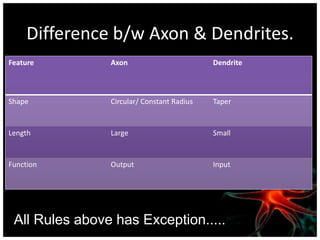
Difference b/w Axon & Dendrites.
Feature         Axon                        Dendrite


Shape           Circular/ Constant Radius   Taper


Length          Large                       Small


Function        Output                      Input


 All Rules above has Exception.....
Synapse
• A site where two neurons join and
  intercommunicate......
• The axon terminal contains synapses,
  specialized structures
  where neurotransmitter chemicals are
  released to communicate with target neurons.
Nodes of Ranvier

• Nodes of Ranvier are short fragments of
  unmyelinated segments of the axon, which
  are found periodically in between the cells
  of the myelin sheath. These nodes are areas
  where the action potential is amplified
  using a high density of sodium (Na+) ions
  and is subsequently passed along the axon.
• The points between segments of myelin are
  called nodes of Ranvier.
Support Cells
•   Schwann cells
•   Glial cells
•   Oligodendroglia
•   Astroglia or astrocytes
•   Microglia
Neuron
Neuron
Neuron

Neuron

  • 1.
    Nervous Tissue (Neuron) S.S Hotchandani BDS Student @ BADC SMBBMU Larkana.
  • 2.
    Introduction • Nervous Tissueis four of major class of tissue. • Neuron. • Supporting Cells.
  • 3.
    Neuron • Neuron isan electrically excitable cell that processes and transmits information by electrical and chemical signaling. • A nerve is made up of many nerve cell fibers (neurons) bound together by connective tissue. • Epineurium (Connective Tissue of Nerve). • Perineurium ( Connective Tissue of Bundle of Nerve Fibers). • Endoneurium (Connective Tissue of Nerve Fiber)
  • 4.
    Structure of Neuron •Cell body (soma). -> Nucleus. ->Perikaryon (Cytoplasm). ->Neurolema (Plasma Membrane). • Dendrites. • Axon. • Synapse.
  • 5.
    Cell Body (Soma) •The neuronal cell body is the site where almost all of the metabolic and biosynthetic machinery is located. • Mostly in C.N.S. • 4 to 100 micrometers in diameter. • The soma is the central part of the neuron. It contains the nucleus and Organells of the cell, and therefore is where most protein synthesis occurs. • The nucleus ranges from 3 to 18 micrometers in diameter.
  • 6.
    Dendrites • A branchedprotoplasmic extension of a nerve cell that conducts nerve impulses from adjacent cells inward toward the cell body; a single nerve may possess many dendrites; typically dendrites are relative short.
  • 7.
    Axon • An axonis a special cellular extension that arises from the cell body at a site called the axon hillock. • Some axons are enveloped by Schwan Cells which provide structural and metabolic support. • These are classified on Basis of Presence/Absence of Myeline Sheath. -> Myelinated ( Concentric Layers of Schwan Cells) E.g Longer Axons -> Non-Myelinated ( No Concentration).
  • 8.
    Myelin • Myelin isa fatty covering which envelops many axons and permits action potentials to be propagated at a much greater velocity.
  • 9.
    Myelination • A Schwanncell is illustrated with brown cytoplasm. • The blue oval is the Schwann cell's nucleus. • Observe that as the growing Schwann cell spirals inward around the axon, it wraps its membrane into layers of myelin.
  • 10.
    Axon (Continued) • Manyneurons have only one axon, but this axon may—and usually will—undergo extensive branching, enabling communication with many target cells. • The part of the axon where it emerges from the soma is called the axon hillock. • Axon Hillock the most easily-excited part of the neuron and the spike initiation zone for the axon.
  • 11.
    Difference b/w Axon& Dendrites. Feature Axon Dendrite Shape Circular/ Constant Radius Taper Length Large Small Function Output Input All Rules above has Exception.....
  • 12.
    Synapse • A sitewhere two neurons join and intercommunicate...... • The axon terminal contains synapses, specialized structures where neurotransmitter chemicals are released to communicate with target neurons.
  • 13.
    Nodes of Ranvier •Nodes of Ranvier are short fragments of unmyelinated segments of the axon, which are found periodically in between the cells of the myelin sheath. These nodes are areas where the action potential is amplified using a high density of sodium (Na+) ions and is subsequently passed along the axon. • The points between segments of myelin are called nodes of Ranvier.
  • 14.
    Support Cells • Schwann cells • Glial cells • Oligodendroglia • Astroglia or astrocytes • Microglia