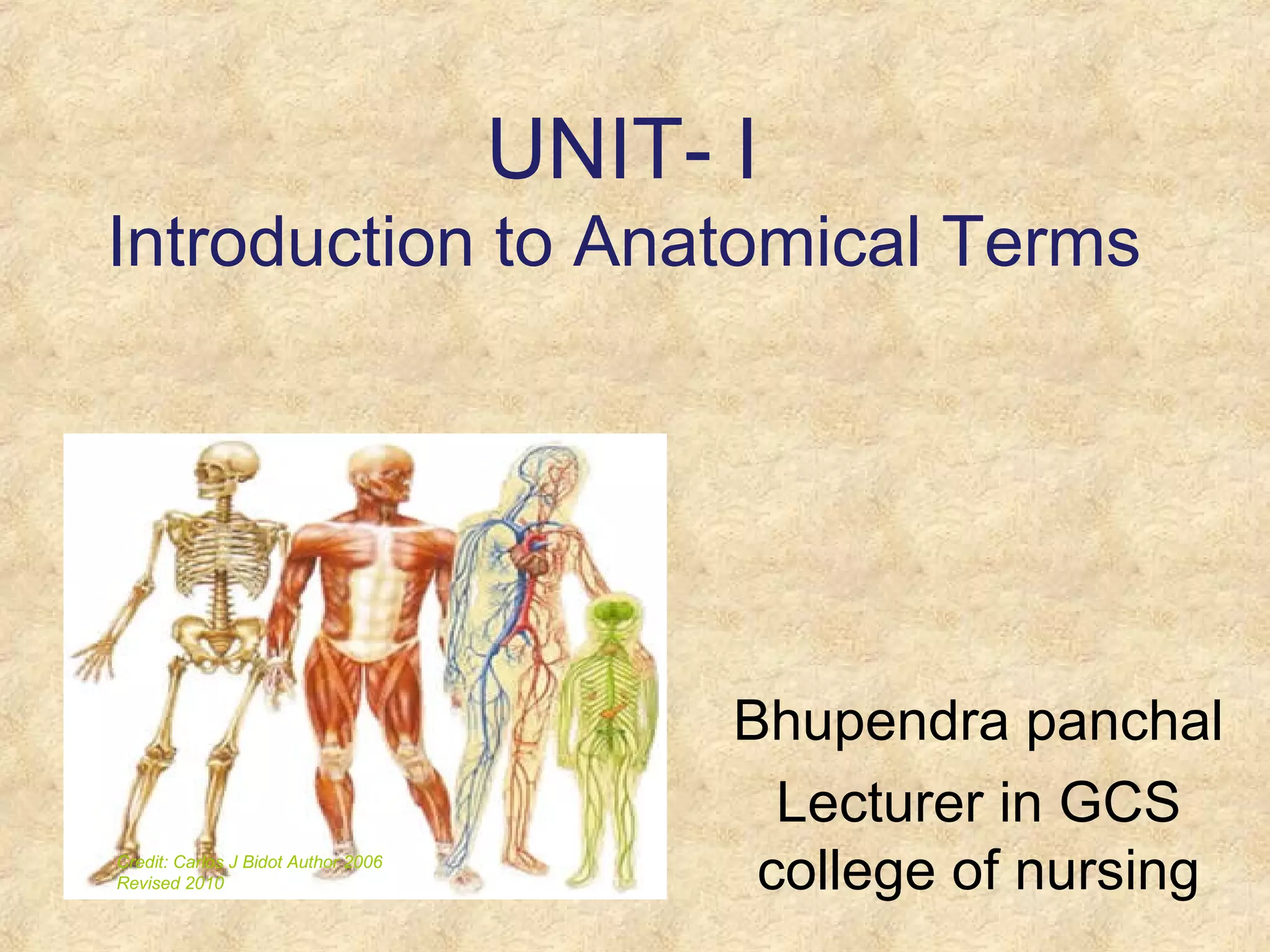
UNIT- I
Introduction to Anatomical Terms
Bhupendra panchal
Lecturer in GCS
college of nursingCredit: Carlos J Bidot Author 2006
Revised 2010
Overview of Anatomy and Physiology
• AnatomyAnatomy – the study of the structure of
body parts and their relationships to one
another
– Gross or macroscopic
– Microscopic
– Developmental
• PhysiologyPhysiology – the study of the function of the
body’s structural machinery
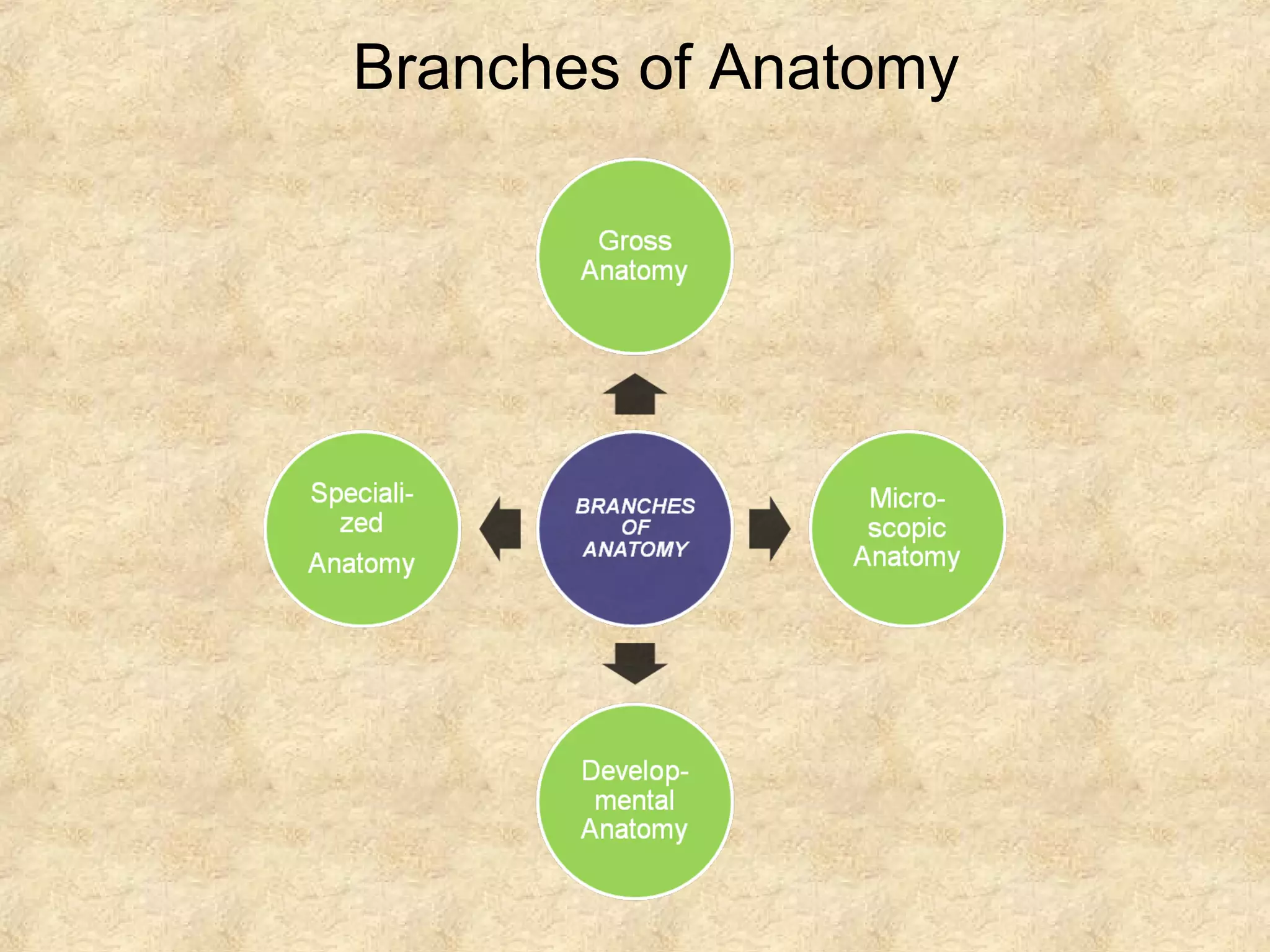
Branches of Anatomy
Gross / Cadaveric Anatomy
• RegionalRegional – all structures in one part of the
body (such as the abdomen or leg)
• SystemicSystemic – gross anatomy of the body
studied by system
• SurfaceSurface – study of internal structures as
they relate to the overlying skin
Microscopic Anatomy
• CytologyCytology – study of the cell
• HistologyHistology – study of tissues
Developmental Anatomy
• Traces structural changes throughout life
• EmbryologyEmbryology – study of developmental
changes of the body before birth
Specialized Branches of
Anatomy
• Pathological / clinical anatomyPathological / clinical anatomy– study of
structural changes caused by disease
• Radiographic anatomyRadiographic anatomy – study of
internal structures visualized by X ray
• Comparative anatomyComparative anatomy
• Experimental anatomyExperimental anatomy
• Physical AnthropologyPhysical Anthropology
• GeneticsGenetics
Physiology
• Considers the operation of specificConsiders the operation of specific
organ systemsorgan systems
– Renal – kidney function
– Neurophysiology – workings of the nervous
system
– Cardiovascular – operation of the heart and
blood vessels
• Focuses on the functions of the body,Focuses on the functions of the body,
often at the cellular or molecular leveloften at the cellular or molecular level
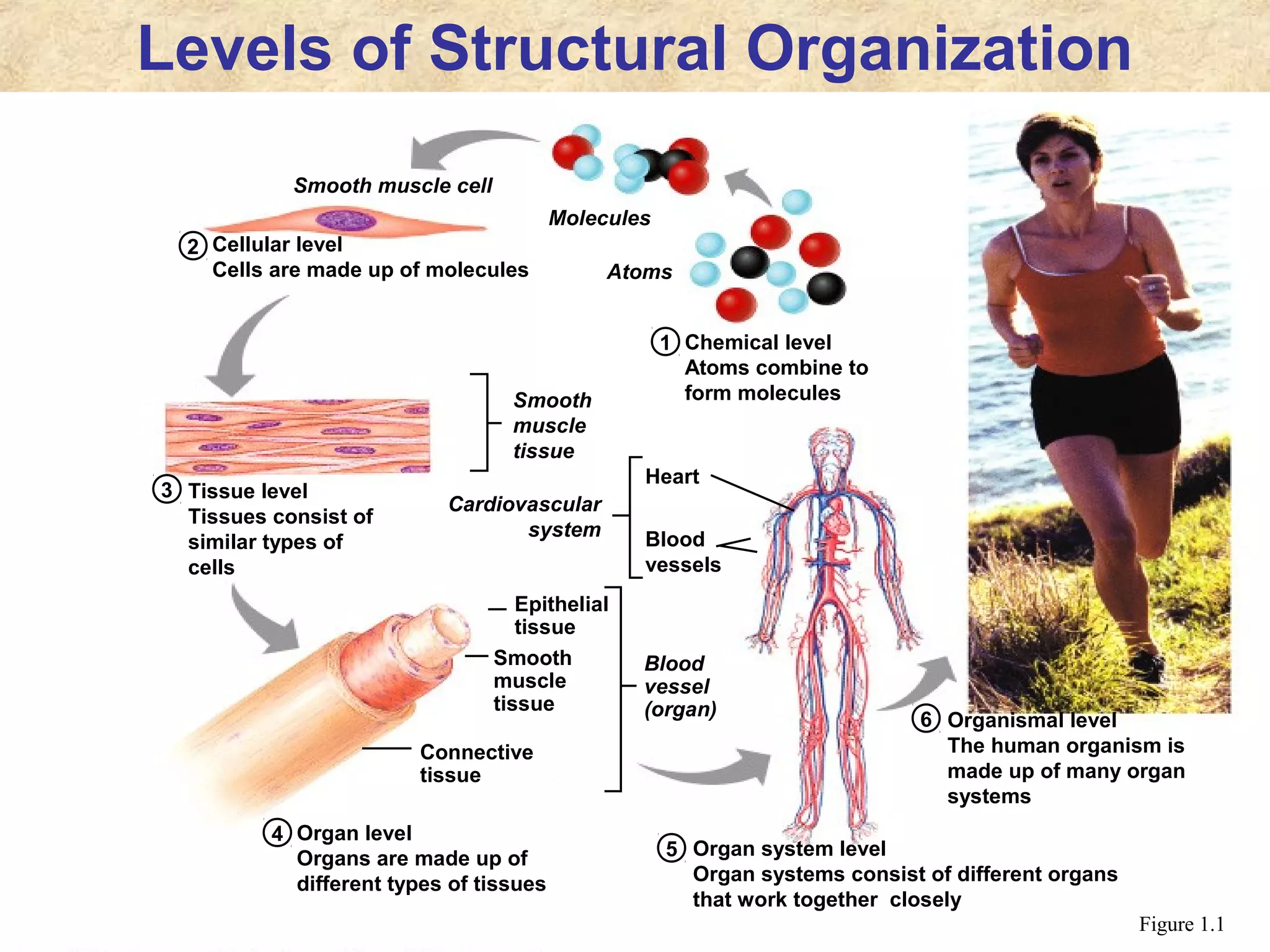
Chemical level
Atoms combine to
form molecules
1
2
3
4
Cellular level
Cells are made up of molecules
Tissue level
Tissues consist of
similar types of
cells
5 Organ system level
Organ systems consist of different organs
that work together closely
Organ level
Organs are made up of
different types of tissues
6 Organismal level
The human organism is
made up of many organ
systems
Atoms
Molecules
Smooth muscle cell
Smooth
muscle
tissue
Connective
tissue
Smooth
muscle
tissue
Epithelial
tissue
Blood
vessel
(organ)
Heart
Blood
vessels
Cardiovascular
system
Levels of Structural Organization
Figure 1.1
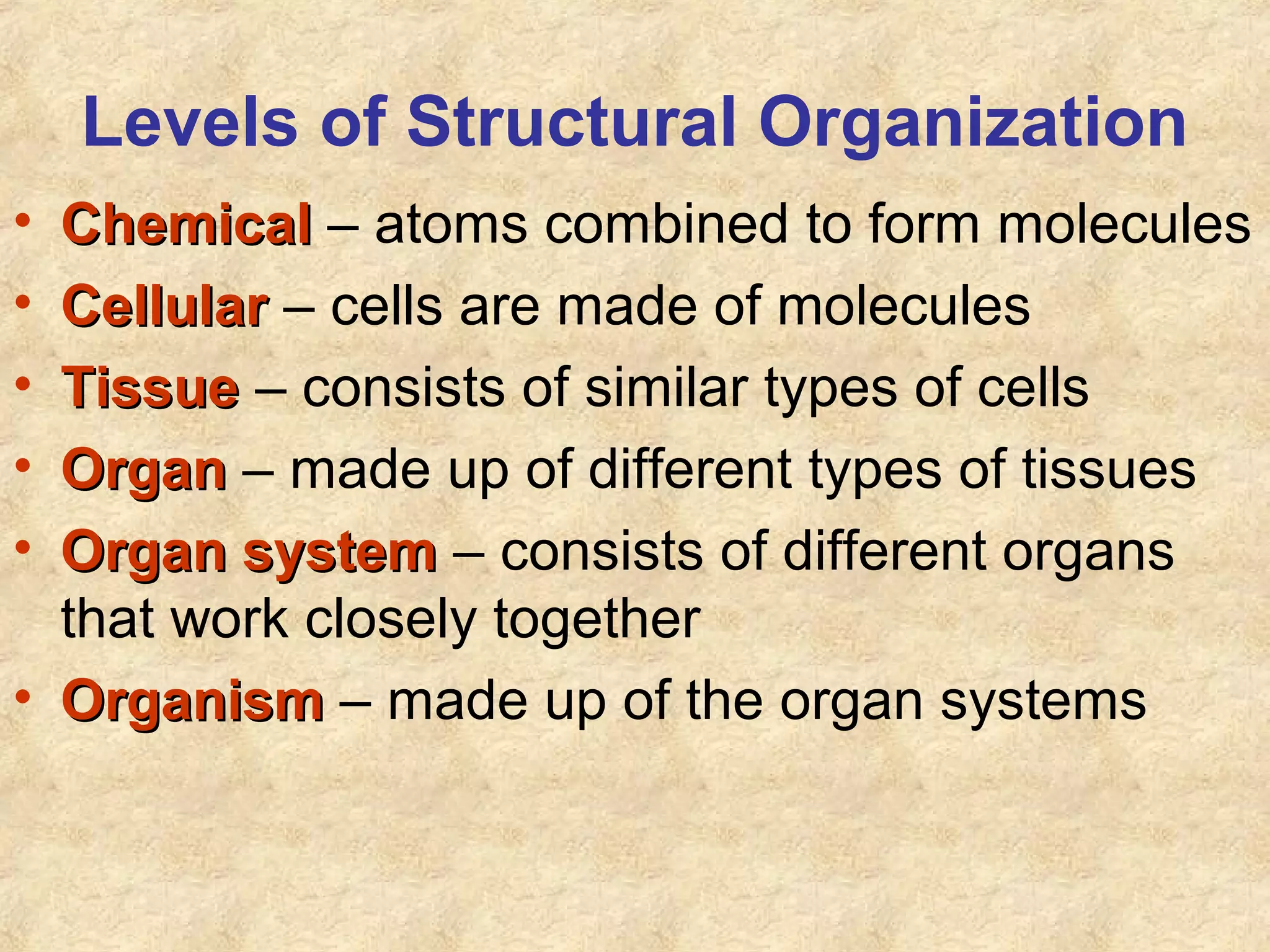
Levels of Structural Organization
• ChemicalChemical – atoms combined to form molecules
• CellularCellular – cells are made of molecules
• TissueTissue – consists of similar types of cells
• OrganOrgan – made up of different types of tissues
• Organ systemOrgan system – consists of different organs
that work closely together
• OrganismOrganism – made up of the organ systems
Terms Used In Anatomy
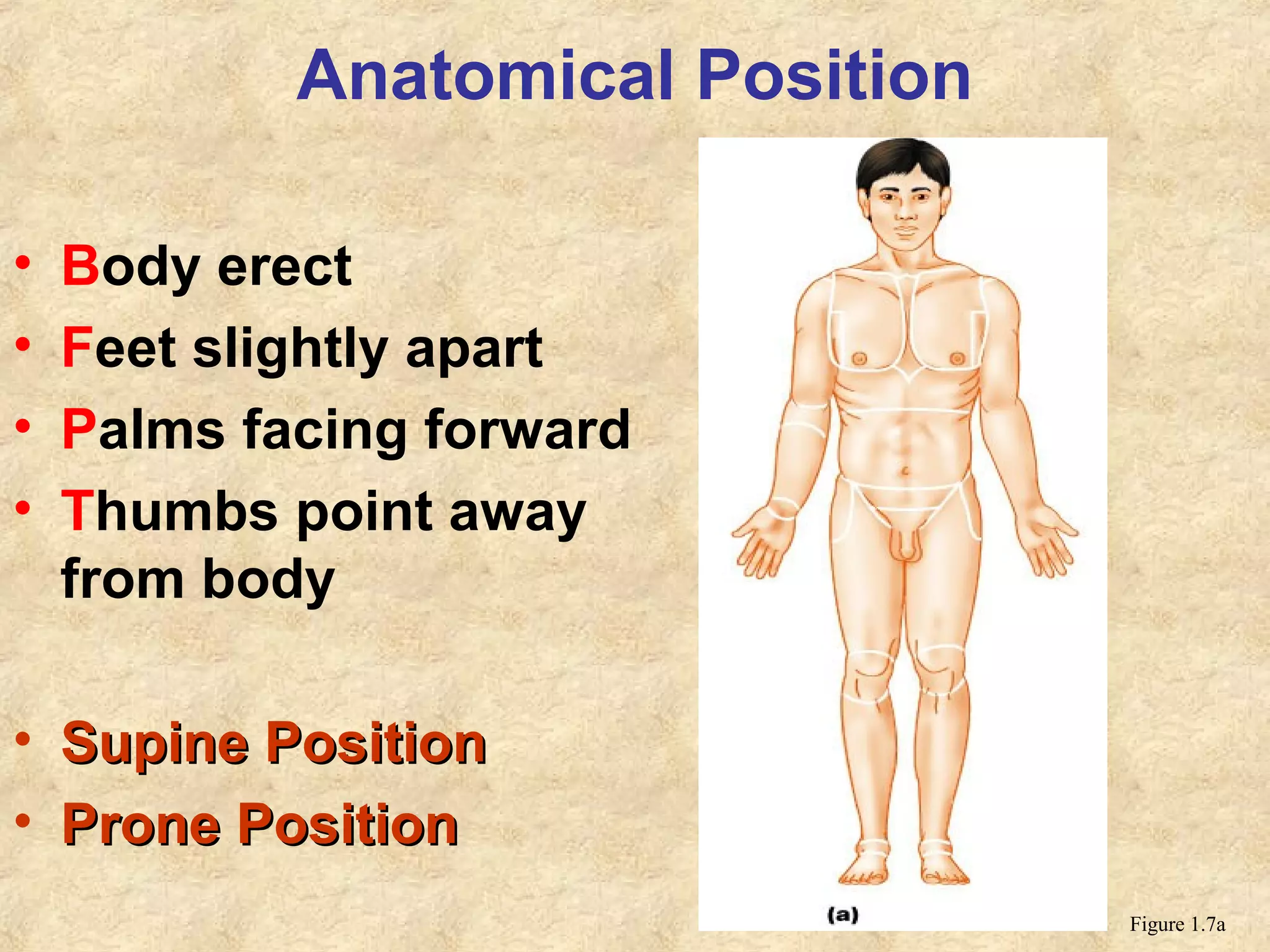
Anatomical Position
• Body erect
• Feet slightly apart
• Palms facing forward
• Thumbs point away
from body
• Supine PositionSupine Position
• Prone PositionProne Position
Figure 1.7a
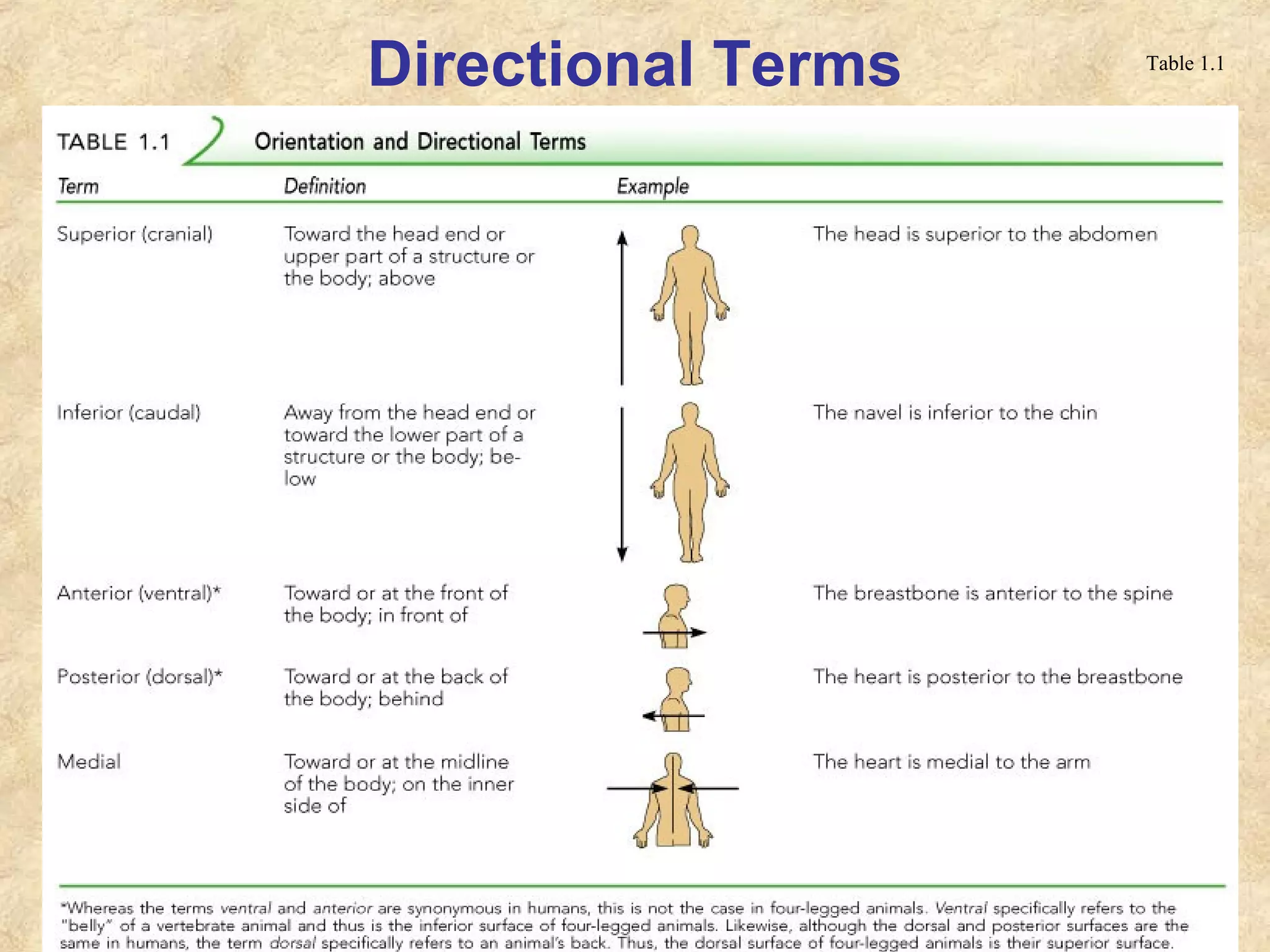
Directional Terms
• Superior and inferiorSuperior and inferior – toward and away
from the head, respectively
• Anterior and posteriorAnterior and posterior – toward the front
and back of the body
• Medial, lateral, and intermediateMedial, lateral, and intermediate –
toward the midline, away from the midline,
and between a more medial and lateral
structure
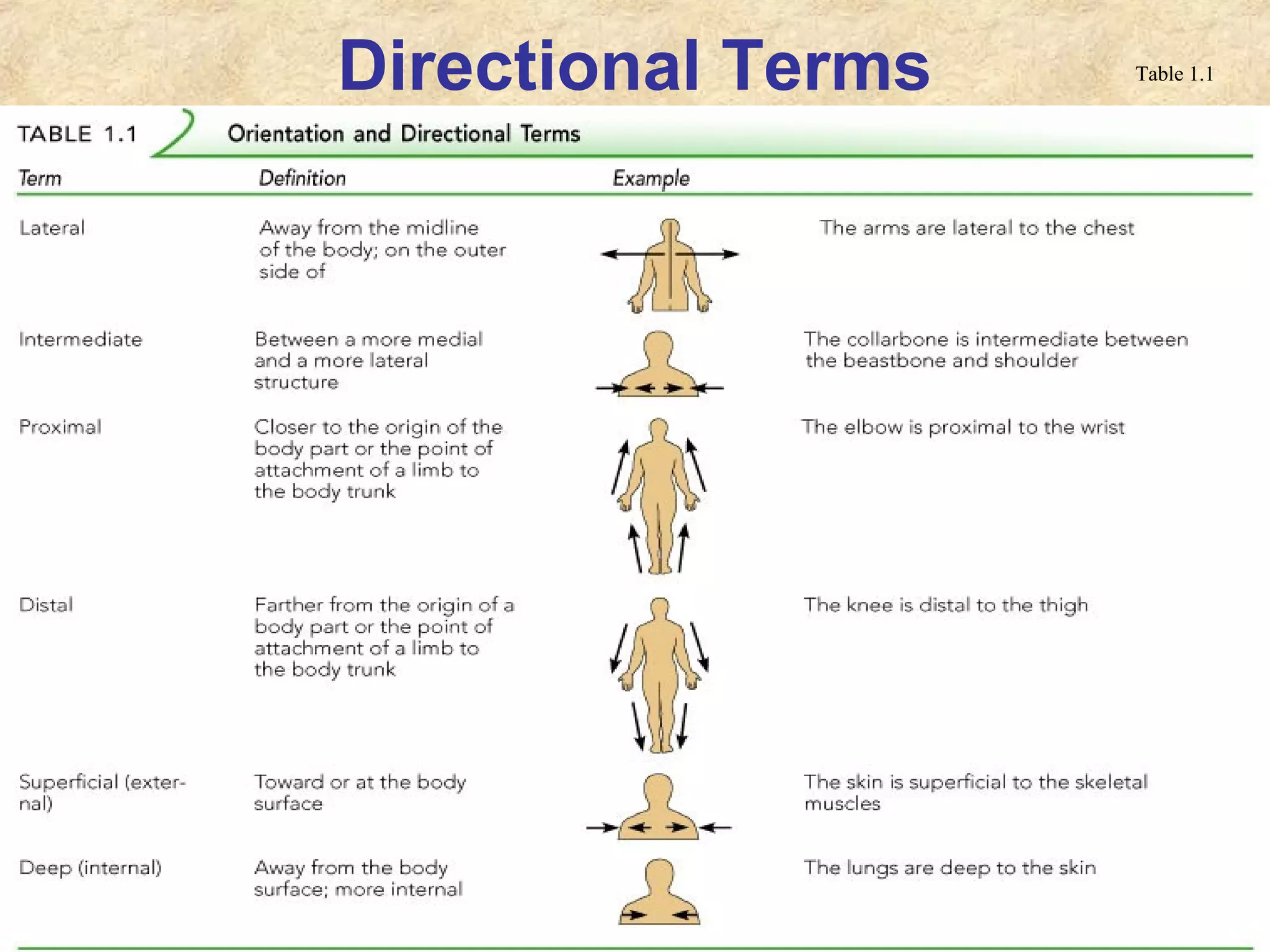
Directional Terms
• Proximal and distalProximal and distal – closer to and
farther from the origin of the body
• Superficial and deepSuperficial and deep – toward and away
from the body surface
Directional Terms Table 1.1
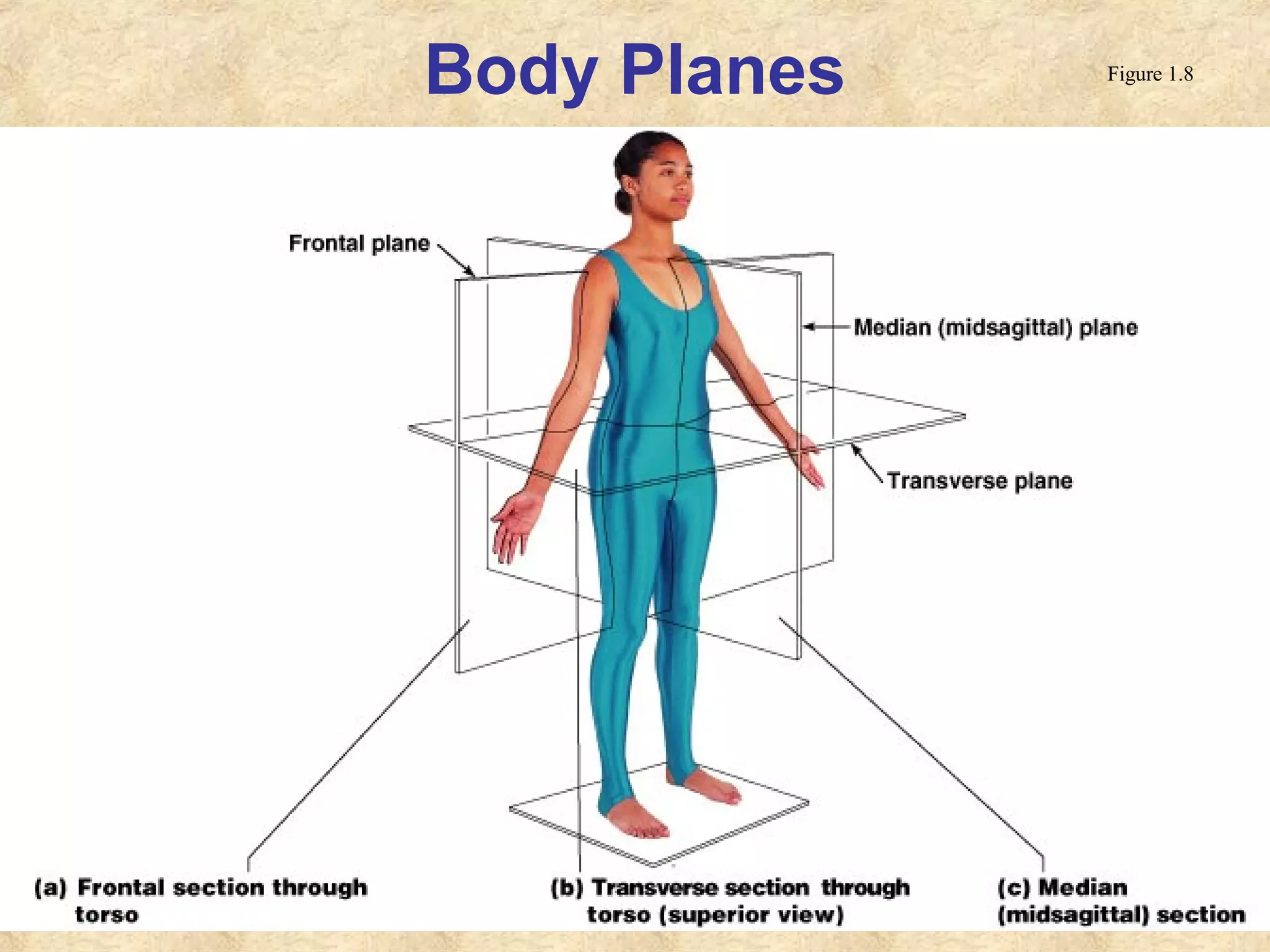
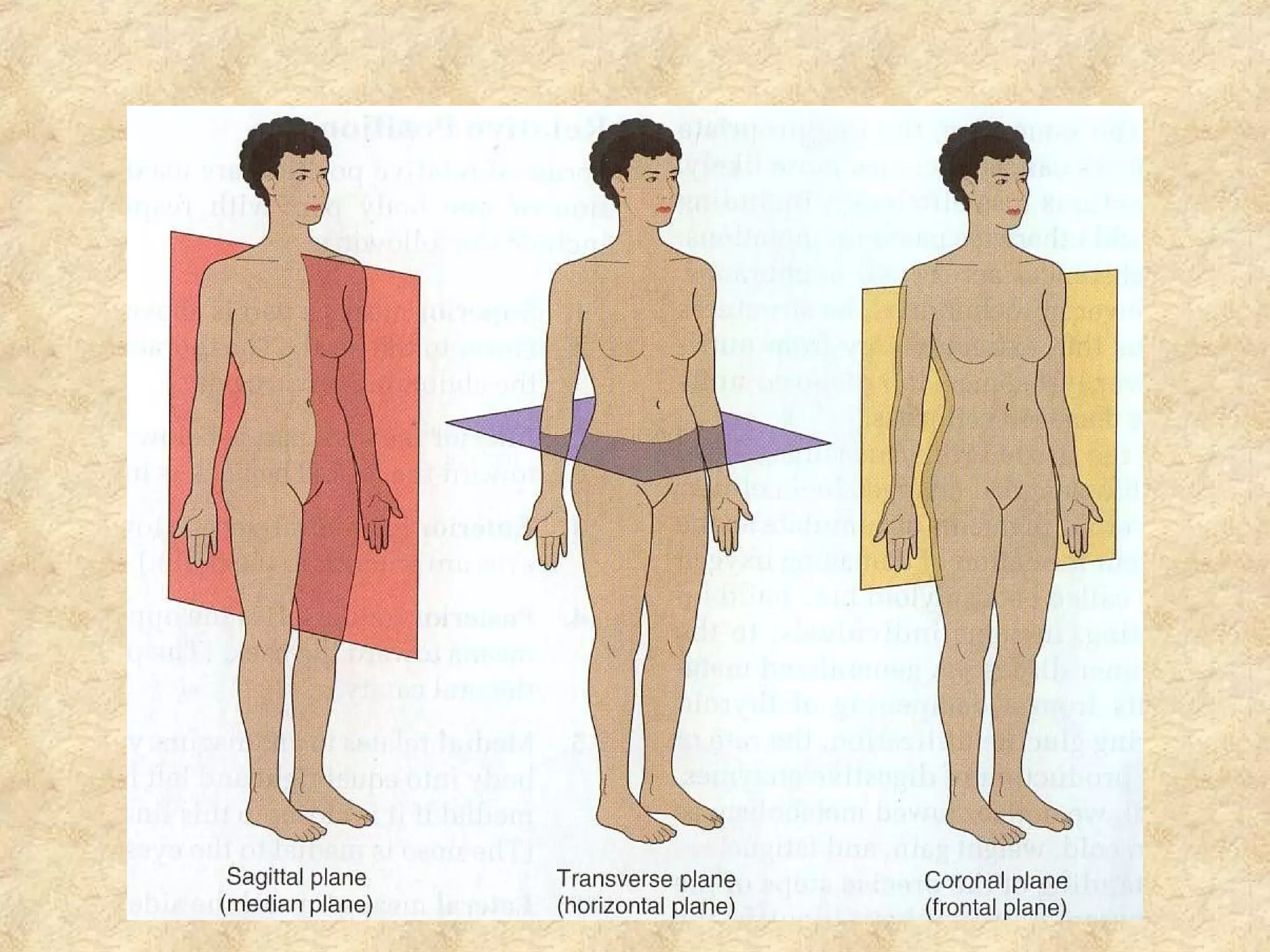
Body Planes
• SagittalSagittal – divides the body into right and
left parts
• Midsagittal or medialMidsagittal or medial – sagittal plane that
lies on the midline
• Frontal or coronalFrontal or coronal – divides the body into
anterior and posterior parts
• Transverse or horizontalTransverse or horizontal (cross section)
– divides the body into superior and
inferior parts
• Oblique sectionOblique section – cuts made diagonally
Body Planes Figure 1.8
21
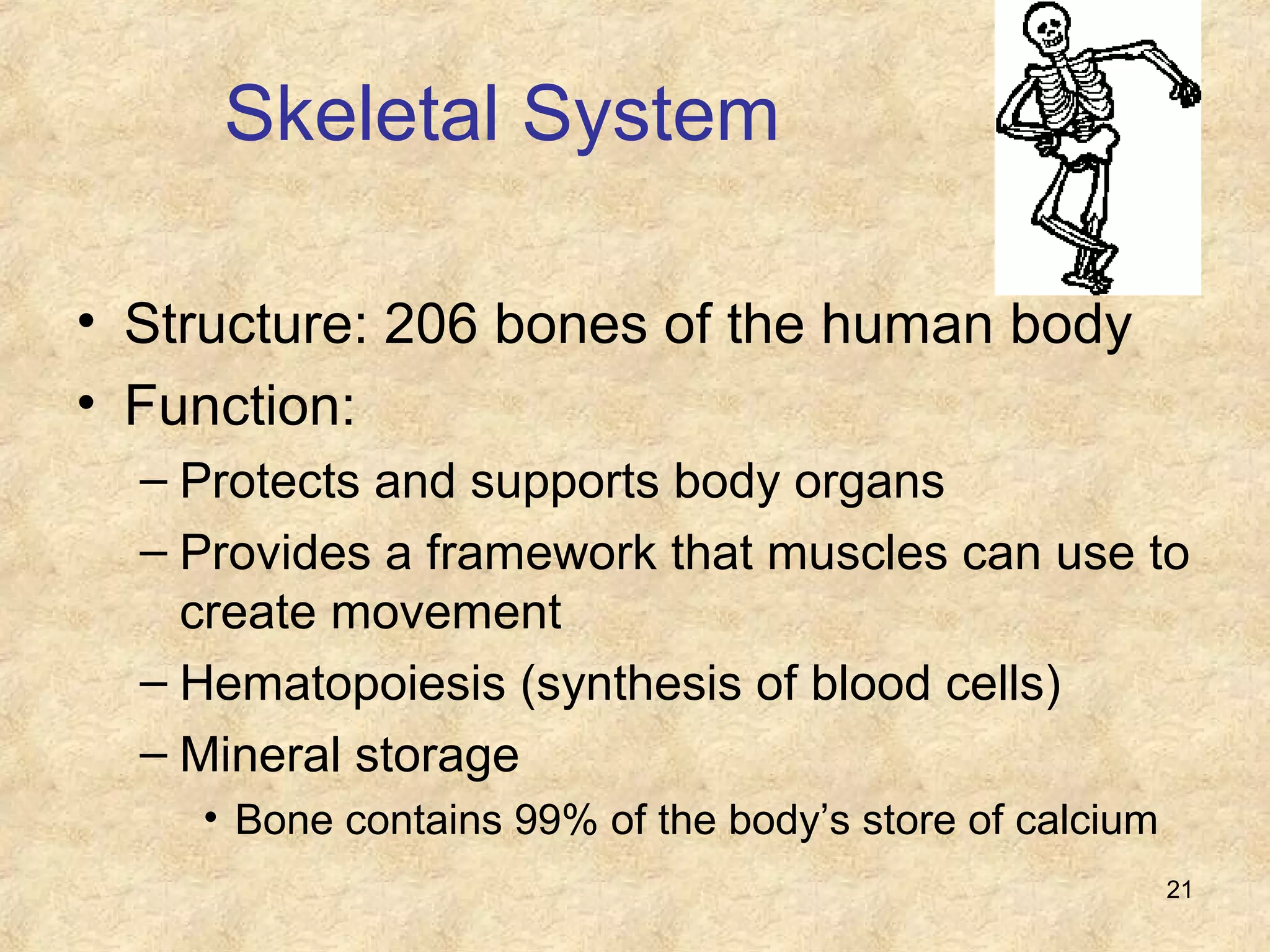
Skeletal System
• Structure: 206 bones of the human body
• Function:
– Protects and supports body organs
– Provides a framework that muscles can use to
create movement
– Hematopoiesis (synthesis of blood cells)
– Mineral storage
• Bone contains 99% of the body’s store of calcium
22
Muscular System
• Structures: The 600+ muscles of the body
• Function:
– Locomotion
– Manipulation of the environment
– Maintaining posture
– Thermogenesis (generation of heat)
23
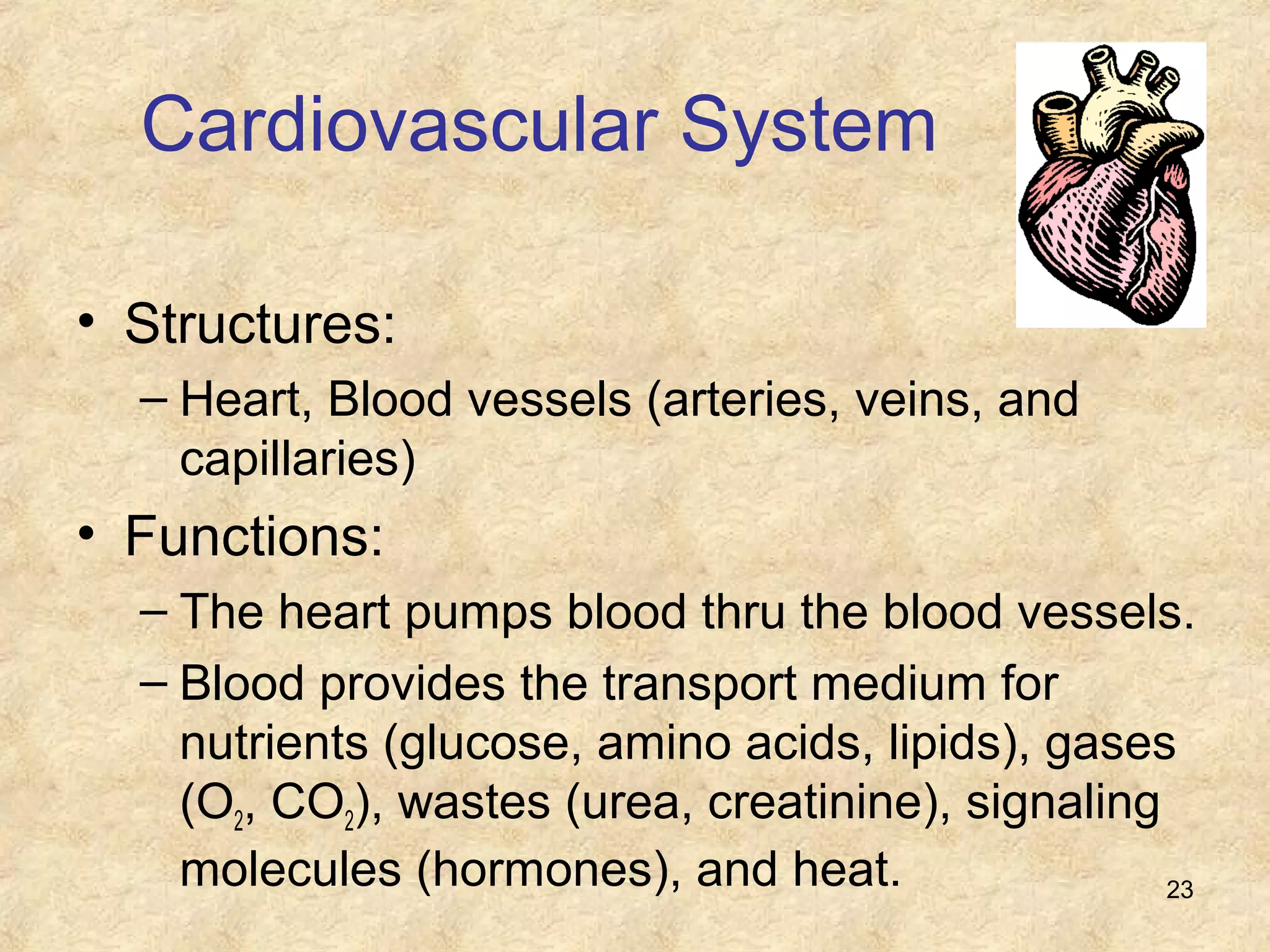
Cardiovascular System
• Structures:
– Heart, Blood vessels (arteries, veins, and
capillaries)
• Functions:
– The heart pumps blood thru the blood vessels.
– Blood provides the transport medium for
nutrients (glucose, amino acids, lipids), gases
(O2, CO2), wastes (urea, creatinine), signaling
molecules (hormones), and heat.
24
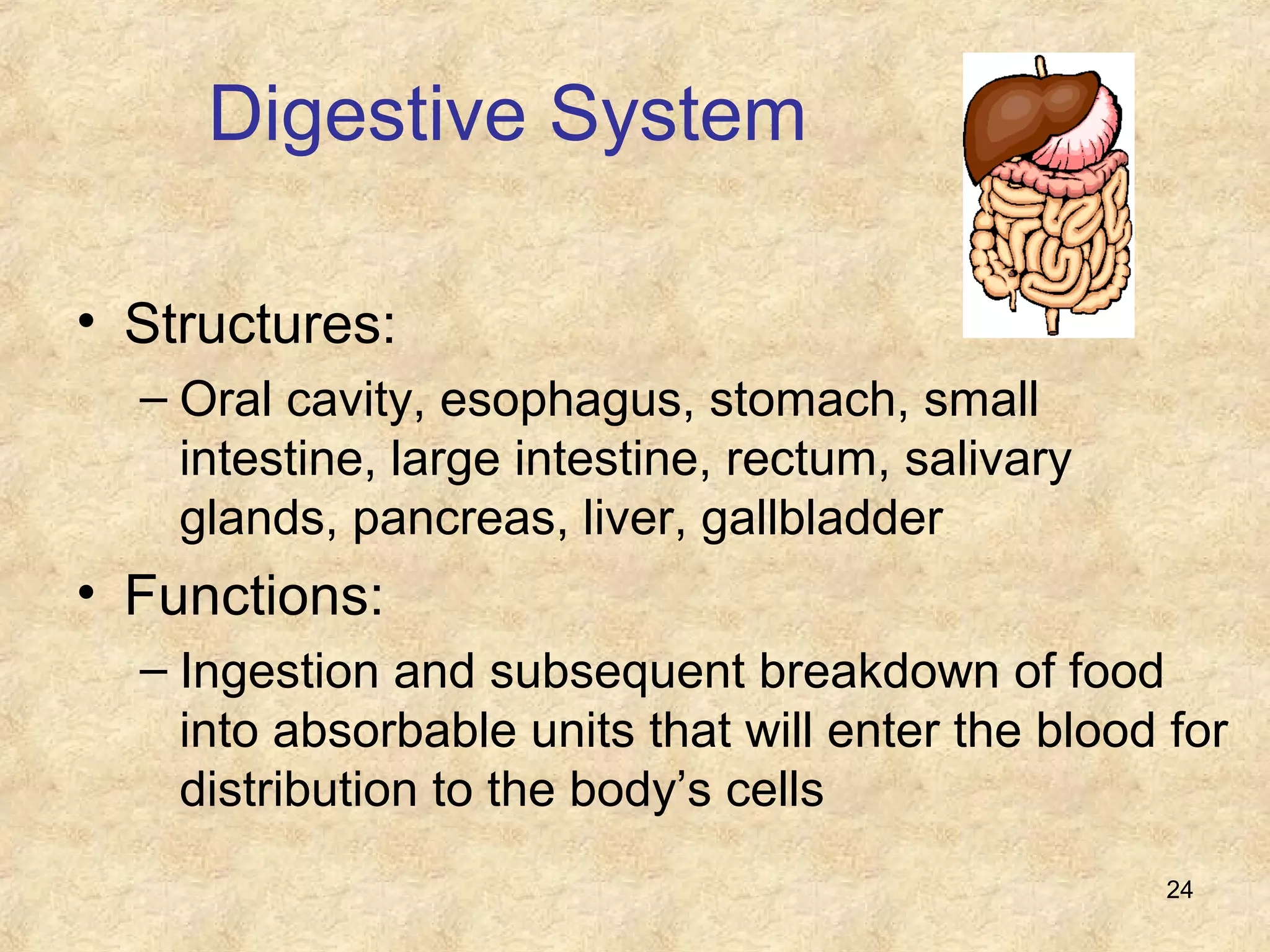
Digestive System
• Structures:
– Oral cavity, esophagus, stomach, small
intestine, large intestine, rectum, salivary
glands, pancreas, liver, gallbladder
• Functions:
– Ingestion and subsequent breakdown of food
into absorbable units that will enter the blood for
distribution to the body’s cells
25
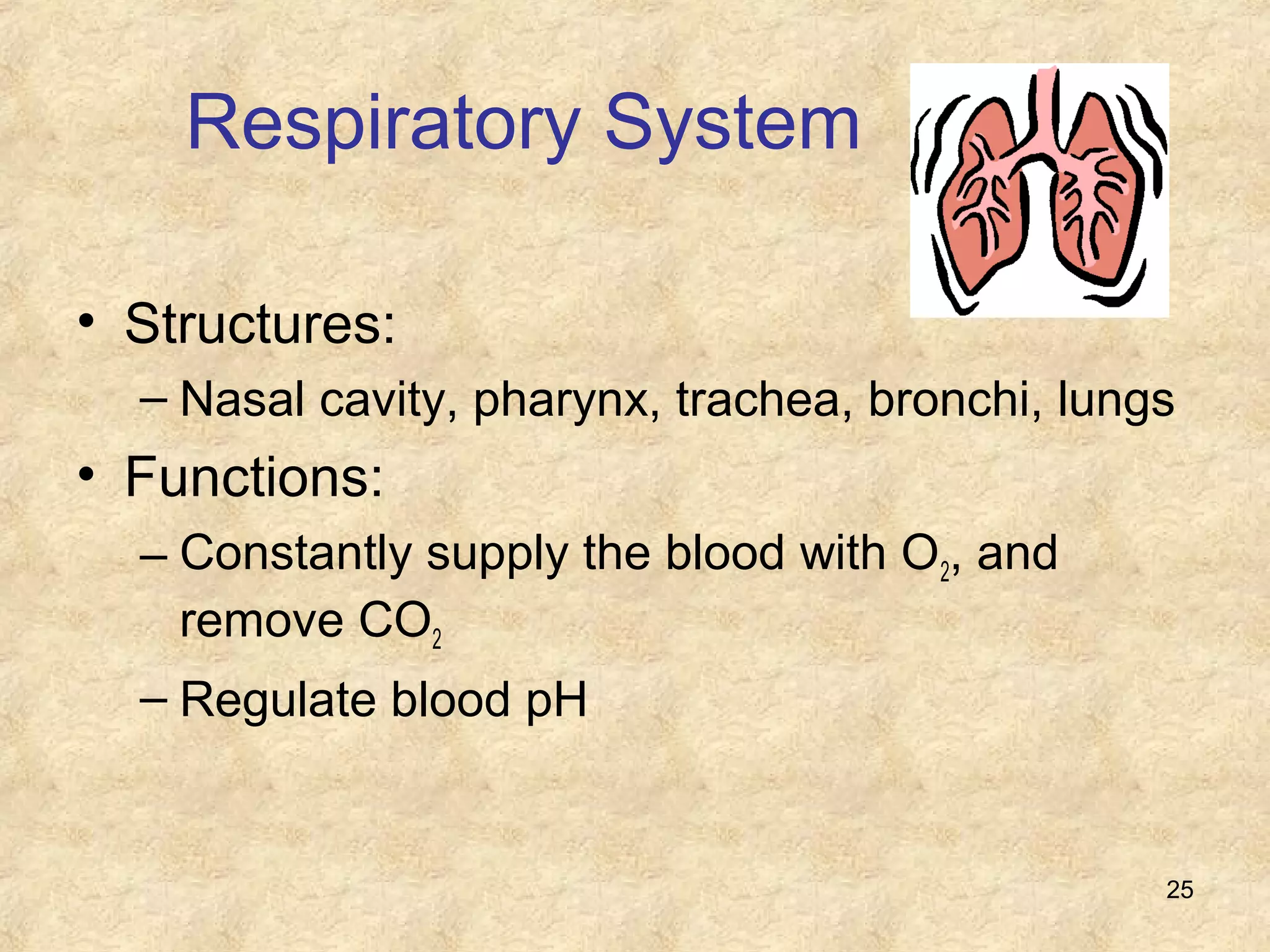
Respiratory System
• Structures:
– Nasal cavity, pharynx, trachea, bronchi, lungs
• Functions:
– Constantly supply the blood with O2, and
remove CO2
– Regulate blood pH
26
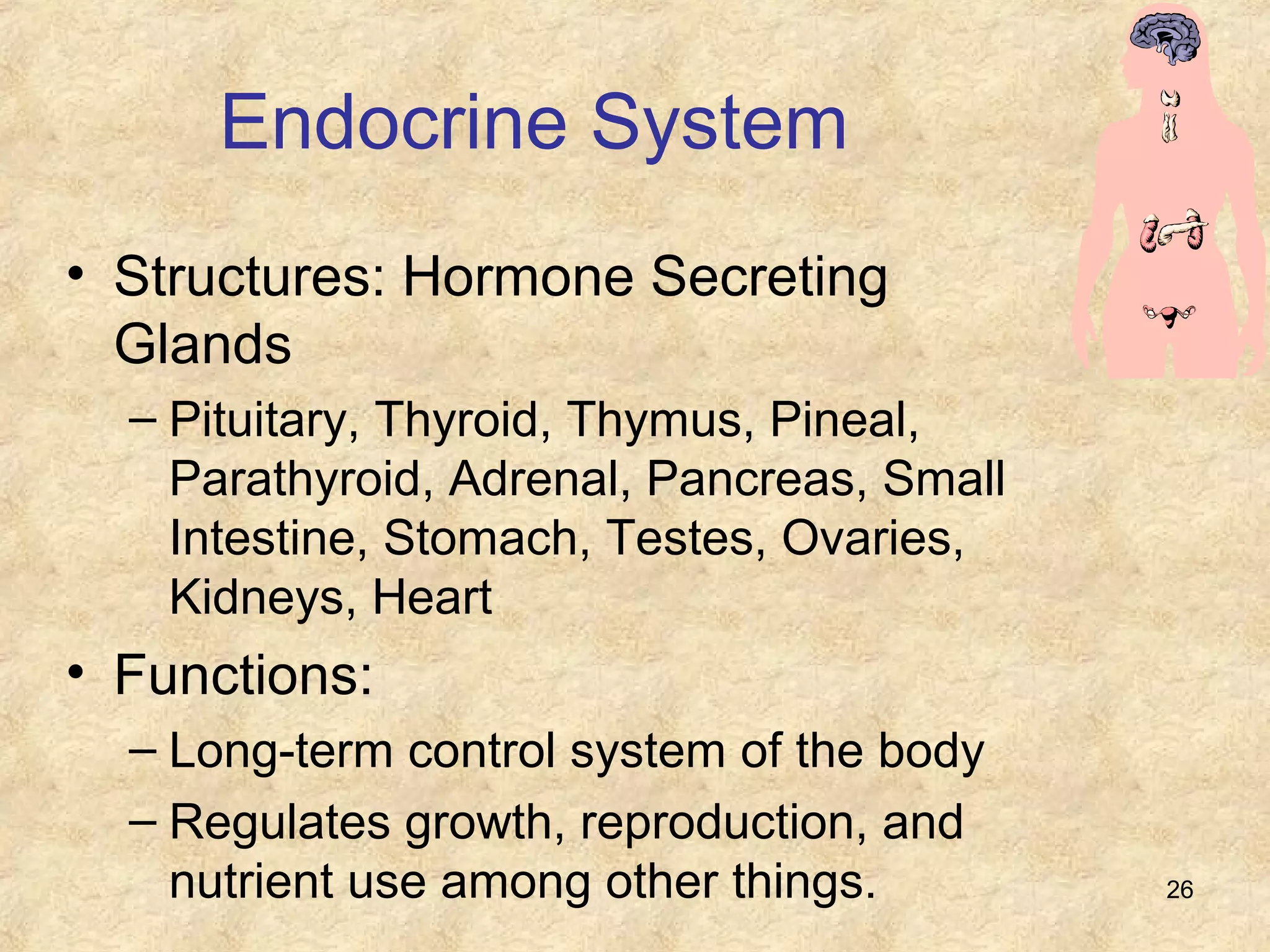
Endocrine System
• Structures: Hormone Secreting
Glands
– Pituitary, Thyroid, Thymus, Pineal,
Parathyroid, Adrenal, Pancreas, Small
Intestine, Stomach, Testes, Ovaries,
Kidneys, Heart
• Functions:
– Long-term control system of the body
– Regulates growth, reproduction, and
nutrient use among other things.
27
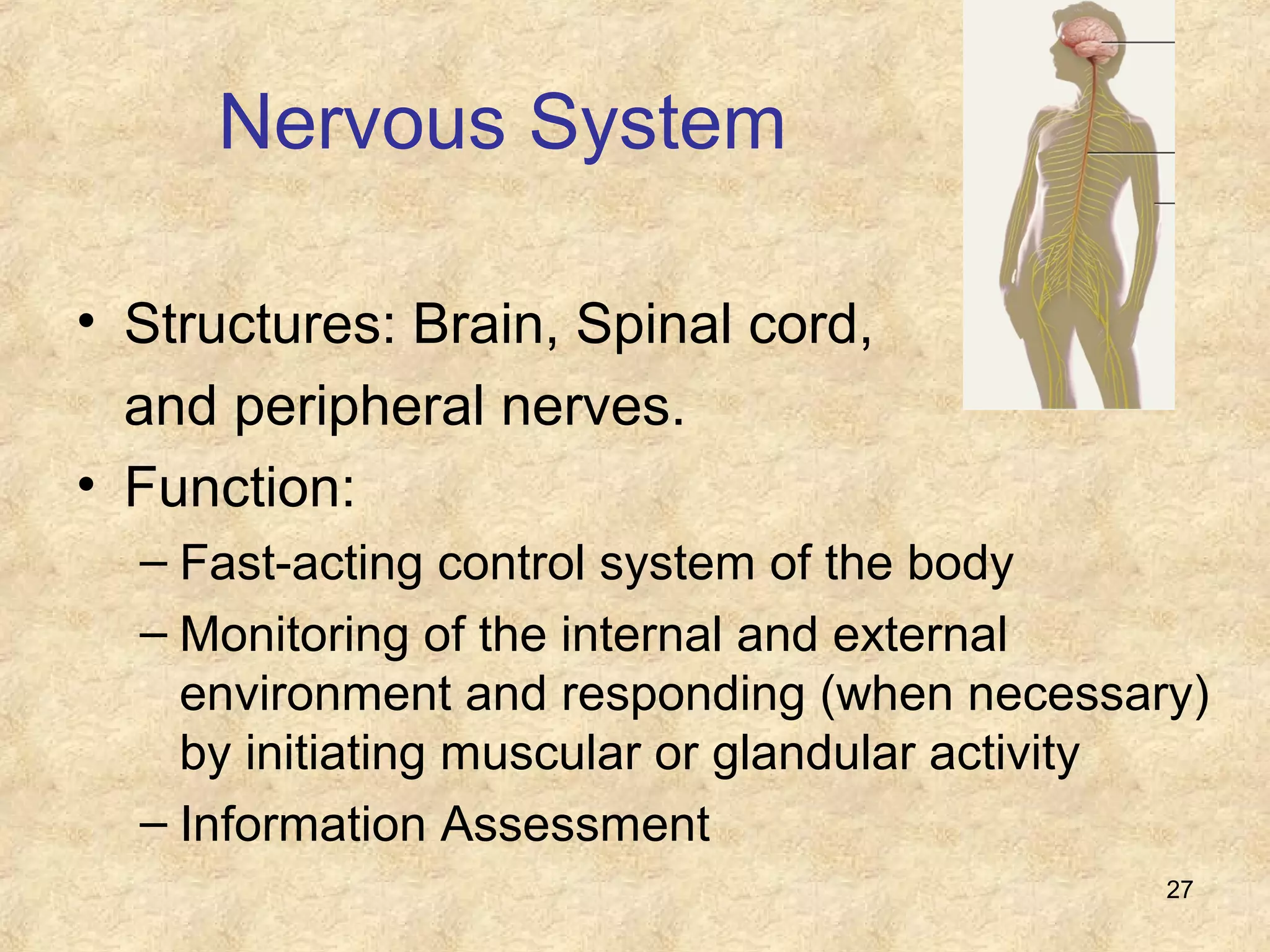
Nervous System
• Structures: Brain, Spinal cord,
and peripheral nerves.
• Function:
– Fast-acting control system of the body
– Monitoring of the internal and external
environment and responding (when necessary)
by initiating muscular or glandular activity
– Information Assessment
28
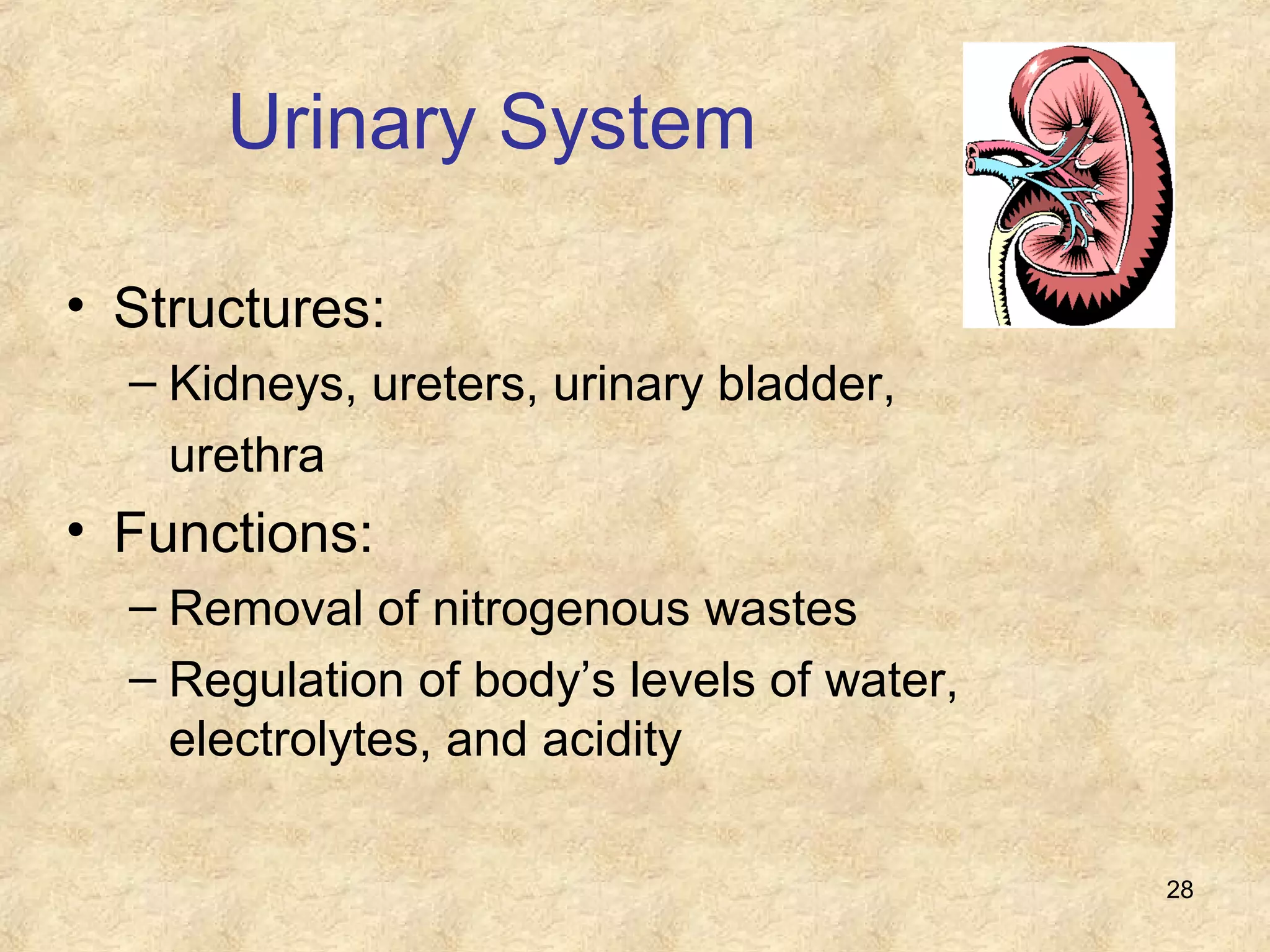
Urinary System
• Structures:
– Kidneys, ureters, urinary bladder,
urethra
• Functions:
– Removal of nitrogenous wastes
– Regulation of body’s levels of water,
electrolytes, and acidity
30
Reproductive System
• Structures:
– Male:
• Testes, scrotum, epididymis, vas deferens, urethra,
prostate gland, seminal vesicles, penis
– Female:
• Ovary, uterine tube, uterus, cervix, vagina,
mammary glands
• Functions:
– Making Babies
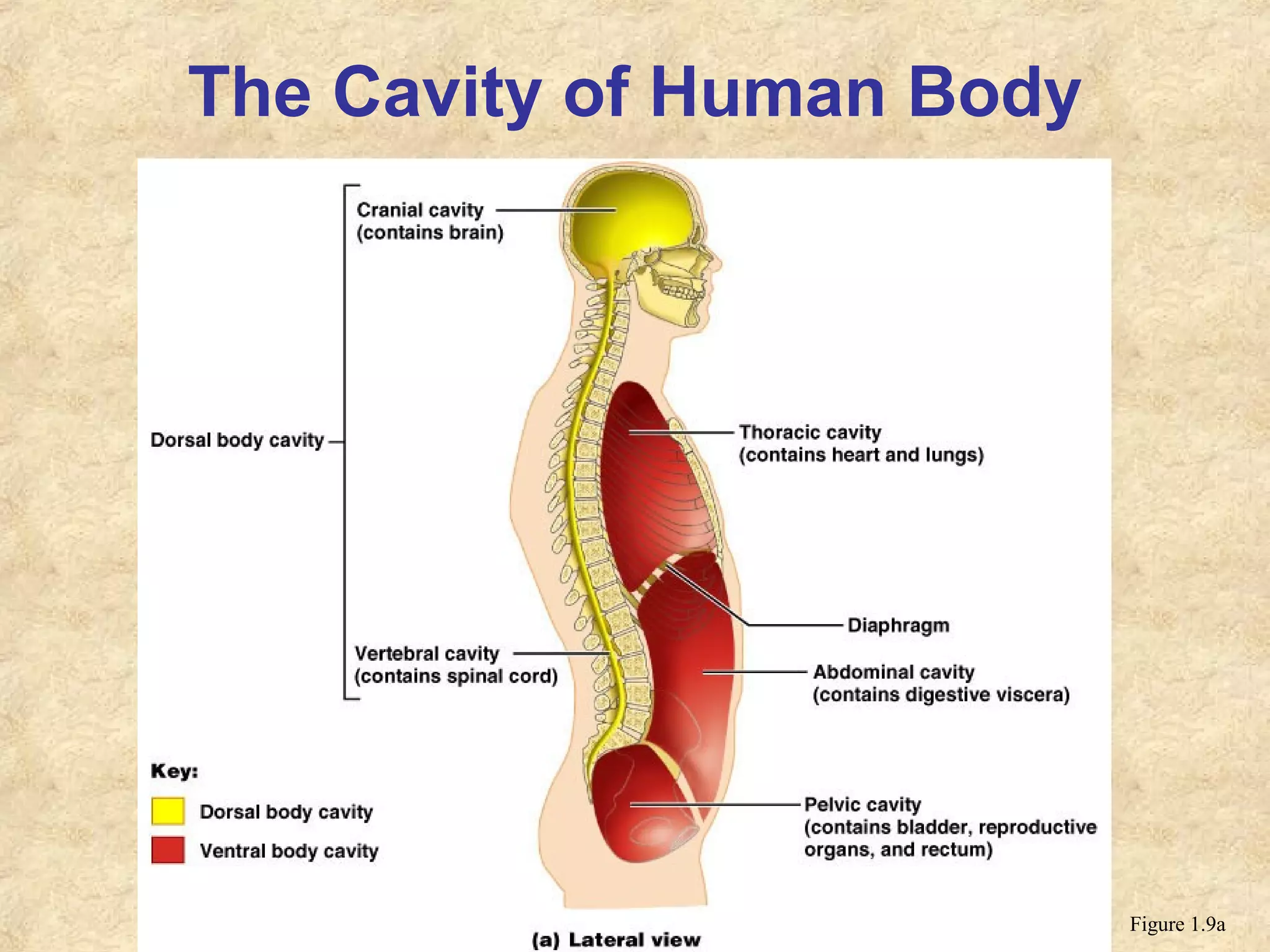
The Cavity of Human Body
Figure 1.9a
Body Cavities
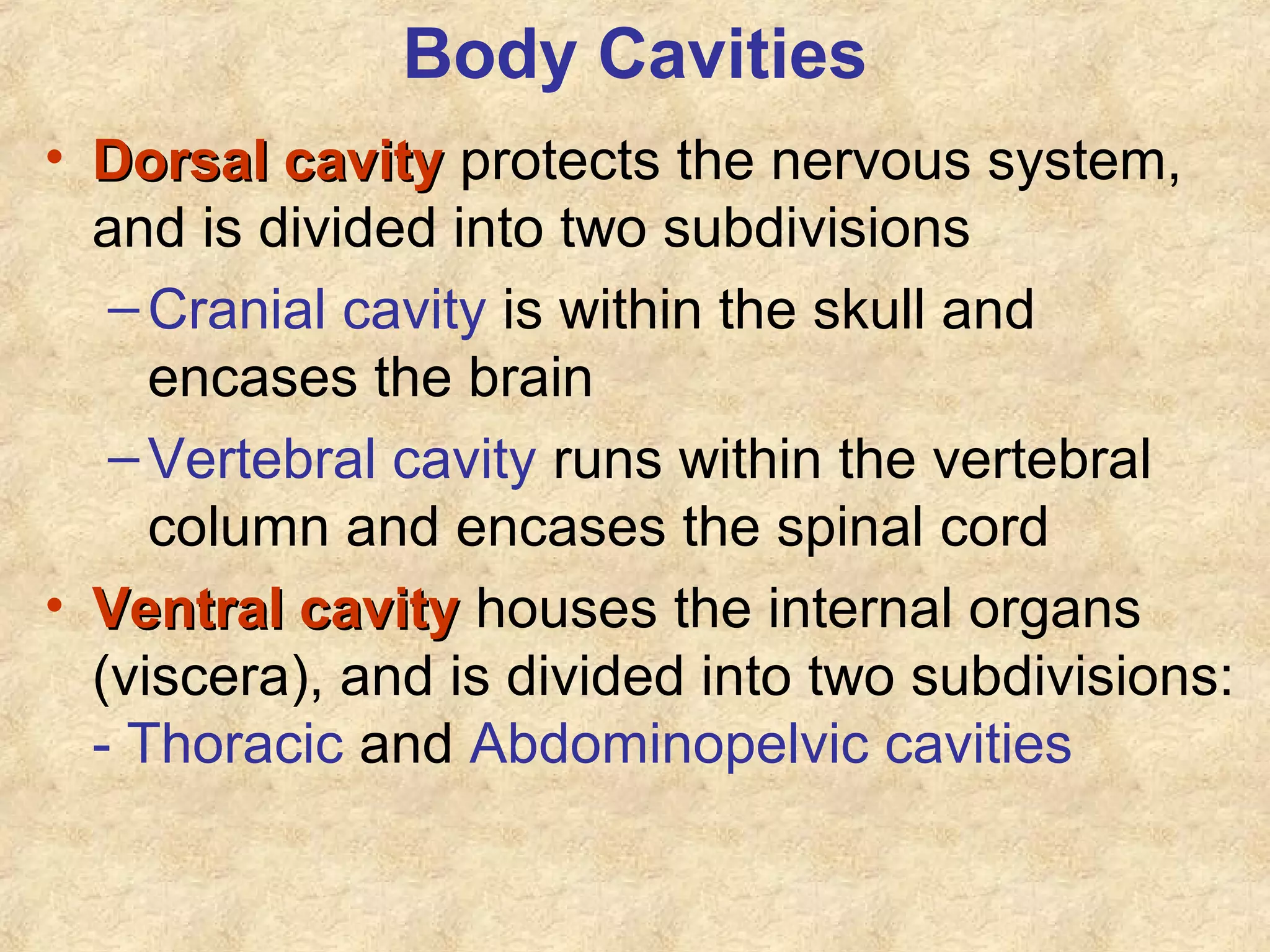
• Dorsal cavityDorsal cavity protects the nervous system,
and is divided into two subdivisions
–Cranial cavity is within the skull and
encases the brain
–Vertebral cavity runs within the vertebral
column and encases the spinal cord
• Ventral cavityVentral cavity houses the internal organs
(viscera), and is divided into two subdivisions:
- Thoracic and Abdominopelvic cavities
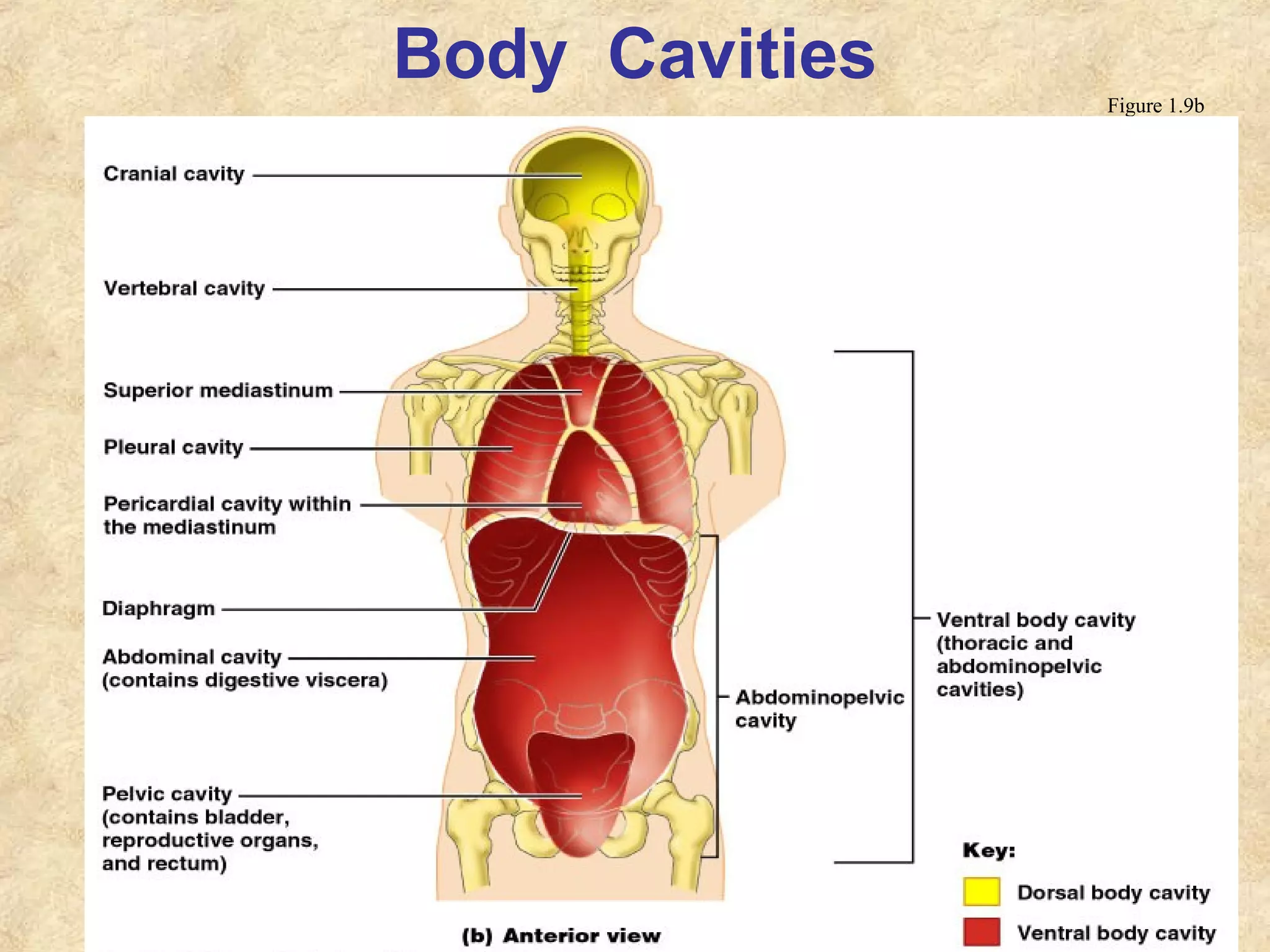
Body Cavities Figure 1.9b
Body Cavities
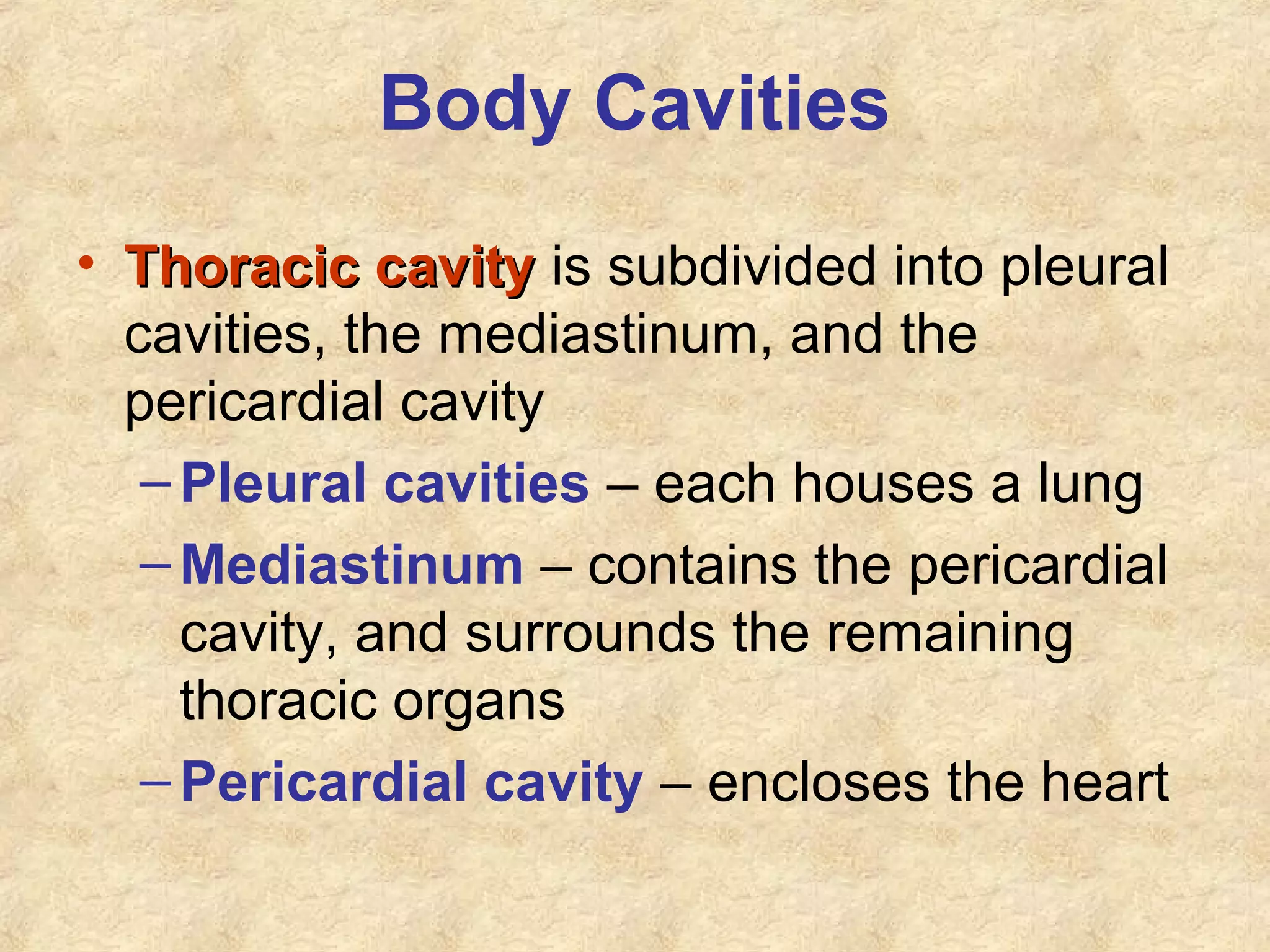
• Thoracic cavityThoracic cavity is subdivided into pleural
cavities, the mediastinum, and the
pericardial cavity
–Pleural cavities – each houses a lung
–Mediastinum – contains the pericardial
cavity, and surrounds the remaining
thoracic organs
–Pericardial cavity – encloses the heart
Body Cavities
• The abdominopelvic cavity is separatedThe abdominopelvic cavity is separated
from the superior thoracic cavity by thefrom the superior thoracic cavity by the
dome-shaped diaphragmdome-shaped diaphragm
• It is composed of two subdivisions
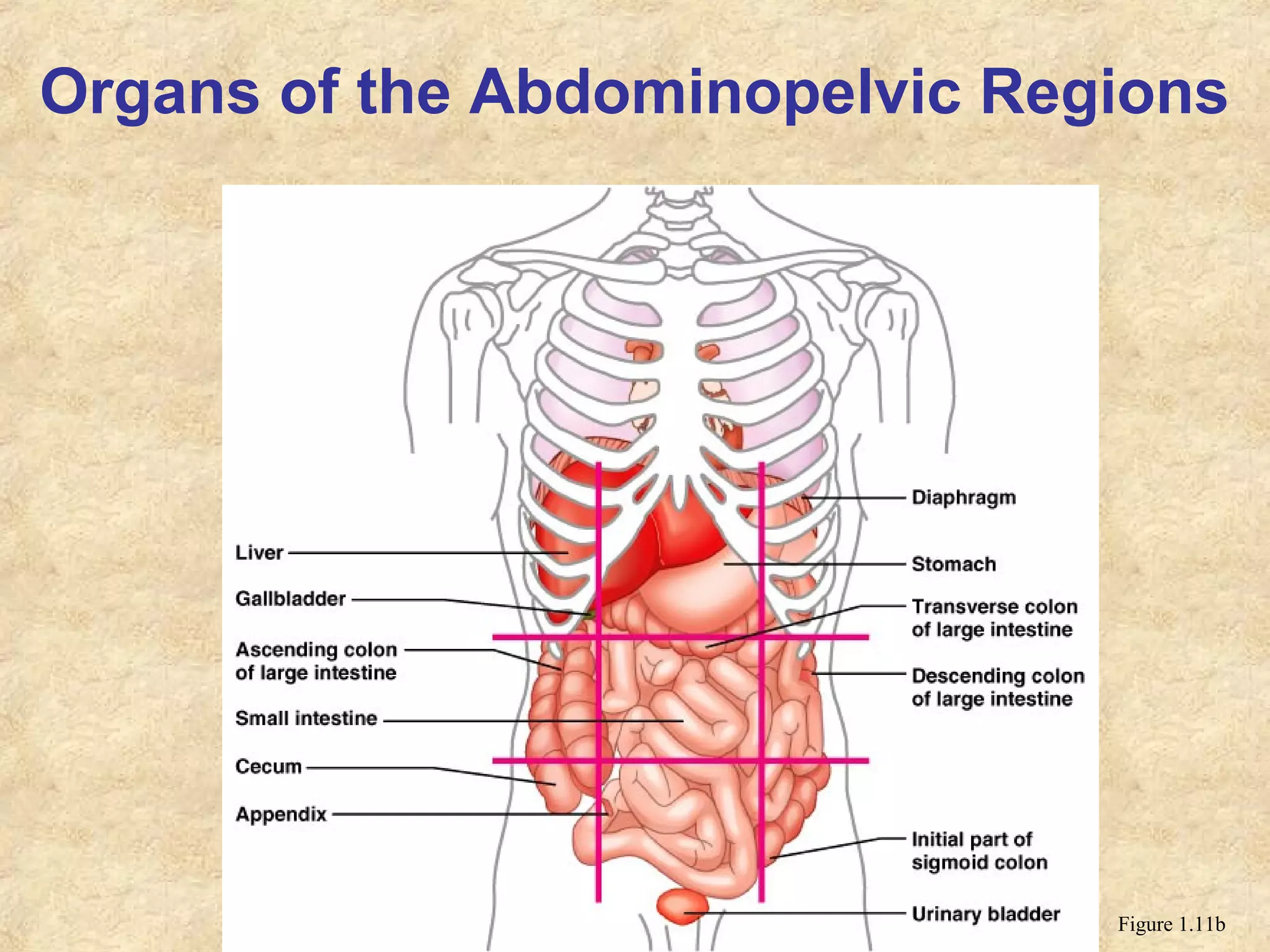
–Abdominal cavity – contains the
stomach, intestines, spleen, liver, and
other organs
–Pelvic cavity – lies within the pelvis and
contains the bladder, reproductive
organs, and rectum
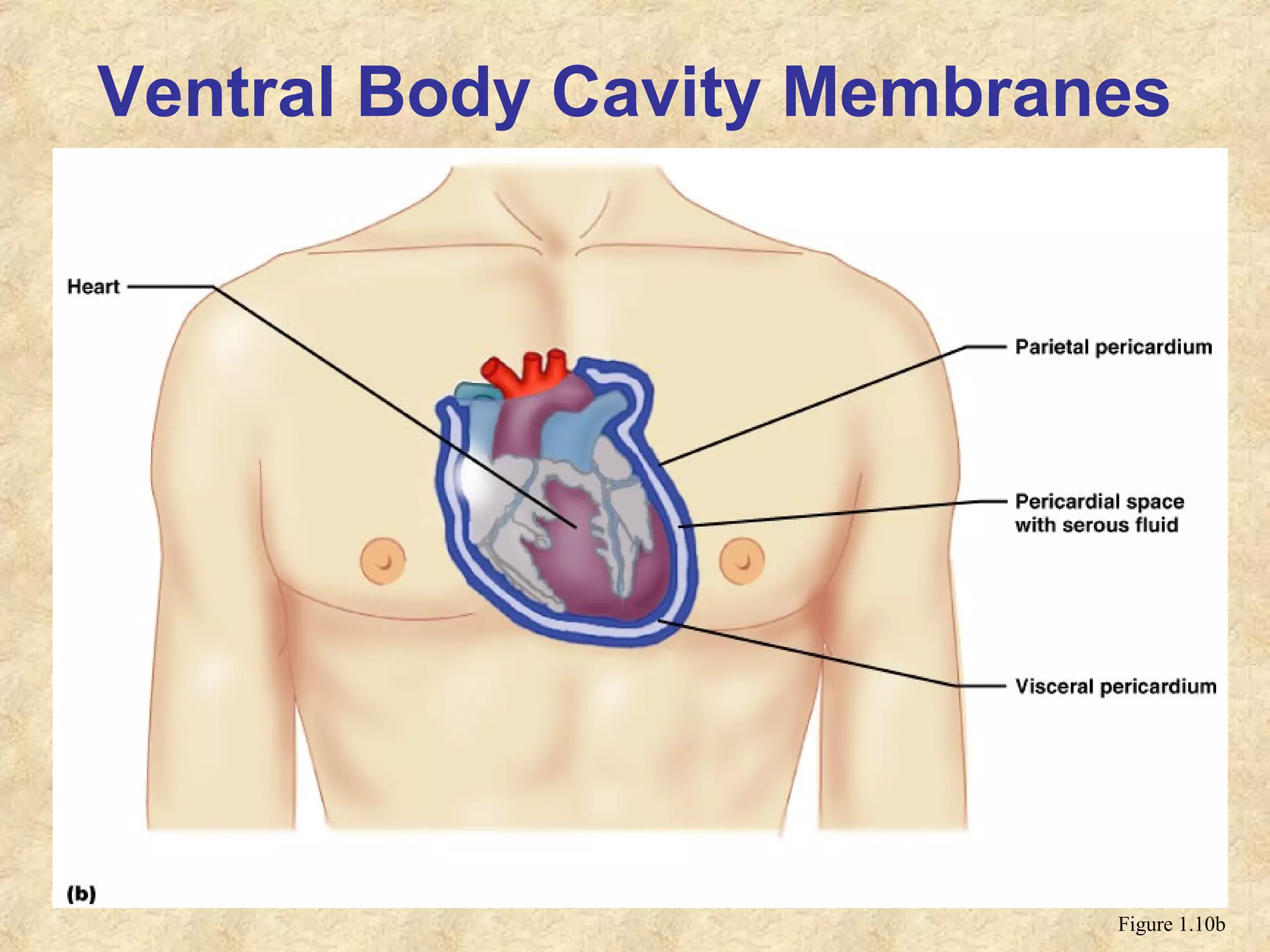
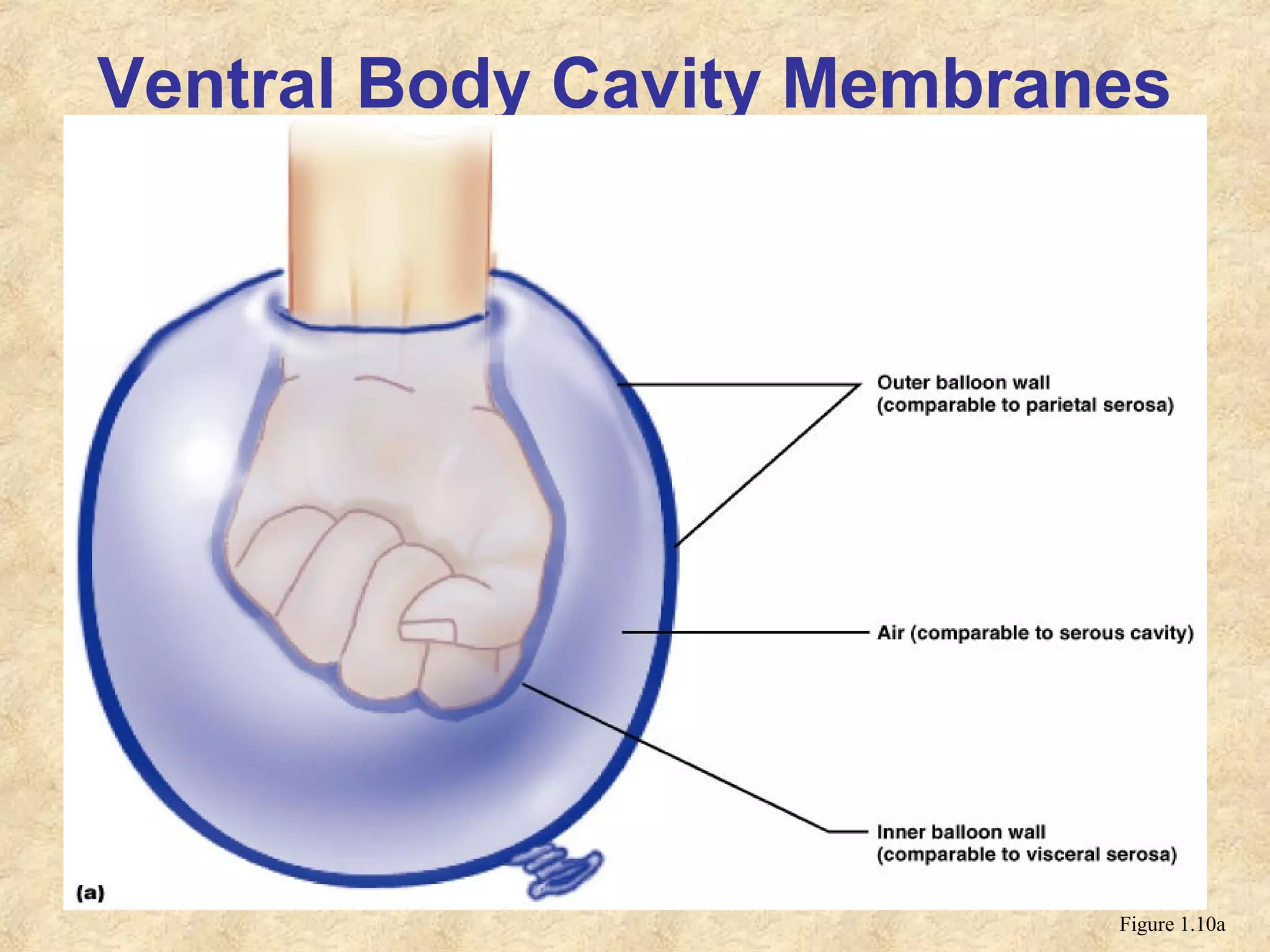
Ventral Body Cavity Membranes
• Parietal serosaParietal serosa lines internal body walls
• Visceral serosaVisceral serosa covers the internal organs
• Serous fluid separates the serosae (A serous
membrane, especially one that lines the
pericardial, pleural, and peritoneal cavities,
enclosing their contents)
Ventral Body Cavity Membranes
Figure 1.10b
Ventral Body Cavity Membranes
Figure 1.10a
Other Body Cavities
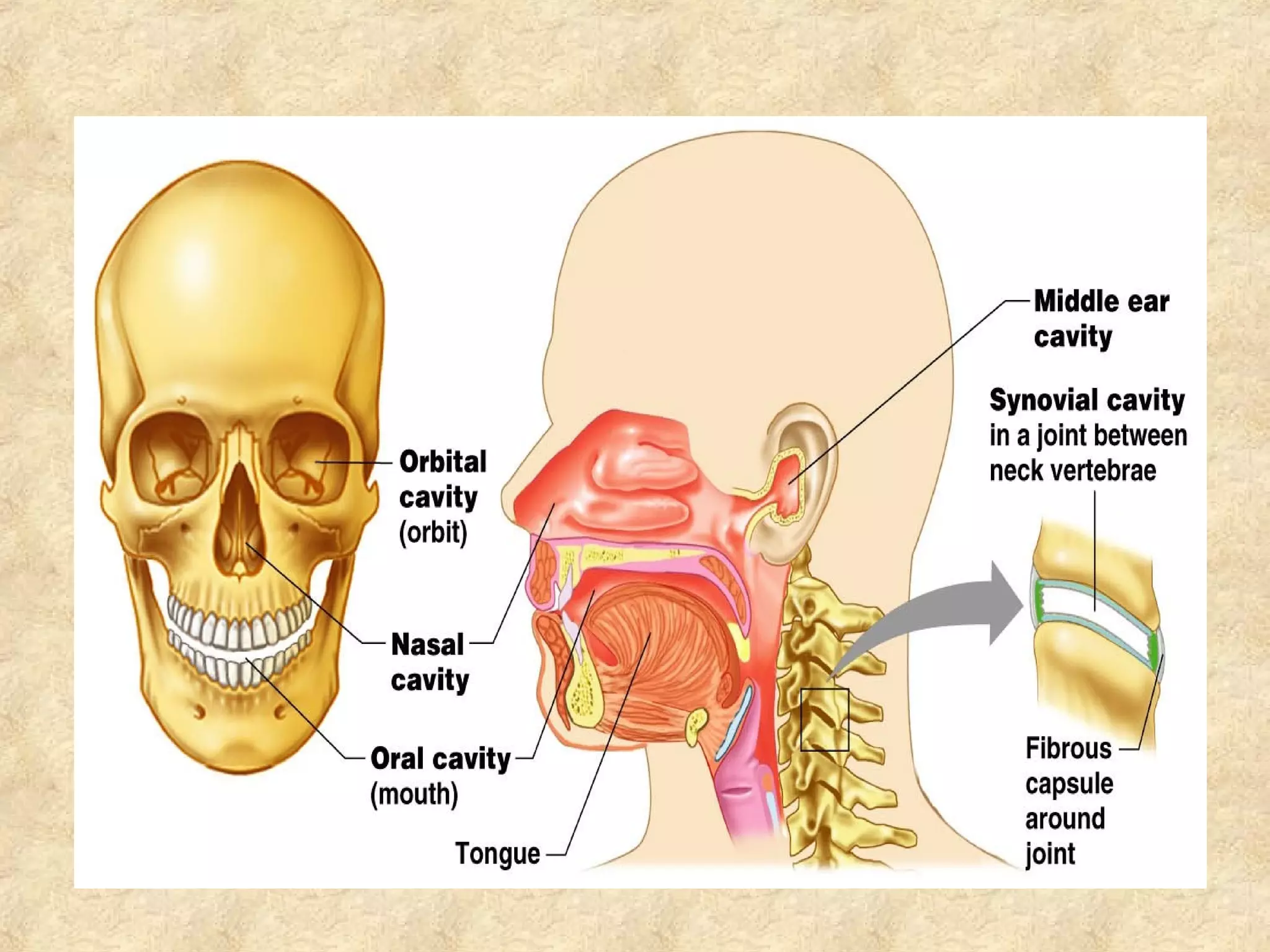
• Oral and digestiveOral and digestive – mouth and cavities
of the digestive organs
• NasalNasal –located within and posterior to the
nose
• OrbitalOrbital – house the eyes
• Middle earMiddle ear – contain bones (ossicles) that
transmit sound vibrations
• SynovialSynovial – joint cavities
Abdominal Regions and Quadrants
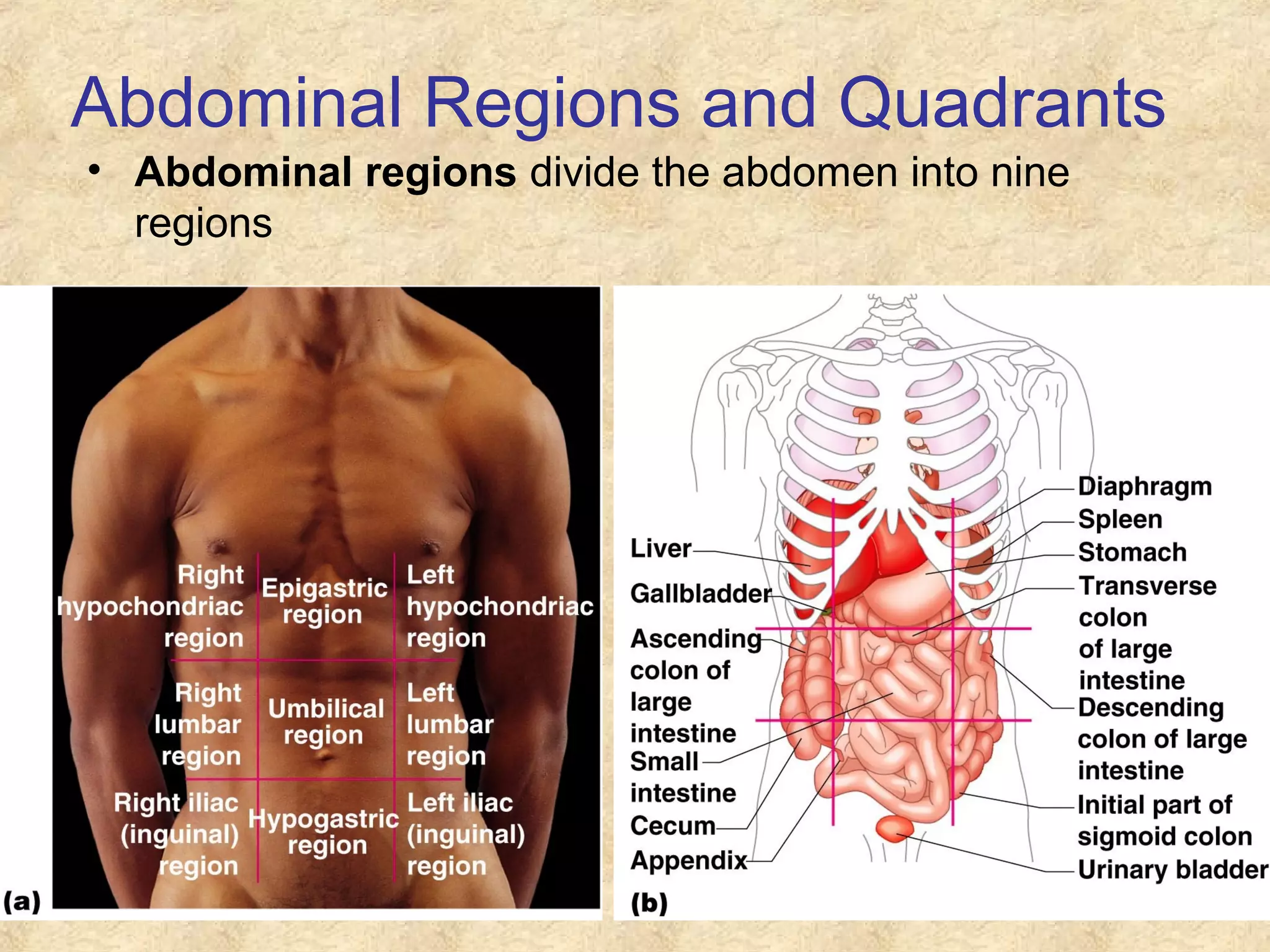
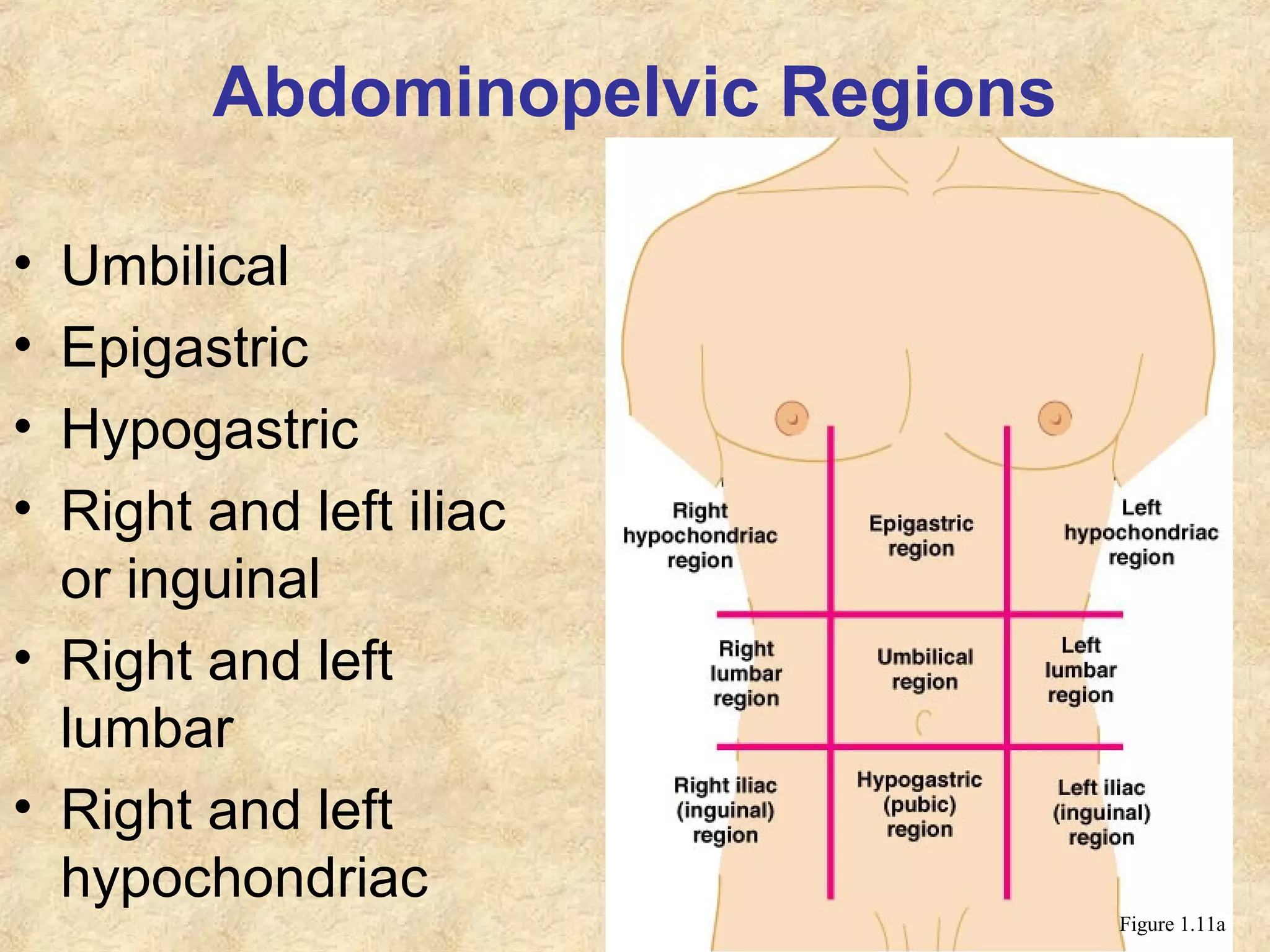
• Abdominal regions divide the abdomen into nine
regions
Abdominopelvic Regions
• Umbilical
• Epigastric
• Hypogastric
• Right and left iliac
or inguinal
• Right and left
lumbar
• Right and left
hypochondriac
Figure 1.11a
Organs of the Abdominopelvic Regions
Figure 1.11b
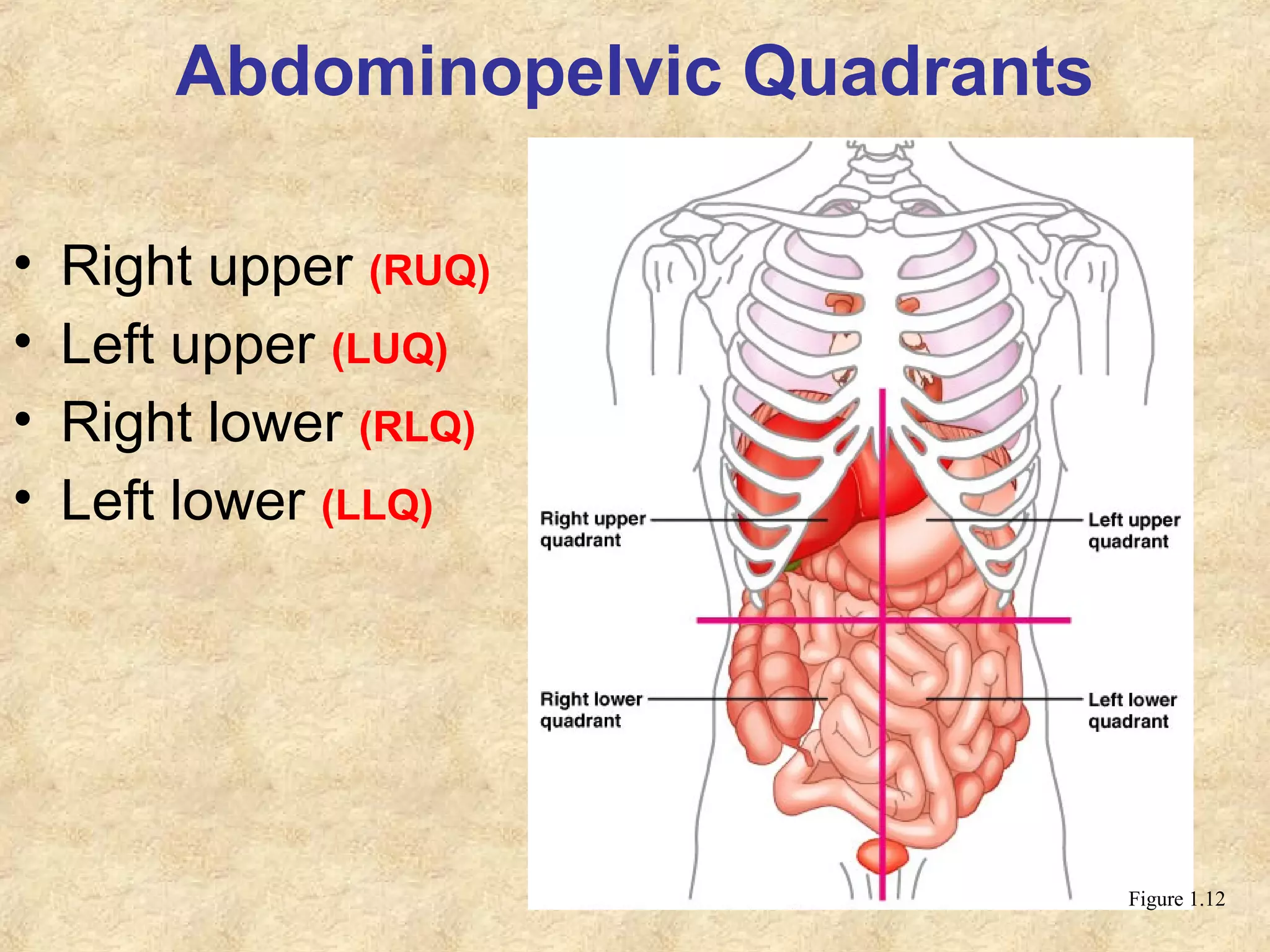
Abdominopelvic Quadrants
• Right upper (RUQ)
• Left upper (LUQ)
• Right lower (RLQ)
• Left lower (LLQ)
Figure 1.12
Unit i introduction to anatomical terms

Unit i introduction to anatomical terms

  • 1.
    UNIT- I Introduction toAnatomical Terms Bhupendra panchal Lecturer in GCS college of nursingCredit: Carlos J Bidot Author 2006 Revised 2010
  • 2.
    Overview of Anatomyand Physiology • AnatomyAnatomy – the study of the structure of body parts and their relationships to one another – Gross or macroscopic – Microscopic – Developmental • PhysiologyPhysiology – the study of the function of the body’s structural machinery
  • 3.
  • 4.
    Gross / CadavericAnatomy • RegionalRegional – all structures in one part of the body (such as the abdomen or leg) • SystemicSystemic – gross anatomy of the body studied by system • SurfaceSurface – study of internal structures as they relate to the overlying skin
  • 5.
    Microscopic Anatomy • CytologyCytology– study of the cell • HistologyHistology – study of tissues
  • 6.
    Developmental Anatomy • Tracesstructural changes throughout life • EmbryologyEmbryology – study of developmental changes of the body before birth
  • 7.
    Specialized Branches of Anatomy •Pathological / clinical anatomyPathological / clinical anatomy– study of structural changes caused by disease • Radiographic anatomyRadiographic anatomy – study of internal structures visualized by X ray • Comparative anatomyComparative anatomy • Experimental anatomyExperimental anatomy • Physical AnthropologyPhysical Anthropology • GeneticsGenetics
  • 8.
    Physiology • Considers theoperation of specificConsiders the operation of specific organ systemsorgan systems – Renal – kidney function – Neurophysiology – workings of the nervous system – Cardiovascular – operation of the heart and blood vessels • Focuses on the functions of the body,Focuses on the functions of the body, often at the cellular or molecular leveloften at the cellular or molecular level
  • 9.
    Chemical level Atoms combineto form molecules 1 2 3 4 Cellular level Cells are made up of molecules Tissue level Tissues consist of similar types of cells 5 Organ system level Organ systems consist of different organs that work together closely Organ level Organs are made up of different types of tissues 6 Organismal level The human organism is made up of many organ systems Atoms Molecules Smooth muscle cell Smooth muscle tissue Connective tissue Smooth muscle tissue Epithelial tissue Blood vessel (organ) Heart Blood vessels Cardiovascular system Levels of Structural Organization Figure 1.1
  • 10.
    Levels of StructuralOrganization • ChemicalChemical – atoms combined to form molecules • CellularCellular – cells are made of molecules • TissueTissue – consists of similar types of cells • OrganOrgan – made up of different types of tissues • Organ systemOrgan system – consists of different organs that work closely together • OrganismOrganism – made up of the organ systems
  • 11.
    Terms Used InAnatomy Terms Used In Anatomy
  • 12.
    Anatomical Position • Bodyerect • Feet slightly apart • Palms facing forward • Thumbs point away from body • Supine PositionSupine Position • Prone PositionProne Position Figure 1.7a
  • 13.
    Directional Terms • Superiorand inferiorSuperior and inferior – toward and away from the head, respectively • Anterior and posteriorAnterior and posterior – toward the front and back of the body • Medial, lateral, and intermediateMedial, lateral, and intermediate – toward the midline, away from the midline, and between a more medial and lateral structure
  • 14.
    Directional Terms • Proximaland distalProximal and distal – closer to and farther from the origin of the body • Superficial and deepSuperficial and deep – toward and away from the body surface
  • 15.
  • 16.
  • 17.
    Body Planes • SagittalSagittal– divides the body into right and left parts • Midsagittal or medialMidsagittal or medial – sagittal plane that lies on the midline • Frontal or coronalFrontal or coronal – divides the body into anterior and posterior parts • Transverse or horizontalTransverse or horizontal (cross section) – divides the body into superior and inferior parts • Oblique sectionOblique section – cuts made diagonally
  • 18.
  • 21.
    21 Skeletal System • Structure:206 bones of the human body • Function: – Protects and supports body organs – Provides a framework that muscles can use to create movement – Hematopoiesis (synthesis of blood cells) – Mineral storage • Bone contains 99% of the body’s store of calcium
  • 22.
    22 Muscular System • Structures:The 600+ muscles of the body • Function: – Locomotion – Manipulation of the environment – Maintaining posture – Thermogenesis (generation of heat)
  • 23.
    23 Cardiovascular System • Structures: –Heart, Blood vessels (arteries, veins, and capillaries) • Functions: – The heart pumps blood thru the blood vessels. – Blood provides the transport medium for nutrients (glucose, amino acids, lipids), gases (O2, CO2), wastes (urea, creatinine), signaling molecules (hormones), and heat.
  • 24.
    24 Digestive System • Structures: –Oral cavity, esophagus, stomach, small intestine, large intestine, rectum, salivary glands, pancreas, liver, gallbladder • Functions: – Ingestion and subsequent breakdown of food into absorbable units that will enter the blood for distribution to the body’s cells
  • 25.
    25 Respiratory System • Structures: –Nasal cavity, pharynx, trachea, bronchi, lungs • Functions: – Constantly supply the blood with O2, and remove CO2 – Regulate blood pH
  • 26.
    26 Endocrine System • Structures:Hormone Secreting Glands – Pituitary, Thyroid, Thymus, Pineal, Parathyroid, Adrenal, Pancreas, Small Intestine, Stomach, Testes, Ovaries, Kidneys, Heart • Functions: – Long-term control system of the body – Regulates growth, reproduction, and nutrient use among other things.
  • 27.
    27 Nervous System • Structures:Brain, Spinal cord, and peripheral nerves. • Function: – Fast-acting control system of the body – Monitoring of the internal and external environment and responding (when necessary) by initiating muscular or glandular activity – Information Assessment
  • 28.
    28 Urinary System • Structures: –Kidneys, ureters, urinary bladder, urethra • Functions: – Removal of nitrogenous wastes – Regulation of body’s levels of water, electrolytes, and acidity
  • 30.
    30 Reproductive System • Structures: –Male: • Testes, scrotum, epididymis, vas deferens, urethra, prostate gland, seminal vesicles, penis – Female: • Ovary, uterine tube, uterus, cervix, vagina, mammary glands • Functions: – Making Babies
  • 31.
    The Cavity ofHuman Body Figure 1.9a
  • 32.
    Body Cavities • DorsalcavityDorsal cavity protects the nervous system, and is divided into two subdivisions –Cranial cavity is within the skull and encases the brain –Vertebral cavity runs within the vertebral column and encases the spinal cord • Ventral cavityVentral cavity houses the internal organs (viscera), and is divided into two subdivisions: - Thoracic and Abdominopelvic cavities
  • 33.
  • 34.
    Body Cavities • ThoraciccavityThoracic cavity is subdivided into pleural cavities, the mediastinum, and the pericardial cavity –Pleural cavities – each houses a lung –Mediastinum – contains the pericardial cavity, and surrounds the remaining thoracic organs –Pericardial cavity – encloses the heart
  • 35.
    Body Cavities • Theabdominopelvic cavity is separatedThe abdominopelvic cavity is separated from the superior thoracic cavity by thefrom the superior thoracic cavity by the dome-shaped diaphragmdome-shaped diaphragm • It is composed of two subdivisions –Abdominal cavity – contains the stomach, intestines, spleen, liver, and other organs –Pelvic cavity – lies within the pelvis and contains the bladder, reproductive organs, and rectum
  • 36.
    Ventral Body CavityMembranes • Parietal serosaParietal serosa lines internal body walls • Visceral serosaVisceral serosa covers the internal organs • Serous fluid separates the serosae (A serous membrane, especially one that lines the pericardial, pleural, and peritoneal cavities, enclosing their contents)
  • 37.
    Ventral Body CavityMembranes Figure 1.10b
  • 38.
    Ventral Body CavityMembranes Figure 1.10a
  • 39.
    Other Body Cavities •Oral and digestiveOral and digestive – mouth and cavities of the digestive organs • NasalNasal –located within and posterior to the nose • OrbitalOrbital – house the eyes • Middle earMiddle ear – contain bones (ossicles) that transmit sound vibrations • SynovialSynovial – joint cavities
  • 41.
    Abdominal Regions andQuadrants • Abdominal regions divide the abdomen into nine regions
  • 42.
    Abdominopelvic Regions • Umbilical •Epigastric • Hypogastric • Right and left iliac or inguinal • Right and left lumbar • Right and left hypochondriac Figure 1.11a
  • 43.
    Organs of theAbdominopelvic Regions Figure 1.11b
  • 44.
    Abdominopelvic Quadrants • Rightupper (RUQ) • Left upper (LUQ) • Right lower (RLQ) • Left lower (LLQ) Figure 1.12