Anatomy of the Nervous System
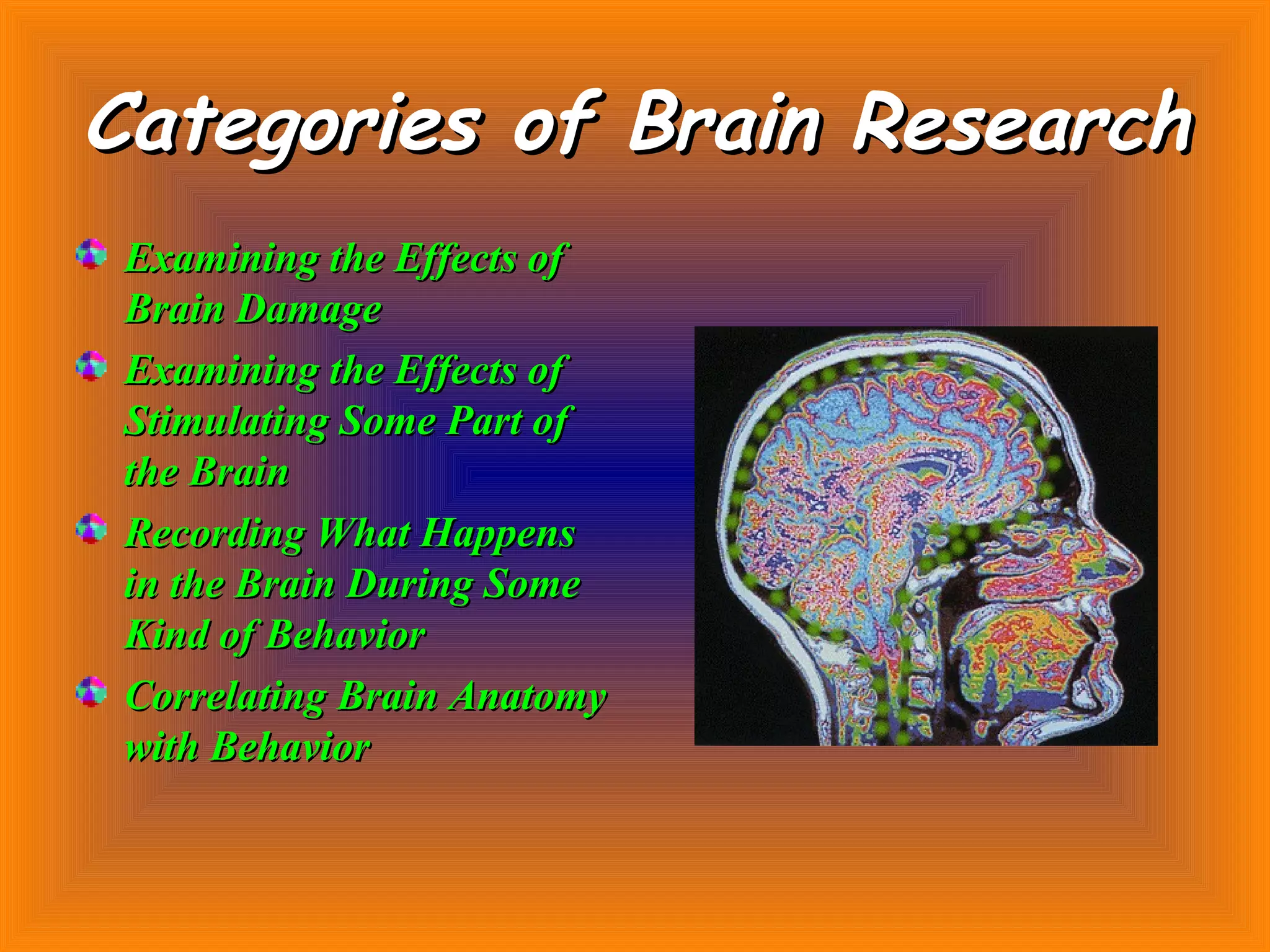
Categories of Brain Research Examining the Effects of Brain Damage Examining the Effects of Stimulating Some Part of the Brain Recording What Happens in the Brain During Some Kind of Behavior Correlating Brain Anatomy with Behavior
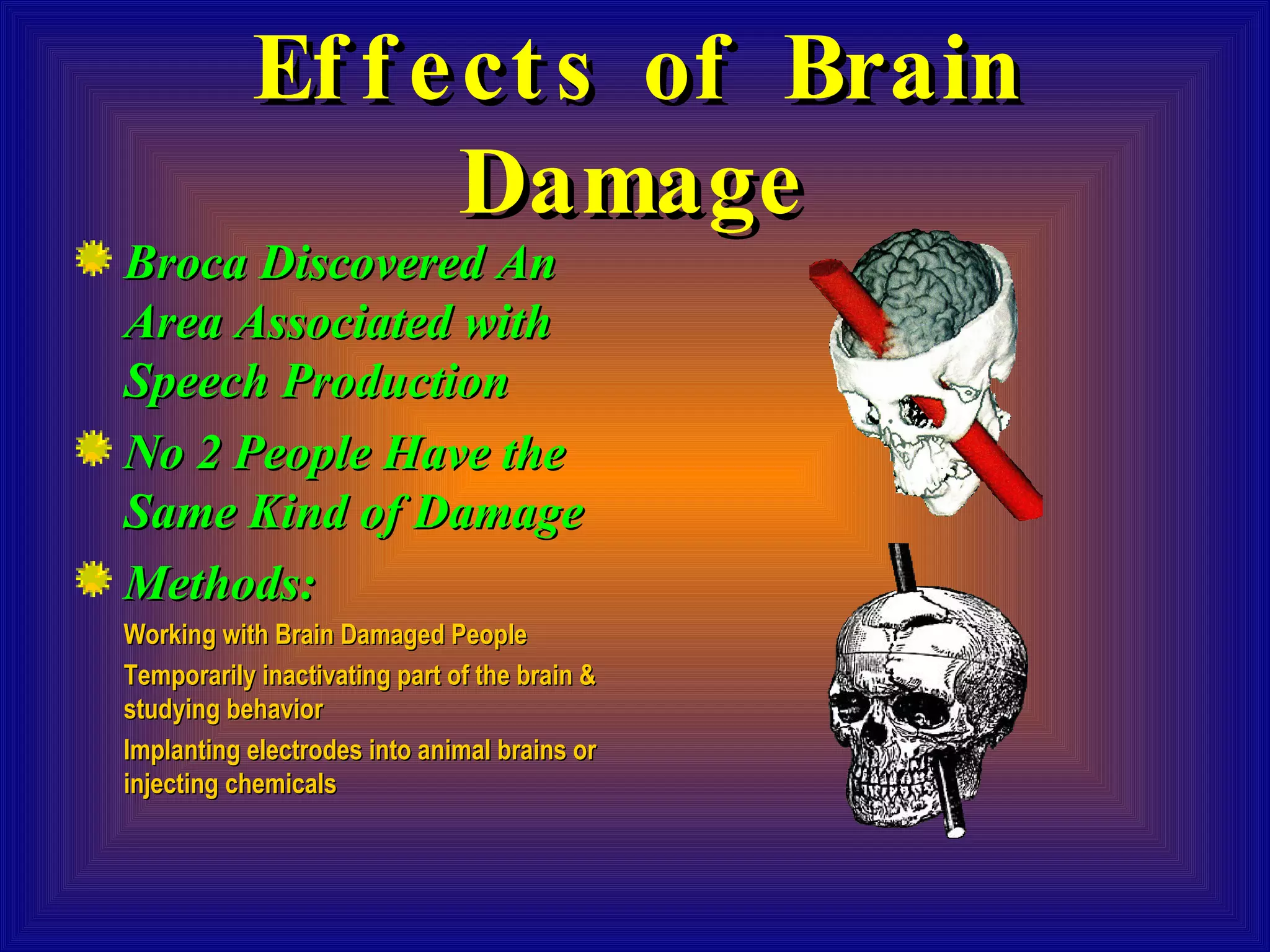
Effects of Brain Damage Broca Discovered An Area Associated with Speech Production No 2 People Have the Same Kind of Damage Methods: Working with Brain Damaged People Temporarily inactivating part of the brain & studying behavior Implanting electrodes into animal brains or injecting chemicals
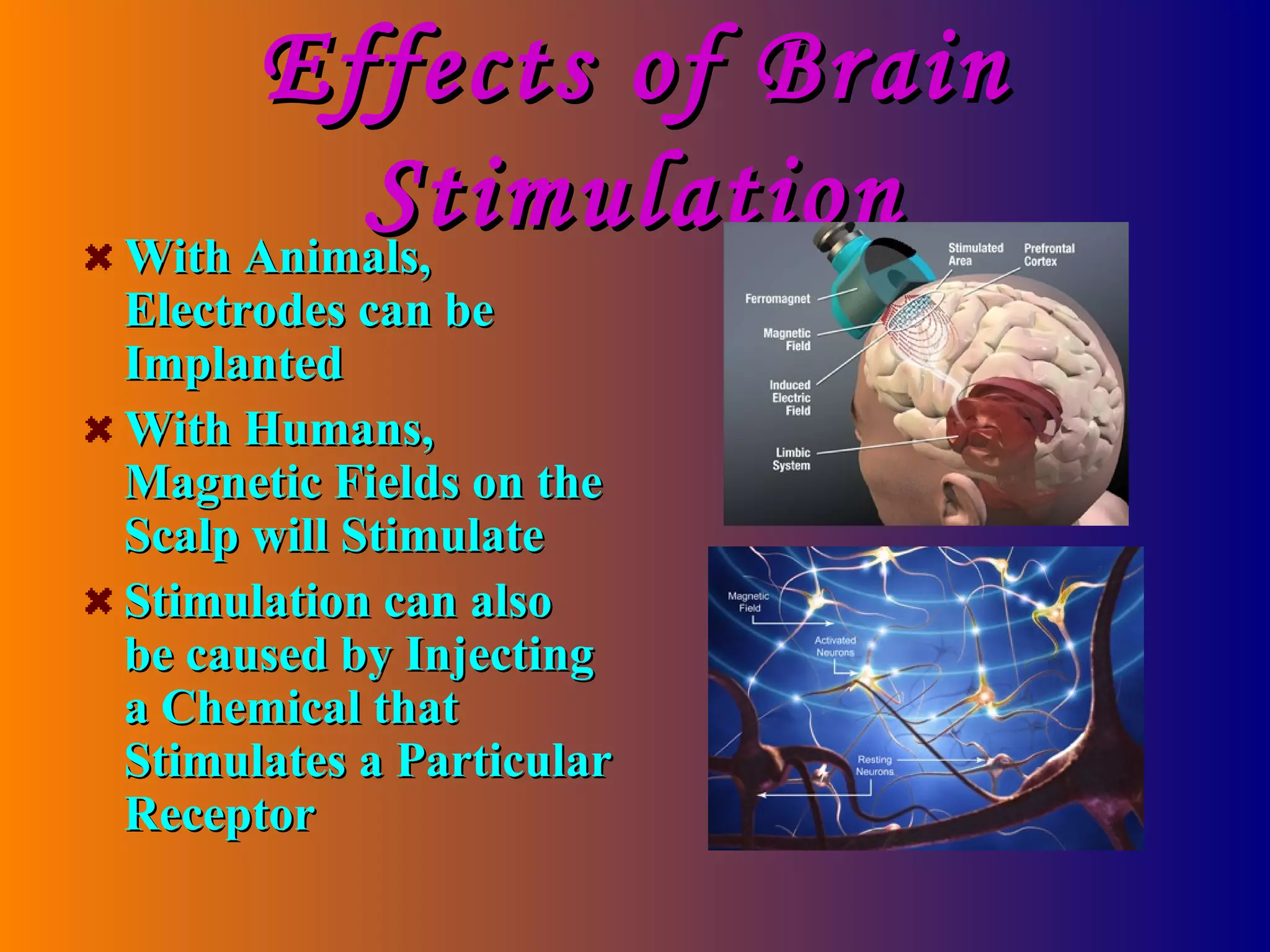
Effects of Brain Stimulation With Animals, Electrodes can be Implanted With Humans, Magnetic Fields on the Scalp will Stimulate Stimulation can also be caused by Injecting a Chemical that Stimulates a Particular Receptor
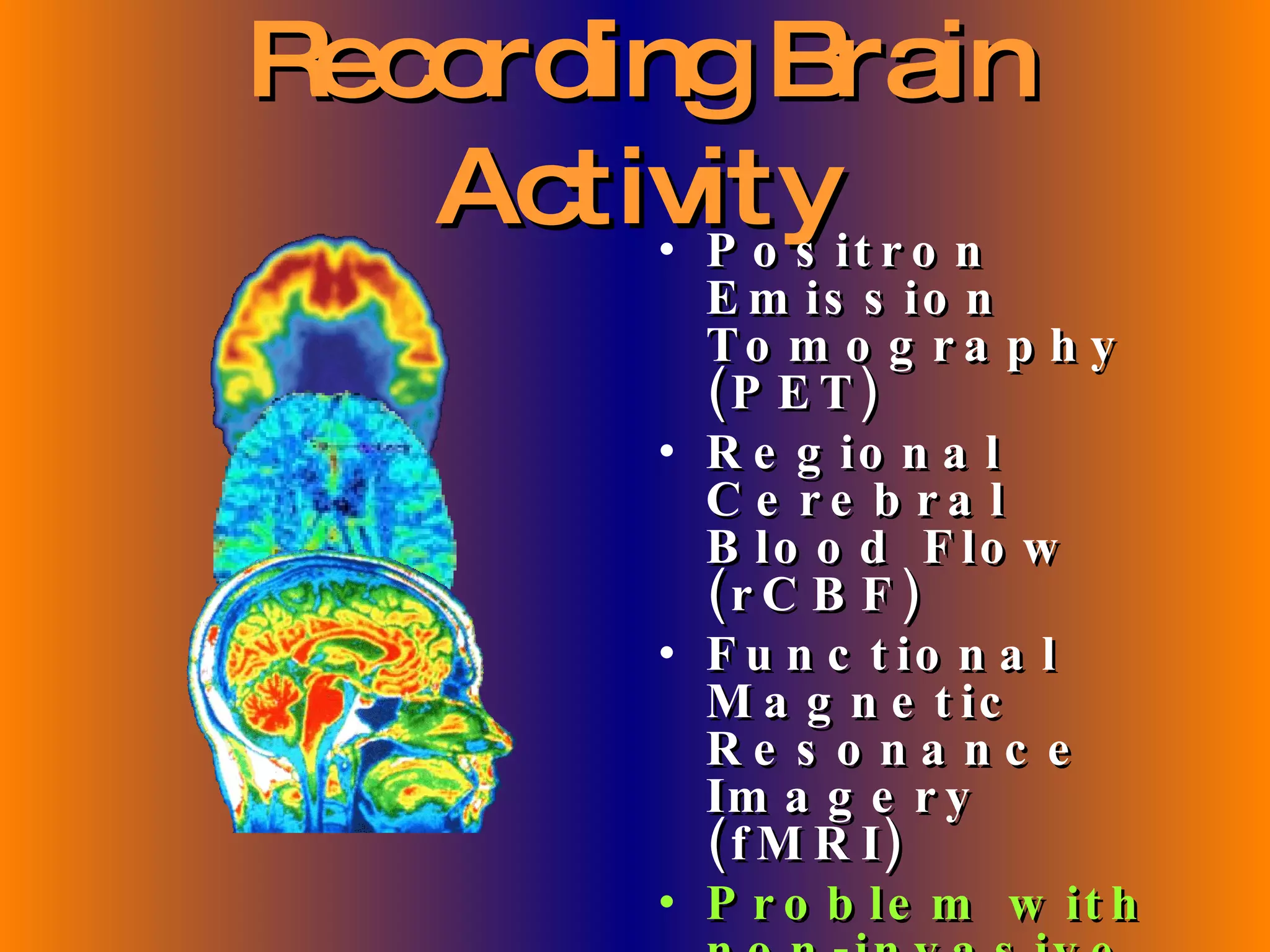
Recording Brain Activity Positron Emission Tomography (PET) Regional Cerebral Blood Flow (rCBF) Functional Magnetic Resonance Imagery (fMRI) Problem with non-invasive methods is interpreting the images
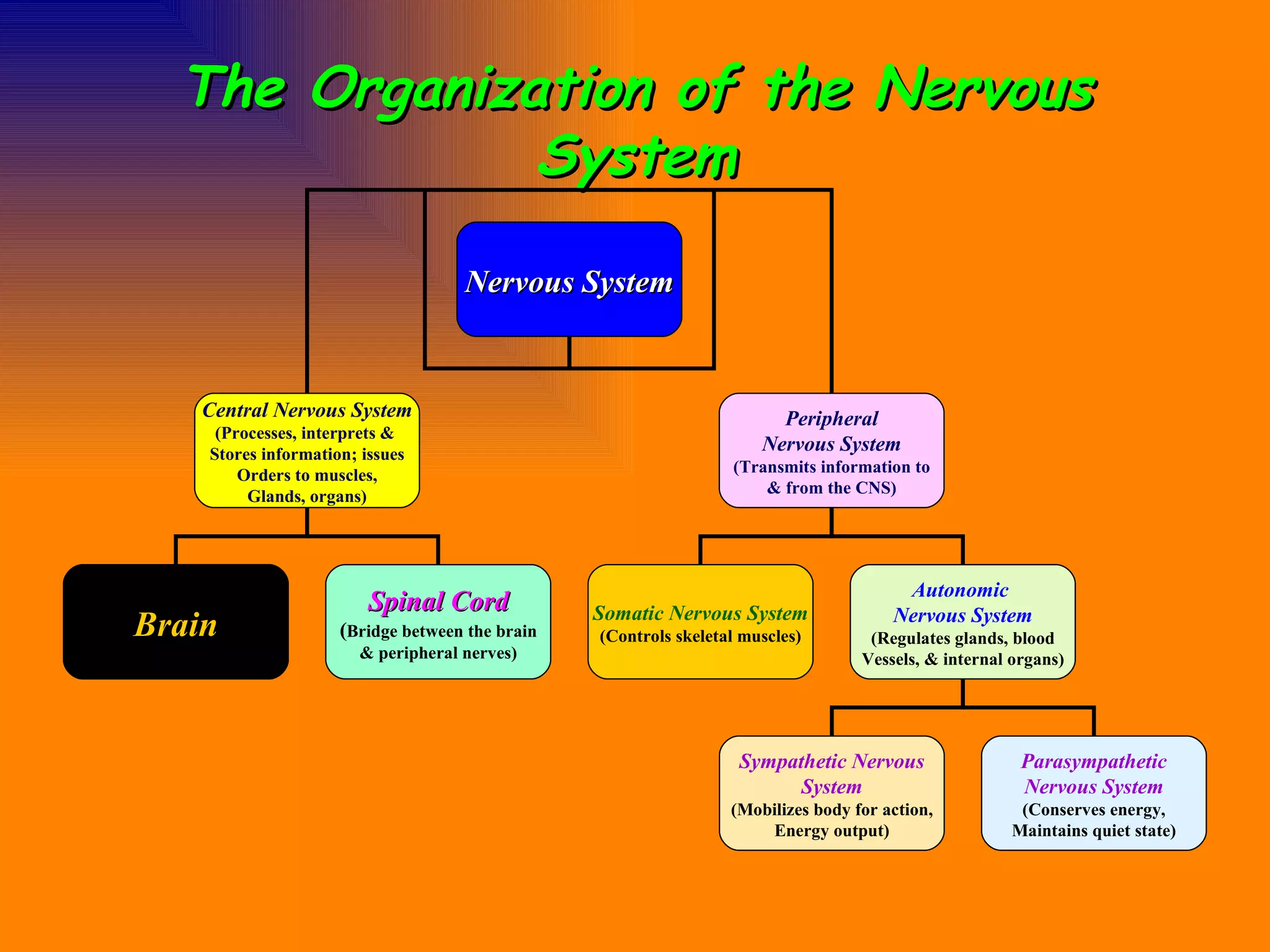
The Organization of the Nervous System Nervous System Central Nervous System (Processes, interprets &  Stores information; issues Orders to muscles, Glands, organs) Peripheral Nervous System (Transmits information to & from the CNS) Brain Spinal Cord ( Bridge between the brain & peripheral nerves) Somatic Nervous System (Controls skeletal muscles) Autonomic  Nervous System (Regulates glands, blood Vessels, & internal organs) Sympathetic Nervous System (Mobilizes body for action, Energy output) Parasympathetic Nervous System (Conserves energy, Maintains quiet state)
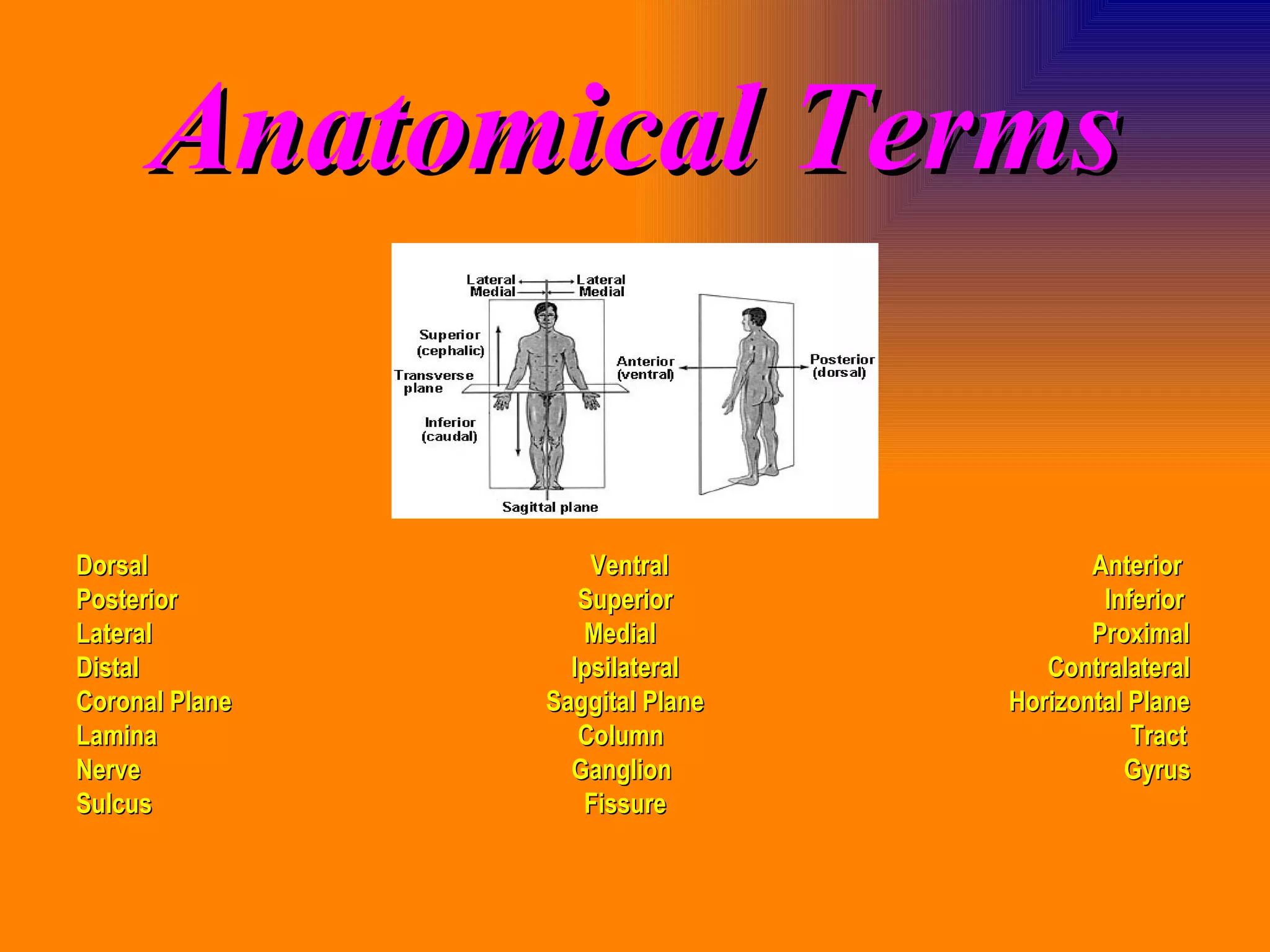
Anatomical Terms Dorsal   Ventral   Anterior Posterior   Superior   Inferior Lateral   Medial   Proximal Distal   Ipsilateral   Contralateral Coronal Plane   Saggital Plane  Horizontal Plane Lamina   Column   Tract Nerve   Ganglion   Gyrus Sulcus Fissure
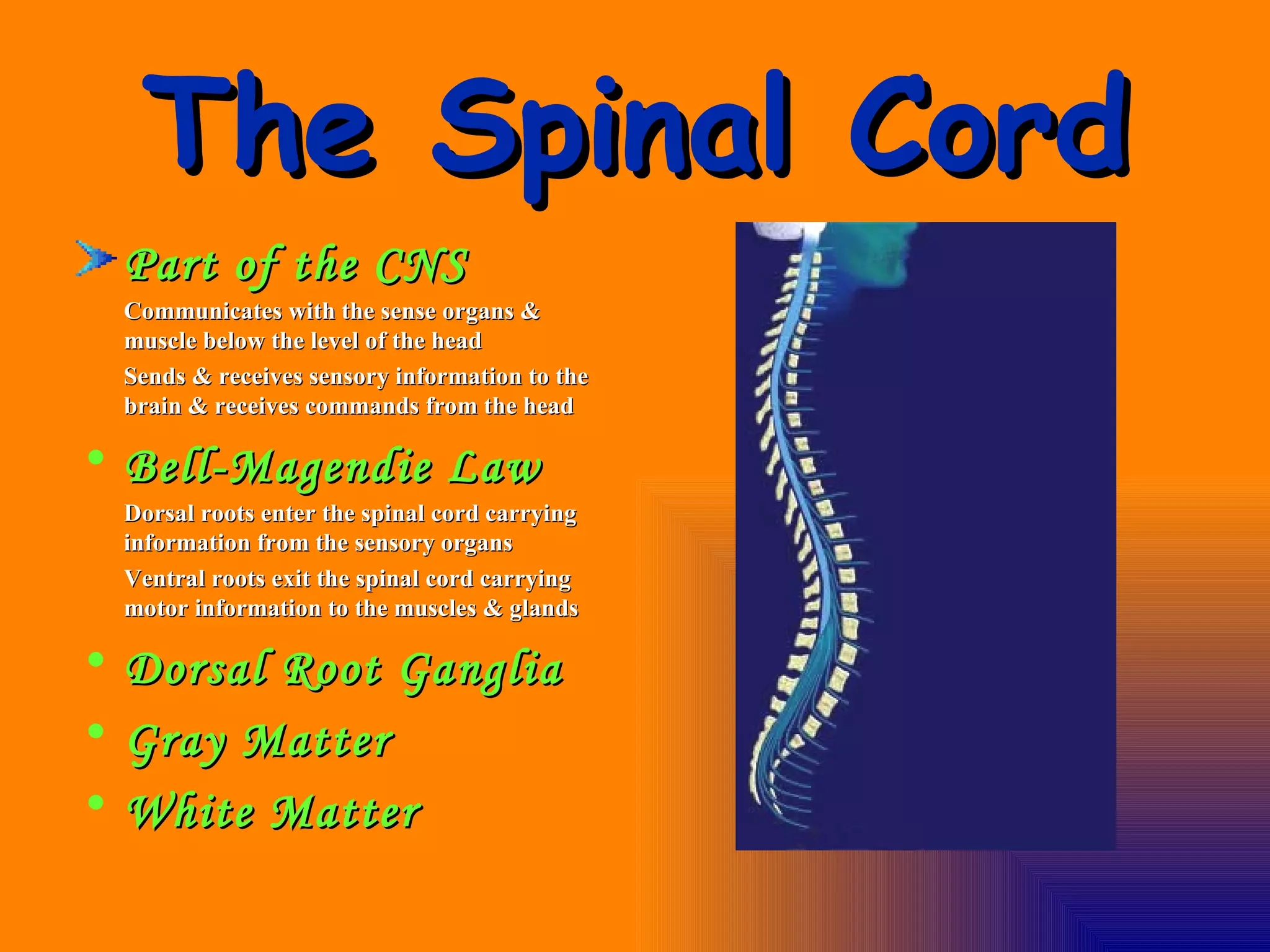
The Spinal Cord Part of the CNS Communicates with the sense organs & muscle below the level of the head Sends & receives sensory information to the brain & receives commands from the head Bell-Magendie Law Dorsal roots enter the spinal cord carrying information from the sensory organs Ventral roots exit the spinal cord carrying motor information to the muscles & glands Dorsal Root Ganglia Gray Matter White Matter
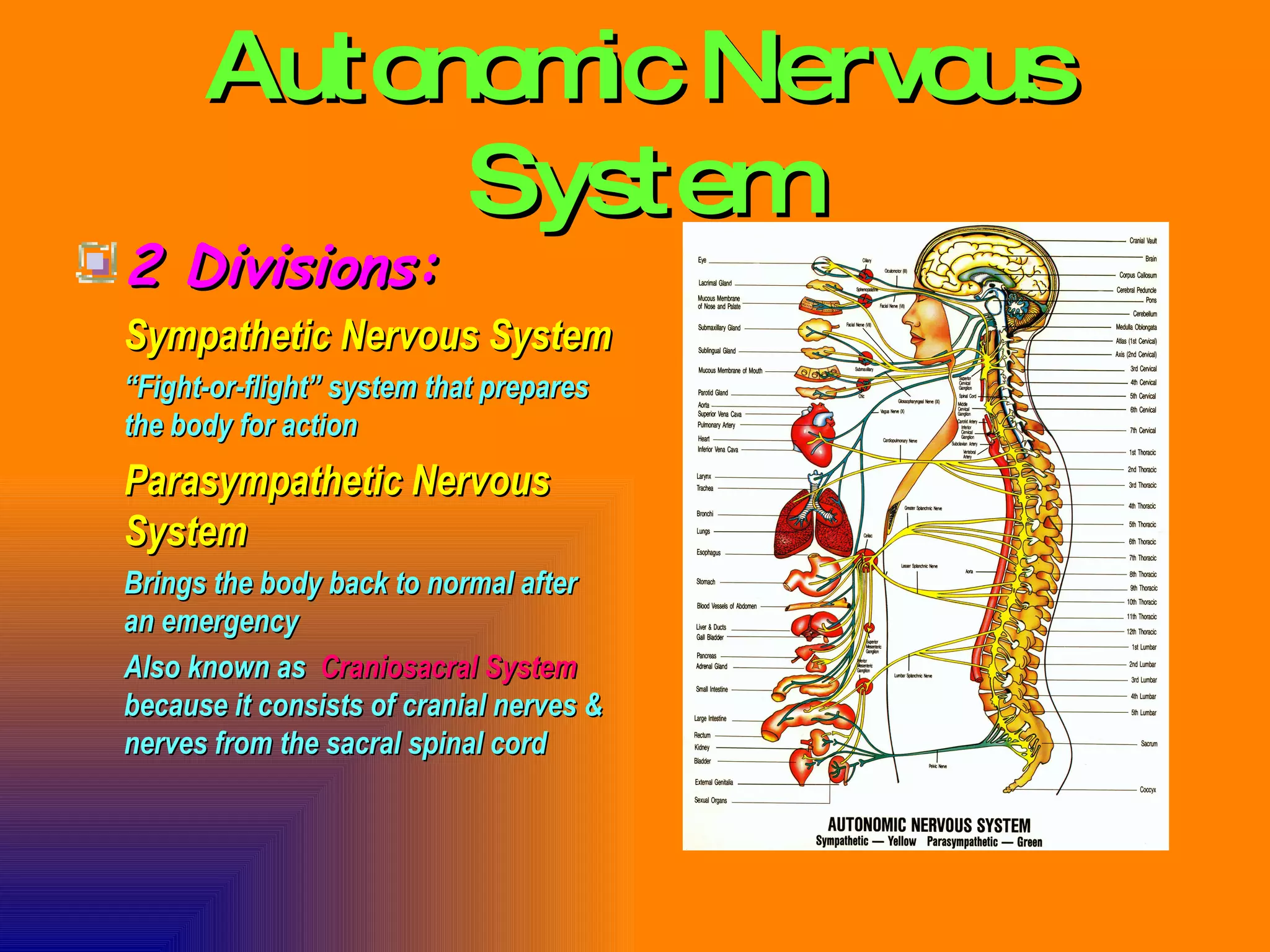
Autonomic Nervous System 2 Divisions: Sympathetic Nervous System “ Fight-or-flight” system that prepares the body for action Parasympathetic Nervous System Brings the body back to normal after an emergency Also known as  Craniosacral System  because it consists of cranial nerves & nerves from the sacral spinal cord
The Brain
 
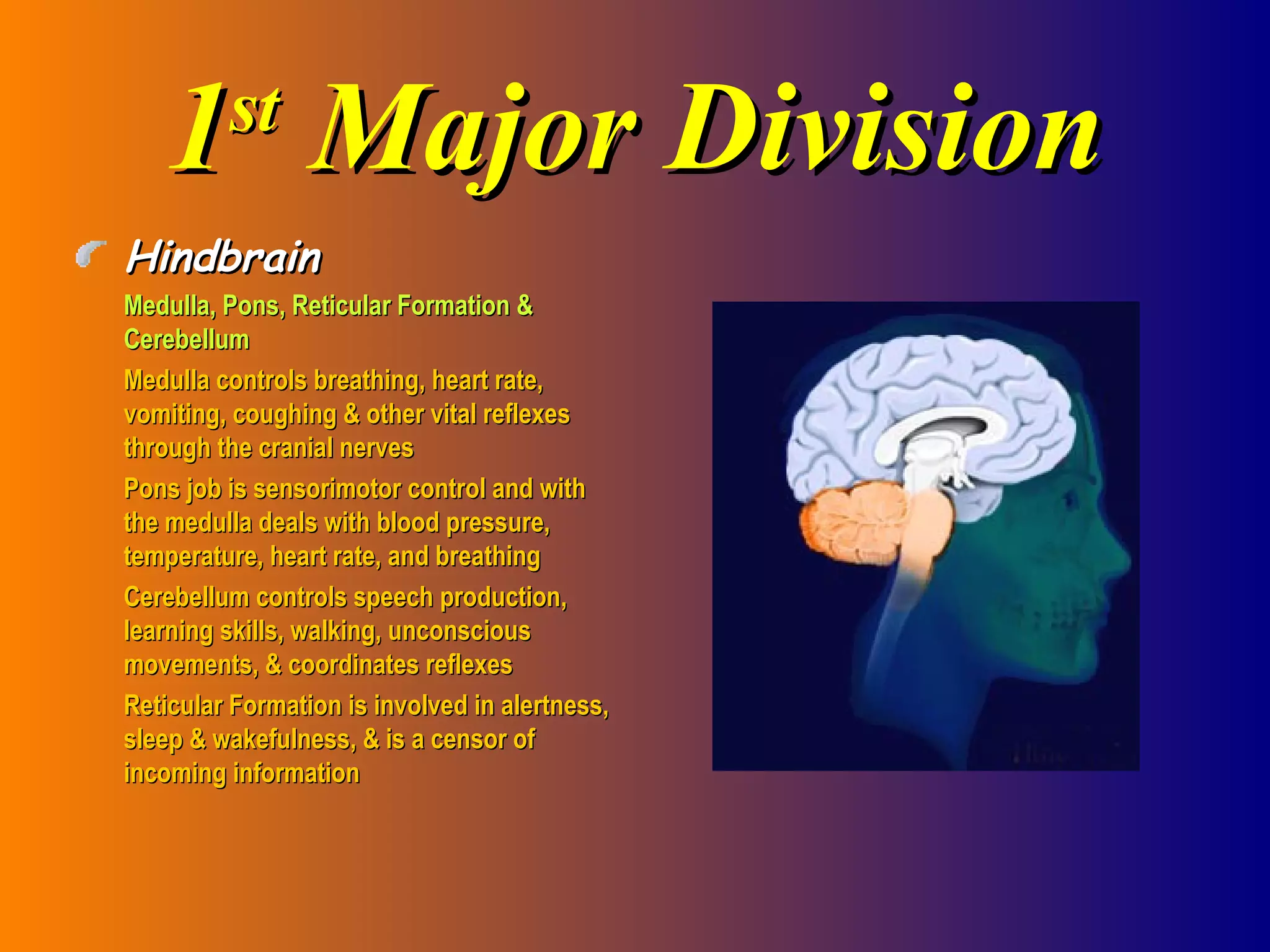
1 st  Major Division Hindbrain Medulla, Pons, Reticular Formation & Cerebellum Medulla controls breathing, heart rate, vomiting, coughing & other vital reflexes through the cranial nerves Pons job is sensorimotor control and with the medulla deals with blood pressure, temperature, heart rate, and breathing Cerebellum controls speech production, learning skills, walking, unconscious movements, & coordinates reflexes Reticular Formation is involved in alertness, sleep & wakefulness, & is a censor of incoming information
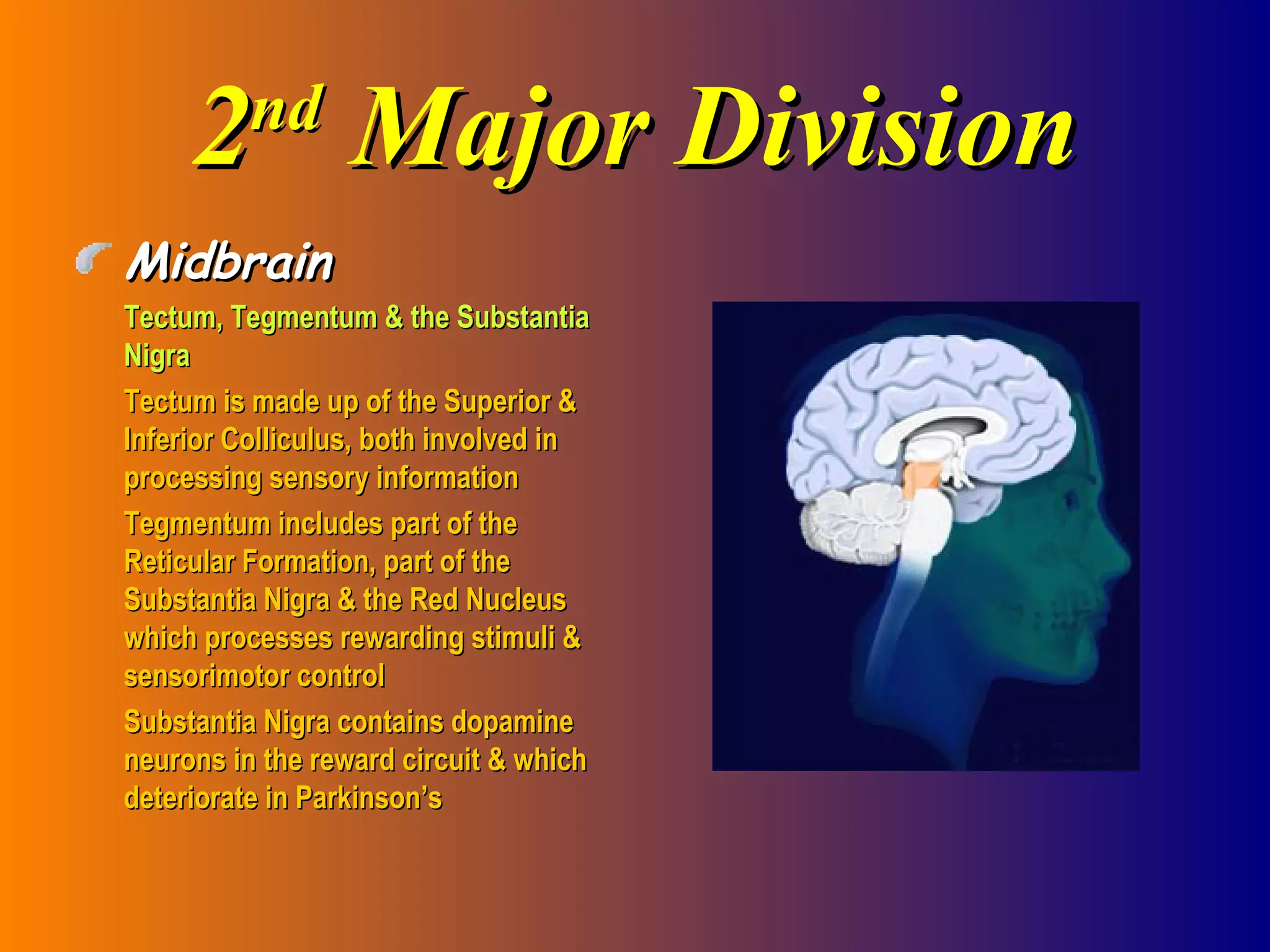
2 nd  Major Division Midbrain Tectum, Tegmentum & the Substantia Nigra Tectum is made up of the Superior & Inferior Colliculus, both involved in processing sensory information Tegmentum includes part of the Reticular Formation, part of the Substantia Nigra & the Red Nucleus which processes rewarding stimuli & sensorimotor control Substantia Nigra contains dopamine neurons in the reward circuit & which deteriorate in Parkinson’s
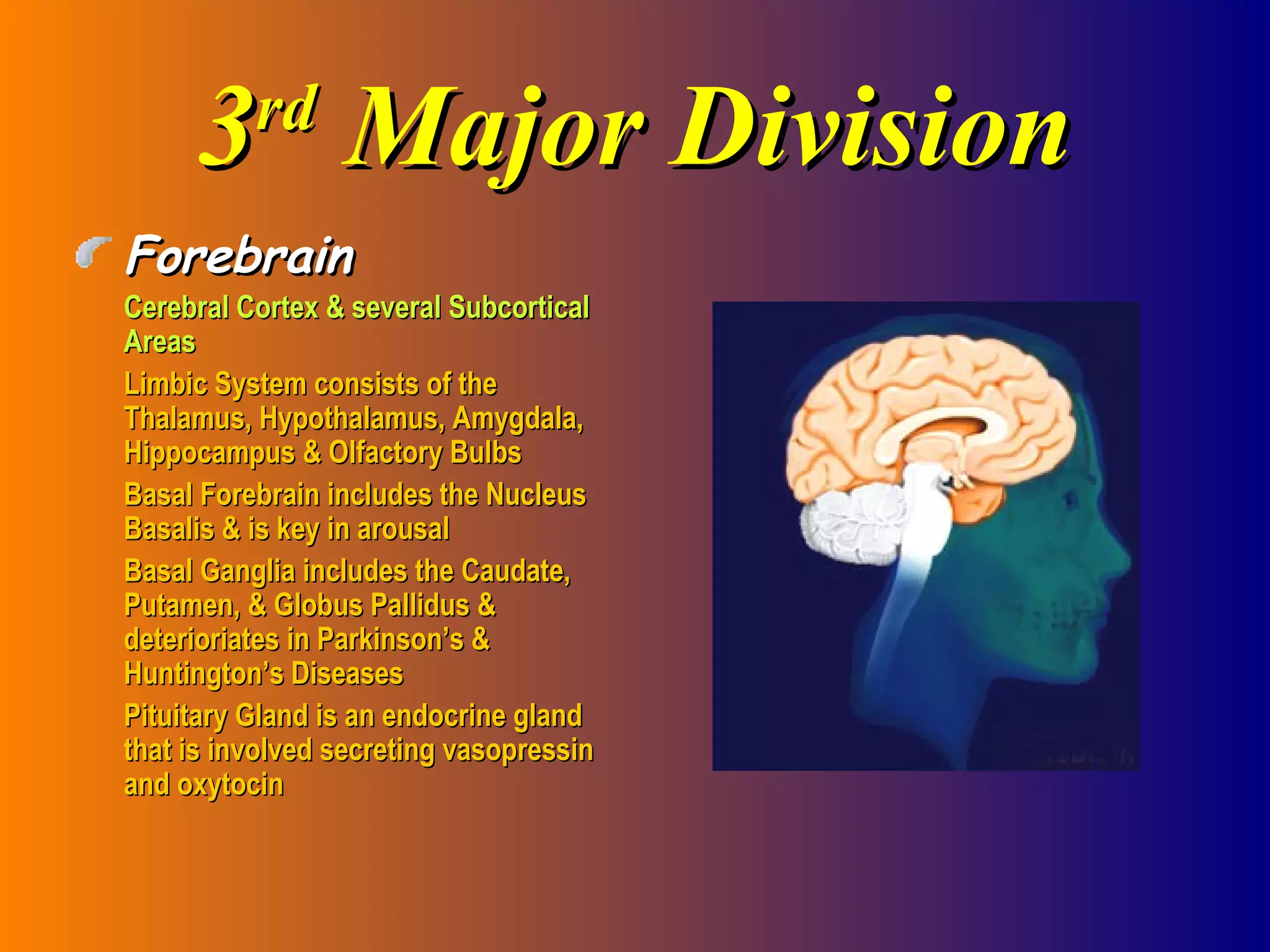
3 rd  Major Division Forebrain Cerebral Cortex & several Subcortical Areas Limbic System consists of the Thalamus, Hypothalamus, Amygdala, Hippocampus & Olfactory Bulbs Basal Forebrain includes the Nucleus Basalis & is key in arousal Basal Ganglia includes the Caudate, Putamen, & Globus Pallidus & deterioriates in Parkinson’s & Huntington’s Diseases Pituitary Gland is an endocrine gland that is involved secreting vasopressin and oxytocin
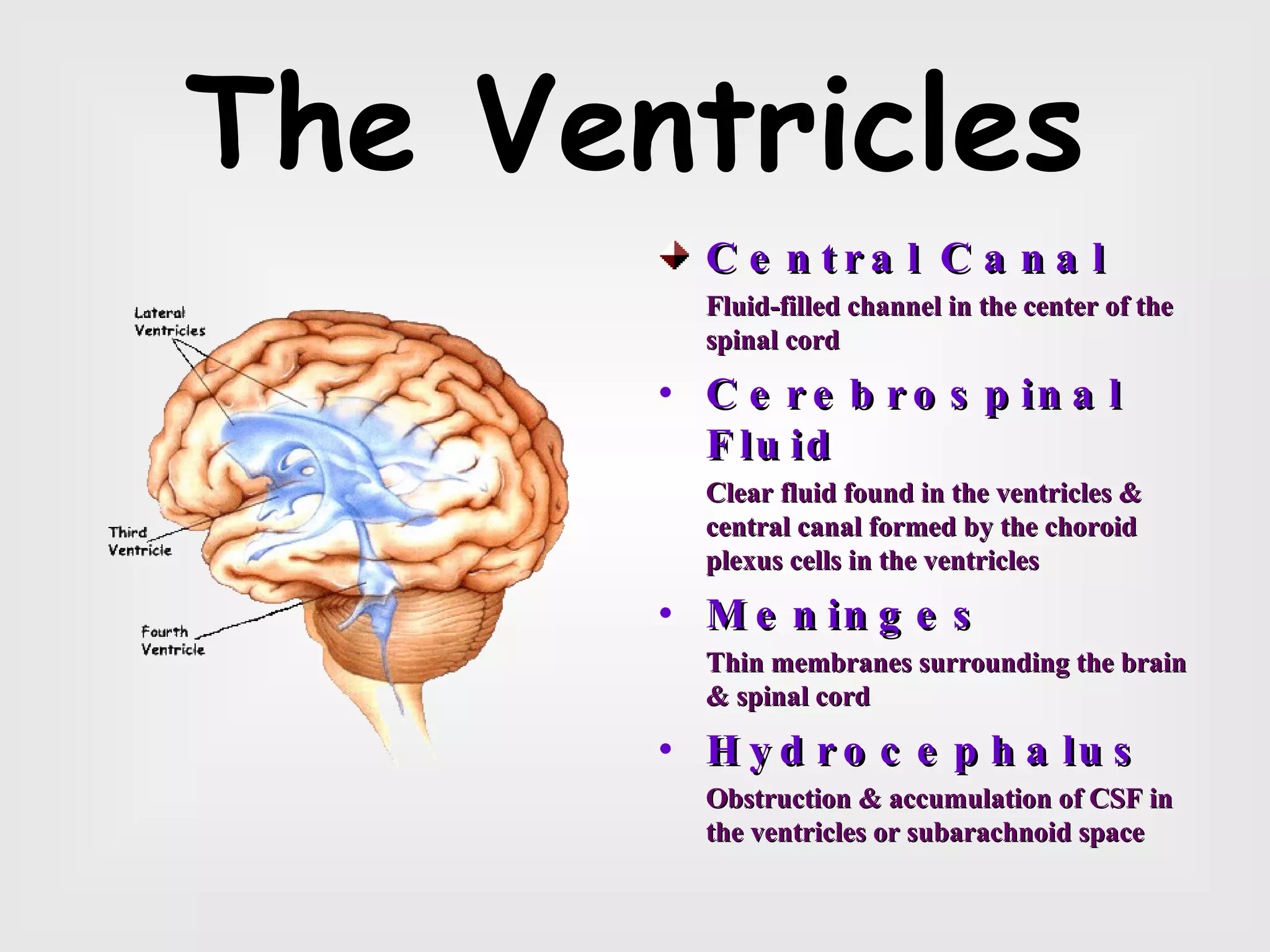
The Ventricles Central Canal Fluid-filled channel in the center of the spinal cord Cerebrospinal Fluid Clear fluid found in the ventricles & central canal formed by the choroid plexus cells in the ventricles Meninges Thin membranes surrounding the brain & spinal cord Hydrocephalus Obstruction & accumulation of CSF in the ventricles or subarachnoid space
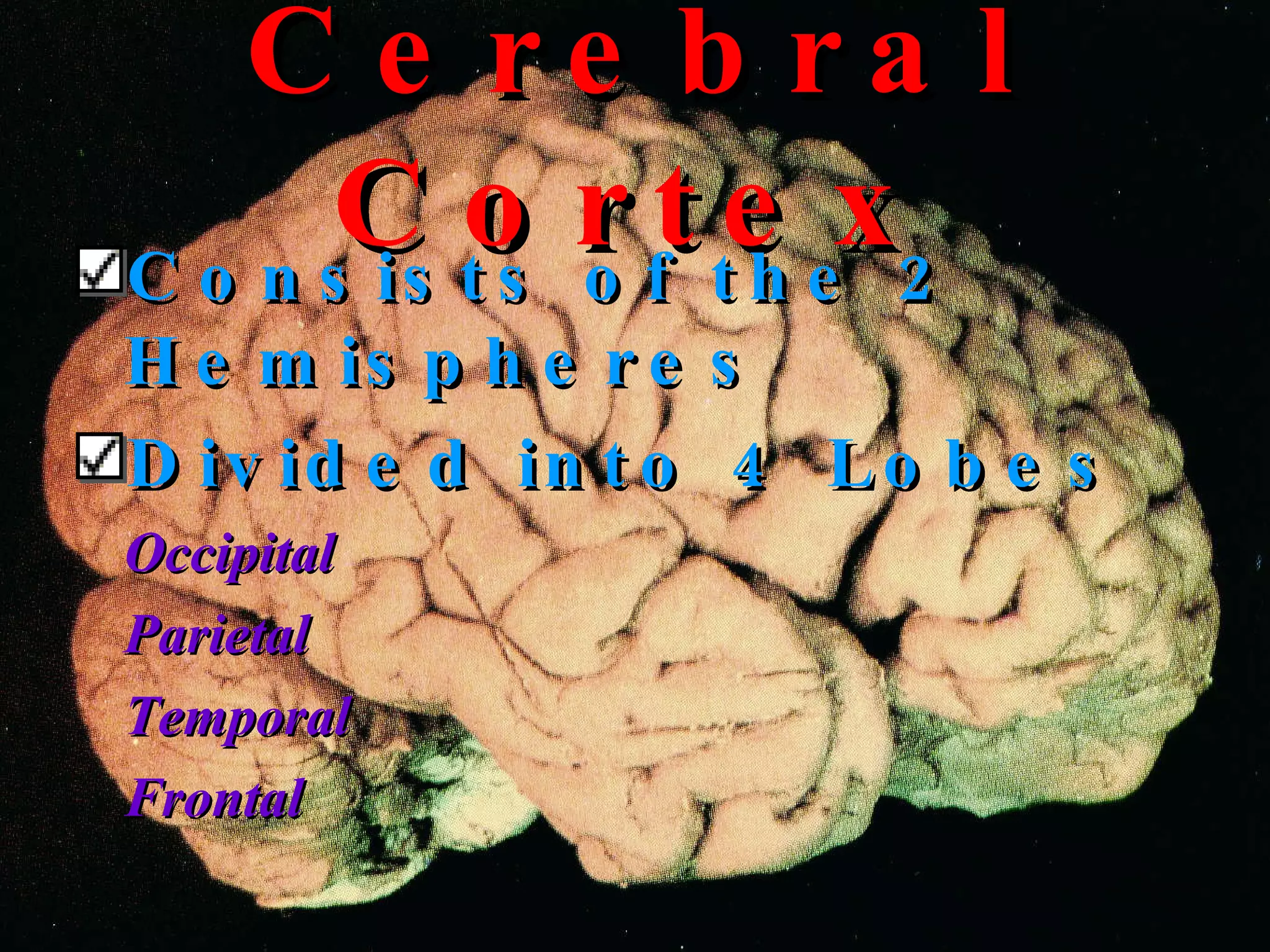
Cerebral Cortex Consists of the 2 Hemispheres Divided into 4 Lobes Occipital Parietal Temporal Frontal
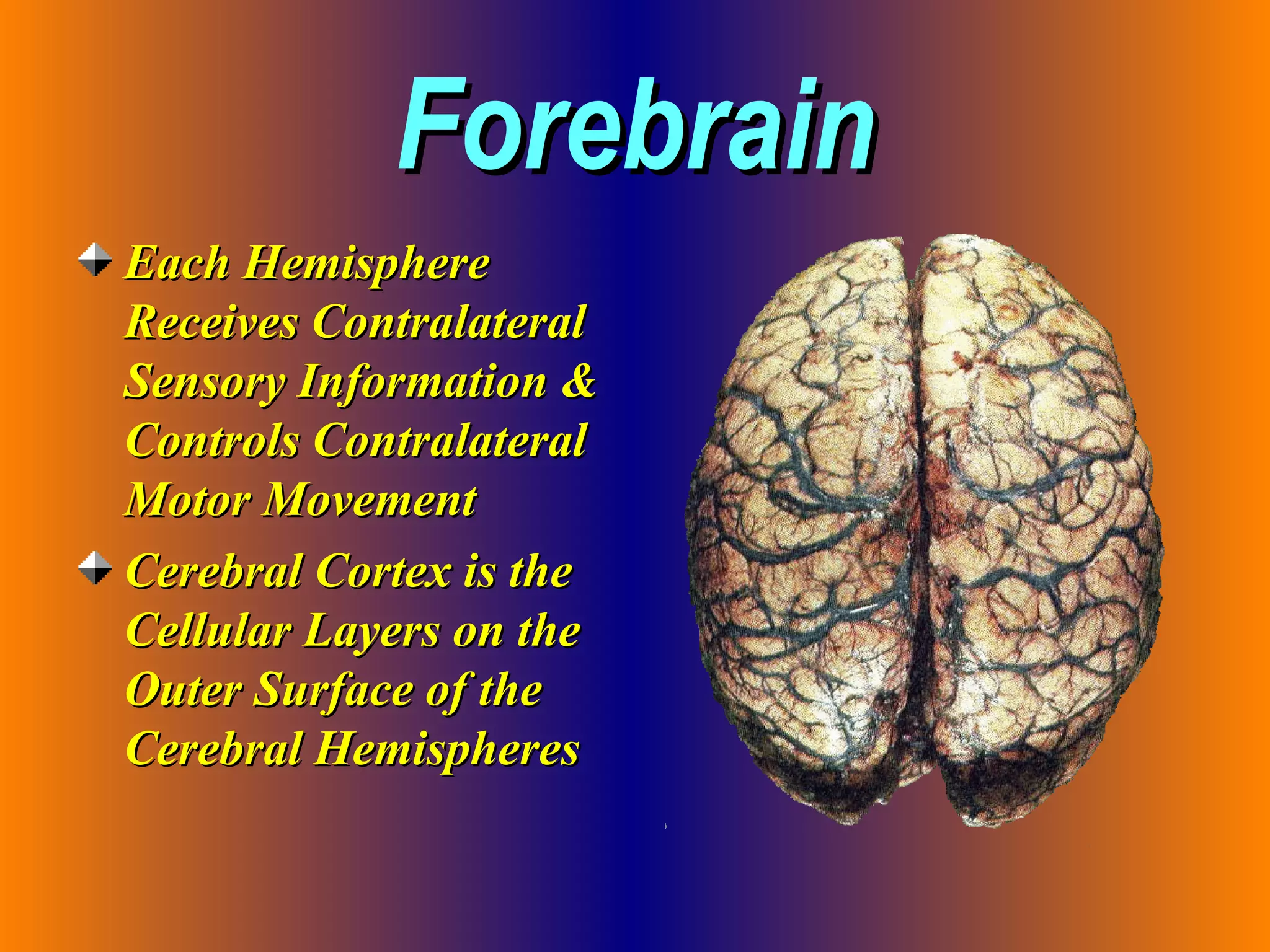
Forebrain Each Hemisphere Receives Contralateral Sensory Information & Controls Contralateral Motor Movement Cerebral Cortex is the Cellular Layers on the Outer Surface of the Cerebral Hemispheres
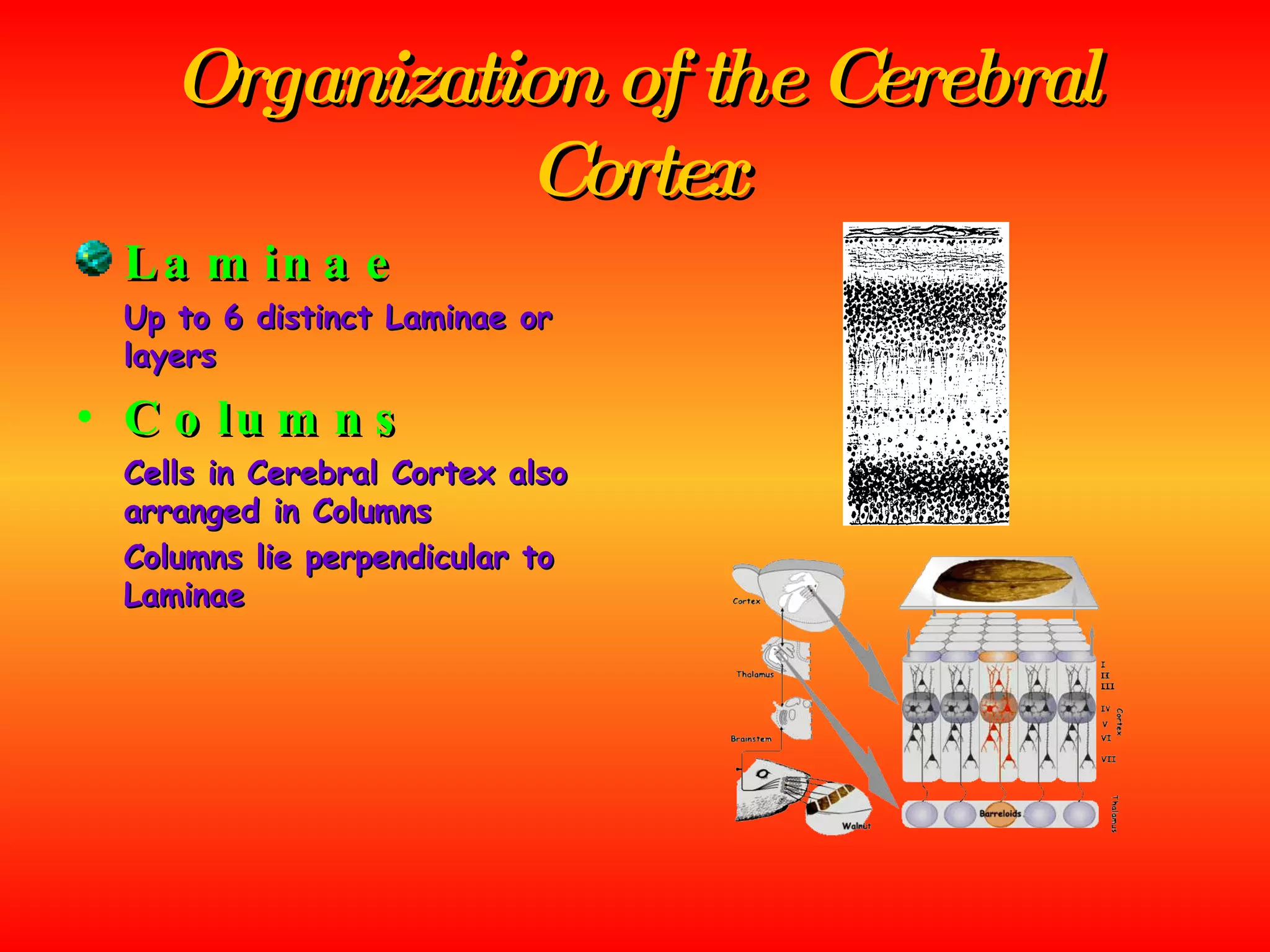
Organization of the Cerebral Cortex Laminae Up to 6 distinct Laminae or layers Columns Cells in Cerebral Cortex also arranged in Columns Columns lie perpendicular to Laminae
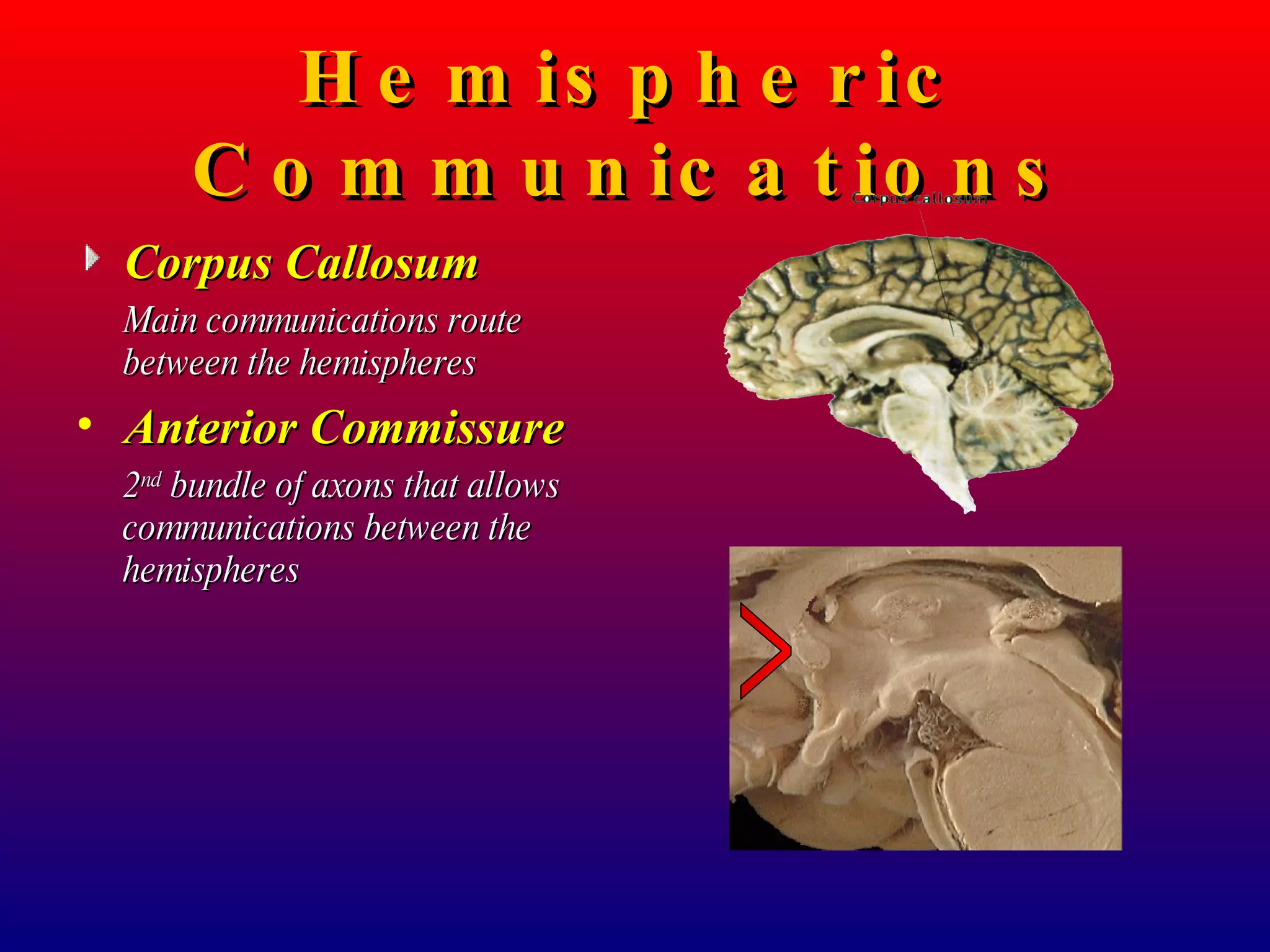
Hemispheric Communications Corpus Callosum Main communications route between the hemispheres Anterior Commissure 2 nd  bundle of axons that allows communications between the hemispheres >
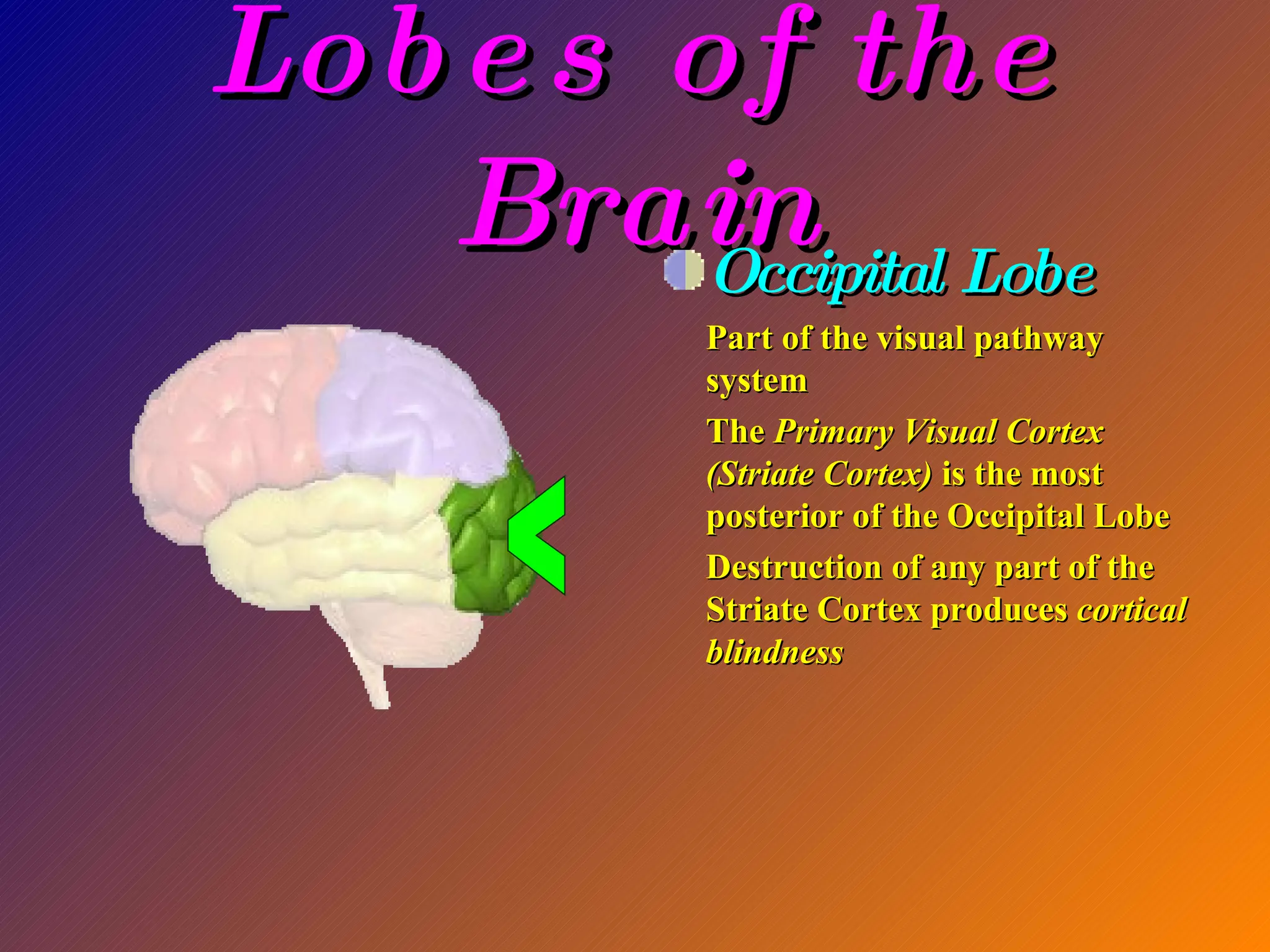
Lobes of the Brain Occipital Lobe Part of the visual pathway system The  Primary Visual Cortex (Striate Cortex)  is the most posterior of the Occipital Lobe Destruction of any part of the Striate Cortex produces  cortical blindness <
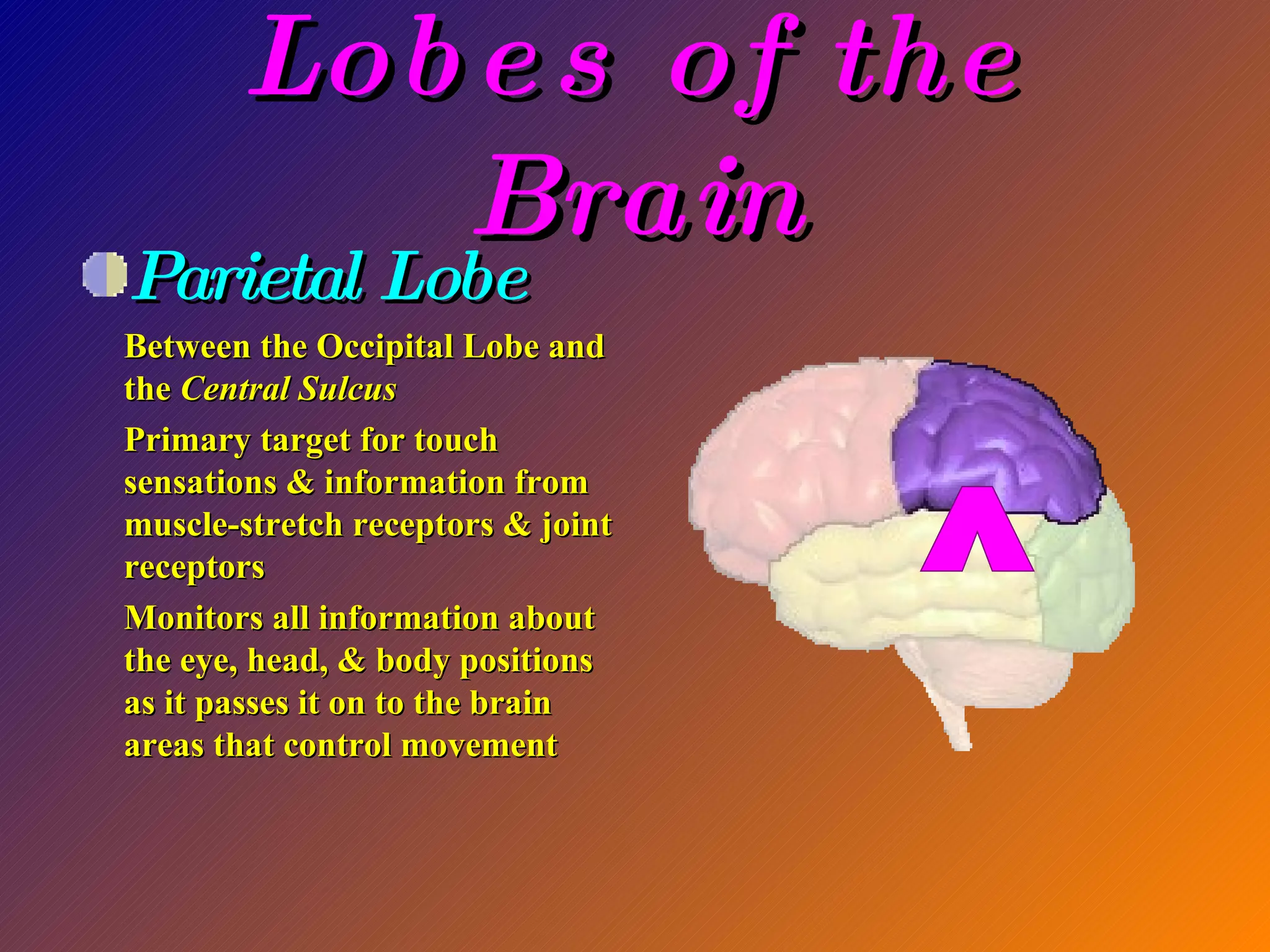
Lobes of the Brain Parietal Lobe Between the Occipital Lobe and the  Central Sulcus Primary target for touch sensations & information from muscle-stretch receptors & joint receptors Monitors all information about the eye, head, & body positions as it passes it on to the brain areas that control movement ^
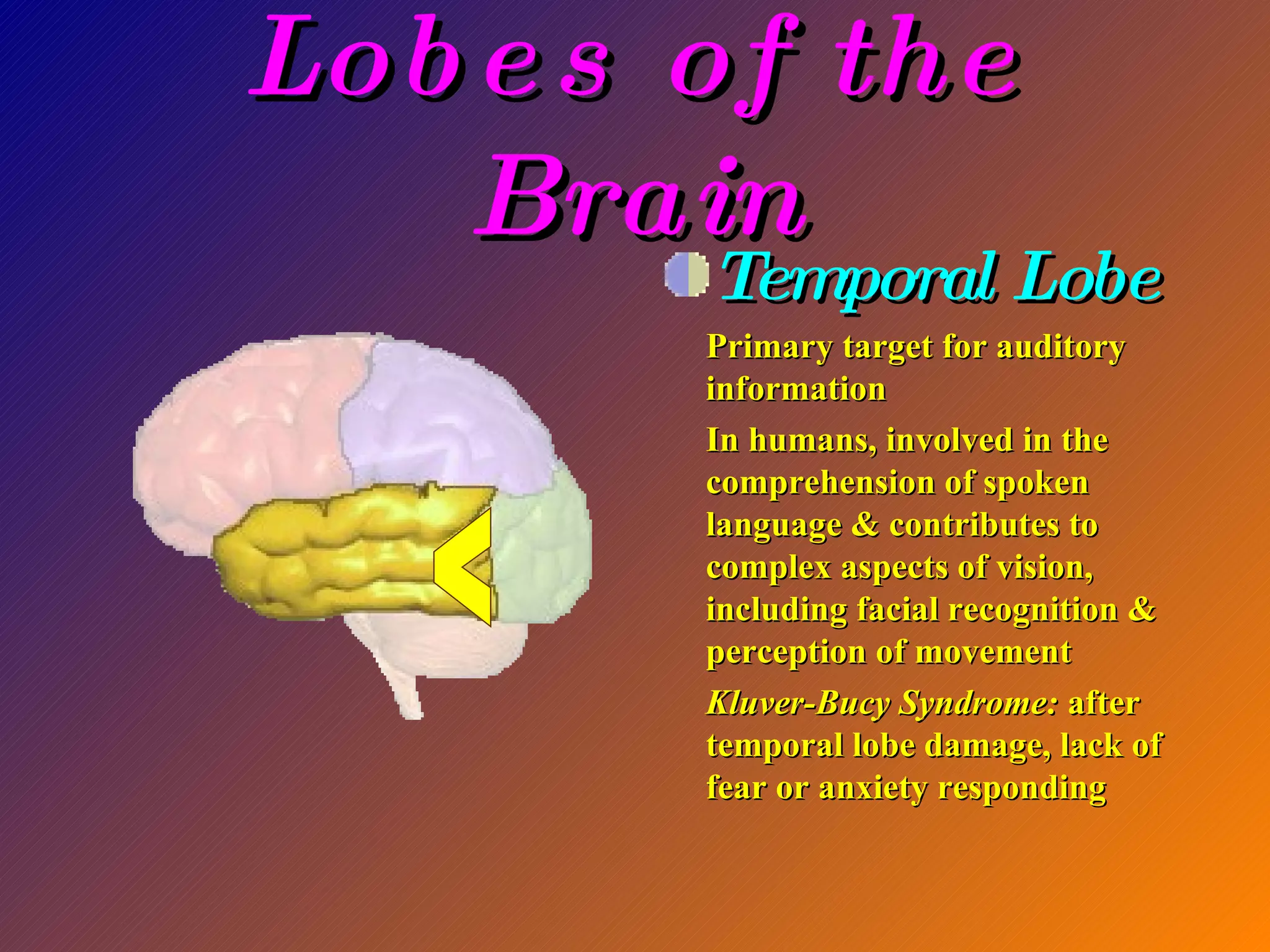
Lobes of the Brain Temporal Lobe Primary target for auditory information In humans, involved in the comprehension of spoken language & contributes to complex aspects of vision, including facial recognition & perception of movement Kluver-Bucy Syndrome:  after temporal lobe damage, lack of fear or anxiety responding <
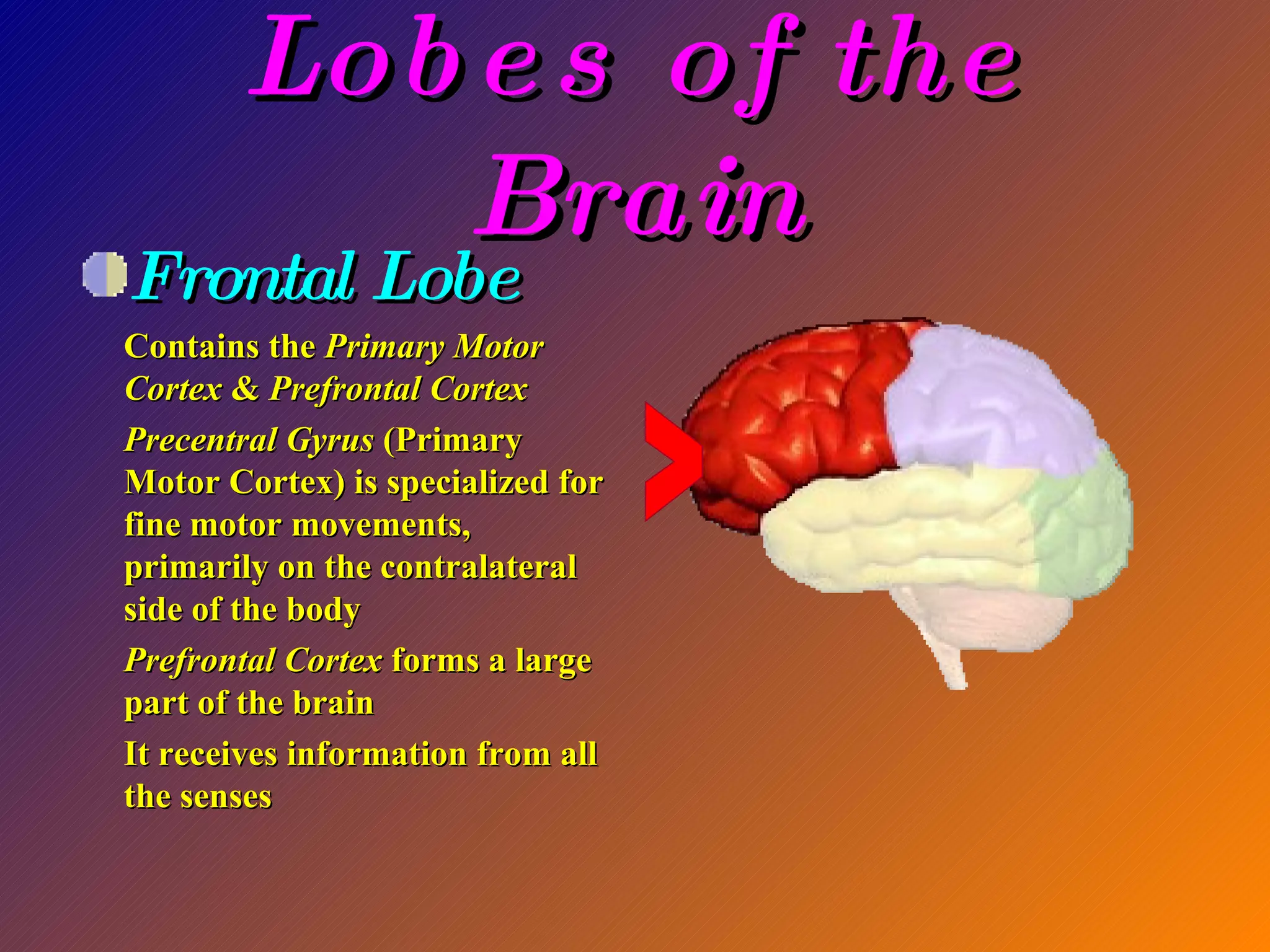
Lobes of the Brain Frontal Lobe Contains the  Primary Motor Cortex  &  Prefrontal Cortex Precentral Gyrus  (Primary Motor Cortex) is specialized for fine motor movements, primarily on the contralateral side of the body Prefrontal Cortex  forms a large part of the brain It receives information from all the senses >
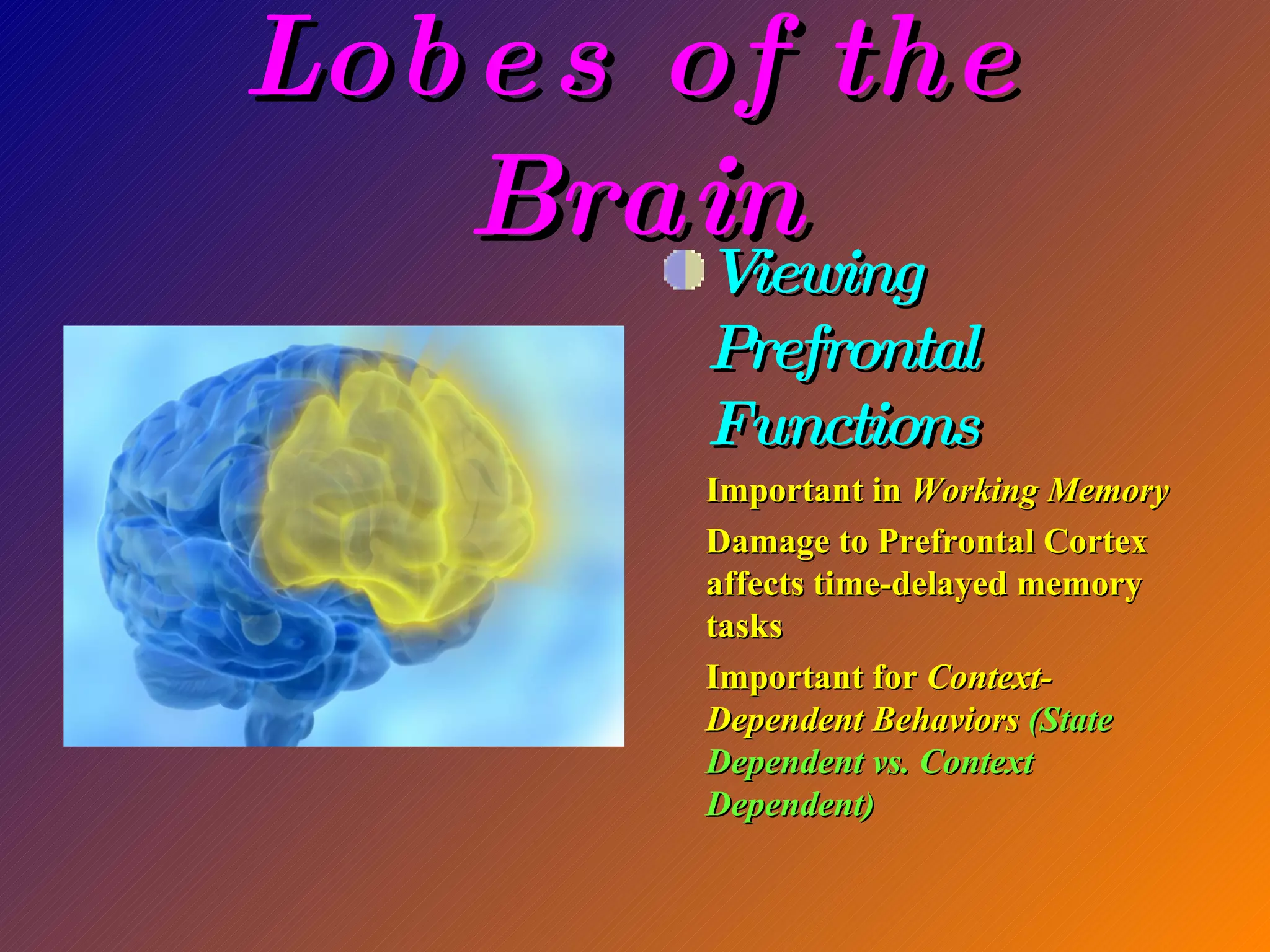
Lobes of the Brain Viewing Prefrontal Functions Important in  Working Memory Damage to Prefrontal Cortex affects time-delayed memory tasks Important for  Context-Dependent Behaviors  (State Dependent vs. Context Dependent)
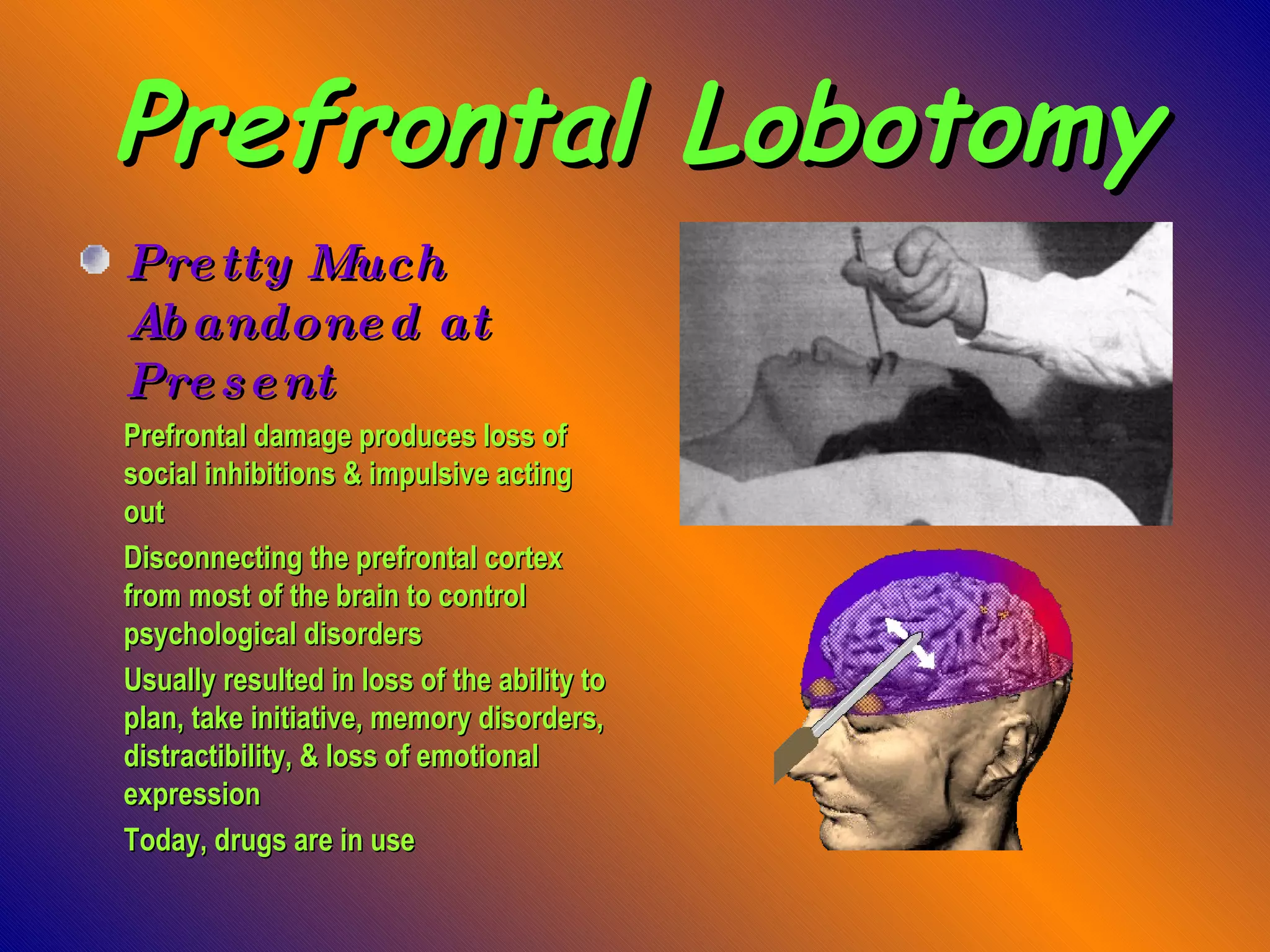
Prefrontal Lobotomy Pretty Much Abandoned at Present Prefrontal damage produces loss of social inhibitions & impulsive acting out Disconnecting the prefrontal cortex from most of the brain to control psychological disorders Usually resulted in loss of the ability to plan, take initiative, memory disorders, distractibility, & loss of emotional expression Today, drugs are in use
The Binding Problem How do Visual, Auditory, & other areas of the brain influence one another to produce a combined perception of a single object? Early on, it was thought the Association Areas were used for processing & linking information from several sensory modalities Binding may depend on simultaneous activity in various areas of the brain

Chapter 04: Anatomy of the Nervous System

  • 1.
    Anatomy of theNervous System
  • 2.
    Categories of BrainResearch Examining the Effects of Brain Damage Examining the Effects of Stimulating Some Part of the Brain Recording What Happens in the Brain During Some Kind of Behavior Correlating Brain Anatomy with Behavior
  • 3.
    Effects of BrainDamage Broca Discovered An Area Associated with Speech Production No 2 People Have the Same Kind of Damage Methods: Working with Brain Damaged People Temporarily inactivating part of the brain & studying behavior Implanting electrodes into animal brains or injecting chemicals
  • 4.
    Effects of BrainStimulation With Animals, Electrodes can be Implanted With Humans, Magnetic Fields on the Scalp will Stimulate Stimulation can also be caused by Injecting a Chemical that Stimulates a Particular Receptor
  • 5.
    Recording Brain ActivityPositron Emission Tomography (PET) Regional Cerebral Blood Flow (rCBF) Functional Magnetic Resonance Imagery (fMRI) Problem with non-invasive methods is interpreting the images
  • 6.
    The Organization ofthe Nervous System Nervous System Central Nervous System (Processes, interprets & Stores information; issues Orders to muscles, Glands, organs) Peripheral Nervous System (Transmits information to & from the CNS) Brain Spinal Cord ( Bridge between the brain & peripheral nerves) Somatic Nervous System (Controls skeletal muscles) Autonomic Nervous System (Regulates glands, blood Vessels, & internal organs) Sympathetic Nervous System (Mobilizes body for action, Energy output) Parasympathetic Nervous System (Conserves energy, Maintains quiet state)
  • 7.
    Anatomical Terms Dorsal Ventral Anterior Posterior Superior Inferior Lateral Medial Proximal Distal Ipsilateral Contralateral Coronal Plane Saggital Plane Horizontal Plane Lamina Column Tract Nerve Ganglion Gyrus Sulcus Fissure
  • 8.
    The Spinal CordPart of the CNS Communicates with the sense organs & muscle below the level of the head Sends & receives sensory information to the brain & receives commands from the head Bell-Magendie Law Dorsal roots enter the spinal cord carrying information from the sensory organs Ventral roots exit the spinal cord carrying motor information to the muscles & glands Dorsal Root Ganglia Gray Matter White Matter
  • 9.
    Autonomic Nervous System2 Divisions: Sympathetic Nervous System “ Fight-or-flight” system that prepares the body for action Parasympathetic Nervous System Brings the body back to normal after an emergency Also known as Craniosacral System because it consists of cranial nerves & nerves from the sacral spinal cord
  • 10.
  • 11.
  • 12.
    1 st Major Division Hindbrain Medulla, Pons, Reticular Formation & Cerebellum Medulla controls breathing, heart rate, vomiting, coughing & other vital reflexes through the cranial nerves Pons job is sensorimotor control and with the medulla deals with blood pressure, temperature, heart rate, and breathing Cerebellum controls speech production, learning skills, walking, unconscious movements, & coordinates reflexes Reticular Formation is involved in alertness, sleep & wakefulness, & is a censor of incoming information
  • 13.
    2 nd Major Division Midbrain Tectum, Tegmentum & the Substantia Nigra Tectum is made up of the Superior & Inferior Colliculus, both involved in processing sensory information Tegmentum includes part of the Reticular Formation, part of the Substantia Nigra & the Red Nucleus which processes rewarding stimuli & sensorimotor control Substantia Nigra contains dopamine neurons in the reward circuit & which deteriorate in Parkinson’s
  • 14.
    3 rd Major Division Forebrain Cerebral Cortex & several Subcortical Areas Limbic System consists of the Thalamus, Hypothalamus, Amygdala, Hippocampus & Olfactory Bulbs Basal Forebrain includes the Nucleus Basalis & is key in arousal Basal Ganglia includes the Caudate, Putamen, & Globus Pallidus & deterioriates in Parkinson’s & Huntington’s Diseases Pituitary Gland is an endocrine gland that is involved secreting vasopressin and oxytocin
  • 15.
    The Ventricles CentralCanal Fluid-filled channel in the center of the spinal cord Cerebrospinal Fluid Clear fluid found in the ventricles & central canal formed by the choroid plexus cells in the ventricles Meninges Thin membranes surrounding the brain & spinal cord Hydrocephalus Obstruction & accumulation of CSF in the ventricles or subarachnoid space
  • 16.
    Cerebral Cortex Consistsof the 2 Hemispheres Divided into 4 Lobes Occipital Parietal Temporal Frontal
  • 17.
    Forebrain Each HemisphereReceives Contralateral Sensory Information & Controls Contralateral Motor Movement Cerebral Cortex is the Cellular Layers on the Outer Surface of the Cerebral Hemispheres
  • 18.
    Organization of theCerebral Cortex Laminae Up to 6 distinct Laminae or layers Columns Cells in Cerebral Cortex also arranged in Columns Columns lie perpendicular to Laminae
  • 19.
    Hemispheric Communications CorpusCallosum Main communications route between the hemispheres Anterior Commissure 2 nd bundle of axons that allows communications between the hemispheres >
  • 20.
    Lobes of theBrain Occipital Lobe Part of the visual pathway system The Primary Visual Cortex (Striate Cortex) is the most posterior of the Occipital Lobe Destruction of any part of the Striate Cortex produces cortical blindness <
  • 21.
    Lobes of theBrain Parietal Lobe Between the Occipital Lobe and the Central Sulcus Primary target for touch sensations & information from muscle-stretch receptors & joint receptors Monitors all information about the eye, head, & body positions as it passes it on to the brain areas that control movement ^
  • 22.
    Lobes of theBrain Temporal Lobe Primary target for auditory information In humans, involved in the comprehension of spoken language & contributes to complex aspects of vision, including facial recognition & perception of movement Kluver-Bucy Syndrome: after temporal lobe damage, lack of fear or anxiety responding <
  • 23.
    Lobes of theBrain Frontal Lobe Contains the Primary Motor Cortex & Prefrontal Cortex Precentral Gyrus (Primary Motor Cortex) is specialized for fine motor movements, primarily on the contralateral side of the body Prefrontal Cortex forms a large part of the brain It receives information from all the senses >
  • 24.
    Lobes of theBrain Viewing Prefrontal Functions Important in Working Memory Damage to Prefrontal Cortex affects time-delayed memory tasks Important for Context-Dependent Behaviors (State Dependent vs. Context Dependent)
  • 25.
    Prefrontal Lobotomy PrettyMuch Abandoned at Present Prefrontal damage produces loss of social inhibitions & impulsive acting out Disconnecting the prefrontal cortex from most of the brain to control psychological disorders Usually resulted in loss of the ability to plan, take initiative, memory disorders, distractibility, & loss of emotional expression Today, drugs are in use
  • 26.
    The Binding ProblemHow do Visual, Auditory, & other areas of the brain influence one another to produce a combined perception of a single object? Early on, it was thought the Association Areas were used for processing & linking information from several sensory modalities Binding may depend on simultaneous activity in various areas of the brain