Sarita Sharma
Assistant professor of
pharmacology
Mumbai
Meninges
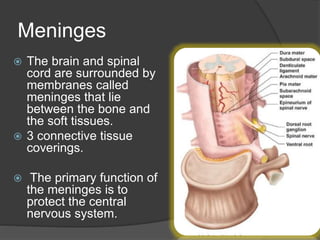
 The brain and spinal
cord are surrounded by
membranes called
meninges that lie
between the bone and
the soft tissues.
 3 connective tissue
coverings.
 The primary function of
the meninges is to
protect the central
nervous system.
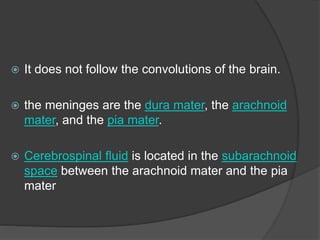
 It does not follow the convolutions of the brain.
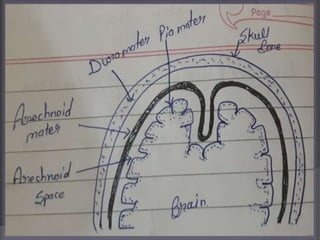
 the meninges are the dura mater, the arachnoid
mater, and the pia mater.
 Cerebrospinal fluid is located in the subarachnoid
space between the arachnoid mater and the pia
mater
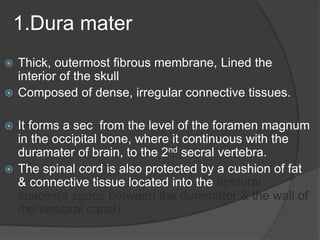
1.Dura mater
 Thick, outermost fibrous membrane, Lined the
interior of the skull
 Composed of dense, irregular connective tissues.
 It forms a sec from the level of the foramen magnum
in the occipital bone, where it continuous with the
duramater of brain, to the 2nd secral vertebra.
 The spinal cord is also protected by a cushion of fat
& connective tissue located into the epidural
spaces(a space between the duramater & the wall of
the vertibral canal)
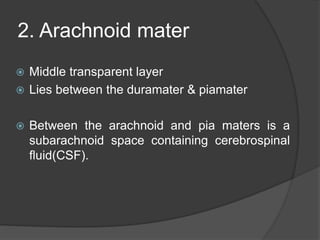
2. Arachnoid mater
 Middle transparent layer
 Lies between the duramater & piamater
 Between the arachnoid and pia maters is a
subarachnoid space containing cerebrospinal
fluid(CSF).
3. Pia mater
 The innermost layer
 Closely covers the brain & spinal cord
 It also dips into the fissures of the brain
 Contain the minute blood vessels which
supply the brain & spinal cord
Spinal cord
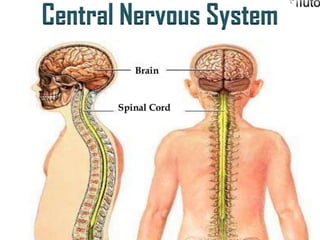
 Runs through the vertebral canal
 The spinal cord begins at the base of the brain
(medulla oblongata)and extends as a slender cord to
the level of superior border of 2nd lumbar vertebrae.
 Adult spinal cord is about 42-45 cm long.
 Regions
 Cervical
 Thoracic
 Lumbar
 Sacral
 Coccygeal
CSF presant in central canal of spinal cord & in the
subarachnoid space
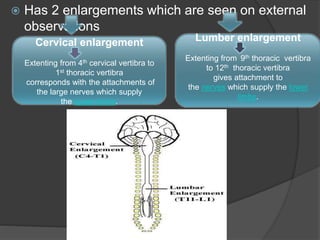
 Has 2 enlargements which are seen on external
observations
Cervical enlargement
Extenting from 4th cervical vertibra to
1st thoracic vertibra
corresponds with the attachments of
the large nerves which supply
the upper limbs.
Lumber enlargement
Extenting from 9th thoracic vertibra
to 12th thoracic vertibra
gives attachment to
the nerves which supply the lower
limbs.
Internal anatomy of spinal cord
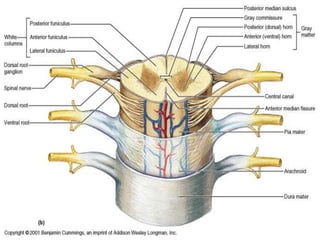
 The spinal cord can be anatomically divided into 31
spinal segments based on the origins of the spinal
nerves.
 Each segment of the spinal cord is associated with a
pair of ganglia, called dorsal root ganglia, which are
situated just outside the spinal cord. These ganglia
contain cell bodies of sensory neurons. Axons of
these sensory neurons travel into the spinal cord via
the dorsal roots.
 Ventral roots consist of axons from motor neurons,
which bring information to the periphery from cell
bodies within the CNS. Dorsal roots and ventral roots
come together and exit the intervertebral foramina as
they become spinal nerves.
(a) Gray mater
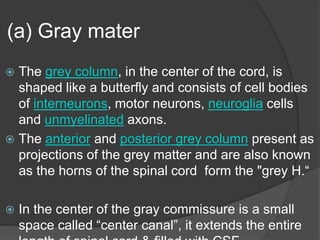
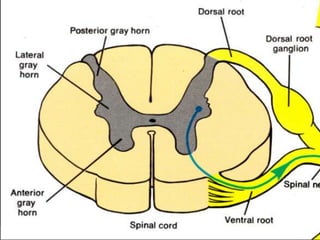
 The grey column, in the center of the cord, is
shaped like a butterfly and consists of cell bodies
of interneurons, motor neurons, neuroglia cells
and unmyelinated axons.
 The anterior and posterior grey column present as
projections of the grey matter and are also known
as the horns of the spinal cord form the "grey H.“
 In the center of the gray commissure is a small
space called “center canal”, it extends the entire
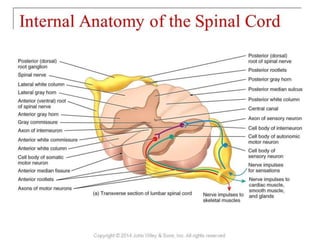
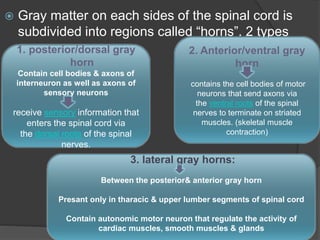
 Gray matter on each sides of the spinal cord is
subdivided into regions called “horns”. 2 types
1. posterior/dorsal gray
horn
Contain cell bodies & axons of
interneuron as well as axons of
sensory neurons
receive sensory information that
enters the spinal cord via
the dorsal roots of the spinal
nerves.
2. Anterior/ventral gray
horn
contains the cell bodies of motor
neurons that send axons via
the ventral roots of the spinal
nerves to terminate on striated
muscles. (skeletal muscle
contraction)
3. lateral gray horns:
Between the posterior& anterior gray horn
Presant only in tharacic & upper lumber segments of spinal cord
Contain autonomic motor neuron that regulate the activity of
cardiac muscles, smooth muscles & glands
(b)White mater
 The white matter is located outside of the grey
matter and consists almost totally
of myelinated motor and sensory axons.
"Columns" of white matter carry information either
up or down the spinal cord.(white color due to
myelin)
 Like gray mater it is also divided in to 3 parts
 1. Anterior/ventral white columns
 2. posterior/dorsal white columns
 3. lateral white columns
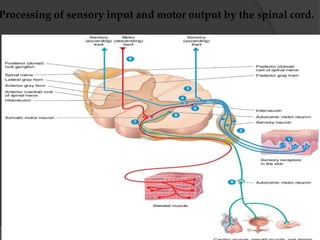
Processing of sensory input and motor output by the spinal cord.
Reflex action/ reflex arc
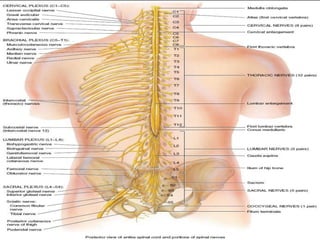
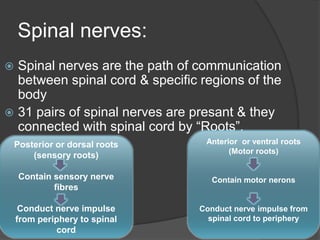
Spinal nerves:
 Spinal nerves are the path of communication
between spinal cord & specific regions of the
body
 31 pairs of spinal nerves are presant & they
connected with spinal cord by “Roots”.
 2 types of rootsPosterior or dorsal roots
(sensory roots)
Contain sensory nerve
fibres
Conduct nerve impulse
from periphery to spinal
cord
Anterior or ventral roots
(Motor roots)
Contain motor nerons
Conduct nerve impulse from
spinal cord to periphery
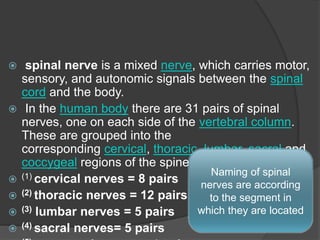
 spinal nerve is a mixed nerve, which carries motor,
sensory, and autonomic signals between the spinal
cord and the body.
 In the human body there are 31 pairs of spinal
nerves, one on each side of the vertebral column.
These are grouped into the
corresponding cervical, thoracic, lumbar, sacral and
coccygeal regions of the spine.
 (1) cervical nerves = 8 pairs
 (2) thoracic nerves = 12 pairs
 (3) lumbar nerves = 5 pairs
 (4) sacral nerves= 5 pairs
Naming of spinal
nerves are according
to the segment in
which they are located
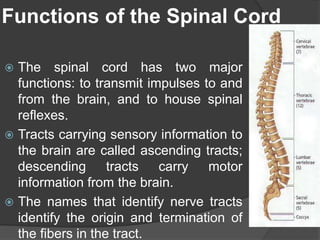
Functions of the Spinal Cord
 The spinal cord has two major
functions: to transmit impulses to and
from the brain, and to house spinal
reflexes.
 Tracts carrying sensory information to
the brain are called ascending tracts;
descending tracts carry motor
information from the brain.
 The names that identify nerve tracts
identify the origin and termination of
the fibers in the tract.

Central nervous system

  • 1.
    Sarita Sharma Assistant professorof pharmacology Mumbai
  • 4.
    Meninges  The brainand spinal cord are surrounded by membranes called meninges that lie between the bone and the soft tissues.  3 connective tissue coverings.  The primary function of the meninges is to protect the central nervous system.
  • 5.
     It doesnot follow the convolutions of the brain.  the meninges are the dura mater, the arachnoid mater, and the pia mater.  Cerebrospinal fluid is located in the subarachnoid space between the arachnoid mater and the pia mater
  • 7.
    1.Dura mater  Thick,outermost fibrous membrane, Lined the interior of the skull  Composed of dense, irregular connective tissues.  It forms a sec from the level of the foramen magnum in the occipital bone, where it continuous with the duramater of brain, to the 2nd secral vertebra.  The spinal cord is also protected by a cushion of fat & connective tissue located into the epidural spaces(a space between the duramater & the wall of the vertibral canal)
  • 8.
    2. Arachnoid mater Middle transparent layer  Lies between the duramater & piamater  Between the arachnoid and pia maters is a subarachnoid space containing cerebrospinal fluid(CSF).
  • 9.
    3. Pia mater The innermost layer  Closely covers the brain & spinal cord  It also dips into the fissures of the brain  Contain the minute blood vessels which supply the brain & spinal cord
  • 10.
    Spinal cord  Runsthrough the vertebral canal  The spinal cord begins at the base of the brain (medulla oblongata)and extends as a slender cord to the level of superior border of 2nd lumbar vertebrae.  Adult spinal cord is about 42-45 cm long.  Regions  Cervical  Thoracic  Lumbar  Sacral  Coccygeal CSF presant in central canal of spinal cord & in the subarachnoid space
  • 11.
     Has 2enlargements which are seen on external observations Cervical enlargement Extenting from 4th cervical vertibra to 1st thoracic vertibra corresponds with the attachments of the large nerves which supply the upper limbs. Lumber enlargement Extenting from 9th thoracic vertibra to 12th thoracic vertibra gives attachment to the nerves which supply the lower limbs.
  • 13.
    Internal anatomy ofspinal cord  The spinal cord can be anatomically divided into 31 spinal segments based on the origins of the spinal nerves.  Each segment of the spinal cord is associated with a pair of ganglia, called dorsal root ganglia, which are situated just outside the spinal cord. These ganglia contain cell bodies of sensory neurons. Axons of these sensory neurons travel into the spinal cord via the dorsal roots.  Ventral roots consist of axons from motor neurons, which bring information to the periphery from cell bodies within the CNS. Dorsal roots and ventral roots come together and exit the intervertebral foramina as they become spinal nerves.
  • 16.
    (a) Gray mater The grey column, in the center of the cord, is shaped like a butterfly and consists of cell bodies of interneurons, motor neurons, neuroglia cells and unmyelinated axons.  The anterior and posterior grey column present as projections of the grey matter and are also known as the horns of the spinal cord form the "grey H.“  In the center of the gray commissure is a small space called “center canal”, it extends the entire
  • 17.
     Gray matteron each sides of the spinal cord is subdivided into regions called “horns”. 2 types 1. posterior/dorsal gray horn Contain cell bodies & axons of interneuron as well as axons of sensory neurons receive sensory information that enters the spinal cord via the dorsal roots of the spinal nerves. 2. Anterior/ventral gray horn contains the cell bodies of motor neurons that send axons via the ventral roots of the spinal nerves to terminate on striated muscles. (skeletal muscle contraction) 3. lateral gray horns: Between the posterior& anterior gray horn Presant only in tharacic & upper lumber segments of spinal cord Contain autonomic motor neuron that regulate the activity of cardiac muscles, smooth muscles & glands
  • 19.
    (b)White mater  Thewhite matter is located outside of the grey matter and consists almost totally of myelinated motor and sensory axons. "Columns" of white matter carry information either up or down the spinal cord.(white color due to myelin)  Like gray mater it is also divided in to 3 parts  1. Anterior/ventral white columns  2. posterior/dorsal white columns  3. lateral white columns
  • 20.
    Processing of sensoryinput and motor output by the spinal cord.
  • 21.
  • 22.
    Spinal nerves:  Spinalnerves are the path of communication between spinal cord & specific regions of the body  31 pairs of spinal nerves are presant & they connected with spinal cord by “Roots”.  2 types of rootsPosterior or dorsal roots (sensory roots) Contain sensory nerve fibres Conduct nerve impulse from periphery to spinal cord Anterior or ventral roots (Motor roots) Contain motor nerons Conduct nerve impulse from spinal cord to periphery
  • 23.
     spinal nerveis a mixed nerve, which carries motor, sensory, and autonomic signals between the spinal cord and the body.  In the human body there are 31 pairs of spinal nerves, one on each side of the vertebral column. These are grouped into the corresponding cervical, thoracic, lumbar, sacral and coccygeal regions of the spine.  (1) cervical nerves = 8 pairs  (2) thoracic nerves = 12 pairs  (3) lumbar nerves = 5 pairs  (4) sacral nerves= 5 pairs Naming of spinal nerves are according to the segment in which they are located
  • 24.
    Functions of theSpinal Cord  The spinal cord has two major functions: to transmit impulses to and from the brain, and to house spinal reflexes.  Tracts carrying sensory information to the brain are called ascending tracts; descending tracts carry motor information from the brain.  The names that identify nerve tracts identify the origin and termination of the fibers in the tract.